Recent measles outbreaks have occurred in many community settings despite strong vaccine policies, notably in developed countries like the United Kingdom and the United States.Reference Baxi, Mytton and Abid 1 , Reference McCarthy 2 The immunocompromised, pediatric, and geriatric populations in healthcare facilities are especially vulnerable to infection acquisition from visitors, other patients and healthcare providers.Reference Hope, Boyd, Conaty and Maywood 3 Thus, it is necessary to ensure that staff demonstrate immunity to reduce mortality and morbidity,Reference van den Hof, Conyn-van Spaendonck and van Steenbergen 4 especially with approximately 20% of local staff originating from countries with diverse vaccination policies and uncertain immunity status. 5
Measles vaccination has been mandatory in Singapore since 1985, with national coverage consistently greater than 90% for 2 doses of trivalent measles-mumps-rubella (MMR) vaccine. 6 Despite this, Singapore has not achieved elimination, unlike many Western Pacific countries. 7
In February 2014, a teenager with leukemia was discovered to have an atypical case of measles on day 18 of admission, determined by polymerase chain reaction (PCR) testing of bronchoalveolar samples, bone marrow aspirate, and paraffin lung biopsy tissue.
The staff involved in the patient’s care and patients in adjacent units were screened as part of the epidemiological investigation conducted by the infectious disease/epidemiological unit (EPIU) in our 1,000-bed academic medical center.Reference Chan, Sridhar and Chan 8
We report here the results of the staff screening that was conducted urgently in view of recent outbreaks and this highly visible case. This screening allowed us to evaluate the usefulness of current laboratory serological testing methods for immunity determination. Cost scenarios of different strategies for healthcare staff vaccination were calculated to help guide future policy decisions.
METHODS
Staff working during the incubation period (7–21 days from the time of index case diagnosis and notification) or with self-reported contact were screened at the hospital Occupational Health clinic. Personal history of previous measles infection and vaccinations were obtained from hospital records and interviews.
Testing was performed at the hospital laboratory by enzyme immunoassay (EIA) using commercial (EUROIMMUN, Lübeck, Germany) plate assay kits. Immunity was defined as serum immunoglobulin (IgG) levels over 250 mIU/mL or documented testing within 6 months. Nonimmune staff underwent vaccination with a single dose of MMR vaccine with further confirmatory testing via plaque reduction neutralization test (PRNT) using previously described methods.Reference Cohen, Doblas and Andrews 9
Statistical analysis
Two-tailed χ2 testing was used for proportions of immunity comparison. A budget impact analysis compared different screening and vaccination approaches. Direct costs were calculated using service charges for laboratory testing, clinic attendance, nursing, consultation, and vaccination services from hospital cost centers. Indirect costs, eg, time lost from laboratory or clinic attendance were not included.
All costs were standardized to 2014 Singapore dollars and represented as US dollars using the 2014 exchange rate (USD $1: SGD $1.30).
RESULTS
A total of 161 staff were exposed, including 70 doctors, 56 nurses, 20 allied health staff, 1 porter, 1 ward clerk, and 13 with undisclosed occupations. Of these, 147 staff completed testing. Reasons for testing refusal included self-declared immunity, low transmission risk, contact was outside of the incubation period, previously documented vaccination or immunity. All staff were monitored for symptoms during the entire incubation period, with no furloughing implemented due to manpower issues. In our study group, 138 staff (93.8%) had documented immunity by EIA. There was no significant difference in proportion of staff immunity between professions (P=.223).
Of the 9 nonimmune staff, all underwent booster vaccination with the exception of 2 staff; 1 of these 2 was ultimately determined to be falsely low, with previously documented vaccination, and the other delayed vaccination due to pregnancy. However, all 9 staff members with low EIA titers were found to be immune by PRNT criteria.
Total individual direct costs under 3 different scenarios were as follows: (1) screening prior to vaccination (SGD $78.11/USD $101.54), (2) screening without vaccination (SGD $51.36/USD $66.77) and (3) blanket vaccination (SGD $26.75/USD $34.78).
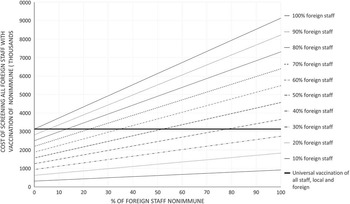
Figure 1 shows the extrapolation of these direct costs when screening and vaccinating with different proportions of foreign-born staff. Screening of only foreign staff prior to vaccination becomes costlier than blanket vaccination of all staff when foreign staff comprise greater than 35% of total manpower (Figure 1).
Comparison of cost against proportion of foreign staff and nonimmunity.

DISCUSSION
Recent measles outbreaks highlight the importance of vaccination and proper isolation and contact precautions. The American measles outbreak affected >100 patients, with 7 nosocomial cases.Reference McCarthy 2 No healthcare staff were infected, unlike in Singapore, where a doctor had laboratory-confirmed measles after an occupational exposure.Reference Chan, Sridhar and Chan 8 Hence, there is need for constant vigilance.
We found false negatives on serological testing; staff who were negative on EIA eventually found to be immune by PRNT. Official documentation of completed vaccination course may thus be more useful with booster doses given to the exposed without 2 documented doses of MMR instead of routine blood screening followed by vaccination.
This study is limited by small sample size and purposive sampling and may not be representative of the hospital population. Nevertheless, the results provide insights into healthcare provider immunity with a diverse workforce as well as the limitations of commercial measles serological testing.
Simple direct cost comparisons showed that blanket vaccination of all exposed staff was the cheapest strategy for ensuring immunity, also reducing non-tangible costs (eg, time lost, manpower use). However, similar to other vaccines,Reference Lee, Tok, Chow, Phua, Ooi, Tambyah and Chen 10 costs of adverse effects and vaccination time off should be considered. Cost-comparison scenarios used could be adjusted to other settings with diverse levels of foreign-born staff with uncertain vaccination histories.
To prevent nosocomial measles transmission in a cost-effective manner, individual healthcare facilities need to perform risk assessments based on the proportion of staff with documented vaccinations and the costs of accurate testing strategies and vaccination approaches.
ACKNOWLEDGMENTS
We extend our appreciation to Staff Nurse Jareena Kasim and Nurse Manager Grant Ciccone from the Occupational Health Clinic for phlebotomy and laboratory result collection, and to Professor Wong Mee Lian for helping with the manuscript.
Financial support: No financial support was provided relevant to this article.
Potential conflicts of interest: The authors have read the journal’s policy and have the following conflicts. Dr. Paul Tambyah has received research support from Baxter, GSK, ADAMAS, Merlion Pharmaceuticals, Sanofi Pasteur, Fabentech, and Inviragen. He has also received honoraria from Novartis and Astra-Zeneca. However, the authors have adhered to all the journal’s policies on sharing data and materials.
All other authors—Aidan Tan, Joanne Yoong, Jareena Kasim, Grant Ciccone, and Judy Sng—report no conflicts of interest relevant to this article.