One of the unwritten chapters on the introduction of evolutionary theory to China and East Asia is how the literary imagination came to mediate the public awareness of the novel questions raised by evolutionary biology and, in particular, how literary discourse became the primary site of struggle over the meanings of life, consciousness, religion, and science. For example, when Lu Xun 魯迅 made a strange phrase, renya 人芽 (human seedling), based on a Japanese translation to render the English term “life-germ” in his 1905 translation of a work of science fiction that I will discuss later, he was doing something more innovative than introducing a neologism into the Chinese language. The characters “human” and “[vegetarian] seedling” figure a reproductive process that brings humans and plants together in a unified cellular conception of the roots of life. This cellular conception may be taken as emblematic of the kind of pressures and challenges that modern writers in many parts of the world would inevitably face if and when they wanted to reflect on the problem of life after Darwin. As far as China and East Asia were concerned, there were more compelling, circumstantial reasons for writers in these societies to heed the European developments in evolutionary biology.Footnote 1
Imagine literary realism and evolutionary biology entering your consciousness the first time as a simultaneous event. Would the experience cause a jolt, a conversion, or a literary revolution? The scenario I am pondering here is not entirely hypothetical because it did happen to many writers at the turn of the twentieth century in East Asia and in other places where literary realism and evolutionary biology were experienced, first and foremost, as twin projects of modernity. The publication of Yan Fu's 嚴復 celebrated translation of Thomas Huxley's Evolution and Ethics in 1898 and Liang Qichao's 梁啟超 call for the New Novel in the same year may be taken as symptomatic of that pivotal moment. Benjamin Schwartz and others have demonstrated how social Darwinism achieved popularity among the Chinese elite and how the unintended readings of evolutionary theory outside Europe might help illuminate critically the originating assumptions of European liberalism (Schwartz Reference Schwartz1964). On further reflection, however, social Darwinism was not the only reason that the Chinese intellectual elite were interested in evolutionary theory, in spite of their open pursuit of national wealth and prestige. It is important to keep in mind that the simultaneous arrival of evolutionary biology and literary realism in China presented uniquely philosophical and ethical as well as historical challenges to the literary imagination. The writers—especially those who were deeply versed in Buddhism—had been fascinated by the new conceptual schemas provided by Darwin, Ernst Haeckel, Henri Bergson, and other thinkers because they raised such fundamental questions as, what is life? Can the idea of organism, cell, or mutation lead to ethical views of life? Can theories of evolution biology uproot religion? Where are the boundaries of the real in this fast-changing world? How do these questions bear upon their social struggle?Footnote 2
It is not as if Chinese writers and critics did not try to understand or experiment with other imported literary theories and ideas such as romanticism. The self-styled romantic poet Guo Moruo 郭沫若, for example, employed tropes of evolution and physical sciences extensively in his early works. But literary realism came to command more attention because it was perceived as a potential force in China's social reform, progressive in the evolutionary order of world literature, and “a token of faith that Chinese literature was moving forward along the universal path pioneered by Western literary practice” (Huters Reference Huters, Kang and Tang1994, 154). Realist fiction was allowed to play a central role in moral education, identity formation, and nation building by uplifting and disciplining the imagination of the people. Marston Anderson's earlier study (Reference Anderson1990, 6) has pointed out the durability and ambiguity of literary realism in modern China by demonstrating how this notion acquired new and different meanings in response to changing cultural and historical conditions. No less important in these developments, I argue, is the question of “life as form,” which needs to be raised here. The question implies a relationship between life and text that goes beyond the usual preoccupation with representational mimesis, and it means that the threshold of literary realism can be rethought in light of the growing presence of biomimetic technologies since the beginning of the last century.
Life as Form: From Mimesis to Biomimesis
So much depends on the technology of mimesis in modern life. Like other mimetic events, iconographies of evolutionary biology act on our senses in powerful ways and raise the possibility of structural parallels between genetic cloning and literary mimesis. But would such parallels suggest meaningful directions for theoretical work on biomimesis? When the scientist pushes the idea of mimesis beyond the analogical realms of diagram, drawing, three-dimensional modeling, electron microscopy, or even digital imaging, what is going to happen next? The goal is to seize the power of mimesis to replicate life's own reproductive process. With the arrival of molecular biology, literature (and religion) appears to have lost some of its ground, if not all of it, as a privileged site for asking new and fundamental questions about life (in contrast to the robust flows of ideas more than a century ago between evolutionary biology and naturalist literature in Europe). In fact, the subject of mimesis in literary studies is seldom taken beyond the rhetorical operations of representational discourse to reflect on the possibility of biomimesis. To be sure, writers and critics continue to evoke some vague, inherited notions of life or reality in their works, but these ideas can no more ground the work of mimesis for literature than the theory of mimesis can continue to stand as a moving ethnocentric threshold upholding the bar between the so-called Western tradition of representation (with Erich Auerbach's Mimesis as a foundational text in comparative literature) and the rest of the world.Footnote 3
The common perception that the humanist and the biologist have little to say to each other on the question of life cannot obscure that the fact that literary realism and visual isomorphism in scientific modeling have both persisted in rearing the old specter of mimesis.Footnote 4 This peculiar state of affairs deserves investigation. In his book Ten Thousand Things (Reference Ledderose1998), Lothar Ledderose grounds the problem of mimesis in what he terms “modular systems.” He suggests that all aspects of Chinese civilization—the script, bronze casting, tomb arts, factory production, architecture, the invention of print, bureaucratic systems, and so on—come under one form of modularity or another. His argument goes as follows: The fundamental differences between the Western tradition and the Chinese tradition lie in the fact that the former has tried to make things look like creations of nature (i.e., appearance), whereas the latter imitates the principles of nature (i.e., essence), which turns out to be a modular system with quantitative dimensions. “These principles,” he writes, “included prodigious creation of large numbers of organisms. Variations, mutations, changes here and there add up over time, eventually resulting in entirely new shapes.”Footnote 5 Nature is taken as a gigantic system of biomimetic machines in which organisms evolve through an ever-changing process of replication, mutation, variation, multiplication, and so on. Interestingly, Ledderose reverses the ethnocentric priority of imitative acts by bifurcating the West and China along the imaginary line between mimesis and biomimesis, but the difficulty is that biomimesis presumes a theory of life that originated in European evolutionary biology. Do we need a modern theory of life to justify creativity or artistic creation in China or anywhere?Footnote 6
Nevertheless, Ledderose's biomimetic foray helps bring into focus the implicit assumptions about the relevance of molecular biology to a generalized theory of mimesis. Regardless of whether we agree with him about the sources of artistic creativity, it is impossible not to be aware of the challenges presented by the postvitalist theory of life to literary mimesis at the level of biological technology. It is true that genetic engineering and the cloning of life are some of the typical biomimetic technologies, but biomimesis should not be confined to the biological sciences alone. Recognizing a deeply shared concern with life across literature, religion, philosophy, and life sciences is the first step toward a more supple or global conception of mimesis as technology—what I call biomimesis in my essay. The central question, then, boils down to this: Can form—be it literary figuration or scientific iconography—deliver the truth of life? This question will redirect our attention to some of the core issues of modernity that have made the study of modern literature meaningful in the first place. I am convinced that the ways in which the questions of life and biogenetics have been raised and discussed in China and other parts of the world can put certain things in perspective with respect to both the genealogy of a long-standing problem of modernity and the broader and deeper, international legacy of critical thinking surrounding the question of life.
Insomuch as writing has always been a technology, might it not be susceptible to retooling and be turned into the literary equivalent of a microscope, a scalpel, or some other apparatus to serve the purpose of realism?Footnote 7 The answer is yes, and I argue that realist writing in modern literature is a biomimetic technology that produces specific types of knowledge about life and excludes other knowledge. Without downplaying the technical distinctions among realist writing, anatomical drawing, electron microscopy, and digital imaging, I believe we can raise some meaningful questions about the emergence of visual and textual mimesis in China and East Asia at the meeting ground of evolutionary biology and literary realism: How does the literary imagination fashion biomimesis at the level of writing? Does the meaning of life—now that old ghosts and spirits are being chased away—transform simultaneously? How successful are the efforts of disciplining and disenchantment? Will biomimesis free itself from being haunted by other kinds of knowledge, by dreams, and by death? What is the ultimate challenge to life as form? Is there an elsewhere from which we can properly anchor our knowledge of life?
Lu Xun figures centrally in my study because he kept an abiding interest in the problem of “life as form” from the early days of his engagement with Haeckel and biological science through the end of his literary career. In particular, I would like to call attention to his 1905 translation of fragments of a science fiction story on the subject of human cloning called “Technique for Creating Humans” 造人術 in Japan. This work and Lu Xun's early essays on Haeckel can clarify some of the obscure points regarding his stance on science and religion and, in particular, the enigma of his self-imposed silence during the Science and Metaphysics debate in China in 1923–24. Contrary to the universal treatment of Lu Xun as a nonparticipant in that highly publicized debate, I suggest that he did make a seminal contribution by publishing the story “Prayers for Blessing” 祝福 (Zhufu) in the spring of 1924 (also known in English as “New Year's Sacrifice”). That contribution has been overlooked in studies of modern Chinese literature and intellectual history both in China and in the West. The omission has been rather unfortunate in my view, because Lu Xun's story took the Science and Metaphysics debate to a much higher level by staging a fantastic meeting between a realistic narrative mask (embodied by the modern intellectual/narrator) and a literary exemplum from the Sūtra of the Wise and Foolish 賢愚經 (embodied by Bhiksuni Suksma 微妙比丘尼 in the guise of Xianglin's Wife). As my analysis will demonstrate, the occulted voice of Bhiksuni Suksma sets the limits of literary realism in “Prayers for Blessing” and cannot be banished without coming back to haunt the biomimetic mastery of life.
Lu Xun and Ernst Haeckel
Lu Xun's brother, Zhou Zuoren 周作人, is widely credited for having invented the literary credo known as “literature for humans” in 1918. It should be pointed out that Zhou's much-touted notion of humanism takes evolutionary theory as the foundation of a new literature whose defining feature consists of the writer's ability to transcribe and study human life in realistic detail. In a recent study that traces the “discovery of the child” and the concurrent discourse of development in China to evolutionary biology, Andrew Jones (Reference Jones2002, 713–14) pinpoints the role that Zhou Zuoren played in disseminating the developmental discourse for the new literary and pedagogical project. In his well-known manifesto “Literature for Humans” (also translated as “Humane Literature”), for example, Zhou Zuoren rejects premodern Chinese fiction and drama for failing to meet the criterion of realism, charging that these works obstruct the natural growth of human nature by populating the texts with gods, goddesses, immortals, supernatural beings, fox spirits, and demons. To change this situation, he proposes a thoroughgoing transvaluation of the concept of ren人 (human), arguing that “[t]he human being that we want to deal with is not the so-called crowning piece of nature, or the so-called ‘round skull, and square footed’ man, but rather the human species, as it has progressively evolved from the animal kingdom” (1996, 153).Footnote 8 The time-honored concept of the ren (human) in Confucian philosophy, along with other traditional schools of thought, is thus made to undergo drastic transformation to conjure something new. Leo Ou-fan Lee has questioned the anachronistic strain in this conception of a humanistic ren—“Can we in fact translate the Confucian belief in ren as humanism?”—and has suggested that it is perhaps worth “pondering the difference between these etymologies, if not the entire hermeneutic, of ren and ‘humanism,’ renxue (the study of humanity) and ‘humanities’” (1995, 7). In Zhou Zuoren's manifesto, the translingual supersign ren/human has left the old Confucian signified of ren behind as it picks up a new signified in the evolutionary theory of life.Footnote 9 The forging of this new supersign ren/human is as radical as the making of modern Chinese literature itself and signals the beginning of a new biomimetic technology that seeks to ground the truth of life in literary realism.
It bears asking how literal minded Zhou Zuoren's or other writers’ approach to evolutionary biology was whenever they evoked the theory to support the new idea of literary realism. In what ways did the notions of microorganism, bacterial cell, or embryonic growth shape the writers’ understanding of life, death, and immortality? Lu Xun's early work suggests a good entry point for reflecting on these issues because, as a medical student, he had studied biology in Japan and went on to treat the questions of life and death as much more than a literary motif or as one of those familiar topoi handed down from time immemorial. For him, life and death were very much framed by specific physiognomic subtexts, ranging from bacterial cells under the microscope to the physiognomy of blood, metabolism, and the central nervous system.
Anatomy and bacteriology were among the subjects that young Lu Xun (Zhou Shuren 周樹人) studied at the Sendai School of Medicine in Japan. He took courses in organic chemistry, angiology, microscopic anatomy, pathology, and practical and topographical anatomy besides working on oseology, neurology, and bacteriology. We know that Lu Xun also had hands-on experience dissecting human cadavers and learned to draw anatomical diagrams in the courses taught by Fujino Genkuro 藤野厳九郎. In a well-known essay remembering Mr. Fujino decades later, Lu Xun wrote down a number of anecdotes about the instructor and singled out a memorable detail concerning Fujino's correction of the anatomical diagram he had submitted with his class notes. On that occasion, Fujino summoned Lu Xun to his office and began a conversation that the latter recalls as follows:
“Look, you have moved this blood vessel slightly out of place. It certainly looks more elegant when you do this, but a dissection-based diagram is no fine arts. If this is what the real thing looks like, there is no way we can change it. I have corrected it for you for now; in future you must draw everything as I put it on the blackboard.” Yet I was not going to be persuaded by him. Though agreeing out loud, I thought to myself: “I did a pretty good job drawing those diagrams. As for the actual state of things, of course I remember how these things look.” (Lu Xun Reference Lu1981, 2:302; Yang and Yang Reference Xianyi and Yang1985, 104)Footnote 10
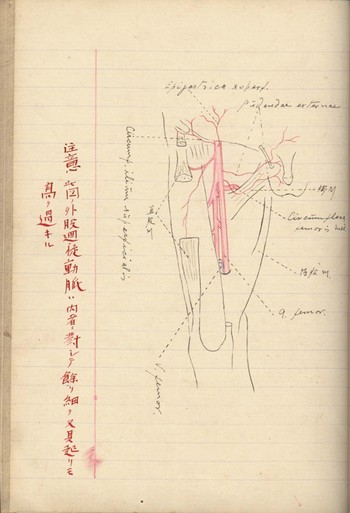
Little surprise that Lu Xun earned a failing grade (59.3) in Fujino's course on practical and topographical anatomy.Footnote 11 The episode about Fujino's correction of the anatomical diagram is tangentially supported by the evidence we have found in the six surviving volumes of Lu Xun's class notes, which were believed to have been lost when the writer relocated from Shaoxing to Beijing. Recovered in 1951 in the home of a relative and presented to the Lu Xun Museum, these notebooks neatly document the courses in which Lu Xun officially registered between September 1904 and March 1906, including those taught by Fujino.Footnote 12 The lettering of Fujino's corrections in red ink is still visible among the notes and drawings in Lu Xun's handwriting. One of the corrections appears to correspond to the mispositioned blood vessel as described in the foregoing quotation (see figure 1).
Lu Xun's anatomy drawing from his notebooks at the Sendai School of Medicine. Courtesy of the Lu Xun Museum in Beijing.

The mispositioned blood vessel in Lu Xun's essay, though a mere detail, has led to all sorts of speculation among critics, typically those who are intrigued by Lu Xun's ineptitude for studying medicine. Larissa Heinrich is critical of literal-minded approaches and suggests a new reading of this detail in her recent work. Focusing on what she calls “medical realism,” she argues that “Lu Xun has reserved the right to subordinate ‘the way real things are’ in diagrams of the dissected body to subjective renderings that nonetheless ‘aren't bad’” and that Lu Xun's insistence on the artistic license raises an important issue about the representational regime of human anatomy as a mode of realism among others.Footnote 13 This is a compelling insight. Is Lu Xun jettisoning realism by making the cracks visible across the artistic and scientific modes of representation? A diagram is a diagram and can never be the object it claims to represent. Should the anatomic diagram be regarded as a mere heuristic device? To what extent should we view visual mimesis—a conceptual realm that is undoubtedly governed by aesthetic judgment—as central and indispensable to the modern theory of life?
To answer these questions, we may turn to some of the clues in the work of Ernst Haeckel and Lu Xun's interest in him. In a number of his early essays, Lu Xun discussed and introduced the work of the German biologist and comparative zoologist and devoted an essay called “The Human Evolution” 人之歷史 (also 人間之歷史) in 1907 to analyzing Haeckel's theory of ontogenie and phylogenie, which was the cutting-edge theory of evolutionary biology of the time.Footnote 14 Some scholars suggest that Lu Xun came into contact with Haeckel's major work, Anthropogenie; oder Entwickelungsgeschichte des Menschen (Anthropogenie, or the Evolution of Man, 1874) during this time, and others contend that Haeckel's Die Welträthsel (The Riddle of the Universe, 1899) was more likely to have been Lu Xun's main source, even though the writer may also have consulted a couple of Japanese texts in the course of composing his essay (Wang Shijing Reference Wang2001, 54). Furthermore, we know that one could purchase German editions of Die Welträthsel in Japanese bookstores at the time, and, in fact, a Japanese translation of this title became available after 1906. The inventory of Lu Xun's library indicates two popular Haeckel titles that the writer owned, one a 1903 German edition of Die Welträthsel and the other a 1906 edition of Die Lebenswunder (The Wonders of Life, 1904) (Pan Reference Pan2002, 8). It is unclear at which point Lu Xun was first exposed to Haeckel's works. Was it in the curricula of the Sendai School of Medicine, or in the biology class he took at the German Language School in Tokyo (1906–9), or through his own capacious reading habits, which closely followed the latest developments in both the sciences and literature?Footnote 15 In any case, Lu Xun's essay on Haeckel conveys the sense that the author was up to date in his knowledge of evolutionary biology and that the extent of his knowledge went well beyond what he had glimpsed in the 1898 edition of Yan Fu's acclaimed translation of Thomas Huxley's Evolution and Ethics.
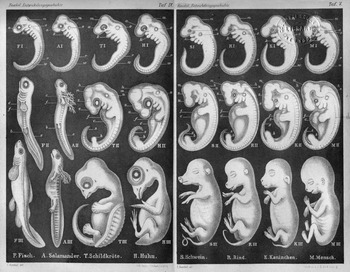
Haeckel's distinctive and controversial contribution to evolutionary biology is his recapitulation theory. The most remarkable thing about him is not that he had a monistic philosophy of science to preach but that, being a talented draughtsman, he created exquisite drawings of life-forms with which to illustrate the science books he published. The Riddle of the Universe and The Wonders of Life were issued in many languages and became instant best-sellers around the world. R. B. Goldsmith, author of The Golden Age of Zoology, has this to say about Haeckel: “Haeckel's easy hand at drawing made him improve on nature and put more into the illustrations than he saw . . . one had the impression that he first made a sketch from nature and then drew an ideal picture as he saw in his mind” (quoted in Richardson et al. Reference Richardson1997, 104). The detailed drawings are intended to show how fish, reptiles, birds, and mammals are indistinguishable at the early stage of embryonic growth (i.e., the presence of somites, neural tubes, optic anlagen, notochords, and pharyngeal pouches; see figure 2).
Ernst Haeckel's illustration of vertebrate embryonic development in Anthropogenie: Entwickelungsgeschichte des Menschen (Leipzig, 1874). Groups from left to right are fish, salamander, turtle, chicken, pig, cow, rabbit, and human. The rows from top to bottom indicate an early stage that is common to all groups, a middle stage of development, and a late stage embryo. Courtesy of the Butler Library of Columbia University.

Haeckel's enduring legacy lies in the biogenetic law that he propounded, namely, “ontogenesis is a brief and rapid recapitulation of phylogenesis, determined by the physiological functions of heredity (generation) and adaptation (maintenance)” (1929, 66). What it means is that vertebrate embryos of different species pass through identical stages of development from the early tailbud stage—invisible to the naked eye—to the late, visible adult form. Haeckel's adroit translation of microscopic objects onto iconographic drawings enabled the theory of biogenetics to disseminate quickly and widely around the world, shaping school curricula and popular understandings of evolutionary biology to this day.Footnote 16 In 1997, embryologist Michael K. Richardson and his research team lent new evidence to a century-old suspicion that Haeckel may have manipulated his 1874 drawings of amniotic embryos to fabricate key evidence for the recapitulation theory—his best-known contribution to evolutionary biology (Richardson et al. Reference Richardson1997, 102).
The renewed debate over Haeckel's fraudulent drawings in top science journals such as Anatomy and Embryology, Nature, and Science has brought the technical differences between microscopic images and reproduced drawings to the fore of bioethical scrutiny. Richardson's systematic comparison of microscopic imaging with Haeckel's drawings led to the conclusion that the latter had deliberately erased the traces of the limb bud in the mammal embryo at the tailbud stage (see figure 3).
Photographs of mammal embryos at the tailbud stage except for a. which is slightly younger. a. echidna or spiny anteater; b. brush-tailed possum; c. eastern Australian native “cat”; d. domestic cat; e. domestic dog; f. domestic sheep; g. scaly anteater; h. rat; i. rabbit; j. hedgehog; k. human. Courtesy of Michael K. Richardson.

The suppression of this important detail, which Haeckel could not but have noticed under the microscope, helped fabricate a type of visual isomorphism between the human embryo and those of other vertebrates in favor of the recapitulation theory. It seemed that Haeckel's aesthetics went so far as to concoct some of his early fish images with bits and pieces of different animals and even mythical beings. Richardson's findings no doubt furnished powerful evidence to discredit Haeckel's visual rhetoric, but the scrutiny he brought to bear on the technical differences between microscopic images and reproduced drawings raises a further issue: Can electron-microscopic images be made to lie as well? As if anticipating an answer to our question, the recent scandal surrounding Dr. Woo-suk Huang's fabricated evidence for the cloning of human embryonic stem cells at Seoul National University in South Korea demonstrates that the use of electron-microscopic images for rhetorical purposes is not only easily practiced but may go on to trouble the life sciences, because the simulacrum of cloning or other biomimetic projects falls entirely within the epistemic provenance of electron microscopy and other advanced imaging technologies. So the issues surrounding biomimesis turn out to be more fundamental than the role of the individual scientist's professional integrity: Do propositions about life depend on visual or textual mimesis for verification? Can the truth of life be grounded in realism?
Richardson's censure of Haeckel's artistic fraud presents an interesting parallel to Mr. Fujino's correction of Lu Xun's anatomical diagram that we saw earlier. But what does the parallel signify? Of course, our interpretation need not begin by reducing these interrelated events and reflections to the singularity of each happening or to fortuitous parallelisms or comparisons. Rather, it would be fruitful to explore science and biomimesis at a more generalized, theoretical level. Does the science of life presuppose the technology of visual mimesis? Can realism deliver the truth of life? As discussed in the next section, an obscure literary translation that Lu Xun undertook at Sendai a couple of years before he published “The Human Evolution” on Haeckel may help shed some further light on these questions.
Translating Human Cloning Avant la Lettre
Lu Xun's translation “Technique for Creating Humans” or “Zaoren shu” 造人術 (more appropriately, “Technique for Human Cloning” in today's parlance) was first published in 1905 under his pseudonym, Suozi 索子, in a magazine called Nüzi shijie 女子世界 (Women's World). This early work has remained largely unknown to the scholarly world because it is not included in Lu Xun's early collected works, nor is it mentioned in the authoritative sixteen-volume edition of the Lu Xun quanji 魯迅全集 (Complete Works of Lu Xun).Footnote 17 For a long time, very few people were aware of its existence until more recently, when Tarumoto Teruo 樽本照雄 tracked down the English originals for the Japanese version, which Lu Xun had adopted for his translation “Technique for Creating Humans.”Footnote 18 Like most Chinese students who borrowed and pirated Japanese translations of Western works in the late Qing period, Lu Xun's text followed a 1903 Japanese rendering of an American short story by Louise J. Strong in the February 1903 issue of The Cosmopolitan under a different title, “An Unscientific Story.” His translation was a faithful representation of the Japanese version, which took wild liberty with the English original. Not only did the Japanese translator Hara Hōitsuan 原抱一庵 reduce the story to a mere one-seventh of its original length, but also he eliminated Strong's unassuming title, replacing it with “Technique for Creating Humans” to cut to the point.Footnote 19
Contrary to what one might expect, Strong's “Unscientific Story” is not a refashioning of the Frankenstein motif about the mad scientist and his creation of a monster.Footnote 20 Mary Shelley held vitalist views on the roots of life, whereas Strong had the protagonist Dr. Levison conduct his experiment with stem cells, which was evidently inspired by the new biogenetic theory. Shelley's novel posits the vital force as existing independently of the physical and chemical processes of the body. In her view, the presence of the vital force could bring dead matter to life. Thus, the eight-foot-tall monster in Shelley's novel is an assemblage of dead limbs and animal organs that its creator stole from church vaults and charnel houses for experiment. This dead assemblage is brought to life by Victor Frankenstein, who has somehow mastered the art of bestowing animation upon lifeless matter (Shelley Reference Shelley1996, 37, 179) In this regard, the Frankenstein story would make better sense as a narrative of alchemical technology rather than science fiction, as opposed to the postvitalist, cellular physiology of living organisms, embryonic growth, and proto-cloning that we find in Strong's story.Footnote 21 The new cellular theory, which forms the backbone of modern biology and genetics, postulates that life begins in a single stem cell and that the repeated division and replication of the stem cell is what leads to the development of a multicellular living being, be it human, animal, plant life, and so on. Not surprisingly, the best-known proponent of this theory at the turn of the century was Ernst Haeckel.
Haeckel defines the “life-germ” as an impregnated egg cell. “This new cell,” writes Haeckel, “is the individual stem-cell (the cytula), the continued segmentation of which produces the cells of the germinal layers and the gastrula. With the formation of this cytula, hence in the process of conception itself, the existence of the personality, the independent individual, commences.”Footnote 22 Lu Xun translated the term “life-germ” as renya 人芽 (human seedling) based on the Japanese compound ningen no me 人間の芽, which was adopted to echo the Latin root germen (Tarumoto Reference Tarumoto2007, 57). As I mentioned at the outset, this metaphorical figuring of embryonic processes is supposed to embrace all animals and plants in a unified cellular conception of life.
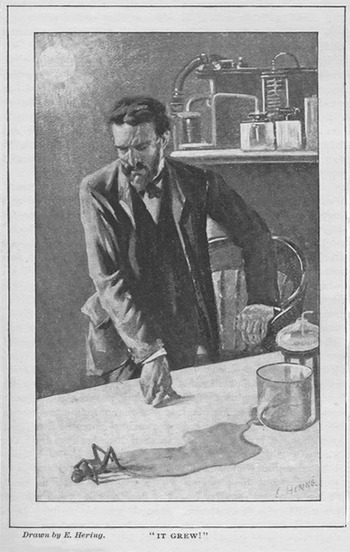
In the opening scene of “Technique for Creating Humans,” the scientist Dr. Levison is looking through his microscope to examine his tiny “life-germ” in a glass receptacle of compounded liquid in the laboratory. It appears that he is cloning a stem cell, except that this stem cell is of a higher species than Dolly the sheep, which would be successfully cloned in the late twentieth century. Watching his “life-germ” grow under the microscope, Dr. Levison feels increasingly confident that the secret of life will soon be in the palm of his hand. “A-h!” he draws a long breath, “it was no illusion of sight, no delusion of his mind. The creature—it was clearly a living creature—had grown, and taken shape, even in those few moments” (Strong Reference Strong1903, 411; see figures 4–5). But as the stem cell divides and further subdivides into a multicellular life form, the life-germ begins to show some strange and disturbing features:
It [the creature] had lain, quivering, on the marble slab, breathing regularly and steadily, making aimless movements. The four limbs, that had seemed but swaying feelers, grew into long, thin arms and legs, with claw-like hands, and flat, six-toes feet. It lost its spherical shape; an uneven protuberance, in which was situated the breaking-orifice, expanded into a head with rudimentary features. He took his spatula, and turned it over. It responded to the touch with an effort to rise; the head wobbled weakly, and two slits opened in the dim face, from which looked out dull, fishy eyes. It grew! Each moment found it larger, more developed; yet he could no more see the growth than he could see the movement of the hour-hand of his watch. (Strong Reference Strong1903, 412)
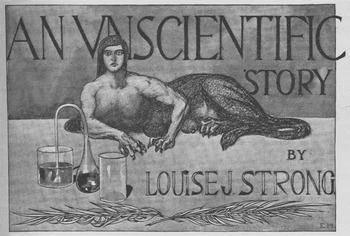
Louise J. Strong, “An Unscientific Story,” illustrated by E. Hering, in The Cosmopolitan. February 1903.

Dr. Levison and his creation from “An Unscientific Story,” illustrated by E. Hering.

The six-toed creature with dull, fishy eyes bodes ill for the scientific project. The trouble is that not only does this bioengineered monster adopt the gait of a primitive creature and terrify its creator with the crude caricature of a human being, but also it has the superior ability to mature quickly and make copies of itself. Dr. Levison is horrified to see a lump appearing in the creature's breast that grows into a large scale. The next day, this scale develops into a second creature, and in no time is the scientist's laboratory populated by a multitude of little monsters that begin to assert their will against the creator. To wipe out the degenerate creatures, the scientist resorts to genocide by planting a bomb in his own laboratory, and he himself narrowly escapes the explosion. Tarumoto (Reference Tarumoto2007, 60–61) has made an interesting suggestion that Strong's monster evokes the racist portrayals of the Chinese and blacks in the American popular media. It would be interesting to speculate whether Hara Hōitsuan or Lu Xun were aware of the racial traits in the translation process, as the biological science and theories of primitivism, atavism, and eugenics were inextricably linked at that time.
What we do know is that news of the genocide never reached the Japanese and Chinese audiences because the translators produced only fragments of the original story, leaving off at the point at which Dr. Levison successfully creates a human being and is relishing his God-like power as a life giver. Did the Japanese translator Hara Hōitsuan suppress the downward spiral of Strong's story in order not to contradict the sanguine view of scientific progress prevalent in Meiji Japan at the time? If so, to what extent did Lu Xun share this euphoria of progress when he decided to translate the Japanese fragments? We cannot give a straightforward answer because Lu Xun seldom commented on his early work and left it more or less to the device of the reader. One of his first readers was Ding Chuwo 丁初我, the editor of Women's World, who was responsible for publishing “Technique for Creating Humans” in the magazine. Evidently, Ding intuited something other than scientific mastery from Lu Xun's translation. In his editorial note appended to the story, Ding wrote, “The story in ‘The Technique for Creating Humans’ gratified me and also horrified me. I was gratified to know that this marvelous technology could bring about a new human species but I was horrified to think that this same art might also be capable of spreading deviant seeds 謬種 (miuzhong) and supporting evil causes 惡因 (eyin)” (Suozi Reference Suozi1963, 90). If the editor had read only fragments of the story through Lu Xun's translation, how could he have correctly predicted the dystopia of Louise Strong's original on the basis of partial knowledge? Was he a clairvoyant? Or did he perhaps interpret the fragment as a kind of zhiguai 志怪 tale, a premodern Chinese genre of fantastic tales that would be condemned by Zhou Zuoren in his literary manifesto for realism?
There is something uncanny about biomimesis whenever the unpredictable appears.Footnote 23 This logic operates in Strong's story as well as in the mind of a reader like Ding Chuwo, for whom the “life-germ” alone provides the potential for “deviant seeds” to sprout. Ding Chuwo's use of “evil cause” (eyin 惡因) is particularly interesting for suggesting a Buddhist judgment. The term yin (因, hetu in Sanskrit) is of Buddhist origin, which evokes a chain of karma and transformations whereby an eyin may cause an eguo 惡果, “evil fruit” (果, phala in Sanskrit).Footnote 24 Ding Chuwo's insight about karma points us to the role of religion, especially popular Buddhism, in Lu Xun's subsequent engagement with evolutionary biology, which I will discuss in the next section.
After all, Women's World was a journal devoted to women's issues. How did Lu Xun's translation of Strong's fiction contribute to the ongoing discussion of women and their lives in the late Qing period? In a short postscript to “Technique for Creating Humans,” Zhou Zuoren mentions that Lu Xun was drawn toward Strong's story in a moment of melancholy when he saw how morally corrupt his fellow countrymen were. Strong's science fiction raised the possibility of eugenics and self-regeneration for his people. That young Lu Xun did contemplate eugenics as a path toward national self-rejuvenation appears to support the speculative point raised earlier about his awareness of the racial image in Strong's work. But eugenics would have required faith in the power of science, a faith that Lu Xun was beginning to question. In his postscript, on the other hand, Zhou Zuoren raises a fascinating point about gender, arguing that women, not scientists, are the true creators of human life. He complains that Chinese women were not yet mentally advanced enough to qualify as true creators and that it would take years before they could compete with scientists in the ability to bring about new forms of life and a new nation (Suozi Reference Suozi1963, 90). Zhou Zuoren's emphasis on the nation's need for strong and educated mothers would have sounded familiar to late Qing readers and reform-minded intellectuals who participated in the male-led campaign against foot-binding. Whatever its merit, Zhou's postscript highlights the question of gender, which, as we will discuss in the next section, would become increasingly pronounced in Lu Xun's thought as he continued to ponder science, religion, literature, and matters pertaining to gender and life.
Gender, Science, and Metaphysics
I argue that “Technique for Creating Humans” marked an important beginning in Lu Xun's lifelong exploration of the question of life as form. To teach himself about the biogenetic theories of life, he devoured all the scientific literature he could find in Japan and continued to do so even after he gave up medical studies and returned to Tokyo in 1906.Footnote 25 While in Tokyo, he regularly attended the lectures given by Buddhist activist Zhang Taiyan, whose critical perspectives on religion and science were becoming well known (Lu Xun 1981, 2:304; Yang and Yang 1985, 1:104).Footnote 26 In his mature years, Lu Xun would explore the problem of life as form and its relationship to religion extensively in his fictional works, most notably the mythical tale “Mending the Sky” 補天 (Butian), later to be collected in Old Stories Retold, and, more systematically, in the narrative fiction “Prayers for Blessing.” His critical consciousness concerning these issues began to emerge as early as 1908, as can be seen in two of his early essays, entitled “On the History of Science” 科學史教篇 (Kexueshi jiaopian) and “Toward a Refutation of Malevolent Voices” 破惡聲論 (Po esheng lun).
These essays were occasioned by the mushrooming of social enlightenment programs in late Qing China, where the newly educated elite began to attack the religious faith of common people as superstition and to demolish their temples and places of worship to make way for modern schools. In “On the History of Science,” Lu Xun argues that the natural sciences no doubt raise important questions about life and deserve serious philosophical attention, but one must not mystify the sciences and take them as the new ground of truth, for “scientific discoveries are often driven by supra-scientific forces; in other words, they are moved and inspired by non-scientific ideals” (Lu Xun 1981, 1:29). His argument is that the problem of life cannot be grounded in scientific knowledge alone because that knowledge has been framed by the general condition of human experience, whose meanings must be sought elsewhere. What are those meanings? And how can we locate this “elsewhere”? The answer would emerge many years later in his literary experiments.
In his next essay, “Toward a Refutation of Malevolent Voices,” Lu Xun categorically ridicules the textbook arguments advanced by the newly educated elite in the slogans they fashioned in antisuperstition campaigns. Statements such as “Phosphorous is a chemical element, not a will-o’-the-wisp” or “The human body is composed of cells, so how can there be a soul?” did not impress him because they revealed a commonsensical approach to scientific evidence and a superficial and materialist grasp of what the sciences can explain or cannot explain (Lu Xun 1981, 8:28). By pondering the way of things in life, Lu Xun began to view Haeckel in a new light. He writes,
Our current knowledge is far from complete, yet some people insist upon interpreting all phenomena on the basis of a smattering of chemistry and a dash of physics, the most basic principles of which they misconstrue. They fail to understand that the ineffable principles governing the myriad changes in the world simply cannot be contained in a primer on the natural sciences. Is it not sheer fantasy to attack religion simply on the basis of so meager a knowledge of science? There have, in fact, long been people in Europe and the West who proposed the creation of a religion based on science. The German scholar Haeckel, through his studies in zoology, established monism—the theory that all phenomena in the universe arise from a single underlying principle. He proposed the dedication of a shrine to rationality, the true Trinity of the nineteenth century. What were its three components? Truth, goodness, and beauty. He believed that rites and ceremonies continued to have a function, that is, to enable people to cope with present-day realities and encourage them to make further advances. (1981, 28–29)Footnote 27
The reference to Haeckel's temple of rationality is intended to dismantle the opposition of science and religion. If science comes with its own temple, ritual, faith, followers, superstition, and so on, there is no reason why religion and folk beliefs should be rejected on those same grounds. Lu Xun explored folk religious beliefs further in his story of the goddess Nüwa 女媧, who mends the broken sky with five colored stones, and in many of the other folk legends he sought to revive in the collection Old Stories Retold.
The story “Mending the Sky” (Lu Xun 1981, 2:345–56), first published in 1922, is brought in as an implicit dialogue with “Technique for Creating Humans” in the direction that Zhou Zuoren and Ding Chuwo had suggested earlier. In fact, Lu Xun introduces a tension between the biomimetic project of cloning and female fecundity in his retelling of the ancient legend as a Freudian parable. The goddess Nüwa molds soft mud into a human being and is surprised and delighted by her own work. She repeats the act until she feels exhausted, so she plucks a gigantic wisteria and flicks it across the muddy water to send up a spray of mud. Specks of mud fall onto the ground and turn into countless identical creatures that resemble the ones she made before. Soon these little creatures begin to take on grotesque and repulsive features, with heads like those of deer and eyes like those of rats. The creatures also invent speech, writing, dress codes, social hierarchy, the art of war, and so on. Nüwa is doomed. Her female fecundity is gradually overtaken by social and mechanical forms of self-production, which brings to mind Dr. Levison's genetic project in Strong's story. Nüwa is disgusted by the degenerate creatures and turns away from humanity in contempt to concentrate on the job of mending the broken sky until the last moment. Nüwa's death leaves a universe devoid of meaning and “reigned by a silence deeper than death.”Footnote 28 This otherworldly silence introduces a cosmic and distinctively non-biomimetic perspective into our examination of Lu Xun's thoughts on gender and religion. It certainly gives us a “larger-than-human” perspective on the narrative fiction that I will analyze in the next section.
To anticipate my reading of Lu Xun's fiction “Prayers for Blessing,” I would like to observe that the enigmatic silence that ends Nüwa's tale of creation bears further scrutiny in light of the writer's own self-imposed silence in the Science and Metaphysics debate in 1923–24. On February 14, 1923, German-educated philosopher Zhang Junmai 張君勱 (Carsun Chang) delivered a public lecture called “Views on Human Life” (Rensheng guan) at the invitation of Tsinghua University in which he raised the question, “Can science dictate all theories of life?” Drawing on Henri Bergson, Rudolf Euken, and other idealist European thinkers, Zhang argued that scientific reasoning had its limitations with respect to subjectivity, free will, and the human spirit. To those who believed that Darwinian biology offered the objective truth about life and humanity, he countered that Darwinism was merely a theory among other theories. When these views were printed in the Tsinghua Weekly, they infuriated the geologist Ding Wenjiang 丁文江, who was provoked into publishing a rebuttal in the Endeavor Weekly 努力周報 (Nuli zhoubao) to defend science.Footnote 29 Ding dubbed Zhang Junmai a “metaphysical ghost” whose muddled reasoning could only betray his ignorance of scientific knowledge. The heated exchanges that ensued between Zhang and Ding opened a floodgate of polemics, arguments, and accusations involving several dozen prominent intellectuals and scientists, including Hu Shi 胡適, Liang Qichao, Wu Zhihui 吳稚暉, Chen Duxiu 陳獨秀, and other May Fourth figures, but with two notable exceptions: Lu Xun's voice and women's voices. The bulk of the intellectuals’ arguments appeared in the year 1923, but the debate itself lingered on through the fall of 1924, by which time the academic community had begun to form a consensus that the Science and Metaphysics debate was a watershed in the development of modern (male) Chinese thought.
Let us recall that, in his 1908 essays, Lu Xun had argued that scientific knowledge was framed by the general conditions of human experience, whose meaning lay not in science but elsewhere. He had long been preoccupied with the questions of science and metaphysics and had staked out a strong position in his criticisms of iconoclastic late Qing educators. But he refused to jump into the fray in the 1923 debate of the young republic. Was it all déjà vu for him? The intellectuals on both sides of the Science and Metaphysics debate, including the Marxists who joined the debate belatedly, such as Chen Duxiu and Qu Qiubai 瞿秋白, appeared to have one thing in common: the absence of uncertainties. Each was confident that the truth was on his side regardless of whether that truth happened to lie in verifiable data (Ding Wenjiang, et al.) or in free will (Zhang Junmai, et al), and practically all of them argued on the basis of some borrowed authority from Europe or America. Lu Xun would have balked at the thought of absolute certainties and would have avoided adjudicating the questions of life and science in this crude manner. Did he choose to stay out of the debate completely? The answer is no. One little-noted detail in the history of the Science and Metaphysics debate is the timing of Lu Xun's short story “Prayers for Blessing,” which was published on February 7, 1924, just as the Science and Metaphysics debate was drawing to a close. This extraordinary timing invites his contemporary readers to treat this work as his silent rebuttal of the certainties and egoisms of the male intellectuals who spoke with such assertiveness in that debate.
What “Prayers for Blessing” did for the debate was to reframe their questions by pointing to gender, class, and religion as the forgotten or disavowed terms of the debate.Footnote 30 The staging of a fortuitous encounter and conversation between the narrator and a poor woman, Xianglin's Wife 祥林嫂, on New Year's Eve sets the scene for a hypothetical dialogue between the so-called rational mind and the superstitious mind. The narrator—who mirrors the modern, educated intellectual with scientific learning—is accosted by Xianglin's Wife, who, instead of begging him for money, demands an answer to some of the metaphysical questions that trouble her. Her questions touch on the existence or nonexistence of an afterlife, such as, “Is there a soul after death?” The narrator is flabbergasted by her questions and does not know how to address them without implicating himself in the actual circumstances of her destitution and impending death. When confronted by Xianglin's Wife and her questions, the narrator stands rooted to the ground, feeling “more nervous than during a surprise examination at school when the teacher chose to stand next to me” (Lu Xun 1918, 2:6–7; Yang and Yang 1985, 1:170–71). The innocuous trope of pedagogical disciplining presents the reader with a doubly coded message about gender, rationality, spirit, and religion, which instantly brings Mr. Fujino back to mind.
In the course of discussing Lu Xun's memories of his Japanese teacher, I indicated how a minor detail in his anatomical diagrams could throw useful light on the technology of biomimesis in biomedicine. I should add that the mispositioned blood vessel was not an isolated event during Lu Xun's time at the Sendai School of Medicine. Shortly after his first class on dissection, Fujino summoned Lu Xun to his office and remarked, “People alerted me to the fact that the Chinese worship ghosts and spirits, so I was afraid that you might not be willing to dissect corpses. But my mind is put at rest now, because this seemed not to be the case [with you]” (Lu Xun 1981, 2:305). Fujino's remark anticipated Ding Wenjiang's anxieties about the superstitious mentality of his countrymen, as well as his accusation of Zhang Junmai as “a metaphysical ghost.” In his reminiscences, Lu Xun confesses that Fujino's allusions made him feel extremely uncomfortable. He promptly remembers another occasion when Fujino, surrounded by human skulls and skeletons in his office, expressed a strong desire to examine the physiognomy of mutilated bones of Chinese women's bound feet. Assuming the mien of a voyeuristic Western missionary doctor, Fujino pumped his student for detailed information about the women's bound feet and then leaned back with a sigh: “But one must inspect the feet with one's own eyes to know the real truth” (Lu Xun 1981, 2:305). How did this expression of curiosity touch Lu Xun emotionally? Did it sound blasphemous (as the eldest in the family, Lu Xun was respectfully close to his mother, who had bound feet) and downright racist and sexist in his pretension of objectivity?Footnote 31 This is not, however, the place to speculate about Lu Xun's psyche. I am interested in the Fujino episodes because they can help us reframe a number of recurrent elements in Lu Xun's works—rationality, superstition, ghost, soul, human suffering, gender, realism, and so on—most of which would turn into the flash points of contention in the Science and Metaphysics debate decades later.
How do we go from the certainties of anatomical diagrams of the human body in biomimesis to fuzzy meditations on consciousness, the soul, or the superstitious mind? Haeckel speculated about what he called the molecule-based soul when he was developing the monist approach to life and devoted a whole chapter to discussing the soul in The Riddle of the Universe. Henri Bergson, whose authority was repeatedly evoked by Zhang Junmai, also tried to develop a coherent explanation of the soul, which did not satisfy Ding Wenjiang, who attacked his philosophy during the Science and Metaphysics debate. It seems to me that the main difficulty here is to determine the threshold or an “elsewhere” from which one can form a judgment. In the next section, I trace the movement of this “elsewhere” in Lu Xun's story “Prayers for Blessing” and explain why I think this work represents a fruitful intervention into the Science and Metaphysics debate on life and realism. Specifically, I am going to show how the invisibility of an ancient Buddhist avadāna in the text of “Prayers for Blessing” might pose a hermeneutic problem for those who take the story as a realistic tale about social oppression.
Lu Xun treats the hermeneutic gap between text and context as a framing problem, as the very idea of context begins to dissolve when we realize that the so-called context in his works emerges retroactively as a network of written and oral texts whose traces must be ascertained first. How do we know, for example, that a story like “Prayers for Blessing” is only concerned with the lived reality of oppressed women in traditional Confucian society or even with a modern intellectual's troubled conscience with respect to the condition of a social outcast? Will our reading allow for a Buddhist avadāna to be retold in modern guise and for a few doubts to emerge concerning objective knowledge?
Thresholds of Biomimesis: The Invisible Brahmin Woman
Anyone who encounters “Prayers for Blessing” for the first time will be immediately struck by the ironic stance of the narrator, whose reflections, memories, and flashbacks produce the effect of unity within the story but do not announce themselves as such. Lu Xun's text offers silent resistances to interpretation through an elaborate deployment of narrative prolepsis, structural openness, and ambiguities whose meaning seems endlessly deferred. We feel secure and trusting when the narrator opens the story by describing the scene of festivities in his native town Luzhen 魯鎮 on the eve of the lunar Chinese New Year. Being a visitor in his uncle's home, the narrator is prepared to return to the city as soon as the holiday season ends. On the eve of the lunar New Year, however, he happens to overhear a servant's gossip that a former maid in his uncle's family named Xianglin's Wife has just died. The narrator is seized by anxiety and fears that he himself might have been responsible for her death because he had spoken to her the night before. The narrator recalls their strange encounter as follows:
I stopped, waiting for her to come and ask for money. “So, you're back?” were her first words. “Yes.” “That's good. You are a scholar who's traveled and seen the world. There's something I want to ask you.” A sudden gleam lit up her lackluster eyes. This was so unexpected that surprise rooted me to the spot. “It's this.” She drew two paces nearer and lowered her voice, as if letting me into a secret: “Is there a soul after death?”
My flesh crept. The way she had fixed me with her eyes made a shiver run down my spine. I felt far more nervous than when a surprise text is sprung on you at school and the teacher insists on standing over you. Personally, I had never bothered myself in the least about whether souls existed or not; but what was the best answer to give her now? I hesitated for a moment, reflecting that the people here still believed in spirits, but she seemed to have her doubts, or rather hopes—she hoped for life after death and dreaded it at the same time. Why increase the sufferings of someone with a wretched life? For her sake, I thought, I'd better say there was. (Lu Xun 1981, 2:6–7; Yang and Yang 1985, 1:170–71)Footnote 32
Xianglin's Wife continues to press the narrator on two related issues: If spirits exist, “that means there must be a hell too,” and a final question: “Will all the members of a family meet after death?” Throughout the conversation, the narrator equivocates between yes and no, fearing this woman is about to make a dreadful decision depending on how he answers the questions. Beating a quick retreat, he finally says, “I cannot say for sure whether there is a soul after death.”
The passage just quoted has elicited numerous commentaries from critics who have remarked on the role reversal between the narrator and Xianglin's Wife after the donor–beggar relationship quickly transforms into that of student and teacher. Marston Anderson sees in this “a radical critique of his [Lu Xun's] own method and of the realist project in general. Realism, he implies, risks making authors accomplices to the social cruelty they intend to decry. The realist narrative, by imitating at a formal level the relation of oppressor to oppressed, is captive to the logic of that oppression and ends by merely reproducing it” (1990, 91). This is a superb insight, but it raises a further issue for us to consider: What textual mechanism enables that critique and allows Lu Xun to wrestle with, if not escape, the grip of realism beyond manifest irony?
Marxist critics have tended to read “Prayers for Blessing” as an allegory of the failure of the Chinese Enlightenment, showing why class struggle is the sure path toward human emancipation, whereas postcolonial critics seem more attentive to the voices of the subaltern, taking the irony of the situation as a subversion of the Confucian elite and their hold on knowledge. Both readings are no doubt meaningful interpretations, insofar as Lu Xun's story does seem to anchor itself in the semblance of the lived reality. But these interpretations come with a cost, a lapse of attention, because they give short shrift to the metaphysical issues posed by Xianglin's Wife. One simply assumes from the post-Enlightenment vantage point that Xianglin's Wife is a superstitious woman and that her questions are not worth serious engagement even as the story, in the words of Theodore Huters, urges the reader to examine “the nature of his complicity in the continuation of a rapacious social system” (Huters Reference Huters1984, 68). The problem is that our refusal to take her questions seriously puts us—readers and critics—right back in the original situation of Lu Xun's narrator, who dodges her question in a similar manner. That is to say, the interpretive trap faced by the reader and critic mirrors the ethical dilemma in which the narrator finds himself. This heterodiegetic doubling is interesting as a formal problem and makes the job of interpretation doubly difficult.
A couple of classic examples may help illustrate the situation here. Isaac Newton was once asked by the wife of an Italian scientist, “Pray, Sir Isaac, may I ask you what is your opinion of the immortality of the soul?” Newton, who made a point of avoiding the litmus test concerning his views on the orthodoxy (Trinity, etc.), replied, “Madam, I'm an experimental philosopher” (Snobelen Reference Snobelen1999, 400). Another example involves Lord Shaftesbury, who was similarly questioned about his stance on religion, also by a woman. Shaftesbury said that his religion was “the religion of wise men.” As the woman pressed further, “what was that?” he said, “wise men never tell” (Snobelen Reference Snobelen1999, 381). It seems that some women like to give wise men litmus tests and the wise men won't be tested. But it does not mean that we should not take these women and their questions seriously. In the case of Xianglin's Wife in Lu Xun's fiction, the question of the soul entails not only a subversion of the narrator's hold on rational knowledge, which is the standard interpretation, but leads us to other texts and subtexts that may shed unexpected light on the location of an “elsewhere” as a valid angle of interpretation. The suffering woman would then serve as the conduit to that invisible and occulted knowledge.
The Penguin English edition of Lu Xun's story relies on Hsien-I Yang and Gladys Yang's translation, which renders the title of the story Zhufu 祝福 as “New Year's Sacrifice.” This familiar translation reiterates the sociological interpretation of the figure of Xianglin's Wife as a sacrificial lamb in traditional Chinese society and does so by suppressing the interplay of irony and Buddhist metaphysical thinking in the story. The translators achieved this sleight of hand by leaving the individual characters zhu 祝 (pray or prayers) and fu 福 (blessing) untranslated while inventing a new English title, conveniently masking the fact that neither “New Year” nor “sacrifice” is to be found in the original title. I have proposed an alternative translation, “Prayers for Blessing,” which is a literal reading based on epigraphic exegesis.Footnote 33 The character fu 福 shares the radical—the ideographic sign for “altar”—with the character zhu 祝. The latter, denoting the act of offering prayers, is made up of three iconic/indexical signs suggesting an altar, a person, and a mouth that says prayers, respectively. In fact, the character zhu 祝 is one of the oldest surviving archaic characters to be borne out by the deciphering of ancient oracle bone inscriptions. Furthermore, the first character xiang 祥 in the name of Xianglin's Wife (her husband's name) shares the same “altar” radical as the characters zhu and fu and further intensifies the intertextual play in the story.
This exegesis is further corroborated by the recurrence of a narrative detail in the life of Xianglin's Wife, namely, the repeated effort this woman makes to redeem her sins by offering prayers and donating a threshold to the Temple of the Tutelary God. Her efforts fail to redeem her sins in the eyes of the Lu family and of the hypocritical townspeople who continue to treat her as a source of pollution no matter how hard she tries. Is Lu Xun lampooning Chinese religion here or putting the national character on trial? As we closely examine the battery of techniques and formal mechanisms he employs in the storytelling, it appears that the sociological approach has left some important questions unasked: The first question is, who is Xianglin's Wife or what is she taken to be? Second, from what textual sources does her embedded oral narrative derive? Finally, how is the narrative of suffering framed by the narrator's retelling of it? These last two questions also speak to the ideographic symbol for the “mouth” in the written characters I analyzed earlier.
It may come as a surprise that the primary literary prototype of Xianglin's Wife is not a Chinese woman but a cosmic figure in the image of an alleged Brahmin woman called Weimiao biqiuni 微妙比丘尼 or Bhiksuni Suksma (known as Utpala the Nun in the Mongolian version) in the Sūtra of the Wise and Foolish 賢愚經 (Xianyu jing). Suksma is the protagonist in the “Bhiksuni Suksma” story or number 16 in the Sūtra. Lu Xun was thoroughly familiar with this text as well as with other Buddhist works, and in 1914, he purchased more than eighty titles on Buddhism.Footnote 34 He kept close contact with prominent Buddhist monks such as Mei Guangxi 梅光羲 and Xu Jishang 許季上 of the Buddhist Association in Beijing (Ha Yingfei Reference Yingfei2001, 23). His diary entry shows that he bought a copy of the Sūtra of the Wise and Foolish in four volumes at the Liuli chang 琉璃廠 in Beijing on July 4, 1914, which he sent to his brother Zhou Zuoren. The “Bhiksuni Suksma” tale has been an extremely popular Buddhist avadāna in China and was illustrated in a number of cave paintings of the Mogao Grottoes 莫高窟 in Dunhuang 敦煌, especially cave number 296.Footnote 35 It is a story about the karma of a Brahmin woman who is visited by all kinds of calamities in her life: Suksma first lost her husband, and soon afterward her infant son was carried away by a wolf. She remarried and was abused by her husband until he, too, died. She married again and was twice buried alive with her dead husbands. Finally, the Buddha appeared and ordained this suffering woman as one of his primary disciples so that she could repeat her story to enlighten mankind.Footnote 36
As Bhiksumi Suksma's reincarnation, Xianglin's Wife also repeats her story in “Prayers for Blessing,” but her repetitions to those around her, the narrator included, produce no enlightening effect. Is Lu Xun shifting the burden onto the reader to complete the cycle of storytelling and to be enlightened, even if the narrator and the townspeople remain mired in their narrow and cruel world? To ascertain this possibility, we must examine in further detail how Lu Xun's narrative is framed by “Bhiksumi Suksma” to entail what Marston Anderson has called the “ironical epiphanies” (1990, 91) in the story. The first thing we notice is that the framing of “Prayers for Blessing” by the invisible figure of Bhiksuni Suksma makes it no longer possible for us to attribute the cyclical structure of the former to a realistic representation of the Chinese rural calendar, nor can we treat the embedded oral narratives in Lu Xun's text as the social record of a poor woman's soliloquy in a realist setting because the unity of time and place that contributes to the illusion of Xianglin's Wife as a unified biomimetic image of rural Chinese woman is called into question by the existence of a prior, timeless Buddhist avadāna.
Aside from one scholar who first pointed out the structural similarities between “Prayers for Blessing” and the Buddhist avadāna in a recent article, there has been no further attempt to explore the implications of these parallels beyond structural analysis (Gan Zhigang Reference Zhigang2002, 25–28). My goal is not to establish a single source for Lu Xun's text but to push our understanding of this work in a direction that can better illuminate his relationship with religion, especially Buddhism, and with rational knowledge. For instance, the narrator's inability to cope with the question posed by Xianglin's Wife about the soul figures a tension between a sociological explanation of human suffering and a radical doubt of the sources of that suffering when viewed from a Buddhist point of view. Furthermore, orality characterizes both the sources of the narrator's written version of the story and the reiteration of the misfortunes of Xianglin's Wife. The pattern of this reiteration emerges at three levels. Beginning with the embedded narrative is Xianglin's Wife's repeated telling of her sad story to the townspeople; next comes the narrator's reconstruction of that story from memory and from other people's reports; and finally there is the reiteration of the structured narrative of suffering from the Buddhist tale “Bhiksuni Suksma.” The three levels are interwoven and brought together by the unifying voice of the narrator, who is never named. With “Bhiksuni Suksma,” we know that the nun is compelled to tell her story to illustrate the karma and to enlighten others. What is it that compels Lu Xun's narrator to tell this particular story? Is it the sense of guilt caused by the death of Xianglin's Wife, as suggested by the narrator himself, or is it something else?
As the narrator becomes increasingly haunted by the thought of dead Xianglin's Wife, he begins to worry that people will take him to be a “deviant seed” in collusion with death, ghosts, and spirits (Lu Xun 1981, 2:10; Yang and Yang 1985, 1:173). The allusion to the “deviant seed” 孽种, recalling Ding Chuwo's comment on Lu Xun's earlier translation, suggests a clue to the agency of a narrative that would gradually morph into a cyclical recitation of the story of the deceased. The repetition of the woman's oral story is staged through the mind of the narrator almost in spite of himself, as if the true agent is the ghost of the deceased woman that has attached itself to the narrator. By the same token, Lu Xun's story is haunted by the “Bhiksuni Suksma” tale and becomes its medium and ends on a parody of religious wakening: “I was woken up by the noisy explosion of crackers close at hand” and “enveloped in this medley of sound I relaxed; the doubt which had preyed on my mind from dawn till night was swept clean away” (Lu Xun 1981, 2:21; Yang and Yang 1985, 1:184). The narrator is suddenly released from the hold of the ghost of Xianglin's Wife when the bang of fireworks, intended to chase ghosts and spirits away, interrupts his reiteration and bring him back to the normal, doubt-free world.
Requiring no positive proof of existence, the occulted “elsewhere” is nevertheless powerful enough to hold the narrator spellbound through much of his narrative. The narrator returns to normal life feeling relieved of a sense of guilt, but he is no more enlightened about the existence or nonexistence of the soul than before. On the one hand, the knowledge of the soul eludes him or any rational mind insofar as it lies in what Lu Xun has called “elsewhere” and on the other, the invisibility of the Brahmin woman from the Buddhist avadāna guarantees the illusion of realist storytelling in this modern tale.
Mediated by the narrator's writing brush, the occulted voice allows the figure of cosmic womanhood Bhiksuni Suksma to retell her story of suffering through the reincarnated body of Xianglin's Wife. Reflecting on Lu Xun's obsession with “ghosts,” Wang Hui has suggested how this otherworldly presence might be comprehended, for through the imagined eyes of the ghost, our living world reveals for Lu Xun “its state of ambiguity, terror, otherness, a state of having nothing to rely on. The radicality of the world of ‘ghosts’ illustrates its inherently folkloric, illegitimate, and unofficial nature: all the established rules and accepted opinions, all that is serious and eternal, all of the planned order in life, thinking, and worldviews are a mismatch” (2007, 8). We thus are brought back to the question of biomimesis posed at the beginning of my essay: Can the truth of life be grounded in realism? Lu Xun's answer is no, for “Prayers for Blessing” places the problem of life at the threshold of biomimesis, where the rational mind—that of the narrator, author, or reader—is continually framed and contaminated by invisible or occulted knowledge (from elsewhere) such as life is always foreshadowed by death. Herein lies the ultimate challenge to life as form. If literature and religion continue to reserve a place for death, silence, and shadows, it is because there can be no true knowledge of life without the intimations of an “elsewhere.”Footnote 37 I would like to suggest further that the idea of an “elsewhere” is almost certainly suggested by the general title of Lu Xun's second fiction collection called Panghuang 彷徨, into which “Prayers for Blessing” was incorporated in 1926.
Panghuang is commonly translated as “wandering” or “hesitation,” but this translation has the unfortunate effect of suppressing the subtle play of classical allusions. The earliest written record of such allusion can be traced to the chapter on “Mastering Life” in the Zhuangzi 庄子 (c. 370–301 BCE), where the noun panghuang (also pronounced “fanghuang”) is evoked as a name for the ghost that roams in the wilderness. The enigmatic question raised by Xianglin's Wife could have been inspired by Duke Huan's 桓公 conversation with Huangzi Gao'ao 皇子告敖 in the Zhuangzi, where the term Panghuang appears. Duke Huan asks his interlocutor: “But do ghosts really exist?” Huangzi replies, “Indeed they do. There is the lü 履 on the hearth and the ji 髻 in the stove. The heap of clutter and trash just inside the gate is where the leiting 雷霆 lives. In the northeast corner the bei'a 倍阿 and walong 鲑蠪 leap about, and the northwest corner is where the yiyang 泆陽 lives. In the water is the wangxiang 罔象; on the hills, the shen 峷; in the mountains, the kuei 夔; in the meadows, the panghuang 彷徨; and in the marshes, the weiyi 委蛇.”Footnote 38 Of the categories of ghosts enumerated here, the classical commentator Sima Biao 司馬彪 identifies panghuang as a ghost with the peculiar look of a double-headed snake with colorful patterns on the body. Lu Xun's choice of panghuang to be the title of his second fiction collection lends support to his legendary self-portrait as “a wandering spirit, in the form of a snake with a poison tooth, that does not bite humans, biting instead its own body and causing itself to perish” (Lu Xun 1981, 2:202).Footnote 39 This gnawing, existential pain is as deep as it is ancient, and, like the suffering of Bhiksuni Suksma, the self-inflicted wound of the panghuang has its own roots and is not easily eradicated by modern social programming.Footnote 40 In my reading of “Prayers for Blessing,” I have argued that the invisibility of the Brahmin woman from the Buddhist avadāna is what defines the boundaries that produce the illusion of social realism in Lu Xun's story. As the narrator succumbs to the spell of the occulted “elsewhere,” the figure of cosmic womanhood Bhiksuni Suksma reasserts herself in the image of Xianglin's Wife and puts metaphysical questions to all of us concerning life, suffering, and spirituality.
Conclusion
I began my essay by suggesting that the fraught encounters between biological sciences and the literary imagination have raised an important philosophical question concerning our knowledge of life: Can form ground the truth of life? The underlying theoretical considerations that prompted me to examine the relationship of biomimesis to the modern literary imagination have been threefold. First, the rapid dissemination of evolutionary biology suggests that biological sciences are poised to replace religion and literature as a privileged site for raising interesting and fundamental questions about life. Second, propositions about life depend increasingly on the technologies of biomimesis for verification, and there has been growing pressure on modern societies to ground the truth of life in visual and textual realism. Finally, realist writing has emerged as a technology of biomimesis to grapple with the problem of “life as form” in modern literature and should be analyzed as such. The meetings between biomimesis and Buddhism in Lu Xun suggest some fruitful angles for undertaking the analysis.
Lu Xun's fascination with Haeckel's biogenesis and with science fiction, like his translation “Technique for Creating Humans,” evolved from an early interest in evolutionary biology and biomimesis, and this interest quickly developed into a high degree of critical consciousness regarding life as form. This critical consciousness sprang into existence when Lu Xun was made to confront the aporia of biomimesis practiced at the medical school and in Tokyo as he began to question the ways in which modern scientific work was grounded ethically and philosophically. His subsequent forays into Buddhism, first through exposure to Zhang Taiyan's lectures and then through his lifelong immersion in Buddhist literature, did not lead so much to a religious conversion as to a decision to practice literature. Lu Xun was too much of a skeptic to dedicate himself to established religions or scientific doctrines, so he found his home in literature which allowed contradictory forces, doubts, ambiguities, and indeterminacy to play themselves out endlessly in the complex and ever-changing processes of life. These ambiguities suggest that literary figuration, including religious literature, is the place where a possible “elsewhere” can be thought in the midst of a world dominated by moral and dogmatic certainties.
That is why young Lu Xun's decision to abandon medicine for literature could not have been motivated exclusively by nationalist sentiments. The self-inflicted wound in the figure of the panghuang demands attention and care. The writer's wandering spirit has searched for an earthly home yet found none except in literature. By the same token, the reader is invited to delve into “Prayers for Blessing” to glean a bit of ancient wisdom that can teach us how to recognize the invisible Buddhist avadāna as a source of existential strength and train our inner ear to capture the voice of Bhiksuni Suksma who speaks to us in her modern guise.
Acknowledgments
The research for this essay was first presented at Columbia University in February 2005 and subsequently at Duke University in October of that year. I also read a version of this paper at the conference “Methods and Meanings” held at the University of Chicago in May 2005, where scholars of modern Chinese literature from around the world gathered and provided me with helpful feedbacks. My conversation with Mr. Sun Yu, the director of the Lu Xun Museum, in the summer of 2005 was fruitful and pointed me to further sources. I have benefited from the insightful comments of Dorothy Ko, Andrew F. Jones, Shang Wei, Meng Yue, Guo-Juin Hong, Jon Kowallis, Theodore Huters, and Li Tuo. I am grateful to Tomi Suzuki, Murata Yujiro, Tarumoto Teruo, Victor H. Mair, and D. Neil Schmid for their timely responses to my queries, and I thank Yurou Zhong, Anatoly Detwyler, and Liansu Meng for their research assistance.