Introduction
Although their fossil record extends back to the Late Ordovician (Smith and Savill, Reference Smith and Savill2001), Paleozoic echinoids are rarely preserved. Because Paleozoic echinoids presumably lack the stereomic interlocking present in many post-Paleozoic echinoids (Smith, Reference Smith1980, Reference Smith1984), they have a relatively low preservation potential and, if present, are commonly encountered as disarticulated bioclasts (Schneider, Reference Schneider2008). Echinoids reached their peak species richness during the Mississippian (Kier, Reference Kier1965; Smith, Reference Smith1984) and were likely important members of Late Paleozoic ecosystems (Schneider, Reference Schneider2008). Although Paleozoic echinoids were most diverse during the Mississippian, the relationship between the environments in which they lived and the echinoids themselves is understudied. Echinoids occur from a number of different paleoenvironmental settings in the Mississippian (e.g., Kier, Reference Kier1958; Chestnut and Ettensohn, Reference Chestnut and Ettensohn1988; Mottequin et al., Reference Mottequin, Poty and Prestianni2015), but the precise facies in which certain taxa occur has not been examined rigorously. Post-Paleozoic echinoids are known to display a high level of substrate specificity, with irregular echinoids preferentially inhabiting sandy and muddy substrates and regular echinoids inhabiting hard or rocky substrates (e.g., Kier and Grant, Reference Kier and Grant1965; Greenstein, Reference Greenstein1993; Nebelsick, Reference Nebelsick1996). In addition, the differential preservation potential of post-Paleozoic echinoid families is not only dependent on morphologic factors, such as degree of stereomic interlocking, but also on breadth of facies distribution (Nebelsick, Reference Nebelsick1996). It is unknown whether any of the echinoid families from the Paleozoic display substrate specialization similar to post-Paleozoic echinoids, and the effect of differing facies on Paleozoic echinoid taphonomy is also little known. The Fort Payne Formation is an ideal location in which to examine paleoenvironmental preferences among Paleozoic echinoids and to compare echinoid and crinoid taphonomy because a number of different paleoenvironments are recorded, representing both allochthonous and autochthonous facies (Ausich and Meyer, Reference Ausich and Meyer1990; Meyer et al., Reference Meyer, Ausich, Bohl, Norris and Potter1995; Greb et al., Reference Greb, Potter, Meyer and Ausich2008). Four genera representing three families were collected from the Fort Payne Formation: ?Archaeocidaris, Lepidocidaris, ?Lepidesthes, and an unidentified lepidocentrid. Their paleoenvironmental preference and the taphonomic overprint on their facies distribution in the Fort Payne Formation is discussed herein.
Facies and faunal assemblages from the Fort Payne Formation
The Fort Payne Formation of south-central Kentucky was deposited in an epicontinental basin during the early Viséan (late Osagean; Ausich and Meyer, Reference Ausich and Meyer1990; Leslie et al., Reference Leslie, Ausich and Meyer1996; Greb et al., Reference Greb, Potter, Meyer and Ausich2008; Krivicich et al., Reference Krivicich, Ausich and Keyes2013). The Fort Payne Formation is a mixed siliciclastic-carbonate sequence that includes basinal to toe-of-slope facies. These facies were deposited along a clinoform that prograded westward filling the basin during the early Viséan (Ausich and Meyer, Reference Ausich and Meyer1990; Khetani and Read, Reference Khetani and Read2002; Krause and Meyer, Reference Krause and Meyer2004; Greb et al., Reference Greb, Potter, Meyer and Ausich2008). The Fort Payne sequence comprises myriad facies, including both autochthonous and allochthonous facies (Pryor and Sable, Reference Pryor, Klein and Hannan1974; Lewis and Potter, Reference Lewis and Potter1978; Ausich and Meyer, Reference Ausich and Meyer1990). Autochthonous facies include fossiliferous green shales, wackestone buildups, and crinoid packstone buildups; allochthonous facies include the siltstone ‘background sedimentation,’ sheetlike packstones, and the Jabez Sandstone. A channelform packstone facies also exists. Whereas the fill of this latter facies was composed of allochthonous sediment, this facies supported a distinct, autochthonous fauna.
As demonstrated by Ausich and Meyer (Reference Ausich and Meyer1990), Meyer et al. (Reference Meyer, Ausich, Bohl, Norris and Potter1995), and Greb et al. (Reference Greb, Potter, Meyer and Ausich2008), the autochthonous interpretation of the carbonate buildups are a function of the buildups being geographically and stratigraphically circumscribed carbonate accumulations deposited contemporaneously with turbidite facies and siltstone facies as the background sedimentation of the basin. Both buildup types have a core facies and flank beds. Maximum stratigraphic thickness of individual mounds exceeds 15 m, and the diameter of the areal extent of an individual mound may exceed 400 m laterally.
Both mound types were cored by fossiliferous green shale. A green shale core remained present through the entire existence of a crinoid packstone mound. Mature mounds had a core of interbedded green fossiliferous shale and packstones and large packstone flanking beds (Ausich and Meyer, Reference Ausich and Meyer1990). By contrast, although wackestone buildups also originated above a fossiliferous green shale mound, once carbonate mud production began on a wackestone buildup, green shale deposition ceased. On very large wackestone buildups, packstone flank beds may be present. The Fort Payne Formation wackestone buildups share many characteristics with classical Waulsortian mounds (Meyer et al., Reference Meyer, Ausich, Bohl, Norris and Potter1995). Precise water depth is difficult to determine, but based on stratigraphic evidence, the Fort Payne basin floor was positioned within the lowest portion of storm wave base (Ausich and Meyer, Reference Ausich and Meyer1990). Judging from the distribution of microendolithic borings, Hannon and Meyer (Reference Hannon and Meyer2014) interpreted the Fort Payne basin floor to have been largely below the photic zone.
The autochthonous nature of these facies is further demonstrated because each supported a statistically distinct crinoid and blastoid assemblage (Krivicich et al., Reference Krivicich, Ausich and Meyer2014). Dominant camerates on wackestone buildups were Agaricocrinus americanus (Roemer, 1854 in Roemer, 1851–Reference Roemer1856), Thinocrinus sp., and Alloprosallocrinus conicus Casseday and Lyon, Reference Casseday and Lyon1862; whereas on packstone buildups, dominant camerates were Eretmocrinus magnificus Lyon and Casseday, Reference Lyon and Casseday1859, Actinocrinites gibsoni (Miller and Gurley, Reference Miller and Gurley1893), and Alloprosallocrinus conicus (Krivicich et al., Reference Krivicich, Ausich and Meyer2014). Each facies also had distinct assemblages of disparid crinoids and blastoids. The fossiliferous green shale was dominated by disparid and cyathocrine cladids, and the channels had abundant dendrocrine cladids and Elegantocrinus hemisphaericus (Meek and Worthen, Reference Meek and Worthen1865). Because of contrasting faunas, different facies have different taphonomic signatures (Meyer et al., Reference Meyer, Ausich and Terry1989). Both of the carbonate buildups were dominated by camerate crinoids.
In areas well studied, the autochthonous facies and the channelform facies are geographically clustered (Fig. 1). This may be explained as follows: (1) the channelform facies represent submarine facies on the Fort Payne clinoform; (2) prior to fill of these canyons, carbonate buildups thrived near the mouth of canyons where food- and oxygen-rich waters were funneled into what was otherwise a largely dysaerobic basin; and (3) the channels were filled with sediment during the advancement of the Fort Payne clinoform, which also buried the carbonate buildups.
Location map illustrating occurrences of echinoids from the Fort Payne and distribution of autochthonous carbonate buildups in relation to locations of channelform facies exposed along shore of Lake Cumberland. (1) General location map; (2) Lake Cumberland localities; (3) localities along Kentucky Highway 61 south of Burkesville, Kentucky. Key: squares=carbonate wackestone buildups; circles=carbonate packstone buildups; inverted triangles=channelform facies; filled symbols=locality with known echinoid fossils; X=echinoid occurrences from allochthonous facies. CE=Celina Buildup; RC=Russell Creek Buildup; BU=Bugwood Buildup; CSS=Cave Springs South Buildup; GC=Gross Creek Buildup; GR=Greasy Creek Buildup; HC=Harmon Creek Buildup; LC=Lily Creek Buildup; MGC=Mouth of Gross Creek; OB=Owens Branch Buildup; OC=Otter Creek Buildup; PH=Pleasant Hill Buildup; WCS=Wolf Creek South; 61B=Highway 61 Buildup; 61DW=Highway 61 D West; 61R=Highway 61 Ramp. See Appendix for locality coordinates.

Distribution of Fort Payne echinoids
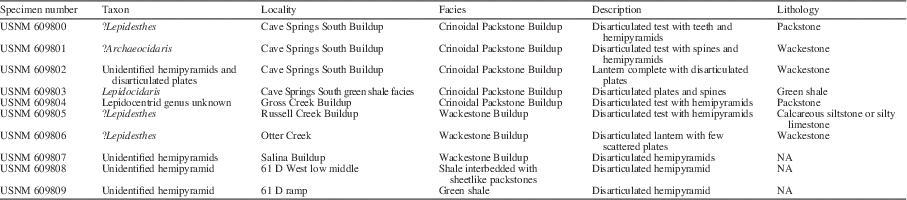
These echinoids were collected over the course of 27 years, from numerous research and class field trips spanning June of 1985 to October of 2012. Relatively few echinoids are known from the Fort Payne Formation, but all echinoids from autochthonous facies are preserved as a scattering of disarticulated plates in close proximity (Table 1). Most of these disarticulated specimens also contain associated hemipyramids. Lepidocentrid genus unknown, ?Archaeocidaris sp. and ?Lepidesthes sp. are all from the crinoidal packstone buildup facies. ?Lepidesthes is also present in the wackestone facies. Isolated, unidentifiable hemipyramids are known from both autochthonous and allochthonous facies (Table 1). With the exception of Leipidocidaris (USNM 609803), all echinoids associated with carbonate buildups were collected from the flank facies.
Locality and facies data for Fort Payne echinoids.
Systematic paleontology
Class Echinoidea Leske, Reference Leske1778
Family Archaeocidaridae M’Coy, Reference M’Coy1844
Genus Archaeocidaris M’Coy, Reference M’Coy1844
Type species
Cidaris urii Fleming, Reference Fleming1828, p. 478; by monotypy (Fell, Reference Fell1966, p. U317); Mississippian of northwestern Europe.
Occurrence
Mississippian–Permian of North America, South America, Russia, Europe, Australia, China.
Remarks
This is arguably the most abundant echinoid genus in the Paleozoic. For a thorough list of species excluding those based solely on disarticulated spines, see Lewis and Donovan (Reference Lewis and Donovan2005).
?Archaeocidaris sp.
Archaeocidarids, lepidesthids, and lepodocentrids from the Fort Payne Formation. (1) ?Archaeocidaris specimen USNM 609801. (2) Lepidocidaris specimen USNM 609803. (3) Lepidocentrid specimen USNM 609804. (4) ?Lepidesthes specimen USNM 609805. (5) ?Lepidesthes specimen USNM 609800. (1, 3–5) Scale bars=10 mm; (2) scale bar=5 mm.
Description
Test disarticulated but likely small. Plating is imbricate. Apical system is not present. Peristome and perignathic girdle are unknown.
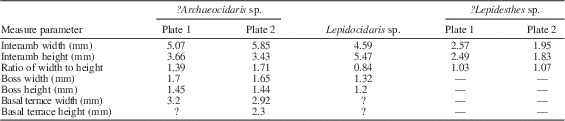
Width of interambulacral plates is 1.3 to 1.7 times their height (Table 2). Plates hexagonal to subhexagonal. Distinction between adambulacral and adradial plates unknown. Single row of scrobicular tubercles along edge of plates, but the details of this row are unclear.
Measurements of Fort Payne echinoids.
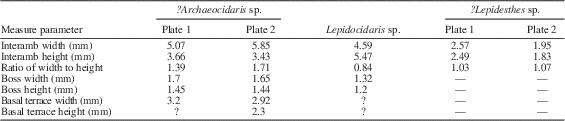
Primary tubercle large, perforate, noncrenulate, located centrally on the plate (Fig. 2.1). Boss is about 0.4 to 0.5 times as high as plate and about 0.3 times as wide as plate. Basal terrace present, about 0.5 times as wide as plate and 0.7 times as high as plate. Mamelon not undercut and sunken area present between mamelon and raised parapet (Fig. 2.1). Radial plications absent and details of scrobicular tubercles unknown.
Primary spines all fragmentary, but the longest spine fragment is 20.2 mm long. Spines are circular in cross section; very finely striate; and, due to crushed nature of some spines, were likely hollow. Most proximal end of spines smooth, but numerous spinules present otherwise. Spinules projecting distally and appear to be present along all shaft.
Lantern disarticulated, but with some elements present. One hemipyramid is preserved, about 9.1 mm high. One rotula is also present and is about 6.7 mm high and 1.9 mm wide across the upper surface. It is slightly eroded, thus details are obscured. The condyles are present; however, they are slightly obscured by matrix.
Material
USNM 609801.
Remarks
Within the Archaeocidaridae, the genera Archaeocidaris and Polytaxicidaris have interambulacral plates that are morphologically similar. Because of this, as pointed out by Kier (Reference Kier1958, Reference Kier1965), without intact interambulacral areas, it is unadvisable to confidently assign disarticulated archaeocidarid plates to Archaeocidaris as has been done consistently since the genus was erected. Therefore, the material herein described cannot be confidently assigned to Archaeocidaris, thus it is designated ?Archaeocidaris sp.
Genus Lepidocidaris Meek and Worthen, Reference Meek and Worthen1873
Type species
?Eocidaris squamosa Meek and Worthen, Reference Meek and Worthen1869, p. 79; by original description and monotypy (Fell, Reference Fell1966, p. U319) from the Tournaisian of Iowa.
Description
Test probably small. Plating likely imbricate. Peristome, perignathic girdle, and lantern unknown.
Details of interambulacral and interambulacral plating unknown, but disarticulated ambulacral and interambulacral plates are present. Ambulacral plate is about 2.0 mm wide and 1.2 mm tall. It is fairly thick and irregularly polygonal in outline (Fig. 2.2).
Interambulacral plates are about 0.8 times as wide as high (Table 2). Plate outlines are slightly obscured, thus plate shape is unclear. Scrobicular tubercles present on raised ridge surrounding tubercle.
Primary tubercle large, perforate, noncrenulate. Boss is about 0.3 times as wide as plate and 0.2 times as high as plate. Tubercle sunken, and it is unclear whether a basal terrace is present. Radial plications absent. Scrobicular tubercles are imperforate and irregularly distributed along plate margin (Fig. 2.2).
Primary spines elongate, coarsely striate (Fig. 2.2). Longest spine is 12.6 mm in length. Milled ring present and spine striate for entire length.
Material
USNM 609803.
Remarks
Lepidocidaris is recognized for its distinctive tubercle morphology with high plates and sunken tubercles. In addition, the smooth, striate spines of this taxon are similar to those of the other known species, Lepidociaris squamosa (Meek and Worthen, Reference Meek and Worthen1873). This specimen is too disarticulated and incomplete to confidently assign to a known or new species of Lepidocidaris; thus, it is designated as Lepidocidaris sp. Lepidocidaris squamosa is known from the Lower Burlington Limestone of Iowa (Meek and Worthen, Reference Meek and Worthen1869); the subspecies Lepidocidaris squamosa anglica Hawkins, Reference Hawkins1935 is known from the Tournaisian and Viséan of the United Kingdom (Hawkins, Reference Hawkins1935; Donovan et al., Reference Donovan, Lewis and Crabb2003, Donovan et al., Reference Donovan, Lewis and Bouman2014). This is the first occurrence of Lepidocidaris from the Viséan of North America, which indicates that the range of the genus is Tournaisian to Viséan in both North America and Europe. Lepidocidaris squamosa anglica is subdivided from Lepidocidaris squamosa because of the slenderness of its spines and its occurrence in the United Kingdom as opposed to North America. Jackson (Reference Jackson1912) adequately described and figured complete spines of Lepidocidaris squamosa from North America, and they also appear slender. Thus, the validity of the subspecies Lepidocidaris squamosa anglica based strictly on morphological differences is questionable; however, taxonomic revision is beyond the scope of this project.
Family Lepidocentridae Lovén, Reference Lovén1874
Lepidocentrid indet.
Lepidesthid and lepidocentrid specimens. (1) Close-up of ?Lepidesthes specimen USNM 609805; note disarticulated lantern elements and teeth. (2) Close-up of ?Lepidesthes specimen USNM 609805; note interambulacral and ambulacral plates. (3) ?Lepidesthes specimen USNM 609806; note tightly associated lantern elements. (4) Close-up of lepidocentrid specimen USNM 609805. (1, 2, 4) Scale bars=10 mm; (3) scale bar equals 5 mm.
Description
Test presumably large. Plating imbricate. Peristome and perignathic girdle unknown due to disarticulation. Ambulacral plates 4 to 6 mm wide, with flange. Interambulacral plates variably polygonal, flat, thin; up to 8 mm wide. Plates about 1 mm thick. No primary tubercles are present on ambulacral plates, and most plates are too eroded to clearly preserve secondary tubercles; however, some may be present on a few plates (Fig. 2.3).
Disarticulated lantern elements are present (Fig. 3.4). Hemipyramids about 16 mm tall. Tooth coming to distal point with three distinct serrations.
Material
USNM 609804.
Remarks
This specimen is assigned to the Lepidocentridae because of its thin interambulacral plating and lack of distinct primary tubercles. Palaechinids also lack primary tubercles; however, they have thick plates that are tessellate and are not similar to the thin, presumably overlapping, plates present here. The state of preservation of this specimen is not good enough to allow for assignment at the generic level; thus, it is left unidentified. The size of the plates does allow for comparison with other lepidocentrid taxa. Judging from the size of the plates, this taxon may be similar to Pholidechinus brauni Jackson, Reference Jackson1912 from the Tournaisian Edwardsville Formation of Crawfordsville, Indiana, or Elliptechinus kiwiaster Schneider, Sprinkle, and Ryder, Reference Schneider, Sprinkle and Ryder2005 from the Pennsylvanian Winchell Formation of Central Texas. These taxa display distinct minute secondary tubercles, which appear similar to those present on a few of the better-preserved plates of this specimen (Fig. 2.3). The taxon described herein is not well enough preserved, however, to determine whether similar tubercles were present on all interambulacral plates.
Family Lepidesthidae Jackson, Reference Jackson1896
Lepidesthes Meek and Worthen, Reference Meek and Worthen1868
Type species
Lepidesthes coreyi Meek and Worthen, Reference Meek and Worthen1868, p. 522; by original designation.
Occurrence
Mississippian–Pennsylvanian of North America; Mississippian of Morocco, England; ?Pennsylvanian of Russia.
Remarks
This genus consists of numerous species and has a wide geographic and temporal distribution. Species included in the genus are L. wortheni Jackson, Reference Jackson1896, L. colletti White, Reference White1878, L. carinata Jackson, Reference Jackson1912, L. alta Kier, Reference Kier1958, L. grandis Kier, Reference Kier1958, L. formosa Miller, Reference Miller1879, L. extremis Jackson, Reference Jackson1912, L. howsei Jackson, Reference Jackson1926, L. caledonica Jackson, Reference Jackson1912, and L. laevis Trautschold, Reference Trautschold1879.
?Lepidesthes sp.
Description
Test small. Plating imbricate. Peristome and perignathic girdle unknown.
Although plating is unknown due to disarticulation of the test, there are far more ambulacral plates than interambulacral plates, which indicates that there are likely numerous columns of ambulacral plates (Fig. 2.4, 2.5).
Ambulacral plates small, wider than high. About 2.3 mm at their widest and 1.3 mm at their highest. Variably polygonal in shape. Each plate pierced by one pore pair with each pore about 0.2 mm apart (Figs. 2.4, 2.5, 3.1, 3.2).
Interambulacral plates are about as wide as high. Specific widths and heights of two plates are recorded in Table 2. They are, on average, larger than ambulacral plates. Faint, small, imperforate secondary tubercles are present on interambulacral plates (Fig 3.2).
Numerous lantern elements are preserved on all three specimens. Hemipyramids about 12.6 mm high. Hemipyramids on specimen USNM 609800 and USNM 609806 have clear indentation, and the foramen magnum on specimens is 0.2 times as shallow as hemipyramids are tall (Fig. 3.1, 3.3). In addition, a poorly preserved rotula is present on specimen USNM 609805 (Fig. 2.5), although the details of the rotula are not clear. All specimens also contain teeth, which come to a single point distally and do not appear to be serrated (Figs. 2.5, 3.1).
Material
USNM 609800, USNM 609805, and USNM 609806.
Occurrence
Cave Springs South and Otter Creek, Lake Cumberland; Russell Creek, Fort Payne Formation (Fig. 1 and Appendix).
Remarks
Lepidesthes is widely known from the Carboniferous of North America. The specimens present, however, are in such a state of disarticulation that identification to the generic level is tenuous. Four species of Lepidesthes, L. colletti, L. wortheni, L. coreyi, and L. carinata are known from siliciclastic facies of the Edwardsville Formation of Montgomery County, Indiana. These strata are coeval with those of the Fort Payne Formation; however, the Edwardsville Formation represents a delta platform environment (Ausich et al., Reference Ausich, Kammer and Lane1979) as opposed to the deeper basinal to toe-of-slope environments represented by the Fort Payne Formation (Ausich and Meyer, Reference Ausich and Meyer1990). Thus, Lepidesthes species may have had a fairly wide environmental tolerance.
Discussion
Paleozoic echinoid taphonomy
Fort Payne autochthonous facies are the sole environments to preserve semiarticulated, or associated, echinoid tests (Table 1). Furthermore, the only facies that preserve these echinoids are the two carbonate buildup facies. Paleozoic echinoids appear to have disarticulated rapidly after death, presumably due to the lack of stereomic interlocking between abutting coronal plates (Smith, Reference Smith1980, Reference Smith1984) and their imbricate test plating. Although all of the Paleozoic families present within this study are extinct, the best taphonomic analogs to Paleozoic echinoids are the basal euechinoids of the clades Echinothurioidea and Diadematoida and the cidaroids. These taxa have limited stereomic interlocking and, in the case of the echinothurioids and diadematoids, more flexible tests (Smith, Reference Smith1980, Reference Smith1984; Greenstein, Reference Greenstein1991, Reference Greenstein1993) than all other extant echinoids. Although no experimental taphonomic studies have been performed on the echinothurioids, the taphonomies of one diadematoid and one cidaroid are well understood (Greenstein, Reference Greenstein1991, Reference Greenstein1993). These two taxa display more stereomic interlocking than was presumably present in Paleozoic echinoids, especially Paleozoic taxa with imbricate plating. Thus, these are the best known, albeit less easily disarticulating, taphonomic analogues to Paleozoic echinoids. Taphonomically, these Mississippian echinoids also have a preservational potential comparable to dendrocrine cladid and flexible crinoids, which completely disarticulate relatively rapidly after death (Meyer et al., Reference Meyer, Ausich and Terry1989). To be preserved articulated, dendrocrine crinoids and the Fort Payne echinoids needed to have been buried very rapidly, perhaps even buried when still alive. If a specimen lay on the sea floor for a short time, the specimen would disarticulate, and in this stage, any transportation would scatter the plates. Thus, the specimens of clustered plates with hemipyramids (Figs. 2.1, 2.4, 2.5, 3.1, 3.2, 3.4) were likely dead specimens whose tests had disarticulated but not been scattered. This is interpreted as parautochthonous preservation and is similar to that of cladid and flexible crinoids also preserved in the Fort Payne carbonate buildups. Both cidaroid and diadematoid echinoids are known to lose their Aristotle’s lantern and apical system within seven days following death (Greenstein, Reference Greenstein1991). Given the even higher rates of disarticulation of Paleozoic echinoids relative to the more derived diadematoids and cidaroids, the association of lantern elements with coronal plates in these specimens also supports the interpretation of rapid burial.
Judging from the specimens recovered for this study, it appears that all of the families represented in the Fort Payne Formation displayed similar likelihoods of preservation. Representatives of three families, archaeocidarids, lepidesthids, and lepidocentrids, are preserved as disarticulated and nondissociated coronal plates and associated lantern elements. The lantern elements are clearly associated with coronal plates in all specimens assignable at the familial level except for the specimen of Lepidocidaris sp. (USNM 609803); however, it is unclear in this specimen whether the lantern elements have been transported from the test or are obscured by rock matrix. Because the spines are still associated with the test, it is likely that the lantern elements have not been lost, as spines usually disarticulated prior to lantern disarticulation in numerous clades of echinoids (Kidwell and Baumiller, Reference Kidwell and Baumiller1990; Greenstein, Reference Greenstein1991; Allison, Reference Allison1990). The archaeocidarids are all preserved with primary spines, further suggesting limited transport and rapid burial (Allison, 1990; Kidwell and Baumiller, Reference Kidwell and Baumiller1990; Greenstein, Reference Greenstein1991). Of interesting note is specimen USNM 609806 of ?Lepidesthes sp., which consists of four closely associated hemipyramids and some scattered coronal plates (Fig. 3.4). In this specimen, many of the coronal plates are scattered and appear to have been transported, leaving the lantern elements essentially where the organism began to disarticulate. It is highly unlikely that the lantern has simply ‘dropped out’ of the test through the peristome following decay of the peristomial membrane, as can be the case in many post-Paleozoic echinoids. This is because the lantern of lepidesthids is significantly smaller than the diameter of their peristome (Jackson, Reference Jackson1912, plate 68, fig. 3). Because of its differential preservation of corona and lantern, this specimen of ?Lepidesthes provides important insight into Paleozoic echinoid taphonomy and disarticulation. Whereas in modern echinoids, the lantern is known to disarticulate well before coronal plates (Kidwell and Baumiller, Reference Kidwell and Baumiller1990; Greenstein, Reference Greenstein1991), it appears that in some Paleozoic echinoids, specifically the lepidesthids, coronal plates may have disarticulated more rapidly relative to lantern disarticulation than in post-Paleozoic taxa. This rapid coronal disarticulation is almost certainly due to the lack of stereomic interlocking between coronal plates and could explain the presence of single, relatively articulated lanterns known from the Paleozoic echinoid fossil record (Jackson, Reference Jackson1912, plate 12, figs. 1–6, 1929, plate 1, figs. 1–3).
Although mass accumulations of echinoids are well known from the Cenozoic rock record (see Nebelsick and Kroh, Reference Nebelsick and Kroh2002 and references therein for a thorough treatment of clypeasteroid mass accumulations), there are no such mass accumulations from the Fort Payne. This is likely due simply to the low abundance of echinoids in the Fort Payne Formation, whose dominant bioclasts are crinoidal in origin. Although mass accumulations comprising entire tests and spine beds are known from the Pennsylvanian of North America (e.g., Schneider et al., Reference Schneider, Sprinkle and Ryder2005; Schneider, Reference Schneider2008; Thompson et al., Reference Thompson, Crittenden, Schneider and Bottjer2015), to date, no such mass accumulations have been identified in the Mississippian. Although Paleozoic echinoid diversity is highest in the Mississippian (Kier, Reference Kier1965), it may be possible that echinoids were actually more abundant during the Pennsylvanian, as evidenced by their heightened occurrence in spine beds and mass accumulations. This hypothesis, however, requires further testing.
Autochthonous facies
The autochthonous facies contain four genera from three families. The Cave Spring South Buildup preserves the most taxa, including Lepidocidaris sp., ?Archaeocidaris, and ?Lepidesthes sp. The specimen of Lepidocidaris sp. was preserved in the interbedded green shale and packstone core of this packstone buildup, indicating a tolerance for siliciclastics. Given that other North American occurrences of Lepidocidaris are from the Lower Burlington Limestone (Meek and Worthen, Reference Meek and Worthen1869), this taxon, at least at the generic level, appears to inhabit both carbonate and siliciclastic substrates. The other archaeocidarid present, ?Archaeocidaris sp., occurs on crinoidal packstone buildup flank beds. Given the occurrence of Archaeocidaris and Polytaxicidaris in a variety of substrates (e.g. Kier, Reference Kier1958, Reference Kier1965; Schneider et al., Reference Schneider, Sprinkle and Ryder2005), it is not surprising that this taxon was present on the crinoidal packstone buildups. In addition, the lepidesthid specimens are known from the autochthonous crinoidal packstone buildup flank beds and wackestone buildups. Lepidesthids are abundant and diverse in the siliciclastic delta shelf environments of the Edwardsville Formation at Crawfordsville (Lane, Reference Lane1973) and the soft-bottomed lagoonal environments of the Sloan’s Valley Member of the Pennington Formation (Chestnut and Ettensohn, Reference Chestnut and Ettensohn1988). Their occurrence on the Fort Payne buildups indicates that in North America, they are not limited to soft-bottomed, primarily siliciclastic environments. Their occurrence on the Fort Payne buildups also argues against a semi-infaunal interpretation for their autecology, as suggested by Chestnut and Ettensohn (Reference Chestnut and Ettensohn1988), because a semi-infaunal lifestyle would not have been likely on either the coarse-grained, poorly sorted substratum of flank beds or the firm, presumably microbially bound wackestone buildups.
As discussed in the preceding, a counterintuitive aspect of Fort Payne deposition is that carbonate buildups formed in a siliciclastic basin with siltstone background sediments. Carbonate buildups were eventually buried by the siltstone and sheetlike packstone facies. The siltstone facies is nearly devoid of fossils, with the primary indication of a faunal presence being trace fossils (Ausich and Meyer, Reference Ausich and Meyer1990). The sheetlike packstones are interpreted to be from turbidite deposition (Ausich and Meyer, Reference Ausich and Meyer1990; Greb et al., Reference Greb, Potter, Meyer and Ausich2008), and their faunal content is a mixture of elements from the autochthonous faunas (Krivicich et al., Reference Krivicich, Ausich and Meyer2014). The fact that Fort Payne echinoid preservation on carbonate buildups was parautochthonous and that these mounds were surrounded by a largely unfossiliferous siltstone facies supports the interpretation that the Fort Payne echinoids lived and were preserved on the carbonate buildups. Given that these echinoids were likely capable of living on firmer, more coarse-grained substrates, such as the flank beds of Fort Payne buildups, it indicates that echinoids had begun to inhabit coarse-grained environments by the Mississippian. Although the colonization of these coarse-grained environments may have corresponded with certain morphological innovations, there are no obvious morphological innovations associated with the colonization of the Fort Payne buildups. All the genera that inhabit the Fort Payne buildups are also known from fine-grained environments (Lane, Reference Lane1973; Chestnut and Ettensohn, Reference Chestnut and Ettensohn1988; Mottequin et al., Reference Mottequin, Poty and Prestianni2015) and, thus, were likely not restricted to specific substrates, at least on the genus level.
Echinoids are known from other mud-mound facies in the Mississippian. The Waulsortian mounds of Clitheroe, England (Miller and Grayson, Reference Miller and Grayson1972), supported a diverse echinoid fauna (Hawkins, Reference Hawkins1935; Donovan et al., Reference Donovan, Lewis and Crabb2003), and echinoids are also known from the Waulsortian facies of Belgium (Jackson, Reference Jackson1929). These deposits were also interpreted to be from a relatively deepwater environment (Miller and Grayson, Reference Miller and Grayson1982; Lees, Reference Lees1997), similar to the Fort Payne buildups. That echinoids were capable of inhabiting these deeper-water environments, likely below the photic zone (Hannon and Meyer, Reference Hannon and Meyer2014), indicates that by the Viséan, numerous families of echinoids had successfully inhabited deeper-water environments. Evidence from the Fort Payne Formation and comparative evidence from the Mississippian of Europe indicate that carbonate mound-type facies were apparently capable of supporting diverse and abundant (relative to Paleozoic standards) echinoid faunas.
Allochthonous facies
No articulated echinoids were found in the allochthonous facies (Table 1), and the only echinoid material recovered from these facies were disarticulated hemipyramids. This can be explained by both preservational biases and worker bias. Hemipyramids have been shown to be relatively robust to laboratory tumbling experiments, remaining fairly intact and recognizable even after 100 hours of tumbling (Greenstein, Reference Greenstein1991). In addition, hemipyramids are relatively recognizable, even to nonechinoid workers, as echinoid fragments. Most of the scientific collecting done in the Fort Payne Formation over the course of the past 30 years has been carried out by crinoid workers. Whereas lantern elements and archaeocidarid interambulacral plates are easily recognizable as belonging to echinoids, many disarticulated coronal plates would be very difficult to distinguish from pelmatozoan thecal and arm plates in the crinoidal limestones that are prevalent in the Fort Payne and other Mississippian strata, which dominate the rocks in which they are found. Therefore, it is not surprising that only hemipyramids have been found in allochthonous facies as they are likely to be preserved and recognizable as echinoid fragments, even after extensive transport.
Conclusions
This is the first study to systematically describe the different facies inhabited by echinoids in the Paleozoic. The Fort Payne Formation yields a relatively diverse echinoid fauna, by Paleozoic standards, containing four genera representing three different families. ?Archaeocidaris sp., Lepidocidaris sp., ?Lepidesthes sp., and an unidentified lepidocentrid are known from the fauna, and all are known from the autochthonous facies. The results of this study indicate that echinoids in the Viséan of North America inhabited carbonate mound facies. Echinoids are also known to inhabit the carbonate Waulsortian mounds of Clitheroe, United Kingdom, and Belgium; and thus, carbonate mud mounds appear to have supported diverse echinoid faunas in the Mississippian of both North America and Europe. All relatively well-preserved echinoids were known from autochthonous facies, whereas only disarticulated lantern elements were recovered from allochthonous facies. This is likely due to taphonomic processes.
Acknowledgments
Many Ohio State University and University of Cincinnati students helped W.I. Ausich and D.L. Meyer in Fort Payne field studies. We are especially appreciative of field support by Ohio State University. Furthermore, support for this research is acknowledged from the National Science Foundation (JRT: IOS-1240626; WIA: EAR-8407516, EAR-8706930). We thank J. Nebelsick and C. Schneider for insightful reviews, which helped us clarify and expand upon the ideas presented in this paper.
Appendix. Locality information
Cave Springs South Buildup, on shores of Lake Cumberland; 36°56’22”N; 85°0’20”W; Jamestown 7.5’ Quadrangle, Russell County, Kentucky.
Celina Wackestone Buildup; 36°32’43”N; 85°30’0”W; Columbia 7.5’ Quadrangle, Clay County, Tennessee.
Gross Creek Buildup, on shores of Lake Cumberland; 36°47’27”N; 84°59’37”W; Cumberland City 7.5’ Quadrangle, Clinton County, Kentucky.
Otter Creek Buildup, on Shores of Lake Cumberland; 36°51’39”N; 85°2’53”W; Cumberland City 7.5’ Quadrangle, Russell County, Kentucky.
Russell Creek Buildup; 37°7’24”N; 85°17’56”W; Columbia 7.5’ Quadrangle, Adair County, Kentucky.
Otter Creek Buildup, on Shores of Lake Cumberland; 36°51’39”N; 85°2’53”W; Cumberland City 7.5’ Quadrangle, Russell County, Kentucky.
Celina Wackestone Buildup; 36°32’43”N; 85°30’0”W; Columbia 7.5’ Quadrangle, Clay County, Tennessee.
61D-West along KY HWY 61; 36°42’55”N; 85°21’52”W; Frogue 7.5’ Quadrangle, Cumberland County, Kentucky.
61 Ramp along KY HWY 61; 36°42’50”N; 85°21’49”W; Frogue 7.5’ Quadrangle, Cumberland County, Kentucky.