Introduction
This paper is based in two research literatures that have so far led separate lives. One is the extensive research on antecedents and determinants of attitudes towards the welfare state. The welfare state is the key device in contemporary societies to achieve redistribution of resources and life chances, and to ameliorate adverse living conditions. The legitimacy of welfare policies is thus of great importance for the coherence of present-day societies and for the opportunities to achieve redistribution. It is therefore not surprising that scholars have spent a great deal of effort trying to understand how attitudes to the welfare state are formed, and why they differ among groups and countries.
This extensive research has to a very limited extent taken into account the (perceived) quality of the public institutions through which welfare policies are enacted. The fairness and effectiveness of such institutions could be expected to be of key importance when citizens decide whether to trust them with tasks and resources. But very few of the existing studies on attitudes to the welfare state take this into account in their analyses of why people support welfare policies and taxation or otherwise.
Conversely, an emerging literature deals with precisely the quality of government and its impact on a host of different social outcomes. The quality of government is something more than the absence of corruption and the existence of democratic elections. It refers to the impartiality and efficiency of the public institutions through which the output side of government is organized (Rothstein and Teorell, Reference Rothstein and Teorell2008). Scholars in this line of research have shown that the quality of government has a clear impact on living conditions, societal trust and other fundamentally important factors. However, as yet none of the analysts has asked to what extent the public's views about public policies and taxation are actually affected by the quality of government, although it is implicit in their argument that people will only support policies that are delivered by public institutions that are of high quality in terms of fairness and efficiency.
We could expect the quality of government to matter in two ways for attitudes towards welfare policies. First, we should suspect that there is a ‘main effect’ in that people who perceive public institutions to be fair and efficient are more inclined to support extensive welfare policies and provide resources for them. Second, it is conceivable that we also find an ‘interaction effect’ with redistributive attitudes. In general, we should expect people who have egalitarian attitudes to be more inclined to support higher taxes and more extensive welfare policies than people with less egalitarian attitudes. But this should only hold when people think that taxes and welfare policies actually work to the benefit of the least resourceful. If, on the contrary, people think that public resources are largely wasted and/or distributed in unfair ways, there is no reason even for committed egalitarians to support high taxes or extensive welfare policies.
In this paper, I bring to bear a novel data set from the European Social Survey (ESS) 2008 to investigate these issues. I use a selection of survey items specifically designed for this survey in order to study public perceptions of the quality of government in terms of efficiency and fairness. The survey also contains measures of redistributive attitudes and attitudes to the balance between taxes and social spending. Hence, it contains all the key elements for testing the issues at hand.
The paper is structured as follows. In the next section, the two relevant research literatures are reviewed, in order to ground my own analyses in the current state of the art. The ‘Data and methods’ section describes the data set and chosen indicators and discusses the choice of statistical methods. The fourth section describes the distribution of the measure of government quality across countries and validates the measure against different expert-based judgements. Then follows the key empirical section, in which the relation among perceived government quality, redistributive attitudes, and attitudes towards taxes and social spending is analysed. The concluding section summarizes the main findings of the paper and points out some implications for research and policymaking.
Welfare state support and quality of government: separate worlds of research
As pointed out in the introduction, this paper is based in two more or less separate corpora of research: one related to the determinants and group patterns of attitudes towards welfare policies, and one that deals with the effects of the quality of government on social outcomes.
Among studies of welfare state attitudes, we find analyses of the social determinants of welfare attitudes, pointing to the most important social and political cleavages around welfare policies. Such studies have shown that people with fewer and smaller market-based resources, such as people with low incomes and higher risks of unemployment, members of the working class and those with low levels of education, tend to be more in favour of extensive welfare policies than more privileged groups (Roller, Reference Roller1992; Iversen and Soskice, Reference Iversen and Soskice2001; Svallfors, Reference Svallfors2004, Reference Svallfors2006; Cusack et al., Reference Cusack, Iversen and Rehm2006; Kitschelt and Rehm, Reference Kitschelt and Rehm2006). They also show that women, public sector employees, and the elderly are more in favour of extensive welfare policies than men, the privately employed and prime-age respondents, although attitudinal differences are not very large (Cook and Barrett, Reference Cook and Barrett1992; Borre and Scarbrough, Reference Borre and Scarbrough1995; Blomberg-Kroll, Reference Blomberg-Kroll1999; Andress et al., Reference Andress, Heien and Hofäcker2001; Arriba et al., Reference Arriba, Calzada and Del Pino2006; Edlund and Svallfors, Reference Edlund and Svallfors2011).
A number of analyses compare countries or ‘welfare regimes’. Over the last decades, this has turned into a veritable cottage industry. The main findings of this line of research are not completely clear-cut, but there seems to be agreement on the following: we do find substantial differences among countries in overall public support for the welfare state, corresponding roughly to welfare policy commitment. Support for equality, redistribution, and state intervention is strongest in the social democratic regime, weaker in the conservative regime, and weakest in the liberal regime. However, we do not find any clear regime-clustering of countries. Differences and similarities among countries show interpretable patterns, but they are too complex to be summarized as ‘worlds of welfare attitudes’ (Svallfors, Reference Svallfors1997, Reference Svallfors2003; Andress and Heien, Reference Andress and Heien2001; Arts and Gelissen, Reference Arts and Gelissen2001; Mau, Reference Mau2003; Larsen, Reference Larsen2006; Brooks and Manza, Reference Brooks and Manza2007).
While institutions play a key part in explaining these country differences, government quality in the sense analysed here has not played any major part in explanations of individual- or country-level variation. Most institutionally based analyses in this field take their starting point in some version of the ‘power-resources’ approach and discuss how distributive conflicts are formed around different types of welfare states (Esping-Andersen, Reference Esping-Andersen1990; Korpi and Palme, Reference Korpi and Palme1998). These analyses may differ in their emphases and analytical strategies, but they share the tendency to see the welfare state as a redistributive machine with the capacity to build different kinds of distributional coalitions (for an extended discussion and application of these perspectives, see Edlund, Reference Edlund2007).
A few studies have looked at how political trust affects attitudes to welfare policies, with mixed results (Edlund, Reference Edlund1999, Reference Edlund2006; Svallfors, Reference Svallfors1999, Reference Svallfors2002). On balance, it seems political trust has a fairly minor importance in explaining individual-level variation in welfare attitudes, and none at all in explaining country differences in support for the welfare state.
But none of these studies have made any attempt to directly measure citizens’ views about the impartiality and efficiency of public institutions. This is a major lacuna. As Rothstein points out, it is not trust in political parties and representative institutions that seem most important for creating government legitimacy. What matters is rather the perceptions of the institutions that are supposed to deliver policies and uphold the rules and laws (Rothstein, Reference Rothstein2009). People expect parties and politicians to be partial, but from their joint public institutions they ask impartiality and effectiveness. So far, the links between such perceptions of government quality and attitudes towards taxation and welfare policies have hardly been studied at all.
For their part, studies of the antecedents and effects of government quality have not focused on citizens’ attitudes. This research has shown that government quality, net of many other factors, has substantial effects on key social and political outcomes such as health and mortality (Holmberg et al., Reference Holmberg, Rothstein and Nasiritousi2009; Holmberg and Rothstein, Reference Holmberg and Rothstein2011), well-being (Frey and Stutzer, Reference Frey and Stutzer2000; Helliwell, Reference Helliwell2003; Helliwell and Huang, Reference Helliwell and Huang2008; Tavits, Reference Tavits2008), economic development (Acemoglu et al., Reference Acemoglu, Johnson and Robinson2001, Reference Acemoglu, Johnson and Robinson2002; Levine and Easterly, Reference Levine and Easterly2003), social trust (Rothstein and Uslaner, Reference Rothstein and Uslaner2005; Rothstein and Teorell, Reference Rothstein and Teorell2008; Rothstein and Eek, Reference Rothstein and Eek2009), political legitimacy (Anderson and Tverdova, Reference Anderson and Tverdova2003; Gilley, Reference Gilley2006), and welfare state spending (Rothstein et al., Reference Rothstein, Samanni and Teorell2011; see summaries in Rothstein, Reference Rothstein2011).
Of particular relevance for the current paper is an analysis of the determinants of social spending and welfare state development, and the role played by the quality of government in this regard. Rothstein et al. (Reference Rothstein, Samanni and Teorell2011) show that not only does the quality of government play a large role in itself in affecting social spending levels in advanced capitalist democracies – in fact, a larger role than the power resources of organized actors, which has so far been the most prominent explanation in the field. It also conditions the effects of power resources on welfare state development. In countries with a high quality of government, the effects of power resources on social spending are substantially stronger than in countries with a lower quality of government. This is presumably a result of the fact that organized actors put less effort into affecting the level of social spending when the institutions are perceived as inefficient and unfair. It is implicit in this argument that citizens’ attitudes matter. People can only be mobilized in support of institutions that are seen as fair and efficient; this is, however, not explicitly tested by the authors. The current paper aims to do precisely this and in doing so also contribute to understanding a so far neglected factor in comparative research on welfare attitudes.
Existing research on the quality of government relies on different expert-based judgements about the overall quality of government in different aspects and countries (as discussed in a later section). In contrast, the current paper is based on general survey respondents’ perceptions of the fairness and efficiency of specific institutions. It is therefore an open question to what extent these different approaches actually measure the same phenomenon, and therefore one to which the first empirical section of the paper is devoted.
Data and methods
The analyses of the paper are based on data from the ESS 2008, and more specifically on the ‘Welfare Attitudes’ module that was one of the topical modules for that year. The ESS is a biannual, high-quality survey of values, attitudes and behaviour among European populations.Footnote 1 The Welfare Attitudes module was designed as a 50-item instrument to tap attitudes related to various aspects of welfare policies, such as attitudes towards welfare state scope and responsibilities, collective financing, different models of welfare, service delivery, and the target groups and receivers of welfare. Furthermore, it aims at measuring evaluations of the task performance of the welfare state, and the perceived economic, moral, and social consequences of welfare policies.
The ESS 2008 data set contains data for 29 countries (with these labels for the figures): Belgium (BEL), Bulgaria (BGR), Croatia (HRV), Cyprus (CYP), the Czech Republic (CZE), Germany (DEU), Denmark (DEN), Estonia (EST), Finland (FIN), France (FRA), Great Britain (GBR), Greece (GRC), Hungary (HUN), Ireland (IRL), Israel (ISR), Latvia (LVA), the Netherlands (NLD), Norway (NOR), Poland (POL), Portugal (PRT), Romania (ROU), Russia (RUS), Spain (EST), Sweden (SWE), Slovakia (SVK), Slovenia (SVN), Switzerland (CHE), Turkey (TUR), and Ukraine (UKR). So the selection of country cases covers not only the much-studied Western European welfare states, with their large institutional continuity and piecemeal development of welfare policies in response to organized social interests (Flora, Reference Flora1986–1988), it also covers the less-analysed East European welfare states, with their ruptures and upheavals where public policies were built by authoritarian regimes and then transformed in various directions after 1990 (Haggard and Kaufman, Reference Haggard and Kaufman2008).
Crucially for this paper, the module contains a set of items intended to measure the perceived fairness and efficiency of public institutions. The items focus on tax authorities and health care, for several reasons. First, these are fundamental tasks that any functioning government would have to be able to organize. They are at the core of state activities. Second, for this same reason, it can be safely assumed that the agencies and institutions in question actually exist in all European countries (in contrast to, say, child care facilities or labour market agencies). Third, as Rothstein points out, the health care sector seems particularly vulnerable to various forms of corruption and partial treatment, since the exact content of the service in question is hard to specify (Rothstein, Reference Rothstein2011: 58–59).
The exact formulations of the four items are
1. Please tell me how efficient you think the provision of health care in [country] is. Choose your answer from this card where 0 means extremely inefficient and 10 means extremely efficient.
2. And how efficient do you think the tax authorities are at things like handling queries on time, avoiding mistakes and preventing fraud? Please use this card where 0 means they are extremely inefficient in doing their job and 10 means they are extremely efficient.
3. Please tell me whether you think doctors and nurses in [country] give special advantages to certain people or deal with everyone equally? Choose your answer from this card where 0 means you think they give special advantages to certain people and 10 means you think they deal with everyone equally.
4. Please tell me whether you think the tax authorities in [country] give special advantages to certain people or deal with everyone equally? Choose your answer from this card where 0 means you think they give special advantages to certain people and 10 means you think they deal with everyone equally.
Answers are given on 0–10 (i.e. 11-point) scales. Exploratory factor analyses (which can be obtained from the author) show that all four items load on the same factor, and all items show high inter-correlations. Hence, it makes sense to see them all as measuring an underlying general government quality dimension. So it is not the case that people, for example, find their institutions to be efficient but unfair or vice versa. They rather find that institutions that are inefficient also tend to be unfair, while impartial institutions also tend to be efficient.
Still, for checking and illustrative purposes, it might be interesting to separate the efficiency from the fairness dimensions, to test whether conclusions differ depending on which measure is chosen. The four items were therefore combined into three different additive indices, focusing on (a) the overall quality of government, (b) the efficiency dimension, and (c) the fairness dimension. All three measures were created so that the original 0–10 scale was retained:
(a) (1 + 2 + 3 + 4)/4 (alpha = 0.75).
(b) (1 + 2)/2 (alpha = 0.61).
(c) (3 + 4)/2 (alpha = 0.73).
As shown, the reliability measure for the efficiency scale is on the low side,Footnote 2 which need only be a concern if the three scales actually yield differing results. As will become obvious, this is not the case.
As measures for egalitarianism, I apply two different indicators, and their combination to an overall additive index. Both items have 5-point answer scales, running from ‘strongly agree’ to ‘strongly disagree’ (i.e. standard Likert-type items), which have been transformed to a 0–10 scale to make them comparable to the measures of government quality:
1. The government should take measures to reduce differences in income levels (transformed to 0–10 scale, 10 = High support for redistribution).
2. For a society to be fair, differences in people's standard of living should be small (transformed to 0–10 scale, 10 = Highly egalitarian).
3. Egalitarian index (1 + 2)/2 (0–10; Alpha = 0.60).
As shown, the reliability of the index is far from ideal. Furthermore, the mentioning of the word ‘government’ in one of the items provides a potential endogeneity problem in relation to the dependent variable in the analyses; that is, that the independent and dependent variables are in fact indicators of the same underlying dimension (‘support for government intervention’). However, results are highly consistent regardless of whether the combined index or any of the single indicators are used. Hence, only results pertaining to the index will be shown (alternative model runs can be obtained from the author). In addition, it will become clear that the associations between redistributive attitudes and those towards taxes and spending vary greatly across countries, something that makes the endogeneity scenario implausible.
In choosing the most appropriate dependent variable, the module offers some alternatives. One question battery deals with the desired extension of government responsibilities for various welfare state-related tasks, a question that has been widely used in comparative research (e.g. in several of the chapters in Svallfors, Reference Svallfors2012). For the purpose of the current paper, however, these items seem less suited. What is at stake is not how respondents see the ideal involvement of government in the welfare of its citizens, but rather how willing they are to provide the actually existing public institutions with resources to redistribute.
Hence, I opted instead for a single-item measure of the desired balance between taxes and social spending, phrased as follows:
If the government had to choose between increasing taxes and spending more on social benefits and services, or decreasing taxes and spending less on social benefits and services, which should they do? (0–10 scale, 0 = Government should decrease taxes a lot and spend much less on social benefits and services, 10 = Government should increase taxes a lot and spend much more on social benefits and services)
Needless to say, this measure should not be directly compared across countries, since it explicitly refers to the current levels of taxation and social spending, which makes it a clearly relativistic measure across countries. But for gauging the impact of government on support for providing resources to welfare policies it seems quite suited. The different country levels of the baseline need be of no great concern, since methods that take this into account are applied.
In terms of analytical methods, the paper first uses simple scatterplots and country-level correlations to give an overview of the postulated relationships. In a subsequent step, fixed-effects models across countries are applied in order to analyse the joint impact of perceived government quality and egalitarianism on attitudes towards taxes and spending, and their interaction.Footnote 3 In the context of this paper, it is essential to apply a method that takes the clustered character of the data into account, and which allows for the intercept of the dependent variable to vary across countries. Countries may differ in their views about taxes vs. spending for any number of reasons that are not relevant for the current issues, and all such unobserved country-level variation should be suspended in the final analysis, or to put it more technically, we should try to eliminate any omitted variable bias.Footnote 4
I also apply a number of individual-level controls to take into account factors that could possibly affect both the dependent and the analytical variables of interest. As described in more detail adjacent to the analyses, I control for a host of demographical and socio-economic factors, and display both uncontrolled and controlled coefficients for the variables of analytical interest.Footnote 5 Potentially, it might well be the case that uncontrolled models actually suppress ‘true’ effects, since people with lower status and smaller resources might be more inclined to simultaneously endorse higher spending and have lower confidence in the quality of institutions. As it turns out, however, differences between controlled and uncontrolled models are not dramatic.
Validating the government quality measure
Should we expect the survey-based citizens’ perceptions of government quality to concur with experts’ judgements of the quality of government? As noted earlier, existing research on the quality of government relies on expert-based judgements, while the current paper, in order to study individual-level effects, is based on individuals’ survey answers. If there is little or no correlation between these two types of measures, it would become problematic to argue that what is analysed here is indeed the impact of the quality of government. If perceptions of the quality of government showed little congruence with reasoned expert judgements of the same phenomenon, one could suspect that any individual-level association between the perceived quality of government and support for social spending was in fact driven by support for the welfare state rather than by the quality of government. In other words, in such a case we would encounter difficult problems of endogeneity and reversed causality that would endanger the whole analysis.
And there are additional reasons to suspect that correlations between the experts’ judgements and the public's need not be particularly strong. First, the public may simply be ignorant about the actual state of affairs, and either exaggerate or underestimate the quality of government.Footnote 6 Second, the public could display strongly adaptive preferences, so that they adjust their expectations to whatever happens to be the case. Words such as ‘efficient’ and ‘treat everybody the same’ may be interpreted in a relativistic rather than absolute way. Someone in an ‘objectively’ very efficient system may be dismayed by a short waiting-time, or a person in a highly corrupt system may be very satisfied because they last time had to pay such a small bribe compared to what used to be the case. Third, the items constructed for the ESS survey may be faulty. Perhaps there is something particular about taxation and health care that people respond to, which does not necessarily tell us something about the overall quality of government. Or perhaps meanings fail to travel in the translations, notwithstanding all the efforts that have been put into establishing reliable design-and-implementation procedures.
The three survey-based measures were correlated with three different expert-based measures: the International Country Risk Guide indicator of Quality of Government (ICRG), the Transparency International Corruption index (CPI), and the World Bank Estimate of Government Efficiency (WBE), all taken from the Quality of Government Institute's database (Teorell et al., Reference Teorell, Charron, Samanni, Holmberg and Rothstein2011).Footnote 7 Although the three measures indicate slightly different aspects, they yield very similar results, something that also goes for the three survey-based measures. Results for the ICRG and overall quality of government measure are displayed in Figure 1, while additional scatterplots are found in the Web Appendix, Figures 1A and 2A.
Expert judgments (International Country Risk Guide) and public perceptions of the quality of government.

As displayed, we find amazingly strong correlations between the experts’ judgements and the public's perceptions. The correlation coefficient is no less than 0.81, which indicates that the measures are very strongly interrelated. Looking at the plot, we find the Nordic countries and the Netherlands clustered in the top right corner, indicating a perception of high government quality both among experts and among the public. In the bottom left corner, we find a number of East European, mostly former communist countries, which are judged as having low government quality.
A few outliers may be detected: Russia and Turkey are both judged more leniently by their publics than by experts, while the contrary goes for Germany. But overall, there is a strikingly strong correspondence between publics and experts. This is further confirmed by looking at the Web Appendix, Figures 1A and 2A, where it is shown that the same pattern appears when the subscales of the survey-based index are plotted against other expert-based measures of the quality of government.
To summarize this section, we find that the measures used are indeed valid, in the sense that they seem to be driven largely by the actual quality of government. Citizens do perceive the quality of their institutions, and there does not seem to be any large extent of adaptive preferences. The ESS survey items seem actually to work as intended. Hence, it makes sense to use them in the next section in order to address the main issues of the paper.
Quality of government, egalitarianism, and attitudes to public policies and taxation
As pointed out in the introduction, I test whether perceptions of government quality have an independent effect on attitudes to taxes and social spending, above and beyond egalitarian attitudes. I also test to what extent perceptions of government condition the effect of egalitarianism: is it only in high-government-quality settings that we find an association between egalitarian attitudes and those towards taxing and spending? One could assume that egalitarians want higher taxes and social spending than others. But that presumably only holds if people actually think that taxes and social spending work as redistributive devices, and that would depend on their perceptions about the quality of government institutions. The argument is summarized in stylized form in Figure 2.
Perceived quality of government, egalitarianism, and attitudes to taxes and social spending.
As a first overview at the country-level, Figure 3 displays the association between the perceived quality of government and attitudes to taxes and social spending. As shown, there is a clear correlation: countries where the public perceives a better quality of government are also countries where support for increased social spending is stronger. This result emerges in spite of the fact that countries with a high quality of government are also countries that already spend more on the welfare state than countries with a lower quality of government (Rothstein et al., Reference Rothstein, Samanni and Teorell2011). Yet, their citizens lean more towards further increases in social spending than citizens in other countries.
Perceived quality of government and attitudes to social spending.
Figure 4 displays the association between correlations between the egalitarianism index and attitudes to taxes and spending on one hand, and perceived government quality on the other. As shown, there is a strong correspondence. In countries where people perceive government quality as high, attitudes towards taxes and social spending are highly structured by egalitarian attitudes. In the Nordic countries, for example, egalitarians are substantially more in favour of higher taxes and spending than people with less egalitarian attitudes. In countries with low quality of government, the relationship between egalitarianism and attitudes to taxes and spending is substantially weaker. In a handful of countries, the relationship is even reversed (i.e. R < 0), which indicates that in these countries egalitarians actually want lower taxes and social spending than less egalitarian people.
Perceived quality of government and correlations between egalitarianism and attitude towards social spending.
A few conspicuous outliers can be detected: the Czech Republic and Ukraine, where correlations between the egalitarianism index and attitudes to taxes and social spending are higher – in the case of the Czech Republic, much higher – than could be expected from their quality of government; also Spain, where these correlations are lower than expected. But overall, the results in Figure 4 provide clear support for the postulated interaction effect among egalitarianism, quality of government, and support for taxes and social spending.
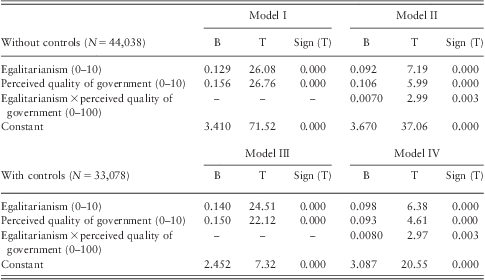
A more direct test is provided by the fixed-effects regression models displayed in Table 1. Here results are provided, first without additional controls (Models I and II), then for models in which relevant control variables are included. Models III and IV control for age, gender, years of education, subjective health status, immigrant background, current unemployment, household income, subjective income, and transfer incomes (for the exact coding of control variables, see Web Appendix, Table 1A).Footnote 8
Lower taxes vs. higher spending on social benefits and services (0–10 scale). Fixed-effects models across 29 countries
Source: European Social Survey 2008.
As shown, both the main effects of egalitarianism and government quality, as well as their interaction, are statistically significant. Egalitarians and those who think that government quality is high want higher taxes and social spending than others. So there is a clear independent effect of government quality, even net of the egalitarian attitudes people hold. The effects of government quality and egalitarianism on attitudes to taxes and spending are roughly of the same magnitude. But as indicated by the significant interaction effect in Models II and IV, the effect of egalitarianism on taxes and spending preferences is stronger when government quality is higher. These results are very stable across models; the inclusion of relevant controls hardly affects the estimates for the key variables at all.
By way of illustrating the conditioning impact of government quality on the effects of egalitarianism on attitudes to social spending, Figure 5 displays the marginal effect of egalitarianism at different levels of perceived government quality.Footnote 9 As shown, these effects are considerably larger at higher levels of perceived government quality. At the maximum value of perceived government quality, the size of the marginal effect of egalitarianism is about 75% higher than when the perceived quality of government is very low.
Marginal effect of egalitarianism on attitudes to social spending.
Statistical significance apart, how large are these effects from a substantive point of view? As a simple illustration, we could calculate the results from Model III and show that, controlling for other confounding factors, a person with maximum values on both independent variables would have a 2.9-unit higher value on the 11-point dependent variable than a person with minimum values on both independent variables (10 × 0.14 + 10 × 0.15).Footnote 10 At first glance, this may seem a substantial though not dramatic difference. But it should be kept in mind that, given the empirical distribution of the dependent variable, this is more than the distance between the 25th and the 75th percentile of the full distribution.
Conclusion
In this research study, the impact of government quality on attitudes to taxes and social spending was analysed. First, the measure of government quality was validated against several expert-based measures. This validation exercise showed that there was a strong congruence between experts and the general population in their perceptions of the quality of government. This indicated that the survey items we used truly provided a reliable picture of the quality of government, and that problems of endogeneity, ignorance, adaptive preferences, and faulty measures were in fact quite small.
In a second step, it was shown that these perceptions of government impartiality and efficiency actually matter a great deal for attitudes towards taxes and social spending. There is a clear effect of government quality on these attitudes – even net of the redistributive attitudes people hold. Furthermore, government quality conditions the impact of egalitarianism on attitudes to public policies. Only where government quality is high do we find clear differences in attitudes to taxes and social spending between people with more or less egalitarian attitudes.
The study clearly provides support for one of the key arguments among scholars interested in the effects of quality of government: that public support for public policies depends to a large degree on the quality of the institutions through which they are delivered. Within research on the quality of government, this has been an implicit, although not explicitly tested assumption.
This also means that the research points to the importance of a neglected factor in the structuration of welfare attitudes. Where institutions have entered this research field, the emphasis has been on the capacity of redistributive institutions to build their own support. Where trust has been in focus, it has been in the form of trust for political actors and political institutions. What this research shows is that it is worthwhile to also focus on the impartiality and efficiency of implementing government agencies.
In a broader, longer-term perspective, a few implications should be drawn out before closing. One is that the most extensive welfare states, such as those found in the Nordic countries and some other north-western European countries, are the results not only of successful working-class mobilization and the incorporation of the middle class into a universal welfare state (Korpi, Reference Korpi1983; Esping-Andersen, Reference Esping-Andersen1985, Reference Esping-Andersen1990), they are also blessed with having already had comparatively incorrupt and impartial state apparatuses at the point the organized working class began to make its impact felt (Knudsen and Rothstein, Reference Knudsen and Rothstein1994). This comparatively high quality of government was a necessary precondition for a successful political mobilization by the political left, in and through the state (cf. Rothstein et al., Reference Rothstein, Samanni and Teorell2011). It is a lasting legacy in these countries, through which the turn to the state for the solution of important societal problems is a reflex not only of the political left, but of large sections of the entire political spectrum. Institutional legacies are therefore key to understanding present-day political conflict and consensus.
At the same time, this situation spells trouble for many currently industrializing countries, provided with substantially less well-functioning state apparatuses, as well as for the Eastern European welfare states, with much weaker accountability mechanisms in place than in the West European context. These states are to a large (but differing) extent suffering from a negative feedback loop, where low quality of government feeds low confidence and weak tax compliance, which in turn translate into a low quality of government (such as when underpaid public sector employees resort to bribes in order to make a living).
If welfare expansion depends crucially on the quality of public institutions, welfare state advocates need to aim for institutional reform, in tandem with struggles for increased social protection from market forces. Campaigns and actions for cleaner and more transparent government decision making are not luxuries to be afforded only once acute problems of sustenance have been solved. They are of fundamental importance for making policies for social protection viable in the first place. If problems of low quality of government cannot be solved, this failing will constitute a formidable limit for welfare state expansion globally, or even across the European continent. As shown in this paper, even in a comparatively advantaged corner of the world such as that surveyed here, support for welfare policies and taxation depends crucially on the quality of the public institutions through which they are enacted.
Acknowledgements
The research has been financed by the Swedish Council for Social and Working Life Research, under the European Science Foundation's program Human Values, Institutions and Behaviour (HumVIB). The paper was prepared while the author enjoyed a Fernand Braudel Fellowship at the European University Institute, January–June 2011. Further support was received from Umeå University, through their Baltic scholarship. Previous versions of the paper were presented at the Welfare Attitudes in Europe project meeting, Berlin, 6 September 2011, and at the Department of Sociology, Umeå University, 23 September 2011. Thanks to participants in these seminars for helpful comments, in particular Arvid Bäckström, Jonas Edlund, and Christian Staerklé. Further helpful comments were received from Lasse Brännström, Bo Rothstein, Jan Teorell, and from anonymous referees for the journal.
Supplementary materials
For supplementary material referred to in this article, please visit http:/dx.doi.org/doi:10.1017/S175577391200015X