The epidemiology of mass casualty incidents like fires, bomb attacks, release of toxic chemicals into the environment, construction disasters, and disasters caused by forces of nature, namely, floods, earthquakes, and other phenomena, has been presented in the literature.Reference Epstein, Ekbatani and Kaplan 1 - Reference Shepherd, Gerdes and Nipper 7 Such events result in multiple casualties that overwhelm local resources and highlight the need for a proper disaster response. There are also many different situations in which patients must be promptly evacuated from the hospital owing to various circumstances posing a threat to their safety.Reference Vilke, Smith and Stepanski 8 - Reference Blumhagen 13 Fortunately, emergency situations forcing the evacuation of patients from the site are relatively rare. As far as Polish hospitals are concerned, available literature mentions the following causes of evacuation: power failure (evacuation of 65 patients, including 21 newborns), medical staff strike (16 patients evacuated from a general internal medicine unit), dangerous animal (scorpion; 50 patients), flood, bomb alert (500 patients), water contamination, and fire (40 patients). The national legal regulations of each state determine the action plans anticipated for such critical situations.
Public health policy makers and emergency planners create and modify safety plans and emergency response systems. What is more, they also compel the management staff of each medical and nonmedical institution to create evacuation plans for each facility. As a consequence, every single hospital and medical center has its own evacuation plan for emergency situations. Despite the fact that mass casualty management schemes and hospital evacuation plans show some discrepancies (concerning aspects such as communication pathways), the overall aims of these safety plans are quite similar. Hospital staff, as well as emergency management and administrators, are to limit unnecessary morbidity and decrease mortality among the smallest and most vulnerable patients.Reference Femino, Young and Smith 11 Many authors emphasize that these safety schemes should be characterized by flexibility and creativity.Reference Femino, Young and Smith 11 , Reference Blumhagen 13 Rapid notification and mobilization of hospital staff not working during a mass casualty incident is one of the stages enumerated in emergency plans. These personnel are immediately required to support those dealing with the emergency situation at the hospital.Reference Epstein, Ekbatani and Kaplan 1 The time frame between the beginning of an emergency situation and mobilization of the staff is crucial for implementation of an action plan. Such actions are usually started in a situation of deficit in personnel, so that each support (even if not provided by “complete” teams) may appear to be beneficial for the action.
Many countries have different communication pathways utilized by hospitals during emergency situations. It has been estimated that 94% of hospitals in the United States have special algorithms, which include calling in additional personnel in case of an emergency situation in the hospital. In most cases this type of communication is based on a phone tree. In a survey conducted by Thompson et al,Reference Thompson, Lyle and Mullins 2 medical institutions also reported other available methods of notification in the case of landline loss, namely, cell phones, ham radios, walkie-talkies, Arkansas Wireless Information Network (AWIN) units, satellite phones, and Tanderberg units. In many hospitals, the phone tree still constitutes a major step in mobilizing extra staff in case of a hospital mass casualty incident.Reference Epstein, Ekbatani and Kaplan 1 , Reference Thompson, Lyle and Mullins 2 The literature also describes an emergency staff recall system based on the use of cell phones as an additional tool for transmitting information within the scope of the safety plan in case of an emergency situation.Reference Epstein, Ekbatani and Kaplan 1 The aim of the present study was to verify the effectiveness of short text messages (short message service, or SMS) as an additional notification tool in case of fire or a mass casualty incident in a hospital.
Methods
Copernicus Memorial Hospital in Lodz is one of the largest nonclinical hospitals in Poland. It fulfills the requirements of the international standard ISO 9001:2008. To improve our procedures, we analyzed our hospital emergency plans in case of fire or a mass casualty incident. Concerning off-duty employees obliged to support the working personnel in such situations, telephone contact remains the standard notification procedure. Nevertheless, this method has not been verified as far as time-related factors are concerned and seems to be ineffective (time consuming and not cost-effective). SMS notification is seen as an alternative method; however, it has not yet been implemented in hospital standards. To verify the effectiveness of this particular method, text messages were sent to 3 groups of hospital employees. Messages were sent from a Samsung GT-S8500 Wave cell phone, which can store up to 2000 phone numbers, and Orange Poland was chosen as the provider (Poland’s leading telecommunication provider). The recipients identified the sender phone number but did not provide a special ring tone or vibration to differentiate from all other texts. Phones that were used in the study had the capability to apply “quiet time” or to block messages for specified time frames. The studied group consisted of 59 hospital workers. The first group included emergency doctors and the leading nurse (n=21), the second group included the management board of the hospital (n=19), whereas the third group comprised the middle management of the hospital (n=19). During a 3-month trial period, messages were sent between 3:35 PM (after normal working hours in the hospital) and midnight on all working days, as well as on weekends and bank holidays, without any regular pattern. The text of the message was prepared ahead of time and was saved in the phone memory: “This message is a part of training. Please respond by telling us how much time (in minutes) would it take you to reach the Hospital in case of MCI, starting from this moment” (where MCI is mass casualty incident). Messages were sent to all participants from all groups and forwarding 1 message took about 4 minutes. IRB approval (RNN/430/13/KB) was granted on June 18, 2013.
Statistical Analysis
Differences in variables between the studied groups were tested with the Kruskal-Wallis (H) test and normality related to data distribution was verified with the Shapiro-Wilk test. A P value of <0.05 was adopted as the significance level.
Results
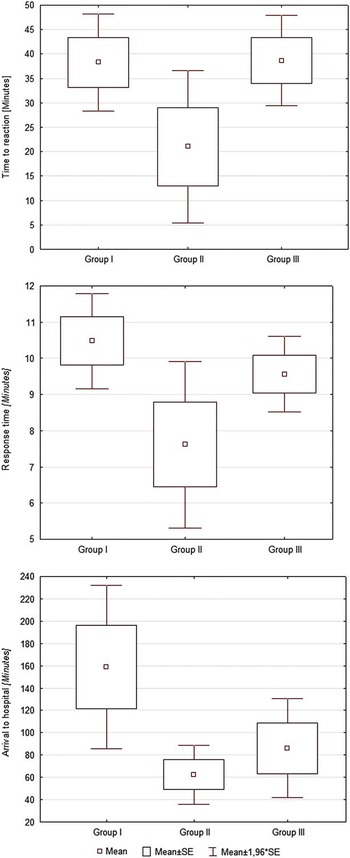
A total of 2242 SMS text messages were sent with the response rate equaling 53% (n=1184). The mean reaction time (SMS reply) was 36.41 minutes (SD: 122.09 min; range: 0 to 1592 min; 95% confidence interval [CI]: 29.45–43.37 min). Within the male group the reaction time was 36.23 minutes (SD: 123.9 min), whereas in the female group it was 36.98 minutes (SD: 116.38 min; H=0.0043823, P=0.9472). The mean response time in the first group (physicians) was 38.27 minutes (SD: 120.61 min), that in the second group (management staff) was 21.01 minutes (SD: 84.32 min), and that in the third group (middle management staff) was 38.68 minutes (SD: 132.45 min). Statistical analysis revealed significant differences in reaction times between the groups (H=8.277678, p=0.0182; Figure 1).
Mean Response Time (Response to the SMS), Mean Response Time for Messages Received Within 60 Minutes, and Mean Declared Time of Arrival to the Hospital. Abbreviation: SMS, short message service (text message). Group I, emergency physicians and the leading nurse (n=21); group II, the management board of the hospital (n=19); group III, the middle management of the hospital (n=19).

Among all 1184 responses, most were received within 60 minutes (n=1038; 87.7%). The mean reaction time for messages received during this period was 10 minutes (SD: 14.34 min; median: 3 min, 95% CI: 9.11–10.86 min) and most SMSs were sent up to 10 minutes after the call (n=782; 75.3%). Analysis focusing on the mean response time to messages received within 60 minutes did not reveal any significant differences between male and female groups (H=0.6138, P=0.9802); however, it was possible to observe certain differences between groups I, II, and III (group I: 10.47 min [SD: 14.77 min]; group II: 7.62 min [SD: 12.03 min]; group III: 9.56 min [SD: 13.93 min]; H=8.7886, P=0.003; Fig. 1).
The mean declared time of arrival to the hospital was 100.5 minutes (SD: 586 min; median: 30 min). For 87% (n=992) of the messages, the declared arrival time was less than 60 minutes. The mean time of arrival within the analyzed groups was as follows: group I, 158.9 minutes (SD: 842.12 min; 95% CI: 85.28–232.53 min; P<0.0001); group II, 62.49 minutes (SD: 136.85 min; 95% CI: 35.73–89.23 min; P<0.0001); and group III, 86 minutes (SD: 602 min; 95% CI: 41.6–130.5 min; P<0.0001). Statistical comparison revealed significant differences in the declared time of arrival between the groups (H=19.2563, P=0.0001; Fig. 1). After excluding 10% of extreme values of the declared arrival time, the mean time was estimated as 38.35 minutes and was 47.3 minutes in group I, 40 minutes in group II, and 36.29 minutes in group III (H=7.34626, P=0.0031).
Discussion
The growing popularity of cell phones (in 2008 about 50% of the global population was estimated to have cell phones) and their increasing potential use or role in medicine can be readily observed.Reference Terry 14 , Reference Ozdalga, Ozdalga and Ahuja 15 The use of SMS is a cheap and rapid means of eliminating weak points in communication and could lead to improved delivery of health services and better health outcomes.Reference Jones, Wasunna and Sudoi 16 To some extent, these messages are better than phone calls. Even if the cell phone is out of coverage, the SMS message will be delivered as soon as the network signal is available again (even if the coverage is available for a short period of time). The great advantage of SMS communication lies in the possibility to send one message to several recipients at the same time. This could be useful for medical staff mobilization during a mass casualty incident because the entire hospital staff can receive the emergency information almost immediately. The evolution from SMS to EMS (enhanced message service) and MMS (multimedia message service) enables transmitting even more information at the same time. For example, apart from the information relating the emergency situation, the message could also include the evacuation plan or evacuation map/paths. What is more, sending SMS messages proves to be a better solution in case of a surge in network traffic; there is a greater chance of receiving an SMS message than a phone call.Reference Epstein, Ekbatani and Kaplan 1
In the case of mass casualty incidents, rapid mobilization of crucial hospital staff within the first hour is of supreme importance for any safety plan. Epstein et alReference Epstein, Ekbatani and Kaplan 1 revealed that the communication pathway based on the phone tree recall system is very complicated and time consuming, whereas the SMS system seems to be the fastest way to communicate.
More than half of the medical personnel participating in our study replied to the test message alerts. The mean time of SMS reply was 36.41 minutes (SD: 122.09 min). The fastest replies were provided by the second analyzed group, which comprised management staff (21.01±84.32 min). The first group (physicians) needed the longest period of time to respond, reaching 38.27 minutes on average (SD: 120.61 min). It should be emphasized that most replies were received within 60 minutes (n=1038; 87.68%). Obtained data were similar to the data presented by other authors. Research by Epstein et alReference Epstein, Ekbatani and Kaplan 1 also revealed that about 50% of personnel answered to the simulated disaster alert. Half of the replies in that research were received within less than 60 minutes and more than 75% of replies were given within about 100 minutes.
Additionally, we analyzed the declared time of arrival to hospital. The mean declared time was 100.5 minutes (SD: 586 min). In most cases (87%) the declared arrival time did not exceed 60 minutes. We observed similar correlations for declared arrival time as for the time of SMS reply. Management staff anticipated the shortest time required to reach the hospital. According to Epstein et al,Reference Epstein, Ekbatani and Kaplan 1 almost 24% of medical staff confirmed that they would be able to be back in the hospital within 60 minutes or less (the research covered only the medical staff, excluding the management staff).
Currently, awareness associated with the need for fast, adequate, and effective response to hospital mass casualty incidents is on the increase. True preparedness for such situations can be achieved by creating good safety plans, repeating disaster drills, and taking advantage of the lessons learned from disaster response to modify safety plans. We truly believe that using an additional notification tool in case of a mass casualty incident is worth considering. Short text messages are one such additional communication pathway.
Conclusions
Short text messages (SMS) can be considered an additional tool for notifying medical staff in case of fire or a mass casualty incident in a hospital. SMS is a rapid, cheap, and simple way of delivering information in emergency situations. Therefore, we believe that SMS could be a part of an integrated communication plan in such cases.