1. Introduction
Degenerate plasmas are defined as plasmas of so high density that the degenerate pressure (generated due to Heisenberg's uncertainty principle with infinitesimally small uncertainty in position and infinitely large uncertainty in momenta of degenerate plasma species) cannot be neglected in any way (Fowler Reference Fowler1926; Chandrasekhar Reference Chandrasekhar1931a,Reference Chandrasekharb, Reference Chandrasekhar1936; Koester & Chanmugam Reference Koester and Chanmugam1990; Horn Reference Horn1991; Koester Reference Koester2002; Shukla & Eliasson Reference Shukla and Eliasson2011; Shukla, Mamun & Mendis Reference Shukla, Mamun and Mendis2011; Brodin, Ekman & Zamanian Reference Brodin, Ekman and Zamanian2016). They usually contain degenerate electron species (Fowler Reference Fowler1926; Chandrasekhar Reference Chandrasekhar1931a,Reference Chandrasekharb, Reference Chandrasekhar1936; Koester & Chanmugam Reference Koester and Chanmugam1990; Horn Reference Horn1991; Koester Reference Koester2002; Shukla & Eliasson Reference Shukla and Eliasson2011; Shukla et al. Reference Shukla, Mamun and Mendis2011; Brodin et al. Reference Brodin, Ekman and Zamanian2016); inertial light nucleus species, i.e.  ${}^{1}_{1}\textrm{H}$ (Fowler Reference Fowler1926; Chandrasekhar Reference Chandrasekhar1931a,Reference Chandrasekharb, Reference Chandrasekhar1936) or
 ${}^{4}_{2}\textrm{He}$ (Koester & Chanmugam Reference Koester and Chanmugam1990; Horn Reference Horn1991; Koester Reference Koester2002) or
 ${}^{12}_{~6}\textrm{C}$ (Koester & Chanmugam Reference Koester and Chanmugam1990; Horn Reference Horn1991; Koester Reference Koester2002); and heavy nucleus species, i.e.
 ${}^{56}_{26}\textrm{Fe}$ (Vanderburg et al. Reference Vanderburg, Johnson, Rappaport, Bieryla, Irwin, Lewis, Kipping, Brown, Dufour and Ciardi2015) or
 ${}^{85}_{ 37}\textrm{Rb}$ (Witze Reference Witze2014) or
 ${}^{96}_{42}\textrm{Mo}$ (Witze Reference Witze2014). The degenerate pressure
 ${\mathcal {P}}_{Cj}$ exerted by the cold (
 $T_j=0$) degenerate plasma species
 $j$ (where
 $j=e$ for the electron species and
 $j=l$ for the light nucleus species) is given by (Chandrasekhar Reference Chandrasekhar1931b, Reference Chandrasekhar1936; Horn Reference Horn1991; Koester Reference Koester2002; Shukla & Eliasson Reference Shukla and Eliasson2011; Shukla et al. Reference Shukla, Mamun and Mendis2011)
 \begin{equation} {\mathcal{P}}_{Cj}={\mathcal{K}}_jN_j^{\gamma_j},\end{equation}
where  $N_j$ is the number density of the plasma species
 $j$. Here
 $\gamma _j$ and
 ${\mathcal {K}}_j$ are
 \begin{equation} \gamma_j=\tfrac{5}{3}, \quad {\mathcal{K}}_j\simeq\frac{3{\rm \pi}\hbar^2}{5m_j}\end{equation}
for the non-relativistic limit (Horn Reference Horn1991; Koester Reference Koester2002; Chandrasekhar Reference Chandrasekhar1936; Shukla & Eliasson Reference Shukla and Eliasson2011; Shukla et al. Reference Shukla, Mamun and Mendis2011) and
 \begin{equation} \gamma_j=\tfrac{4}{3}, \quad {\mathcal{K}}_j\simeq\tfrac{3}{4}\hbar c\end{equation}
for the ultra-relativistic limit (Horn Reference Horn1991; Koester Reference Koester2002; Chandrasekhar Reference Chandrasekhar1936; Shukla & Eliasson Reference Shukla and Eliasson2011; Shukla et al. Reference Shukla, Mamun and Mendis2011), where  $m_j$ is the mass of the plasma species
 $j$,
 $\hbar$ is the reduced Planck constant and
 $c$ is the speed of light in vacuum.
The concept of ion-acoustic waves (Tonks & Langmuir Reference Tonks and Langmuir1929; Revans Reference Revans1933) led Mamun (Reference Mamun2018) to introduce the electron degenerate energy  ${\mathcal {E}}_{e0}={\mathcal {K}}_eN_{e0}^{\gamma _e-1}$ along with the corresponding wave speed
 $C_l[=({\mathcal {E}}_{e0}/m_l)^{1/2}]$ and wavelength scale
 $L_q (=C_l/\omega _{pl})$ (where
 $\omega _{pl}= (4{\rm \pi} N_{l0}Z_l^2e^2/m_l)^{1/2}$,
 $Z_l$ being the charge state of the light nucleus species and
 $N_{e0}$ (
 $N_{l0}$) being the number density of the electron (light nucleus) species at equilibrium). We note that
 ${\mathcal {E}}_{e0}$,
 $C_l$ and
 $L_q$ are associated with the equilibrium electron degenerate pressure and that
 $N_{e0}=Z_lN_{l0}+Z_hN_{h0}$ at equilibrium, where
 $N_{h0}$ (
 $Z_h$) is the number density (charge state) of the heavy nucleus species. Mamun (Reference Mamun2018) then predicted degenerate pressure-driven (DPD) nucleus-acoustic (NA) waves in a degenerate plasma system containing cold non- or ultra-relativistically degenerate electron species (Chandrasekhar Reference Chandrasekhar1931a,Reference Chandrasekharb, Reference Chandrasekhar1936), non-degenerate light nucleus species (i.e.
 ${}^{1}_{1}\textrm{H}$ (Chandrasekhar Reference Chandrasekhar1931a,Reference Chandrasekharb, Reference Chandrasekhar1936) or
 ${}^{4}_{2}\textrm{He}$ (Horn Reference Horn1991) or
 ${}^{12}_{~6}\textrm{C}$ (Koester Reference Koester2002)) and stationary heavy nucleus species (i.e.
 ${}^{56}_{ 26}\textrm{Fe}$ (Vanderburg et al. Reference Vanderburg, Johnson, Rappaport, Bieryla, Irwin, Lewis, Kipping, Brown, Dufour and Ciardi2015) or
 ${}^{85}_{ 37}\textrm{Rb}$ (Witze Reference Witze2014) or
 ${}^{96}_{42}\textrm{Mo}$ (Witze Reference Witze2014)). The linear dispersion relation for the DPD NA waves (Mamun Reference Mamun2018) is given by
 \begin{equation} \omega=\sqrt{\frac{\gamma_e}{1+\mu}}\frac{k C_l}{\sqrt{1+\dfrac{\gamma_e}{1+\mu} k^2L_q^2}}, \end{equation}
where  $\mu =Z_hN_{h0}/Z_lN_{l0}$. The linear dispersion relation (1.4) can be interpreted as follows. (i) The DPD NA waves are driven by the electron degenerate pressure and the DPD NA waves exist in any degenerate plasma system at absolute zero temperature, for which the DPD NA waves are completely different from the ion-acoustic waves (Tonks & Langmuir Reference Tonks and Langmuir1929; Revans Reference Revans1933). (ii) The dispersion relation (1.4) for the long-wavelength DPD NA waves (
 $kL_q\ll 1$) is given by
 \begin{equation} \omega = \sqrt{\frac{\gamma_e}{1+\mu}} kC_l. \end{equation}
(iii) The dispersion relation (1.5) for  $\mu =0$ becomes
 \begin{equation} \omega = \sqrt{\gamma_e}kC_l, \end{equation}
which means that in DPD NA waves, the light nucleus mass density (electron degenerate pressure) provides the inertia (restoring force). (iv) The phase speed ( $\omega /k$) of the long-wavelength DPD NA waves decreases with an increase of the value of
 $\mu$, i.e. with the number density (
 $N_{h0}$), and charge state (
 $Z_h$) of the stationary heavy nucleus species for fixed light nucleus number density (
 $N_{l0}$). (v) The length and time scales of the DPD NA waves (Mamun Reference Mamun2018) are far different from those of the ion-acoustic waves, since their restoring forces and the media of their propagation are completely different.
Recently, a number of theoretical investigations (Mamun, Amina & Schlickeiser Reference Mamun, Amina and Schlickeiser2016, Reference Mamun, Amina and Schlickeiser2017; Zaman et al. Reference Zaman, Amina, Dip and Mamun2017, Reference Zaman, Amina, Dip and Mamun2018; Chowdhury et al. Reference Chowdhury, Hasan, Mannan and Mamun2018; Jannat & Mamun Reference Jannat and Mamun2018a,Reference Jannat and Mamunb; Sultana & Schlickeiser Reference Sultana and Schlickeiser2018; Sultana et al. Reference Sultana, Islam, Mamun and Schlickeiser2018; Das & Karmakar Reference Das and Karmakar2019) have been made of the nonlinear propagation of NA waves in degenerate plasma systems. Mamun et al. (Reference Mamun, Amina and Schlickeiser2016, Reference Mamun, Amina and Schlickeiser2017) considered the strongly (Mamun et al. Reference Mamun, Amina and Schlickeiser2016) and weakly (Mamun et al. Reference Mamun, Amina and Schlickeiser2017) coupled heavy nucleus fluid, and studied the small-amplitude heavy NA shock waves (Mamun et al. Reference Mamun, Amina and Schlickeiser2016) and solitary waves (SWs) (Mamun et al. Reference Mamun, Amina and Schlickeiser2017) in an absolutely cold degenerate electron–light nucleus plasma system. These shock waves and SWs (Mamun et al. Reference Mamun, Amina and Schlickeiser2016, Reference Mamun, Amina and Schlickeiser2017) are associated with the dynamics of the heavy nucleus species, but not with that of the light nucleus species. Zaman et al. (Reference Zaman, Amina, Dip and Mamun2017, Reference Zaman, Amina, Dip and Mamun2018) have examined the effects of non-planar geometry on the NA shock (Zaman et al. Reference Zaman, Amina, Dip and Mamun2017) and solitary (Zaman et al. Reference Zaman, Amina, Dip and Mamun2018) waves propagating in absolutely cold degenerate electron–nucleus plasma systems. On the other hand, Jannat & Mamun (Reference Jannat and Mamun2018a,Reference Jannat and Mamunb) considered an absolutely cold degenerate plasma system containing cold degenerate electron species and cold dissipative (Jannat & Mamun Reference Jannat and Mamun2018a) and non-dissipative (Jannat & Mamun Reference Jannat and Mamun2018b) light nucleus species, and studied the effects of the stationary heavy nucleus species on the NA shock (Jannat & Mamun Reference Jannat and Mamun2018a) and solitary (Jannat & Mamun Reference Jannat and Mamun2018b) waves. Sultana & Schlickeiser (Reference Sultana and Schlickeiser2018) considered an absolutely cold multi-nucleus degenerate plasma with relativistically degenerate electron species to study the arbitrary-amplitude NA solitons in an absolutely cold degenerate quantum plasma system. Sultana et al. (Reference Sultana, Islam, Mamun and Schlickeiser2018) have also investigated the modulated heavy NA waves and associated rogue waves in the same quantum plasma system. Chowdhury et al. (Reference Chowdhury, Hasan, Mannan and Mamun2018) have studied the NA envelope solitons and their modulation instability in an absolutely cold degenerate plasma system. Das & Karmakar (Reference Das and Karmakar2019) have studied the nonlinear propagation of the heavy NA waves associated with the dynamics of cold heavy nucleus species. We note that in heavy NA waves, the inertia is provided by the mass density of heavy nucleus species, but not of light nucleus species, and the length and time scales of heavy nucleus species are far different from those of the NA waves, which are associated with the dynamics of light nucleus species.
The works highlighted above are valid only for absolutely cold degenerate plasma species, but are not valid for degenerate plasma species at finite temperature, particularly for hot white dwarfs (Dufour et al. Reference Dufour, Fontaine, Liebert, Schmidt and Behara2008, Reference Dufour, Béland, Fontaine, Chayer and Bergeron2011; Werner & Rauch Reference Werner and Rauch2015; Werner, Rauch & Reindl Reference Werner, Rauch and Reindl2019; Koester, Kepler & Irwin Reference Koester, Kepler and Irwin2020). To overcome this limitation in previously published works (Mamun et al. Reference Mamun, Amina and Schlickeiser2016, Reference Mamun, Amina and Schlickeiser2017; Zaman et al. Reference Zaman, Amina, Dip and Mamun2017, Reference Zaman, Amina, Dip and Mamun2018; Chowdhury et al. Reference Chowdhury, Hasan, Mannan and Mamun2018; Jannat & Mamun Reference Jannat and Mamun2018a,Reference Jannat and Mamunb; Sultana & Schlickeiser Reference Sultana and Schlickeiser2018; Sultana et al. Reference Sultana, Islam, Mamun and Schlickeiser2018; Das & Karmakar Reference Das and Karmakar2019), the equation of state for a degenerate plasma at finite temperature (Manfredi Reference Manfredi2005; Vavrukh & Smerechynskyi Reference Vavrukh and Smerechynskyi2012; Hossain & Mandal Reference Hossain and Mandal2019) is derived by quantum field theory (Hossain & Mandal Reference Hossain and Mandal2019) and by introducing two parameters, namely  $\sigma _j=m_jc^2/{\mathcal {E}}_{Fj}$ and
 $\sigma _{Tj}=k_BT_j/{\mathcal {E}}_{Fj}$, where
 ${\mathcal {E}}_{Fj}$ (
 $T_j$) is the the Fermi energy (temperature) of species
 $j$ with
 $k_B$ being the Boltzmann constant. The equation of state (1.1) for plasma species
 $j$ at finite temperature
 $T_j$ can, therefore, be modified as
 \begin{equation} {\mathcal{P}}_j= {\mathcal{P}}_{Cj}{\mathcal{K}}_{Tj},\end{equation}
where  ${\mathcal {K}}_{Tj}$ arises due to the effect of finite temperature
 $T_j$, and is given by (Hossain & Mandal Reference Hossain and Mandal2019)
 \begin{equation} {\mathcal{K}}_{Tj}=\left(1+\frac{48\sigma_{\mu j}\sigma_{T_j}^2}{2\sigma_{\mu j} -3\sigma_j^2\sigma_{kj}^2}\right),\end{equation}
in which  $\sigma _{\mu j}=\sqrt {1+\sigma _j^2}$ and
 $\sigma _{kj}=\sqrt {\sigma _{\mu j}+\sigma _j^2\log [\sigma _j/(1+\sigma _{\mu j})]}$. It is obvious from (1.8) that for the cold degenerate plasma limit (
 $T_j=0$),
 ${\mathcal {K}}_{Tj}=1$ so that
 ${\mathcal {P}}_j={\mathcal {P}}_{Cj}$. It may be noted here that
 $1/\sigma _j$ is the ‘relativity parameter’ (Salpeter Reference Salpeter1961), and that the range of its value determines the non-relativistically and ultra-relativistically degenerate plasma regimes. Thus, to make
 ${\mathcal {P}}_{Cj}$ consistent with
 ${\mathcal {K}}_{Tj}$, we use
 $\sigma _j\gg 1$ for
 $\gamma _j=5/3$ (non-relativistically degenerate plasma situation) and use
 $\sigma _j\ll 1$ for
 $\gamma _j=4/3$ (ultra-relativistically degenerate plasma situation), which are of our present interest.
Therefore, in our present work, we consider a warm degenerate plasma (WDP) system containing warm non-relativistically and ultra-relativistically degenerate electron species, non-degenerate light nucleus species as well as low-density stationary heavy nucleus species, and investigate small- but finite-amplitude DPD NA SWs by the reductive perturbation method (Washimi & Taniuti Reference Washimi and Taniuti1966) for one-dimensional (1-D) planar as well as non-planar cylindrical and spherical geometries. The WDP model of our present consideration is applicable not only to cold white dwarfs, but also to hot white dwarfs like DQ white dwarfs, white dwarf H1504+65, white dwarf PG 0948+534, etc. (Dufour et al. Reference Dufour, Fontaine, Liebert, Schmidt and Behara2008, Reference Dufour, Béland, Fontaine, Chayer and Bergeron2011; Werner & Rauch Reference Werner and Rauch2015; Werner et al. Reference Werner, Rauch and Reindl2019; Koester et al. Reference Koester, Kepler and Irwin2020).
The paper is structured as follows. The WDP model is illustrated in § 2. The modified Korteweg–de Vries (MK-dV) equation is derived using the reductive perturbation method, and the basic features of the small- but finite-amplitude DPD NA SWs are investigated by solving the MK-dV equation analytically for 1-D planar geometry and numerically for non-planar cylindrical and spherical geometries in § 3. The WDP model under consideration, the results obtained from this investigation and some important applications are briefly discussed in § 4.
2. Warm degenerate plasma model equations
We consider a WDP system containing warm non-relativistically ( $\gamma _e=\gamma =5/3$) and ultra-relativistically (
 $\gamma _e=\gamma =4/3$) degenerate electron species, non-degenerate (
 $\gamma _l=5/3$) light nucleus species as well as low-density stationary heavy nucleus species. We also consider the nonlinear propagation of DPD NA waves in this WDP system. The dynamics of the warm degenerate electron species is described by
 \begin{equation} N_ee\frac{\partial\varPhi}{\partial R}=\frac{\partial {\mathcal{P}}_e}{\partial R}, \end{equation}
where  $\varPhi$ is the DPD NA wave electrostatic potential and
 $R$ is the space variable. Now, substituting
 ${\mathcal {P}}_e$ (which is obtained from (1.7) for the electron species), we obtain
 \begin{equation} n_e=\left[1+\frac{\gamma-1}{\gamma{\mathcal{K}}_{Te}}\phi\right]^{{1}/({\gamma-1})},\end{equation}
where  $n_e=N_e/N_{e0}$ and
 $\phi =e\varPhi /{\mathcal {E}}_{e0}$, in which
 ${\mathcal {E}}_{e0}={\mathcal {K}}_eN_{e0}^{\gamma -1}$. It is obvious that for
 $T_e=0$,
 ${\mathcal {K}}_{Te}=1$ and
 ${\mathcal {P}}_e= {\mathcal {P}}_{Ce}$. The latter is Chandrasekhar's equation of state defined by (1.1). We note that (2.2) is valid for
 $\gamma =5/3$ (non-relativistically degenerate electron species (Chandrasekhar Reference Chandrasekhar1936; Shukla et al. Reference Shukla, Mamun and Mendis2011)) and
 $\gamma =4/3$ (ultra-relativistically degenerate electron species (Chandrasekhar Reference Chandrasekhar1936; Shukla et al. Reference Shukla, Mamun and Mendis2011)).
The nonlinear dynamics of the DPD NA waves in such a WDP system in 1-D planar or non-planar geometry is governed by
 \begin{gather} \frac{\partial n_l}{\partial t} +\frac{1}{r^\nu} \frac{\partial}{\partial r} (r^\nu n_lu_l) = 0, \end{gather}
 \begin{gather}\frac{\partial u_l}{\partial t} +u_l\frac{\partial u_l}{\partial r}={-}\frac{\partial \phi}{\partial r} - \frac{3}{2}{\mathcal{K}}_{Tl} \beta\frac{\partial n_l^{{2}/{3}}}{\partial r}, \end{gather}
 \begin{gather}\frac{1}{r^\nu}\frac{\partial}{\partial r}\left(r^\nu\frac{\partial \phi}{\partial r}\right) =(1+\mu)n_e-n_l-\mu, \end{gather}
where  $\nu =0$ for 1-D planar geometry and
 $\nu =1$ (2) for non-planar cylindrical (spherical) geometry;
 $n_e$ is given by (2.2);
 $n_l$ is the light nucleus number density normalized by
 $N_{l0}$;
 $u_l$ is the light nucleus fluid speed normalized by
 $C_q$ (
 $=({Z_l\mathcal {E}}_{e0}/m_l)^{1/2}$);
 $r=R/\lambda _q$ with
 $\lambda _q=C_q/\omega _{pl}$;
 $t$ is the time variable normalized by
 $\omega _{pl}^{-1}$; and
 $\beta ={\mathcal {E}}_{l0}/Z_l{\mathcal {E}}_{e0}$ in which
 ${\mathcal {E}}_{l0}={{\rm \pi} \hbar ^2N_{l0}^{2/3}}/{m_l}$ (obtained from (1.2a,b)). We note that that for the cold non-relativistically degenerate light nucleus species (
 $T_l=0$),
 ${\mathcal {K}}_{Tl}=1$.
The normalized basic equations (2.2)–(2.5) in 1-D planar or cylindrical or spherical geometry can be interpreted as follows: (i) (2.2) represents the expression for the warm degenerate inertia-less electron number density, which is valid for  $\gamma =5/3$ and
 $\gamma =4/3$; (ii) (2.3) represents the continuity equation for the warm degenerate light nucleus species, where the effects of the source and sink terms have been neglected; (iii) (2.4) represents the momentum balance equation for the warm degenerate light nucleus species, and the second term on the right-hand side of (2.3) is due to the degeneracy effect of the degenerate light nucleus species at finite temperature
 $T_l$; and (iv) (2.5) is Poisson's equation for the DPD NA wave potential, which closes (2.2)–(2.4), and the parameter
 $\mu$ in (2.5) is due to the assumption of stationary heavy nucleus species, which is valid since the heavy nucleus plasma frequency is much less than the DPD NA wave frequency because of their heavy mass and low number density.
It is important to mention here that the gravitational force acting on warm degenerate electron and light nucleus species, which is inherently very small compared to the other forces under consideration, is neglected.
3. Degenerate pressure-driven NA SWs
To study the planar and non-planar DPD NA SWs using the reductive perturbation method (Washimi & Taniuti Reference Washimi and Taniuti1966), we stretch the independent  $r$ and
 $t$ as (Sahu & Roychoudhury Reference Sahu and Roychoudhury2007)
 \begin{gather} \xi=\epsilon^{{1}/{2}}(r-{\mathcal{M}}t), \end{gather}
 \begin{gather}\tau=\epsilon^{{3}/{2}}t, \end{gather}
and expand the dependent variables ( $n_l$,
 $u_l$ and
 $\phi$) as (Washimi & Taniuti Reference Washimi and Taniuti1966)
 \begin{gather} n_l=1+\epsilon n_l^{(1)}+\epsilon^2 n_l^{(2)}+\cdots , \end{gather}
 \begin{gather}u_l=0+\epsilon u_l^{(1)}+\epsilon^2 u_l^{(2)}+\cdots , \end{gather}
 \begin{gather}\phi=0+\epsilon \phi^{(1)}+\epsilon^2 \phi^{(2)}+\cdots , \end{gather}
where  ${\mathcal {M}}$ is the phase speed (normalized by
 $C_q$) of the DPD NA waves (i.e.
 ${\mathcal {M}}=\omega /kC_q$) and
 $\epsilon$ is the stretching or expansion parameter having any value satisfying the condition
 $0<\epsilon <1$.
Now, using (3.1)–(3.5) in (2.2)–(2.5), and taking the coefficients of  $\epsilon ^{3/2}$ from (2.3) and (2.4), and the coefficients of
 $\epsilon$ from (2.5), we obtain
 \begin{gather} n_l^{(1)}=\frac{1}{{\mathcal{M}}^2-{\mathcal{K}}_{Tl} \beta}\phi^{(1)}, \end{gather}
 \begin{gather}u_l^{(1)}=\frac{{\mathcal{M}}}{{\mathcal{M}}^2-{\mathcal{K}}_{Tl} \beta}\phi^{(1)}, \end{gather}
 \begin{gather}{\mathcal{M}}=\left(\frac{\gamma{\mathcal{K}}_{Te}}{1+\mu}+{\mathcal{K}}_{Tl}\beta\right)^{{1}/{2}}. \end{gather}
We note that (3.8) represents the linear dispersion relation for the DPD NA waves in the degenerate plasma system at finite temperature  $T_j$ of the degenerate electron and light nucleus species. This linear dispersion relation can be written in dimension form as
 \begin{equation} \omega=kC_q\left(\frac{\gamma{\mathcal{K}}_{Te}}{1+\mu}+{\mathcal{K}}_{Tl}\beta\right)^{{1}/{2}}. \end{equation}
This means that the linearized equations (3.6)–(3.8), which are derived using the first-order approximation, are valid for the long-wavelength DPD NA waves. It is obvious from (3.8) that for fixed values of  $\mu$,
 $\gamma$ and
 ${\mathcal {K}}_{Te}$ (which is a function of
 $\sigma _e$ and
 $\sigma _{Te}$), the
 ${\mathcal {M}}^2$ versus
 $\beta$ (
 ${\mathcal {K}}_{Tl}$) curve represents a straight line with slope
 ${\mathcal {K}}_{Tl}$ (
 $\beta$) and with
 ${\mathcal {M}}^2=\gamma {\mathcal {K}}_{Te}/(1+\mu )$ at
 $\beta =0$ or
 ${\mathcal {K}}_{Tl}=0$. Figure 1 shows graphically the variation of
 ${\mathcal {M}}$ with
 $\mu$ and
 $\sigma _{Te}$ for
 $\gamma =5/3$ (figure 1a) and
 $\gamma =4/3$ (figure 1b).
The variation of  ${\mathcal {M}}$ with
 $\mu$ for
 $\beta =0.1$,
 $\sigma _l=20$ and
 $\sigma _{Tl}=0.01$: (a)
 $\gamma =5/3$,
 $\sigma _e=10$,
 $\sigma _{Te}=0.015$ (solid curve),
 $\sigma _{Te}=0.018$ (dotted curve) and
 $\sigma _{Te}=0.021$ (dashed curve); (b)
 $\gamma =4/3$,
 $\sigma _e=0.1$,
 $\sigma _{Te}=0.01$ (solid curve),
 $\sigma _{Te}=0.07$ (dotted curve) and
 $\sigma _{Te}=0.1$ (dashed curve).

Similarly, using (3.1)–(3.5) in (2.2)–(2.5), and taking the coefficients of  $\epsilon ^{5/2}$ from (2.3) and (2.4), and the coefficient of
 $\epsilon ^2$ from (2.5), we obtain
 \begin{gather} \frac{\partial n_l^{(1)}}{\partial\tau}-{\mathcal{M}}\frac{\partial n_l^{(2)}}{\partial\xi}+\frac{\partial u_l^{(2)}}{\partial\xi}+\frac{\partial}{\partial\xi}[n_l^{(1)}u_l^{(1)}]+\frac{\nu u_l^{(1)}}{\tau}=0, \end{gather}
 \begin{gather}\frac{\partial u_l^{(1)}}{\partial\tau}-{\mathcal{M}}\frac{\partial u_l^{(2)}}{\partial\xi}+u_l^{(1)}\frac{\partial u_l^{(1)}}{\partial\xi}={-}\frac{\partial \phi^{(2)}}{\partial\xi}-{\mathcal{K}}_{Tl} \beta\frac{\partial n_l^{(2)}}{\partial\xi}+\frac{1}{6}{\mathcal{K}}_{Tl}\beta\frac{\partial}{\partial\xi}[n_l^{(1)}]^2, \end{gather}
 \begin{gather}\frac{\partial^2\phi^{(1)}}{\partial\xi^2}=\alpha_\mu\phi^{(2)}+\frac{\alpha_\mu(2-\gamma)}{2\gamma{\mathcal{K}}_{Te}}[\phi^{(1)}]^2-n_l^{(2)}, \end{gather}
where  $\alpha _\mu =(1+\mu )/(\gamma {\mathcal {K}}_{Te})$. Now, using (3.6)–(3.12), we eliminate
 $\phi ^{(2)}$,
 $u_l^{(2)}$ and
 $n_l^{(2)}$ to obtain
 \begin{equation} \frac{\partial \phi^{(1)}}{\partial \tau} +\frac{\nu}{2\tau}\phi^{(1)} + {\mathcal{A}}\phi^{(1)} \frac{\partial \phi^{(1)}}{\partial \xi} +{\mathcal{B}} \frac{\partial^{3} \phi^{(1)}}{\partial \xi^{3}}=0, \end{equation}
where  ${\mathcal {A}}$ and
 ${\mathcal {B}}$ are nonlinear and dispersion coefficients, respectively, and are given by
 \begin{gather} {\mathcal{A}}=\frac{{\mathcal{B}\alpha_\mu}}{\gamma{\mathcal{K}}_{Te}} \left[1+\gamma+3\mu+\frac{8\beta}{3\gamma}\frac{{\mathcal{K}}_{Tl}}{{\mathcal{K}}_{Te}}(1+\mu)^2\right], \end{gather}
 \begin{gather}{\mathcal{B}} =\frac{1}{2\alpha_\mu^{{3}/{2}}\sqrt{1+{\mathcal{K}}_{Tl}\beta\alpha_\mu}}. \end{gather}
We note that (3.13) is the MK-dV equation with the nonlinear coefficient  ${\mathcal {A}}$ defined by (3.14) and the dispersion coefficient
 $B$ defined by (3.15), and that
 ${\mathcal {A}}>0$ and
 ${\mathcal {B}}>0$ for all possible values of
 $\gamma$,
 $\mu$,
 $\beta$,
 $\sigma _e$,
 $\sigma _l$,
 $\sigma _{Te}$ and
 $\sigma _{Tl}$. To avoid any confusion, we also note that
 $\gamma _e=5/3$ for non-relativistically degenerate electron species and
 $\gamma _e=4/3$ for ultra-relativistically degenerate electron species, which are of our present interest. It is important to mention here that the second term (
 $\nu \phi ^{(1)}/2\tau$) in (3.13) is due to the effect of the non-planar geometry, and that for
 $\nu =0$ or
 $\tau \rightarrow \infty$, the effect of the non-planar geometry disappears, and becomes 1-D planar geometry.
3.1. One-dimensional planar geometry ( $\nu =0$)

We first consider 1-D planar geometry by substituting  $\nu =0$ or
 $\tau \rightarrow \infty$ into (3.13). The assumption
 $\nu =0$ or
 $\tau \rightarrow \infty$ reduces (3.13) to a standard K-dV equation. To obtain the stationary SW solution of the standard K-dV equation given by (3.13) with
 $\nu =0$, we consider a moving frame
 $\zeta =\xi -{\mathcal {U}}_0\tau$, where
 ${\mathcal {U}}_0$ is the SW speed in the moving frame, and impose the appropriate boundary conditions:
 $\phi ^{(1)}\rightarrow 0$ and
 $d\phi ^{(1)}/d\zeta \rightarrow 0$ at
 $\zeta \rightarrow \pm \infty$. Thus, the stationary SW solution of (3.13) with
 $\nu =0$ is given by
 \begin{equation} \phi^{(1)}=\psi\, \textrm{sech}^2\left(\frac{\zeta}{\delta}\right), \end{equation}
where  $\psi$ and
 $\delta$, respectively, represent the amplitude and the width of the DPD NA SWs, since (3.16) represents the DPD NA SWs with positive electrostatic wave potential, corresponding to the density compression (in the form of solitary profile) of the light nucleus species. This is because of
 ${\mathcal {A}}>0$ and
 ${\mathcal {B}}>0$. The amplitude (
 $\psi$) and the width (
 $\delta$) of the DPD NA SWs are, respectively, given by
 \begin{gather} \psi =\frac{3 {\mathcal{U}}_0}{{\mathcal{A}}}, \end{gather}
 \begin{gather}\delta=\sqrt{\frac{4 {\mathcal{B}}}{{\mathcal{U}}_0}}. \end{gather}
It is obvious from (3.17) and (3.18) that the amplitude (width) of the thermally DPD NA SWs is directly (inversely) proportional to  ${\mathcal {U}}_0$ (i.e.
 $\psi \propto {\mathcal {U}}_0$ and
 $\delta \propto 1/{\mathcal {U}}_0$).
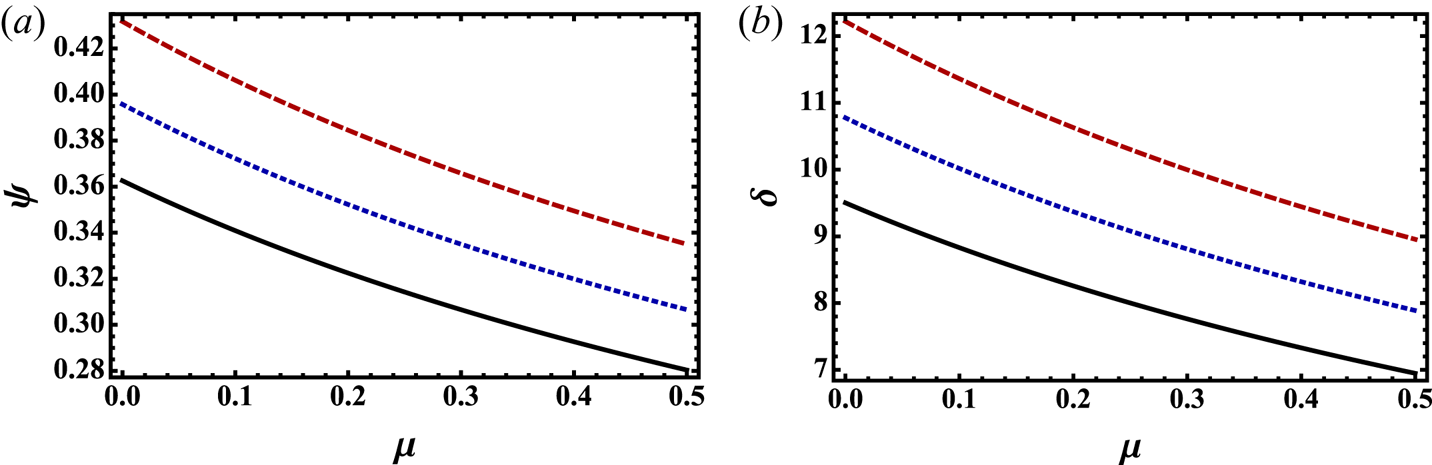
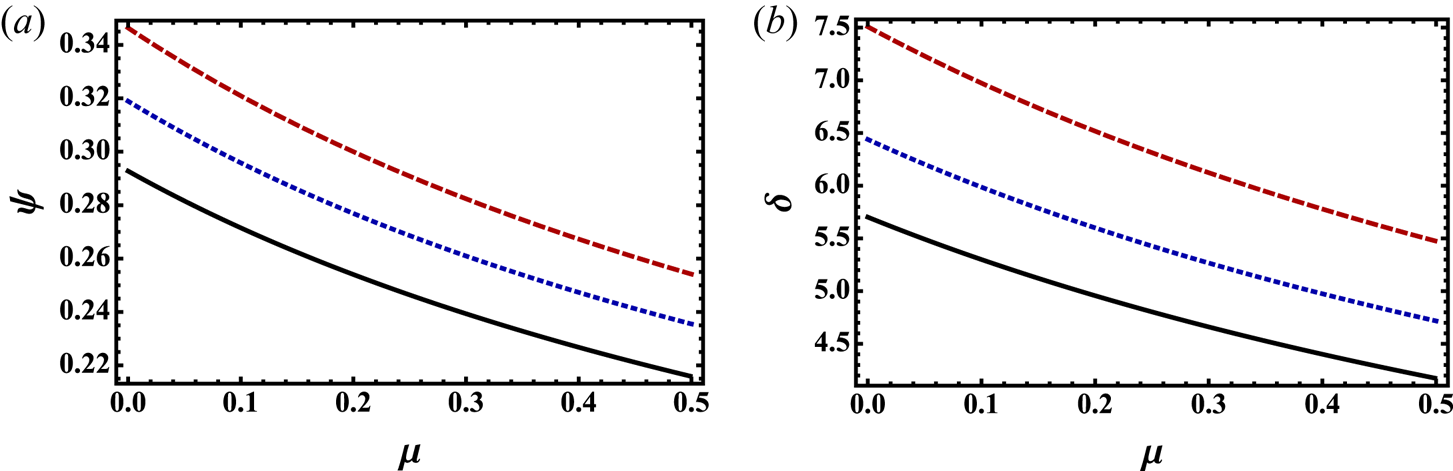
We now graphically show how the basic features, i.e. speed  ${\mathcal {M}}$, amplitude
 $\psi$ and width
 $\delta$, of the DPD NA SWs vary with typical plasma parameters, i.e.
 $\mu$,
 $\gamma$ and
 $\sigma _{Te}$, for fixed values of
 $\sigma _e$,
 $\sigma _l$,
 $\sigma _{Tl}$ and
 $\beta$, corresponding to hot white dwarfs, e.g. DQ white dwarfs (Dufour et al. Reference Dufour, Fontaine, Liebert, Schmidt and Behara2008, Reference Dufour, Béland, Fontaine, Chayer and Bergeron2011; Koester et al. Reference Koester, Kepler and Irwin2020), white dwarf H1504+65 (Werner & Rauch Reference Werner and Rauch2015), white dwarf PG 0948+534 (Werner et al. Reference Werner, Rauch and Reindl2019), etc. The results are displayed in figures 2 and 3, and are interpreted in discussion section.
The variation of  $\psi$ (a) and
 $\delta$ (b) with
 $\mu$ for
 $\gamma =5/3$,
 ${\mathcal {U}}_0=0.1$,
 $\sigma _e=10$,
 $\sigma _l=20$,
 $\beta =0.1$,
 $\sigma _{Tl}=0.01$,
 $\sigma _{Te}=0.015$ (solid curves),
 $\sigma _{Te}=0.018$ (dotted curves) and
 $\sigma _{Te}=0.021$ (dashed curves).

The variation of  $\psi$ (a) and
 $\delta$ (b) with
 $\mu$ for
 $\gamma =4/3$,
 ${\mathcal {U}}_0=0.1$,
 $\sigma _e=0.1$,
 $\beta =0.1$,
 $\sigma _l=20$,
 $\sigma _{Tl}=0.01$,
 $\sigma _{Te}=0.01$ (solid curves),
 $\sigma _{Te}=0.07$ (dotted curves) and
 $\sigma _{Te}=0.1$ (dashed curves).

3.2. Non-planar geometry ($\nu \ne 0$)

We are now interested in direct numerical solutions of (3.13) to observe the time evolution of the DPD NA cylindrical ( $\nu =1$) and spherical (
 $\nu =2$) SWs in the systems under consideration. The initial pulse that we have used in our numerical analysis is (3.16) which is valid for
 $\tau \rightarrow \pm \infty$. To mean ‘time from past to present’, we use
 $\tau <0$. Thus, the initial pulse for the numerical solutions of (3.13) can be expressed as
 \begin{equation} \phi^{(1)}(\tau\rightarrow\pm\infty)=\psi\, \textrm{sech}^2\left(\frac{\zeta}{\delta}\right). \end{equation}
We note that for a large value of  $\tau$, the DPD NA solitary profiles represented by (3.16) are identical to those represented by (3.19), since the effects of non-planar geometry represented by the term
 $\nu \phi ^{(1)}/2\tau$ disappear for the large value of
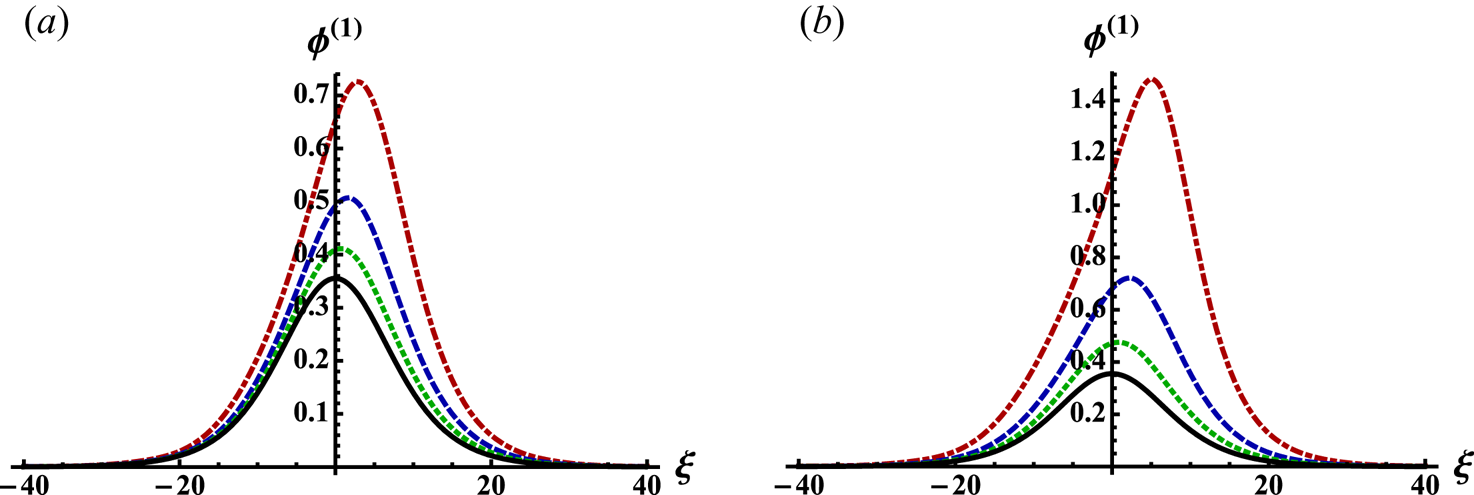
 $\tau$. We have obtained the direct numerical solutions of (3.13) using this initial pulse, and using typical plasma parameters corresponding to hot white dwarfs, e.g. DQ white dwarfs (Dufour et al. Reference Dufour, Fontaine, Liebert, Schmidt and Behara2008, Reference Dufour, Béland, Fontaine, Chayer and Bergeron2011; Koester et al. Reference Koester, Kepler and Irwin2020), white dwarf H1504+65 (Werner & Rauch Reference Werner and Rauch2015), white dwarf PG 0948+534 (Werner et al. Reference Werner, Rauch and Reindl2019), etc. The direct numerical solutions of (3.13) are displayed in figure 4.
The effects of cylindrical (a) and spherical (b) geometries on the DPD NA SWs for  $\gamma =5/3$,
 ${\mathcal {U}}_0=0.1$,
 $\mu =0.3$,
 ${\mathcal {U}}_0=0.1$,
 $\sigma _e=10$,
 $\sigma _l=20$,
 $\beta =0.1$,
 $\sigma _{Tl}=0.01$,
 $\sigma _{Te}=0.02$,
 $\tau =-20$ (solid curves),
 $\tau =-15$ (dotted curves),
 $\tau =-10$ (dot-dashed curves) and
 $\tau =-5$ (dashed curves).

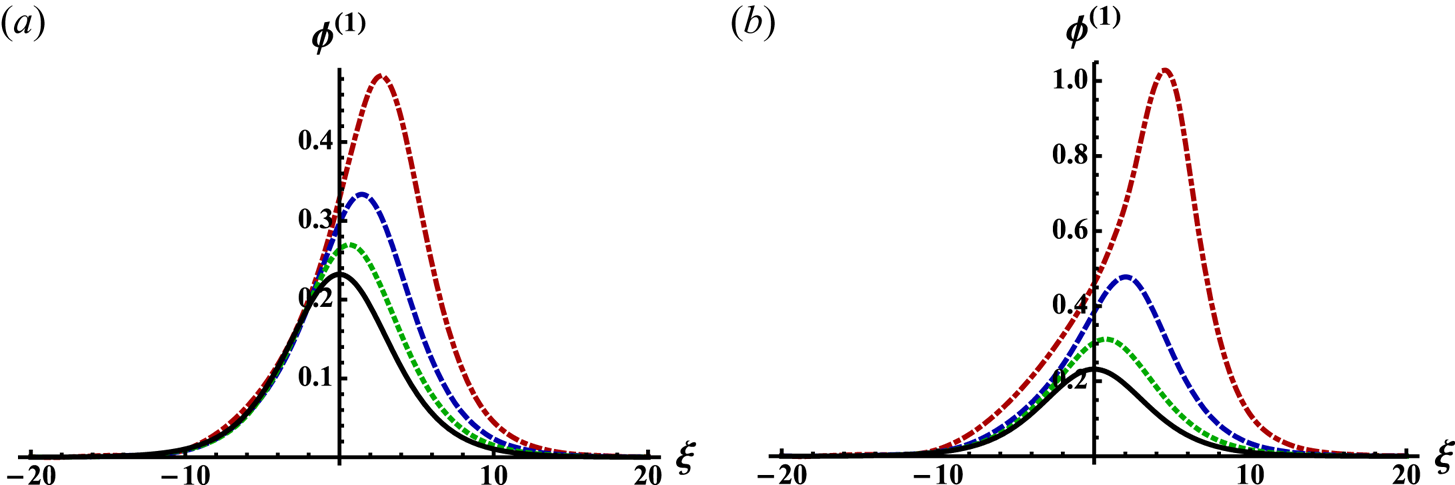
We have also found the direct numerical solutions of (3.13) using the initial pulse represented by (3.19). The direct numerical solutions of (3.13) are displayed in figure 5. The direct numerical solutions of (3.13), which are displayed in figures 4 and 5, clearly indicate that for a large value of  $\tau$ (e.g.
 $\tau =-20$) the spherical and cylindrical thermally DPD NA SWs are similar to the 1-D planar ones. This is because the time- and geometry-dependent extra term
 $(\nu /2\tau )\phi ^{(1)}$ in (3.13) has become insignificant. However, as the value of
 $\tau$ decreases, the term
 $(\nu /2\tau )\phi ^{(1)}$ becomes significant, and both the spherical and cylindrical SWs differ from the 1-D planar ones.
The effects of cylindrical (a) and spherical (b) geometries on the DPD NA SWs for  $\gamma =4/3$,
 ${\mathcal {U}}_0=0.1$,
 $\mu =0.3$,
 ${\mathcal {U}}_0=0.1$,
 $\sigma _e=0.1$,
 $\sigma _l=20$,
 $\beta =0.1$,
 $\sigma _{Tl}=0.01$,
 $\sigma _{Te}=0.02$,
 $\tau =-20$ (solid curves),
 $\tau =-15$ (dotted curves),
 $\tau =-10$ (dot-dashed curves) and
 $\tau =-5$ (dashed curves).

4. Discussion
The WDP model (based on a system containing warm non-relativistically and ultra-relativistically degenerate electron species, warm non-relativistically degenerate light nucleus species and low-density stationary heavy nucleus species) has been considered to study DPD NA SWs in 1-D planar geometry as well as in cylindrical and spherical geometries. The basic features of these DPD NA SWs in such a plasma system have been investigated using the reductive perturbation method (Washimi & Taniuti Reference Washimi and Taniuti1966; Mamun & Shukla Reference Mamun and Shukla2002; Sahu & Roychoudhury Reference Sahu and Roychoudhury2007), which is valid for small- but finite-amplitude DPD NA SWs. The results that have been obtained from these theoretical and numerical investigations can be summarized as follows:
(i) The presence of stationary heavy nucleus species in an electron–nucleus plasma supports the existence of supersonic DPD NA SWs with
$\phi >0$ in both planar and non-planar geometries because of the effect of degeneracy and temperature.(ii) The amplitude (width) of the DPD NA SWs increases (decreases) with an increase of the number density of the heavy nucleus species in both planar and non-planar geometries. This is because of the decrease in the DPD NA wave phase speed with an increase of the stationary heavy nucleus number density.
(iii) The amplitude (width) of the DPD NA SWs decreases (increases) with an increase of temperature of the electron and light nucleus species in both planar and non-planar geometries. This is due to the fact that the temperature of the light electron and light nucleus species enhances the random motion of the electron and light nucleus species, which causes a decrease (increase) in the amplitude (width) of the DPD NA solitary structures in any geometry under consideration.
(iv) The amplitude of the DPD NA SWs for ultra-relativistically degenerate electron species is smaller than that for non-relativistically degenerate electron species. On the other hand, their width for non-relativistically degenerate electron species is larger than that for ultra-relativistically degenerate electron species. This is due to the fact that the amplitude (width) of the SWs increases (decreases) as the value of
$\gamma$ increases.(v) The amplitude of cylindrical and spherical DPD NA SWs increases as the value of
$\tau$ decreases for both degenerate and non-degenerate plasmas. The amplitude of cylindrical DPD NA SWs is larger than that of 1-D planar ones, but smaller than that of spherical ones. This is due to the time- and geometry-dependent extra term $(\nu /2\tau )\phi ^{(1)}$ in the MK-dV equation.


There are many hot white dwarfs (Dufour et al. Reference Dufour, Fontaine, Liebert, Schmidt and Behara2008, Reference Dufour, Béland, Fontaine, Chayer and Bergeron2011; Werner & Rauch Reference Werner and Rauch2015; Werner et al. Reference Werner, Rauch and Reindl2019; Koester et al. Reference Koester, Kepler and Irwin2020) where the electron thermal pressure can be comparable to or greater than the degenerate pressure, and where in addition to non- or ultra-relativistically degenerate electron species (Chandrasekhar Reference Chandrasekhar1931a,Reference Chandrasekharb, Reference Chandrasekhar1936; Horn Reference Horn1991) and non-relativistically degenerate light nucleus species (i.e.  ${}^{1}_{1}\textrm{H}$ (Chandrasekhar Reference Chandrasekhar1931a, Reference Chandrasekhar1936) or
 ${}^{4}_{2}\textrm{He}$ (Horn Reference Horn1991) or
 ${}^{12}_{~6}\textrm{C}$ (Koester Reference Koester2002)), stationary heavy nucleus species (i.e.
 ${}^{56}_{ 26}\textrm{Fe}$ (Vanderburg et al. Reference Vanderburg, Johnson, Rappaport, Bieryla, Irwin, Lewis, Kipping, Brown, Dufour and Ciardi2015) or
 ${}^{85}_{ 37}\textrm{Rb}$ (Witze Reference Witze2014) or
 ${}^{96}_{42}\textrm{Mo}$ (Witze Reference Witze2014)) are also present.
The WDP model of our present consideration is so general that it is applicable not only to cold astrophysical compact objects, but also to hot white dwarfs (Dufour et al. Reference Dufour, Fontaine, Liebert, Schmidt and Behara2008, Reference Dufour, Béland, Fontaine, Chayer and Bergeron2011; Werner & Rauch Reference Werner and Rauch2015; Werner et al. Reference Werner, Rauch and Reindl2019; Koester et al. Reference Koester, Kepler and Irwin2020).
The limitation of the reductive perturbation method (Washimi & Taniuti Reference Washimi and Taniuti1966) used here is that it is not valid for arbitrary- or large-amplitude DPD NA SWs. The arbitrary-amplitude SWs in different plasma situations, such as electron–ion plasma with negatively charged impurity (Popel & Yu Reference Popel and Yu1995), electron–positron plasma with two distinct groups of positrons (Srinivas, Popel & Shukla Reference Srinivas, Popel and Shukla1996), etc., have been studied using the pseudo-potential approach (Bernstein, Greene & Kruskal Reference Bernstein, Greene and Kruskal1957; Sagdeev Reference Sagdeev1966). The pseudo-potential approach is valid for arbitrary- or large-amplitude SWs, but it does not allow us to observe their time evolution. To overcome the limitations of the reductive perturbation (Washimi & Taniuti Reference Washimi and Taniuti1966) and pseudo-potential (Bernstein et al. Reference Bernstein, Greene and Kruskal1957; Sagdeev Reference Sagdeev1966) methods, we have to develop a correct numerical code, and to solve (2.3)–(2.5) with (2.2) numerically using the numerical code to be developed. This type of numerical analysis will be able to show the time evolution of arbitrary- or large-amplitude DPD NA SWs. This is a challenging research problem of great importance, but beyond the scope of our present work. However, we hope that our present work will be helpful in understanding the physics of localized electrostatic disturbances in astrophysical compact objects like hot white dwarfs, e.g. DQ white dwarfs (Dufour et al. Reference Dufour, Fontaine, Liebert, Schmidt and Behara2008, Reference Dufour, Béland, Fontaine, Chayer and Bergeron2011; Koester et al. Reference Koester, Kepler and Irwin2020), white dwarf H1504+65 (Werner & Rauch Reference Werner and Rauch2015), white dwarf PG 0948+534 (Werner et al. Reference Werner, Rauch and Reindl2019), etc.
Acknowledgements
The invaluable suggestions of both anonymous reviewers, which have significantly improved the quality of the work, are gratefully acknowledged.
Editor Luís O. Silva thanks the referees for their advice in evaluating this article.
Declaration of interests
The authors report no conflict of interest.