Introduction
Ventilator-associated tracheitis (VAT) is an infectious tracheobronchitis in patients with endotracheal tubes (ETT) or tracheostomies. Reference Tomatis-Souverbielle, Lyman, Thomas, May and Erdem1–Reference Simpson, Bailey, Higgerson and Christie4 It is a prevalent infection in the pediatric intensive care unit (PICU). Reference Simpson, Bailey, Higgerson and Christie4–Reference Mhanna, Elsheikh and Super7 For patients with chronic tracheostomy dependence, it is a significant reason for hospital admission. Reference Kun, Edwards, Ward and Keens8,Reference Russell, Simon, Mamey, Newth and Neely9
Despite how often VAT is treated, several outstanding issues remain with its diagnosis and management. Chief among these is the absence of a clearly accepted definition. Most definitions include: (1) the presence of purulent secretions; (2) systemic signs such as fever or leukocytosis; and (3) an endotracheal aspirate culture (EAC) with microscopic purulence and significant bacterial growth, in the absence of radiographic pneumonia. Reference Gipsman, Prero, Toltzis and Craven10–Reference Morrison, Hassan, Kysh, Dudas and Russell12 Additionally, surveys of clinical practice reveal that cultures are often obtained based on nonspecific signs such as fever or secretion changes, symptoms that are not reliably predictive of infection. Reference Willson, Kirby and Kicker13–Reference Chiotos, Marshall and Kellom15 This is problematic as growth of bacteria on culture is frequently interpreted as infection, despite the frequency of bacterial colonization in an artificial airway, Reference Venkatachalam, Hendley and Willson16,Reference Willson, Conaway, Kelly and Hendley17 leading to unnecessary antibiotic treatment. Reference Willson, Kirby and Kicker13,Reference Prinzi, Wattier and Curtis18–Reference Chiotos, Blumenthal and Boguniewicz22 Biofilms form rapidly on artificial airways, leading to the frequent presence of bacteria and immune cells on culture and Gram stains, complicating the ability of diagnostic tools to distinguish colonization from true infection. Reference Venkatachalam, Hendley and Willson16,Reference Willson, Conaway, Kelly and Hendley17,Reference Yalamanchi, Saiman and Zachariah23 Furthermore, there is a lack of consensus regarding the management of VAT, including whether antibiotic treatment is necessary, Reference Kalil, Metersky and Klompas24,Reference Koulenti, Arvaniti and Judd25 and when prescribed, the optimal antibiotic duration, Reference Tamma, Turnbull, Milstone, Lehmann, Sydnor and Cosgrove26–Reference Ormsby, Conrad and Blumenthal28 and route of administration. Reference Gipsman, Prero, Toltzis and Craven10
In response to this diagnostic uncertainty and treatment variability, several pediatric institutions have successfully implemented initiatives that rely on diagnostic and antibiotic stewardship principles to reduce unnecessary testing and antibiotic use. Reference Ormsby, Conrad and Blumenthal28–Reference Chiotos, Lee and Sydney31 This has included efforts to standardize the indications for obtaining a culture, Reference Ormsby, Conrad and Blumenthal28,Reference Sick-Samuels, Linz and Bergmann30,Reference Chiotos, Lee and Sydney31 reduce serially repeated cultures, Reference Ormsby, Conrad and Blumenthal28,Reference Sick-Samuels, Linz and Bergmann30,Reference Feldman, Shah and Ahn32,Reference Sick-Samuels, Kelly and Woods-Hill33 and shorten antibiotic duration for diagnosed VAT. Reference Martin-Loeches, Povoa and Rodríguez3,Reference Willson, Hoot and Khemani20,Reference Ormsby, Conrad and Blumenthal28,Reference Ingolfsland, Gonzalez-Villamizar and Moore29 Further, a consensus guideline supported by professional societies has been created to standardize and optimize EAC practices in children with artificial airways suspected of having a respiratory infection. Reference Sick-Samuels, Kelly and Woods-Hill33
Our goal was to revise and implement a clinical decision-support tool to reduce VAT-related diagnostic testing, and to reduce antibiotic duration when diagnosed. Specifically, we aimed to: (1) decrease overall EAC collection by 20% and (2) decrease antibiotic days of therapy (DOT) for VAT by 20%, both over a 14-month period.
Methods
Context
This manuscript was prepared in accordance with the SQUIRE 2.0 (Standards for QUality Improvement Reporting Excellence) guidelines. Reference Ogrinc, Davies, Goodman, Batalden, Davidoff and Stevens34
Key stakeholders for this initiative included critical care, pharmacy, infectious diseases, pulmonology, emergency medicine, as well as the antimicrobial stewardship team. Our PICU is a 37-bed unit that manages medical/surgical, postsurgical cardiothoracic, and neurosurgical patients; patients who have undergone bone marrow and kidney transplantation; and those that require continuous renal replacement therapy and extracorporeal membrane oxygenation. The PICU team includes pediatric intensivists, fellows in pediatric critical care and emergency medicine, pediatric and emergency medicine residents, nurse practitioners, clinical pharmacists, registered nurses, respiratory therapists, dieticians, and students. At the time of study implementation, there were over 2,600 annual admissions to the PICU.
The patient population targeted by this initiative consisted of non-neonatal patients with an artificial airway, ETT or tracheostomy, and a concern for VAT. While patients with tracheostomies are at times excluded when studying VAT in patients with ETTs, Reference Tamma, Turnbull, Milstone, Lehmann, Sydnor and Cosgrove26,Reference Ingolfsland, Gonzalez-Villamizar and Moore29 we chose to have an applicable intervention for all patients with an artificial airway. Reference Ormsby, Conrad and Blumenthal28,Reference Sick-Samuels, Linz and Bergmann30
Prior to this project, a VAT clinical decision-support tool was in place featuring standardized indications for obtaining a culture, a recommendation of a 5-day duration for antibiotic treatment, and guidance on how to interpret Gram stain results and choose the appropriate antibiotic. There was no clear data that practices were being followed.
Interventions
We identified three specific areas for improvement based on a multidisciplinary review of local practice and emerging literature: (1) standardization of recommendations for EAC collection; (2) diagnostic criteria for VAT; and (3) recommendations for antibiotic treatment. There was also an impetus to gain systemwide consensus on care. We therefore created a multidisciplinary improvement team in July 2022 involving one pediatric intensivist, one pediatric critical care medicine fellow, two pediatric infectious disease specialists, one pediatric pulmonologist, and two clinical pharmacists. We conducted a literature search and collected clinical decision-support tools from institutions across the country to inform our understanding of existing practices and to identify strategies that could be adapted and integrated into our own institutional framework (Supplemental Table 1).
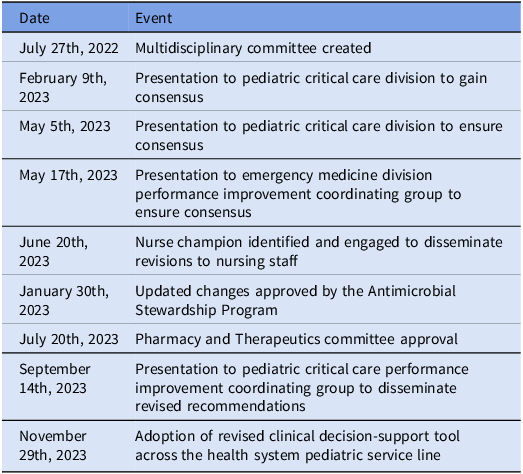
We performed a series of Plan-Do-Study-Act (PDSA) cycles to achieve our objectives. A summary of key dates is listed in Table 1. Our first PDSA cycle aimed to achieve consensus through committee member meetings with key stakeholders between February and September 2023; proposed changes were presented to the inpatient clinical team. Our second PDSA cycle in June 2023 identified a PICU nurse “champion” and communicated availability to other nurses for education and questions regarding the improvement effort. Both cycles were meant to solicit feedback, build consensus, and inform iterative refinement of the intervention. Our third PDSA cycle involved the revision of the existing clinical decision-support tool, followed by approval and health systemwide implementation in November 2023 (Figure 1). The tool was shared by email to key stakeholders, posted in the PICU, and shared with the health system internal website.
Key dates

Table 1. Long description
A table titled ‘Key dates’ with two columns and ten rows. The columns are labeled ‘Date’ and ‘Event’. The rows list specific dates and corresponding events as follows: Row 1: Date, July 27th, 2022; Event, Multidisciplinary committee created. Row 2: Date, February 9th, 2023; Event, Presentation to pediatric critical care division to gain consensus. Row 3: Date, May 5th, 2023; Event, Presentation to pediatric critical care division to ensure consensus. Row 4: Date, May 17th, 2023; Event, Presentation to emergency medicine division performance improvement coordinating group to ensure consensus. Row 5: Date, June 20th, 2023; Event, Nurse champion identified and engaged to disseminate revisions to nursing staff. Row 6: Date, January 30th, 2023; Event, Updated changes approved by the Antimicrobial Stewardship Program. Row 7: Date, July 20th, 2023; Event, Pharmacy and Therapeutics committee approval. Row 8: Date, September 14th, 2023; Event, Presentation to pediatric critical care performance improvement coordinating group to disseminate revised recommendations. Row 9: Date, November 29th, 2023; Event, Adoption of revised clinical decision-support tool across the health system pediatric service line.
Revised clinical decision-support tool. WBC, white blood cell; PIP, peak inspiratory pressure; PEEP, positive end expiratory pressure; FiO2, fraction of inspired oxygen; PMN, polymorphonuclear neutrophil; ESBL, extended spectrum beta-lactamase; TMP-SMX, trimethoprim-sulfamethoxazole.

Revisions were informed by recently published evidence, review of existing institutional frameworks (Supplemental Table 1), and expert consensus among committee members. Key revisions included recommendations against repeating an EAC within 72 hours of a prior collection, implementation of standardized clinical criteria for VAT diagnosis, incorporation of a simplified Gram stain and culture interpretation support table, Reference Craven, Hudcova and Lei35 and recommendation of a 3-day antibiotic treatment duration for uncomplicated cases. We created a novel definition of VAT that emphasized the necessary presence of both respiratory and systemic signs of infection.
Study Population
Patients admitted to the PICU who had an inpatient EAC performed between January 2022 and February 2025 were included in the analysis. Only cultures sent for patients admitted to the PICU were included, including those acquired elsewhere in the hospital (ie, the emergency department prior to physical transfer). Cultures obtained from other hospitals or as an outpatient were not included. Cultures obtained by bronchoalveolar lavage or intended for cystic fibrosis-specific evaluation were excluded. Data were collected from the electronic medical record. There were two team members who reviewed charts (E.F., J.H.) for a diagnosis of VAT. At time of culture retrieval, the presence of pneumonia on clinician documentation and/or radiographically diagnosed pneumonia led to exclusion of these cases for VAT related measures.
Measures
From a diagnostic stewardship perspective, we aimed to decrease EAC use. To assess this, we tracked the number of EACs sent per 100 ETT/tracheostomy days. We also aimed to decrease the rate of monthly serially repeated cultures per 100 ETT/tracheostomy days, which was defined as the number of cultures repeated within 72 hours for the same patient divided by the total number of cultures sent.
From an antimicrobial stewardship perspective, we aimed to decrease antibiotic usage for VAT. To assess this, we tracked DOT for VAT per 100 ETT/tracheostomy days. We defined this as the administration of antibiotics for patients with an ETT or tracheostomy with clinician documentation of VAT diagnosis. Patients who met diagnostic criteria, but did not receive antibiotics, were not included for the purposes of analyzing antibiotic utilization. Antimicrobials used for other purposes (ie, for pneumonia or non-respiratory infections) were not included in the DOT calculation. Antibiotics were counted starting on the day of initiation and included all consecutive antibiotic days until treatment completion. We tracked the monthly proportion of VAT episodes treated with 3 days of antibiotics, which was defined by the number of VAT episodes treated with a 3-day antibiotic duration divided by the total number of treated VAT episodes.
We tracked guideline-defined VAT diagnosis to assess adherence to the new diagnostic framework. Guideline-defined diagnosis met the appropriate clinical indications to obtain a culture, as outlined in Figure 1, and had a corresponding Gram stain with microscopic purulence and significant bacterial growth. The rate of guideline-defined VAT diagnosis was defined as number of episodes meeting this new framework divided by total number of episodes diagnosed, normalized by 100 ETT/tracheostomy days.
Balancing measures were based solely on data from the PICU. Ventilator-associated events were normalized per 1,000 ventilator days and ventilator days per 1,000 patient days. Mortality rate was defined as number of mortalities per 100 admissions. Average length of stay (LOS) was also included.
Cost savings were calculated based on the decrease in EACs sent to the microbiology laboratory. A charge of $20.00 per EAC included both the material and labor costs for Gram stain, culture, and antibiotic susceptibility testing. This, however, did not include savings related to nursing time to collect samples and a potential related reduction in antibiotic use.
Analysis
We used Shewhart control charts to provide a visual representation of process performance over time. U-charts were used to monitor the number of non-conformities per unit with a variable sample size; I-charts to monitor individual continuous data; and P-charts to monitor proportion of observations over time. Charts were created using Microsoft Excel. Centerlines were re-computed when 8 consecutive data points were above or below the mean. Control limits were set at 3 standard deviations above and below the mean. Cumulative data were analyzed using Microsoft Excel (Microsoft Corporation; Redmond, WA).
Ethical considerations
This initiative did not involve human subjects per the Northwell Institutional Review Board and therefore did not require further review (Human Subjects Research Determination Request 23-0193).
Results
Endotracheal aspirate culture utilization
A total of 1,072 cultures were sent during the study period, which originated from 376 unique patients. Cultures were collected in the PICU in 918 (86%) of cases, the remaining were acquired in the emergency department. Five hundred and fifty-eight (52%) grew at least one potentially pathogenic bacterial species (Supplemental Table 2); 326 (30%) resulted in normal respiratory flora and 188 (18%) resulted in no growth. The rate of guideline-defined VAT remained similar throughout the study period (Supplemental Figure 1).
Beginning in April 2024, the average monthly EAC use had a centerline shift downward (Figure 2), from 9.2 to cultures 7.1 per 100 ETT/tracheostomy days, which is a 23% reduction. The estimated cost avoidance during the 11 months following the reduction was $1,242.00, reflecting 62 fewer cultures sent than expected.
Endotracheal aspirate culture rate per 100 endotracheal tube/tracheostomy days. ETT, endotracheal tube; EAC, endotracheal aspirate culture; PDSA, plan-do-study-act; PDSA cycle 1, consensus creation; PDSA cycle 2, PICU nurse champion. PDSA cycle 3, tool adoption. U-chart tracking the frequency of endotracheal aspirate cultures sent, normalized to a rate per 100 ETT/tracheostomy days. Beginning in April 2024, 8 consecutive months fell below the initial centerline, leading to a centerline shift downward. There was a 23% reduction, from 9.2 EACs per 100 ETT/tracheostomy days to 7.1 per 100 ETT/tracheostomy days. This indicates a sustained reduction in the average rate of EACs being sent.

Beginning in December 2023, the average monthly rate of serial EACs sent had a centerline shift downward (Figure 3), from 1.5 to 0.7 cultures per 100 ETT/tracheostomy days, which is a 53% reduction in serial culture use. Of note, by the end of the study period, there were 4 months with no serially repeated cultures. The estimated cost avoidance in the 15 months following the reduction in serially repeated EACs was $709.00, reflecting 35 fewer EACs sent than expected.
Serially repeated endotracheal aspirate culture rate per 100 endotracheal tube/tracheostomy days. ETT, endotracheal tube; EAC, endotracheal aspirate culture; PDSA, plan-do-study-act. PDSA cycle 1, consensus creation. PDSA cycle 2, PICU nurse champion; PDSA cycle 3; tool adoption. U-chart tracking the frequency of serially repeated endotracheal aspirate cultures sent, normalized to a rate per 100 ETT/tracheostomy days. Beginning in December 2023, 8 consecutive months fell below the initial centerline, leading to a centerline shift downward. There was a 53% reduction, from 1.5 EACs per 100 ETT/tracheostomy days to 0.7 per 100 ETT/tracheostomy days. This indicates a sustained reduction in the average rate of serially repeated EACs being sent.

Antibiotic utilization
Two-hundred thirteen instances of VAT were diagnosed in 115 unique patients during the study period; all except one instance was treated with antibiotics. Pseudomonas aeruginosa, Serratia marcescens, and Stenotrophomonas maltophilia were the most common bacteria targeted for treatment (Supplemental Table 3).
Beginning in April 2024, the average monthly antibiotic DOT for VAT had a centerline shift downward (Figure 4), from 10.8 to 5.1 DOT per 100 ETT/tracheostomy days, which is a 53% reduction.
Antibiotic days of therapy for ventilator-associated tracheitis per 100 endotracheal/tracheostomy days. VAT = ventilator-associated tracheitis. ETT, endotracheal tube; DOT, days of therapy; PDSA, plan-do-study-act; PDSA cycle 1, consensus creation; PDSA cycle 2, PICU nurse champion; PDSA cycle 3, tool adoption. U-chart tracking antibiotic DOT for VAT, normalized to a rate per 100 ETT/tracheostomy days. Beginning in April 2024, 8 consecutive months fell below the initial centerline, leading to a centerline shift downward. There was a 53% reduction, from 10.8 DOT per 100 ETT/tracheostomy days to 5.1 per 100 ETT/tracheostomy days. This indicates a sustained reduction in the average rate of antibiotic DOT for VAT. Of note, there were no antibiotic days for VAT in May 2024, resulting in a break in the plotted line for that month.

Beginning in May 2023, the proportion of VAT treated with antibiotics for 3 days had a centerline shift upward (Figure 5), from 5 to 65%.
Proportion of 3-day antibiotic courses for ventilator-associated tracheitis. VAT, ventilator-associated tracheitis; PDSA, plan-do-study-act; PDSA cycle 1, consensus creation. PDSA cycle 2, PICU nurse champion. PDSA cycle 3, tool adoption. P-chart tracking the proportion of VAT treated for 3 days. Beginning in May 2023, with numerous out-of-control points and more than 8 consecutive months above the centerline, there was a centerline shift upwards. The average proportion of VAT episodes treated with a 3-day antibiotic course increased from 5% to 65%, representing a 60-percentage-point increase and a 13-fold relative increase.

Balancing measures
Balancing measures between the pre- and postintervention periods showed no difference in PICU mortality rate, rate of VAEs, ventilator days, and LOS (Supplemental Figure 2a–d).
Discussion
A tertiary-care PICU quality improvement initiative aimed to optimize the diagnosis and management of VAT through the implementation of an updated, standardized clinician decision-support tool. Our key findings demonstrate that revising the guidelines to discourage serial culture use, emphasize stricter clinical and microbiologic criteria, and reduce treatment antibiotic duration to 3 days, led to a 23% reduction in EAC use and a 53% reduction in antibiotic DOT for VAT. Importantly, this initiative had no negative impacts.
Antibiotic utilization for VAT markedly decreased, aligning with our primary aim. This may be attributed to several factors: decreased culture use may have led to fewer opportunities to mistake colonization for infection; Reference Willson, Kirby and Kicker13,Reference Willson, Hoot and Khemani20–Reference Chiotos, Blumenthal and Boguniewicz22 stricter criteria for diagnosis may have reduced the number of VAT needed to be treated; Reference Sick-Samuels, Linz and Bergmann30 and shortened antibiotic treatment duration directly reduced antibiotic utilization. However, given the modest decline in culture utilization and the stable rate of guideline-defined VAT, the primary driver of reduced antibiotic use was most likely the significant acceptance of a shorter treatment duration. This suggests antibiotic utilization can be reduced without fundamental altering clinicians’ diagnostic approach. The reduction of antibiotic duration to 3 days of treatment was without any change in balancing measures, which also demonstrates the safety of short antibiotic courses for this condition. Reference Ormsby, Conrad and Blumenthal28 A reduction in antibiotic use, particularly in patients with tracheostomies, is crucial as antibiotic overuse is linked to the growth of multidrug-resistant organisms, Reference Tamma, Turnbull, Milstone, Lehmann, Sydnor and Cosgrove26,Reference Havens, Rosen and Rivera-Spoljaric36 which carries negative consequences for this population. Reference Havens, Rosen and Rivera-Spoljaric36–Reference Tedja, Nowacki and Fraser38
The impact on EAC utilization, while present, was more modest. EACs are obtained for various reasons many unrelated to VAT, such as pneumonia, or for nonspecific clinical changes, such as fever alone. Reference Sick-Samuels, Fackler, Berenholtz and Milstone14 Thus, the utility of using culture use as a metric specific to VAT-related practices may be limited. This also likely reflects ongoing reliance on cultures for increased diagnostic certainty. Our unit, however, achieved a 53% reduction in serial culture use, suggesting that clinician diagnostic behavior can be influenced by targeted guidance.
Like the initiatives described prior, Reference Ormsby, Conrad and Blumenthal28–Reference Sick-Samuels, Linz and Bergmann30 our intervention relied on a combination of clinician decision-support tools and educational strategies to align practices with current evidence. Our results, also featured a reduction in culture and antibiotic use. Our more modest decrease in culture use may be the result of unit specific differences in baseline practice or amenability to change, or resources available to help influence change. Our estimated cost savings were lower than those reported in prior studies, Reference Ingolfsland, Gonzalez-Villamizar and Moore29,Reference Sick-Samuels, Linz and Bergmann30 likely reflecting differences in cost-estimation methods, lower institutional culture charges, and a more modest reduction in culture utilization. Additionally, we relied on a different definition of VAT that required both respiratory related signs or symptoms, and systemic signs of infection. Our definition did not anchor on the need for the presence of increased secretions, as the other studies did; we considered secretion quantity to be too subjective to be the sole clinical criterion. Reference Sick-Samuels, Kelly and Woods-Hill33 The microbiologic factors that must be present in our definition for VAT diagnosis also included substantial bacterial presence on Gram stain, which differed from other definitions. Overall, our results are consistent with these institutional reports emphasizing guideline-based approaches to VAT management, and align well recent expert consensus recommendations that make use of a paradigm recommending systemic and respiratory signs of infection to both be present for EAC collection. Reference Sick-Samuels, Kelly and Woods-Hill33
There are limitations to our initiative. First, the retrospective nature of the analysis may introduce bias, particularly in classifying episodes of VAT where documentation may be ambiguous. Second, the generalizability of our findings may be limited by the existence of a preexisting VAT clinical decision-support tool, which may have fostered institutional buy-in before implementation of the revisions, in addition to the established stewardship resources that supported this initiative. Third, unmeasured changes in the patient population during the post COVID-19 recovery period may have influenced results. Fourth, it was impractical to track the indications for culture collection, which would be informative as to why clinicians continue to acquire them despite the implementation of stricter criteria.
This initiative demonstrates that the implementation of an updated clinical decision-support tool for VAT in critically ill pediatric patients can lead to both reductions in EAC and antibiotic utilization without adverse effects on patient safety. Our results highlight the feasibility and safety of stewardship-based approaches in PICU settings. The success of this initiative underscores the importance of multidisciplinary collaboration and of ongoing assessment of practices to incorporate the latest evidence. The initiative demonstrated sustainability through integration of the revised clinical decision-support tool into routine practice and ongoing reinforcement via nursing and provider education. Opportunities for spread include adaptation of the clinical decision-support tool to other units or facilities with high rates of tracheostomy use or the NICU with appropriately modified criteria. Future work may incorporate the use of the electronic medical record to further support adherence, recent expert consensus recommendations on EAC collection to further reduce unnecessary culture use, and emerging biomarker data to better distinguish colonization from infection.
Supplementary material
The supplementary material for this article can be found at https://doi.org/10.1017/ice.2026.10522.
Acknowledgements
We acknowledge Diane Song, PharmD, and Maria Teresa Santiago, MD as part of the committee responsible for the creation of the revisions.
Financial support
None reported.
Competing interests
All authors report no conflicts of interest relevant to this article.