INTRODUCTION
In today’s competitive and complex environment, managing human capital is necessary to sustain competitive advantage (Mendenhall, Reiche, Bird, & Osland, 2012). Past research suggests that human capital (also called intellectual capital or human talent), embedded within high-performance work systems (HPWS), creates value for firms (Becker & Huselid, Reference Becker and Huselid1998). From a resource-based perspective, value is created when a firm is able to either decrease product/service costs or alternatively charge a premium price through product differentiation, or some combination of both (Barney, Wright, & Ketchen, Reference Barney and Wright2001). These outcomes are key determinants of performance and enable firms to achieve sustained competitive advantage. One of the key source of competitive advantage is human capital, and HPWS helps create and sustain the human capital advantage (Snell, Morris, & Bohlander, Reference Song, Almeida and Wu2016). Research has increasingly focused on the value of human capital at both micro- and macrolevels (Mahoney & Pandian, 1992; Bell & Kozlowski, Reference Bell and Kozlowski2008; Wright & McMahan, Reference Wright and McMahan2011) and scholars have called for developing a better understanding of the microdynamics of human capital advantages (Coff & Kryscynski, Reference Coff and Kryscynski2011).
While past research has taken a firm-centric view, due to rapid changes in stocks and flows of human capital in the environment firms are increasingly facing skills shortage. The first research question posed here, then, is – do skills shortages lower firm profitability? Furthermore, do HPWS allow firms to mitigate negative relationships between HPWS and profitability? Skills shortage, being defined as a situation when a firm’s existing employees do not have the skills needed to do their job effectively (Green & Ashton, Reference Gordon1992), has become increasingly challenging for firms and could directly affect firm performance. Macroeconomically, skills shortages are on the rise globally, which have created substantial difficulties for firms in recruiting skilled employees in a wide variety of functional areas such as sales, engineering, accounting and finance, management, IT, and production, among others (ManpowerGroup, Reference Manroop2015). Skills shortages, therefore, remain a significant challenge for firms, and the absence of key skills could lower firm performance.
Drivers of skills shortage include increased employee mobility, changing workforce demographics (such as the looming retirement of baby boomers and the relatively small ‘baby bust’ cohort born in the 1970s), and the shortening of life cycles of jobs due to rapid technological advancement, among others (Beechler & Woodward, Reference Beechler and Woodward2009; Vaiman, Scullion, & Collings, Reference Vaiman, Scullion and Collings2012). Increasing concerns about imminent skills shortage call for a closer examination of strategies to lower its impact on firm performance. While traditional human resource (HR) frameworks have focused on developing and managing HR practices around existing skills, there is a paucity of research looking at how firms address talent/skills shortages (Briscoe, Schuler, & Claus, Reference Briscoe, Schuler and Claus2009; Gordon, Reference Guthrie2009). Specifically, little is known, both conceptually and empirically, about the impact of HPWS during skills shortages on firm performance. A goal of this study is to close this gap in the literature by empirically investigating whether firms can improve and sustain their performance by managing their HRs in the midst of skills shortages.
Our research offers theoretical and practical contributions to the literature. Theoretically, first, we introduce HPWS, an important yet hitherto unexplored contextual variable, that can influence the effects of skills shortages on firm performance. HPWS positively impact employee outcomes (e.g., employee skills, abilities, motivation, improved social relationships, and labor productivity and turnover), which in turn positively impact firm performance (i.e., productivity and profitability). In doing so, we explored the interaction effect of HPWS and skills shortages to determine whether the benefits they produce exceed the cost of implementing HPWS when firms face skills shortages. In addition, understanding the processes through which HPWS impact firm performance when firms face skills shortage not only advances Strategic Human Resource Management (SHRM) theory, but will also help practitioners justify whether or not to invest in HPWS in the face of skills shortages (cf. Combs, Liu, Hall, & Ketchen, Reference Combs, Liu, Hall and Ketchen2006).
As a second theoretical contribution, we aim to explain whether HPWS allow organizations to buffer against skills shortage. HR-related systems, practices and tools aim to improve and sustain performance; however, under skills shortage these systems and practices are stretched and their performance restrained due to limited skills available to execute tasks. Whether HPWS are an important mechanism that allow organizations to capitalize on their existing HRs when facing labor shortages helps understand the resilience of HPWS in face of skills shortages. As a combination of selection, recruitment, training, compensation and benefits, and career development, HPWS could help firms provide cushions to and bootstrap with limited human capital under skills shortage (Huselid, Reference Jackson and Schuler1995; Pfeffer, Reference Pitt-Catsouphes and Steven1998). Research has increasingly examined mechanisms through which HPWS impact firm performance (e.g., Datta, Guthrie, & Wright, Reference Delaney and Huselid2005; Collins & Smith, Reference Collins and Smith2006; Macky & Boxall, Reference Macky and Boxall2007; García-Chas, Neira-Fontela, & Castro-Casal, Reference Gephart, Marsick, Van Buren and Spiro2014; Jiang & Liu, Reference Kaufman and Miller2015), and considering its value in the face of skills shortage adds another dimension to our understanding of the value of HPWS.
From a practical standpoint, skills shortage is a critical challenge faced by firms. As such, understanding how firms manage skills shortage is important for managers. McKinsey & Co in its ‘War for Talent’ study (Chambers, Foulon, Handfield-Jones, Hankin, & Michaels, Reference Chambers, Foulon, Handfield-Jones, Hankin and Michaels1998) cautioned US companies about the imminent labor shortages. A number of studies and research reports have highlighted the issue of talent shortages and suggest that organizations take steps to manage talent effectively to cope with potential talent deficiencies (Cappelli, Reference Cappelli2014). For instance, the US Chamber of Commerce predicted that the ‘impending retirement of the baby boomers cohort would lead to an absolute decline in the size of the labor force and a severe worker shortage’ (Reference Cooke2006: 13). Similarly, a talent report within the manufacturing industry published by Deloitte (Reference Dess and Robinson2011) drew attention to the severe shortage of qualified workers in that sector and how it could adversely affect critical functions such as new product development, new technology implementation and the achievement of performance targets. Likewise, McKinsey Global Institute (Reference Mendenhall, Reiche, Bird and Osland2012) cautioned against a potential shortage of about 38–40 million high-skilled workers across the developed economies by 2020.
Similarly, Michaels, Handfield-Jones, and Axelrod warned that skills shortages can pose a serious threat to organizations because ‘a complex economy demands more sophisticated talent with global acumen, multi-cultural fluency, technological literacy, entrepreneurial skills, and the ability to manage increasingly de-layered, disaggregated organizations’ (Reference Miller, Washburn and Glick2001: 1). The lack of these skills could be detrimental for firms in a fiercely competitive environment. Even during a recession, which is associated with a high unemployment rate, firms will still face skills shortages due to a lack of qualified candidates available in the labor market (Gordon, Reference Guthrie2009). This trend is expected to grow as firms in advanced economies face a shortage of highly skilled labor, whereas low- or moderately skilled employees will be in surplus (McKinsey Global Institute, Reference Mendenhall, Reiche, Bird and Osland2012). This study focuses on internal skills shortage, and not on labor shortages in the external labor market. However, the impact that external labor shortages has on a firm’s internal skills shortage is significant. Overall, the findings are both theoretically and practically relevant. By assessing the value of HPWS in face of skills shortages, we aim to understand how HPWS, a widely studied employee practice, help address an emerging challenge of skills shortage.
SKILLS SHORTAGES AND FIRM PERFORMANCE
Resource-based view (RBV) of the firm
The RBV is a meaningful lens to explore skills shortages in a firm. The RBV of the firm suggests that an organization can gain a sustainable competitive advantage over others on the basis of how it uses its resources (Barney, Wright, & Ketchen, Reference Barney and Wright2001; Nason & Wiklund, Reference Nishii, Lepak and Schneider2015). A firm can achieve a competitive advantage insofar as the resources it possesses satisfy the following characteristics: They are: (i) valuable, that is, the degree to which resources allow a firm to outperform competitors; (ii) rare, that is, resources must not be easily and readily available to competitors; (iii) inimitable, that is, competitors must find it very difficult to imitate/copy resources, implying that resources are socially complex and immobile, and therefore, unique only to a particular firm; and (iv) nonsubstitutable, that is, there is no alternative or replacement to resources (Barney, Reference Barney1991). The lack of substitutability is crucial because even if the resource is rare, valuable and inimitable, if other competitors can counter the firm’s value-creating strategy by offering various substitutes, then the profit margins will shrink due to the competition, and the resource can no longer be a source of competitive advantage to the firm (Barney, Reference Barney1991).
Scholars have highlighted various tangible and intangible resources as sources of competitive advantage for firms. Tangible resources include physical capital (e.g., plant, equipment, finances), while intangible resources include human capital (e.g., skills, knowledge judgment), and organizational capital (e.g., structure, monitoring) (Jackson & Schuler, Reference Jiang and Liu1995; Evans & Davis, 2005). Other scholars have also highlighted various intangible resources such as organizational culture, learning and ethics as potential sources of competitive advantage (Fiol & Lyles Reference García-Chas, Neira-Fontela and Castro-Casal1985, Barney, Reference Barney1991, Manroop, 2015). The underlying argument is that these resources are knowledge based and socially complex, and lead to ‘causal ambiguity,’ which is a case when the actual source of competitive advantage is not known as these resources are idiosyncratic to the firm which possesses them.
When a firm possesses human capital in terms of the required skills needed to perform jobs, organizational performance is greater. However, when a firm lacks essential skills to meet strategic objectives at different hierarchical levels, its performance is hindered. Empirical evidence suggests that skills shortages can have a detrimental effect on a firm’s productivity level (Bennett & McGuinness, Reference Bennett and McGuinness2009; Cappelli, Reference Cappelli2014). Haskel and Martin (1993) mentioned that the increased skills shortages during the mid-1980s reduced industry productivity growth by around 0.7% per annum. In a later study, Bennett and McGuinness (Reference Bennett and McGuinness2009) examined the impact of skills shortages (being measured in terms of hard-to-fill and unfilled vacancies) on the performance of high-tech firms and found that both hard-to-fill and unfilled vacancies significantly impact firm performance. More specifically, the findings showed that high-performing firms were more likely to see skills shortages and the output level per worker was reduced by 65% in positions that were difficult to fill, and 75% in the case of vacant positions. These findings suggest that labor and skills shortages can disrupt the productivity gains of the top performing high-tech firms (Bennett & McGuinness, Reference Bennett and McGuinness2009).
Research has shown that skilled employees feel a greater sense of responsibility, are likely to be more confident, can take charge of organizational change and innovation, and are better able to deal with complexity (Morrison & Phelps, Reference Nason and Wiklund1999). Skilled employees offer more suggestions on how to improve processes and fill identified gaps (Song, Almeida, & Wu, Reference Subramony2003). On the one hand, research has shown that the availability of skilled employees accelerates research and development investment by enhancing innovation (individual creativity, organizational change and the acquisition of external knowledge) (Svetlik & Stavrou-Costea, Reference Takeuchi, Chen and Lepak2007; Piva & Vivarelli, Reference Posthuma, Campion, Masimova and Campion2009) and improving organizational performance (Arvanitis, Reference Arvanitis2005). On the other hand, information technology has also created more demand for high-skilled employees (Bresnahan, Brynjolfsson, & Hitt, Reference Bresnahan, Brynjolfsson and Hitt2002).
If skills shortages are not addressed, this can hinder achievement of the company’s strategic goals. It can also be argued that less-skilled employees are less likely to come up with creative ideas and innovative solutions to organizational issues (Guthrie, Reference Huselid2001), and this lack of skills can impede technological initiatives. Therefore, at the firm level, employee skills are one of the key drivers for sustaining improved organizational performance (Bresnahan, Brynjolfsson, & Hitt, Reference Bresnahan, Brynjolfsson and Hitt2002). During turbulent economic times, when firms undergo various technological and organizational changes, skills shortages may become a critical bottleneck for improving firm performance.
Based on above theoretical and empirical evidence is the following:
Hypothesis 1: A firm’s skills shortages will be negatively related to the firm’s performance.
THE MODERATING ROLE OF HPWS
HPWS
In SHRM literature, scholars agree that HPWS represent an important driver for higher firm performance. This assertion has been supported in empirical studies that have consistently found a positive relationship between HPWS and firm performance (Datta, Guthrie, & Wright, Reference Delaney and Huselid2005, Collins and Smith, Reference Collins and Smith2006). These positive outcomes are achieved through a positive impact on employee attitudes and such behaviors as job satisfaction, commitment, empowerment, and low absenteeism and turnover (e.g., Macky & Boxall, Reference Macky and Boxall2007).
HPWS refer to a combination of distinct but interrelated HR practices aimed at enhancing employee skills and efforts (Huselid, Reference Jackson and Schuler1995; Datta, Guthrie, & Wright, Reference Delaney and Huselid2005). These individual practices are often referred to as high-performance work practices (HPWPs) because they develop and leverage employees’ knowledge, skills and abilities to create more value for the firm. The HR practices commonly considered as HPWPs include compensation and benefits, recruitment and selection, career development, employee participation, training, and flexible work arrangements (Pfeffer, Reference Pitt-Catsouphes and Steven1998; Huselid, 1995; Posthuma, Campion, Masimova, & Campion, 2013).
Previous research shows different mechanisms through which HPWPs affect firm performance: (i) HPWPs help a firm develop its human capital by focusing on enhancing employees’ knowledge, skills and abilities; (ii) HPWPs empower employees to leverage their skills for organizational benefits and to enhance their commitment and motivation to do so (Becker & Huselid, Reference Becker and Huselid1998; Delery & Shaw, 2001; Macky & Boxall, Reference Macky and Boxall2007); (iii) HPWPs build organizational social capital and improve internal social structures through information sharing, flexible job designs and resource exchanges among organizational members (Evans & Davis, 2005).
Evidence shows that an organization can gain competitive advantage by investing in HR practices and aligning these practices with the company’s overall business strategy (Cooke, Reference Datta, Guthrie and Wright2007; Sirmon & Hitt, Reference Snell, Morris and Bohlander2009; Kaufman & Miller, Reference Koys2011). However, the effectiveness of HR practices can be increased even more by strategically configuring them, resulting in higher levels of synergistic alignment with organizational strategies (Subramony, Reference Svetlik and Stavrou-Costea2009; Buller & McEvoy, Reference Buller and McEvoy2012). When an organization bundles internally consistent and mutually reinforcing HR practices, it implements HPWS (Huselid, Reference Jackson and Schuler1995). Research has shown that the impact of HPWS is greater than the individual HPWPs operating separately (Combs et al., Reference Combs, Liu, Hall and Ketchen2006). This is because HR practices can have additive and synergistic effects (Huselid, Reference Jackson and Schuler1995; Delery, Reference Delery and Shaw1998). However, HPWS are effective only when HPWPs result in ‘powerful combination’ to maximize firm performance and avoid ‘deadly combination’ that results in negative synergies (Dyer & Reeves, Reference Evans1995; Becker & Huselid, Reference Becker and Huselid1998; Delery, Reference Delery and Shaw1998).
HPWS and RBV
As stated above, according to the RBV, a company can gain a sustainable competitive advantage by creating value through internal resources which are rare and difficult to imitate by competitors. Although human capital is an important resource, a company needs HR practices to make the best use of this resource in order to gain a competitive edge. HPWS are a source of competitive advantage as highlighted by many scholars (e.g., Wright, Dunford, & Snell, Reference Wright, Dunford and Snell2001; Patel & Conklin, Reference Pfeffer2012). HPWS are difficult to imitate because they represent intangible complex and dynamic social structures (Reed & De Filippi, Reference Sels, De Winne, Maes, Delmotte, Faems and Forrier1990; Barney & Wright, Reference Barney, Wright and Ketchen1997; Becker & Huselid, Reference Becker and Huselid1998). In addition, HPWS are path dependent, which is an important dimension of inimitability, thus making it difficult for competitors to replicate (Razouk, 2011). As such the unique historical conditions of the firm make it difficult for competitors to obtain the same assets or HPWS. It should be noted that inimitability can also result from causal ambiguity, which stresses that it is difficult to identify the true source of competitive advantage. It is not only the bundled-together HR practices that embody causal ambiguity but also the alignment of skills, motives, and most importantly, organizational structure, processes and systems simultaneously that enable a firm to achieve competitive advantage. Because of path dependency and causal ambiguity inherent in HPWS, it would be difficult for competitors to imitate HPWS.
Skills shortage, HPWS, and firm performance
This section, suggests that HPWS can mitigate the negative effects of talent shortages on firm performance, that is, HPWS moderate the negative relationship between the firm’s talent shortages and its performance. HPWS allow a company to strategically align its HR practices with the overall business strategy. This strategic alignment will provide a unique focus to direct all of the company’s resources toward achieving the firm’s strategic objectives. In the context of the firm’s talent shortages, the mutually reinforcing HR practices in HPWS result in higher levels of synergic alignment with the business strategy (MacDuffie, Reference Macky and Boxall1995). HPWS constitute a key feature of the work environment and can often signify what the organization values and expects from its employees (Bowen & Ostroff, Reference Bowen and Ostroff2004; Van De Voorde & Beijer, Reference Van De Voorde and Beijer2015). When an organization uses HPWS, employees tend to anticipate that their managers expect increased work effort and improved performance from them (Koys, Reference MacDuffie1988; Van De Voorde & Beijer, Reference Van De Voorde and Beijer2015). The implementation of HPWS will help improve organizational processes such as improving existing employees’ knowledge, skills and abilities, and motivation, and also improving internal social structures through information sharing and increased cooperation (Evans & Davis, 2005; Combs et al., Reference Combs, Liu, Hall and Ketchen2006).
Such HR practices as extensive recruitment and selection will allow the company to find the best talent in the external labor market. When a company hires talented employees with multiple skills, it can deploy them in different areas and across different jobs in the organization (Guthrie, Reference Huselid2001). Wherever there is a need, HPWS employees could be transferred to those positions. When an organization faces talent shortages, it is imperative for it to retain key talent. Extensive training for existing employees will help develop and update existing skills and expand capability and flexibility (Guthrie, Reference Huselid2001).
Employees who receive training learn better how to apply their current and new skills to improve business processes (Gephart, Marsick, Van Buren, & Spiro, Reference Green and Ashton1996). In such circumstances, various programs (such as job flexibility, job involvement, job enlargement, and employee participation) that aim to improve employee engagement can also help retain employees. The contributions of high-skilled employees will be limited when they are not provided with opportunities to utilize their expertise to implement new and better ways to do their jobs (Bailey, Reference Bailey1993).
The organizational structures listed above become even more important when the firm experiences talent shortages. With internal talent shortages, an organization cannot afford to lose existing talent to competitors. Providing career development opportunities and allowing employees to reach their potential is crucial for an organization to sustain its competitive advantage. Thus, the firm’s restructuring through ‘powerful connection’ of HR practices (i.e., HPWS) (Becker, Huselid, Pickus, & Spratt, Reference Becker, Huselid, Pickus and Spratt1997) will be an important means to maximize employees’ contributions to maintain, improve and sustain their performance (Huselid, Reference Jackson and Schuler1995), particularly when an organization faces talent shortages. Hence the following:
Hypothesis 2: HPWS moderate the relationship between the firm’s skill shortages and performance such that the negative relationship between the firm’s skill shortages and performance will be weak when the firm implements HPWS as compared with when it does not implement HPWS.
DATA
We tested the proposed hypotheses using data from the Talent Management Study: US Workplaces in Today’s Business Environment, 2009. The data are publicly available and the study was funded by Alfred P. Sloan foundation (Pitt-Catsouphes & Steven, Reference Piva and Vivarelli2009). The data are from a collection of about 700 workplaces in the United States, and the study aimed to assess the extent to which organizations adapted to the significant socioeconomics changes and workforce aging. The study also sought to understand the employee practices adapted by firms to improve workforce quality. The sampling frame was US workplaces from 10 industry sectors with 50 or more employees. In the pilot phase from February 1 to March 30, 2009, the data collection effort focused on assessing the number of participants to reach the response goal of 750 workplaces. The data collection phase spanned from April 1 to June 30, 2009. The data were collected using a web-based survey, and the questions were drawn from HR practices and organizational composition. The data collection period ranged from March 11 to August 28, 2009.
The response rate was 42.7% from HR Directors or equivalent persons, and the final sample included 696 US workplaces. To test the proposed hypotheses, we included only for-profit firms (579 firms) and dropped nonprofit firms (114 firms), as the motives for HPWS in nonprofits differ fundamentally. In addition, the study did not use any filters and, based on pairwise deletion of the remaining variables, the final sample included 211 US workplaces.
Variables
Relative profitability
This variable was self-reported; each respondent reported ‘Profitability as compared to other organizations in sector’ (1 – poor/at the low end of the industry, 2 – below average, 3 – average or equal to most competitors, 4 – better than average, 5 – superior). The mean was 3.541, and the SD was 0.873.
To further assess the fidelity of the self-reported relative profitability measure, we took three additional steps. First, we test whether the relative profitability is normally distributed. If the self-reported outcome measure is skewed to the right, then there may be a possibility of overreporting of firm performance. Shapiro–Wilk test (z=1.180) suggested that we could not reject the null that relative profitability is normally distributed. Second, we assessed correlation of relative profitability with ‘productivity relative to other organizations in the sector’ (r=0.5780, p=.0000), ‘compared to 1 year ago, assessment of financial performance’ (r=0.1828, p=.0000), or ‘Stock market performance (if publicly traded) as compared to other organization’ (r=0.6344, p=.0000). The strong positive correlations suggest an agreement in the level of performance assessment relative to competitors. Third, we conducted a factor analysis for the three alternate measures of performance, without including the fourth measure of performance (stock market performance relative to other organizations) as very few firms in the sample were publicly traded. The factor analysis resulted in a single factor. Although we cannot fully rule out the possibility of bias in reporting, as in many self-report studies, we conclude that there is a strong internal consistency in reporting of performance. Elsewhere, in other research, self-reported performance is comparable with objective performance (Dess & Robinson, Reference Dyer and Reeves1984; Miller, Washburn, & Glick, Reference Morrison and Phelps2013).
Skills shortage
The respondents were asked to rate ‘To what extent are the following skills in “short supply” at your organization?’ (1 – not at all, 2 – to a limited extent, 3 – to a moderate extent, 4 – to a great extent) in 11 areas: management skills, operation skills, HR skills, finance skills, administrative support skills, legal skills, technical computer skills, sales/marketing skills, basic literacy in writing and math, customer relations skills, and other. We took the mean of the responses. The mean of skills shortage was 1.744 (SD=0.598).
HPWS
The HPWS measure is an index of 30 items. The respondents were asked to evaluate: ‘In your opinion, to what extent does your organization have programs or policies for recruitment, training, engagement, career progression, and retention for the employee groups noted below?” (1 – too few policies/programs, not enough; 2 – just about the right number of policies/programs; 3 – an excessive number of policies/programs, too many) in each of the five areas (recruitment, training, engagement, career progression, and retention): (i) for your employees, in general; (ii) for employees who are racial/ethnic minorities; (iii) for employees who are younger workers; (iv) for employees who are midlife; (v) for employees who are older workers; and (vi) for employees who are women.
Each of the five questions was evaluated on the scale of 1–3 in individual areas of recruitment, engagement, career progression, and retention – resulting in 25 responses ([five areas of recruitment, training, engagement, career progression, and retention] multiplied by [five questions for employees in general, minority, younger, midlife, older, and women employees]). In addition to the 25-items, the authors also included five additional measures of HPWS: (a) profit-sharing schemes; (b) performance-related pay; (c) stock options (if offered); (d) bonuses for individual goals; and (e) bonuses based on team goals (‘Approximately what portion of your workforce has ACCESS to the following employer-sponsored benefits or programs? 0 – None, 1 – some [1% to 50%], 2 – most [51% to 85%], 3 – all/nearly all [approximately 86% to 100%]’). The measures were averaged to create the HPWS index, and the mean was 1.644 (SD=0.329).
Controls
To limit the effects of rival explanations, we included controls for the number of employees (count of employees), the count of worksites of an organization, and whether the firm is owned or controlled by the family (1= nonfamily firm; 2=family firm). As career development opportunities could mitigate the effects of skill shortages, the authors drew on a 13-item scale to measure career development. The lead question was ‘To what extent do you use […] to stimulate learning for career development? 1 – not at all to 4 – to a great extent). The options included special tasks/projects, on the job training for career development, involvement in cross-functional tasks for career development, participation in project team work, networking for career development, formal career plans for career development, succession plans for career development, planned job rotation for career development, internal movement to a different department for career development, external movement to a partner business for a temporary period for care, coaching for career development, mentoring for career development, and E-Learning for career development.’ The Cronbach’s α was 0.867.
As the data collection overlapped with the Great Recession, the survey asked respondents to evaluate ‘How would you characterize the impact of today’s economic circumstances? (1 – very negative to 5 – very positive): in (i) your organization/company; (ii) your industry; (iii) all companies/organizations in the local/state/regional economy (not just for your company/organization), in general; (iv) all companies/organizations operating in the U.S., in general; (v) all companies/organizations around the world, in general;’ and ‘When you think about the ways that economic circumstances affect business operations, how would you characterize today’s situation compared to one year ago? Compared to 1 year ago, impact of economic circumstances on (1 – much worse than to 5 – much better): (vi) your organization/company; (vii) your industry; (viii) all companies/organizations in the local/state/regional economy (not just for your company/organization), in general; (ix) all companies/organizations operating in the U.S., in general; (x) all companies/organizations around the world, in general.’ The 10-item scale is the proxy for assessment of recession effect. The Cronbach’s α was 0.87.
To control for centralized decision making on HR aspects, the authors drew on a 4-item scale ‘Where are decisions primarily made about polices re: (i) compensation and bonus; (ii) talent management; (iii) training and development; (iv) lay-offs/reduction (1 – local sites, 2 – subsidiary or division, 3 – national headquarters, 4 – international headquarters, and 5 – other).’ The Cronbach’s α was 0.929.
In addition the authors controlled for sector effects with pharmaceutical as reference category – construction, manufacturing, wholesale trade, retail trade, transportation and warehousing, finance and insurance, professional scientific and professional services, administrative support and waste management and remediation services, health care and social assistance, accommodation and food services, among others.
RESULTS
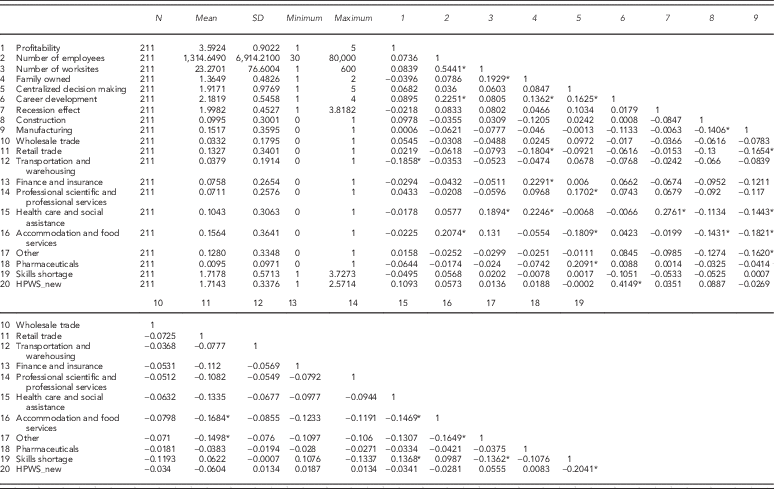
Table 1 lists the mean, standard deviation, and pairwise correlations. The reported correlations and the sample descriptives are based on casewise deletion resulting from inclusion of all the variables in the final model of Table 2.
Descriptives

Note. HPWS=high-performance work systems.
*p<.05 or below (two-tailed test).
Hierarchical ordinary least squares

Note. Robust standard errors in parentheses.
a As the number of variables in Model 1 and Model 2, are the same, the test is based on the assumption that Model 1 is nested in Model 2. Likelihood ratio χ 2 tests are based without the ‘robust’ specification, as the lrtest option in Stata does not allow for robust specification.
HPWS=high-performance work systems.
***p<.001, **p<.01, *p<.05, +p<.10.
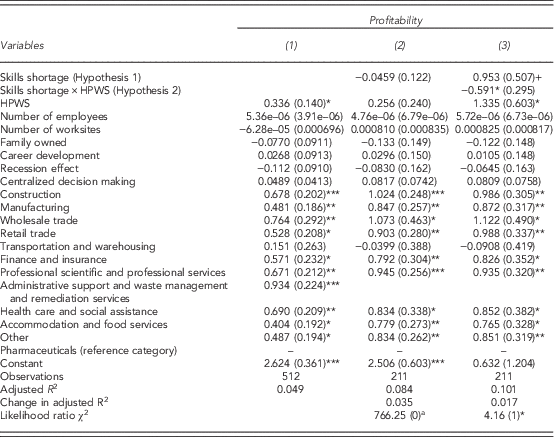
Table 2 presents the results from ordinary least squares. In the first step, we include controls and the HPWS measure (Model 1). In the second step (Model 2) to assess the additional variance explained by skills shortage, and to test for Hypothesis 1, we introduce skills shortage variable. In the third step (Model 3), we introduce the interaction term to test for Hypothesis 2. Based on the recommendation of Aiken and West (Reference Aiken and West1996) the variables were mean centered. The variance inflation factor was 1.19 for skill shortage, and 1.28 for HPWS. The average variance inflation factor was 6.67. As all the variables were self-reported, in a Harman’s single-factor analysis the authors used all variables in the model (except industry sector). The profitability measure had the uniqueness of 0.9286 across five identified factors, and skills shortage and HPWS had a uniqueness of 0.8941 and 0.6727, respectively. In the ordinary least squares model in Table 2, indicating distinction between HPWS and skills shortage, the Wald’s χ 2 difference test was significant (F(2, 191)=2.82; prob. >F=0.0620).
Among the sectors all sectors except transportation and warehousing were positively associated with performance.
Hypothesis 1 predicted that skills shortages would be negatively related to profitability; however, this hypothesis was not supported (Table 2, Model 2: β=−0.0459, p>.10). While the direction of effect was negative as expected, the relationship was not statistically significant. Inclusion of skills shortage in Model 2 increased R 2 by 3.5%.
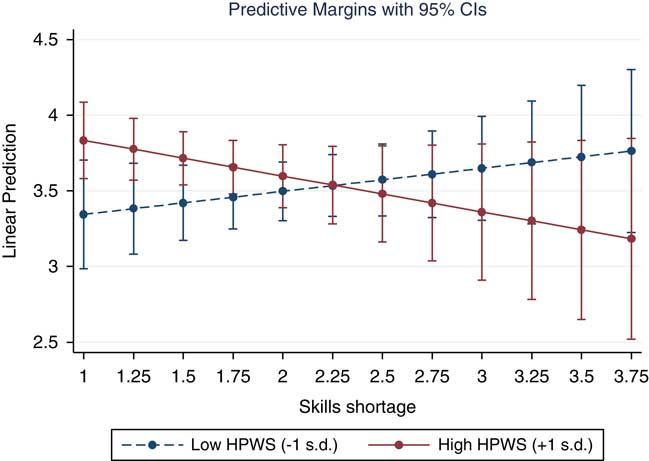
Hypothesis 2 proposed that HPWS would mitigate the negative relationship between skills shortage and profitability (Table 2, Model 3: β=−0.159, p<.05). As presented in Figure 1, with increasing skills shortage, higher levels of HPWS lower performance, whereas lower levels of HPWS increase performance. Thus, Hypothesis 2 is supported in the proposed direction. However, as theory would suggest, at lower levels of skills shortage, HPWS lead to higher performance (to the left of Figure 1), however, as skills shortage increases, returns from higher HPWS decline, and returns from lower HPWS increase. The R 2 increases from Models 2 to 3 by 1.7%. The margins command in Stata 14.2 the value for each level was significant at 0.00. Using the bootstrap option the findings were similar. The inferences for Hypothesis 2 are in the opposite direction of the predicted relationship.
Interaction plot. CI=confidence interval; HPWS=high-performance work systems

DISCUSSION
Our study showed that organizational context is more important than simply adopting HPWS. Although past research demonstrated that HPWS and firm performance are positively related to each other (Delaney & Huselid, Reference Delery1996; Guthrie, Reference Huselid2001), the findings of this study demonstrate that the use of HPWS may not always yield better organizational performance, that is, when organizations face talent shortages, the use of HPWS might be detrimental to organizational performance. Hence, adopting HPWS when a firm is experiencing skills shortage can in fact be much more costly for the organization.
This study first hypothesized that skills shortage will be negatively related to a firm’s profitability. However, no support was found for this hypothesis. Hypothesis 2 proposed that HPWS would moderate the negative relationship between skills shortage and profitability. The findings show that the opposite is true, that is, a firm’s profitability is reduced when it implements HPWS in the context of labor shortages. It is interesting to note that the study found support that HPWS positively impact firm profitability (β=1.34, p<.05 in Model 3). This finding is consistent with existing research on HPWS, which demonstrated the positive association between the use of HPWS and firm performance (Datta, Guthrie, & Wright, Reference Delaney and Huselid2005; Takeuchi, Chen, & Lepak, 2009). However, the results show that the interaction of HPWS with skill shortages changes the direction of the relationship, that is, it becomes negative. Instead of RBV of the firm, these findings support the contingent view of HR management suggesting that the use of various HR practices and the benefits associated with each configuration of HR management depend on contextual factors, that is, the effectiveness of HR bundles vary by sectors and business strategy (Arthur, Reference Arthur1994; Youndt, Snell, Dean, & Lepak, Reference Youndt, Snell, Dean and Lepak1996; Appelbaum, Bailey, Berg, & Kalleberg, Reference Appelbaum, Bailey, Berg and Kalleberg2000). Previous research showed that environmental factors such as industry (Datta, Guthrie, & Wright, Reference Delaney and Huselid2005) and organizational factors such as strategy, culture and routines, and size play an important role in the effectiveness of HPWS (Huselid, Reference Jackson and Schuler1995; Jackson & Schuler, Reference Jiang and Liu1995).
In line with this research, this study contributes to the existing HPWS literature by demonstrating that organizational skills shortage is another important factor that can affect the effectiveness of HPWS. It shows that in the context of skills shortage, HPWS will do more harm as manifested in the decline in profitability (β=−0.59, p<.05). These findings suggest that the benefits produced through the use of HPWS do not exceed the cost associated with implementing HPWS when a firm faces skill shortages. The findings are in line with previous research, which suggests that HPWS do not play any role in increasing firm output when considering organizational context (Sels, De Winne, Maes, Delmotte, Faems, & Forrier, Reference Sirmon and Hitt2006). This could be explained through a labor process approach (Ramsay, Scholarios, & Harley, Reference Reeds and De Filippi2000), suggesting that HPWS may directly or indirectly lead to work intensification. When a firm uses HPWS, it uses extensive recruitment and selection practices, provides employees with extensive training, and gives them discretion to perform their job. In return, employees may feel obligated to give back to their employer by working harder and exerting extra effort. Consequently, employees may feel drained as a result of work intensification. The outcome of this approach would be that employees who are exposed to HPWS could experience higher stress levels leading to work intensification (Macky & Boxall, Reference Mahoney and Pandian2008), a factor which has been shown to negatively affect employee and organizational outcomes (Valeyre, Reference Valeyre2004; Bamberger et al., Reference Bamberger, Larsen, Vinding, Nielsen, Fonager, Nielsen and Ryom2015; Omari & Paull, Reference Patel and Conklin2015). Thus, these opportunities for employees may come at the expense of such negative employee outcomes as strain, and work intensification and, ultimately, adverse organizational outcomes.
From a practical perspective, this study offers useful insights for HR practitioners and senior management. HPWS are usually considered as a panacea to increase firm performance; hence the usefulness of HPWS is accepted without question. This study shows that this is not the case when a firm experiences talent or skills shortage. Managers need to consider internal and external factors before implementing HPWS. In the case of skills shortage, the use of HPWS would be harmful and adversely affect the firm’s profitability as manifested by this study’s findings. In such circumstances some sort of control mechanism through the use of control-focused HR practices coupled with commitment-focused HR practices might be useful to keep employees on track as well as motivate and engage them at the same time (Arthur, Reference Arthur1994). The control-focused HR approach enhances efficiency and reduces direct labor costs by focusing on strict work procedures and basing rewards on outputs (Arthur, Reference Arthur1994). These practices could be used with other developmental practices such as training and constructive performance appraisals.
It is important to note that the data for the study were collected in 2009; since then, the context has changed in that the economy has slowly recovered, consumer spending has increased, fixed asset investment has accelerated, and the unemployment rate has declined (Financial Times, Reference Fiol and Lyles2016). Although, the study controlled for the recessionary effects in the data analysis, caution is required when interpreting the results in today’s competitive business environment.
To the authors’ knowledge, this study is the first to demonstrate that internal skill shortage is an important contextual factor that could impede the effectiveness of HPWS. Thus, scholars doing research in strategic HR management are encouraged to replicate the findings in a similar context in future studies. It is important to note that the study did not examine the inter linkages between HPWS and firm performance, and one can only speculate that reduced profitability could result from negative employee outcomes. Thus, the authors suggest that readers interpret the study’s results with caution. Scholars are encouraged to examine the process of how HPWS reduce firm’s profitability by incorporating employee outcomes in the context of labor shortages.
All data were collected through the same instrument, so common method bias could be an issue. However, the chance of such bias is less in moderation as Monte Carlo simulations have demonstrated significant interaction effects could not be generated through such bias (Evans, Reference Evans and Davis1985). Nevertheless, the results should be interpreted with caution. The authors recommend using employee data on the usage of HPWS, as studies widely recognized that it is not the actual HR practices per se, but rather employees’ perceptions of these practices that affect employee and organizational outcomes (Nishii, Lepak, & Schneider, Reference Omari and Paull2008).
Note, too, that the authors used self-reported data of firm’s relative profitability. While objective measures are recommended due to the possibility of social desirability bias, the descriptive (M=3.541 and SD=0.873) shows that the responses were not biased toward overreporting performance relative to competitors. Moreover, such subjective assessment about a company’s profitability is usually accurate as discussion on the company’s profitability is always on the meeting agenda for senior managers. Hence, the self-reported data should not cast doubt on the usefulness of the results as subjective measures of firm performance are widely used in organizational research and are considered to have good validity equivalent to objective measures (Wall et al., Reference Wall, Michie, Patterson, Wood, Sheehan, Clegg and West2004; Woodside, Reference Woodside2010). Furthermore, the data were collected from US companies; thus, the generalizability of the results could be limited and might not be applicable in other countries.
CONCLUSION
This research study sought to examine whether internal skills shortages lower firm profitability. Additionally, the study aimed to explore the role of HPWS in the context of internal labor shortages. Interestingly, the study found that internal skills shortage was not related to firm profitability. The findings also showed that the use of the HPWS lowers firm profitability when firms face internal skills shortages. The results suggest that the use of HPWS does not necessarily translate into higher firm performance; rather organizational context (i.e., the availability of internal skills) should also be considered in order to make the most optimal use of firm’s human capital.
Acknowledgments
The authors would like to thank the associate editor, Dr. Tim Bentley, and two anonymous reviewers for their helpful comments.