Inflammation acts as a defensive mechanism against a variety of deleterious stimuli such as microbial pathogens and physical or chemical agents(Reference Medzhitov1). Oxidative stress, a process referring to the imbalance between antioxidants and pro-oxidants, is tightly linked to inflammation(Reference Mladenov, Lubomirov and Grisk2). The excess production of reactive oxygen species could damage important cellular biomolecules including DNA, proteins and lipids and activate pro-inflammatory signalling pathways, resulting in cell damage and increased circulating levels of inflammatory mediators(Reference Mittal, Siddiqui and Tran3). Substantial evidence has established that both systemic chronic inflammation and extensive oxidative stress play crucial roles in the initiation of various chronic diseases, including metabolic diseases, cardiovascular diseases, non-alcoholic fatty liver disease and neurodegenerative diseases(Reference Merelli, Repetto and Lazarowski4–Reference Rani, Deep and Singh7). Given the adverse effects of chemical medications, complementary therapies including flavonoid-rich nutraceuticals have garnered increasing attention.
Flavonoids comprise an enormous class of naturally occurring polyphenolic compounds mainly present in plants(Reference Shen, Wang and Gan8). Previous meta-analyses based on randomised controlled human trials have reported the potent anti-inflammatory, antioxidant, anti-hyperglycaemic and anti-hyperlipidaemic activities of flavonoids, showing beneficial effects on human health(Reference Bahari, Shahraki Jazinaki and Rashidmayvan9–Reference Ou, Zheng and Zhao11). Hesperidin (3’,5,7-trihydroxy-4’-methoxy-flavanone-7-rhamnoglucoside), a member of the flavanone subclass of flavonoids, is present in citrus fruits, such as oranges, mandarins, grapefruits and lemons(Reference Li and Schluesener12). Preclinical studies have shown that hesperidin administration downregulates the production of inflammatory cytokines such as IL-1β, IL-6 and TNF-α in animal models of lipopolysaccharide (LPS)-induced lung injury(Reference Yeh, Kao and Lin13), streptozotocin-induced type 2 diabetes(Reference Mahmoud, Ashour and Abdel-Moneim14), high-fat diet-induced non-alcoholic fatty liver disease(Reference Xie, Gao and Lei15), acute myocardial infarction-induced inflammatory responses(Reference Meng, Guo and Li16) and ligation-induced periodontitis(Reference Kuo, Fu and Lin17). Partially aligned with these preclinical studies, randomised controlled human trials have also demonstrated that hesperidin supplementation could decrease the circulating levels of inflammatory markers such as C-reactive protein or high-sensitivity C-reactive protein (CRP/hs-CRP), IL-6 and TNF-α in patients with type 2 diabetes, metabolic syndrome, non-alcoholic fatty liver disease and chronic periodontitis(Reference Cheraghpour, Imani and Ommi18–Reference Yari, Movahedian and Imani22). Furthermore, hesperidin supplementation in amateur cyclists and patients with type 2 diabetes has been reported to decrease oxidative stress markers, such as malondialdehyde (MDA) and glutathione disulphide, as well as increase antioxidant markers, such as superoxide dismutase and total antioxidant capacity (TAC)(Reference Homayouni, Haidari and Hedayati23,Reference Martínez-Noguera, Marín-Pagán and Carlos-Vivas24) .
However, the available data regarding the anti-inflammatory effect of hesperidin remain inconsistent. A previous meta-analysis conducted in 2019 combined six randomised controlled trials (RCT) with 296 participants involving both healthy overweight individuals and patients with type 2 diabetes, myocardial infarction and metabolic syndrome(Reference Lorzadeh, Ramezani-Jolfaie and Mohammadi25). The authors have reported that although purified hesperidin supplementation significantly improved Vascular Cell Adhesion Molecule-1 (VCAM-1) levels, it had no significant effects on other inflammatory markers, including CRP, IL-6, E-selectin and Intercellular Cell Adhesion Molecule-1 (ICAM-1)(Reference Lorzadeh, Ramezani-Jolfaie and Mohammadi25). In contrast, a recent meta-analysis of eighteen studies conducted in 2022 demonstrated that hesperidin supplementation in the form of orange juice/beverage or as a purified supplement significantly reduced levels of not only CRP, IL-6 and IL-4 but also MDA in healthy people(Reference Buzdagli, Eyipinar and Kaci26).
The inconsistency of meta-analyses may be partly explained by methodological disparities, including differences in the study selection criteria. Regarding individual clinical trials, inconsistent effects have been observed across participants with various characteristics and different hesperidin supplementation regimens. The discrepancy may be partly explained by significant inter-individual variability in hesperidin bioavailability. Previous studies have suggested that host factors such as age, gender, race and physiological/pathological status affect the bioavailability and bioactivity of phenolic compounds(Reference Favari, Rinaldi de Alvarenga and Sanchez-Martinez27). In addition, individuals of different ages and health statuses exhibit diverse baseline inflammation levels(Reference Furman, Campisi and Verdin28,Reference Nakajima, Yamaoka and Morita29) . Therefore, the optimum intervention route including dosage and duration may be varied among participants with heterogeneous characteristics. Collectively, both host factors and intervention parameters may play important roles in the bioactivities of hesperidin. Given the inconsistent results in human trials and meta-analyses, we performed a systematic review and meta-analysis of RCT, aiming to evaluate the anti-inflammatory and antioxidant effects of hesperidin in human adults.
Methods
This systematic review and meta-analysis were performed according to the Preferred Reporting Items for Systematic Reviews and Meta-analyses (PRISMA) reporting guideline(Reference Page, McKenzie and Bossuyt30). The study protocol was registered in the International Prospective Register of Systematic Reviews (registration ID: CRD42025639935).
Search strategy
We searched PubMed, EMBASE and Cochrane Central Register of Controlled Trials for available studies published up to 4 January 2025. To identify all the RCT articles regarding the effects of hesperidin supplementation on inflammatory and oxidative stress markers in adults, we used the following MESH terms and text keywords in combination for literature search: (‘hesperidin’ OR ‘orange juice’ OR ‘citrus flavonoid’ OR ‘citrus flavanone’) AND (‘inflammation’ OR ‘C-reactive protein’ OR ‘CRP’ OR ‘tumor-necrosis factor’ OR ‘TNF’ OR ‘interleukin-6’ OR ‘IL-6’ OR ‘oxidative stress’ OR ‘Malondialdehyde’ OR ‘MDA’ OR ‘Total antioxidant capacity’ OR ‘TAC’) AND (‘intervention’ OR ‘trial’ OR ‘controlled trial’ OR ‘randomized’ OR ‘random’ OR ‘randomly’ OR ‘placebo’ OR ‘assignment’ OR ‘clinical trial’ OR ‘randomized controlled trial’ OR ‘randomized clinical trial’ OR ‘RCT’ OR ‘blinded’ OR ‘double-blinded’ OR ‘cross-over’ OR ‘parallel’). References of the included studies were also manually searched to minimise the possibility of missing studies.
Inclusion and exclusion criteria
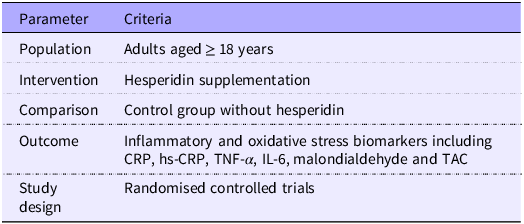
Studies were included if they met the following criteria: (1) RCT investigated the effects of hesperidin on inflammatory and oxidative stress biomarkers including CRP, hs-CRP, TNF-α, IL-6, MDA and TAC; (2) studies with human adults aged ≥ 18 years; (3) studies with an appropriate control group (the only difference between the intervention group and control group was hesperidin); (4) studies reported the change values of the inflammatory and oxidative stress biomarkers during the intervention or the baseline and follow-up values of these biomarkers; and (5) studies reported the sd of biomarkers or values that could be convertible to sd (Table 1). Exclusion criteria included (1) reviews, meta-analyses, animal studies, in vitro studies, trial protocols, conference abstracts without available data, observational studies and trials without an adequate control group, (2) studies with data that cannot be converted to mean and sd and (3) studies where hesperidin was administered through natural dietary sources (e.g. citrus fruits, orange juice or other hesperidin-containing foods/beverages) rather than as a purified supplement. The flow diagram of the study selection has been drafted in accordance with the PRISMA principles(Reference Page, McKenzie and Bossuyt30).
PICOS criteria for inclusion of studies

Table 1 Long description
A table with two columns labeled Parameter and Criteria, and five rows detailing the criteria for inclusion of studies. The parameters include Population, Intervention, Comparison, Outcome, and Study design. The criteria specify that the population must be adults aged 18 years or older, the intervention must involve hesperidin supplementation, the comparison must include a control group without hesperidin, the outcome must measure inflammatory and oxidative stress biomarkers including CRP, hs-CRP, TNF-α, IL-6, malondialdehyde, and TAC, and the study design must be randomised controlled trials.
Data extraction and quality assessment
L.O. and Y.G. screened independently to determine which studies should be included, and any discrepancies were resolved by M.Y. The extracted data included the name of the first author, publication year, country, study design, participants’ characteristics (sample size, mean age, gender and health condition), the duration of hesperidin intervention, the dosage of hesperidin and the outcomes of interest.
The quality of the included RCT was assessed by L.O. and Y.G. according to the revised Cochrane risk-of-bias tool for RCT (RoB 2), which consists of five categories (randomisation process, deviation from the intended interventions, missing outcome data, measurement of outcome and selection of the reported results)(Reference Sterne, Savovic and Page31). The risk of bias in the studies was categorised into low risk of bias, some concerns and high risk of bias, respectively.
Statistical analysis
Statistical analyses were performed using Review Manager 5.4 (The Cochrane Collaboration) and R statistical software version 4.4.2. For studies reporting the median and interquartile range, we determined the skewness of data by the method described by Shi et al. using an established online tool (http://www.math.hkbu.edu.hk/~tongt/papers/median2mean.html)(Reference Shi, Luo and Wan32). If there was no significant evidence to show that the data were skewed, we then applied the formula-based method described by Luo et al. (Reference Luo, Wan and Liu33) and Wan et al. (Reference Wan, Wang and Liu34) to transform the data into the mean and sd using the above online tool. For studies reporting standard error or 95 % CI instead of sd, we applied estimation methods recommended by the Cochrane Handbook for Systematic Reviews of Intervention(Reference Higgins, Thomas and Chandler35). The sd values were calculated according to the equations: sd = se × square root of n; sd = square root of n × (upper limit – lower limit)/3·92(Reference Higgins, Thomas and Chandler35). The baseline and follow-up mean and sd values of the inflammatory and oxidative stress biomarkers were extracted or converted. The mean changes were calculated by subtracting the mean values at baseline from the mean values at follow-up. The sd values of the mean difference were calculated according to the equation: sd change = square root [(sd baseline)2 + (sd final)2 – (2R × sd baseline × sd final)] (R = 0·5)(Reference Serban, Sahebkar and Zanchetti36). The pooled effect size was represented as the standardised mean differences (SMD) and 95 % CI to estimate the anti-inflammatory and antioxidant effects of hesperidin. The I 2 statistic was used to evaluate the heterogeneity of the pooled estimate. Heterogeneity was considered as low (< 25 %), moderate (25–75 %) and high (> 75 %)(Reference Roncon, Zuin and Rigatelli37). If I 2 < 50 %, a fixed-effects model was used to combine the data(Reference Wang, Wang and Xiang38). Otherwise, a random-effects model was selected. To explore the potential source of heterogeneity, subgroup analyses based on geographic region of study, participant characteristics (age, gender and health status) and intervention measures (duration of intervention and dosage of hesperidin) were performed. Studies were categorised into either a disease-free group or a disease-confirmed group, which included type 2 diabetes(Reference Homayouni, Haidari and Hedayati19), metabolic syndrome(Reference Yari, Movahedian and Imani22,Reference Rizza, Muniyappa and Iantorno39) , chronic periodontitis(Reference Shirodkar, Vasani and Sahney20), non-alcoholic fatty liver disease(Reference Cheraghpour, Imani and Ommi18,Reference Yari, Cheraghpour and Alavian21) and myocardial infarction(Reference Haidari, Heybar and Jalali40). The diagnosis of the disease was confirmed by physicians according to clinical diagnostic criteria. In addition, the cutoff values for age, duration of intervention and dosage of hesperidin were determined. The age threshold of 55 years was selected based on evidence showing significantly higher logCRP levels in elderly (≥ 55 years old) compared with middle-aged subjects (< 55 years old), reflecting the influence of aging(Reference Nakajima, Yamaoka and Morita29). The intervention dosage of 500 mg was determined as it represented a commonly administered dose in the existing clinical studies investigating the efficacy of hesperidin(Reference Homayouni, Haidari and Hedayati19,Reference Shirodkar, Vasani and Sahney20,Reference Martínez-Noguera, Marín-Pagán and Carlos-Vivas24,Reference Rizza, Muniyappa and Iantorno39) . The 8-week cutoff for hesperidin intervention duration was selected according to the previous meta-analyses investigating the effects of orange juice intake(Reference Alhabeeb, Sohouli and Lari41,Reference Motallaei, Ramezani-Jolfaie and Mohammadi42) . Sensitivity analysis was performed using a leave-one-out method to confirm the robustness of outcomes. The leave-one-out analysis was performed by iteratively removing one study at a time and recalculating the pooled effect size(Reference Higgins43). The Galbraith plot was applied to identify the possible sources of heterogeneity(Reference Anzures-Cabrera and Higgins44). Publication bias was determined by a visual inspection of the funnel plot when the number of included studies was no less than ten. Otherwise, Egger’s test and Begg’s test were utilised to evaluate the publication bias. P value less than 0·05 was regarded as statistically significant.
Results
Study selection
A total of 895 articles were identified according to the search strategy. First, duplicated articles (n 281) were excluded. After screening the titles and abstracts, 585 articles were removed, and twenty-nine articles underwent full-text review. Eighteen articles were excluded due to the following reasons: studies without outcome of interest, study protocols, non-RCT, conference abstracts without available data and studies without an appropriate control group. Finally, a total of eleven articles (ten RCT) involving 532 participants (270 in the intervention group and 262 in the control group) were included in our systematic review and meta-analysis(Reference Cheraghpour, Imani and Ommi18–Reference Martínez-Noguera, Marín-Pagán and Carlos-Vivas24,Reference Rizza, Muniyappa and Iantorno39,Reference Haidari, Heybar and Jalali40,Reference Hashizume and Tandia45,Reference Morand, Dubray and Milenkovic46) . The full PRISMA flow diagram of study selection is shown in Figure 1.
PRISMA flow chart of included and excluded studies.

Study characteristics
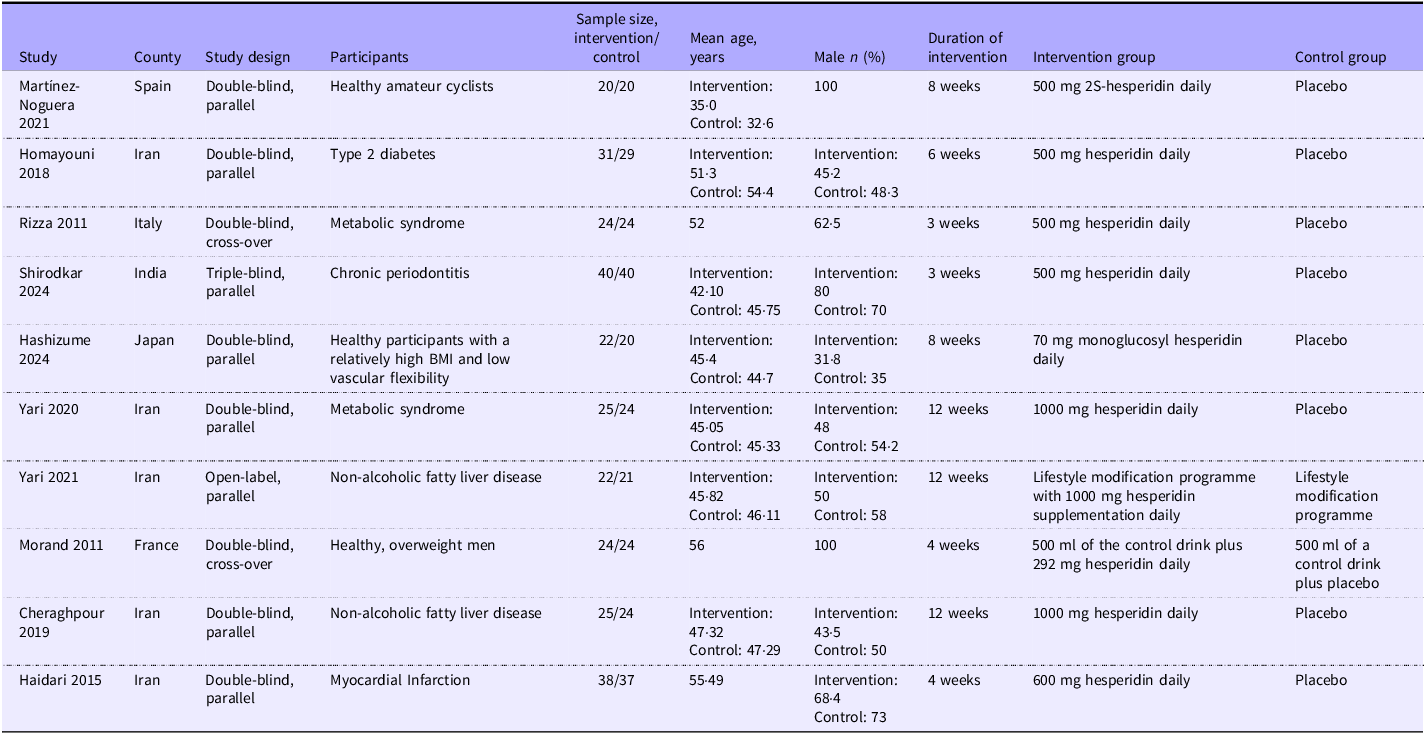
The characteristics of the included studies are summarised in Table 2. Two records with different outcomes of interest came from the same RCT and were therefore recorded as Homayouni 2018(Reference Homayouni, Haidari and Hedayati19,Reference Homayouni, Haidari and Hedayati23) . Ten trials evaluated the effect of hesperidin supplementation on CRP or hs-CRP(Reference Cheraghpour, Imani and Ommi18–Reference Yari, Movahedian and Imani22,Reference Martínez-Noguera, Marín-Pagán and Carlos-Vivas24,Reference Rizza, Muniyappa and Iantorno39,Reference Haidari, Heybar and Jalali40,Reference Hashizume and Tandia45,Reference Morand, Dubray and Milenkovic46) , five on TNF-α (Reference Cheraghpour, Imani and Ommi18,Reference Homayouni, Haidari and Hedayati19,Reference Yari, Cheraghpour and Alavian21,Reference Yari, Movahedian and Imani22,Reference Martínez-Noguera, Marín-Pagán and Carlos-Vivas24) , four on IL-6(Reference Homayouni, Haidari and Hedayati19,Reference Martínez-Noguera, Marín-Pagán and Carlos-Vivas24,Reference Haidari, Heybar and Jalali40,Reference Morand, Dubray and Milenkovic46) and one on MDA and TAC(Reference Homayouni, Haidari and Hedayati23). Studies were published between 2011(Reference Rizza, Muniyappa and Iantorno39,Reference Morand, Dubray and Milenkovic46) and 2024(Reference Shirodkar, Vasani and Sahney20,Reference Hashizume and Tandia45) . The studies were conducted in Europe (Spain, Italy and France)(Reference Martínez-Noguera, Marín-Pagán and Carlos-Vivas24,Reference Rizza, Muniyappa and Iantorno39,Reference Morand, Dubray and Milenkovic46) and Asia (Iran, India and Japan)(Reference Cheraghpour, Imani and Ommi18–Reference Yari, Movahedian and Imani22,Reference Haidari, Heybar and Jalali40,Reference Hashizume and Tandia45) . The majority of the studies were double or triple blinded, with only one study unblinded(Reference Yari, Cheraghpour and Alavian21). Most of the included studies employed a parallel design, with only two adopting a cross-over design(Reference Rizza, Muniyappa and Iantorno39,Reference Morand, Dubray and Milenkovic46) . Most of the included studies were conducted in patients (type 2 diabetes, metabolic syndrome, chronic periodontitis, non-alcoholic fatty liver disease and myocardial infarction), with only three studies conducted in healthy participants without diagnosed diseases(Reference Martínez-Noguera, Marín-Pagán and Carlos-Vivas24,Reference Hashizume and Tandia45,Reference Morand, Dubray and Milenkovic46) . The mean age of the participants ranged from 32·6(Reference Martínez-Noguera, Marín-Pagán and Carlos-Vivas24) to 56(Reference Morand, Dubray and Milenkovic46) years, and the sample sizes of the studies ranged from 24(Reference Rizza, Muniyappa and Iantorno39,Reference Morand, Dubray and Milenkovic46) to 80(Reference Shirodkar, Vasani and Sahney20). The dosage of hesperidin in the studies varied from 70 mg(Reference Hashizume and Tandia45) to 1000 mg(Reference Cheraghpour, Imani and Ommi18,Reference Yari, Cheraghpour and Alavian21,Reference Yari, Movahedian and Imani22) per day. The intervention duration of hesperidin in the included studies varied from 3(Reference Shirodkar, Vasani and Sahney20,Reference Rizza, Muniyappa and Iantorno39) to 12(Reference Cheraghpour, Imani and Ommi18,Reference Yari, Cheraghpour and Alavian21,Reference Yari, Movahedian and Imani22) weeks.
Characteristics of the included studies

Table 2 Long description
The table presents characteristics of studies on hesperidin supplementation, including study location, design, participants, sample size, mean age, intervention duration, and groups. It has 11 rows and 8 columns. Column headers are Study, County, Study design, Participants, Sample size, intervention/control, Mean age, years, Male n (%), Duration of intervention, Intervention group, and Control group. Row 1: Martinez-Noguera 2021, Spain, Double-blind, parallel, Healthy amateur cyclists, 20/20, Intervention: 35-0 Control: 32-6, Male 100%, 8 weeks, 500 mg 2S-hesperidin daily, Placebo. Row 2: Homayouni 2018, Iran, Double-blind, parallel, Type 2 diabetes, 31/29, Intervention: 51-3 Control: 54-4, Male 45-2%, 6 weeks, 500 mg hesperidin daily, Placebo. Row 3: Rizza 2011, Italy, Double-blind, cross-over, Metabolic syndrome, 24/24, 52, Male 62-5%, 3 weeks, 500 mg hesperidin daily, Placebo. Row 4: Shirodkar 2024, India, Triple-blind, parallel, Chronic periodontitis, 40/40, Intervention: 42-10 Control: 45-75, Male 80%, 3 weeks, 500 mg hesperidin daily, Placebo. Row 5: Hashizume 2024, Japan, Double-blind, parallel, Healthy participants with a relatively high BMI and low vascular flexibility, 22/20, Intervention: 45-4 Control: 44-7, Male 31-8%, 8 weeks, 70 mg monoglucosyl hesperidin daily, Placebo. Row 6: Yari 2020, Iran, Double-blind, parallel, Metabolic syndrome, 25/24, Intervention: 45-05 Control: 45-33, Male 48%, 12 weeks, 1000 mg hesperidin daily, Placebo. Row 7: Yari 2021, Iran, Open-label, parallel, Non-alcoholic fatty liver disease, 22/21, Intervention: 45-82 Control: 46-11, Male 50%, 12 weeks, Lifestyle modification programme with 1000 mg hesperidin supplementation daily, Lifestyle modification programme. Row 8: Morand 2011, France, Double-blind, cross-over, Healthy, overweight men, 24/24, 56, Male 100%, 4 weeks, 500 ml of the control drink plus 292 mg hesperidin daily, 500 ml of a control drink plus placebo. Row 9: Cheraghpour 2019, Iran, Double-blind, parallel, Non-alcoholic fatty liver disease, 25/24, Intervention: 47-32 Control: 47-29, Male 43-5%, 12 weeks, 1000 mg hesperidin daily, Placebo. Row 10: Haidari 2015, Iran, Double-blind, parallel, Myocardial Infarction, 38/37, 55-49, Intervention: 68-4 Control: 73, Male 55%, 4 weeks, 600 mg hesperidin daily, Placebo.
Risk of bias
The overall risk of bias was assessed by the ROB2 tool. As shown in Figure 2, four studies(Reference Cheraghpour, Imani and Ommi18,Reference Homayouni, Haidari and Hedayati19,Reference Yari, Movahedian and Imani22,Reference Rizza, Muniyappa and Iantorno39) included in this meta-analysis showed a low risk of bias in all the domains, leading to the low overall risk of bias. Five studies(Reference Shirodkar, Vasani and Sahney20,Reference Martínez-Noguera, Marín-Pagán and Carlos-Vivas24,Reference Haidari, Heybar and Jalali40,Reference Hashizume and Tandia45,Reference Morand, Dubray and Milenkovic46) had some concerns in the overall risk of bias due to some concerns in the domain of deviations from the intended interventions, missing outcome data and selection of the reported result. Only one study(Reference Yari, Cheraghpour and Alavian21) exhibits a high overall risk of bias because of the high risk of bias in the domain of measurement of the outcome.
Risk of bias assessment based on the revised Cochrane risk-of-bias tool for randomised controlled trials (RoB 2). (a) Risk of bias graph; (b) risk of bias summary.

The effect on hesperidin on serum C-reactive protein levels
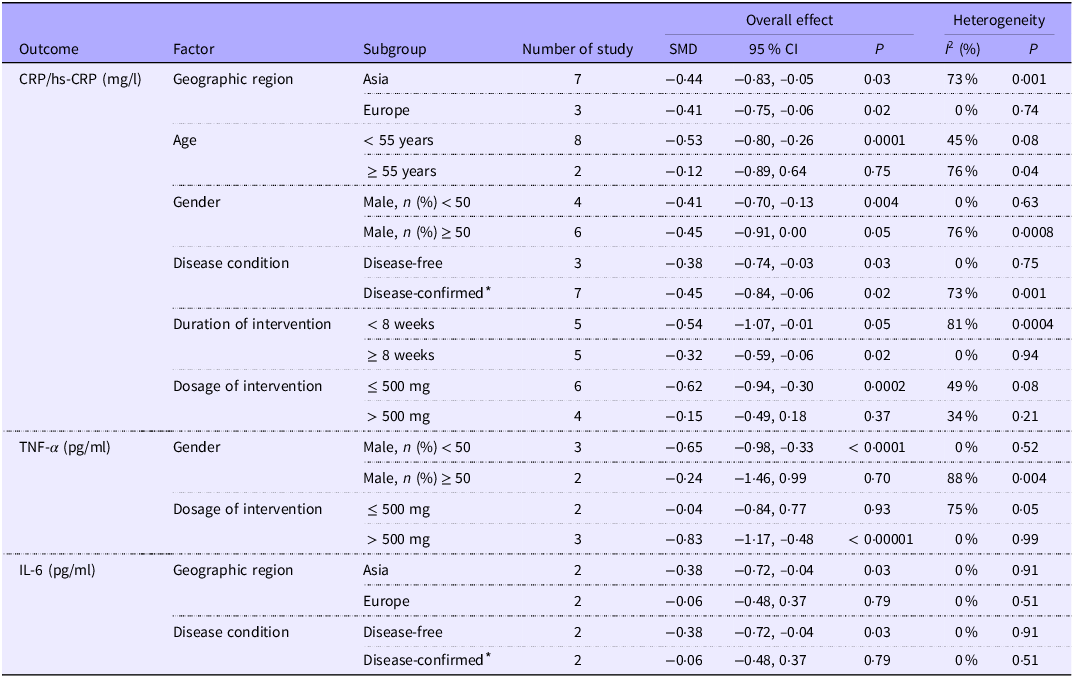
Ten studies involving 532 participants with various health conditions were pooled to evaluate the effect of hesperidin supplementation on serum CRP/hs-CRP levels. As shown in Figure 3, hesperidin intervention significantly decreased CRP/hs-CRP levels compared with the control groups (SMD: −0·43; 95 % CI −0·71, −0·15; P = 0·002) with considerable heterogeneity (I 2 = 60 %, P = 0·007). The Galbraith plot was applied to assess the between-study heterogeneity visually. The study conducted by Shirodkar et al. (Reference Shirodkar, Vasani and Sahney20) was identified as the outlier, which is a possible source of heterogeneity (online Supplementary Figure 1). Sensitivity analysis was performed to confirm the robustness of the results using the leave-one-out method. The sensitivity analysis showed that the overall effects were not influenced by the exclusion of any individual study (online Supplementary Figure 2). Subgroup analysis was conducted based on potential confounding factors including participant characteristics (age, gender, geographic region and health status) and intervention measures (duration and dosage of intervention). The finding remained unchanged in the majority of subgroups; however, no significant effect of hesperidin on CRP/hs-CRP was found in the subgroup of studies with hesperidin dosage > 500 mg/d(Reference Cheraghpour, Imani and Ommi18,Reference Yari, Cheraghpour and Alavian21,Reference Yari, Movahedian and Imani22,Reference Haidari, Heybar and Jalali40) (n 4; SMD: −0·15; 95 % CI −0·49, 0·18; P = 0·37) and studies with participant aged ≥ 55 years(Reference Haidari, Heybar and Jalali40,Reference Morand, Dubray and Milenkovic46) (n 2; SMD: −0·12; 95 % CI −0·89, 0·64; P = 0·75). The detailed information of subgroup analysis is summarised in Table 3.
Forest plot of the effect of hesperidin supplementation on serum CRP/hs-CRP level. CRP, C-reactive protein; hs-CRP, high-sensitivity C-reactive protein.

Subgroup analyses for the effects of hesperidin supplementation on the inflammatory markers

Table 3 Long description
A table with 12 rows and 9 columns summarizing subgroup analyses for the effects of hesperidin supplementation on inflammatory markers. The columns are Outcome, Factor, Subgroup, Number of study, SMD, 95 % CI, P, I squared (%), and P. The table includes data for CRP/hs-CRP (mg/l), TNF-α (pg/ml), and IL-6 (pg/ml) across various factors such as geographic region, age, gender, disease condition, duration of intervention, and dosage of intervention. Each row provides specific values for the number of studies, standardized mean difference (SMD), 95 percent confidence interval (CI), P-value, and heterogeneity (I squared and P-value). Notable trends include significant effects of hesperidin on CRP/hs-CRP levels in most subgroups, except for studies with hesperidin dosage greater than 500 mg/day and participants aged 55 years or older.
CRP/hs-CRP, C-reactive protein or high-sensitivity C-reactive protein; SMD, standardised mean difference.
* Disease-confirmed group: Participants were clinically diagnosed with specific diseases, including type 2 diabetes, metabolic syndrome, chronic periodontitis, non-alcoholic fatty liver disease or myocardial infarction.
The effect on hesperidin on TNF-α
Five studies including 241 participants were combined to estimate the effect of hesperidin supplementation on TNF-α levels. As shown in Figure 4, the intake of hesperidin significantly lowered the TNF-α concentration (SMD: −0·51; 95 % CI −0·95, −0·07; P = 0·02) compared with the control groups with considerable between-study heterogeneity (I 2 = 65 %, P = 0·02). Following sensitivity analysis, we identified the study conducted by Martínez-Noguera et al. (Reference Martínez-Noguera, Marín-Pagán and Carlos-Vivas24) as the potential origin of heterogeneity. No between-study heterogeneity was found after removing this study (I 2 from 65 % to 0 %), while the overall estimate on TNF-α did not change significantly (SMD: −0·70; 95 % CI −0·99, −0·42; P < 0·00001). Subgroup analyses revealed that hesperidin significantly decreased TNF-α levels in studies with hesperidin dosage > 500 mg/d(Reference Cheraghpour, Imani and Ommi18,Reference Yari, Cheraghpour and Alavian21,Reference Yari, Movahedian and Imani22) (n 3; SMD: −0·83; 95 % CI −1·17, −0·48; P < 0·00001) and studies with ratio of male participants < 50 %(Reference Cheraghpour, Imani and Ommi18,Reference Homayouni, Haidari and Hedayati19,Reference Yari, Cheraghpour and Alavian21) (n 3; SMD: −0·65; 95 % CI −0·98, −0·33; P < 0·0001).
Forest plot of the effect of hesperidin supplementation on TNF-α level.

The effect on hesperidin on IL-6
Four studies including 221 participants were selected to estimate the effect of hesperidin supplementation on IL-6 levels. As shown in Figure 5, no significant effect of hesperidin on IL-6 levels was found (SMD: –0·25; 95 % CI –0·52, 0·01; P = 0·06) compared with the control groups with no between-study heterogeneity (I 2 = 0 %, P = 0·62).
Forest plot of the effect of hesperidin supplementation on IL-6 level.

Sensitivity analysis revealed that exclusion of the study by Martínez-Noguera et al. (Reference Martínez-Noguera, Marín-Pagán and Carlos-Vivas24) changed the pool SMD effect of hesperidin on IL-6 (SMD: –0·33; 95 % CI –0·62, –0·04; P = 0·03). Subgroup analyses showed that hesperidin supplementation significantly decreased IL-6 levels in studies with unhealthy participants with type 2 diabetes or myocardial infarction (SMD: –0·38; 95 % CI –0·72, –0·04; P = 0·03) and studies conducted in Asia (SMD: –0·38; 95 % CI –0·72, –0·04; P = 0·03).
The effect on hesperidin on oxidative stress markers malondialdehyde and total antioxidant capacity
Only one study conducted by Homayouni et al. (Reference Homayouni, Haidari and Hedayati23) from Iran reported the effects of hesperidin on MDA and TAC in patients with type 2 diabetes, involving thirty-one participants in the intervention group and twenty-nine participants in the placebo-control group. The authors found a significant decrease in the MDA level (mean value from 5·78 μM to 4·60 μM) and a significant negative percent change (mean (sd): –16·46 (sd 18·04)) in MDA concentrations in the group supplemented with hesperidin. In contrast, a significant increase in TAC level (mean value from 0·74 mM to 0·82 mM) and a significant positive percent change in TAC concentrations (mean (sd): 13·35 (sd 19·21)) were observed in the hesperidin supplementation group.
Publication bias
Potential publication bias was evaluated by visual inspection of the funnel plot (online Supplementary 3) as well as Egger’s and Begg’s tests (online Supplementary Table 1). No evidence of publication bias was found regarding the effects of hesperidin on CRP, TNF-α and IL-6 levels in the present meta-analysis.
Discussion
To the best of our knowledge, this is the first systematic review and meta-analysis of RCT evaluating the anti-inflammatory and antioxidant effects of hesperidin supplementation in adults with various health conditions. The present study indicated that hesperidin supplementation significantly decreased the serum levels of CRP/hs-CRP and TNF-α in human adults, yet no significant effect of hesperidin on IL-6 was found. In addition, subgroup analyses indicated that daily doses of ≤ 500 mg hesperidin supplementation inhibited CRP/hs-CRP production, whereas only hesperidin at daily doses higher than 500 mg decreased the TNF-α level. Moreover, hesperidin intake exhibits a beneficial impact on the IL-6 level in patients with type 2 diabetes or myocardial infarction but not in healthy adults.
Hesperidin, a flavanone glycoside consisting of the aglycone portion called hesperetin and the disaccharide rutinose, exhibits a wide range of pharmacological properties including anti-inflammatory, antioxidant, anti-tumour and hypoglycaemic activities(Reference Li and Schluesener12). The biological efficacy of hesperidin is highly dependent on its absorption and bioavailability, particularly when administered orally(Reference Wdowiak, Walkowiak and Pietrzak47). Orally administered hesperidin is resistant to stomach and small intestine enzymes and then reaches the colon, where it is converted into the active form hesperetin by the intestinal microbiota(Reference Mas-Capdevila, Teichenne and Domenech-Coca48). Hesperetin is then transported into enterocytes via active transport and passive diffusion and released into the bloodstream in the form of glucuronide and sulphate conjugates(Reference Najmanova, Voprsalova and Saso49). As documented by literatures, the oral bioavailability of hesperidin is estimated to be about 20 %, which is attributed to its low solubility and permeability(Reference Paczkowska-Walendowska, Miklaszewski and Cielecka-Piontek50).
Studies have shown conflicting results regarding the anti-inflammatory effect of hesperidin in human trials involving healthy participants and patients with inflammatory diseases. Several RCT studies conducted in patients with type 2 diabetes, non-alcoholic fatty liver disease, metabolic syndrome and chronic periodontitis have demonstrated that hesperidin could decrease the levels of inflammatory markers(Reference Homayouni, Haidari and Hedayati19–Reference Yari, Movahedian and Imani22). However, the study by Haidari et al. conducted in patients with myocardial infarction and the study by Martínez-Noguera et al. with healthy amateur cyclists did not suggest the higher anti-inflammatory effect of hesperidin compared with the control group(Reference Martínez-Noguera, Marín-Pagán and Carlos-Vivas24,Reference Haidari, Heybar and Jalali40) . The inconsistent results may be partly attributed to different participant characteristics, particularly the health status of the population. Given that the conversion of hesperidin to hesperetin could be promoted by specific intestinal microorganisms such as Bifidobacterium pseudocatenulatum (Reference Mas-Capdevila, Teichenne and Domenech-Coca48), differences in composition and activity in intestinal microbiota among heterogeneous individuals with various health statuses may result in variability of hesperidin bioavailability and biological efficacy. In addition, the baseline inflammatory levels are different in healthy and diseased participants, suggesting the variation of optimum hesperidin dosage across distinct health statuses. Notably, the baseline hs-CRP level in patients with myocardial infarction reported by Haidari et al. (Reference Haidari, Heybar and Jalali40) was significantly higher than the levels in other included studies. It is plausible to assume that hesperidin does not reach sufficient circulating concentrations that are needed for the regulation of inflammation in the myocardial infarction study. In contrast, healthy amateur cyclists in the study by Martínez-Noguera et al. (Reference Martínez-Noguera, Marín-Pagán and Carlos-Vivas24) showed baseline inflammatory levels within normal or low physiological ranges. It is possible that the sensitivity of conventional markers such as CRP is insufficient to detect the true effect of hesperidin.
Another important factor that could influence hesperidin efficacy is the intervention route, including the administered forms and doses of hesperidin as well as the duration of intervention. With regard to administered forms of hesperidin, most studies included in this meta-analysis used hesperidin, while the remaining two studies used 70 mg of monoglucosyl hesperidin(Reference Hashizume and Tandia45) and 500 mg of 2S-hesperidin(Reference Martínez-Noguera, Marín-Pagán and Carlos-Vivas24), respectively. Glucosyl hesperidin is an enzymatically modified and more hydrophilic form of hesperidin that improves solubility and absorption, leading to greater circulating hesperetin levels(Reference Nielsen, Chee and Poulsen51). Additionally, the dosage of hesperidin included in this meta-analysis ranged from 70 mg to 1000 mg. Subgroup analyses indicated that daily doses of ≤ 500 mg hesperidin supplementation inhibited CRP/hs-CRP production, whereas only hesperidin at daily doses higher than 500 mg decreased the TNF-α level. For the CRP/hs-CRP subgroup receiving > 500 mg/d hesperidin, the null effect was primarily influenced by the myocardial infarction study(Reference Haidari, Heybar and Jalali40) using 600 mg/d hesperidin for only 4 weeks. It contrasted sharply with the other three studies administering 1000 mg/d hesperidin for 12 weeks in non-alcoholic fatty liver disease and metabolic syndrome(Reference Cheraghpour, Imani and Ommi18,Reference Yari, Cheraghpour and Alavian21,Reference Yari, Movahedian and Imani22) . The 600 mg/d hesperidin supplementation for 4 weeks may not be able to effectively decrease the CRP/hs-CRP level in myocardial infarction patients. Regarding TNF-α, only two studies with high heterogeneity (healthy condition and type 2 diabetes) were included in the subgroup receiving <= 500 mg/d hesperidin(Reference Homayouni, Haidari and Hedayati19,Reference Martínez-Noguera, Marín-Pagán and Carlos-Vivas24) , resulting in limited statistical power to detect the true effect. Collectively, the efficacy of hesperidin depends on various factors including the forms, dosage, the duration of supplementation and the baseline inflammation levels in heterogeneous health contexts.
So far, only two meta-analyses have investigated the anti-inflammatory role of hesperidin while yielded inconsistent results. In the meta-analysis conducted by Lorzadeh et al. (Reference Lorzadeh, Ramezani-Jolfaie and Mohammadi25), hesperidin supplementation exerted no significant effect on the circulating CRP level in healthy and diseased participants based on five eligible RCT, which is inconsistent with our result. The discrepancy may be partly explained by the number of trials included, as our meta-analysis included more recent published trials. In another recent meta-analysis based on both RCT and non-RCT, the authors observed that hesperidin supplementation exhibited a significant lowering effect on serum CRP level in healthy people, which aligns with our result(Reference Buzdagli, Eyipinar and Kaci26). In contrast to the meta-analysis by Buzdağlı et al. (Reference Buzdagli, Eyipinar and Kaci26), which included studies supplemented with orange juice or hesperidin in healthy individuals, our meta-analysis exclusively included RCT studies with pure hesperidin administration in healthy individuals and patients with inflammatory diseases. However, the health status of participants across the included studies in our meta-analysis exhibited significant heterogeneity. In addition, studies involving healthy participants showed substantial variation. One study recruited healthy amateur cyclists(Reference Martínez-Noguera, Marín-Pagán and Carlos-Vivas24), another enrolled a healthy overweight man(Reference Morand, Dubray and Milenkovic46), while the third one included a healthy participant with relatively high BMI and low vascular flexibility(Reference Hashizume and Tandia45). Therefore, caution is warranted when drawing conclusions regarding the anti-inflammatory effect of hesperidin, particularly in subgroups based on health status.
Numerous studies involving patients and animals have established that hesperidin exhibits an anti-inflammatory effect through suppressing NF-κβ activation(Reference Cheraghpour, Imani and Ommi18,Reference Mahmoud52,Reference Tejada, Pinya and Martorell53) , which is a transcription factor playing a crucial role in the expression of pro-inflammatory cytokines including IL-6 and TNF-α. Research has demonstrated that hesperetin binds intracellularly to MD2, a key co-receptor of TLR4, thereby disrupting the formation of the MD2/TLR4 complex and subsequently inhibiting MAPK activation, Iκβ degradation and NF-κβ activation in mice with LPS-induced acute lung injury(Reference Ye, Guan and Lu54). CRP is an acute-phase protein produced by hepatocytes. CRP expression is primarily regulated by the IL-6/STAT3 signalling pathway(Reference Ruminy, Gangneux and Claeyssens55). A previous molecular docking study has indicated that hesperetin exhibits strong binding affinity to IL-6(Reference Wu, Lin and Xu56). Experimental data also confirmed the inhibition of the IL-6/STAT3 pathway by hesperetin(Reference Wu, Lin and Xu56). Taken together, hesperidin may decrease the circulating levels of CRP/TNF-α/IL-6 through modulating signalling pathways including NF-κβ, MAPK and STAT3.
The oxidative stress state could be reflected by increased oxidation of molecules including lipids, DNA and proteins by excessive reactive oxygen species(Reference Marrocco, Altieri and Peluso57). MDA and 4-hydroxy-nonenal represent the most investigated end products of lipid oxidation(Reference Ayala, Munoz and Arguelles58). In addition, oxidative stress may be assessed indirectly through a decrease of antioxidant enzymes including superoxide dismutase, catalase and glutathione peroxidase or by measuring TAC in seminal plasma(Reference Marrocco, Altieri and Peluso57). It is noteworthy that despite the widespread use of these biomarkers in preclinical and clinical research, consensus is lacking regarding the validated oxidative stress biomarkers relevant to clinical significance(Reference Marrocco, Altieri and Peluso57). The anti-oxidative effect of hesperidin has been extensively documented across numerous preclinical studies(Reference Kumar, Akhtar and Rizvi59,Reference Wang, Liu and Zhu60) . Hesperidin decreases oxidative stress through potent radical scavenging activity and by upregulating the Nrf2 pathway, which regulates > 600 genes involved in cell protection and antioxidant defense(Reference Aggarwal, Tuli and Thakral61). While a previous meta-analysis reported that healthy and at-risk participants showed lower but non-significant change of MDA after consuming 100 % orange juice(Reference Cara, Beauchesne and Wallace62), another meta-analysis demonstrated that orange juice or hesperidin supplementation had a significant lowering effect on MDA level but not TAC and antioxidant enzymes levels in healthy people(Reference Buzdagli, Eyipinar and Kaci26). In our meta-analysis, only one included study reported the beneficial effect of hesperidin on oxidative markers MDA and TAC in patients with type 2 diabetes(Reference Homayouni, Haidari and Hedayati23). Therefore, further high-quality RCT are needed to draw a reliable conclusion regarding the anti-oxidative effect of hesperidin.
A significant limitation of this meta-analysis is the substantial heterogeneity observed across the included studies. The significant heterogeneity could be in part due to the variability in the participant characteristics, including age, gender, BMI and health status at the baseline. In addition, different intervention routes including hesperidin forms, dosage and intervention period across included trials may also account for the significant heterogeneity. To explore the potential origin, we performed a Galbraith plot, sensitivity and subgroup analysis. Galbraith plot and sensitivity analysis identified studies conducted by Shirodkar et al. (Reference Shirodkar, Vasani and Sahney20) and Martínez-Noguera et al. (Reference Martínez-Noguera, Marín-Pagán and Carlos-Vivas24) as the potential origin of heterogeneity. The study by Shirodkar et al. enrolled patients with chronic periodontitis, a condition pathophysiologically distinct from other systemic metabolic dysfunctions including non-alcoholic fatty liver disease, metabolic syndrome and type 2 diabetes. In addition, the study by Martínez-Noguera et al. recruited healthy amateur cyclists with lower BMI values than those in other included studies. Notably, the exclusion of the above studies did not change the overall significant effect of hesperidin on circulating levels of CRP/hs-CRP and TNF-α.
There are several strengths in our study. A modest number of RCT studies with acceptable methodological quality were included in the present study. Moreover, no evidence of publication bias was found. However, besides significant heterogeneity, the present study has several additional limitations that need to be acknowledged. First, half of the included studies were judged as ‘some concerns’ based on the risk-of-bias assessment. Second, the number of eligible studies regarding the effects of hesperidin on TNF-α and IL-6 is limited. Unfortunately, only one study regarding the effects of hesperidin on MDA and TAC was obtained. Therefore, meta-analysis could not be performed on these two biomarkers. Further high-quality RCT with larger sample sizes are warranted to draw a more robust conclusion. Third, the subgroup analyses regarding the effect of hesperidin on IL-6 based on the geographic region of the study and the health status of participants included identical studies. Therefore, the observed effects in the subgroup analyses could be driven by ethnic factors, the health status of the participants or a combination of both factors. More well-designed studies are needed to clarify the potential influence of various factors on the efficacy of hesperidin. Finally, the age subgroup analysis relied on study-level mean age rather than individual participant-level data, which is prone to confounding and aggregation bias and lower statistical power(Reference Veroniki, Seitidis and Tsivgoulis63). Caution is warranted when interpreting the results based on age classification. Further update study is needed when individual participant-level data are available.
Conclusion
The current systematic review and meta-analysis demonstrated the potential beneficial impacts of hesperidin supplementation on serum CRP/hs-CRP and TNF-α levels in human adults. Although a significant lowering effect on serum IL-6 level was observed following hesperidin intake in patients with type 2 diabetes and myocardial infarction, it is difficult to make a general statement considering the limited number of studies with significant heterogeneity. Given the low level of current evidence, the potential of hesperidin as a complementary treatment for chronic inflammatory diseases should be substantiated through further rigorous research. A more homogeneous high-quality RCT with a larger sample size and rigorous design are required to draw a definite conclusion and provide comprehensive data regarding the optimal dosage of hesperidin and duration of intervention.
Supplementary material
For supplementary material/s referred to in this article, please visit https://doi.org/10.1017/S0007114526106898.
Acknowledgements
Not applicable.
This research did not receive any specific grant from funding agencies in the public, commercial or not-for-profit sectors.
L. O. screened studies for eligibility, conducted the statistical analysis and wrote the first draft of the manuscript. Y. G. conceived and designed the study, screened studies for eligibility and critically revised the manuscript. M. Y. and W. Z. addressed discrepancies in screening and data extraction, performed data analysis and critically revised the manuscript. All co-authors were involved in the final editing of the manuscript. The corresponding authors attest that all listed authors meet the authorship criteria and that no others meeting the criteria have been omitted.
The authors declare no competing interests.
Ethics approval and consent to participate: Not applicable.
All data supporting the findings of this study are available within the paper and its Supplementary Information.