Introduction
The prevalence of obesity among pregnant women in the world is increasing. In addition to the short-term complications of obesity during pregnancy in both mother and child, it has now been demonstrated that maternal obesity has long-term adverse effects, including childhood obesity and health risks for these children in later life.Reference Drake and Reinolds 1 , Reference Blackmore and Ozanne 2
The main concern is that the rising rates of childhood obesity will promote an epidemic of chronic diseases such as heart disease, arterial hypertension and ‘type 2’ diabetes. One view is that childhood obesity and adult diseases are being initiated by excess nutrition in utero or during infancy. People who become obese tend to have had a high birth weight and above average weight through infancy.Reference Stettler, Zemel, Kumanika and Stallings 3 , Reference Dietz 4 Although fetuses of women with obesity appear to be exposed to an excess of circulating nutrients, they may not benefit as a result.
In many cases, however, early life development that leads to obesity-related disease begins with low birth weight and small body size during infancy.Reference Barker, Osmond, Forsén, Kajantie and Eriksson 5 – Reference Lithell and Leon 7
Amino acids used both for protein synthesis and energy production represent together with glucose, fatty acids and lactate, the main nutrients during intrauterine growth.Reference Battaglia and Regnault 8
Fetal protein synthesis is dependent on both amino acid and energy supply. During positive energy balance, glucose and fatty acids utilization as fuel substitute for amino acids. In this reciprocal manner energy supply and amino acid metabolism are closely balanced.
A relationship has been demonstrated between metabolism of amino acids and apolipoproteins.Reference Parhofer, Barrett, Bier and Schonfeld 9 Because of the incorporation into apolipoproteins synthesis, various amino acids such as leucine, glycine, valine, lysine, arginine and phenylalanine labeled with different stable isotopes have been used as tracers to study the metabolism of apolipoproteins A, B, C and E.Reference Lichtenstein, Cohn and Hachey 10
Active amino acid transport via micro-villous and basal membranes of the trophoblast together with placental synthesis of some non-essential amino acids result in higher amino acid concentrations in fetal than in maternal serum.Reference Young and Prenton 11 , Reference Johnson and Smith 12
Studies in preeclampsia and type 1 diabetic mothers have reported a significant increase in most amino acids concentrations in both mother and fetus.Reference Kalkhoff, Kandaraki and Morrow 13 , Reference Evans, Powers and Ness 14 In women with preeclampsia several amino acids demonstrated significant inverse correlations with fetal head circumference.Reference Evans, Powers and Ness 14 In diabetic women a significant changes in fetal/maternal amino acid concentration differences were also shown, suggesting alteration in placental amino acids exchange and/or fetal/placental amino acids metabolism.Reference Kalkhoff, Kandaraki and Morrow 13
However, no data are available on the relationship between amino acid concentrations in both newborn infant and maternal serum in pregnancies associated with maternal obesity.
The objective of this investigation was to study maternal cholesterol and lipoprotein metabolism and maternal and fetal amino acid concentrations from pregnancies associated with maternal obesity in two groups of obese women who were born with normal and low birth weight themselves. We hypothesize to find differences in pregnancy outcome and serum amino acids concentrations in both mother and fetus when maternal intrauterine development was normal or complicated by growth restriction. We also hypothesize there exists a relationship between apolipoprotein and maternal serum amino acid concentrations.
Materials and methods
Subjects
A total of 118 nulliparous subjects were recruited (2007–2012) and gave their informed consent at admission to labor and delivery at Mother and Child Research Institute (Yekaterinburg, Russia) as a part of ongoing investigation of maternal obesity approved by the institutional ethics committee.
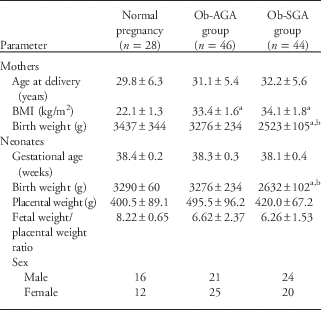
Twenty-eight healthy, normal weight (BMI<25 kg/m2) with no significant past medical history women were included in the control group. Forty-six women with obesity (BMI>30 kg/m2) and normal birth weight were included in Ob-AGA group. Forty-four pregnant women with obesity (BMI>30 kg/m2) who themselves were small for gestational age (SGA) at birth were included in Ob-SGA group (Table 1). All women were non-smokers. The information on maternal birth weight was obtained from medical documentation related to birth certificate kept by the parents of pregnant women. Small for gestational age women were defined as those who were less than the 10th percentile for birth weight corrected for gestational age and sex. 15 The criteria for exclusion in the control, Ob-AGA and Ob-SGA groups were hypertension, proteinuria and hyperuricemia. Hypertension was defined as a blood pressure more than 140/90 mmHg. Proteinuria was defined as >300 mg per 24 h urine collection. Hyperuricemia was defined as >5.5 mg/dl at term.
Clinical characteristics of the mothers and infants involved in the study

a P<0.05 compared with normal pregnancy values
b P<0.05 compared with Ob-AGA group.
Fetal gestational age was calculated from the last menstrual period and confirmed by ultrasound before 20 weeks of gestation. For the neonates, gestational age at delivery, birth weight and length, sex and placenta weight were recorded.
Blood samples
Blood samples were collected at the time of delivery from maternal brachial vein after a 12-h overnight fasting as well as from umbilical vein in tubes containing 1.0 mg/ml Na2EDTA.
Maternal and cord-blood serum samples were allowed to stand at room temperature for 1 h, centrifuged at 2000 g for 20 min, aliquoted under sterile conditions and then stored at −80°C until they were assayed. For analysis plasma was quickly thawed and deproteinized with a solution of 10% sulfosalicylic acid with norleucine added as an internal standard and buffered with lithium hydroxide to pH 2.2. Samples were centrifuged at 14,000 rpm for 10 min and the supernatant fraction was filtered throughout a Millipore (Millipore Corp, Bedford, MA, USA) filter. Plasma amino acid concentrations were determined using automatic amino acid analyser AAA-T339M (Mikrotechna Praha, Czech Republic) according to the user’s manual.
Fetal–maternal amino acid gradient was calculated as a ratio between fetal and maternal concentration of certain amino acid and was used for the assessment of placental concentration function. Maternal glucose, cholesterol and other lipid and lipoproteins fractions were determined by automated clinical analyzer Sapphire 400 (Tokyo Boeki Ltd, Japan).
Statistical analysis
Means and standard errors are reported. After confirming normality of dependent variables by the Kolmogorov–Smirnov test, we analyzed the data. A t-test was used to compare means. ANOVA, followed by Tukey’s test, was used to compare three means. Correlation coefficients between ApoA, ApoB concentrations and amino acid concentrations were calculated by Pearson’s method. The STATISTICA 10.0 (StatSoft) package was used. Significance was accepted at P<0.05.
Results
The characteristics of the subjects are shown in Table 1. The mothers of all groups were matched for the age. There were significant differences for body mass index (BMI) between mothers of the control and both obesity groups. The mean birth weight of Ob-SGA group of mothers was significantly lower than that of the control and Ob-AGA groups of mothers.
The mean birth weight of infants of the Ob-AGA group was not essentially different from that of infants in the control group. The infants of Ob-SGA group mothers were on average smaller at birth than the infants from mothers of the control and Ob-AGA groups. There were no significant changes in placental weight and fetal weight/placental weight ratios between all groups of women.
Maternal cholesterol and lipoprotein concentrations
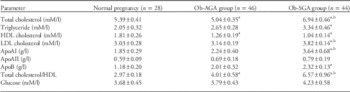
The main serum total cholesterol concentration was significantly higher in mothers of Ob-SGA group than in both the control and Ob-AGA group (Table 2). Triglyceride concentration was higher in Ob-SGA group than in the control group. High-density lipoprotein (HDL) cholesterol was significantly less in both Ob-AGA and Ob-SGA groups than in the control group of mothers. However, low-density lipoprotein (LDL) cholesterol was increased only in Ob-SGA group, apolipoprotein AI was also significantly increased in Ob-SGA group in comparison with Ob-AGA and the control groups. The most dramatic difference between groups was shown in total cholesterol/HDL ratio, which was almost two-fold higher in Ob-SGA group than in the control. This ratio was also significantly increased in Ob-AGA group comparing to the control group. There were no significant differences between fasting glucose concentrations in all groups of mothers.
Mean fasting lipid, lipoprotein and glucose concentrations in pregnant women of control and two obese groups

a P<0.05 compared with normal pregnancy values.
b P<0.05 compared with Ob-AGA group.
Maternal amino acids in obese women
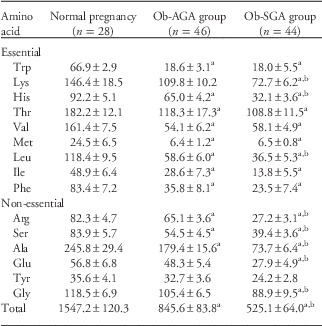
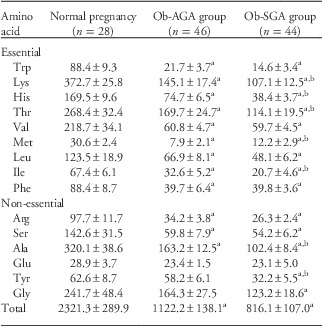
The mean concentration of most maternal amino acids was lower in both groups of obese women. Results for all amino acids required for protein synthesis and their summed total are shown in Table 3. Nine essential and five non-essential amino acids concentrations (except tyrosine) were significantly lower in Ob-AGA and Ob-SGA groups than in the control group mothers. However, the decrease in amino acid concentrations was more prominent in Ob-SGA group. The concentration of lysine in Ob-SGA group was two times lower than in the control group. Lysine concentration in Ob-AGA main group was only 1.3 times lower than in the control.
Maternal plasma amino acid concentrations (µM/l) in control, Ob-AGA and Ob-SGA groups

a P<0.05 compared with normal pregnancy values.
b P<0.05 compared with Ob-AGA group.
The mean total amino acid concentration for women of Ob-SGA group (525.1±64.0 µM/l) was significantly decreased compared with women of Ob-AGA (845.6±83.8 µM/l) and the control (1547.2±120.3 µM/l) groups. Also there was a significant difference between total amino acid concentration in Ob-AGA and the control groups.
Relationship between amino acid concentrations and ApoA, ApoB in maternal plasma
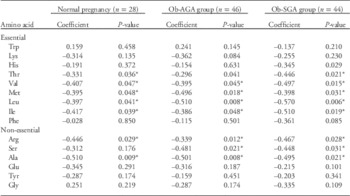
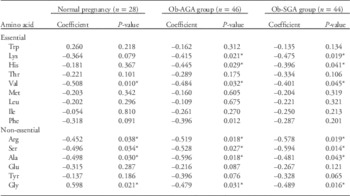
As shown in Table 4 there are negative correlations between ApoA and threonine in the Ob-SGA group, between ApoA and valine, methionine, leucine, arginine in all three groups of women and between ApoA and serine in the Ob-AGA and Ob-SGA groups. Table 5 demonstrates inverse correlation between ApoB and lysine and hystidine in Ob-AGA and Ob-SGA groups and between ApoB and following amino acids: valine, arginine, serine, alanine and glycine in all three groups of women.
Correlation coefficients and P-values between ApoA and amino acid concentrations in maternal plasma

*P<0.05.
Correlation coefficients and P-values between ApoB and amino acid concentrations in maternal plasma

*P<0.05.
Cord blood amino acid concentrations
Obese pregnancy groups had lower umbilical venous plasma amino acid concentrations (except glutamine, tyrosine and glycine for Ob-AGA and glutamine for Ob-SGA groups) than the control pregnancy group (Table 6).
Newborn infants plasma amino acid concentrations (µM/l) in control, Ob-AGA and Ob-SGA groups

a P<0.05 compared with normal pregnancy values.
b P<0.05 compared with Ob-AGA group.
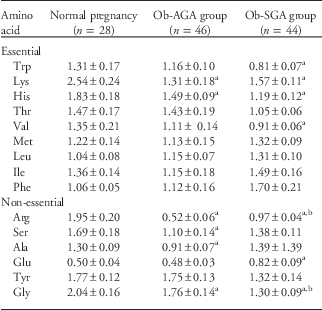
In normal pregnancy umbilical venous plasma concentrations for most essential and non-essential amino acids (except leucine and glutamine) were significantly higher than maternal concentrations (high fetal–maternal amino acids gradient) (Table 7). The fetal–maternal amino acid gradients were lowest in Ob-SGA group. However, for several amino acids (Met, Leu, Ile, Phe) these gradients were higher than in Ob-AGA and the control groups.
Fetal–maternal amino acid gradients for control and obesity groups

a P<0.05 compared with normal pregnancy values.
b P<0.05 compared with Ob-AGA group.
Discussion
This study shows a significant increase in serum lipids which is more prominent in the Ob-SGA group. Women of this group had serum concentration of total cholesterol that would be considered as an increased risk of cardiovascular disease in nonpregnant women. We have also shown that the concentrations of LDL cholesterol and their corresponding apolipoproteins B and AI are increased in women of Ob-SGA group. The increase in total, LDL cholesterol and triglyceride has been demonstrated during normal pregnancy.Reference Ordovas, Pocovi and Grande 16 , Reference Piechota and Staslewski 17 The mechanism whereby pregnancy induces hyperlipidemia has not been fully elucidated. The positive correlation between changes in the lipid and lipoprotein concentration and pregnancy hormones (estradiol, progesterone and human placental lactogen) has been demonstrated.Reference Desoye, Schweditsch, Pfeiffer, Zechner and Kostmer 18
Although the significance of these changes in plasma lipids and lipoproteins is uncertain, they are likely to relate to the maintenance of energetic fuel to the fetus.Reference Martin, Davies, Hayavi, Hartland and Dunne 19
Estrogens could be responsible for most of the changes in lipoprotein metabolism during pregnancy, but its effects are complemented and opposed by the other pregnancy hormones (progesterone) and by increasing insulin resistance in late pregnancy. Our study demonstrates that lipid and lipoprotein concentration in obese pregnant women who themselves were born SGA could be significantly increased in comparison with the control women and women with diet-induced obesity. We suggest that potentially the Ob-SGA group could be atherogenic. The changes in lipid profile observed in women of Ob-SGA group may be of potential importance for women’s long-term health because elevated serum triglycerides are independent risk factors for coronary heart disease in women.Reference Hachey 20
The complex nature of apolipoproteins synthesis and metabolism has been demonstrated in many studies based upon the use of labeled amino acids.Reference Patterson, Hachey and Cook 21 , Reference Cohn, Wagner, Cohn, Millar and Schaefer 22 In this study we assessed the relationship between ApoA, ApoB and several amino acids concentrations in maternal plasma. Negative correlations (correlation coefficients from −0.3 to −0.5) were seen between these apolipoproteins and several amino acids concentrations. Negative correlation between ApoA and threonine concentration was demonstrated only in Ob-SGA group and between ApoA and serine concentration in both groups of obese mothers. Inverse correlations between ApoB and lysine, hystidine concentrations were also seen only in obese women. Earlier the inverse association was demonstrated between intakes of alanine, isoleucine, methionine, serine, tryptophan, tyrosine and ApoA/ApoB ratio among female adolescents.Reference Bel-Serrat, Mouratidou and Huybrechts 23 One can speculate that the increase of the amino acids contribution to the synthesis of apolipoproteins could diminish the role of such amino acids as an energetic fuel to the fetus.
It was shown earlier, that women who were SGA at birth are at increased risk of developing hypertension during pregnancy.Reference Klebanoff, Secher, Mednick and Schulsinger 24 Also it was shown that maternal hypercholesterolemia dramatically raised the cumulative area of intimal lipid accumulation and the area of the largest lesion per fetal aortic section, increasing offspring risk of future cardiovascular disease.Reference Napoli, D’Armiento and Mancini 25
Our results support the Barker theory that malnutrition and impaired fetal growth are associated with an increased risk of developing a variety of risk factors for cardiovascular disease, including dyslipidemia during adulthood.Reference Barker 26
Amino acids
Amino acids along with glucose and lactate represent major nutrients used by fetus both for protein synthesis and oxidation.Reference Battaglia and Regnault 8 It is demonstrated that amino acid concentrations are higher in the fetal than in maternal body. Number of studies has provided evidence for significant participation of placenta in amino acid metabolism.Reference Cetin 27
Amino acids uptake across the syncytiotrophoblast membranes is mediated through active transporters and exchangers. Active accumulative transporters increase intracellular amino acid concentrations by transferring these substances against their concentration gradient, usually by co-transporting extracellular sodium.Reference Broer 28 Exchangers are able to modify amino acid content by exchanging amino acids between intracellular and extracellular compartments.
The placenta not only concentrates amino acids in the fetal compartment but is also involved in synthesis of some non-essential amino acids. As recently demonstrated, some external factors may regulate the activity of amino acid transporters (such as oxygenation, insulin, leptin).Reference Desforges, Greenwood, Glazier, Westwood and Sibley 29
Fetal intrauterine growth is the result of interaction between maternal–placental nutrient supply and genetically determined growth potential.Reference Battaglia and Regnault 8 Some factors may influence fetal nutritional supply: maternal nutrition, uteroplacental circulation, and placental transfer capacity.Reference Jansson, Ylven, Wennergren and Powell 30 We demonstrated that newborn infants of Ob-SGA group women were born SGA. Moreover, in this group umbilical concentrations for most amino acids were significantly lower than in the control and even in Ob-AGA group. Earlier it was shown that concentration of most amino acids is significantly decreased both in the umbilical artery and vein of intrauterine growth restriction (IUGR) pregnancies when it compared to normally grown babies.Reference Economides, Nicolaides, Gahl, Bernardini and Evans 31 , Reference Cetin, Corbetta and Sereni 32 However, in IUGR maternal concentrations of the most essential amino acids were significantly higher than in pregnancies with appropriate for gestational age fetuses.Reference Economides, Nicolaides, Gahl, Bernardini and Evans 31
In IUGR pregnancies, increasing the maternal concentration of amino acids leads to an increased umbilical uptake of some of the amino acids to the fetus. However, the changes in the uptake of the essential amino acids such as lysine, histidine, threonine, valine, and phenylalanine suggest the presence of competition for the same transporter that might diminish the transport.Reference Marconi, Paolini and Stramare 33 Studies in human pregnancies demonstrate that during constant infusion of L-[1-13C]-leucine, the fetal–maternal leucine gradient decreases in IUGR in parallel with clinical severity.Reference Marconi, Paolini and Stramare 33 It was suggested than not only the transplacental transport of leucine is impaired but also a possible increased protein catabolism in IUGR pregnancies.Reference Solomons 35 The injection as a bolus of two essential amino acids, leucine and phenylalanine demonstrated in IUGR pregnancies decreased fetal–maternal gradient in comparison with AGA pregnancies, whereas no differences were presented for the nonessential amino acids glycine and proline.Reference Paolini, Marconi and Ronzoni 34
We have demonstrated that Ob-SGA group had the lowest fetal–maternal amino acid gradients for most amino acids that could reflect the impaired concentration/synthetic function of the placenta. However, these gradients for Met, Leu, Ile, Phe were higher in Ob-SGA group than in other groups of women. It could be the result of changing the balance between placental amino acid transporting systems in such type of obesity. Many types of these systems have been identified in the placenta.Reference Battaglia and Regnault 8 Each transporter is highly stereospecific, but different transporting systems have overlapping substrate specificity, with possible compensation of one system by another.Reference Battaglia and Regnault 8
It is interesting that we demonstrated increase in fetal–maternal gradient for leucine and phenylalanine in OB-SGA group in contrary to the results shown by Paolini et al.Reference Paolini, Marconi and Ronzoni 34 One can speculate that changes in placental transporting function in obese mothers born themselves SGA significantly differ from corresponding placental changes in IUGR.
The fetal growth and metabolism are adaptive processes and programmed by the intrauterine nutrition and environment.Reference Solomons 35 Furthermore, as suggested earlier, the placenta could play a role of a nutrient sensor.Reference Jansson and Powell 36 If the placenta senses the fetal environment with low nutrient levels, it increases its transport activity to support normal fetal growth. On the other hand, if there is an insufficient nutrient supply at the maternal site, the placenta may diminish its transport activity, adapting fetal growth to a lower level, in order to reduce the postnatal demand.Reference Economides, Nicolaides, Gahl, Bernardini and Evans 31
In our study, decreased fetal–maternal amino acid gradients for most amino acids observed in Ob-SGA group suggest that placental amino acid exchange and/or fetal–placental metabolism are altered in obese women who were born SGA. We can also suggest that hypercholesterolemia in Ob-SGA women could affect the fetal amino acid metabolism due to the reciprocal relationship between fetal energy supply and placental amino acid transport. One can speculate that significant changes in lipids and apolipoproteins metabolism during the intrauterine development of Ob-SGA women affected future placental function in a specific manner that resulted in the development of low birth weight infants.
Limitation
The limitation of this research project is that authors have no complete information on the cause of maternal SGA women of Ob-SGA group.
Acknowledgments
This research was supported by grant from Russian Academy of Sciences (12-P-4-1036).