Introduction
The Dominican Republic has a restrictive abortion policy; not even in cases of incest and rape is abortion permitted (Rights, Reference Rights2005). The strict nature of this law has encouraged the practice of unsafe and clandestine abortions (Paiwonsky, Reference Paiwonsky1999). In 1992, 16,500 women were treated for abortion complications in hospitals; the annual rate of admission to hospital for treatment of complications from abortion is 9.8 per 1000 women aged 15–44 years (Singh, Reference Singh2006). The World Health Organization estimates that in the year 2003, 12% of maternal deaths in the Latin American and Caribbean region were attributable to unsafe abortion (World Health, 2007). The high rates of maternal mortality and morbidity in the Dominican Republic have been attributed to the poor quality of obstetric services in hospitals, including post-abortion care (PAC). A myriad of factors contribute to the poor quality of obstetric care, including the lack of obstetric protocols and poor adherence to protocols that do exist, inadequate medical supplies, overcrowded hospitals and poorly trained staff (Miller et al., Reference Miller, Tejada, Murgueytio, Diaz, Dabash and Putney2002). Although recent work suggests that the increased use of misoprostol (Cytotec) has contributed to a decrease in abortion-related maternal mortality (Miller et al., Reference Miller, Lehman, Campbell, Hemmerling, Anderson and Rodriguez2005), women who use misoprostol often require treatment to complete the abortion, and officials have begun to press charges against doctors who provide, and women who seek, PAC services under these circumstances (Robles, Reference Robles2007).
Post-abortion care is critical to saving women's lives and preventing future unwanted pregnancies and repeat abortions. The core components of a PAC standard of care include emergency treatment, counselling, and partnerships between community members and service providers to prevent unwanted pregnancy and unsafe abortion (Corbett & Turner, Reference Corbett and Turner2003; Solo et al., Reference Solo, Curtis, Malarcher and Leonard2004). The counselling component includes providing information on contraception and providing the client's preferred method; testing for and treating sexually transmitted infections (STIs), including HIV (or referral to services where these services can be obtained); and offering information on post-abortion complications so patients can seek appropriate follow-up care when necessary.
The WHO (Olukoya et al., Reference Olukoya, Kaya, Ferguson and AbouZahr2001) and the PAC Consortium (www.pac-consortium.org), which provides technical guidance to programme planners on making PAC services more youth-friendly, both contend that the needs of adolescent PAC patients differ from those of older women seeking the same services. In part, this is because younger women are different from adult women in that they are more likely to delay seeking an abortion and are more likely to seek an unsafe abortion, increasing their risk of complications. They are less likely to seek PAC treatment once complications occur (Pathfinder International et al., 2001; Youth Friendly P. A. C. Working Group, 2006). Adolescents have less frequent sexual activity, more partners and higher rates of forced sex than older women (Pathfinder International et al., 2001). For many adolescents, PAC services may be their first contact with a reproductive health service and their first opportunity to receive comprehensive counselling on pregnancy and HIV/STI prevention. PAC providers need to be equipped with adequate counselling skills to meet the needs of the adolescent PAC patient; this includes being sensitized to the circumstances that place young people at risk for unwanted pregnancies and allowing more time to explain reproductive information in detail, including addressing misinformation or misperceptions, strategies to negotiate condom use, and dual protection (Group, Reference Group2006).
Despite the call for youth-friendly PAC services, only a few studies have specifically focused on adolescent PAC patients, and these have examined the types of abortion complications experienced by adolescents, the kinds of providers who perform the abortion, reasons for seeking abortions, and parental involvement in minors' decisions to obtain abortions (Leke, Reference Leke1989; Archibong, Reference Archibong1991; Thapa et al., Reference Thapa, Thapa and Shrestha1992; Henshaw & Kost, Reference Henshaw and Kost1992; Barnett, Reference Barnett1993).
EngenderHealth conducted a qualitative study in the Dominican Republic in 2002 and another in Malawi in 2003 to determine how hospitals can better meet the needs of adolescent PAC patients. Young PAC patients in the Dominican Republic reported fear of sterility, and women in Malawi feared death (Girvin, Reference Girvin2004). Patients reported that PAC counselling was not provided, despite their need for information, particularly on contraception. In the Dominican Republic, 33 of the 40 adolescents interviewed had not wanted to become pregnant, but were not using a contraceptive method at the time they became pregnant. While most of the adolescents interviewed knew about contraception, most doubted that contraceptive methods were effective at preventing pregnancy. Studies on PAC providers' attitudes and practices have documented that some providers perceive abortion and non-marital sex as immoral, and they provide PAC services to young women begrudgingly (if at all), often blaming and stigmatizing young women for their circumstances (Farfan et al., Reference Farfan, Kestler, Aguilar, Mercedes, Jarquin and Vallecillos1997; Díaz et al., Reference Díaz, Loayza, Torres de Yépez, Lora, Alvarez and Camacho1999; EngenderHealth & Centro De Estudios Sociales Y, 2003).
Counselling on contraception and provision of contraceptive methods are key components of all PAC service delivery models. In a review of ten PAC operations research studies conducted in Latin America, Billings & Benson (Reference Billings and Benson2005) documented improvements in contraceptive counselling and subsequent contraceptive uptake with modest intervention efforts. Studies carried out in the Dominican Republic highlight the need to improve the public sector's post-abortion services offered to women of all ages. One major concern in the public PAC services in the Dominican Republic is that contraceptive counselling is sporadic and methods are not readily available to patients (Miller et al., Reference Miller, Tejada, Murgueytio, Diaz, Dabash and Putney2002; EngenderHealth & Centro De Estudios Sociales Y, 2003).
Between 2002 and 2007, CONECTA (a project funded by the United States Agency for International Development in the Dominican Republic) worked to reduce maternal mortality and improve adolescent health care in public hospitals in the Dominican Republic. A main focus of their strategy was to work with smaller hospitals to improve essential and emergency obstetric care by upgrading hospital facilities, establishing obstetric protocols and training personnel. In addition, activities were carried out to generate demand for obstetric services in the communities served by these smaller hospitals. These activities were seen as crucial to relieving the burden on the large understaffed and overcrowded maternity hospitals. As part of this work, CONECTA trained staff in smaller hospitals in the clinical treatment of PAC patients and the use of manual vacuum aspiration (MVA). In addition, CONECTA established adolescent integrated care units, where providers were trained to better meet the health needs (e.g. family planning, prenatal care) of adolescents.
In 2005, the YouthNet project implemented an intervention to complement CONECTA's efforts to establish PAC services in the smaller hospitals. This intervention focused on improving PAC providers' counselling skills and patients' acceptance of a contraceptive method, with a special emphasis on meeting the needs of the adolescent patient. The YouthNet intervention efforts were evaluated in a larger study (McCarraher et al., Reference McCarraher, Oronoz, Grey, Tucker, Chen and Bailey2007). This paper reports on the subset of the study findings, namely, the impact of the intervention on PAC provider knowledge, attitudes and behaviours and an assessment of the differences in the counselling and the contraceptive method received by adolescent patients prior to discharge in comparison with older patients.
Methods
The intervention and study were implemented in four public hospitals that were supported by the CONECTA project. Three hospitals were located in the Santo Domingo area and the fourth was located in La Romana, two hours east of Santo Domingo.
Providers
The study used a non-experimental pre/post-test design to evaluate the impact of the intervention efforts on PAC providers' knowledge, attitudes and behaviours. One female research assistant was assigned to each study hospital. CONECTA provided the research assistants with a list of all PAC providers who were providing PAC services at the study hospitals, including obstetricians/gynaecologists, general doctors, licenced nurses and auxiliary nurses. The research assistants attempted to interview all of the providers on the list but also interviewed providers who were providing PAC services but not on the initial list provided by CONECTA. The research assistant read the oral consent form to the provider and after the provider agreed to participate, conducted the face-to-face interviews at the hospitals at a time and place that was convenient for the provider. The interviews were conducted in Spanish and contained mainly close-ended questions. The interviews investigated provider attitudes toward PAC patients and basic PAC knowledge and the counselling and information they gave patients on the clinical treatment they received, risk for pregnancy and STI/HIV, contraceptive options and post-abortion complications. Eighty-eight providers were interviewed as part of the baseline between September and October 2004. For the follow-up data collection, 88 providers were interviewed between February and July 2006, approximately 6 months after the intervention activities were implemented. Providers were not excluded from the follow-up interviews based on their participation in the intervention activities, as staff migration between hospitals is common, and hospitals are expected to be able to sustain intervention activities and ensure that new staff are appropriately trained. The response rates for both data collection periods were over 90%.
Patients
A post-test only study design was used to assess the impact of the intervention on the patient outcomes of interest. This design was chosen because three of the four study hospitals did not offer PAC services to patients prior to the implementation of the intervention efforts, making a baseline survey not feasible.
The primary indicator of success was for the overall study was the proportion of adolescents, among those who wanted to delay pregnancy, who were discharged with a contraceptive method. This indicator encompassed many of the aspects targeted in the intervention efforts, such as contraceptive counselling and providers' attitudes regarding contraception for adolescents, and adequate access to methods. The goal set for the intervention was for at least 60% of the PAC adolescent patients treated at the study hospitals being discharged with a contraceptive method. A total of 140 adolescents were needed to estimate the proportion receiving a contraceptive method within 8 percentage points of 60% with a confidence level of 95%. The goal was to recruit the same number of older PAC patients for comparison purposes. This sample size provides 80% power to detect a difference of at least 15% (e.g. 60% for adolescents and 75% for older women) in the contraceptive uptake rate (two-sided) with a significance level of 5%.
A two-step process was used to recruit PAC patients into the study. Due to confidentiality concerns, the hospital staff (not the research assistants) asked the adolescent PAC patients who had received PAC clinical services (MVA or dilation and curettage (D&C)) if they would be willing to take part in a research study about the services they received. Those who agreed to participate were introduced to the research assistant by the hospital staff. The research assistant read the consent form to the patient, which contained detailed information on the purpose of the study, the patients' role in the study, and the risks and benefits associated with study participation. After the PAC patient agreed to participate, the interviews were conducted at the bedside. Parental consent was only obtained for adolescents who were accompanied by a parent because it would have been difficult to interview an adolescent PAC patient without the consent of the accompanying parent. To protect the confidentiality of the treatment received by the PAC patient, particularly in cases where the parent may not be well informed about the services their child received, the words ‘post-abortion care’ were not used on the parent consent form and the PAC services were referred to as ‘the services your adolescent child received here today’. Parental consent was not obtained from adolescents who presented at services without a parent since seeking consent in these circumstances could potentially harm adolescents whose parents were unaware of their child's need for PAC services. For every adolescent PAC patient enrolled into the study, an older PAC patient was recruited. After a young patient was identified, the next older patient admitted for PAC services at the same hospital was asked to participate in the study, using the same two-step process outlined above.
The intention was to interview all PAC patients just before their discharge from the hospital. However, due to an error in data collection, 23 patients were interviewed well before discharge. A questionnaire that contained mainly closed-ended questions was administered at the bedside when the PAC patient was comfortable enough to be interviewed. Interviews were conducted in Spanish and included information on the counselling they received, their desire for children in the future, and whether or not they were leaving the study hospital with a contraceptive method.
One-hundred and forty adolescents aged 12–19 and 134 older PAC patients aged 20–35 accessing PAC services at the study sites were interviewed between February and July 2006. During this time period, a total of 158 adolescents were eligible for the study, yielding a response rate of 89%. Adolescents were not interviewed if they were going to be transferred to another facility (n=7), they denied being a post-abortion patient (n=5), they were in too much pain (n=2), and for other reasons (n=4). Only one adolescent patient refused to be interviewed. A total of 305 women aged 20–35 were treated at the study hospitals for post-abortion complications during this time period. Of these, 134 were matched with an adolescent patient by study hospital and time of arrival. The response rate among the older women was high; three women were excluded because they were being transferred to another facility for treatment and one participant reported she was in too much pain.
The study was reviewed and approved by the Protection for Human Subjects Committee at Family Health International. None of the study participants received incentives to participate in the study.
Design of the intervention
Details of the intervention activities are described in detail in the final report of the study (Mccarraher et al., Reference McCarraher, Oronoz, Grey, Tucker, Chen and Bailey2007). In brief, in March 2004, the study hospitals were visited to assess the willingness of hospital administrators and providers to participate in the study, the availability of contraception at the study sites and the status of the hospitals' PAC services. All hospitals agreed to participate in the study. Two of the study hospitals received their contraceptive supplies from a non-governmental organization (NGO) and did not experience stock-outs. The other two study hospitals did not have a consistent supply of contraceptives and had experienced stock-outs. However, at the time of the assessment visits, all study hospitals had contraceptive methods in stock.
The goal of the intervention was to improve the PAC counselling given to all patients, with special attention being given to meeting the needs of the adolescent patient. The assessment and provider baseline findings were used to develop intervention activities and materials, including a provider training curriculum, a provider counselling guide, a poster and a patient brochure. These were based on existing materials, were reviewed and revised based on input by EngenderHealth, IPAS, Pathfinder, and other members of the PAC consortium, and were pre-tested. The provider counselling guide was pre-tested during three separate focus groups with 23 PAC providers. The patient poster and brochure were pre-tested via five focus group discussions with adolescents. Four focus groups were held with adolescents, a few of whom have utilized PAC services themselves. One focus group discussion was held with a group of adolescent peer educators. The pre-test results were used to revise the intervention materials.
Three-day provider training was conducted in June and July of 2005. The interactive training focused on key PAC counselling messages, the use of the counselling guide and other intervention materials. An entire day was dedicated to discussing the Ministry of Health norms for providing care to adolescents, providers' attitudes towards adolescent PAC patients, and factors that predispose adolescents to unwanted pregnancy and subsequently abortion, such as violence and coercion, lack of information about conception and contraceptive methods and reliance on peers for information about sex and pregnancy prevention. Follow-up meetings were held in the study hospitals one to two months (August and September 2005) after the training to answer any questions providers had about the training or the materials.
Outcome measures
The primary outcome of interest for PAC patients focused on those who wished to delay pregnancy. The proportion of patients who were subsequently discharged with a contraceptive method was estimated. Women who reported they wanted to delay pregnancy for at least one month or were unsure when they wanted to become pregnant again were defined as having a need for contraception. The interval of one month was chosen because the return to fertility among PAC patients is almost immediate. For women who wished to delay pregnancy, the percentage of women who received a contraceptive method was calculated. It is not known if patients who were interviewed significantly prior to being discharged did in fact leave the hospital with a method. Therefore, the patients' responses to whether they left the hospital with a contraceptive method were coded as yes, no, don't know/missing, and unclear (referring to those interviewed in advance of discharge). In the multivariate analysis, this outcome variable was coded dichotomously, with the no, don't know and unclear responses collapsed into the reference category.
In addition, responses from adolescents and older women were compared with respect to five secondary outcomes, namely, whether they were: (1) asked if they wanted to use a method of contraception (coded dichotomously yes/no); (2) counselled on the immediate risk of pregnancy (coded dichotomously yes/no); (3) told about the methods available in the hospital (coded dichotomously yes/no); (4) reasons why patients were not leaving the hospital with a method of contraception and; (5) the method received prior to hospital discharge.
Socio-demographic variables – education, number of living children and marital status – were measured because they were important predictors of contraceptive uptake in other studies conducted in the Dominican Republic (Castro Martin & Njogu, Reference Castro Martin and Njogu1994; Population Council & Macro, 2006). Finally, information on employment status, living with a parent, and being accompanied to the hospital were assessed to investigate differences between the adolescents and older women.
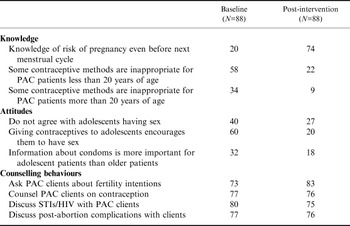
Percentage of providers that endorse knowledge, attitudes and counselling behaviours at baseline and post-intervention

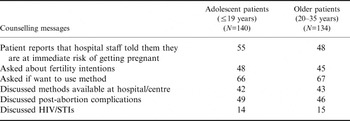
Percentage of patients who reported receiving counselling messages

Statistical methods
All analyses were conducted using the statistical package SAS 9.1. Providers' findings were analysed descriptively and changes in provider knowledge and attitudes were assessed. For patient outcomes, the estimates of contraceptive uptake for both age groups (adolescent and older patients) and their corresponding 95% confidence intervals were computed. Second, the outcomes between these two groups were compared using conditional logistic regression models to account for matching resulting from recruiting older participants based on the same hospital and time/day as adolescent participants. To account for differences in various socioeconomic variables between the two age groups, the models related to contraception controlled for potential confounding effects of marital status, education, parity and prior contraceptive use. The models related to the immediate risk of pregnancy controlled for the socio-demographic variables only and not previous contraceptive use. The odds ratio and 95% confidence interval were tabulated.
Results
Eighty-eight providers were interviewed at baseline and post-intervention, and of these 70% participated in the CONECTA/FHI post-abortion training. More than two-thirds of the nurses, general doctors and obstetricians/gynaecologists interviewed were women.
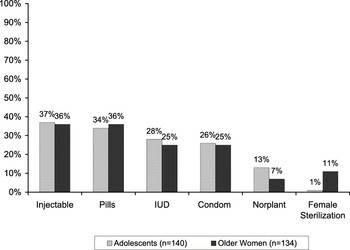
Patient report of the contraceptive methods discussed by patient age.

The baseline assessment revealed important gaps in provider knowledge. Only 20% reported that a PAC patient is at immediate risk of pregnancy, even before she has her next menstrual period. After the intervention, this percentage increased to 74%. While the majority of providers at baseline (89%) and follow-up (94%) reported that severe bleeding was a post-abortion complication, knowledge of other complications increased after the intervention as well: vaginal secretions with bad odour (30% vs 65%), fever (75% vs 92%) and dizziness (12% vs 41%).
At baseline more providers considered some contraceptive methods inappropriate for adolescent PAC patients than for older PAC patients (58% vs 34%). After intervention, these percentages decreased (22% vs 9%) but the gaps between the two groups remained, with a larger proportion of providers considering some methods inappropriate for adolescents. In addition, after intervention, providers reported better attitudes towards adolescents (Table 1). With respect to counselling behaviours, a high proportion (>70%) of providers reported they asked patients about their fertility intentions and counselled them on contraception, STI/HIV and post-abortion complications.
Compared with provider reports, fewer PAC patients indicated they received the counselling on risk of pregnancy, fertility intentions, contraceptive method availability, STI/HIV risk and post-abortion complications (Table 2). However, these proportions were similar among adolescents and older women. Half of the patients reported that they were told that their risk for pregnancy was immediate and two-thirds reported that providers asked them if they wanted to use a contraceptive method. Slightly more than a third of patients were counselled on injectables and pills (Fig. 1). Approximately one-quarter reported they were counselled on IUDs and condoms. Finally, fewer adolescents were counselled on female sterilization than their older counterparts.
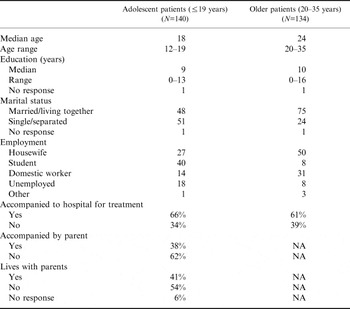
Median values and percentage distribution of selected socio-demographic characteristics stratified by patient age

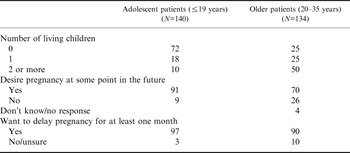
The median ages of the adolescents and the older women were 18 and 24, respectively (Table 3). The two groups had similar levels of education. More of the older women were married (75%) than the adolescents (48%). About 60% of both groups reported that someone accompanied them to the hospital. A larger percentage of the adolescents were still attending school, and half of the older women reported they were housewives. Thirty-eight per cent of adolescents were accompanied by a parent and 40% of adolescents lived with their parents.
The majority of older women had children, whereas only about a quarter of the adolescents had children (Table 4). Approximately a quarter of the older women and 9% of the adolescents reported they did not want to become pregnant in the future. Ninety per cent or more of all the participants reported they wanted to delay a subsequent pregnancy for at least one month.
Median values and percentage distribution of selected reproductive health characteristics stratified by patient age

For the following results the focus was on PAC patients who indicated they wanted to delay pregnancy for at least one month. Given that risk of pregnancy is almost immediate, women who wish to delay pregnancy for a month or more have an immediate need for contraception.
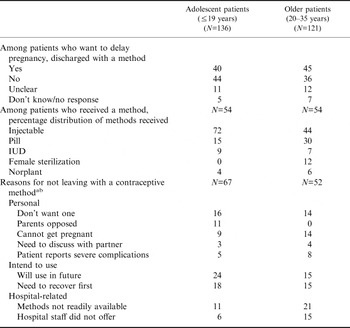
About 42% (95% confidence interval [CI]: 36–48%) of patients wishing to delay pregnancy were discharged with a contraceptive method. Forty per cent of adolescents (95% CI: 32–48%) and 45% of older women (95% CI: 36–54%) left hospital with a method (Table 5). This is probably a conservative estimate, because some patients were interviewed well before they were discharged (11% of adolescents and 12% of older women). Of adolescents who received a method, the majority received an injectable. Older women most often received an injectable or oral contraceptive pills. Twelve per cent of older women were discharged with appointments to be sterilized. No patients received condoms.
Percentage distribution of patients who wanted to delay pregnancy who were discharged with a contraceptive method, and reasons for not receiving a method

a Among those who were coded as no, don't know or no response to the question about leaving the hospital with a contraceptive method.
b Multiple responses allowed, thus percentages do not sum to 100%.
Adjusted odds ratios and 95% confidence intervals for conditional logistic regression analyses for the association between patient age and the study outcomes

a Adolescents (N=136) vs reference category older women (N=121). Adjusted for martial status, education, number of living children and previous contraceptive use using conditional logistic regression models.
Adolescents and older women differed only slightly in the reasons they gave for leaving hospital without a contraceptive method (Table 5). For adolescents, parental opposition was an important factor, whereas method availability and not being offered a method were cited more often by older women. Both adolescents and older women reported leaving without a contraceptive method because they believed they could not get pregnant. Finally, a large proportion of adolescents and older patients reported they intended to use a method at some point in the future but were not prepared to accept one at the time of their hospital discharge.
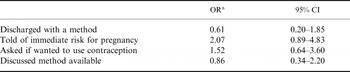
In the multivariate analyses, patient age (adolescent vs older women) was not a significant predictor of any of the study outcomes related to family planning (discharged with contraceptive method, counselled about immediate risk of pregnancy, asked if want to use family planning and told about methods available) after controlling for factors including marital status, education, number of living children and previous use of contraception (Table 6).
Discussion
The most important contribution of this study is that it expands the evidence base regarding adolescents seeking PAC services. Provider knowledge increased and attitudes towards working with adolescents improved. Adolescents and older women reported receiving PAC counselling messages and were discharged with contraceptive methods at similar rates. This was the finding anticipated given that the intervention efforts were focused on meeting the needs of adolescents. Worse outcomes for adolescents would have been anticipated if the intervention efforts did not have this focus. These findings also suggest that efforts to improve PAC contraceptive counselling and contraceptive uptake that include dedicated materials and training time to meeting the needs of adolescents, can benefit both adolescents and older women.
The intervention efforts were successful in improving provider knowledge and attitudes towards adolescent PAC patients. However, efforts to improve contraceptive uptake among adolescents met with less success than other efforts in Latin America, which have reported post-intervention contraception uptake of approximately 50% or greater among PAC patients (Díaz et al., Reference Díaz, Loayza, Torres de Yépez, Lora, Alvarez and Camacho1999; Medina et al., Reference Medina, Vernon and Aquilar2001; Kestler et al., Reference Kestler, Valencia, Del Valle and Silva2006). This rate of uptake is similar to or higher than the rate of contraceptive use among adolescents in the general population (Achécar et al., Reference Achécar, Ramírez, Polanco, Ochoa, Lerebours and García2003). Perhaps the benchmark of 60% was too high given that PAC services were not routinely offered at three of the four study hospitals before CONECTA's and this study's intervention efforts. At the final dissemination meeting, only one study hospital reported that it currently had methods available in the wards where patients recover. No condoms were available for distribution at any of the study hospitals. This is especially problematic given that condom use is the second most popular contraceptive method among unmarried, sexually active women between the ages of 15 and 24 (Achécar et al., Reference Achécar, Ramírez, Polanco, Ochoa, Lerebours and García2003). Post-abortion care is an opportunity to give condoms to adolescents who already use them and to promote condom use among those who do not, and this opportunity should not be wasted.
For adolescents, the intention to use a contraceptive method in the future (but not immediately) and parental opposition were cited as reasons for not accepting a method before leaving the hospital, whereas hospital-related factors and the belief they could not become pregnant played a larger role for older women. Both the intention to use a method in the future and hospital-related factors can in part be addressed by improved counselling efforts. Providers should take every opportunity to remind women that their risk of pregnancy is immediate. Linkages to contraceptive services are critical for PAC patients (Solo et al., Reference Solo, Billings, Aloo-Obunga, Ominde and Makumi1999) and providers need to be reminded that one way to prevent repeat unplanned pregnancies and repeat abortions is to offer women contraception (Johnson et al., Reference Johnson, Ndhlovu, Farr and Chipato2002; Gillespie, Reference Gillespie2004).
Improved counselling is only one strategy to increase contraceptive uptake. Despite efforts to emphasize the importance of having contraceptive methods available to patients at all times, these changes were not institutionalized in three of the four study hospitals. Providers from these hospitals who attended the dissemination meeting reported that in order to prevent theft, contraceptives are often kept in locked cabinets, and in most instances only one member of staff had access to the keys. Twenty-one per cent of older women and 11% of adolescents reported leaving the hospital without a contraceptive method because the hospital did not have the one they wanted. Unfortunately, the contraceptive counselling and provision of family planning methods to post-abortion care patients in the Dominican Republic remains problematic. A situational analysis of the contraceptive provision of post-abortion care clients in 59 hospitals and health centres conducted by the Population Council reported only 12% of patients received contraceptive counselling and 9% were discharged with a contraceptive method (Quiterio et al., Reference Quiterio, Molina, Miric, Vernon and Rivero-Fuentes2008). One of the biggest barriers to receiving a contraceptive method was that family planning services are offered during limited time periods (mainly in the morning) whereas most post-abortion patients are discharged in the afternoon. In addition, contraceptive methods were not available in some PAC treatment areas and one-quarter of the facilities visited were out of stock of one or more of the contraceptive methods.
The inherent biases with self-reported data are important limitations in this study. While provider attitudes and knowledge increased over time, provider self-reported counselling behaviours were reported at high rates and were consistent over time. For example, 77% of the providers interviewed at baseline and 76% interviewed at follow-up reported that they routinely discussed contraceptive methods with PAC patients. Moreover, disparities were noted in the provider and patient reports. Following the example above, about 40% of the patients interviewed reported that providers discussed contraceptive methods with them. The disparity between provider and patient reports can in part be attributed to different biases associated with self-reported data. In the case of the provider, social desirability bias most likely influenced providers to over-report their counselling behaviours. This type of bias occurs when respondents distort the truth in ways that the respondent believes will be perceived as favourable (Miller et al., Reference Miller, Fisher, Miller, Ndhlovu, Maggwa and Askew1997; Stuart & Grimes, Reference Stuart and Grimes2009). In this case, PAC providers report they are counselling PAC patients in part due to the fact they believe they should be doing so. The PAC patient interviews were subject to recall bias. Given that patients had just received treatment and could be in some discomfort it is possible they do not remember all of the details of their counselling experience. Besides the potential biases inherent in the data collection processes, the comparisons between the self-reported provider and patient data should be viewed with caution because the reports are not linked directly to one another and therefore do not represent a direct comparison about what a provider and a patient report about the same counselling event. One way to eliminate or minimize these biases would have been to conduct direct observations of the counselling sessions. The ethics board that reviewed this study felt that direct observation of the provider–patient interactions would undermine the adolescent patient's confidentiality and limit the patient's willingness to ask the provider questions.
There are other important study limitations that should be considered. First, as noted in the results, for some women it was unclear if they left the hospital with a contraceptive method due to an error in data collection. Thus, the estimates of contraceptive uptake presented in this paper are conservative. Eliminating this group would lead to higher estimates of contraceptive uptake, but would not change the comparisons substantially. Second, baseline data were not collected for PAC patients since three of four study hospitals were just starting to treat PAC patients making baseline assessment not feasible. In addition, the study did not employ a control group. While these results are suggestive of the intervention efforts benefiting both younger and older women, the methodological limitations limit the ability to state that the findings are conclusive and directly attributable to the intervention efforts. A more rigorous study, one that employs an adequate control group, is needed to adequately evaluate the intervention efforts. Despite all of these limitations, training to implement or improve PAC services should not overlook the needs of adolescents. Improvements in provider attitudes towards this vulnerable group are important to increase the quality of the post-abortion care services adolescents receive and to bring them the level of the services received by adult patients.
Acknowledgments
This study was funded by the United States Agency for International Development (USAID) through a five-year cooperative agreement (No. GPH-A-00-01-00013-00) entitled YouthNet. This global programme was awarded in October 2001 to Family Health International, which worked in partnership with CARE USA and RTI International.