Significant Outcomes
-
• In summary, the present study could prove that methylphenidate has a positive yet non-significant effect on facial affect recognition abilities of ADHD patients. Reasons for that are thought to lie in different fields of the interactions between diagnosis and medication, one of which would be within the endophenotype theory.
Limitations
-
• There are some limitations to the present study. First of all the sample size of 21 individuals must be mentioned, which is too small to show significant results for minor differences. Moreover, the FEFA tasks did not have a time limit for their answers. The tester tried to encourage the children to take a decision if they hesitated for too long, but nevertheless did the time vary. This could have an effect on the results, as the degree of impulsivity could be less pronounced without being pressed for time.
-
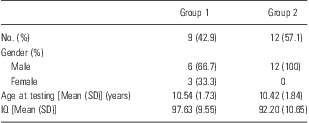
Methylphenidate leads to an amelioration of inhibition control (Reference Scheres, Oosterlaan and Swanson1). If those deficits are less distinctive without time pressure, it might explain why methylphenidate lacks the significance. Furthermore, there may be an allocation bias because group assignment was not randomised. Therefore, the number of participants was unequal (9 and 12 in Group 1 and 2) and all three participating girls were found in Group 1, accounting for 1 of 3 of all group members.
Introduction
Attention-deficit/hyperactivity disorder (ADHD) is a neurodevelopmental disorder with the three key symptoms attention-deficit, impulsivity and hyperactivity (2). About 5% of school-aged children are affected, (Reference Huss, Hölling, Kurth and Schlack3) with a predominance of boys (Reference Ramtekkar, Reiersen, Todorov and Todd4,Reference Skounti, Philalithis and Galanakis5). The recognition of facial affect is part of the Theory of Mind (the ability to ‘impute a mental state to himself and to others’ (Reference Premack and Woodruff6). It is known to be deficient in individuals with autism (Reference Baron-Cohen, Jolliffe, Mortimore and Robertson7,Reference Humphreys, Minshew, Leonard and Behrmann8) and in patients with ADHD (Reference Buitelaar, van der Wees, Swaab-Barneveld and van der Gaag9,Reference Sinzig, Morsch and Lehmkuhl10), which can result in a reduced social competence of the affected children (Reference Kats-Gold, Besser and Priel11).
The key issue to approach the therapy of ADHD is a multimodal way, consisting of psychotherapy, psychoeducation and medication (12). The most common pharmaceutical in children is methylphenidate, authorised for individuals above 6 years of age. It enhances the norepinephrine concentration in the synaptic space, but its main effect is the blockade of a dopamine transporter that leads to a rise in the extracellular concentration of active dopamine (Reference Gatley, Pan, Chen, Chaturvedi and Ding13–Reference Volkow, Wang and Fowler15). The main areas of the methylphenidate effect are, for example, the cerebellum and frontoparietal cortex. However, besides having an effect on the neuronal activity of some regions, methylphenidate also improves the interconnections between them (Reference Rubia, Halari, Cubillo, Mohammad, Brammer and Taylor16).
As some psychiatric diseases that are underlying the dopaminergic pathway (e.g. schizophrenia, Parkinson's disease) show deficits in the perception of emotions, and because this process takes place in the dopaminergic-controlled limbic system, a connection between the dopaminergic pathway and the perception of emotions was demonstrated [for an overview see (Reference Salgado-Pineda, Delaveau, Blin and Nieoullon17)]. This line of reasoning is the underlying argument for the study's hypothesis: because of the fact that a dopaminergic deficit is an aetiological factor for ADHD's three key symptoms and the ToM-deficit, we concluded that the donation of methylphenidate improves not only those key symptoms of ADHD but also the deficient Theory of Mind via the dopaminergic pathway.
Methods
Participants
The group of participants consisted of 21 children (18 boys and three girls) between the age of 7.9 and 14.4 years. The inclusion criteria were the intake of methylphenidate (in this study exclusively Medikinet® or Medikinet retard® of Medice) for at least a month, an age between 7.0 and 14.11 years and an IQ ≥75. Excluded were children with severe associated psychiatric comorbidities. In advance, parents were informed about the study structure and they signed a written agreement; the children carried out an oral agreement. The study was approved by the ethic committee of the University of Cologne.
All participants were recruited in the Department for Child & Adolescent Psychiatry of the University of Cologne and were diagnosed by an experienced clinician. A total of four children showed the diagnosis F90.0 (Disturbance of activity and attention) and 17 the diagnosis F90.1 (Hyperkinetic conduct disorder).
Design methods
The present study is a double-blind placebo-controlled cross-over study. All children were tested twice, once under placebo and once under methylphenidate. To ensure that all children also received methylphenidate in case of treatment with placebo, each child was given one pill before and one after the test, of which one was placebo and the other one methylphenidate. That sequence was different on day 1 and day 2. For this purpose, all participants were divided into two groups. Group 1 (nine children) received placebo on day 1 before the test and methylphenidate on day 2. Group 2 (12 children) was given the medication the other way around.
FEFA (Frankfurt Test and Training of Facial Affect)
The Frankfurt Test and Training of Social Affect was developed by Boelte et al. (Reference Boelte, Feineis-Matthews, Leber, Dierks, Hubl and Poustka18) as a training module for a deficit in facial affect recognition with autistic individuals. It consists of a series of two consecutive tests. In the first one, 50 black-and-white photographs of faces of different sexes and ages the size of 13 × 9 cm are shown, whereas in the second one 40 photographs of only the eye area (4.5 × 12 cm) are demonstrated. Children had to choose the correct emotion from a given list (joy, sadness, fear, anger, surprise, disgust and neutral) for each face and eye pair. For the seven sub-emotions, there is the following number of correct answers for the face and eye-pair tasks, respectively: joy (9/8), sadness (9/8), fear (5/8), anger (8/9), surprise (6/6), disgust (6/3) and neutral (7/8) (Reference Boelte, Feineis-Matthews, Leber, Dierks, Hubl and Poustka18). For the eye-pair task, there exist 50 right answers for only 40 questions, because for some questions two answers are considered to be correct by the test's designers.
The FEFA total scores for faces and eyes are calculated as numbers of correct answers, scores for sub-emotions accordingly.
Statistical methods
All calculations were carried out with IBM SPSS Statistics Version 20 and the significance level was set to 5% for all evaluations.
FEFA scores were described in terms of numbers or percentage for treatment and placebo.
The hypothesis whether the donation of methylphenidate leads to an improvement of facial affect recognition with ADHD individuals was examined by analysing the treatment effect in the carry-over design with a Mann–Whitney U-test, considering design effect by calculating carry-over and period effect (Reference Jones and Kenward19).
As the study can only be explorative, subject to group allocation method and sample size, we did not adjust p-values for multiple testing.
Results
Demographic statistics are presented in Table 1.
Descriptive statistics of participants

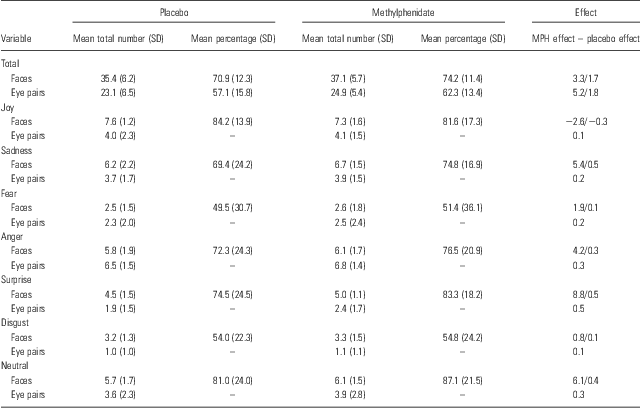
The descriptive statistics for the total scores of the face and the eye-pair task as well as face sub-emotions could be calculated in total numbers and percentages. The sub-emotions of the eye-pair task, however, were different. Because there existed two correct answers for some questions, only total numbers could be calculated (Table 2).
Descriptive statistics of face and eye-pair tasks

Cross-over effects
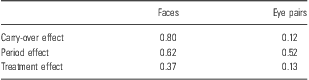
To examine our hypothesis of whether methylphenidate leads to an amelioration of the facial affect recognition, we compared the two treatment groups in the cross-over design. For both FEFA scores (face and eye) carry-over and period effect were not significant, and therefore we assumed the treatment effect to be unbiased by the cross-over design. The treatment effects for FEFA face score (mean difference = 3.3%) and eye score (mean difference = 5.2%) were also not significant (Table 3).
Cross-over effects of face and eye-pair tasks (p-value)

The same calculations were carried out for the sub-emotions of both tests (joy, sadness, fear, anger, surprise, disgust and neutral). None of the calculated p-values proved to be below the significance level of 0.05, and therefore the hypothesis was rejected for the sub-emotions as well.
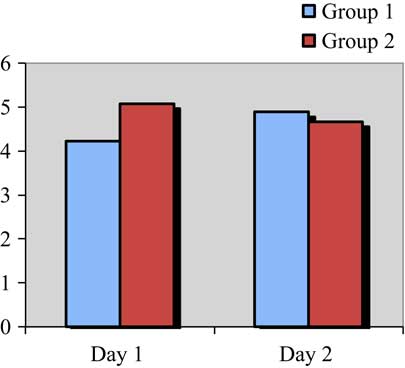
For the emotion disgust, we found different results for Group 1 and Group 2 that are shown in a graphic illustration (Fig. 1).
Discussion
Because face tasks were far more often tested in other studies, we were able to compare these results with the literature and therefore concentrated on this test in the discussion of our hypothesis.
Looking at the results for the seven sub-emotions of the face task a succession could be detected. In the placebo round, joy > neutral > surprise > anger > sadness > disgust > fear were found in declining order. Therefore, positive emotions and neutral were better identified than negative, similar to the methylphenidate round (although there was a different order within the positive emotions): neutral > surprise > joy > anger > sadness > disgust > fear. These results were similar to those of an earlier study of Sinzig and colleagues. The face task showed a comparable number of right answers (70.86% in our study vs. 69.1% in Sinzig's et al.), but in the eye-pair task our participants achieved with 57.14% a little below those of the previous study (60.4%). In both studies, the eye-pair tasks were consistently worse than the face task (Reference Sinzig, Morsch and Lehmkuhl10).
To examine our hypothesis, the three cross-over effects were calculated. The carry-over effect showed no significant p-value, which is why, for example, a learning effect of the first on the second task day could be ruled out. Also the period effect had to be dismissed because of a non-significant p-value, which showed that the order of the medications did not have an effect on the results of the facial affect recognition abilities.
The main effect – the treatment effect – was hereafter calculated to examine whether methylphenidate exerts an effect on the facial affect recognition task. All p-values proved to be above the set significance level of 5%. However, looking closer into the results, it was found that an improvement of the facial affect recognition abilities had taken place under a medication with methylphenidate in every total and subscore, except sub-emotion joy, just not on a significant level. To look further for the reasons of this lacking significance, the seven sub-emotions were more closely examined. None of the sub-emotions was significant.
Joy
By looking at the results in both Groups 1 and 2, one can conclude that methylphenidate even leads to a worsening of the results compared with the placebo round. A reason for that could lie in the fact that joy was the best-identified emotion of all seven in ADHD individuals and in healthy control groups (Reference Williams, Hermens and Palmer20,Reference McAlpine, Singh, Kendall and Ellis21). This stays in line with other studies that also received worse results under methylphenidate than under placebo for ADHD individuals (Reference Williams, Hermens and Palmer20). Therefore, the reason for the (very small) decline in right answers under methylphenidate might lie in the fact that joy is so easily identified that it could not be improved any further under methylphenidate.
Sadness
Methylphenidate led to improved identification ability of the emotion sadness. Williams et al. (Reference Williams, Hermens and Palmer20) found a decreased level of activation in the right occipital cortex during perception of this emotion, which was increased under the donation of methylphenidate. This equalisation of the activation deficit might be the reason for the improvement in identification in this study.
Fear
For the emotion fear, the results under a medication with methylphenidate were only slightly better. However, this emotion was also the worst identified with a healthy control group (Reference McAlpine, Singh, Kendall and Ellis21). This leads to the conclusion that this emotion might be too difficult even under normal circumstances, so that the donation of methylphenidate could not perform a great enough effect to have any change of results.
Anger
The participants in the present study showed an improved ability to recognise and identify the emotion anger correctly under methylphenidate. These results stay in line with Williams et al. (Reference Williams, Hermens and Palmer20) who demonstrated amelioration even on a highly significant level (p < 0.0001).
Surprise
The recognition of surprise showed the best improvement of all emotions under methylphenidate. This is especially interesting by considering the nature of this emotion, which is described as being very complex to identify (Reference Buitelaar, van der Wees, Swaab-Barneveld and van der Gaag9). This multi-faceted character is also shown in the fact that subjects in this study most often mistook surprise for joy (7.94%), but the second often confusion was with fear (7.12%).
Disgust
The emotion disgust poses an ambiguous result: whereas Group 1 showed an improvement of the results, there even was a reduction of correct answers at Group 2 (see Fig. 1). The distribution of gender in these two groups might serve as an explanation. Zhu and colleagues found significant gender differences for the emotions disgust, surprise and sadness (number of correct answers: girls > boys), but with disgust having the highest significance (p > 0.0000) (Reference Zhu, Chen and Moyzis22). Looking at our two groups it can be seen that all three girls in the present study are found in Group 1, accounting here for even 1 of the 3 of the group's participants. Considering now that, according to Zhu and colleagues, they might achieve better results than boys, this gender difference could give a hint on the different effectiveness of methylphenidate on the recognition of this emotion (Reference Zhu, Chen and Moyzis22).
Emotion surprise by group and day.

Neutral
Methylphenidate led to the second best rise in correct answers of the emotion neutral compared with the placebo group. This contradicts Williams et al. (Reference Williams, Hermens and Palmer20) who showed a small improvement in the recognition abilities of neutral, almost lifting it to the level of healthy reference subjects.
Therefore, all in all we found a slightly improved ability of facial affect recognition in patients with methylphenidate treatment, but none of the improvements were significant. A probable explanation for this result is our very small sample size of 21 children.
Furthermore, some differences in the localisation and directions of Theory of Mind's and methylphenidates’ cerebral activity changes can be found. Although the perception of emotions takes place in the right hemisphere (Reference Borod, Koff, Perlman Lorch and Nicholas23–Reference Harciarek and Heilman25), methylphenidate leads to an increase in activity among others in the frontal and parietal cortex, striatum, amygdala and cerebellum (Reference Rubia, Halari, Cubillo, Mohammad, Brammer and Taylor16,Reference Ludolph, Kassubek and Schmeck26). Comparing these two action sites some accordance can be found. However, looking into a study of Huck and colleagues, who examined the effects of amphetamines, some reasons for the non-significant effects of methylphenidate may be noticed. The authors stated that amphetamines, which have a pretty similar mode of action as methylphenidate, show their effect on facial affect recognition abilities only after 46 h of sleep deprivation, and even then only with complex emotions (Reference Huck, McBridge, Kendall, Grugle and Killgore27). Therefore, perhaps the reason for the lacking significance of methylphenidate's effect can be explained such that the medication indeed changes the cerebral activity towards the right direction, but that this change is not enough with some emotions to show a significant effect on the facial affect recognition abilities.
Moreover, the basic concept of the Theory of Mind is seen partly to lie in the dopaminergic pathway (Reference Lackner, Sabbagh, Hallinan, Liu and Holden28), with changes in this neurotransmitter system having a direct effect on the emotion recognition abilities (Reference Zhu, Chen and Moyzis22). Lackner et al. (Reference Lackner, Sabbagh, Hallinan, Liu and Holden28) demonstrated a direct correlation between the length of the DRD4-allele (of the dopamine receptor) and the Theory of Mind abilities. Individuals with two short alleles (≤4 repeats) showed significantly better results than those with at least one long allele (≥6). ADHD patients are most likely to have the seven-repeat allele (Reference Faraone, Doyle, Mick and Biederman29,Reference Grady, Harxhi and Smith30). This, however, is counted into the group of long alleles in Lackner's et al. (Reference Lackner, Sabbagh, Hallinan, Liu and Holden28) study, therefore to achieve worse results in the Theory of Mind tasks. In addition, Froehlich and colleagues could prove that individuals with at least one four-repeat allele showed a twice as high reduction in their ADHD symptoms under methylphenidate than other allele carriers (Reference Grady, Harxhi and Smith30). Therefore, maybe, applying the endophenotype concept (Reference Flint and Munafò31–Reference Zobel and Maier33), this allele-specific response does also apply on the facial affect recognition. If the shorter alleles, which cause a lesser deficit in facial affect recognition, lead to a stronger improvement of this deficit, this might explain the lacking significance of our results. Moreover, Lackner et al. (Reference Lackner, Sabbagh, Hallinan, Liu and Holden28) did not find a connection between Theory of Mind abilities and other sites of methylphenidate's effect (e.g. DAT1 – another dopamine transporter, or COMT – catechol-o-methyltransferase), which might also indicate a reduced effect of the medication.
In conclusion, it can be stated that the reasons for our lacking significance might lie in the fact that there can be found some overlapping between the pathological cerebral changes of activity during Theory of Mind processes and the sites of methylphenidate's action. This deficit of cerebral activity is partly balanced by medication, but the effect might not be sufficient enough to show a significant improvement in facial affect recognition. Another explanation might be the different affected regions of the dopaminergic pathway. Although it is influenced by methylphenidate, and Theory of Mind is partly processed via it, different molecular subareas are involved and could explain the non-significant effect of the medication on the facial affect recognition abilities. Abu-Akel (Reference Abu-Akel34) stated that there is a direct correlation between the severity of the Theory of Mind deficit with the length of the illness and the age, at which the deficit of the dopaminergic pathway begins.
As ADHD is a life-long disease (Reference Abu-Akel34) that manifests in early childhood (Reference Breuer and Doepfner35) and its deficits are compensated only temporarily by medication (e.g. methylphenidate) (Reference Rubia, Halari, Cubillo, Mohammad, Brammer and Taylor16), it therefore fulfils all of Abu-Akel and colleagues’ criteria for a particular severity of the Theory of Mind deficit. That could also express itself in the reduced effect of the stimulant therapy.
Conclusion
We were not able to demonstrate a significant effect of methylphenidate on facial affect recognition, but the treatment shows a slightly positive influence on all FEFA scores, except sub-emotion joy. Different genes of the dopaminergic pathway might be responsible for the deficit in facial affect recognition with ADHD individuals and the response to methylphenidate. Future studies should test a greater number of participants to provide a better initial situation for significance. They could also set a time limit at the FEFA in order not to influence their impulsivity with a longer time to response and could, for example, perform longitudinal analyses on how this improvement of facial affect recognition abilities influences everyday lives of patients. However, especially thoughts regarding the endophenotype concept should be pursued on a larger scale.
Moreover, Boelte and colleagues proposed another therapy option. They developed the FEFA to become a training module for facial affect recognition and showed great improvements with autistic individuals after a training period (Reference Boelte, Feineis-Matthews, Leber, Dierks, Hubl and Poustka18). This might also be the case with ADHD individuals and it should therefore be examined whether the training alone or maybe especially in combination with medication could also lead to amelioration.