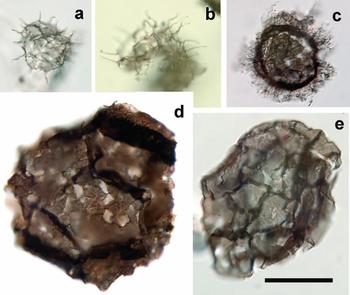
1. Introduction
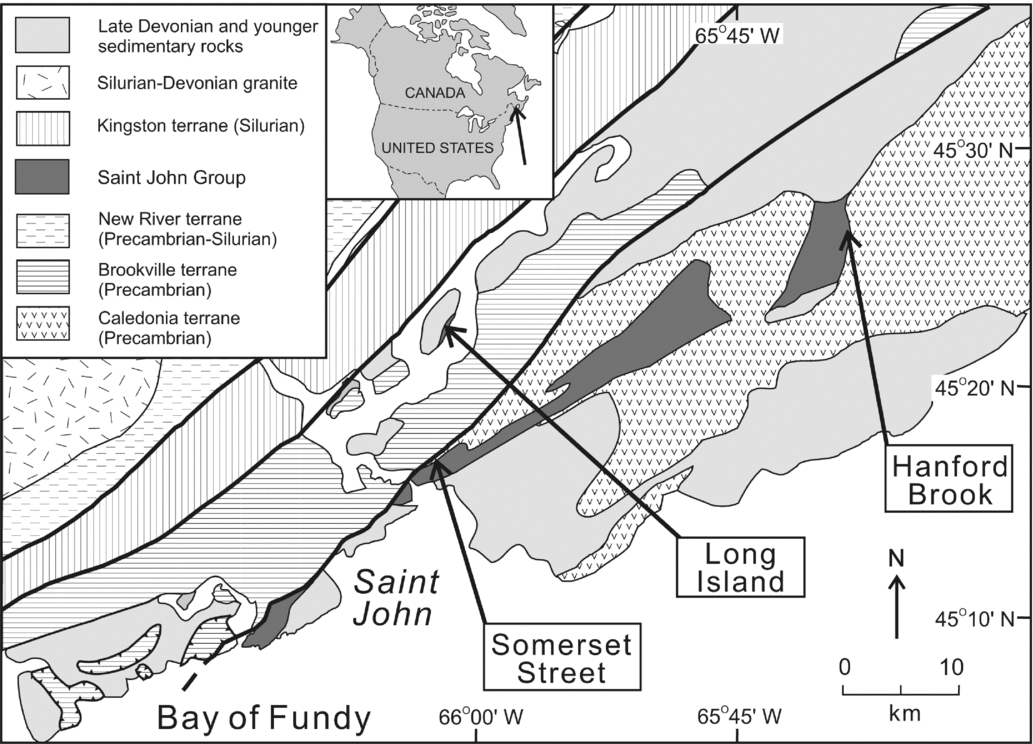
The siliciclastic Hanford Brook Formation of southern New Brunswick has remained of international interest ever since George F. Matthew and his son William described the trilobite Protolenus and associated fauna from a section on Hanford Brook, some 40 km east of the city of Saint John (Matthew, Reference Matthew1892, Reference Matthew1895; Fig. 1). Protolenid trilobites were subsequently found elsewhere in Maritime Canada, various locations in present-day Europe and northern Africa, and found to consistently pre-date paradoxidids, trilobites widely considered to be middle Cambrian marker fossils (e.g. Cobbold, Reference Cobbold1910; Richter & Richter, Reference Richter and Richter1941; Schwarzbach, Reference Schwarzbach1939) (lower Cambrian and middle Cambrian are here used in the sense of Lower Cambrian and Middle Cambrian, informal series that were used with more or less specific regional definitions and in a somewhat disparate sense in the various regions). Various, but often tentatively defined, Protolenus zones have been therefore considered terminal early Cambrian (e.g. Cowie, Rushton & Stubblefield, Reference Cowie, Rushton and Stubblefield1972; Sdzuy, Reference Sdzuy1972). This interpretation has more recently come into question as the stratigraphical ranges of protolenids and paradoxidids overlap in both Morocco and Turkey (e.g. Geyer, Reference Geyer1990a ; Dean & Özgul, Reference Dean and Özgul1994; Fletcher, Reference Fletcher2003). Furthermore, most protolenid species have highly restricted geographic ranges, meaning that they have limited use in direct correlation. Protolenus elegans, for example, has not been found outside the Hanford Brook Formation.
Location and geological setting for the Hanford Brook Formation in southern New Brunswick.
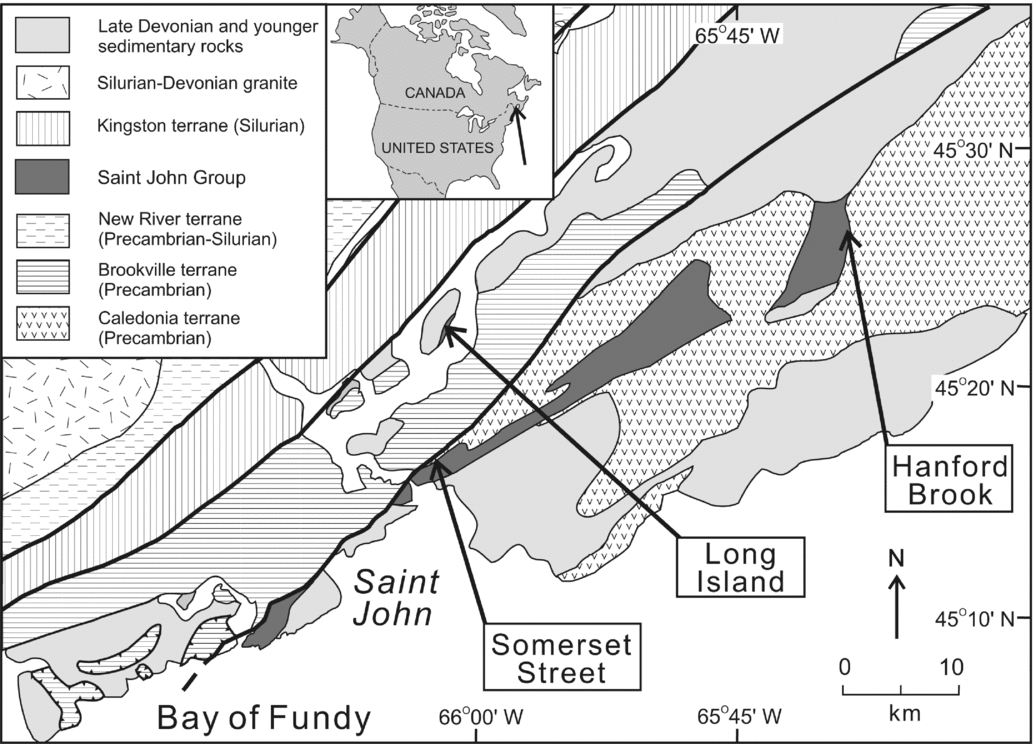
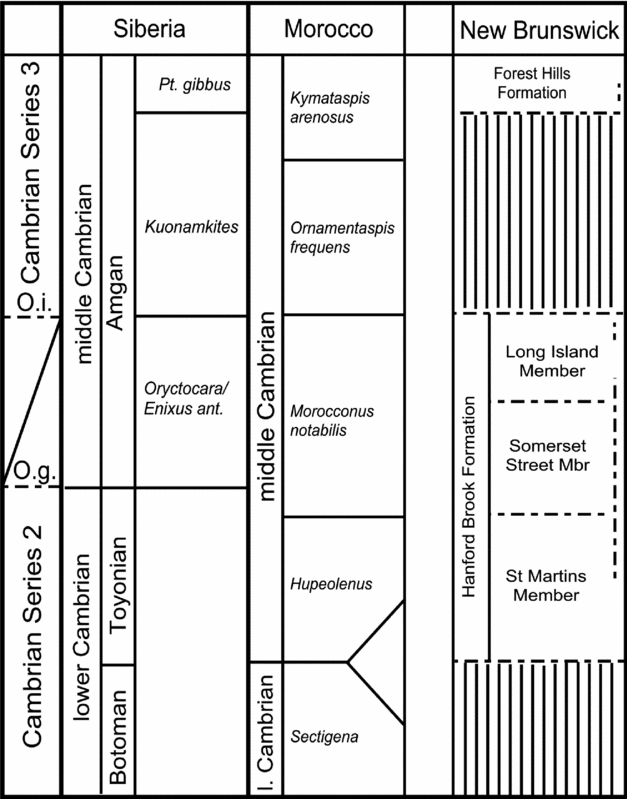
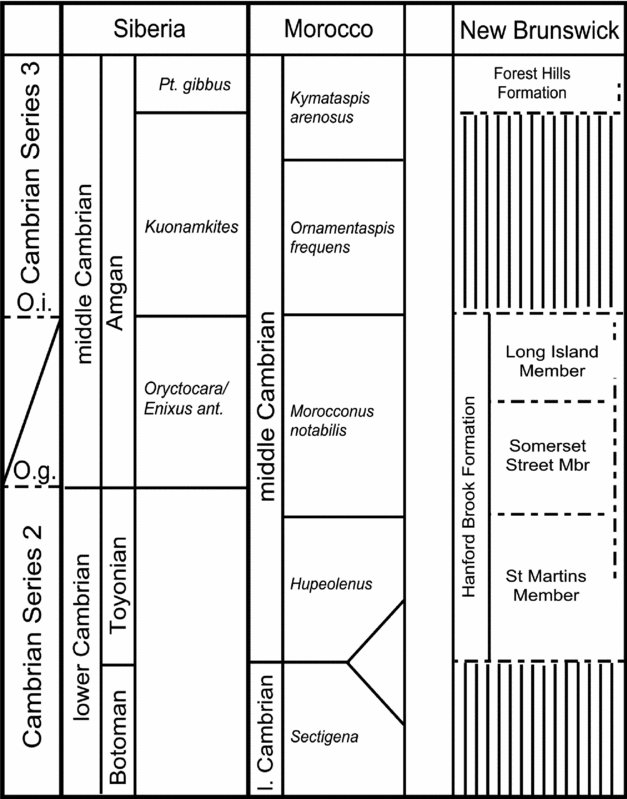
Particularly relevant to current discussions on Cambrian stratigraphy, the Hanford Brook Formation contains one of the few dated ashes with a position close to the traditional lower–middle Cambrian transition, and to the as yet undefined Cambrian Series 2 to Cambrian Series 3 boundary (Peng, Babcock & Cooper, Reference Peng, Babcock, Cooper, Gradstein, Ogg, Schmitz and Ogg2012). This ash bed, from the Somerset Street section in the city of Saint John (Fig. 1), originally reported as c. 511 Ma (Landing et al. Reference Landing, Bowring, Davidek, Westrop, Geyer and Heldmaier1998), was an important piece of evidence in establishing the current Cambrian time scale. The biochronological context of this ash bed is, however, not known with precision as the fauna of the Hanford Brook Formation consists of species not known elsewhere (trilobites; Westrop & Landing, Reference Westrop and Landing2000) or with relatively long stratigraphic ranges (brachiopods and bradorids; Siveter & Williams, Reference Siveter and Williams1997). Landing et al. (Reference Landing, Bowring, Davidek, Westrop, Geyer and Heldmaier1998) suggested that the dated ash bed correlates with the late early Cambrian Toyonian Stage of Siberia (see Fig. 2). However, it has also been suggested that beds with Protolenus elegans correlate with the Morocconus notabilis Zone of Morocco (Geyer & Palmer, Reference Geyer and Palmer1995; Geyer, Buschmann & Elicki, Reference Geyer, Buschmann and Elicki2014), there traditionally considered middle Cambrian, and either uppermost Cambrian Series 2 or basal Cambrian Series 3 (Geyer, Reference Geyer2015; Fig. 2).
Acritarch-based chronostratigraphic context of the Hanford Brook Formation with respect to the traditional lower–middle Cambrian transition as recognized in Siberia and Morocco, and the two possible candidate definitions for the base of Cambrian Series 2 on the first appearance of Ovatoryctocara granulata (O. g.) or Oryctocephalus indicus (O. i.). Correlation of Siberia and Morocco based on Geyer (Reference Geyer2015).
Here we provide new biochronological information on the Hanford Brook Formation based on the first study of acritarchs from this unit. Acritarchs have been widely used to provide biochronological age constraints on the traditional lower–middle Cambrian transition in the Acado-Baltic region and have been proposed as potential markers for the lower–middle Cambrian boundary there (e.g. Moczydłowska, Reference Moczydłowska1999). Because Cambrian acritarchs show a high degree of cosmopolitanism (e.g. Molyneux et al. Reference Molyneux, Delabroye, Wicander, Servais, Harper and Servais2013), they have the potential to add insights into correlations where other fossil groups have more local distributions.
2. Geological setting and fauna
The Hanford Brook Formation is part of the Cambrian–Ordovician Saint John Group, a succession of mainly siliciclastic sedimentary rocks that crop out in fault-bounded slivers in and around Saint John, New Brunswick (Fig. 1; Tanoli & Pickerill, Reference Tanoli and Pickerill1988). The thickest and best-preserved section of the Hanford Brook Formation is on Hanford Brook. The general lithological succession and fossil contents were first outlined by Matthew (e.g. Reference Matthew1890, Reference Matthew1895), who recognized this unit as band b of division 1 of the (then) St John Group. The name Hanford Brook Formation originated from Hayes & Howell (Reference Hayes and Howell1937), who recognized two members: a lower Beyrichonia sandstone consisting of grey fine-grained sandstone, with glauconite, from which have been recovered brachiopods and bradorids but with no confirmed finds of trilobites, and an upper trilobite-bearing Protolenus shale dominated by siltstone and shale. Hayes & Howell (Reference Hayes and Howell1937) remarked that this division is readily recognized only at Hanford Brook and that also here the transition is gradual. They also remarked on black sandstone that locally separates the Hanford Brook Formation from the underlying white quartz arenite of the Glen Falls Formation. The Hanford Brook Formation is overlain by dark shale of the Forest Hills Formation, yielding paradoxidid trilobites, a unit that has been correlated with, and by some equated with, the Chamberlain's Brook Formation in Newfoundland.
In recent studies of the Hanford Brook Formation, Landing & Westrop (Reference Landing and Westrop1996, Reference Landing, Westrop, Landing and Westrop1998) and Westrop & Landing (Reference Westrop and Landing2000) revised the lithostratigraphical terminology and introduced three members (facies associations), and new insights were offered on the sedimentology and depositional history. Their St Martins Member approximates to the Beyrichonia sandstone of Hayes & Howell (Reference Hayes and Howell1937), with the addition of the basal black sandstone, the base of which they interpreted to represent a depositional hiatus from the underlying white quartzite. They interpreted the St Martins Member to represent nearshore deposition. The overlying dark grey mudstone and fine sandstone facies of the Protolenus elegans-bearing Somerset Street Member was interpreted by Landing & Westrop (Reference Landing and Westrop1996) as dysaerobic sediments formed on a low-energy shelf. As originally conceived the top of this member consists of thick beds of massive quartz arenite, which they, in a later paper (Landing & Westrop, Reference Landing, Westrop, Landing and Westrop1998), made the basal part of the Long Island Member, and which they interpreted to represent a depositional hiatus. The Long Island Member consists of mudstone and fine- to medium-grained grey sandstone, with hummocky cross-stratification and planar lamination. As already first observed by Matthew (Reference Matthew1890) the sandstone beds are typically streaky owing to iron oxides.
A modern revision of the Hanford Brook trilobites is found in Westrop & Landing (Reference Westrop and Landing2000), and the bradorids were critically reviewed by Siveter & Williams (Reference Siveter and Williams1997). From the Somerset Street Member are known Protolenus elegans, Protolenus? articephalus, Protagraulos priscus, Micmacca matthewi, Conomicmacca plana and Ellipsocephalus? galeatus. These fossils are all known only from the Hanford Brook Formation, and several are known from scarce material only (see Westrop & Landing, Reference Westrop and Landing2000). Trilobites in the Long Island Member on Hanford Brook include Kingaspidoides cf. obliquoculatus and, on Long Island, Berabichia milleri (Westrop & Landing, Reference Westrop and Landing2000). Because Protolenus elegans only occurs in a narrow portion of the strata that had been historically assigned to the Protolenus Zone, Westrop & Landing (Reference Westrop and Landing2000) erected the Protolenus elegans Zone, with a more restricted stratigraphical range.
The Forest Hills Formation is dominated by grey mudstone with an impure limestone, close to the base. Trilobites in the basal part of the Forest Hills Formation, including Eccaparadoxides eteminicus, indicate correlation with the upper part of the Chamberlain's Brook Formation in Newfoundland, and the presence of a depositional break between the Hanford Brook and Forest Hills formations (e.g. Landing & Westrop, Reference Landing and Westrop1996).
3. Sections and sampling
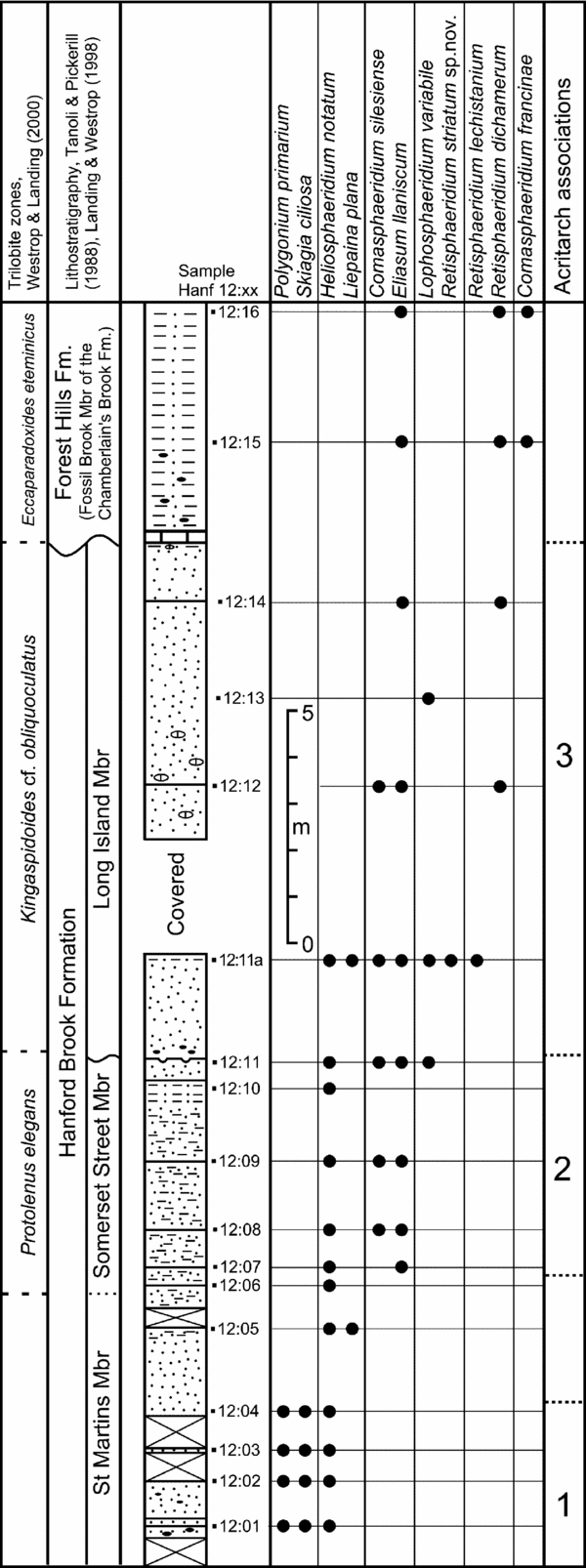
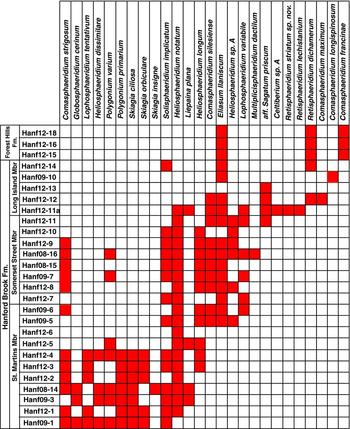
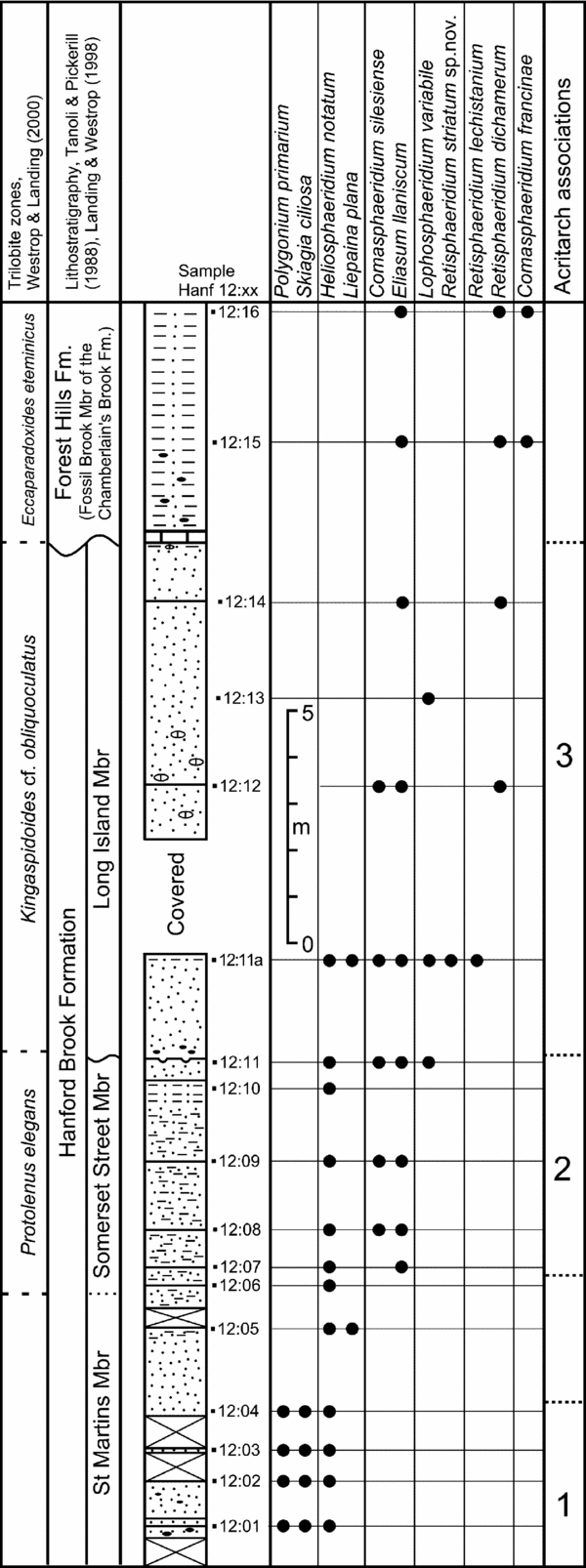
The present study is largely based on detailed sampling through the Hanford Brook Formation at Hanford Brook (Fig. 1). Here the contact of the St Martins Member with the underlying Glen Falls Formation is not exposed. The Somerset Street Member is continuously exposed. We sampled the lower and upper parts of the Long Island Member, whereas the middle portion is covered. The lower part of the Forest Hills Formation was also sampled. The distribution of samples collected in 2012 is shown in Figure 3, which also indicates occurrences of selected acritarchs, and an interpretation of how our measured section compares to the members of Landing & Westrop (Reference Landing, Westrop, Landing and Westrop1998). The positions of acritarch samples are well constrained with respect to those of key levels yielding trilobites in earlier studies. Figure 4 includes complete information on acritarchs in each sample and also adds information from less systematic sampling in 2008 and 2009. The approximate positions of these samples relative to those of the 2012 samples are indicated.
Distribution of the more representative acritarchs in the Hanford Brook Formation and lower part of the Forest Hills Formation on the basis of sampling conducted in 2012. Full species list is provided in Figure 4.
Plot of acritarchs found in samples of the Hanford Brook Formation and lower part of the Forest Hills Formation collected in 2008, 2009 and 2012. Sample 09:1 approximates level of sample 12:1. Samples 09:3 and 08:14 approximate level of 12:4. Sample 09:5 approximates level of sample 12:7. Samples 08:15 and 09:6 approximate level of sample 12:8. Samples 08:16 and 09:7 approximate level of sample 12:9.

Additional sampling of the Hanford Brook Formation was made within the area of the city of Saint John, on Somerset Street, and on Long Island (Fig. 1). The section on Somerset Street consists of a thin St Martins Member and the Somerset Street Member. Although the fine-grained material of the Hanford Brook Formation in this section is affected by metamorphism, the section is of importance as the location of the ash bed dated by Landing et al. (Reference Landing, Bowring, Davidek, Westrop, Geyer and Heldmaier1998). Samples from coastal exposures on Long Island are within the Long Island Member.
Samples of shale and mudstone of about 50 grams were collected and treated with palynological preparation techniques as outlined in Vidal (Reference Vidal1988). Palynological slides containing figured and type material are reposited in the collections of the New Brunswick Museum (NBMG), Saint John, New Brunswick, with numbers 15578–15597, except material from the Hell's Mouth Formation, Wales, which is reposited in the collections of Área de Paleontología of the Universidad de Extremadura, Badajoz. Accession numbers are referred to in the figure captions, which also provide sample numbers and England finder coordinates.
4. Distribution of acritarchs
Most acritarchs from the Hanford Brook Formation are readily identifiable as well-characterized species (Figs 5–12). In the systematic palaeontology (Section 8 below) remarks are provided on the identification of Retisphaeridium Staplin, Jansonius & Pocock (Reference Staplin, Jansonius and Pocock1965), Retisphaeridium lechistanium Jachowicz-Zdanowska (Reference Jachowicz-Zdanowska2013) and Lophosphaeridium variabile Volkova (Reference Volkova, Zhuravleva and Rozanov1974), and the new species Retisphaeridium striatum Palacios sp. nov., is described.
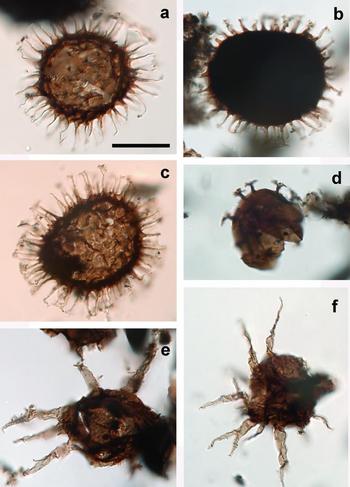
Acritarchs from the St Martins Member, Hanford Brook Formation, Hanford Brook. Scale bar is equivalent to 20 μm. (a–c) Skiagia ciliosa (Volkova) Downie, Reference Downie1982. (a) Hanf 12:1, NBMG15584:001, V-31-1. (b) Hanf 12:3, NBMG15586:001, B-15-4 specimen with internal endocyst. (c) Hanf 12:3, NBMG15585:001, E-20-2. (d) Skiagia insigne (Fridrichsone) Downie, Reference Downie1982, Hanf 08:14, NBMG15578:001, H-31-1. (e, f) Polygonium primarium (Jankauskas) Sarjeant & Stancliffe, Reference Sarjeant and Stancliffe1994. (e) Hanf 09:1, NBMG15581:001, N-48-4. (f) Hanf 12:4, NBMG15587:001, F-31.

Acritarchs from Hanford Brook Formation at Hanford Brook. St Martins Member (a, b, i), Somerset Street Member (c–f, h) and Long Island Member (g, j). Scale bar is equivalent to 20 μm. (a) Heliosphaeridium dissimilare (Volkova) Moczydłowska, Reference Moczydłowska1991, Hanf 08:14, NBMG15578:002, D-47-1. (b) Heliosphaeridium notatum (Volkova) Moczydłowska, Reference Moczydłowska1991, Hanf 12:1, NBMG15584:002, B-41-2. (c) Heliosphaeridium longum (Moczydłowska) Moczydłowska, Reference Moczydłowska1991, Hanf 08:15, NBMG15579:001, E-38-3-4 (d) Heliosphaeridium sp. A, Hanf 12:8, NBMG15588:001, L-49-3. (e, f) Multiplicisphaeridium dactilum Vidal in Moczydłowska & Vidal, Reference Moczydłowska and Vidal1988. (e) Hanf 08:16, NBMG15580:001. (f) Hanf 08:16, NBMG15580:002, B-28-1-2. (g). Celtiberium sp., Hanf 12:11a, NBMG15592:001, C-39. (h) Polygonium varium (Volkova), Sarjeant & Stancliffe, Reference Sarjeant and Stancliffe1994, Hanf 08:16, NBMG15580:003, T-30-2. (i, j). Liepaina plana Jankauskas & Volkova in Volkova et al. Reference Volkova, Kirjanov, Piskun, Pashkyavichene, Jankauskas, Keller and Rozanov1979. (i) Specimen of small dimensions, Hanf 08:14, NBMG15578:003, D-38-1. (j) Hanf 12:11a, NBMG15592:002, C-20-4.

Acritarchs from the Hanford Brook Formation at Hanford Brook. (a, c, d) Somerset Street Member, (b) Long Island Member. Scale bar is equivalent to 20 μm. (a, b) Lophosphaeridium variabile Volkova, Reference Volkova, Zhuravleva and Rozanov1974. (a) Hanf 08:16, NBMG15580:004, G-24. (b) Hanf 12:11a, NBMG15593:001, Z-47-3. (c, d) Eliasum llaniscum Fombella, Reference Fombella1977, or (c) a flattened leiosphaerid? (c) Hanf 12:9, NBMG15589:001, G-42-4. (d) Hanf 12:8, NBMG15588:002, F-34-4.

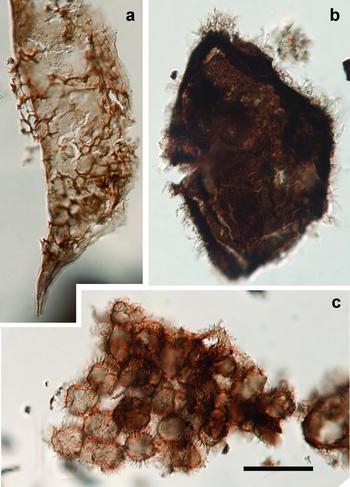
Acritarchs from the Hanford Brook Formation at Hanford Brook. (a, c) Somerset Street Member, (b) Long Island Member. Scale bar is equivalent to 20 μm. (a) aff. Sagatum priscum (Kirjanov & Volkova) Vavrdová & Bek, Reference Vavrdová and Bek2001, Hanf 12:11, NBMG15590:001, F-48-2. (b) Comasphaeridium maximum Palacios, Reference Palacios2015, Hanf 12:12, NBMG15594:001, N-38-1. (c) Asteridium lanatum (Volkova) Moczydłowska, Reference Moczydłowska1991, cluster of up to 30 specimens, Hanf 09:5, NBMG15582:001, Y-48-3.

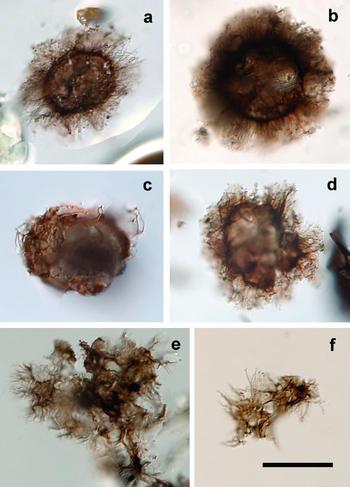
Acritarchs from the Hanford Brook (a–d) and Forest Hills (e, f) formations at Hanford Brook. (a, d) Somerset Street Member, (b, c) Long Island Members. Scale bar is equivalent to 20 μm. (a) Comasphaeridium strigosum (Jankauskas) Downie, Reference Downie1982, Hanf 08:16, NBMG15580:005, T-33-2. (b, d) Comasphaeridium silesiense Moczydłowska, Reference Moczydłowska1998. (b) Hanf 12:11a, NBMG15593:002, J-39. (d) Hanf 12:8, NBMG15588:003, D-38-3 (c) Comasphaeridium longispinosum Hagenfeldt, Reference Hagenfeldt1989, Hanf 09:10, NBMG15583:001, Z-42. (e, f) Comasphaeridium francinae Jachowicz-Zdanowska, Reference Jachowicz-Zdanowska2013. (e) Hanf 12:15, NBMG15595:001, Q-19-4. (f) Hanf 12:16, NBMG15596:001, B-25-1.

Acritarchs from the Hell's Mouth Formation, St Tudwal's Peninsula, Wales. Scale bar is equivalent to 20 μm. (a) Heliosphaeridium notatum (Volkova) Moczydłowska, Reference Moczydłowska1991, TUD-2, UexWal 001:001, B-31-2-4 (b) Heliosphaeridium sp. A, TUD-2, UexWal 001:002, V-17-4 (c) Comasphaeridium silesiense Moczydłowska, Reference Moczydłowska1998, TUD-2, UexWal 001:003, K-17-2-4. (d) Retisphaeridium lechistanium Jachowicz-Zdanowska, Reference Jachowicz-Zdanowska2013, TUD-2, UexWal 002:001, B-43-4. (e) Retisphaeridium dichamerum Staplin, Jansonius & Pocock, Reference Staplin, Jansonius and Pocock1965, TUD-2, UexWal 001:004, B-39.

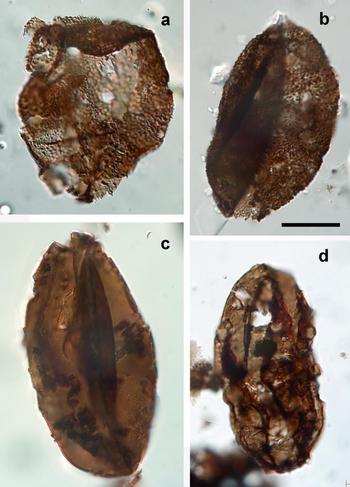
Retisphaeridium striatum Palacios sp. nov., from the Long Island Member, Hanford Brook Formation (a, b) and Hell's Mouth Formation, St Tudwal's Peninsula, Wales (c–f). Scale bar is equivalent to 20 μm. (a) Holotype, showing the clear plate division and circular pylome, Hanford Brook, Hanf 12:11a, NBMG15592:005, Z-38-1 (b) Long Island, Li 09:5, NBMG15597:001, U-41-2-4. (c) Specimen showing the clear plate division, TUD-2, UexWal 002:003, A-15-4. (d) Degraded specimen showing circular pylome, TUD-2, UexWal 002:004, F-46-4. (e) TUD-2, UexWal 002:005, K-23-3. (f) TUD-2, UexWal 002:006, L-27-4.

Retisphaeridium lechistanium Jachowicz-Zdanowska, Reference Jachowicz-Zdanowska2013, from the Long Island Member, Hanford Brook Formation, Hanford Brook. Scale bar is equivalent to 20 μm. (a) Specimen showing plate division, Hanf 12:11a, NBMG15593:004, X-31 (b) Flattened specimen showing circular pylome, Hanf 12:11a, NBMG15593:005, S-25-2-4. (c) Specimen showing incipient plate division, Hanf 12:11a, NBMG15592:006, H-25. (d) Flattened specimen showing polygonal outline, Hanf 12:11a, NBMG15593:006, Z-38-1.

4.a. Hanford Brook Formation, Hanford Brook section
In this section acritarchs are well preserved and the near complete outcrop has enabled a clear palynological characterization of the section. Three distinctive associations of acritarchs are recognized (Fig. 3). The preservation of acritarchs in the St Martins and Long Island members is generally superior to that of the Somerset Street Member, in which acritarch vesicles are affected by the growth of cubic or framboidal pyrite. This is consistent with more strongly reducing conditions during deposition of the Somerset Street Member. The occurrence in sample Hanf 12:11 of the problematic organic-walled microfossil Octoedryxium truncatum Rudavskaya, Reference Rudavskaya, Vozzhennikova and Timofeev1973 is possible direct evidence for sulphate-reducing bacteria (cf. Stanevich, Reference Stanevich, Hoover, Rozanov and Lipps2003).
Association 1, found in much of the St Martins Member, includes diverse and well-preserved acritarchs of the diagnostic species Skiagia ciliosa (Volkova) Downie, Reference Downie1982 (Fig. 5a–c), S. orbiculare (Volkova) Downie, Reference Downie1982, Polygonium primarium (Jankauskas) Sarjeant & Stancliffe, Reference Sarjeant and Stancliffe1994 (Fig. 5e, f), P. varium (Volkova) Moczydłowska, Reference Moczydłowska1991 (Fig. 6h), Heliosphaeridium notatum (Volkova) Moczydłowska, Reference Moczydłowska1991 (Fig. 6b), Comasphaeridium strigosum (Jankauskas) Downie, Reference Downie1982 (Fig. 9a), Heliosphaeridium longum (Moczydłowska) Moczydłowska, Reference Moczydłowska1991 (Fig. 6c), H. dissimilare (Volkova) Moczydłowska, Reference Moczydłowska1991 (Fig. 6a), Granomarginata squamacea Volkova, Reference Volkova, Volkova, Zhuravleva, Zabrodin and Klinger1968, Solisphaeridium implicatum (Fridrichsone) Moczydłowska, Reference Moczydłowska1998, Globosphaeridium cerinum (Volkova) Moczydłowska, Reference Moczydłowska1991, and scarce Liepaina plana Jankauskas & Volkova in Volkova et al. Reference Volkova, Kirjanov, Piskun, Pashkyavichene, Jankauskas, Keller and Rozanov1979 (Fig. 6i) and Skiagia insigne (Fridrichsone) Downie, Reference Downie1982 (Fig. 5d).
Association 2, found through the Somerset Street Member, is characterized by the appearance of Comasphaeridium silesiense Moczydłowska, Reference Moczydłowska1998 (Fig 9b, d), undoubted Eliasum llaniscum Fombella, Reference Fombella1977 (Fig. 7d), Lophosphaeridium variabile Volkova, Reference Volkova, Zhuravleva and Rozanov1974 (Fig. 7a, b), Multiplicisphaeridium dactilum Vidal in Moczydłowska & Vidal, Reference Moczydłowska and Vidal1988 (Fig. 6e, f) and Heliosphaeridium sp. A (Fig. 6d). These are associated with species present in the previous association such as Heliosphaeridium notatum and H. longum. Besides the first appearance of several taxa, of note is the disappearance of Polygonium primarium and Skiagia species, and a short interval in the upper part of the St Martins Member characterized by a low diversity and abundant non-diagnostic Leiosphaeridia spp.
Association 3, coinciding with the Long Island Member, is marked by the appearance of Celtiberium sp. (Fig. 6g), Comasphaeridium maximum Palacios, Reference Palacios2015 (Fig. 8b), C. longispinosum Hagenfeldt, Reference Hagenfeldt1989 (Fig. 9c), Retisphaeridium dichamerum Staplin, Jansonius & Pocock, Reference Staplin, Jansonius and Pocock1965, R. lechistanium Jachowicz-Zdanowska, Reference Jachowicz-Zdanowska2013 (Fig. 12a–d) and Retisphaeridium striatum Palacios sp. nov (Fig. 11a). This assemblage also includes abundant and well-preserved Liepaina plana (acme) (Fig. 6j) and aff. Sagatum priscum (Kiryanov & Volkova) Vavrdová & Bek, Reference Vavrdová and Bek2001 (Fig. 8a).
4.b. Hanford Brook Formation, other sections
Acritarchs are scarce and poorly preserved in the Hanford Brook Formation in the Somerset Street section. Skiagia cf. ciliosa was identified close to the St Martins Member – Somerset Street Member transition, and in samples some metres above the dated ash bed were found Heliosphaeridium longum and H. notatum. Samples from the Long Island Member on Long Island include Retisphaeridium striatum (Fig. 11b) and R. lechistanium, also found in this member on Hanford Brook.
4.c. Forest Hills Formation, Hanford Brook section
In samples from the Forest Hills Formation appear abundant Comasphaeridium francinae Jachowicz-Zdanowska, Reference Jachowicz-Zdanowska2013, a characteristic acritarch first described in open nomenclature by Martin in Martin & Dean (Reference Martin and Dean1984) from Newfoundland. There its first appearance is from the upper part of the Chamberlain's Brook Formation, below a level that contains Badulesia aff. B. tenera, Eccaparadoxides eteminicus and Hartella terranovica (Martin & Dean, Reference Martin and Dean1988, fig. 3), included in the AO-1 acritarch Zone (equivalent to the Hartella Zone). This zone also includes scarce Eliasum llaniscum and Retisphaeridium dichamerum, and the zone is also characterized by the absence of Cristallinium cambriense (Slaviková) Vanguestaine, Reference Vanguestaine1978. Other occurrences of C. francinae are in the Nant-y-big Formation, NW Wales, in levels of the Tomagnostus fissus Zone (lower Drumian, recorded as Acritarch gen. et sp. nov. Martin in Martin & Dean, Reference Martin and Dean1984; Young et al. Reference Young, Martin, Dean and Rushton1994), where it occurs with R. dichamerum, C. cambriense and Heliosphaeridium? llynense Martin. A similar assemblage, but without Cristallinium cambriense, occurs in the Dugald Formation in Nova Scotia (Palacios et al. Reference Palacios, Jensen, White and Barr2012). Jachowicz-Zdanowska (Reference Jachowicz-Zdanowska2013) described Comasphaeridium francinae from the Sosnowiec Formation in Silesia, Poland, in her BAMA VIII acritarch assemblage Zone, from levels that correlate with the Paradoxides paradoxissimus Zone. On the Iberian Peninsula it appears in the Oville Formation, northern Spain, in the IMC1 and lower part of the IMC2 acritarch zones, in levels assigned to the Upper Leonian – Lower Caesaraugustian (P. asturianus–Badulesia tenera zones). In southern Spain it appears in volcanosedimentary beds of the upper part of the Vallehondo Formation, top of the IMC1 acritarch Zone, in levels that overlie an occurrence of Parasolenopleura sp. and Paradoxides sp. (Palacios, Jensen & Apalategui, Reference Palacios, Jensen, Apalategui and Fernández-Martínez2006; Palacios, Reference Palacios, Devaere, Clausen and Álvaro2014).
5. Biochronological implications of the acritarch distribution
The distribution of the three acritarch associations described here each broadly corresponds with a member of the Hanford Brook Formation and with a faunal zone. Westrop & Landing (Reference Westrop and Landing2000) suggested that some of the differences in fauna through the Hanford Brook Formation are related to differences in depositional setting. The distribution of organic-walled microfossils in general is not considered to be strongly affected by environmental conditions, except for low-diversity assemblages dominated by leiosphaerids in stressed shallow-water or deep-water basinal settings. We therefore find it likely that the observed changes in acritarch associations largely reflect evolutionary events/turnover. The succession of acritarchs through the section of the Hanford Brook Formation at Hanford Brook therefore offers the opportunity to contrast the succession of acritarchs through a section that is likely to be close to, or span, the lower–middle Cambrian transition and the base of Cambrian Series 3. The succession of acritarchs across the traditional lower–middle Cambrian transition has been studied in particular detail in Baltica (e.g. Volkova et al. Reference Volkova, Kirjanov, Piskun, Pashkyavichene, Jankauskas, Keller and Rozanov1979, Reference Volkova, Kirjanov, Piskun, Paskeviciene, Jankauskas, Urbanek and Rozanov1983; Moczydłowska, Reference Moczydłowska1991, Reference Moczydłowska1999) and in Spain (e.g. Palacios, Reference Palacios2015). The Hanford Brook Formation contains a range of acritarch species also found in those areas, making it possible to put its macrofossils and dated ash bed in an improved biochronological framework. In turn, this allows numerical ages to be placed on acritarch associations.
Association 1, with Heliosphaeridium notatum, H longum and rare Liepaina plana, is indicative of the Volkovia–Liepaina Zone of Moczydłowska (Reference Moczydłowska1991). This zone has been considered to be latest early Cambrian in age and to correspond to the Protolenus Zone as recognized in Baltica (Moczydłowska, Reference Moczydłowska1991). Moczydłowska (Reference Moczydłowska1991) established the Volkovia–Liepaina Zone in eastern Poland on the basis of the first appearance of V. dentifera and L. plana, although both are scarce and consequently recognition of this acritarch zone is difficult, as Moczydłowska (Reference Moczydłowska1991) indicated. Liepaina plana is reported from the middle Cambrian in Baltica (Kibartai Horizon, Volkova et al. Reference Volkova, Kirjanov, Piskun, Pashkyavichene, Jankauskas, Keller and Rozanov1979, Reference Volkova, Kirjanov, Piskun, Paskeviciene, Jankauskas, Urbanek and Rozanov1983, and the Acadoparadoxides oelandicus Beds in south-central Sweden and western Finland (Hagenfeldt, Reference Hagenfeldt1989). Żylińska & Szczepanik (Reference Zylinska and Szczepanik2009) reported Liepaina plana from the Cambrian Series 3 Kobierniki Beds of the Holy Cross Mountains. In the Oville Formation, northern Spain, it appears in levels that include Upper Leonian trilobites (Paradoxides asturianus and Tonkinella aff. breviceps, Palacios, Reference Palacios2015). In the Hanford Brook Formation, Liepaina plana is abundant in the Long Island Member, where it occurs with acritarchs diagnostic of Cambrian Series 3 (see below). Occurrences of L. plana in the lower Cambrian are scarce. Moczydłowska & Vidal (Reference Moczydłowska and Vidal1986) referred to, but did not illustrate, the occurrence of L. plana with Skiagia ciliosa from the Holmia C Zone of Norway. Żylińska & Szczepanik (Reference Zylinska and Szczepanik2009) reported small specimens as Liepaina sp. from the Cambrian Series 2 of Poland, considering that these differ from specimens typical for the Cambrian Series 3. A similar situation is found in the St Martins Member of the Hanford Brook Formation with rare (three) specimens, although this well-preserved material can be assigned to Liepaina plana (Fig. 6i). Two additional species characteristic of the Volkovia–Liepaina Zone are Heliosphaeridium notatum and H. longum (Moczydłowska, Reference Moczydłowska1991, fig. 5). H. notatum is a common species with a wide distribution in beds equivalent to the Protolenus Zone and lowermost middle Cambrian of Baltica, Avalonia and Gondwana (Moczydłowska, Reference Moczydłowska1991, Reference Moczydłowska1998; Palacios & Moczydłowska, Reference Palacios and Moczydłowska1998; Palacios, Jensen & Apalategui, Reference Palacios, Jensen, Apalategui and Fernández-Martínez2006; Palacios, Reference Palacios, Rábano, Gozalo and Bellido2008; Palacios et al. Reference Palacios, Jensen, White and Barr2012).
Among the species of Association 2, Comasphaeridium silesiense has been considered diagnostic of the middle Cambrian or Cambrian Series 3 (Moczydłowska, Reference Moczydłowska1998, Reference Moczydłowska1999; Palacios, Reference Palacios, Rábano, Gozalo and Bellido2008; Jachowicz-Zdanowska, Reference Jachowicz-Zdanowska2013). One problematic aspect of this species is the possible confusion with the lower Cambrian Comasphaeridium strigosum, although in C. strigosum the processes are separated at the distal tips (Moczydłowska, Reference Moczydłowska2011) whereas in C. silesiense they are fused and densely arranged (Moczydłowska, Reference Moczydłowska1998). Eliasum llaniscum is characterized by a vesicle divided into spindle-shaped areas or plates, although care has to be taken to avoid confusion with flattened specimens of Leiosphaeridia (Palacios, Reference Palacios2015). The lower stratigraphic range is mostly given as uppermost lower Cambrian – middle Cambrian (e.g. Molyneux, Le Hérissé & Wicander, Reference Molyneux, Le Hérissé, Wicander, Jansonius and McGregor1996) or middle Cambrian (e.g. Moczydłowska, Reference Moczydłowska1999). Moczydłowska (Reference Moczydłowska1998) identified as Eliasum llaniscum specimens described by Volkova et al. (Reference Volkova, Kirjanov, Piskun, Pashkyavichene, Jankauskas, Keller and Rozanov1979, pl. 16:6–8) from the Rausve horizon, but noted that the age of this occurrence is in question. Additionally, we note this material likely is flattened Leiosphaeridia sp. Lophosphaeridium variabile is characteristic of the middle Cambrian, with occurrences in the Acadoparadoxides oelandicus Superzone in the Baltic area (Volkova, Reference Volkova, Zhuravleva and Rozanov1974; Volkova et al. Reference Volkova, Kirjanov, Piskun, Pashkyavichene, Jankauskas, Keller and Rozanov1979, Reference Volkova, Kirjanov, Piskun, Paskeviciene, Jankauskas, Urbanek and Rozanov1983; Hagenfeldt, Reference Hagenfeldt1989), and the Sosnowiec Formation, Poland, in the Acadoparadoxides oelandicus Superzone (Moczydłowska, Reference Moczydłowska1998). In Newfoundland it has been reported as Eliasum? hutchinsonii (see synonymy in Section 8) from the basal Manuels River Formation, within the Paradoxides hicksii Zone (Martin & Dean, Reference Martin and Dean1984). Heliosphaeridium sp. A. is a problematic form that has been reported as Multiplicisphaeridium martae Cramer & Díez, Reference Cramer and Díez1972 in Silesia (Moczydłowska, Reference Moczydłowska1998; Jachowicz-Zdanowska, Reference Jachowicz-Zdanowska2013) and in southern Spain from the IMC 1 Zone (Palacios, Jensen & Apalategui, Reference Palacios, Jensen, Apalategui and Fernández-Martínez2006; Palacios, Reference Palacios, Devaere, Clausen and Álvaro2014), where it is found with E. llaniscum and C. silesiense. The specimens assigned to M. martae likely constitute a new species with diagnostic characters of the genus Heliosphaeridium, with heteromorphic simple and bifurcate processes. In Multiplicisphaeridium martae, the processes are columnar, heteromorphic and manate, with rounded distal terminations as described in the type material from the Oville Formation (Cramer & Díez, Reference Cramer and Díez1972, fig 2). Multiplicisphaeridium dactilum, which is rare in this association, has been reported from southern Sweden, where it is found with Tubulosphaera perfecta Palacios in Palacios & Moczydłowska, Reference Palacios and Moczydłowska1998, Celtiberium geminum Fombella, Reference Fombella1977 (attributed to Celtiberium sp., see above) and E. llaniscum in glauconitic sandstone in levels assigned to the Eccaparadoxides insularis Zone (Eklund, Reference Eklund1990; Palacios & Moczydłowska, Reference Palacios and Moczydłowska1998).
Association 3, from the Long Island Member, includes Celtiberium, Comasphaeridium maximum, Comasphaeridium longispinosum, Retisphaeridium dichamerum, Retisphaeridium lechistanium and Retisphaeridium striatum, all of which have first appearance datums in this assemblage. This assemblage also includes abundant and well-preserved Liepaina plana and aff. Sagatum priscum. Comasphaeridium longispinosum has been reported from the middle Cambrian or Cambrian Series 3 of Sweden (Acadoparadoxides oelandicus Superzone, Hagenfeldt, Reference Hagenfeldt1989), Silesia, Poland (Moczydłowska, Reference Moczydłowska1998; Jachowicz-Zdanowska, Reference Jachowicz-Zdanowska2013), Nant-y-big Formation, Wales (P. paradoxissimus Zone; Young et al. Reference Young, Martin, Dean and Rushton1994), southeastern Turkey (Pardailhania to Solenopleuropsis Zone, Dean et al. Reference Dean, Martin, Monod, Gunay, Kozlu and Bozdogan1997), the Oville Formation, northern Spain, Upper Leonian – Lower Caesaraugustian (Badulesia Zone), IMC1–IMC2 acritarch zones (Palacios, Reference Palacios2015), and southern Spain (IMC1 Zone, Palacios, Reference Palacios, Devaere, Clausen and Álvaro2014). Comasphaeridium maximum has been reported from the Oville Formation, where it occurs in the IMC2–IMC4 acritarch zones, bracketed between the Badulesia and Solenopleuropsis zones (Palacios, Reference Palacios2015). Celtiberium sp. corresponds to a specimen illustrated as Celtiberium geminum from Sweden (glauconitic sandstone, Eklund, Reference Eklund1990), but which is significantly different from genuine Celtiberium geminum (Fombella, Reference Fombella1977, pl. 1:10–11; Palacios, Reference Palacios2015, pl. 3:7). Retisphaeridium lechistanium (see Section 8) has been reported from the Cambrian Series 3 of Silesia, Poland (P. paradoxissimus Zone, Jachowicz-Zdanowska Reference Jachowicz-Zdanowska2013). A sample from the Eskasoni Formation of the Bourinot Belt, Nova Scotia, yielded Eliasum llaniscum, Retisphaeridium dichamerum, Heliosphaeridium notatum, aff. Sagatum priscum and Skiagia sp, and was considered most likely attributable to basal Cambrian Stage 5 (Palacios et al. Reference Palacios, Jensen, White and Barr2012).
Acritarchs do not provide data for an evaluation of the duration of a possible Somerset Street Member to Long Island Member hiatus, but in any case would be consistent with Westrop & Landing's (Reference Westrop and Landing2000) suggestion that it is of minor duration.
6. Interregional correlation
6.a. Correlation with Newfoundland
Species-based macrofossil correlation between the Hanford Brook Formation and Avalonian successions in Newfoundland is not possible, but correlation has generally been made with the Brigus Formation. Near the top of the Redlands Cove Member, Cape St Mary's Peninsula, are found the protolenids Orodes howleyi, Protolenus mckillopi, Catadoxides harveyi and Latoucheia sp. (Fletcher, Reference Fletcher2006). Ovatoryctocara granulata, an important form for the ongoing discussion of the Cambrian Series 2–3 transition, occurs near the top of the Brigus Formation within beds attributed to the Morocconus notabilis Zone (Fletcher Reference Fletcher2003, Reference Fletcher2006). The only information on acritarchs from the Brigus Formation in Newfoundland is Martin & Dean's (Reference Martin and Dean1983) report from Manuels River, Conception Bay, in grey-green shales of the Catadoxides magnificus Zone, some 6 m below middle Cambrian beds. The relationship of this zone to the general trilobite zonation is uncertain, and it has been considered both younger (e.g. Geyer & Palmer, Reference Geyer and Palmer1995) and older (Landing & Westrop, Reference Landing, Westrop, Landing and Westrop1998) than the Orodes Zone. Acritarchs, of low diversity and lacking any processes-bearing forms, include Peramorpha manuelsensis Martin in Martin & Dean, Reference Martin and Dean1983, Retisphaeridium dichamerum and Granomarginata squamacea. From the same location Martin & Dean (Reference Martin and Dean1983) recorded acritarchs from the lower part of the Chamberlain's Brook Formation (Paradoxides bennettii Zone). The main addition compared to the acritarch assemblage of the Brigus Formation is Eliasum llaniscum.
Landing & Westrop (Reference Landing and Westrop1996) and Westrop & Landing (Reference Westrop and Landing2000) suggested that the Protolenus-bearing part of the Hanford Brook Formation correlates in time with lower parts of the Brigus Formation of the Callavia Zone. Accordingly, Landing & Westrop (Reference Landing, Westrop, Landing and Westrop1998, fig. 20) tentatively attributed the Hanford Brook Formation to their latest early Cambrian depositional sequences 4A and 4B in Newfoundland represented respectively by the St Mary's (Callavia Zone) and Jigging Cove members of the Brigus Formation. The acritarch associations from the Somerset Street and Long Island members both suggest that these units are younger than previously thought. In terms of the depositional sequences of Landing & Westrop (Reference Landing, Westrop, Landing and Westrop1998), the Somerset Street Member would be at least as high as sequence 4B, with the Long Island Formation corresponding to one of the basal middle Cambrian sequences, meaning a short duration for the hiatus between the Hanford Brook and Forest Hills formations.
6.b. Correlation with Morocco
An important lower–middle Cambrian transition succession is found in Morocco, with a trilobite-based zonation (Fig. 2) that has also in part been implemented in Avalonia. In the zonation of Geyer (Reference Geyer1990a ), the first middle Cambrian Zone in Morocco, the Hupeolenus Zone, is characterized by the appearance of species of the protolenid Hupeolenus. The second zone is defined on the range of the eodiscid Morocconus notabilis (previously Cephalopyge notabilis: see Geyer & Landing, Reference Geyer and Landing2004 for a discussion of this zone). The lower part of this zone contains species of the protolenid Hamatolenus. In Morocco, species of Protolenus are restricted to the Morocconus notabilis Zone. The level of first appearance of Ovatoryctocara granulata likely correlates to the middle portion of the Morocconus notabilis Zone (Elicki & Geyer, Reference Elicki and Geyer2013). There are no macrofossils that allow direct correlation of the Hanford Brook Formation with the Moroccan succession. Early reports of varieties of Protolenus elegans from Morocco (e.g. Neltner & Poctey, Reference Neltner and Poctey1950) were later revised and assigned to other protolenid genera (e.g. Geyer, Reference Geyer1990b ). However, Geyer & Malinky (Reference Geyer and Malinky1997) noted that of the species of Protolenus described from Morocco, Protolenus densigranulatus and P. interscriptus, more closely resemble Protolenus elegans than do any other protolenid. This would suggest that the Protolenus elegans Zone in the Hanford Brook Formation can be correlated with the Morocconus notabilis Zone, as suggested by Geyer, Buschmann & Elicki (Reference Geyer, Buschmann and Elicki2014). Some additional evidence in this direction is presented below (Section 6.c) from Wales. On the other hand, Kingaspidoides cf. obliquoculatus from the Long Island Formation compares to Kingaspidoides obliquoculatus Geyer, from the Hupeolenus Zone of the Asrir Formation of Morocco. The only published study of Moroccan middle Cambrian acritarchs (Vanguestaine & van Looy, Reference Vanguestaine and van Looy1983) comes from a section that does not allow for comparison with the trilobite zonation. T.P. sampled for acritarchs in rocks of the Morocconus notabilis Zone in two sections of the Jbel Wawrmast Formation in the Anti-Atlas region of Morocco (see Devaere, Clausen & Álvaro, Reference Devaere, Clausen and Álvaro2014 for section details). Here the Tatelt Member is attributed to the upper part of the Hupeolenus Zone and the lower part of the Morocconus notabilis Zone. Fauna of the Morocconus notabilis Zone is found in the succeeding Brèche à Micmacca and Tarhoucht members. At the type section for the Jbel Wawrmast Formation at Ourika Wawrmast, seven samples from the Tatelt Member and four samples from the Tarhoucht Member were all negative. At the Assemame quarry five samples from the Brèche à Micmacca and one sample from the Tarhoucht Member were all negative. All processed samples were devoid of organic material, also in the Assemame quarry where ongoing excavation essentially eliminates the possibility of recent weathering. The Moroccan Cambrian Series 2–3 transition remains to be characterized with acritarchs.
6.c. Correlation with England and Wales
In England and Wales part of the comparable time interval has been referred to as the Protolenid–Strenuellid Zone (Cowie, Rushton & Stubblefield, Reference Cowie, Rushton and Stubblefield1972). Cobbold (Reference Cobbold1910, Reference Cobbold1921) correlated a fauna from carbonates in the Comley area, Shropshire, with the Protolenus fauna of Matthew. The succession here is condensed and thought to contain many hiatuses, but is richly fossiliferous and of additional importance in containing dated ash beds. Protolenids have been reported from a 15 cm thick phosphatic limestone, known as bed Ac5 of the Comley Limestone, and also as the Protolenus Limestone (e.g. Rushton, Reference Rushton and Holland1974). From this unit has been reported the protolenids Latoucheia latouchei and Cobboldites comleyensis, as well as bradorids (Siveter, Waloszek & Williams, Reference Siveter, Waloszek and Williams2003). Harvey et al. (Reference Harvey, Williams, Condon, Wilby, Siveter, Rushton, Leng and Gabbott2011) reported a date of 509.10 ± 0.77 Ma from an ash bed in the Upper Comley Sandstone, tentatively assigned to the Eoparadoxides harlani Zone. There exists no published information on acritarchs from this succession, which represent shallow-water deposition within the Welsh basin, but acritarchs relevant to the present study have been reported from Hell's Mouth Formation on the St Tudwal's Peninsula in distal parts of the Welsh basin.
Young et al. (Reference Young, Martin, Dean and Rushton1994) reported a diverse acritarch assemblage from the Hell's Mouth Formation, St Tudwal's Peninsula, Wales, including Retisphaeridium dichamerum, Peramorpha manuelsensis, Cymatiosphaera ovillensis Cramer & Díez (probably synonymous with Retisphaeridium lechistanium), Eliasum llaniscum and Comasphaeridium sp. (very similar to C. silesiense) that they considered uppermost lower Cambrian. Peramorpha manuelsensis, an acritarch otherwise only described from the Brigus Formation of Newfoundland, was recorded from a level some 66 m below the top of the formation. This material came from a section at Trwyn y Ffosle. Trilobites have been found at the nearby section at Trwyn Carreg-y-Tir, with Leptochilodiscus (formerly Kerberodiscus) succinctus, Serrodiscus ctenoa and the protolenid Hamatolenus douglasi found 16.5 m below the top of the formation (Bassett, Owens & Rushton, Reference Bassett, Owens and Rushton1976). Rushton & Molyneux (Reference Rushton, Molyneux, Rushton, Brück, Molyneux, Williams and Woodcock2011) tentatively correlated the trilobite-bearing beds near the top of the Hell's Mouth Formation at Trwyn Carreg-y-Tir with the Morocconus notabilis Zone of eastern Newfoundland. Here we provide new information on acritarchs in a sample from the trilobite locality at Trwyn Carreg-y-Tir, which include Retisphaeridium striatum (Fig. 11c–f), R. dichamerum (Fig. 10e), R. lechistanium (Fig. 10d) and Comasphaeridium silesiense (Fig. 10c). This association compares closely to that of the Long Island Member in New Brunswick, with particular note of the occurrence of Retisphaeridium striatum. Accepting Rushton & Molyneux's (Reference Rushton, Molyneux, Rushton, Brück, Molyneux, Williams and Woodcock2011) correlation of the upper part of the Hell's Mouth Formation with the Morocconus notabilis Zone, the commonality in acritarch associations supports the interpretation that at least the Long Island Member can be correlated with the Morocconus notabilis Zone.
7. Discussion
The present study documenting the succession of acritarch associations through some 20 m of section in the Hanford Brook Formation provides one of the most complete records of these fossils across the lower–middle Cambrian transition anywhere, and the most detailed to date from Avalonia. The assemblage of acritarchs in the St Martins Member is best considered terminal Cambrian Stage 4, with diverse Skiagia, and with Heliosphaeridium longum and H. notatum. This assemblage may broadly correspond to the Volkovia dentifera–Liepaina plana acritarch Zone in Baltica, although as discussed above the recognition of that zone is problematic. Because of its abundance and wide distribution, H. notatum may be the species best suited to characterize the uppermost part of the lower Cambrian (and potentially Cambrian Series 2). Association 2 of the Somerset Street Member contains several species that have been previously considered indicative of the middle Cambrian, such as Eliasum llaniscum, Lophosphaeridium variabile and Comasphaeridium silesiense (Volkova, Reference Volkova, Zhuravleva and Rozanov1974; Moczydłowska, Reference Moczydłowska1998, Reference Moczydłowska1999). Under the assumption of no substantial age difference between the Protolenus elegans Zone in the sections on Somerset Street and Hanford Brook, the dated ash bed is middle Cambrian on the basis of acritarchs. Originally reported as 511 ± 1 Ma (Landing et al. Reference Landing, Bowring, Davidek, Westrop, Geyer and Heldmaier1998), it was later reported as 510 ± 1 Ma (Bowring & Schmitz, Reference Bowring, Schmitz, Hanchar and Hoskin2003, fig. 3) and 508.05 ± 2.75 Ma (Schmitz, Reference Schmitz, Gradstein, Ogg, Schmitz and Ogg2012). This is within error of the 509.10 ± 0.77 Ma date from an ash bed in the Upper Comley Sandstone, England, that Harvey et al. (Reference Harvey, Williams, Condon, Wilby, Siveter, Rushton, Leng and Gabbott2011) considered to provide a minimum age for the boundary between Cambrian Series 2 and 3. The combined acritarch and geochronological evidence show that Protolenus elegans is close to the Cambrian Stage 4–5 transition and more likely Cambrian Stage 5. Our study also supports earlier suggestions that Eliasum llaniscum and Comasphaeridium silesiense are useful middle Cambrian marker fossils (Moczydłowska, Reference Moczydłowska1999). Association 3 from the Long Island Member includes a number of species indicative of the middle Cambrian.
The available acritarch studies suggest that the traditional lower–middle Cambrian transition is marked by a clear change in acritarchs, well reflected in the Hanford Brook Formation, including: the appearance of large acritarchs (Eliasum llaniscum, Lophosphaeridium variabile, Comasphaeridium maximum) and important evolutionary innovations that are maintained through the middle Cambrian and Furongian with morphological characteristics similar to those of dinoflagellates (division into plates, with vesicle of ‘placoid acritarchs’, represented by Eliasum, Retisphaeridium, Cristallinium, Vulcanisphaera and Timofeevia). This innovation of ‘plate structured forms’, was already identified by Potter (Reference Potter1974). Both tendencies are well seen in associations 2 and 3 of the Hanford Brook Formation. Acritarch associations 2 and 3 may both correspond to the Morocconus notabilis Zone (Fig. 2), although additional acritarch data from sections with macrofossils are needed.
One of the favoured candidates for defining the base of the not-yet-defined Cambrian Series 3 is the first appearance of the oryctocephalid trilobite Ovatoryctocara granulata, likely to approximate the lower–middle Cambrian transition as traditionally used in Europe and Siberia (e.g. Peng, Babcock & Cooper, Reference Peng, Babcock, Cooper, Gradstein, Ogg, Schmitz and Ogg2012; Gozalo et al. Reference Gozalo, Dies Alvarez, Gamez Vintaned, Zhuravlev, Bauluz, Subias, Chirivella Martorell, Mayoral, Gursky, Andres and Liñán2013; Fig. 2). A candidate type section for the base of Cambrian Series 2 defined on Ovatoryctocara granulata is in the Kaili Formation of China, where acritarchs have been reported by Yang & Yin (Reference Yang and Yin2001) and Yin et al. (Reference Yin, Yang, Peng and Kong2009, Reference Yin, Zhao, Yang and Peng2010). Two acritarch assemblages have been identified from the potential Cambrian Series 2–Series 3 transition in the Wuliu–Zengjiayan section of the Kaili Formation, south China (Yin et al. Reference Yin, Zhao, Yang and Peng2010). The lower Leiomarginata simplex–Fimbriaglomerella membranacea assemblage contains morphologically simple forms and long-ranging forms. A second Cristallinium cambriensis–Heliosphaeridium nodosum–Globosphaeridium cerinum assemblage commences slightly below the first appearance of Oryctocephalus indicus, providing a potential tight correlation point between trilobites and acritarchs. The report of Cristallinium cambriensis and Cristallinium dubium at this level is, however, lower than that from other known occurrences, and typical transitional taxa such as Eliasum llaniscum and Comasphaeridium silesiense are missing. Kaili Formation acritarchs have also been reported from sections at Balang (Yang & Yin, Reference Yang and Yin2001). Figured material of Cristallinium is not convincing. These incongruous aspects of the acritarch record in the Chinese sections with respect to that of the Acado-Baltic region need to be clarified before it allows for a fuller evaluation of global acritarch-based correlation of these levels.
8. Systematic palaeontology
Group ACRITARCHA Evitt, Reference Evitt1963 (incertae sedis)
Genus Retisphaeridium Staplin, Jansonius & Pocock, Reference Staplin, Jansonius and Pocock1965
Type species. Retisphaeridium dichamerum Staplin, Jansonius & Pocock, by original designation.
Remarks. Retisphaeridium and Cymatiosphaera are frequently confused because ʻThe collapse of the body produces a roughly reticulate pattern of folds, simulating polygonal fieldsʼ (Downie, Reference Downie1982). The diagnostic features of Retisphaeridium are most evident in those specimens that are least deformed, and consist of clear evidence of polygonal plates limited by sutures along which they rupture into plates (Staplin, Jansonius & Pocock, Reference Staplin, Jansonius and Pocock1965, pl. 19: 1, 2; Downie, Reference Downie1982, fig 11p; Martin & Dean, Reference Martin and Dean1983, pl. 43.2, fig. 9; Palacios, Reference Palacios2015, pl. 2:1). Following this criterion, the presence of a vesicle divided into equal-sized polygonal plates, and in some case the presence of a circular pylome, described for the first time in R. striatum, are considered the most diagnostic features of Retisphaeridium. These characters are shared with Cristallinium in which plate sutures additionally are ornamented and some species, such as C. cambriense possess a circular pylome (Moczydłowska et al. Reference Moczydłowska, Landing, Zang and Palacios2011, fig. 3d; Palacios Reference Palacios2015, pl. 2:3). The similarity of Retisphaeridium and Cristallinium (Downie, Reference Downie1982, p. 279) might justify their inclusion in a common genus. However, this would require an extensive review of the two genera, which is beyond the scope of this paper. Here, forms with sutures without ornamentation are included in Retisphaeridium.
Retisphaeridium striatum Palacios sp. nov
(Fig. 11a–f)
Holotype. Hanf 12:11a, specimen NBMG15592:005, from sample Hanf 12:11a, England finder coordinates Z-38-1, Fig. 11a.
Type locality and stratum. Hanford Brook, southern New Brunswick, Canada. Hanford Brook Formation (shale and mudstone of the Long Island Member).
Etymology. From the Latin striatum, from the striate surface ornamentation.
Diagnosis. Vesicle polygonal in outline, thick walled with striate surface. Vesicle divided into polygonal plates (mainly pentagonal) that rupture readily along the plate sutures. Excystment by circular pylome.
Dimensions. Based on 47 well-preserved specimens. Vesicle width 37–59 µm (mean 45 µm); 42 µm in holotype. Number of plates in visible area 7–10 (mean 8); 10 in holotype. Pylome (observed in 11 specimens) width 12–19 μm; 13 μm in holotype. Ratio between pylome diameter and vesicle is 0.29–0.36; 0.30 in holotype.
Discussion and comparison. Retisphaeridium dichamerum and Cristallinium cambriense are similar in size and in the number of plates and in both has been observed a circular pylome (Palacios, Reference Palacios2015 and unpub. obs.). R. dichamerum lacks ornamentation and C. cambriense has a granular ornamentation and sutures ornamented with small denticles.
Stratigraphic occurrence. The best-preserved material, although rare, come from Hanford Brook and Long Island, New Brunswick, Canada in the Long Island Member, Hanford Brook Formation. More abundant, but less well-preserved, material from the St Tudwal's Peninsula, Wales, in the Hell's Mouth Formation.
Retisphaeridium lechistanium Jachowicz-Zdanowska, Reference Jachowicz-Zdanowska2013
Figs 10d, 12a–d
1994 Cymatiosphaera ovillensis Cramer & Díez(Reference Cramer and Díez1972), Martin in Young et al., pl. 10j, q.
2013 Retisphaeridium lechistanium Jachowicz-Zdanowska sp. nov., Jachowicz-Zdanowska, pl. 34: 1–6.
Description. Vesicle polygonal in outline, thick walled with microgranulate ornamentation. The vesicle is divided into large polygonal plates that rupture readily along the plate sutures. The suture zones of the plates are frequently folded in flattened specimens.
Dimension. Based on 13 well-preserved specimens. Vesicle width 51–66 µm (mean 58 μm). Number of plates in visible area 4–8 (mean 6).
Remarks. The dimensions and number of plates in the present material correspond to that of R. lechistanium and although the vesicle surface was considered smooth in the original diagnosis, material illustrated by Jachowicz-Zdanowska (Reference Jachowicz-Zdanowska2013, pl. 34) shows a microgranular surface. Figured specimens of Cristallinium ovillensis in Young et al. (Reference Young, Martin, Dean and Rushton1994) are here considered to be flattened specimens of R. lechistanium.
Stratigraphic occurrence. Present record in Hanford Brook Formation (Long Island Member), New Brunswick, Canada. Hell's Mouth and Ceriad formations in Wales equivalent to Protolenus–P. paradoxissimus Zone (this paper and Young et al. Reference Young, Martin, Dean and Rushton1994). Sosnowiec Formation, Silesia, Poland, equivalent to Paradoxides paradoxissimus Zone.
Genus Lophosphaeridium Timofeev, Reference Timofeev1959, ex Downie, Reference Downie1963, emended Lister, Reference Lister1970
Type species. Lophosphaeridium rarum Timofeev, Russia, ‘Glauconitic beds’, Lower Ordovician.
Lophosphaeridium variabile Volkova, Reference Volkova, Zhuravleva and Rozanov1974
Fig. 7a, b
1974 Lophosphaeridium variabile Volkova sp. nov.,Volkova, pl. 28:4–5.
1979 Lophosphaeridium variabile Volkova, Reference Volkova, Zhuravleva and Rozanov1974, Volkova et al., pl. 16:9–12.
1984 Eliasum? hutchinsonii Martin in Martin & Dean, pl. 57:2, figs 1–5, 7, 9.
1989 Lophosphaeridium variabile Volkova, Reference Volkova, Zhuravleva and Rozanov1974, Hagenfeldt, pl. 2:8.
Description. Spherical vesicle, circular in outline and ellipsoidal in flattened specimens. The vesicle surface is granulate with granulae of different sizes. One specimen has a possible circular pylome.
Dimensions. Diameter of vesicle 52–101 µm (mean 68 µm), granulae 2.5–0.3 µm, based on 11 well-preserved specimens.
Remarks. The present specimens are similar to the type material of Lophosphaeridium variabile described by Volkova (Reference Volkova, Zhuravleva and Rozanov1974), in both vesicle size and shape, and in tubercle dimensions. Eliasum? hutchinsonii is synonymous with L. variabile because it shows the same dimensions and type of ornamentation.
Stratigraphic occurrence. Baltica, Acadoparadoxides oelandicus Zone (Volkova, Reference Volkova, Zhuravleva and Rozanov1974; Volkova et al. Reference Volkova, Kirjanov, Piskun, Pashkyavichene, Jankauskas, Keller and Rozanov1979, Reference Volkova, Kirjanov, Piskun, Paskeviciene, Jankauskas, Urbanek and Rozanov1983; Hagenfeldt, Reference Hagenfeldt1989). Newfoundland, Canada, Manuels River Formation, Paradoxides hicksii Zone, Martin & Dean (Reference Martin and Dean1984). Present record New Brunswick, Canada, Somerset Street and Long Island members, Hanford Brook Formation.
Acknowledgements
TP and SJ acknowledge funding from the Spanish Ministry of Science and Innovation through grants CGL-2008-0473 and CGL 2012–37237, both co-financed by Fondo Europeo de Desarrollo Regional (FEDER). Fieldwork and travel costs for TP and SJ were defrayed partially by two Matthew Grants from the New Brunswick Museum, which are gratefully acknowledged. SB acknowledges support for her work in New Brunswick over the years from the New Brunswick Department of Energy and Mines and from the Natural Sciences and Engineering Research Council of Canada. This paper benefited from the reviews of Stewart Molyneux and Małgorzata Moczydłowska.