The colours in feathers of birds are produced by a variety of pigments, microstructures that refract and/or reflect selected wavelengths of light, or by a combination of both. As for pigments, the principal ones are melanins and carotenoids. Carotenoids are red to yellow pigments acquired from the diet; they are either directly incorporated as colorants to integumentary tissues or metabolized into other forms, before being deposited in growing feathers. Colour abnormalities associated with carotenoids result almost exclusively from nutritional imbalances. In contrast, birds synthesize two basic types of melanin: eumelanin and pheomelanin. The former is responsible for black, grey and dark-brown coloration; whereas the latter is responsible for light-brown, reddish and dull-yellow ones. The synthesis of melanins is a genetically controlled, complex biochemical process involving the oxidation of the aminoacid tyrosine; therefore, any alteration in this process is expected to influence plumage colouration (Sage, Reference Sage1962; Lucas & Stettenheim, Reference Lucas and Stettenheim1972; van Grouw, Reference van Grouw2006).
The most commonly reported genetically based plumage abnormalities in birds are melanism, albinism and leucism. Melanism results from the increased production of one type of melanin over another. So far, simultaneously high concentrations of both types have not been detected in birds. Albinism is the complete absence of melanins, not only in the feathers but also in the eyes and skin, as a result of an inherited absence of the enzyme tyrosinase. Leucism is the partial or total lack of both melanins in feathers, due to inherited disorders in the transfer of theses pigments into feathers cells. The extent of white feathering can vary, from just a few feathers (partially leucistic) to a completely white plumage. Partially leucistic birds may have a normally coloured bare parts (i.e. bill, legs and feet), depending on where the colourless patches occur, but all leucistic birds have normally coloured eyes (Sage, Reference Sage1962; Lucas & Stettenheim, Reference Lucas and Stettenheim1972; van Grouw, Reference van Grouw2006, Reference van Grouw2013).
Leucism is regarded as the most common plumage colour aberration in birds and has been reported for several groups, including seabirds (e.g. Garrett, Reference Garrett1990; Thompson et al., Reference Thompson, Murdoch and Page2000; Mancini et al., Reference Mancini, Jiménez, Neves and Bugoni2010; Delord et al., Reference Delord, Barbraud and Bertrand2012). However, there are other causes for reduction or absence of pigments in feathers that are more common than leucism. For example, the ‘progressive greying’, which can be defined as the total or partial lack of both melanins in feather due to progressive loss of melanocytes in some or all of the skin areas with age (van Grouw, Reference van Grouw2013). Progressively greying birds exhibit all-white plumage or all white-feathers mixed with normal-coloured ones; the bill and feet may be pinkish or normally coloured, and eyes are always normally coloured (van Grouw, Reference van Grouw2013).
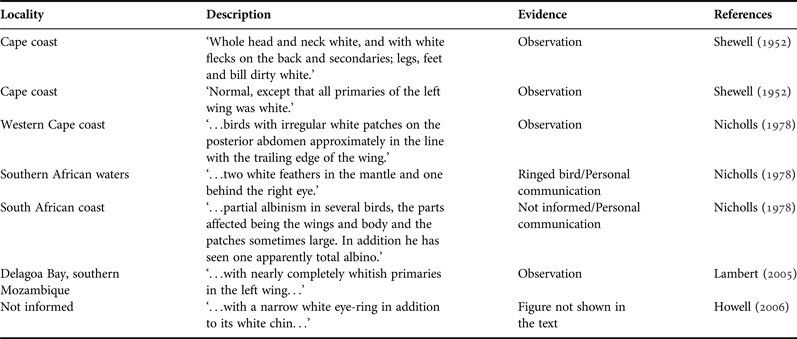
Here, we report several cases of plumage aberrations in White-chinned Petrels Procellaria aequinoctialis (Procellariidae) from the Brazilian Economic Exclusive Zone (EEZ) in the south-west Atlantic Ocean. These are, to the best of our knowledge, the first reports based upon documented evidence for the region (Table 1).
Published records of plumage aberration in White-chinned Petrels Procellaria aequinoctialis.

The White-chinned Petrel is a medium-sized (length 51–58 cm; wingspan 134–147 cm) seabird showing a horn-coloured bill, and a mainly sooty black plumage with a variable amount of white on the chin and throat. The species breeds on a few sub-Antarctic islands of the southern Atlantic, southern Indian and south-western Pacific Oceans, but ranges widely at sea, from the pack-ice to the subtropics, including the Brazilian waters (Howell, Reference Howell2006; Onley & Scofield, Reference Onley and Scofield2007; Carlos, Reference Carlos2009). In the Atlantic, the White-chinned Petrel may well be confused with the very similar-looking Spectacled Petrel Procellaria conspicillata, but the latter has diagnostic white eye-rings and dark-tipped bill (Howell, Reference Howell2006; Onley & Scofield, Reference Onley and Scofield2007).
On 6 October 2011, G.F. photographed an apparently aberrantly plumaged White-chinned Petrel from a fishing boat operating about 1.8 nautical miles (3.3 km) off Tramandaí (circa 29°59′29.63″S 50°06′06.85″W) in the State of Rio Grande do Sul, south Brazil. The plumage of this bird was mostly sooty black except for some dark-based, white-tipped feathers on the upper-wing coverts and primaries besides its white chin; the eyes and the bare parts were normally coloured (Figure 1A). The presence of such strange, partially non-pigmented feathers is puzzling, but at least leucism can be ruled out (cf. van Grouw, Reference van Grouw2013; Table 1).
Aberrantly plumaged White-chinned Petrels Procellaria aequinoctialis from Brazil: (A) 6 October 2011; (B) 16 June 2012; and (C, D) 19 September 2013. Photographs: G.F. (A, C, D) and N.W.D. (B).
On 16 June 2012, N.W.D. photographed a second aberrantly plumaged petrel off Torres (circa 29°21′21.68″S 49°39′43.52″W), also in Rio Grande do Sul. This bird, like the previous one, displayed a predominantly sooty black plumage, but besides the white chin, it also exhibited a narrow white eye-ring; its bare parts had a normal colouration (Figure 1B). According to the identification key by van Grouw (Reference van Grouw2013), this bird can be identified either as a partial leucistic or as a progressively greying mutant.
Finally, on 19 September 2013, G.F. observed and photographed a medium-sized and extremely light-plumaged petrel while aboard a fishing boat about 4 nautical miles off Passo de Torres (circa 29°21′26.30″S 49°36′39.52″W), State of Santa Catarina, southern Brazil. This bird had a flight style similar to that described for Procellaria petrels – glides and wheels over the water followed by glides on slightly bowed wings with bouts of strong but fairly languid, loose flapping, the wings held fairly straight out from the body (Howell, Reference Howell2006). Most of the bird's plumage was whitish with brown freckles on its upper- and underparts, head and nape (Figure 1C, D); the eyes, bill, legs and feet had a colouration similar to that of the previously described individuals. The uniform, horn-coloured bill lacked a dark tip, confirming the bird as a White-chinned Petrel (cf. Howell, Reference Howell2006; Onley & Scofield, Reference Onley and Scofield2007); therefore, ruling out the possibility of an aberrantly plumaged Spectacled Petrel. The plumage colour of this bird is most likely the result of a brown mutation, which consists in the reduction of eumelanin due to its incomplete oxidation. Feathers with incompletely oxidized eumelanin bleach very fast under the sunlight, hence the many whitish (worn) feathers in that bird (van Grouw, Reference van Grouw2013; Figure 1C, D).
In albatrosses and petrels, as in other birds, albinism and leucism have been erroneously regarded the most common melanin-pigmentation anomalies. However, most cases of aberrant colourations may actually involve either brown or progressively greying mutants (van Grouw, Reference van Grouw2013). Anyway, ‘albinism’ and ‘leucism’ have been recorded for at least 19 genera, including Procellaria (Bried & Mougeot, Reference Bried and Mougeot1994; Bried et al., Reference Bried, Fraga, Calabuig-Miranda and Neves2005; Mancini et al., Reference Mancini, Jiménez, Neves and Bugoni2010). In both leucistic and progressively-greying birds, the white patches, as well as the extent of white, can show a great variability, irrespective of species. In White-chinned Petrels, the extent and positioning of white colouration in aberrantly plumaged birds varies from just a narrow ring around the eyes to large patches on the head, belly and wings (Table 1).
The leucistic/progressively-greying bird photographed in June 2012 was similar to those reported by Howell (Reference Howell2006) and A. Thomas (in Nicholls, Reference Nicholls1978): all these individuals showed the lowest degree of colour aberration recorded for the species. In contrast, the individual from September 2013 was among those with the highest degree of abnormally coloured feathers (Table 1). The other cases of supposedly high degree of ‘leucism’ for White-chinned Petrel were those reported by J.C. Sinclair (in Nicholls, Reference Nicholls1978) and Shewell (Reference Shewell1952): the former author erroneously mentioned an ‘apparently total albino’ bird, whereas, the latter described an individual with about half of the plumage and bare-parts whitish. However, both records lack documentation (i.e. a photograph or even a museum specimen) that enables their verification and validation. It should be remembered that besides being similar to each other, White-chinned and Spectacled Petrels were considered conspecifics until the late 1990s (Ryan, Reference Ryan1998). To date, only one case of ‘leucism’ has been reported in the Spectacled Petrel: a bird with a ‘white abdominal patch accompanied by white on the head’ (Nicholls, Reference Nicholls1978). As far as we know, plumage aberrations have not been reported for the remaining three species in the genus – Black Petrel Procellaria parkinsoni, Westland Petrel Procellaria westlandica and Grey Petrel Procellaria cinerea.
The identifications of the individuals from October 2011 and June 2012 were straightforward, as both exhibited a nearly normal plumage colouration. In contrast, the individual from September 2013 was identified only when it came close to boat, thus enabling the observer to see its bill colour and structure. At-sea identification of seabirds often depends on close observation of plumage colour pattern, body shape and structure, and flight style – the so-called ‘jizz’ (e.g. Howell, Reference Howell2006; Carlos & Voisin, Reference Carlos and Voisin2008). In this context, the occurrence of plumage aberrations adds complications not only by changing the overall colour of a bird, but also because it may affect its flight performance and, consequently, flight style: feathers with low levels, or absence, of melanin are much more susceptible to wear (Lee & Grant, Reference Lee and Grant1986). So, every supposedly aberrantly plumaged seabird must be observed at close range and under good light to confirm its identification. Garrett (Reference Garrett1990), for example, mentioned aberrantly plumaged Black-vented Shearwaters Puffinus opisthomelas, that could be confused with Cape Petrels Daption capense or Streaked Shearwaters Calonectris leucomelas, unless seen extremely well at close range.
Here, we presented the first records of aberrantly plumaged White-chinned Petrels from Brazil (Table 1). They correspond to the third report of plumage colour abnormalities in petrels occurring in this country (Murphy & Pennoyer, Reference Murphy and Pennoyer1952; Sick, Reference Sick1997; Mancini et al., Reference Mancini, Jiménez, Neves and Bugoni2010). This scarcity of reports of aberrantly plumaged seabirds in the Brazilian EEZ is due to the inherent difficulties of identifying them and to the still relatively low effort of at-sea observation in the region.
ACKNOWLEDGEMENTS
Our observations were made possible thanks to the generous assistance of fishermen from Tramandaí, Imbé and Passo de Torres; and the Instituto de Biociências, Universidade Federal do Rio Grande do Sul. The manuscript benefited from comments by H. van Grouw and J. Bried. G.F. and C.J.C. were supported by Coordenação de Aperfeiçoamento de Pessoal de Nível Superior (CAPES), Brazil. N.W.D. received a scholarship from Grupo de Pesquisas em Ecologia e Conservação da Megafauna Marinha (EcoMega) – FURG/CNPq.