Introduction
Appropriate and accurate drug dosages, equipment sizes, and fluid rates are essential for treatment of pediatric patients.Reference Lowe, Campwala, Ziv and Wang 1 , 2 Most pediatric drug doses are per kilogram bodyweight. 3 During resuscitation, when a weight is unknown and a scale is unavailable, accurate weight estimation is crucial for appropriate drug administration.Reference Abdel-Rahman, Ridge and Kearns 4 Weight estimation by medical personnel is of variable accuracy.Reference Abdel-Rahman, Ridge and Kearns 4 - Reference Rosenberg, Greenberger, Rawal, Latimer-Pierson and Thundiyil 7 Parents frequently are able to provide a reliable weight,Reference Abdel-Rahman, Ridge and Kearns 4 but they may not be available during emergent situations. Resuscitation aids and formulas may assist in estimating pediatric patients’ weights.Reference Krieser, Nguyen, Kerr, Jolley, Clooney and Kelly 8 , Reference So, Farrington and Absher 9 Some of these aids have been validatedReference Kleinman, de Caen and Chameides 5 clinically and provide more accurate weight estimations than formula computations and subjective estimations.Reference Kleinman, de Caen and Chameides 5 , Reference Krieser, Nguyen, Kerr, Jolley, Clooney and Kelly 8 , Reference So, Farrington and Absher 9 Current American Heart Association (AHA; Dallas, Texas USA) guidelines support using resuscitation aids that combine length-based weight estimation with pre-calculated drug dosing to decrease medication/dosing errors.Reference Lubitz, Seidel, Chameides, Luten, Zaritsky and Campbell 6
The Broselow Pediatric Emergency Tape (Armstrong Medical Industries; Lincolnshire, Illinois USA) is used commonly in resuscitations in the prehospital care of pediatric patients as it has been found to be superior to other estimation devices and formulas.Reference Lubitz, Seidel, Chameides, Luten, Zaritsky and Campbell 6 - Reference Krieser, Nguyen, Kerr, Jolley, Clooney and Kelly 8 It facilitates rapid weight estimations and provides corresponding drug dosages based on the length of a child.Reference Kleinman, de Caen and Chameides 5 , Reference Krieser, Nguyen, Kerr, Jolley, Clooney and Kelly 8 , Reference Wells, Coovadia, Kramer and Goldstein 10 The Broselow tape was developed using height/weight correlations from a nationally representative sample of children in the United States.Reference Kleinman, de Caen and Chameides 5 , Reference Wells, Coovadia, Kramer and Goldstein 10 The color zone categories predict the 50th percentile weight for height,Reference Kleinman, de Caen and Chameides 5 estimating ideal body weight of US children. 3 Based on predicted weight and AHA recommendations, pre-calculated doses for common resuscitation drugs are listed in each color zone.Reference Kleinman, de Caen and Chameides 5 The Broselow tape can estimate weight within 10% of actual weight in 55%-65% of children,Reference Lubitz, Seidel, Chameides, Luten, Zaritsky and Campbell 6 , Reference So, Farrington and Absher 9 making it an accurate tool for estimating pediatric weights, particularly in younger children approximately 25 kg or less.Reference Kleinman, de Caen and Chameides 5 , Reference Krieser, Nguyen, Kerr, Jolley, Clooney and Kelly 8 However, it considerably underestimates weight in obese children. 3 , Reference Lubitz, Seidel, Chameides, Luten, Zaritsky and Campbell 6 , Reference Krieser, Nguyen, Kerr, Jolley, Clooney and Kelly 8 For children longer than the tape and older than 12 years of age, adult dosages and equipment are recommended.Reference Lubitz, Seidel, Chameides, Luten, Zaritsky and Campbell 6 However, children in this category are not necessarily of adult weights. 11 Thus, there is a need for a simple tool that can accurately predict the weight of older, taller, and obese children.
A novel pediatric weight estimation tool, the Handtevy Length-Based Tape (Pediatric Emergency Standards Inc.; Weston, Florida USA), has been developed which eliminates the need for dosage calculations for a wider range of children. The Handtevy tape, a component of the Handtevy Pediatric Box, uses age and length to estimate weight.Reference Cattermole, Leung, Graham and Rainer 12 The tape is recommended for children up to age 14 years of age and is longer than the Broselow tape. It also uses color zones to predict ideal body weight for height ranges. In contrast to the Broselow system, which prints pre-calculated drug doses (mg) directly onto the tape, the Handtevy Pediatric Box provides a supplemental booklet which lists drug dosing for each predicted weight for dose (mg/kg), amount (mg), and volume dosing (mL). This eliminates the need for volume calculations, thus decreasing medical errors and increasing patient safety.
This study aimed to compare the relative performance of each color zone of two commercially available, pediatric, length-based tapes (Broselow and Handtevy) in predicting actual weights of US children using a national database.
Methods
Study Design and Population
The Centers for Disease Control and Prevention (CDC; Atlanta, Georgia USA) facilitates the National Health and Nutrition Examination Survey (NHANES) program that assesses the health and nutritional status of US adults and children.Reference Antevy 13 The representative NHANES data, including sociodemographic, dietary, medical, dental, and physiological information, are collected yearly from individuals of all ages from 15 US counties. The NHANES demographics and examination data from 2009-2010 were used for this study.Reference Antevy 13 Variables extracted from all study participants younger than 14 years of age included: age (months: < one year; years: ≥ one year); body length (centimeters of height or recumbent length preferred, when available); weight (kilograms); race; and gender (Table 1). The 2009-2010 NHANES Anthropometry Procedures Manual 14 describes how measurements were obtained.
Characteristic of Study Subjects

Abbreviation: BMI, body mass index.
a The mean BMI of the 3018 study subjects was 18.12 kg/m2.
Patients were excluded if data were missing or flagged by NHANES for equipment-related measurement inaccuracies, such as: (1) Height - patient was too tall/long to be measured by the stadiometer/infantometer, measurement could not be obtained, or measurement was inaccurate due to patient’s stature not being straight; and (2) Weight - patient wore street clothing/shoes or had a medical appliance such as cast/prosthesis. 14 From a dataset of 10,253 patients, children between the ages of 0 months to 13.9 years were included. The cut-off age of 14 years was selected since the Handtevy tape is recommended for use in children≤13 years of age. 15
In the current study, a sub-group analysis was performed excluding patients who were obese. Body mass index (BMI) was calculated using the formula: weight (kg) / body length (m2). To interpret BMI, the CDC recommends using the World Health Organization (WHO; Geneva, Switzerland) BMI growth charts (November 2009) separately for boys and girls less than two years of age. Alternatively, for boys and girls over two years of age to 20 years of age, the CDC recommends using their own BMI growth charts. 16 Overall, pediatric obesity is defined as BMI ≥ the 95th percentile. 17
Length-based Tape Measurement Systems
Broselow System
The Broselow Pediatric Emergency Tape 2011 edition (released 2011-present), which is based on the latest NHANES data available at the time of manufacture,Reference Wells, Coovadia, Kramer and Goldstein 10 was used. The tape includes lengths 47.0-143.6 cm and is divided into nine color zones. Each zone has one corresponding weight assigned for drug dosages, except for the Gray zone, which is divided into three sub-zones of weights for three drug dosages (3.0 kg, 4.0 kg, and 5.0 kg). For clarity, numbers were assigned to each sub-zone per color zone (ie, Gray 1, 2, and 3).
Handtevy System
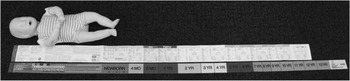
The Handtevy Length-Based Tape 2011-2012 edition (released 2012-present) was used in this study and is also divided into nine color zones. Four of the color zones are sub-divided (White 1 and 2, Blue 1 and 2, Orange 1 and 2, and Green 1-5) and provide weight estimations for drug dosages, resulting in 16 weight estimations compared to 11 on the Broselow tape. The tape includes lengths 47.0-164.5 cm. The color zones of each tape mirror one another with each color approximately aligning when laid flat side-by-side (Figure 1).
Baby Anne (Laerdal; Wappingers Falls, New York USA [top row]), Broselow Tape (middle row), and Handtevy Tape (bottom row).

Study Procedures
With both tapes flat, the length ranges of each zone and sub-zone in centimeters were measured (Table 1). Using these measured length ranges and the NHANES-extracted body length variables, every case from the study sample was coded into a Broselow and Handtevy color zone and thus received a predicted weight (Table 2). The predicted weights of each tape’s color zones were compared to the actual weight obtained from the NHANES measured weight. To approximate how closely Broselow color zones predicted actual weight compared to the Handtevy color zones, corresponding color zones were compared. For zones containing sub-zones, the weighted average of each variable was compared to that of the other tape’s corresponding color zone. Since the Handtevy tape is 20.9 cm longer than the Broselow tape, approximately overlapping zones were compared (Handtevy Green zones 1 and 2 vs Broselow Green zone).
Outcome Measures of Performance of the Broselow vs Handtevy Tapes for Children of all BMIsFootnote b (Data are presented as mean (SD), unless otherwise indicated)

Abbreviations: BMI, body mass index; LOA, Limits of Agreement; MD, mean difference; MPE, mean percentage error; NHANES, National Health and Nutrition Examination Survey; SE, standard error.
a There were no children in the 3 kg weight prediction category in the NHANES dataset. Thus, the first length category (Gray 1) of the Broselow Tape (47.00 cm-52.00 cm) was left out of this table.
b The NHANES demographics and examination data from 2009-2010 was used.
The Institutional Review Board at Children’s Hospital Los Angeles (Los Angeles, California USA) approved this study. As the study is descriptive, no power analysis was performed. Data analyses were performed using IBM Statistical Package for the Social Sciences for Windows Version 19 (IBM Corporation; Armonk, New York USA; 2010).
Definitions
Zone performance of each tape was assessed in relation to actual weights. Performance was evaluated by the outcome measures of bias, precision, and accuracy.
Bias
Bias is the mean of the difference between the estimated and actual value. 18 Bias was estimated by the mean difference (MD) between estimated and measured weights (predicted weight-actual weight / sample size)Reference Annis 19 , Reference Ackwerh, Lehrian and Nafiu 20 and by mean percentage error (MPE; mean of the sum of [predicted weight – actual weight/actual weight] x 100).Reference So, Farrington and Absher 9 , Reference Bland and Altman 21
Precision
Precision is how widely values cluster around the mean of the sampling distribution.Reference Abdel-Rahman, Paul, James and Lewandowski 22 , Reference Hanneman 23 According to Bland and Altman, most of the differences between predicted weight and actual weight should lie between the “Limits of Agreement” (LOA; MD [SD=2]), which are estimates of the values of a population from a given sample.Reference Ackwerh, Lehrian and Nafiu 20 To assess the precision of the estimates in terms of defining the range within which a value is likely to lie,Reference Abdel-Rahman, Paul, James and Lewandowski 22 the standard error (SE) of the MD and its 95% confidence intervals (CI) were used.Reference Ackwerh, Lehrian and Nafiu 20
Accuracy
Accuracy is how close a measurement is to its true value.Reference Hanneman 23 Consistent with other studies, accuracy was defined as the proportion of estimated weights that were within 10% of actual weight.Reference Lubitz, Seidel, Chameides, Luten, Zaritsky and Campbell 6 , Reference So, Farrington and Absher 9 , Reference Annis 19 , Reference Bland and Altman 21
Results
There were 3,312 children between 0-13.9 years of age. Criteria for exclusion included: could not obtain (8, 0.2%); clothing (116, 3.5%); medical appliance (4, 0.1%); missing weight (114, 3.5%); and no height documented (52, 1.6%), leaving 3,018 subjects. Of these, 2,434 and 2,941 were assessed using the Broselow tape and Handtevy tapes, respectively (with the remainder exceeding the length of each tape). Subject demographics and characteristics are presented in Table 1. Of the patients assessed by the Broselow and Handtevy tapes, 82.6% and 80.6% had a BMI<95th percentile, respectively. Table 2 and Table 3 present the performance outcome measures of each tape, per color zone, for all and non-obese children, respectively. Overall, the performance of both tapes progressively decreased along the higher length zones, most markedly in the Green zone.
Outcome Measures of Performance of the Broselow vs Handtevy for Children with BMI<95th PercentileFootnote b (Data are presented as mean (SD), unless otherwise indicated)

Abbreviations: BMI, body mass index; LOA, Limits of Agreement; MD, mean difference; MPE, mean percentage error; NHANES, National Health and Nutrition Examination Survey; SE, standard error.
a There were no children in the 3 kg weight prediction category in the NHANES dataset. Thus, the first length category (Gray 1) of the Broselow Tape (47.00 cm-52.00 cm) was left out of this table.
b The NHANES demographics and examination data from 2009-2010 was used.
Bias
All BMIs
Both tapes underestimated weight in almost every zone. The Broselow tape demonstrated smaller biases (MD and MPE) of weight estimation compared to the Handtevy tape in all zones. Mean differences of the Handtevy tape most markedly and progressively increased along the Green sub-zones. The highest MPEs of both tapes were found in the Gray zones (Broselow, -9.42; Handtevy, -25.03). In the Handtevy tape, the MPEs were larger on either end of the tape and gradually decreased towards the middle.
Non-obese
When obese children were excluded, overall, biases of both the Broselow and Handtevy decreased, indicating closer approximation to actual weights. The bias (MD and MPE) improved in the Handtevy tape in all zones (except Blue 1, which stayed approximately the same), with the greatest improvement occurring along the upper half (greater length) of the tape. In the Broselow tape, the bias decreased in all color zones, except Yellow, White, and Orange, where the bias increased. Weight was overestimated in the Broselow Yellow through Green zones. Biases remained lower in all Broselow vs Handtevy zones, except for the Orange zone.
Precision
All BMIs
The precision of both tapes was relatively high in the lower lengths and decreased in the higher length zones. Within the Broselow tape, precision was relatively high (low SE) in all color zones, decreasing in the Blue, Orange, and Green zones. Precision was comparable between the two tapes for the Gray through Yellow zones. The Handtevy tape was less precise than the Broselow tape in the White through Green zones, though the magnitude of these differences was low.
Non-obese
Excluding obese children increased the precision in all zones of both tapes.
Accuracy
All BMIs
The Broselow tape was more accurate in the lower half of the tape with the Handtevy more accurate in the upper half (Figure 2). The percentage of predicted weights falling within 10% of actual weights in the Broselow color zones ranged from 40.29%-68.58%. The Red and Yellow zones were the most accurate of the Broselow tape, and the Green zone was least accurate. The accuracy of the Handtevy zones ranged from 8.82%-66.51%. The most accurate zones of the Handtevy were in the White and Blue zones with the Gray zone being the least accurate.
Comparison of Accuracy between the Broselow and Handtevy Tapes. Accuracy was defined as the percent of predicted weights within 10% of actual weight. For color zones with sub-zones (Broselow: Gray; Handtevy: White, Blue, Orange, and Green), the average weighted accuracy was calculated. The Handtevy Green zone was only averaged with the first two sub-zones (Green 1 and 2) since they approximately overlap with the Broselow Green zone.

Non-obese
Excluding obese children improved the accuracy of all zones in each tape.
Discussion
This study compared bias, precision, and accuracy of the Broselow and Handtevy pediatric tapes in the prediction of actual weights of children in the US using a national database. The Broselow is limited to children between 47.0-143.6 cm in length and 3-34 kg in weight. Furthermore, the relative accuracy of the Broselow is known to be inferior in older, taller, and obese children. 3 , Reference Lubitz, Seidel, Chameides, Luten, Zaritsky and Campbell 6 , Reference Krieser, Nguyen, Kerr, Jolley, Clooney and Kelly 8 The Handtevy is a longer tape developed to incorporate these subsets of children. The differences between the Handtevy and Broselow tapes were most pronounced at the extremes of height and weight (obesity). The utility of each tape was interpreted based on the three metrics of bias, precision, and accuracy using previously published methodologies.Reference Bland and Altman 21 Because particular interest exists in the literature on the effect of obesity and estimation of weight and dosing,Reference Lubitz, Seidel, Chameides, Luten, Zaritsky and Campbell 6 , Reference Annis 19 the effect of obesity on the utility of these tapes was addressed separately.
For the Handtevy tape, these data show the accuracy to be favorable in older, taller children, and the Broselow tape has a higher accuracy in younger infants and toddlers. Among the NHANES cohort, the accuracy for the Broselow tape within 10% of the actual weight was between 45%-68.33% for the Gray, Pink, and Red zones, and appears to be lower than previous reports.Reference Cattermole, Leung, Graham and Rainer 12 , 16 In other studies, this accuracy is similar for infants (63.9% Abdel-Rahmen, et al and 63.6% Wells, et al).Reference So, Farrington and Absher 9 , Reference Bland and Altman 21 The loss of accuracy in infants with the Handtevy tape likely is due to differences in methods of estimation (Fig. 2). Of note, weights are underestimated in this age group by the Handtevy tape.
In contrast, with older, taller children, the Handtevy tape is more accurate than the Broselow tape. This may be due Handtevy’s longer size, which allows for taller children and better estimates. However, the performance of both tapes increased when obese children were excluded. These findings are consistent with other studies showing that the accuracy of the Broselow tape is reduced in overweight and obese children.Reference Lubitz, Seidel, Chameides, Luten, Zaritsky and Campbell 6 , Reference Rosenberg, Greenberger, Rawal, Latimer-Pierson and Thundiyil 7 , Reference So, Farrington and Absher 9 Two other commercially available tapes, the PAWPER (Dr. M. Wells; Johannesburg, South Africa) and Mercy (Children’s Mercy Hospital and Clinics; Kansas City, Missouri USA) tapes, use body habitus and arm circumference to estimate and adjust for predicted BMI,Reference So, Farrington and Absher 9 , Reference Bland and Altman 21 as these methods increase the predictive accuracy among obese children. Abdel-Rahman, et al showed that among overweight and obese children, the accuracy of the Mercy tape is still maintained above 50%, whereas the Broselow dropped below 10% accuracy.Reference Bland and Altman 21 It appears that a length-based tape with no other formula or active adjustment for BMI sacrifices weight estimation accuracy in obese patients. This is significant since 17% of children in the US are obese, with over 20% in certain ethnic groups (Hispanics and non-Hispanic black youths).Reference Mantha, Roizen, Fleisher, Thisted and Foss 24
Results suggest that both tapes should be updated with the current weight of children. Further, the Handtevy tape should be updated to improve performance, particularly for extremes of the tape. The clinical significance of each tape’s weight underestimation is unknown. Problems could include significant under-dosing of medications, whereby the desired clinical and therapeutic effect of the drug may not be obtained. This potentially could be detrimental in the resuscitation of a critically ill child, possibly leading to multiple re-dosing of medications and inefficiency and inadequacy of resuscitative efforts.
While the performance of both tapes decreases in taller and overweight children, both tapes serve as valuable tools to provide weight estimates in emergent situations. Even with biases and inaccuracies of both tapes, studies indicate using the Broselow in emergent situations is still better than visual estimation of weight by physicians or the use of weight-estimation formulas.Reference Lubitz, Seidel, Chameides, Luten, Zaritsky and Campbell 6 , Reference Krieser, Nguyen, Kerr, Jolley, Clooney and Kelly 8 , 25 Further, the incorporation of pre-calculated volume dosages on the Handtevy tape has the potential to prevent medical dosage calculation errors from occurring. Regardless of which tape is used, speculation of clinical judgment and regional protocols may dictate appropriate medication dosing.
Limitations and Future Directions
The NHANES database contains over 3,000 study participants. Although these data represent one of the largest samples used for tape performance, it still may not be representative of all children, and is a retrospective cohort whose measurements cannot be verified. In addition, NHANES excluded 7.2% of the participants that met age criteria for various reasons. This may have limited the analysis of the tapes. Furthermore, no correction was made for potential NHANES participants with medical conditions that could affect anthropometrics.Reference Krieser, Nguyen, Kerr, Jolley, Clooney and Kelly 8
Separate analyses on patients who are underweight for their given age were not performed. Underweight patients are at risk for being inappropriately assigned to a heavier weight, thereby overdosing on a medication, which could have serious consequences.
Of note, the corresponding color zones of the tapes are not identical in length making direct, 1-to-1 comparisons difficult. However, methods from Abdel-RahmanReference Bland and Altman 21 and WellsReference So, Farrington and Absher 9 to characterize performance that are agnostic to the relative matching capabilities of the two tapes were incorporated.
This study was not designed to examine clinical implications either with real or simulated patients. The Handtevy tape allows for instant volume calculation dosing for medications, which may exert a significant clinical 25 time-saving effect and reduction of error that was not captured in this analyses. This study did not look at clinical dosing errors, and it is likely that the greatest timesaving measures lie here. Similarly, clinical conclusions were unable to be made about the downstream consequences of underestimating the weight, if any. Conclusions regarding clinical implications of the underestimations, particularly in obese children, cannot be drawn.
Conclusions
The Broselow tape performed better in predicting pediatric weights than the Handtevy tape throughout all zones in most outcome measures. While both tapes underestimated weight, the Handtevy tape overall underestimated pediatric weights more pronouncedly, particularly in short and tall children. The Handtevy tape, however, displayed greater accuracy in the longer children while the Broselow was more accurate in the shorter children. When obese children were excluded from the study sample, the performance of both tapes improved. Further refinements in both tapes would likely improve their performance, although use of either is still likely to be better than physician estimations.
Acknowledgments
The authors thank Leighanne Johnson, MS; Pradip Chaudhari, MD; and Phung K. Pham, MS for their constructive comments and suggestions during the course of this study.
Supplementary material
To view supplementary material for this article, please visit http://dx.doi.org/10.1017/S1049023X16000455