The complex relationship between Arab and Berber identity is one of the central questions in North African historiography. It enjoys a long genealogy in colonialist, nationalist, and postindependence scholarship and continues to generate heated political debate in light of recent Amazigh activism in defense of Berber cultural identity and ethnolinguistic rights in Algeria and Morocco.Footnote 1 This article revisits a critical phase in the negotiation of Arab and Berber identity in Morocco by examining how colonial state-building during the early decades of the Protectorate transformed the context in which collective identity could be conceived. Between the signing by the French consul and the Moroccan sultan of the Treaty of Fes in 1912 and the early 1930s, relationships between city and countryside, between coast and interior, and among Morocco's social groups were dramatically altered as rural resistance was brutally conquered, a vast transportation infrastructure was constructed, an extractive colonial economy took hold, and a highly articulated governmental apparatus was extended throughout the Sharifian Empire. In this process, multiple dimensions of collective identity—local, regional, national, and transnational—were renegotiated as ethnic, linguistic, and religious categories including Arab, Berber, Muslim, and Moroccan became politically salient in new ways.
Most scholarship on Arab and Berber identity in Protectorate Morocco has focused on the nexus of colonial ethnography, military operations, and administrative policy constituting French “Berber policy,” or it has dealt with the nationalist mobilization against this policy by young, urban Arab Moroccan elites, particularly the campaign against the 16 May 1930 decree (which they referred to as the “Berber Dahir”) reorganizing customary law courts in certain Berberophone regions.Footnote 2 Although the rural “Berber” populations at the center of this intense struggle over national identity are frequently talked about, these groups are rarely, if ever, heard from in the prodigious colonialist or nationalist sources from the period or in the scholarship that builds off them.Footnote 3 This study relocates the frame of analysis regarding the Arab–Berber controversy in Protectorate Morocco by focusing on the neglected perspectives of Tamazight-speaking groups in the Atlas Mountains.
This move entails a shift from the standard base of colonial and nationalist written sources to a unique collection of Tamazight oral poetry gathered in the Middle and High Atlas mountains during the first decades of the Protectorate. Because primary-source records from a nonliterate population are rarely available, or only gathered via an oral history much later, these poems composed and collected contemporaneously with the events they describe represent a unique historical source base.Footnote 4 As a repository of public discourse, they provide an unparalleled window into how collective identity among these Berber speakers was impacted by the forceful expansion and consolidation of the French Protectorate state between 1912 and the mid-1930s. Complementing recent scholarship exploring how ethnic identity is contextually situated in the Maghrib,Footnote 5 these sources from an important historic period demonstrate how collective identity, rather than being static, was dynamically negotiated and reimagined among Berber-speaking groups in the midst of a rapidly changing social, political, economic, and military context. The story of these Atlas communities also sheds light on broader trends concerning the role of Islam and Arabization in mapping out collective identity elsewhere in Morocco, the Maghrib, and the larger Arab world.
STATE SPACE, TOTAL PACIFICATION, AND THE ELIMINATION OF BILĀD AL-SĪBA
In the Treaty of Fes, signed on 30 March 1912, the French Republic pledged to “protect” the position of the Moroccan sultan by strengthening the Moroccan government, or makhzan,Footnote 6 through the euphemistically labeled “pacification” of the tribal interior, modernization of governmental institutions, and economic development.Footnote 7 In this state-building iteration of a colonial mission civilisatrice, the French justified their “tutorial” intervention in Morocco by emphasizing the alleged failure of the Moroccan state at the close of the 19th century.Footnote 8 Over the next two decades, the rapid construction of a modern governmental apparatus radically transformed state–society relations in Morocco.
The political ecosystem in North Africa, famously described by Ibn Khaldun in the Muqaddima, had historically been characterized by dense interactions between urban and seminomadic rural groups. Dynastic states were consolidated by directly co-opting the military potential of the tribal periphery or defusing it by projecting the sultan's symbolic power through granting titles, conferring gifts, and mediating conflicts. Two conceptual categories (oversimplified in later colonial writings) were used to describe this topography: bilād al-makhzan, the land of the government, and bilād al-sība, the land outside governmental control.Footnote 9 While state control was generally anchored in the lowland plains and fluctuated in the upland areas in the Rif and Atlas ranges and the southern deserts, in pre-Protectorate Morocco there were myriad gradations between the two zones as relations between the makhzan and various urban and rural groups were constantly negotiated.
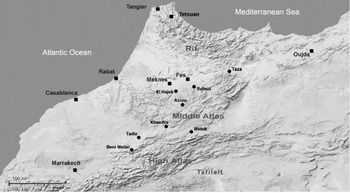
The failure to eliminate sība (better understood as degrees of autonomy from the state) was used to justify French intervention “on behalf” of the Moroccan sultan, and after 1912 a “total pacification” of Moroccan territory was launched. While the more accessible plains and coasts were pacified quickly, it took until 1934 to completely quell fierce resistance in the Rif, Atlas, and Anti-Atlas mountain ranges. In the French zone, the pacification occurred in three major waves. The immediate priority was securing Morocco's critical lateral corridor joining the Atlantic coastal plain to the border with Algeria at the city of Oujda (Fig. 1). Operations in 1913 focused on the tribes threatening this east–west axis from the mountains south of Meknes and Fes and at the Taza gap. The route stretching northeast from Marrakech to Fes also had to be secured, with early operations focused on the Tadla plain and the regions around Khenifra and Azrou. The second wave, completed in the early 1920s, established a vertical corridor linking Meknes south to the Tafilelt region, building a north–south road and military posts at Midelt and Rich to separate tribes around Taza from those in the eastern/central High Atlas. After the delay of the Rif War, in which French forces aided the Spanish in suppressing ʿAbd al-Krim's republic in 1925 and 1926,Footnote 10 the rising German threat in Europe put pressure on French military planners in Morocco to complete operations in order to free up troops for redeployment in France. Stubborn resistance in the central High and Anti-Atlas delayed the pacification's completion, however, until 1934, with the final operations against the Ait ʿAtta in the Jbel Saghro.
Relief map of Morocco. Created by the author with ArcView GIS software.

This total pacification radically altered the power relationship between the makhzan and the sība, dramatically expanding what Scott has described as “state space,” the landscape and social groups “legible” to the state that can be feasibly censused, taxed, conscripted, and administered.Footnote 11 It systematically eliminated “nonstate space,” forcing tribal groups previously wielding a degree of autonomy from the makhzan to submit completely to the state. Railroad, road, and telegraph networks were built to link previously remote areas to the rest of the country. Aerial photography charted the expansion of state space through the pacification, and annual maps from the cartographic services delineated receding “areas of dissidence.” Newly pacified regions were also made legible through the production of tribal maps, detailed cartes and fiches des tribus, censuses, land surveys, and careful research and codification of customary law. At the same time, the military potential of the former sība groups was exploited as newly conquered tribes were incorporated in the colonial army and used against neighboring unsubmitted tribes.
OPPOSING “MOROCCAN VULGATES”
The expansion of a reinvented makhzan in the first two decades of the Protectorate created increasing tensions between the French administration and Moroccan Arab nationalists over the trajectory of French state-building in Morocco. Protectorate officials, similar to those of other colonial regimes, relied on cultural technologies such as historical, sociological, and ethnographic research as tools for gathering knowledge of native social structures, language, law, and institutions.Footnote 12 The consolidation of a “Moroccan colonial archive,” before and after the establishment of the Protectorate, relied on scientific expeditions, ethnographic surveys, and the creation of research institutes.Footnote 13 While the “historiographic state” in Algeria, as described by Abdelmajid Hannoum, sought to redefine the country as French, in Morocco it focused on discovering how the “archetypal” makhzan was organized and functioned.Footnote 14 This information was used to give the Protectorate a veneer of legitimacy through the preservation and reinvention of the “traditional” forms and trappings of Moroccan rule. It also helped justify French control, reinforcing a view that the weak Moroccan “Arab” state had never succeeded in controlling the “Berber” countryside.
As the pacification of this countryside proceeded in the Protectorate's first years, an “ethnographic state” became necessary, and field research, publications, and research institutes focused on understanding Atlas Berber tribal society. Burke calls the distillation of these efforts the “Moroccan Vulgate,” a set of simplifying binaries lining up ethnolinguistic, religious, economic, and political divisions according to a reified antagonism between makhzan and sība. The “land of government” was rigidly equated with the plains and coasts, urban centers, Arabization, and Islamization. The “land of dissidence” was associated with mountains and deserts, the countryside, Berber language, and superficial, syncretic Islam. In this attempt to make the fluid political, ethnic, and linguistic categories within Moroccan society legible to the colonial state, language and law were privileged as markers to identify (and make) “Arab” and “Berber” groups in Moroccan society.
The “Berber Policy” that emerged in the first decade of the pacification was profoundly shaped by the vulgate's ascription of an ethnic antagonism between the “Berbers” of the mountains and the “Arabs” of the plains. In early pacification operations in 1913, Lieutenant Colonel Henrys, who had been charged with the task of subduing the Middle Atlas tribes, concluded that the resistance of the Berbers stemmed from a desire to continue practicing their own customary law rather than submitting to the shariʿa (Islamic law) court system of the makhzan. A 1914 decree was summarily issued, providing for the continuance of tribal courts implementing customary law in areas labeled “as of Berber custom.” Inspired in part by the Kabyle myth inherited from Algeria, a Moroccan school of French Berber experts emerged over the next decade who believed they could exploit Arab–Berber animosity and who romanticized the “noble savages” of la montagne berbère as France's natural allies.Footnote 15 By the 1920s, a strategy had coalesced to create what Jacques Berque describes as “a Berber reserve, a sort of national park which was to be sheltered from the ideologies of the plain, whether Arab or French.”Footnote 16 As Katherine Hoffman has demonstrated, Berber linguistic identity was tied by colonial authorities to legal, cultural, religious, political, and even moral identity, and strenuous efforts were made to police the “contamination” of Berber areas by the Arabization and Islamization emanating from the plains and cities.Footnote 17 Separate “Berber” judicial, educational, and administrative structures were put in place for this purpose.
It was a decree issued on 16 May 1930 clarifying the legal status of the separate “Berber” customary court system (which was in place in parts, though not all, of the Berber-speaking regions) that served as a catalyst for young Arab nationalists in Morocco's cities to challenge the colonial “Moroccan Vulgate.” This small network of like-minded young men in Fes, Rabat, Salé, and Tetouan constituted a post World War I generation whose hopes had been conditioned in the 1920s by salafī reformism, Wilsonian ideals of self-determination, the military success of Ataturk and ʿAbd al-Karim al-Khattabi, the rise of the Pan-Islamic movement, and the stirrings of nationalism in the Middle East and in the Indian subcontinent. By the early 1930s, the structural transformations wrought by the expansion of the colonial state created a context in which a national unit of political identity had become increasingly relevant. For the young Moroccan men in the secret societies, the stakes involved in nation-building were raised because Berber identity had been reified by the colonial state in regions of the Middle and central High Atlas through policies designed to preserve Berber distinctiveness and preclude Arabization and Islamization.
In addition, while the official policy of the laicist Residency was clearly not to encourage the mass conversion of the Berbers to Christianity, various factors in the late 1920s had heightened the religious dimensions of the colonial state-building project. French church journals including Le Maroc catholique and the La Revue d'histoire des missions openly advocated evangelizing the Berber population of Morocco, and the bishopric of Rabat received subsidies out of the Moroccan budget for missionary activities. In the late 1920s, Commander Paul Marty, who was an open advocate of assimilation and Christianization, distributed an Arabic version of a book titled Life of Jesus and installed Algerian Kabyle court clerks who had converted to Christianity in several of the Berber tribal councils. Muslim unease increased in 1928, when Mohammed ʿAbd al-Jalil, son of a Fassi notable family and brother of a nationalist leader, converted to Christianity and became a Catholic priest.Footnote 18 Finally, the Residency had fused political and religious dimensions in its classifications of Arab and Berber identity by using legal status—shariʿa versus izref (customary law)—to differentiate between ethnic groups. Urban Arab activists naturally seized upon the maintenance of a separate system of customary law as a critical barrier to their vision of Arabo-Islamic national assimilation.
The 16 May 1930 decree creating customary tribunals with jurisdiction over civil, commercial, and real and personal property cases while transferring most criminal cases to the French courts provided a strategic opportunity for these activists to mobilize political protest, which spread from Salé to other major Moroccan cities that summer. In these demonstrations, the “Berber Dahir” served as an emblem for a constellation of Protectorate “Berber policies” the nationalists claimed were intended to destroy the unity of the Moroccan umma. In June, July, and August, nationalists used the traditional latif prayer in mosques, with the addendum “and do not separate us from our brothers, the Berbers,” to energize demonstrations against French efforts to curtail the jurisdiction of Islamic law over Berber areas of Morocco, prohibit the teaching and use of Arabic in large areas of the countryside, and ultimately (they claimed) Christianize the Berber-speaking portion of the country's population. By the fall of 1930, the Geneva-based Pan-Islamic propagandist Shakib Arslan had joined the cause, railing against what he construed as a French neocrusade in his journal La Nation Arabe and making the Berber Dahir a cause célèbre energizing anti-French protests across the Muslim world, from Egypt to Indonesia.Footnote 19 French Berber policy was subsequently attacked in annual commemorations of the “Berber Dahir” on 16 May; in numerous articles in the early Moroccan Arab nationalist press published in Paris, Fes, and Rabat; and in the “Plan de Réformes,” submitted by the nationalists in 1934 to the French administration.Footnote 20
Both the historiographic and ethnographic pillars of the colonial vulgate were evoked and rebutted by the nationalists throughout this campaign in the early 1930s to construct and defend Arabo-Islamic national unity in Morocco. The Islamization of the Berbers centuries earlier was affirmed, as was the claim that all of Morocco had been unified for a millennium under Muslim dynasties stretching back to Mawlay Idriss in the 8th century. Although they supported the Protectorate's pacification campaign to bring rural tribes under the direct control of the central government, the Moroccan nationalists rejected the administrative policies implemented afterward to reinforce a division between Arab and Berber. At stake in this struggle was how the national community should be imagined and how the state should seek to realize this vision through educational, linguistic, and legal policy. The nationalists asserted that Arabic should be the official language of the Protectorate and that the official use of Berber (which was taught in some schools and used for court records on a limited basis) should be banned. Likewise, tribal customary law was denigrated, and calls were made for a unified Moroccan judiciary implementing shariʿa. In the Arabo-Islamic Moroccan nationalist countervulgate flowing from the anti-Berber policy protests, Berber cultural or linguistic markers of identity were explicitly rejected due to their association with colonial “divide and rule” policies, an association actively cultivated by Moroccan nationalists.Footnote 21 Instead, the nationalists imagined an “Arab” and “Muslim” Moroccan national community unified by a history of allegiance to the Alawite throne. For them, the state should reinforce national unity through policies consistent with a historic trajectory of Arabization and Islamization.
IMAGINING COMMUNITIES IN THE ATLAS MOUNTAINS
In turning now to the story of the “Berbers,” it is first necessary to more precisely define this problematic ethnic classification at the center of the struggle between the colonialist and nationalist vulgates. There are three major Berber-speaking groupings in Morocco: Tarifit in the Rif,Footnote 22 Tamazight in the Middle Atlas and central-eastern High Atlas, and Tashelhit in the western High Atlas, Souss Valley, and Anti-Atlas. It was predominately the Tamazight regions in which a “Berber policy” was implemented during the Protectorate. This linguistic zone stretches south from the plains around Meknes and Fes to the Saghro range and parts of the Tafilelt. Bilingualism (Berber and colloquial Arabic) was somewhat prevalent among men and among tribes living close to Arabophone centers, but very few Tamazight speakers were literate in classical Arabic. Because this oral culture left little written documentation, the Protectorate history of the “Berbers” of the Atlas has rarely, if ever, been told from their own perspective.
The Creation of a Tamazight Oral Archive
In a footnote to his ethnography of the Ahansal in the High Atlas, Gellner laments, “If only one possessed all the couplets, with their political and social commentary, invented and sung since the start of the century or earlier, one would have a most vivid account of the social history of the Atlas imaginable.”Footnote 23 While recognizing the tremendous possibilities of the region's ubiquitous poetry, Gellner was unaware that a trove of this oral literature had already been collected and transcribed by French Berberists and Tamazight-speaking Moroccan interlocutors during the pacification and afterward. While some poems appeared in French translation in the 1930s and 1940s,Footnote 24 the most extensive collection is the Fond Roux, which is archived at the Institut de Recherches et d'Etudes sur le Monde Arabe et Musulman in Aix-en-Provence, France, parts of which have recently begun to be published.Footnote 25
Arsène Roux was a French soldier reassigned from Algeria to serve as an interpreter with forces involved in the first wave of the pacification in the Middle Atlas in 1913. He was stationed from 1914 to 1918 at the military post in El Hajeb, a market town controlling the critical transition zone between the plains and mountains south of Meknes. In the early 1920s, he taught Arabic and Berber at the military school in Meknes, and in 1927 he helped create the Berber College in Azrou, where the French channeled the sons of rural “Berber” notables. He served as its director until 1935, then was assigned to other duties, including directing the elite Collège Moulay Youssef in Rabat in the 1940s. Throughout this period, Roux's personal hobby was the collection of Berber poetry, primarily in Tamazight but also in Tashelhit. While Roux gathered much poetry himself, he also relied extensively on Moroccan assistants, who fanned out to various locations in the Middle Atlas to collect songs, transcribing the oral performance of poems in a Latin-script form of Tamazight.
In its geographic and chronological breadth, this collection forms a remarkably comprehensive archive, made even more unique in that it was collected almost contemporaneously with the events the poems were composed to describe. Notes included with the poems typically indicate the author and/or the tribe from which they originated and where, when, and by whom the poems were collected. Most of the gathering took place in market centers along the route south from Meknes to the Tafilelt (El Hajeb, Azrou, and Midelt), though Roux's informants also gathered in Sefrou, Boulemane, and smaller villages.Footnote 26 The genre and explanatory notes about the context and performance are also frequently included.
It is difficult to assess the impact and role of the person collecting the poems and transcribing them, including self-censorship possibly practiced in recounting poems to a French officer or even to other Moroccan interlocutors. One of the poets who visited Roux in El Hajeb, Moha u Bentaher, an Ait Myill (Ait Ngild or Beni Mguild) poet from the town of Gigou further up in the mountains, provides some insight into the transcription process in a humorous autobiographical poem: “Moha entered the house of the arumi [Christian] / He approached the chair and sat down / The arumi told him, ‘Explain your poems to me, I want to write them down in my notebook, but speak slowly!’ / And the whip was snapped over my head.”Footnote 27 The poems, like any other oral or written source, have to be read with care, but it seems individuals relating their poems to Roux and other interlocutors felt free to relate a wide range of perspectives. Though the metaphorical “whip” in the poem alludes to the power differential between the ethnographer and informant in this process, poets did not seem to be inhibited in relating numerous highly critical poems regarding their “Christian” rulers. In addition, the clear concern for a faithful rendering of the lyric by both performer and collector indicates the transcriptions offer a relatively reliable record of poems in circulation. While the transcription process is unavoidably an imperfect process of capturing a speech act, the poems represent perhaps the only extant primary source record from these communities and one of the only means to gain insight into personal and public negotiations of collective identity in the Tamazight-speaking Atlas during this eventful period.
The Performance Context and Dissemination of Tamazight Poetry
A significant factor making the poems such an important source for investigating questions of public perception and opinion is the fact that, in its production and performance, North African poetry, like that of other oral cultures, constitutes a highly public, often interactive, discourse.Footnote 28 One of this genre's most fascinating aspects is the scope of its content—from highly intimate to social, political, and theological matters—and the vital function its performance provided for the community as a shared discursive space.
In a discussion of poetry performed in Sefrou, Clifford Geertz notes how the performance context of popular poetry generates its remarkable power in Moroccan society:
The performance frame of poetry, its character as a collective speech act, only reinforces this betwixt and between quality of it—half ritual song, half plain talk—because if its formal, quasi-liturgical dimensions cause it to resemble Quʾranic chanting, its rhetorical, quasi-social ones cause it to resemble everyday speech.Footnote 29
This mixture also creates a strong editorial dimension, as poets process, interpret, and didactically comment on society and current events. As Hoffman observes in her analysis of women's use of Tashelhit poetry in the Souss, an important distinction is made between conversational speech and poetic singing, with the latter viewed as more valuable. Most significantly for this discussion: “collective identity is publicly displayed in these contexts, in contrast to the practices of concealing knowledge prevalent in other discursive domains.”Footnote 30
Poems would be chanted or sung in the course of everyday activities; for example, ahellel poems were composed and sung by women performing routine chores such as grinding grain. They were also performed in a wide range of group contexts, often in a lyrical gamesmanship among local poets during celebrations such as weddings and feasts, which often concluded with a large ahidūs circle in which men and women dancers responded to individual lines as a chorus. In the late 1920s, local poets took advantage of increased security and ease of travel to perform among neighboring tribes. Poems were also disseminated far beyond the local level through the activities of the imdyazen (sing. amdyaz), wandering bards, whom one scholar has labeled the “rural intellectuals” of the Atlas.Footnote 31
The imdyazen profession originated in the Ait Yahia tribe of the eastern High Atlas and spread among the other tribes of the Ait Yafelman confederation.Footnote 32 They traveled with a troupe, performing in encampments during the spring and early summer before returning home for the harvest. The imdyazen and amateur poets used a poetic lingua franca that preserved a level of linguistic unity within the Tamazight bloc and helped sustain an awareness of common identity by disseminating a shared repertoire of oral literature. The itineraries of the imdyazen traversed this linguistic grouping, from the oases in the Saharan south over the Atlas Mountains to the plains around Meknes and Fes. In the course of their travels, the imdyazen brought news from other regions about the state of crops, herds, and, most significantly, after 1907, the progress of the irumin, or Christians, invading the country. In addition to linking rural regions of Morocco, they also linked city and countryside, moving between the mountains and great urban centers of Marrakesh, Meknes, and Fes, where some even established winter residences.Footnote 33
RESISTING AND ACCOMMODATING THE FRANCO-MAKHZAN IN THE MIDDLE ATLAS
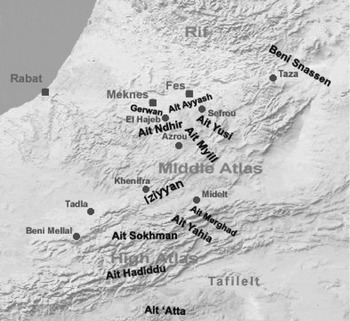
The earliest poems in the archive were collected during Roux's stint from 1914 to 1918 in El Hajeb, on the slope joining the mountain to the plain about thirty kilometers south of Meknes. Strategically positioned astride the route from Fes to the coast and from Fes to Marrakesh, the French made El Hajeb an administrative and market center they hoped would draw in tribes to “peacefully” submit to the state. These factors made it an ideal site for gathering poetry from submitted tribes in the transition zone between the plains and the Middle Atlas, such as the Gerwan and Ait Ndhir (Beni Mtir), and those up higher, including the Ait Myill (Beni Mguild) and Iziyan (Zaian), which remained in “dissidence” (Fig. 2). Roux also conducted interviews with touring imdyazen from the High Atlas, far outside Protectorate control. These poems thus provide a wide variety of commentary about the onset of Protectorate rule and the early pacification campaign.
Map of Tamazight-speaking tribes appearing in poems. Created by the author with ArcView GIS software, adapted from “Carte des Tribus du Maroc 1933,” Residence Generale du France au Maroc, Carton 3H 308, Service Historique de la Défense-Chateau de Vincennes.

Many poems from the Ait Ndhir tribe, whose territory encompasses both plain and mountains, add historical insight into a critical issue in the colonial-nationalist polemic about the historic strength of the Moroccan state and unity of the nation: namely, how the sība related to the makhzan. In the late 19th century, the Ait Ndhir were split between factions cooperating with the makhzan and resisting it. Later, the tribe was intimately involved, along with neighboring Middle Atlas tribes, in the civil war between ʿAbd al-ʿAziz and ʿAbd al-Hafiz in the years just prior to the Protectorate.Footnote 34 Several poems comment on hopes placed in ʿAbd al-Hafiz, who passed through Ait Ndhir territory in 1908 on his way to receive the bayʿa oath of loyalty in Fes, and express utter disillusionment after his capitulation in signing the Treaty of Fes. An Ait Ndhir poet, Lyazid u Lahsen, states:
The French are generally referred to as irumin (sing. arumi), or “Christians,” throughout the poems and only rarely as fransis. As was the case among the urban population in Fes, in the countryside the treaty was viewed as a “bill of sale” by the sultan to the French “Christians.”Footnote 37 Another poet, l-Haj Asusi, chides the ʿAlawites, saying:
The Christians have formed their columns and have risen against us from the places they occupy.
The sultan sold them the plains of the west under the condition that they come subdue them.
We have fought them beautifully.
They stated the conditions of their act of purchase; they cited the justness of their claim, that they had bought us and were within their rights.Footnote 38
In this case, the poet interprets the Treaty of Fes as a type of jaysh agreement in which the sultan sold off his rights to lands in the fertile western plains to the French, as had been done historically to Arab tribes, in exchange for French help in subduing the troublesome mountain tribes.
While highly critical of the failure of the sultan and makhzan to resist “Christian” penetration, these early poems also demonstrate how these sība tribes felt solidarity with the so-called bilād al-makhzan being invaded by the French. The following poem demonstrates the Middle Atlas-based poet's clear awareness of the encroaching invasion from the Atlantic coast, in the reference to occupation of the Zaer region (inland from Rabat-Sale) and of Fes: “The Christian is coming / He has built outposts in the middle of Zaer country / He has planted his flags over the city of Fes / And he has stretched out his hands to conquer other territories and other riches.”Footnote 39 Another poem also laments the fall of Morocco's major cities to the irumin:
The poet l-Haj Asusi links the imazighen (Berbers) to Meknes, which no longer “belongs” to them:
An amdyaz of the Ait Yusi tribe above Sefrou laments the fall of nearby Fes, picturing the “grief” of the medina's major gates: “The Christians have fallen upon the chiefs as the sheep are fallen upon in the cities / Lift up your grief, O gate of Bab-Ftuh, lift up your grief, O Bab-Guissa! / Next to you the sons of pigs have come to wash their coats.”Footnote 44 These poems clearly demonstrate a strong sentiment of solidarity with the cities by tribal groups on their periphery.
Even when a division is drawn between mountains and plains, a sense of greater territorial unity is present. A poet from Guigou, an Ait Myill (Ar. Beni Mguild) village in the Middle Atlas not yet pacified, fears the pacification's progress, saying:
The poet uses l-Gherb to refer to the coastal lowland plain to the west. The poet foresees that the French “General” will inherit the entire land, including the poet's own “people of the mountains.” Though the mountains and plains are viewed as distinct, they have a shared destiny.
The multiple uses of the term l-Gherb provide important insight into territorial conceptions among Tamazight-speaking tribes. The Arabic term al-Maghrib ambiguously refers to the “west,” the west of the Muslim world (North Africa), and at times specifically to Morocco itself, “the farthest west,” as an abbreviation of al-Maghrib al-aqsa. This ambiguity is also expressed with its Berberized version, l-Gherb. As shown in previous poems, it was used at times to refer to lowland areas to the northwest. At other times, it indicates a larger Moroccan territorial entity. The poet cited previously calls out, “O l-Gherb! He had already sold you to the Christians [irumin]!”Footnote 46 In this case the term corresponds to the territory of the sultan's empire, including the poet's own territory. Another poem, about the invading French army, further clarifies the distinction made between this l-Gherb and the rest of North Africa: “We have seen the Christian commander / The Senegalese, the troops of l-Gherb l-wasta / Even the ‘Jew’ [uday] porter carrying their black coats.”Footnote 47 Here the poet breaks down the contingent into groups including the French officer (l-hakem), Senegalese riflemen (saligān), the craven porters (udayn not only literally means “Jews” but also is used as a term of scorn for “cowards”), and the (Arab) troops of Algeria. The phrase l-Gherb al-wasta, a Berberized form of the Arabic phrase meaning “the middle west,” is used to denote Algeria, a “middle west” distinct from the poet's own country, which is presumably “the west,” or l-Gherb. Another important geographical designation in the poems is tamazirt, used mostly to designate a much closer homeland or countryside. However, the term tamazirt also carries the flexible connotations of patrie, used for a much larger Moroccan “country.” For example, an Ait Ndhir poet cries out, “The French have received the whole country [tamazirt] as an inheritance. / Everywhere they have built their military posts and over them they have hung their flags as a sign of victory.”Footnote 48 The presence of Indigenous Affairs posts and the French tricolore are visual symbols creating dread for the poet, who pessimistically envisions their total control over the “whole tamazirt.”
From the perspective of these Tamazight-speaking groups, the sultan's capitulation to the French and the fall of Morocco's cities, coasts, and central plains to Christian control left the unsubdued tribes of the Atlas ranges as the final line of defense for Morocco's Muslim community. In contrast to the assumptions of the colonial vulgate, Islam served as the primary category of identity for these Berber groups and motivated resistance against the colonial state. Having nominally submitted to the French in 1911, the Ait Ndhir revolted in 1912 under pressure from tribal confederations to their south. Beginning in 1913, Lyautey directed the military to focus on pacifying the troublesome Middle Atlas tribes who threatened the Rabat-Meknes-Fes-Oujda axis. Facing the pacification, poets affirmed the obligation for a defensive jihad against the Christian invader. A poet of the Ait Ndhir cries out to the chiefs of the tribe:
Another chides and urges Muslims to keep fighting: “Let's go! Rise up, O Cowards, and join the Jews [udayn]! / Stand up, O Muslims against the Christians [irumin]! Are you already dead?”Footnote 50
These exhortations represent an intense struggle within and among tribes over whether to submit to the “Christian” makhzan or continue a religious resistance, or jihad, against it. One Ait Ndhir poet exclaims, “There is no question of submission / We will fight, if victory eludes us we will move the camp, we will go from country to country / We cannot bear the enemy of the Prophet.”Footnote 51 Moha u Bentaher, from the Ait Myill tribe to the south of the Ait Ndhir, criticizes those who submit: “O you who have submitted / Is it a sultan you follow? / Is it a holy person you accompany? / No, it's by a swine that you let yourself be led / But I see no one who is scared.”Footnote 52 Submission to the Christians and the nominal authority of the sultan is attacked as being against Islam.
In addition to the religious dimension, both men and women also interpreted submission in gendered terms, as a diminution of masculinity. In a two-line izli, an Ait Ndhir man declares: “I am going to repudiate the mistress of my tent and leave her to marry Pisani / For I did not know how to fight you enemies of the Prophet.”Footnote 53 Having failed to resist the Christian invader, the poet feels obligated to forfeit marital rights to his wife, ceding them to the French officer, Pisani. Another Ait Ndhir man asks the women of his tribe a similar question, reflecting a crisis after the men have submitted: “Women, did you not say you would not admit in your bed a man who does not fight in the jihad? / And now that they kiss the hands of Desjobert, what will you do?”Footnote 54
This interweaving of sexuality, gender roles, and religious identity is explicit in duels between two poets, often within the same tribe, over the choice between submission and jihad. The following exchange is between two Ait Ndhir female poets. ʿAisha Uqessur was the wife of a qaid named Driss, who recently had led his fraction of the tribe to submit at El Hajeb. Tabasnut was the wife of ʿAlla ou Driss, leader of a group of Ait Ndhir continuing to fight. In her first lines, Tabasnut taunts ʿAisha's husband, implying that he lets the French officer have his way with his wife: “What happens in your heart, O Qaid Driss, when the French chief orders you to leave your tent so he can enter in?”Footnote 55 ʿAisha parries this insult to her honor by reveling in the ease of her present life under the French compared to the hardships faced by the dissidents: “I use the mules to transport the great water skins / I can, O senseless rebels, choose among the springs of the country / You, on the other hand, have been overtaken by misfortune / Your harvest is lost and you fight in vain!” Tabasnut responds by equating submission with prostituting oneself to the French: “I give up the springs of the country, and I leave you to Roux, O Aisha! / Share your bed also with Pisani.”Footnote 56 Then she attacks ʿAisha as a collaborator with the Christians against the jihad: “The large water skins in which you are going to draw water and carry it / Are drying up the thirst of the holy warriors [imjuhad] / O ʿAisha, who curses me while you prepare your tent / To let the French chief spend the night in!”Footnote 57
THE END OF JIHAD
In this oral medium of public discourse, the tribes of the Middle Atlas fretted over the implications of submission and debated the limits of the sacrifices incumbent on the community in resisting the pacification. Gender was prominent in these debates linking sexual and religious fidelity to jihad against the French. These dilemmas continued, and intensified, as the pacification entered its final stages in the late 1920s. A large volume of poetry was composed during this period by those fighting the Franco-Moroccan makhzan; by partisans who had joined, or been conscripted into, the makhzan army to finish the pacification; and by tribes who had submitted previously but anxiously followed the pacification campaign against neighboring tribes to the south. Roux was director of the Berber College in Azrou during these pivotal years, and his students, practicing their transcription of Tamazight in Latin script, had assignments to write down poetry, legends, and information on local customs during school holidays. Roux's older Tamazight-speaking colleagues also actively collected poetry circulating during these years.
Many poems express a sense of apocalyptic doom, resignation, and despair as the last remaining “free” imazighen were finally conquered by the Christians. For those still fighting, the technological and organizational superiority of the French army generated a religious crisis. A song collected by Moha u Driss al-Yusi in the early 1930s exclaims: “What swords! What Senegalese tirailleurs! What organization among the Christians! How can we fight them?”Footnote 58 An izli from the Ait Hadiddu of the Assif Melloul, which was subdued in 1932, expresses despair: “If the Prophet had had to defend against machines like those that are attacking me / It would have been a long time ago / That the Muslims would have been conquered by the Christians / And that they would have broken their pacts of mutual support.”Footnote 59 In this poem, the author evokes the greater Muslim umma, with a reference to the Prophet Muhammad and intra-Muslim defense alliances against a common enemy. The “machines,” or the modern technology the warrior faces, demonstrate the failure of his religious community: even the Prophet Muhammad would not have been able to defeat this foe. Seeing no deliverance in sight as their flocks, fields, and families were destroyed in modern warfare, another poet was overwhelmed by the inevitability of defeat: “I look at the land; it is covered with automobiles / I look at the sky, it is full of planes / Where then will the Muslim go who asks himself: / ‘What have I to do in the territories governed by the Christian?’”Footnote 60
This disillusionment was also directed at the marabouts and charismatic chiefs (igurramen) among the High Atlas tribes that galvanized the last waves of resistance with mahdist promises of deliverance. For many warriors, the juxtaposition between their meager resources and their enemy's vast arsenal led to a sense of betrayal. A poem collected in 1933 from an Ait Yahia poet challenges these religious leaders: “Who among our saints would know how make an automobile or build a plane? / Who among them would be capable of setting it on its way, flying it, and flying over you, O Sidi ʿAli?”Footnote 61 The legendary battle of Tazizaout in 1932 demonstrates the complexities of the disappointment created in the final failure of the jihad. A group of a thousand, mainly Ait Sokhman and Ait Hadiddu, warriors plus their families were led to this stronghold to the east of Imilchil by Sidi l-Mekki, one of the igurramen whose millenarian rhetoric encouraged the last pockets of resistance. After heroically holding out for more than a month against three French army columns, Sidi l-Mekki negotiated a surrender in late September. L-Mekki was then despised by many of his former followers when his deal making with the French led to his appointment as a qaid over the Ait Sokhman.Footnote 62
Finally falling under the control of the “Christian” government, which involved relinquishing weapons and being registered by the Indigenous Affairs officers, was interpreted as a religious cataclysm. Sidi Mohand, a warrior of the Ait Merghad tribe, composed the following self-searching poem after surrendering at the Kebaʿa military outpostFootnote 63 in 1933: “Can he that has passed in front of the outpost / And has been registered by the Christian / Become a Muslim again? / Is the outpost better than Islam / In the eyes of the subjugated / Who have forgotten the Prophet for the French?”Footnote 64 Submission is equated with apostasy.Footnote 65 In another poem collected in the early 1930s, an Ait Yusi poet grieves, “What sorts of prayers are left? / The Koran is mishandled, and the Christians [irumin], wearing their kepis, trample on our sanctuaries.”Footnote 66 Here the pacification is interpreted as a desecration.
Previously pacified tribes in the north also agonized over the last stages of the pacification, mixing hope and an expectation of doom regarding the fate of these last bastions of “free men” (the literal meaning of imazighen): “The imazighen hope that the Saint Sidi Yahia u Yusuf will turn back the Christians. / But then, look, the Senegalese are camping close to the sanctuary.”Footnote 67 As news about French victories in the High Atlas spread, intense disappointment and anxiety were expressed in lower-elevation regions. In a poem collected in 1932, a poet in Azrou rhetorically asks the Ait Hadiddu tribe if the airplanes have reached their mountain fastnesses: “Question the pilot, O man of the Ait Hadiddu, and ask him if he is coming to bomb. / Has he reached all the way to the Ait Hadiddu? Has he succeeded in subduing them?”Footnote 68 In another poem collected that year, a member of the Ait Ayyash of the Saiss plain near Fes grieves the fate of a region 200 kilometers to the south: “Why did you submit? O Assif Melloul!”Footnote 69 These poems display an awareness of events transpiring across a wide region, a circulation of poems back and forth across the line of dissidence, and a growing awareness of the encroachments of the modern state—via telegraph lines, air power, artillery, and roads—advantages poets clearly identified as the cause of their defeat.
LIFE UNDER THE IRUMIN
By the end of 1934, the entire Tamazight-speaking region had been brought under the control of the Protectorate state. A large number of poems in the collection offer commentary on life under the Christians, the injustices and inconveniences of the Protectorate administration, and, occasionally, the benefits of the order. Some criticized the Protectorate administration as an unwelcome imposition interfering with daily life. One poet complains: “I am going again on the route without being granted a travel permit / Today the Christians were without pity and gave me a fine.”Footnote 70 Increased security, however, was appreciated by the amdyaz Smaʿil n-Hammami, who exclaims: “From now on, fear is unknown / The French authorities have banished it / Go then, O travelers, follow your route without any shred of fear / No one will question you / The paths will be without obstacle for you.”Footnote 71 If one had to get a travel permit, at least the roads were safe.
This ambiguity is also expressed in attitudes toward the Protectorate's administration of justice. The French are applauded by some: “I tell you, the Christians are good / Without them, the rights of orphans and widows would be trampled by injustice.”Footnote 72 Another poet, Buhali l-Burezzuni l-Mtiri, also lauds them in a poem composed early in the Protectorate, saying: “The French are worth more than our sultan / They do not love injustice / They follow a straight path and do not turn from it.”Footnote 73 The same poet, however, also observes the cost that these benefits entail:
The last two lines poignantly reflect the bard's awareness of the new reality in which a Weberian monopoly on violence has been ceded to the modern state. The amdyaz is also highly sensitive to the profound shifts that have transpired, pitting his oral culture against the hegemony of the written word in the new bureaucratic system. In another poem, Buhali asserts: “It is in the spoken word that I will write the number two / I have no notebooks and, even more, I am illiterate / But it is in my memory that I inscribe my reports.”Footnote 75 The census operations of the Indigenous Affairs officer reflected a deeper ordering felt not only in the countryside but also in the whole of Moroccan society. Buhali expresses a general ambivalence about this process in another poem: “The Christian chief registered the women in his log / I attended the operation / It was my lawful wife at the head of the line.”Footnote 76
Another poet, Lyazid u Lahsen, laments the new order under the Protectorate state, contrasting it with life before:
A poem collected in 1934 from the Ait Ayyash describes life under the Franco-Moroccan makhzan with the metaphor of a flour mill: “The qaid is like a mill / The French commander [hakim] plays the role of the canal that brings him water / And the poor guys [msakin] are like the kernels of grain that are crushed under the grindstone.”Footnote 78 The makhzan-appointed qaid is viewed with antagonism, the French chief enables the exploitation, and the poor normal folks are exploited.
One of the most significant transformations during these years was the incorporation of many tribesmen into the colonial army. Having been put through a series of military exercises, one soldier composes lines exclaiming: “Where could I have learned to do this drill? / What do these orders mean—‘At arms!’ ‘At ease!’ or ‘To the right!’ / Is it not true that the Christians break us like one breaks an ox with a yoke to train it for the plough?”Footnote 79 Fighting on the side of the irumin could generate a great deal of ambivalence. One early poem ridicules Moroccan soldiers under the French: “O wearer of the blue burnoose / O dogs of the ‘kicking officer’ / O servants of the Christian! / When you hear the bugle call announcing the raising of the flag / You salute, putting your hand over your ear.”Footnote 80 As the pacification progressed, however, more and more Tamazight-speaking soldiers were incorporated into the forces sent against neighboring tribes in the Atlas. The campaigns in the late 1920s and early 1930s in the Upper Moulouya and the Assif Melloul relied heavily on Iziyyan partisan forces (lbertiza) who had fiercely fought the French the decade before. Called up to fight in 1931, a soldier expresses reluctance: “When they gave us our turbans / I understood that we were close to departing for the operation / I was hoping that he would discharge us back to our tents.”Footnote 81 Another soldier asks: “Why should I attack the zāwiya of Sidi Yahya u Yusuf? / Why should I curse the poor people I oppress?”Footnote 82
In contrast, poems were composed with pride about the importance of imazighen troops and French reliance on them. The Ait Ndhir poet Smaʿil n Hammani composed an izli boasting:
A poem about campaigns in the Rif War by Hammami celebrates Ait Ndhir bravery: “We have conquered you, O post of ʿAin ʿAicha / But the qaid Haddou and the khalifat Moha were wounded there / The Ait Ndhir have always been courageous.” Another poem, composed by Moha ou ʿAbid and collected in 1932, hints at the role auxiliary troops played in quelling urban nationalist protests. In the poem, a young man's mother buys him a horse, and he goes to the bureau to join as a mokhzani. After resolving the issue of his lack of a travel permit, the officer gives him a blue burnous and a sword as long as a pole. He asks, “But who am I going to hit with this saber? It will overload my horse.” The final line of the poem answers the question, stating, “Rejoice O jackal! I'm going to prepare you a feast of the bone marrow of the rich inhabitants of Fes!”Footnote 84 Given the date of the poem, it seems likely the young poet is being sent to quell disturbances in Fes, namely, the nationalist protests against French Berber policy and the 1930 “Berber” Dahir!
Although Tamazight-speaking colonial troops were successfully incorporated as the backbone of the French colonial army—deployed in Morocco's cities and in Europe and Indochina in subsequent decades—it quickly became evident that the overall project of a Berber policy separating Arabs and Berbers was totally unviable due to processes the French themselves had set in motion, including the transportation, communication, and administrative transformation involved in the pacification. By the early 1940s, many of the Atlas notables refused to send their children to the Franco-Berber schools, demanding entry instead into the Arabic schools in the major cities or pressuring the local Berber schools (in Sefrou, El Hajeb, Khemisset) to offer more Arabic and Islamic instruction.Footnote 85 Upward mobility was tied to Arabization, and Tamazight speakers wanted access. Service in the army, interaction with an Arabic-dominated government administration, increasing economic activity in market centers conducted in Moroccan Arabic, and, above all, massive migration to cities were inexorable factors accelerating the process of Arabization, particularly for the younger generations growing up under the Protectorate. In the 1950s, transformations wrought by the colonial state in prior decades ultimately resulted in unleashing political pressure for Moroccan independence, including a mass-based nationalist movement, which made the Protectorate unfeasible.
CONCLUSION
Studies of collective identity in the interwar Arab world have largely focused on how Pan-Islamism, Pan-Arabism, and local nationalisms functioned following European partitioning of the Ottoman Empire into smaller political units. The first wave of studies focused on Arab nationalism and more recent efforts to “rethink” the subject have been concerned primarily with how communities were imagined in the Middle East and with a few exceptions, on how communities were imagined in an urban milieu.Footnote 86 I have relocated this focus on multiple levels, shifting to the “farthest west” of the region, Morocco, and away from the textual production of the elites to analyze how Tamazight poetry collected during the colonial period reveals how collective identity was expressed at ground level in the Atlas mountains.
Underneath the struggle over Arab and Berber identity waged between the agents of the colonial state and Moroccan Arab nationalists in colonial ethnographies, administrative policies, print media, and public protest, this analysis of Tamazight oral primary sources reveals a much more nuanced and complex negotiation of collective identity among the “Berbers” during the Protectorate period. On one level, this shared repertoire of poetry disseminated within a Tamazight-speaking bloc in the Atlas ranges demonstrates how an illiterate, transhumant population had the capacity to imagine a broad community at a national level.Footnote 87 This corporate “Moroccan” identity was crystallized by the threat of a foreign invasion by the French army. The primary distinction that emerges in the poems is between Christians and Muslims; for the Tamazight population of the Atlas, Muslim identity was primary, and many viewed themselves as the last true defenders of a Moroccan community defined in Islamic terms. It is significant that the most intense struggles were waged over whether to continue to fight to preserve this community. Although a clear identification with a distinct “Morocco-sized” territorial and social entity is present in the poetry, this level of imagined identity was only one of many identities at play among the Tamazight-speaking groups. Individual tribal identity was expressed on one level, and an intertribal solidarity of the imazighen was articulated on another. This level of collective identity as “Berbers” is further implicit in the use of various classifications to distinguish among Algerian Arabs, Jews, and the despised Senegalese deployed in Morocco as colonial troops.
While a shared oral literary tradition did unify the Tamazight-speaking groups, language in no way constituted an impermeable “ethnic” boundary, as colonial theorists ardently hoped. Following the completion of the pacification in 1934, the Berber-speaking areas formerly labeled the bilād al-sība became more and more integrated into a larger national entity due to the increased ease of travel, the enlistment or conscription of much of the male population into the colonial army, and an economic upheaval that encouraged, or forced, much of this population to migrate to the cities, all of which entailed a concomitant Arabization. In this respect, the “Berbers” of the Atlas present an important case study of interactions between the consolidation of state space, Arabization and Islamization, and Arab and Muslim collective identity in North Africa and elsewhere. None of these identities were completely fixed, and contextual factors continue to influence how collective identity is imagined, including how Arab and Berber identities are negotiated, in the contemporary Maghrib.