“There is a serious cultural renaissance taking place in Saudi Arabia… Much of this activity can still be situated in the realm of popular culture and be classified as ‘entertainment,’ but the seeds of art-making, discursive thought, and independent institutionalization have been sown, and we can already start to see them taking hold.”
—Monira al-QadiriFootnote 1““The arts, and culture in general, are a means through which you can inject ideas into people. [It] is a form of soft power. Through culture, art, and music you can change people's behavior, instill social awareness in them, and make knowledge visible. Art and culture are a very important means if one wants to express oneself to others, especially the visual arts, which do not require translation”.
—Abdulnasser GharemFootnote 2“Social media,” Saudi artist Abdullah al-Shehri (known as Shaweesh) observes, is the “best tool we have available to showcase and express our art” because it allows millions of Saudis to share and comment on a given work of art simultaneously.Footnote 3 Building on this insight, this essay argues that Saudi artists, who have among the largest followings on Saudi social media, have used the online public sphere to build a new social movement. They have adopted a role akin to Antonio Gramsci's concept of organic intellectuals – namely, men and women who are not part of the traditional intellectual elite, but who, through the language of culture, articulate feelings and experiences the masses cannot easily express.Footnote 4 To paraphrase Ezra Pound, Saudi artists are the “antennae” of the Kingdom's society,Footnote 5 whose work is not “mere self-expression” but, in the words of Marshall McLuhan, the “distant early warning system that can always be relied upon to tell the old culture what is beginning to happen to it.”Footnote 6
In this essay, I draw from my extensive in-country and online research on Saudi art and artists that I conducted for Changing Saudi Arabia: Art, Culture, and Society in the Kingdom.Footnote 7 Rather than viewing art and online engagement as solely political opposition or resistance, my work helps us see that they can have a very different role, one that is both clear and sophisticated without being confrontational toward the Saudi state or political system.Footnote 8 As Madawi al-Rasheed observed in her review of Changing Saudi Arabia in The Times Literary Supplement, my work shows it is possible for (a) a significant artistic movement to exist and to flourish in an authoritarian political system, and (b) for scholars to gain great insights about the Kingdom's politics by focusing on what is possible, rather than what cannot be done.Footnote 9 The approach of my book and this article stands in stark contrast to those of many analysts of Saudi Arabia, who focus on the country's elites and the limits of cultural and political action in the country.Footnote 10
Understanding this perspective is especially important following the killing of Jamal Khashoggi, which has generated widespread outrage in Europe and the United States, much of it leveled at Crown Prince Muhammad Bin Salman (MbS) and the initiatives that he has championed, including exhibitions featuring leading Saudi artists.Footnote 11 But the issues raised in this essay point in a very different direction. They do not reflect the machinations of royalty or economic and political elites but are concerned with the productions of an extraordinary group of men and women, almost all of whom are based in the Kingdom. “People,” the Saudi artist Abdulnasser Gharem has recently noted, “need to listen to the artist.”Footnote 12 His and other artists’ activities have produced what Monira al-Qadiri has rightly hailed as a “cultural renaissance”Footnote 13 while exposing the deep consciousness of the country's people – a force or form of soft power that often reveals itself through either a free press or participatory political systems in the West. Moreover, Saudi artists allow us to transcend the dialectical structures that exist in most Western scholarly discussions of Saudi Arabia, frameworks that Edward Said wisely warned us to avoid in Orientalism.Footnote 14 Ultimately, the art that I will discuss in this article embodies a dance of intellect and feeling that rouses its audience, including both the masses and rulers of Saudi Arabia, to introspective thought.Footnote 15
The Rise of an Artistic Movement in Abha
In the first decade of the twenty-first century, an artistic movement emerged in Abha, the capital of Asir province in southern Saudi Arabia.Footnote 16 There, a group of young professionals, none of whom had any training in the arts, formed a majlis, or forum for group discussion, and began to gather at an Abha cultural center, where they had been granted studio space and been introduced to one another by Jamal Khashoggi, then the editor of Al-Watan (The Nation), an Arabic-language daily newspaper based in Abha.Footnote 17 Over time, the men discussed art, culture, current events, the influence of mass media, and the power of images to shape opinion in the contemporary world.Footnote 18 Using the Internet, which had just been introduced into the Kingdom, these young professionals gathered as many articles and books about art as they could and shared them among themselves.Footnote 19
In these discussions, this group of artists developed a new approach to contemporary art – one which, in the words of Iraqi art critic Faruq Yousef, “absorbed” artistic ideas from around the world while retaining clearly Saudi aesthetic and intellectual principles.Footnote 20 Rather than utilizing the Western framework in which an artist works in a studio on his or her own, these artists looked at the creation of culture as a process that involves multiple people. What also set apart the work of this movement was its use of collage, which often blended Arab and Western images, along with its exoteric approach, wherein artists did not assign meaning or truth to their work. Rather, that was left up to the audience, or, more broadly, to Saudi society. As one of the movement's leading voices, Gharem has noted that he and his colleagues were not picking sides: instead, they were acting as a mirror to society.Footnote 21 But that did not mean that they did not want their mirror to serve a greater good, to inspire reaction and change. “Sometimes when you become a mirror as an artist and you show your society who they are,” Gharem Tweeted, “they get upset.”Footnote 22
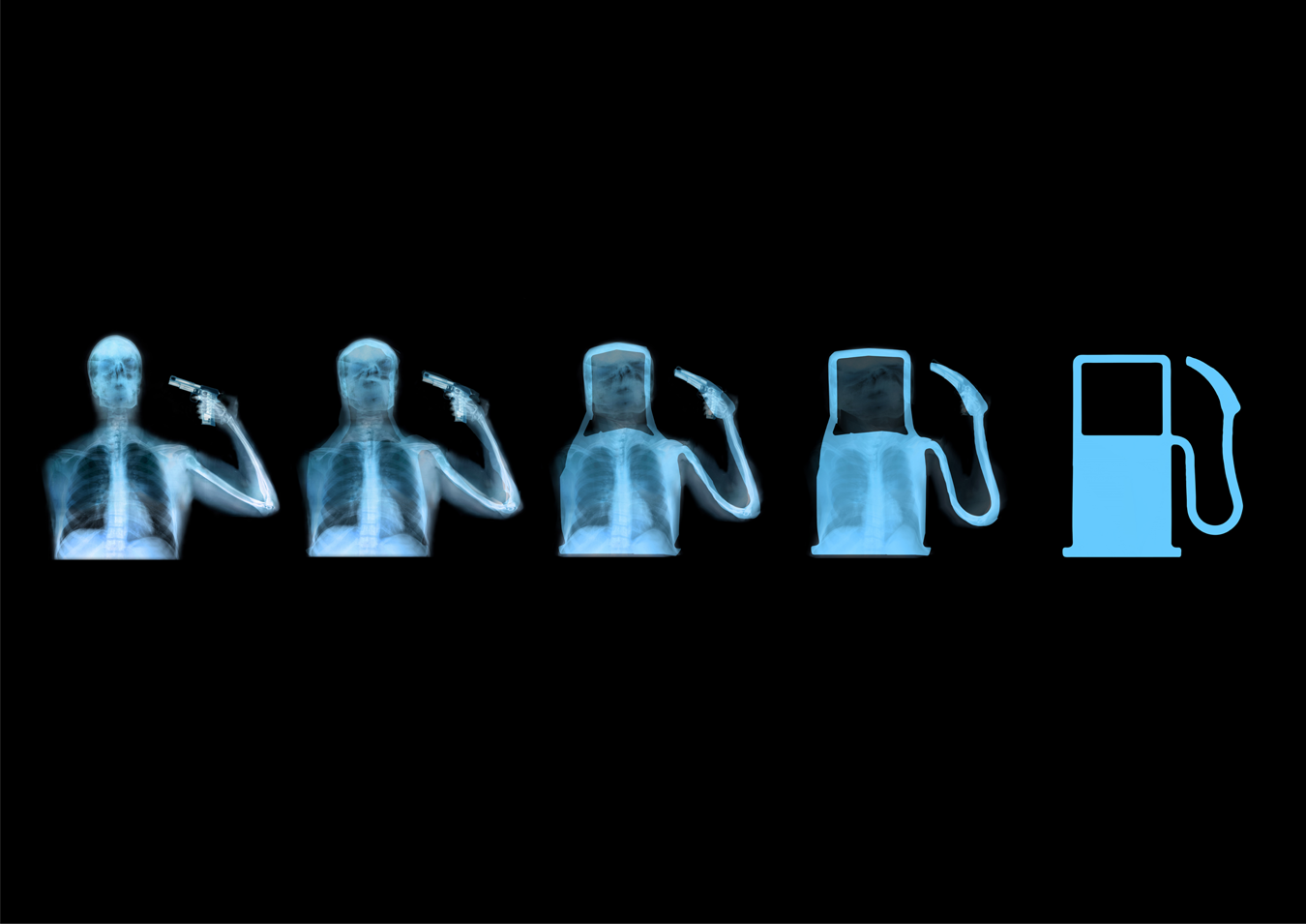
Through this approach, Gharem and other Saudi artists extended the process of creating art and culture beyond themselves, so that all of society might have a say in creating culture and thereby become more invested in it. Over time, the process transformed the artists, and those who followed them, into organic intellectuals: individuals, who, through the language of culture, express the feelings and experiences of society in ways that could not be replicated by academia, business, or the media. As Ahmed Mater, another early leading figure in the movement, observed, he seeks to inhabit the “grass roots” of Saudi society's “ecosystem”Footnote 23 – a phraseology that brings to mind the term “organic” – in order “to give a voice” to the people, and to “create images and visual narratives that can articulate” their “hopes and fears for the future.”Footnote 24 Ambiguity is paramount within this approach, for it offers a mechanism for artists to explore sensitive topics, such as the role of oil in society [Figure 1], while still providing space to claim that they and their works of art are “apolitical” or at least non-partisan, i.e., not promoting a specific side in contentious social debates.Footnote 25 As Gharem remarked in 2019, “I do not belong to any ideology… I'm an artist. I try to be neutral.”Footnote 26
Ahmed Mater (Saudi b.1979), Evolution of Man (2010), 31 1/2 x 23 5/8 in (80 x 60 cm), printed on 400GSM Somerset Tub paper.

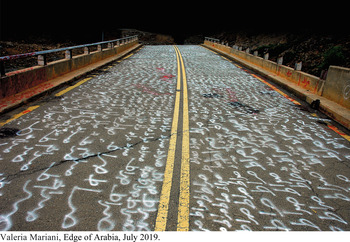
An essential moment for the movement in Abha was Gharem's decision to accept how others defined or could define Sirat (The Path) [Figure 2] – a photographic collage that he hoped would initiate a new conversation about the country's crumbling infrastructure, a subject that bothered many Saudis but did not receive coverage in the Kingdom's media until devastating floods hit Jeddah in 2009.Footnote 27 Begun in 2003 and completed several years later, Sirat displays the ruins of an abandoned bridge in southern Saudi Arabia, which had been devastated by a flash flood many years before at a considerable loss of life shortly after it was built. To enhance the power of the piece, Gharem both photographed the bridge so that it appeared to be heading towards a dark abyss and spray-painted sirat, an Arabic word with multiple meanings, all over the bridge. Not only does sirat mean a road-like “path,” but it also denotes the “path” to the “other side.” The word has great religious significance for many Saudis and other Muslims generally, for it is part of the Sura al-Fatiha, the opening words of the Quran: “Guide us to the straight path” (1:6).Footnote 28
Abdulnasser Gharem, Sirat (The Path), 129.6 x 180 in (or 329.18 x 457.2 cm) silkscreen paining.

In 2008, Sirat was set to be a major part of the first exhibit ever of modern Saudi artists in London. But a badly worded press release for the exhibit convinced a number of Saudis that Sirat gave viewers the license to walk and even drive over the words of God. Although no one who had actually seen the piece, including a leading British imam, had said they were offended by it, the show's curators worried about a worst-case scenario in which a conservative Muslim might be offended by the piece. Consequently, they asked Gharem to provide another piece.Footnote 29
For Gharem, the request put him in a difficult position. He had spent years on the piece as a way to start a conversation about infrastructure, not religion. But asserting his role as a modern artist who could define the meaning of his own work was very perilous, as it risked launching a debate in which Gharem and other artists might be labeled un-Islamic for promoting the notion of the artist as God. Even Gharem's father, who had always supported his son's art, warned him to be careful about showing the piece at the show in London, noting others might see things in Sirat that he did not intend.Footnote 30
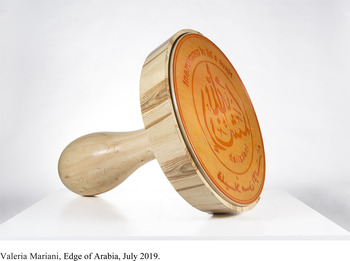
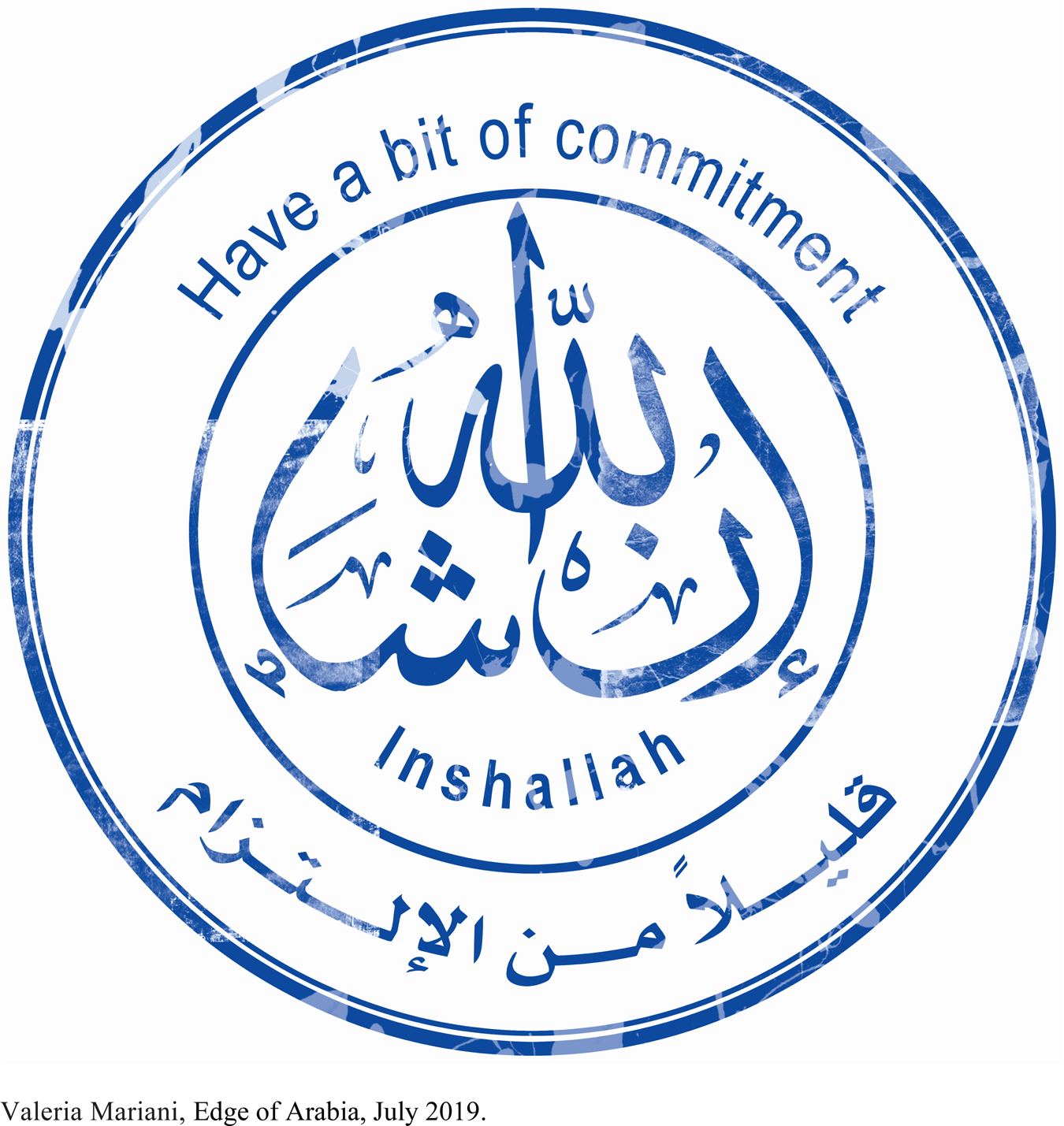
Consequently, Gharem agreed to provide an entirely new piece for the show: a giant rubber stamp modeled on the official ones that he used to mark his paperwork as a bureaucrat in the army [Figure 3]. The Stamp (Inshallah), as the installation was called, was emblazoned with a phrase written in both Arabic and English that could be interpreted in multiple ways: “Have a bit of commitment, Inshallah” [Figure 4] Thanks to his decision to remove Sirat, the show was a success, helping to lay the foundation for the future of the arts in the Kingdom, and removing all doubt about whether or not the movement was organically linked to Saudi society.Footnote 31
Abdulnasser Gharem, The Stamp (Inshallah), 37 3/8 x 37 3/8 x 47 ¼in (95 x 95 x 120cm.).

Abdulnasser Gharem, The Stamp (Inshallah), Silkscreen version of Figure 3, The Stamp (Inshahallah).

The Internet and a National Saudi Artistic Movement
That show in part helped to attract artists throughout the Kingdom to the movement that was born in Abha. Three are worthy of note here.
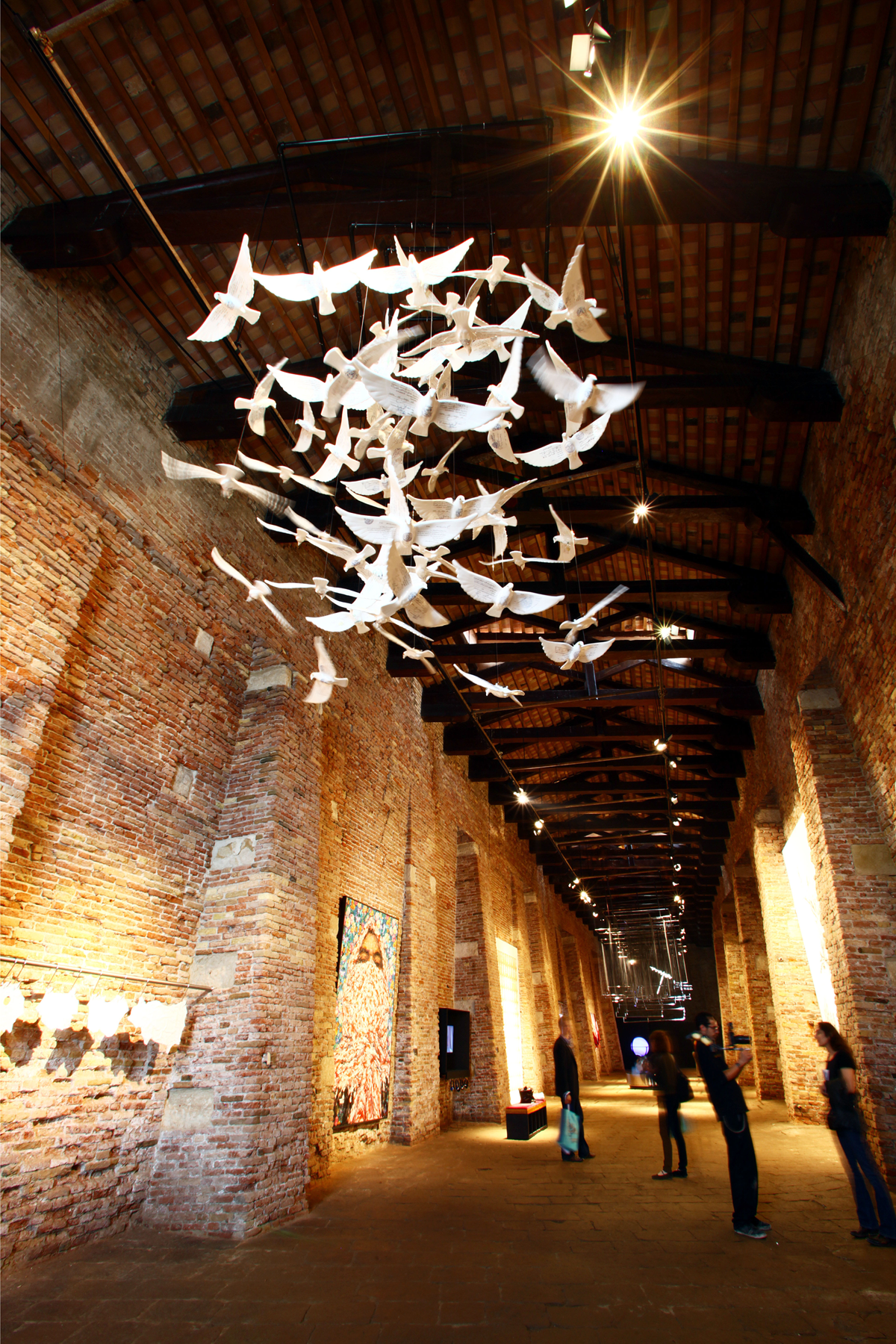
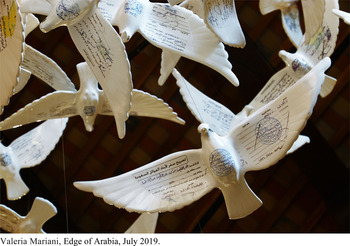
The first, Manal al-Dowayan, once worked at Aramco, the Saudi state oil company, but later emerged as one of the Saudi art movement's fiercest female voices.Footnote 32 Her Suspended Together takes on diametrically opposed meanings depending on how a viewer looks at it. At first glance [Figure 5], the 200 hanging, painted porcelain dove sculptures that make up the piece give the feeling of free movement and travel. But upon closer inspection [Figure 6], the viewer realizes that the figures are frozen in place, with each dove carrying on its body a permission document that allows a Saudi woman to travel – a key part of the country's controversial guardianship system.Footnote 33 For Al-Dowayan, Suspended Together not only reflects her experiences but also those of countless other women in the country, who when travelling, regardless of their age or achievement, are in her eyes “treated like a flock of suspended doves.”Footnote 34
Manal al-Dowayan (Saudi, b.1973) Suspended Together.

Manal al-Dowayan (Saudi, b.1973) Suspended Together, close up.

Two other artists helped to bring new technology into the Saudi arts community – technology that would allow Saudi artists to communicate directly with mass society for the first time. Street artist Sarah Mohanna al-Abdali gained fame in the Kingdom by using social media to post a series of graffiti pictures that featured a road sign to Mecca, with the Kaaba replaced by a group of high-rise buildings. She sees social media as a vehicle to start a discourse between people, telling CNN in 2013, “I didn't want it to be a beautiful artwork, I wanted to create debate… People took photos [of my work] and shared them on Facebook and Twitter.”Footnote 35 By contrast, Shaweesh went one step further, turning to social media to publicize and elicit feedback on his work – just as one might do in a majlis, but in such a way that would be impossible to do on the streets. Through this process of online criticism, Shaweesh has created striking photos by adding figures from popular culture to historic photographs.Footnote 36 In one of his most powerful pieces, Vader and the Delegation, he added Darth Vader to a photograph of Emir Feisal and his delegation at the Versailles Peace Conference in 1919. The conference, which determined the boundaries of the modern Middle East, symbolizes for many Arabs the nefarious role of Western imperialism in their region.Footnote 37
Building on the examples of Shaweesh and Al-Abdali, the artists from Abha sought to harness the power of social media, beginning with Facebook but extending as well to Instagram and Twitter. In particular, they realized that Instagram was well suited for promoting visual art because of its focus on images. Saudi artists also turned to Twitter and its hashtags to spark a debate among Saudis and later a global audience. For example, their 2012 show in London was named #Cometogether, which organizers hoped would invoke the Beatles’ song but in a new way for the twenty-first century by adding a Twitter hashtag.Footnote 38
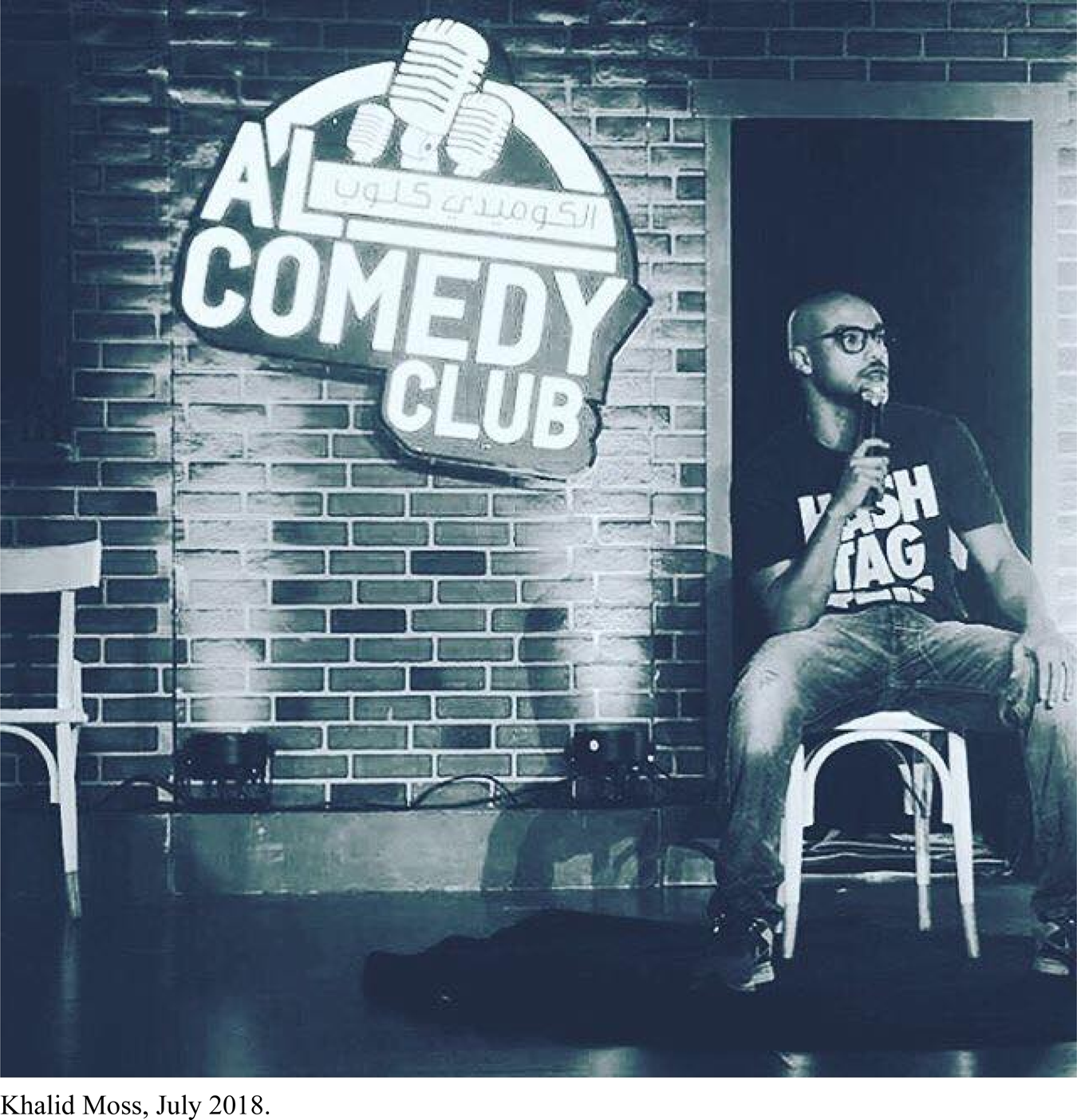
By that time, a new generation of Saudi artists had emerged who were interested in exploring many of the same questions as the artists in Abha had but through stand-up comedy – a medium that many of them had learned while studying in the United States. The comedy that emerged from this consciousness was often as exoteric as the work of Gharem, functioning in the same way that an abstract painting does. Notably, stand-up comedy in Saudi Arabia is most often performed in an interactive group setting where everyone is expected to participate [Figure 7]. Jokes often contrast multiple ways of viewing a subject or assigning meaning to it and bring together humor that is both lowbrow and highbrow. Comedians provide just enough information for the audience members to use their imagination to fill in the blanks. This type of ambiguity reinforces a key strength of Saudi stand-up comedy: the listeners are not supposed to take the comedians’ work seriously. This gives the comedians the opportunity to pretend that what they are saying is “only a joke,” absolving them of any liability for what they say. This technique essentially keeps Saudi humor “all in the family” – to use the title of a famous American TV show that took a similar stance.
Saudi stand-up comedian Khalid Moss performing in 2018 at the Alcomedy Club, a premier space for stand-up comedy in Jeddah, Saudi Arabia.

Starting in the late 2000s, Saudi stand-up comedians engaged mass Saudi audiences in a way that would have been unimaginable to the Abha artists in two key ways. First, they staged live stand-up shows that drew tens of thousands of people, using social media to aggressively market their events.Footnote 39 Second, the stand-up comedians founded private media companies that made original content viewed millions of times on YouTube. After YouTube's advertising policy changed in 2009 to permit ad-placement within the site's videos, Saudi media companies such as Telfaz11Footnote 40 became extremely profitable through partnerships with leading domestic and foreign companies.Footnote 41 Telfaz11 and other media companies, which advertised their work and interacted with fans on social media, utilized their new wealth to produce new videos and to transform what was possible to discuss in Saudi society, taking advantage of the fact that while the Internet was regulated in the Kingdom, it did not face nearly the same amount of scrutiny and censorship as state or satellite television did.Footnote 42 In addition, Telfaz11 capitalized on the strong online presence of its stars, such as stand-up comedian Fahad Albutairi, who in 2017 was hailed as one of the top 20 social media stars in the Arab world, Footnote 43 with one writer noting that his fans “are more than engaged, they're manic.”Footnote 44
Another leading digital-age media company in Saudi Arabia is 8IES, which has grown famous in the Kingdom thanks to the videos produced and directed by Majed Alesa.Footnote 45 They connect Western music with Saudi cultural genres,Footnote 46 especially Samri, an ancient Saudi folk dance accompanied by the Saudi daf drum, and are set to poetry.Footnote 47 Through these combinations, Alesa has created musical collages which call to mind the visual work of the artists in Abha by blending Samri with Western musical norms and cultural symbols. Indeed, Alesa has purposely combined these cultural forces to reach as diverse an audience as possible.Footnote 48
For instance, in Samri Kinq (“Samri King”), produced in 2015, we see young Saudi men dancing to Samri music while wearing either Saudi or hip-hop clothing.Footnote 49 Many of them are also wearing masks – a gorilla head, an eagle head, a frog head, or a mask of U.S. President Barack Obama's face. As part of their costumes, the young men carry or wear a series of Saudi and hip-hop symbols. The music and words of the song, which were written by leading Saudi poet Sulaiman bin Sharim,Footnote 50 are presented as a collage. A representative of 8IES Studios told journalist Charles Akl that Alesa aimed to revive an old Saudi musical genre, the Samri, making it more “catchy by speeding the rhythm and westernizing the melody.”Footnote 51 Over the past decade, Samri Kinq and the other recordings and videos that Alesa has made have been collectively viewed more than 88 million times on YouTube – a number that is nearly triple the population of the Kingdom, evidencing a clear, authentic connection between the young Saudi director and the experiences and views of the masses.
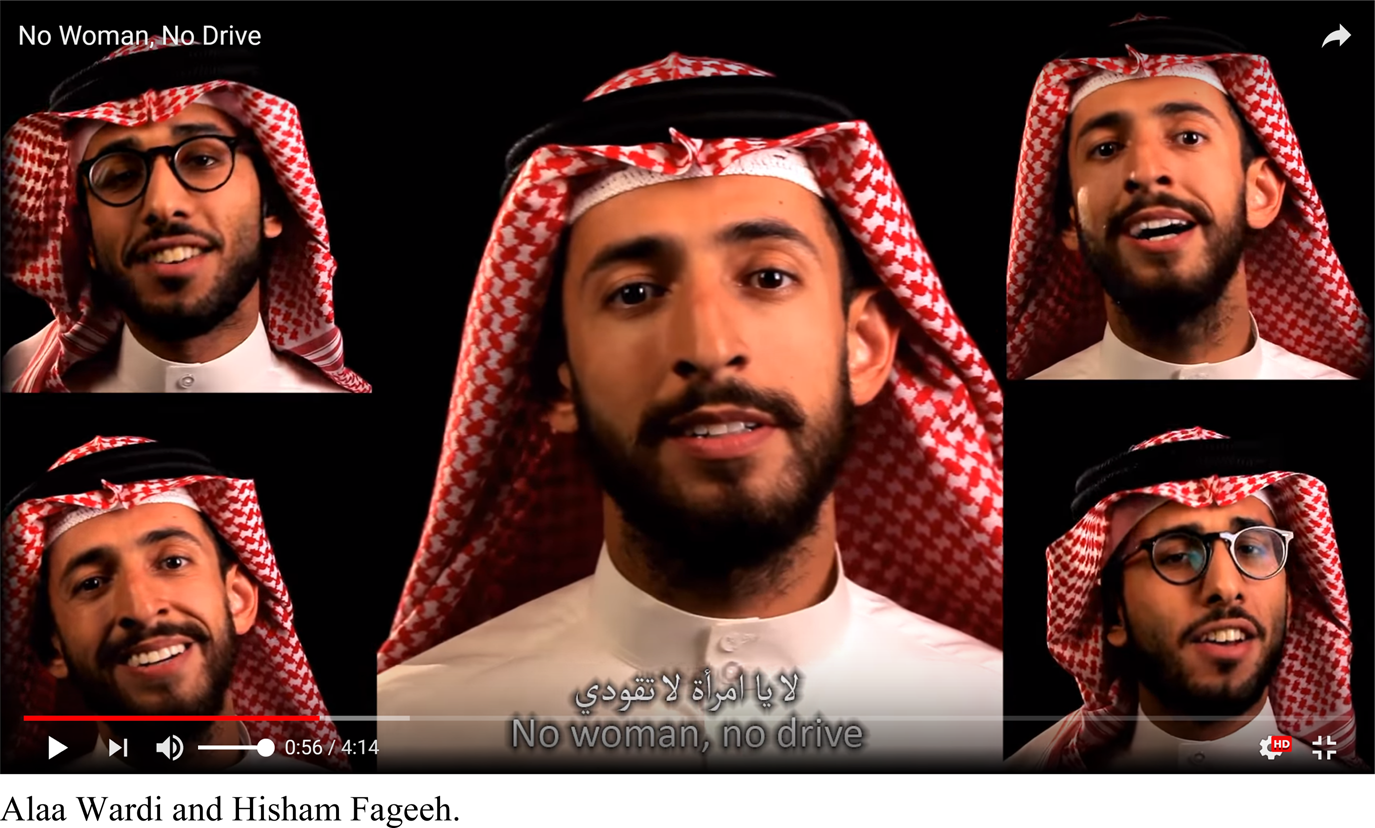
Thus, it should come as no surprise that Alesa played a role in one of the two works of art that shaped the debate on women driving. The first of those works was No Woman, No Drive [Figure 8], a satirical music video from 2013, which starred stand-up comedians Fahad Albutairi, Hisham Fageeh, and other men working for Telfaz11.Footnote 52 The second was Hawajis (Concerns), a satirical music video starring a group of Saudi women, which was produced in late 2016 by Alesa.Footnote 53 The two satirical music videos, which have been viewed on YouTube around the world over 40 million times, received extensive coverage outside the Kingdom.Footnote 54 Together, the two videos reveal both the global appeal of Saudi art and, more importantly, its role as a barometer of the prevailing cultural and political winds in the country. Presciently, Hawajis, which has over 24 million views online, was released on December 23, 2016 – almost nine months to the day before King Salman announced that he was lifting the restriction on women driving in Saudi Arabia.Footnote 55
Clip from “No Woman, No Drive” a YouTube video released by Saudi media company Telfaz11 on October 26, 2013, the same day as a major women's driving protest in the Kingdom. The 4:14 minute video, which dealt comically with the issue of women driving, went viral.

Since that video's release, some scholars have questioned if the movement can continue to flourish as it has in the past, especially after the murder of Khashoggi along with the arrest of a number of leading women activists, including Loujain al-Hathloul, the wife of Albutairi, a stand-up comedian.Footnote 56 Although Albutairi has vanished from public life in the months since his wife's arrest,Footnote 57 other Saudi artists continue to be active, creating new works while forging new ties to global and domestic institutions, including with MiSK, the Crown Prince's non-profit organization for the promotion of creativity and art.Footnote 58 Despite the new role of the Saudi state in the arts, the country's artists continue to explore sensitive issues, searching for fresh ways for their fellow citizens to better discuss even the most contentious of issues.
An excellent example of the newer work is Gharem's The Safe (Al-Kazna), a piece that many see as an allusion to the murder of Jamal Khashoggi, an event that has profoundly impacted Saudi society and the country's relations with the rest of the world.Footnote 59 Unveiled at Art Basel in Basel, Switzerland, in June 2019, The Safe is part performance piece, part artistic collage in which individual viewers are permitted sixty seconds inside a white padded room. The piece, which has only one door controlled by guards, has prompted viewers to compare it to a prison cell, a room in an insane asylum, or the consulate in Istanbul where Khashoggi was killed. In fact, Art Basel's webpage is clear: “Abdulnasser Gharem's The Safe alludes to the assassination of the journalist Jamal Khashoggi.”Footnote 60
Outside the room, viewers see a door with a canopy that is analogous to the one at the Saudi Consulate in Istanbul, made famous worldwide because it appeared in the final closed-circuit video footage showing Khashoggi alive. Inside the room, viewers experience a series of jarring and oppositional concepts, images, and sounds. They hear Beethoven in a space defined by objects that are rarely if ever associated with the Viennese composer and symbol of Western culture: padded walls, a sofa, and a large Saudi flag. Even more unsettling is the stainless-steel table on wheels along the wall perpendicular to both the Saudi flag and the sofa. It has a sink and resembles the tables that coroners use – yet another allusion to the late journalist, whom Saudi agents reportedly dismembered after he was murdered. Further reinforcing the allusion to Khashoggi is the blood-red felt which covers part of the stainless-steel table along with the small stamps in Arabic or English that visitors are encouraged to post on the back wall.Footnote 61
Gharem has used stamps in the past, as he did in 2008 in London, but the stamps in The Safe contain far more ambiguous and even unsettling messages,Footnote 62 such as:
“Have more than thou showest, speak less than thou knowest,” a famous line from King Lear,Footnote 63 or “the method of collective punishment has so far proven effective” – a phrase identical to General Moshe Dayan's infamous justification for Israel's harsh military measures against Arab civilians in the late 1940s and early 1950s following border clashes with neighboring Arab states.Footnote 64 Other quotations could be seen as direct allusions to Khashoggi's death: “Violence is its own demise” or “the difference between the terrorist and the martyr is the media coverage.”Footnote 65 Overall, these quotations and the rest of The Safe had a profound effect on many people at Basel, with viewers reportedly in tears after their time in the piece had elapsed.Footnote 66
While Gharem's representatives at Basel stressed that The Safe does not deal directly with Khashoggi's death,Footnote 67 Gharem himself has not denied the linkages. While he has not commented on the piece on Twitter or other social media, he retweeted an El País interview in which he answered questions from journalist Ángeles Espinosa about The Safe.Footnote 68 In that interview, Gharem told Espinosa that the “mission” of the piece was to start a dialogue among citizens rather than nations, adding:Footnote 69
What happened to journalist Jamal Khashoggi was so serious … The [Saudi] government itself said it was horrible. It has been condemned all over the world. People need to listen to the artist. That's the story of The Safe. I'm not defending anyone. It's all so sad … They have even prayed for him in the Sacred Mosques of Mecca and Medina. Everyone is affected. We need to talk about it at an intellectual level, far from politics.Footnote 70
When Espinosa followed up by asking if Gharem had suffered any negative repercussions for producing The Safe and whether he has seen changes over the last three years in his country, he responded that he lived happily in Riyadh, where he had in fact seen major changes that he thought were “wonderful.” Strikingly, Espinosa never asked Gharem, and he did not discuss, his personal connection to Khashoggi, who, in 2003, had introduced him to the group of men with whom he would forge the foundations of the artistic movement that would transform his life and inspire a new generation of widely influential Saudi artists.
By the time Gharem spoke to Espinosa in late June 2019, Saudi Arabia's online and artistic communities had become a single national movement. Visual artists and comedians look to culture as a vehicle for transforming society indirectly from the bottom up, an approach that relies on faith in persuasion rather than toppling power structures, looking to art rather than violence for salvation. This strategy has worked in part because Saudi artists have not abandoned tribalism in favor of individualism. That has been a critical choice, for tribalism and religion are viewed with suspicion among many liberal intellectuals in the West, especially in the United States.Footnote 71 Yet, individualism has its weaknesses, just as tribalism and religion have their strengths. The latter, in fact, even addresses some of the problems inherent in the former, as in “the lonely crowd.” The people I have been discussing wish to maintain elements of tribalism, while functioning in the contemporary secular world in which individualism is paramount.
This paradox provides a powerful lesson for observers of Saudi politics and society. If scholars limit their focus to the men in the forefront of Saudi society, they may overlook many of the instrumental creators of art that shape the culture and mass opinion of the society, although this process often occurs organically, and thus more diffusely, without explicit assertions. Indeed, Gharem and other Saudi artists aspire to be, to use Shelley's famous phrase, “the unacknowledged legislators” of their country.Footnote 72 They begin by using social media to bring complex issues into the spotlight, using art and laughter to undermine the taboos that prevent open discussion or even the identification of such issues. Their success is perhaps an indication that “thought control” is, in the final analysis, not a very profitable way to go: Give people the means and objects of thought, and they will think, no matter who or what commands political power.