Introduction
Recommendations of the fifth edition of the Diagnostic and Statistical Manual of Mental Disorders (DSM-5) Substance Use Disorders (SUD) Workgroup for changes in DSM-5 diagnostics for SUD include consolidating the two main DSM fourth edition (DSM-IV) SUD, dependence and abuse, into one disorder that is defined by all DSM-IV dependence criteria, three of the four DSM-IV abuse criteria (dropping legal problems), and craving (APA, 2010a). Extensive evidence showing that the 11 criteria indicate one latent trait (e.g. Lynskey & Agrawal, Reference Lynskey and Agrawal2007; Borges et al. Reference Borges, Ye, Bond, Cherpitel, Cremonte, Moskalewicz, Swiatkiewicz and Rubio-Stipec2010; Shmulewitz et al. Reference Shmulewitz, Keyes, Beseler, Aharonovich, Aivadyan, Spivak and Hasin2010; Kerridge et al. Reference Kerridge, Saha, Smith, Chou, Pickering, Huang, Ruan and Pulay2011; Hasin et al. Reference Hasin, Fenton, Beseler, Park and Wall2012; Saha et al. Reference Saha, Compton, Chou, Smith, Ruan, Huang, Pickering and Grant2012; reviewed in D. Hasin et al. unpublished observations) supports this consolidation.
DSM-IV handled nicotine differently from other substances by including nicotine dependence (ND) but not abuse. Omitting abuse was based on expert opinion about two issues. First, abuse criteria were assumed to be redundant (i.e. rarely endorsed) in the absence of ND (Hughes, Reference Hughes, Widiger, Frances, Pincus, First, Ross and Davis1994). This assumption, also made for DSM-IV alcohol and drug abuse but subsequently shown to be incorrect (Hasin & Grant, Reference Hasin and Grant2004; Hasin et al. Reference Hasin, Hatzenbueler, Smith and Grant2005), might also be incorrect for nicotine. Second, the abuse criteria were assumed irrelevant for nicotine disorders (Hughes, Reference Hughes, Widiger, Frances, Pincus, First, Ross and Davis1994). Increasingly widespread anti-smoking norms and policies (potentially causing more problems with others about smoking) and greater recognition of smoking-related injury (Benowitz, Reference Benowitz2010; Shmulewitz et al. Reference Shmulewitz, Keyes, Wall, Aharonovich, Aivadyan, Greenstein, Spivak, Weizman, Frisch, Grant and Hasin2011) suggest increasing relevance of abuse criteria as indicators of a nicotine disorder.
Therefore, the DSM-5 SUD Workgroup investigated whether to align DSM-5 criteria for nicotine use disorders (NUD) with those for other substances, a greater change for nicotine because it involves adding three new abuse criteria and craving (APA, 2010b). Initial evidence indicated that these criteria formed one latent trait (Shmulewitz et al. Reference Shmulewitz, Keyes, Wall, Aharonovich, Aivadyan, Greenstein, Spivak, Weizman, Frisch, Grant and Hasin2011; Chung et al. Reference Chung, Martin, Maisto, Cornelius and Clark2012). However, further validity evidence was needed, given critiques of the general DSM approach to nicotine disorders.
These general critiques focus on (a) the individual criteria and (b) the criteria as a set. Concerns about the individual criteria include face and concurrent validity (Hughes, Reference Hughes2006; DiFranza et al. Reference DiFranza, Ursprung, Lauzon, Bancej, Wellman, Ziedonis, Kim, Gervais, Meltzer, McKay, O'Loughlin, Okoli, Fortuna and Tremblay2010; Baker et al. Reference Baker, Breslau, Covey and Shiffman2012). Some believe that several dependence and abuse criteria lack face validity, seeing them as less relevant to nicotine than other substances, e.g. tolerance and activities given up to smoke (Hughes, Reference Hughes2006; Hughes et al. Reference Hughes, Baker, Breslau, Covey and Shiffman2011; Baker et al. Reference Baker, Breslau, Covey and Shiffman2012). The sparse evidence for concurrent validity is inconsistent: most ND criteria are associated with smoking quantity in the general population (Nelson & Wittchen, Reference Nelson and Wittchen1998; John et al. Reference John, Meyer, Hapke and Rumpf2004) but not in clinical samples (Hendricks et al. Reference Hendricks, Prochaska, Humfleet and Hall2008), where variance may be limited because participants were heavy smokers. No concurrent validity evidence for nicotine abuse criteria has been reported.
Concerns about the DSM-IV ND criteria as a set include: lack of craving (considered a key indicator) (DiFranza et al. Reference DiFranza, Ursprung, Lauzon, Bancej, Wellman, Ziedonis, Kim, Gervais, Meltzer, McKay, O'Loughlin, Okoli, Fortuna and Tremblay2010; Hughes et al. Reference Hughes, Baker, Breslau, Covey and Shiffman2011; Baker et al. Reference Baker, Breslau, Covey and Shiffman2012), inconsistent evidence on concurrent validity (DiFranza et al. Reference DiFranza, Ursprung, Lauzon, Bancej, Wellman, Ziedonis, Kim, Gervais, Meltzer, McKay, O'Loughlin, Okoli, Fortuna and Tremblay2010; Baker et al. Reference Baker, Breslau, Covey and Shiffman2012), dichotomized diagnosis (Shiffman et al. Reference Shiffman, Waters and Hickcox2004; Hughes et al. Reference Hughes, Baker, Breslau, Covey and Shiffman2011; Baker et al. Reference Baker, Breslau, Covey and Shiffman2012) and under-diagnosis leading to low prevalence (Baker et al. Reference Baker, Breslau, Covey and Shiffman2012). Additional concerns about the proposed DSM-5 NUD set include: lack of direct evidence on concurrent validity (i.e. based on number of criteria endorsed) and that adding criteria could decrease the predictive validity (or discriminatory ability) of the set if the new items were of poor quality (Hughes, Reference Hughes2006; Chung et al. Reference Chung, Martin, Maisto, Cornelius and Clark2012).
Validation involves analysing relationships of the criteria (individually or as a set) with external validators, i.e. variables theoretically linked to the underlying disorder (e.g. NUD) but external to the criterion set (Cronbach & Meehl, Reference Cronbach and Meehl1955; Feighner et al. Reference Feighner, Robins, Guze, Woodruff, Winokur and Munoz1972; Colby et al. Reference Colby, Tiffany, Shiffman and Niaura2000a; Piper et al. Reference Piper, McCarthy and Baker2006). Those relevant to nicotine disorders include key indicators already shown to predict smoking course, such as smoking quantity/frequency (Breslau & Johnson, Reference Breslau and Johnson2000; Colby et al. Reference Colby, Tiffany, Shiffman and Niaura2000a; Hughes, Reference Hughes2006), smoking shortly after morning awakening (Colby et al. Reference Colby, Tiffany, Shiffman and Niaura2000b; Baker et al. Reference Baker, Piper, McCarthy, Bolt, Smith, Kim, Colby, Conti, Giovino, Hatsukami, Hyland, Krishnan-Sarin, Niaura, Perkins and Toll2007) and waking at night to smoke (Scharf et al. Reference Scharf, Dunbar and Shiffman2008). Validating the individual criteria could determine if the abuse criteria are weaker NUD indicators than the others, and could support adding abuse and craving. Validating the set, using total number of criteria endorsed, would also provide evidence for criterion count as a continuous measure of NUD severity. Comparing validity of the two sets, DSM-5 NUD and DSM-IV ND, by comparing the associations between the sets and external validators, would indicate if adding abuse and craving criteria improves validity by strengthening the associations. Lastly, investigating relative prevalence of binary DSM-IV ND and DSM-5 NUD could address validity concerns (i.e. under-diagnosis) as well as redundancy, since adding redundant criteria should not affect prevalence.
The proposed DSM-5 changes could alleviate the concerns noted above if the changes show validity. The present study therefore aimed to: (1) validate the individual DSM-5 NUD criteria by evaluating their relationships to each external validator and examining strength of associations; (2) validate the DSM-5 NUD criteria as a set by evaluating the relationship between each validator and number of NUD criteria endorsed; (3) test differences in the validity of the DSM-IV ND and DSM-5 NUD criterion sets; and (4) assess NUD prevalence. We used data from an Israeli household sample (Hasin et al. Reference Hasin, Aharonovich, Liu, Mamman, Matseoane, Carr and Li2002; Shmulewitz et al. Reference Shmulewitz, Keyes, Beseler, Aharonovich, Aivadyan, Spivak and Hasin2010, Reference Shmulewitz, Keyes, Wall, Aharonovich, Aivadyan, Greenstein, Spivak, Weizman, Frisch, Grant and Hasin2011) that has contributed findings concerning the proposed DSM-5 changes to alcohol (Shmulewitz et al. Reference Shmulewitz, Keyes, Beseler, Aharonovich, Aivadyan, Spivak and Hasin2010) and nicotine (Shmulewitz et al. Reference Shmulewitz, Keyes, Wall, Aharonovich, Aivadyan, Greenstein, Spivak, Weizman, Frisch, Grant and Hasin2011) use disorders.
Method
Study procedures and sample
Data were collected in 2007–2009 from 1349 household residents; details are available elsewhere (Hasin et al. Reference Hasin, Aharonovich, Liu, Mamman, Matseoane, Carr and Li2002; Shmulewitz et al. Reference Shmulewitz, Keyes, Beseler, Aharonovich, Aivadyan, Spivak and Hasin2010, Reference Shmulewitz, Keyes, Wall, Aharonovich, Aivadyan, Greenstein, Spivak, Weizman, Frisch, Grant and Hasin2011). We oversampled males because alcohol use (a key aspect of the general study) is limited in Israeli women (Hasin et al. Reference Hasin, Rahav, Meydan and Neumark1998; Spivak et al. Reference Spivak, Frisch, Maman, Aharonovich, Alderson, Carr, Weizman and Hasin2007). Interviewers received structured training and administered face-to-face computer-assisted interviews, after obtaining written informed consent approved by relevant American and Israeli Institutional Review Boards (Shmulewitz et al. Reference Shmulewitz, Keyes, Beseler, Aharonovich, Aivadyan, Spivak and Hasin2010, Reference Shmulewitz, Keyes, Wall, Aharonovich, Aivadyan, Greenstein, Spivak, Weizman, Frisch, Grant and Hasin2011). The overall response rate was 68.9%. Quality control included field observations, reviews of recorded interviews, and telephone verification of responses. This analysis included the final sample of lifetime smokers, respondents who ever smoked ⩾100 cigarettes (n = 734). Of these, 81.6% were male; 19.4% were aged 21–29 years, 33.4% were aged 30–44 years, and 47.3% were aged 45 years or older; 28.2% were immigrants from the former Soviet Union (FSU).
Measures
Nicotine criteria and disorders
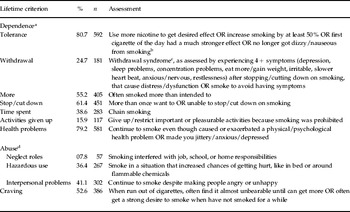
Lifetime ND criteria (Table 1) were assessed with the Alcohol Use Disorder and Associated Disabilities Interview Schedule (AUDADIS; Grant et al. Reference Grant, Harford, Dawson, Chou and Pickering1995, Reference Grant, Dawson, Stinson, Chou, Kay and Pickering2003, Reference Grant, Stinson, Dawson, Chou, Ruan and Pickering2004b), also used in other large epidemiological studies (Pull et al. Reference Pull, Saunders, Mavreas, Cottler, Grant, Hasin, Blaine, Mager and Ustun1997; Grant & Dawson, Reference Grant and Dawson2001; Grant et al. Reference Grant, Hasin, Chou, Stinson and Dawson2004a). The AUDADIS has excellent test–retest reliability for number of lifetime ND symptoms (intra-class correlation coefficient = 0.76; Grant et al. Reference Grant, Dawson, Stinson, Chou, Kay and Pickering2003). The ND criteria, except tolerance, were operationalized using the generic DSM-IV dependence criteria (APA, 2000, p. 197). For tolerance, we included two additional symptoms with better face validity (first cigarette of the day had a much stronger effect; no longer dizzy or nauseous from smoking) (Hughes, Reference Hughes1993; APA, 2000, p. 264). The nicotine abuse criteria were assessed with questions parallel to those for DSM-IV substance abuse (Table 1). These questions underwent pre-testing in Israel and post hoc review by the DSM-5 SUD Workgroup (Shmulewitz et al. Reference Shmulewitz, Keyes, Wall, Aharonovich, Aivadyan, Greenstein, Spivak, Weizman, Frisch, Grant and Hasin2011), confirming that they represent the proposed nicotine abuse criteria. The craving criterion was similar to alcohol and drug craving questions from other studies (Hasin et al. Reference Hasin, McCloud, Li and Endicott1996; Foroud et al. Reference Foroud, Wetherill, Liang, Dick, Hesselbrock, Kramer, Nurnberger, Schuckit, Carr, Porjesz, Xuei and Edenberg2007; Keyes et al. Reference Keyes, Krueger, Grant and Hasin2010). Use of lifetime criteria count (total number of criteria endorsed) was justified by the unidimensionality of DSM-IV ND criteria and DSM-5 NUD criteria (Shmulewitz et al. Reference Shmulewitz, Keyes, Wall, Aharonovich, Aivadyan, Greenstein, Spivak, Weizman, Frisch, Grant and Hasin2011). We refer to the seven ND criteria as ‘DSM-IV criteria’ and to the eleven proposed NUD criteria as ‘DSM-5 criteria’. Lifetime ND was diagnosed by endorsing three or more (⩾3) criteria, and lifetime NUD was diagnosed with ⩾2 criteria (the proposed DSM-5 threshold; APA, 2010a) and explored with four additional cut-offs (⩾3, ⩾4, ⩾5 or ⩾6 criteria).
Prevalence of and questions used to assess lifetime nicotine criteria in lifetime smokers (n = 734) (adapted from Shmulewitz et al. Reference Shmulewitz, Keyes, Wall, Aharonovich, Aivadyan, Greenstein, Spivak, Weizman, Frisch, Grant and Hasin2011)

External validators
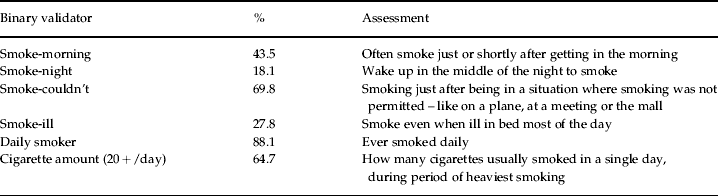
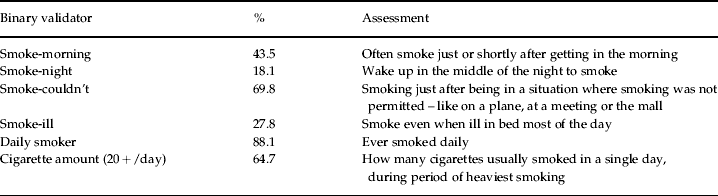
We use six lifetime validators, each considered a key indicator of nicotine addiction and/or predictor of smoking course (Table 2): (1) smoke-morning: smoking shortly after morning awakening (Colby et al. Reference Colby, Tiffany, Shiffman and Niaura2000b; Foulds et al. Reference Foulds, Gandhi, Steinberg, Richardson, Williams, Burke and Rhoads2006; Baker et al. Reference Baker, Piper, McCarthy, Bolt, Smith, Kim, Colby, Conti, Giovino, Hatsukami, Hyland, Krishnan-Sarin, Niaura, Perkins and Toll2007; Hughes et al. Reference Hughes, Baker, Breslau, Covey and Shiffman2011); (2) smoke-night: wake at night to smoke (Foulds et al. Reference Foulds, Gandhi, Steinberg, Richardson, Williams, Burke and Rhoads2006; Scharf et al. Reference Scharf, Dunbar and Shiffman2008); (3) smoke-couldn't: smoking just after being in a situation where smoking was prohibited, similar to ‘Do you find it difficult to refrain from smoking in places where it is forbidden?’ from the Fagerström Test for Nicotine Dependence (FTND; Heatherton et al. Reference Heatherton, Kozlowski, Frecker and Fagerström1991); (4) smoke-ill: smoking when sick in bed (Heatherton et al. Reference Heatherton, Kozlowski, Frecker and Fagerström1991); (5) daily smoker: ever smoked daily (Sargent et al. Reference Sargent, Mott and Stevens1998); and (6) cigarette amount: number of cigarettes usually smoked per day during heaviest period (Breslau & Johnson, Reference Breslau and Johnson2000; Colby et al. Reference Colby, Tiffany, Shiffman and Niaura2000a; Hughes, Reference Hughes2006; Baker et al. Reference Baker, Piper, McCarthy, Bolt, Smith, Kim, Colby, Conti, Giovino, Hatsukami, Hyland, Krishnan-Sarin, Niaura, Perkins and Toll2007), dichotomized at ⩾20/day (John et al. Reference John, Meyer, Hapke and Rumpf2004).
Assessment and prevalence of lifetime validators in lifetime smokers (n = 734)
Statistical analysis
Association between validators and nicotine criteria
Logistic regression (SAS 9.2; SAS Institute Inc.) evaluated the relationship between each external validator (predictor) and each DSM-5 criterion (outcome), reported as odds ratios (ORs) indicating the increase in odds of endorsing the criterion given the presence of the validator, adjusted for gender, age and FSU status (Baron-Epel et al. Reference Baron-Epel, Haviv-Messika, Tamir, Nitzan-Kaluski and Green2004). Both generic tolerance and tolerance expanded (including the additional nicotine-specific symptoms) were analysed. Associations were significant for both forms, but slightly stronger for tolerance expanded; those results were reported.
Comparative validity of the DSM-IV and DSM-5 sets
Receiver operating characteristic (ROC) curve analysis evaluates the predictive ability (validity) of a continuous diagnostic test (e.g. criterion count) against a binary standard (e.g. validator) (Shin, Reference Shin2009). The area under the ROC curve (AUC) measures discrimination, i.e. the total ability of the continuous diagnostic test to predict the presence or absence of the binary standard (Hanley & McNeil, Reference Hanley and McNeil1982). The AUC of a test without predictive value is 0.50 (50%), reflecting chance, while the AUC of a perfect test is 1.0; AUC > 0.7 indicates good validity (Terwee et al. Reference Terwee, Bot, De Boer, Van Der Windt, Knol, Dekker, Bouter and De Vet2007). ROC analysis can also test differences in discrimination (or validity) between two continuous tests by testing differences between the two AUCs for the same validator.
ROC curve analysis was conducted with proc logistic (SAS 9.2), correcting for gender, age and FSU status (Shin, Reference Shin2009). For each validator, we plotted two ROC curves, corresponding to the DSM-IV and DSM-5 sets, and calculated the AUC for each. A criterion set had significant predictive value for the validator if the difference between the AUC and the AUC for chance (0.50) was significantly greater than zero (DeLong et al. Reference DeLong, DeLong and Clarke-Pearson1988). Since both criterion sets were measured in the same sample, paired-sample tests were used to compare the AUCs (DeLong et al. Reference DeLong, DeLong and Clarke-Pearson1988; Shin, Reference Shin2009). We subtracted the DSM-IV AUC from the DSM-5 AUC; a difference significantly greater than zero indicated that the DSM-5 set offered significantly more validity than the DSM-IV set. To further understand the differences between the sets, additional comparisons were explored: (1) DSM-IV set and craving (DSM-IV + C) v. DSM-IV; (2) DSM-IV set and abuse criteria (DSM-IV + AB) v. DSM-IV; (3) DSM-IV + C v. DSM-IV + AB; (4) DSM-IV + C v.DSM-5; and (5) DSM-IV + AB v. DSM-5.
Binary NUD
We evaluated prevalence of DSM-IV ND and DSM-5 NUD (using five thresholds) and measured chance-corrected agreement between ND and each NUD diagnosis with the κ statistic (SAS 9.2).
Results
Prevalence of the nicotine criteria and validators is shown in Tables 1 and 2. The average number of criteria endorsed was 3.56 (s.d. = 1.77) for DSM-IV and 4.93 (s.d. = 2.56) for DSM-5.
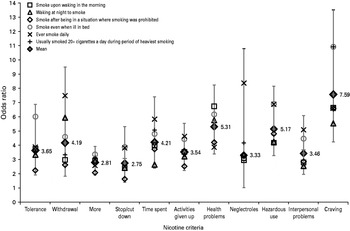
Each of the 11 DSM-5 criteria was strongly and significantly associated with each validator (Fig. 1; Tables S1 and S2), with one exception [‘neglect roles to smoke’ was not associated with smoking when ill in bed (smoke-ill)]. For example, ORs for the associations were as follows: ‘tolerance’, 2.23 (smoke-ill) to 6.01 [smoke just after being where smoking was prohibited (smoke-couldn't)]; ‘activities given up to smoke’, 2.52 (smoke-ill) to 4.64 (daily smoker); ‘smoking in hazardous situations’, 4.18 (smoking shortly after morning awakening) to 6.91 (smoke-couldn't); and ‘craving’, 5.53 (waking at night to smoke) to 10.93 (smoke-couldn't) (Fig. 1, Tables S1 and S2). For each criterion, mean OR across all validators was calculated, and error bars representing the 95% confidence interval (CI) of the OR distribution around the mean were generated. Visually, associations with craving were higher than with other criteria, but the 95% CIs overlapped across all criteria with one exception (‘craving’ and ‘smoking more than intended’; Fig. 1), indicating that generally the dependence, abuse and craving criteria showed validity evidence of similar strength.
Association of Diagnostic and Statistical Manual of Mental Disorders, fifth edition (DSM-5) nicotine use disorder criteria and validators. Symbols indicate odds ratios corrected for age, gender and former Soviet Union status. Confidence intervals for odds ratios are shown in Tables S1 and S2. For each criterion, gray diamonds indicate mean odds ratios across all validators, with error bars representing 95% of the distribution around the mean.

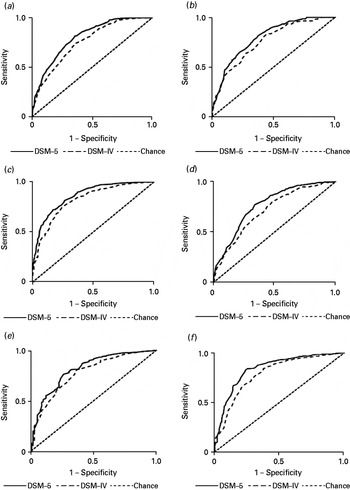
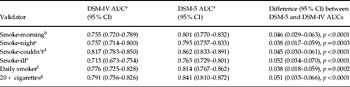
For all validators, the DSM-5 criteria as a set significantly discriminated between individuals with or without the validator, indicated by AUCs (Fig. 2) significantly greater than chance (50%), p < 0.0001 (Table 3). For example, based on criteria count, the DSM-5 set had 86.2% (AUC = 0.862) probability of correctly distinguishing a person endorsing smoke-couldn't from a person not endorsing smoke-couldn't. Stated otherwise, 86.2% of the time, a person endorsing smoke-couldn't would have more DSM-5 criteria than a person not endorsing that validator.
Receiver operating characteristic curves for validators and Diagnostic and Statistical Manual of Mental Disorders (DSM)-IV and DSM-5 criterion sets. See Table 3 for a summary of the areas under the receiver operating characteristic curves (AUCs) for each figure. (a) Smoke upon waking in the morning; (b) wake at night to smoke; (c) smoke after being in a situation where smoking was prohibited; (d) smoke even when ill in bed; (e) ever smoke daily; (f) usually smoked 20+ cigarettes a day during period of heaviest smoking.

Receiver operating characteristic curve analysis in lifetime smokers (n = 734), showing the relationship of the validators and the number of DSM-IV or DSM-5 criteria endorsed
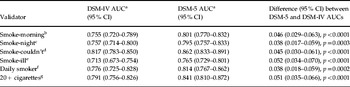
DSM, Diagnostic and Statistical Manual of Mental Disorders; AUC, area under the receiver operating characteristic curve, CI, confidence interval.
a All AUCs significantly greater than chance (0.50), p < 0.0001.
b Smoke upon waking in the morning.
c Wake at night to smoke.
d Smoke after being in a situation where smoking was prohibited.
e Smoke even when ill in bed.
f Ever smoke daily.
g Usually smoked 20+ cigarettes a day during period of heaviest smoking.
The DSM-5 set resulted in AUCs significantly larger than those from the DSM-IV set (i.e. the differences were significantly greater than 0; Table 3) for all validators. For example, the DSM-5 set had 4.5% more discriminatory ability for smoke-couldn't than DSM-IV; across all validators, the DSM-5 set showed increases ranging from 3.8% to 5.2%.
Further exploration (Table S3) showed that adding craving only (DSM-IV + C) significantly increased discrimination over DSM-IV for all validators (increases from 1.6% to 3.4%), and adding three abuse criteria (DSM-IV + AB) significantly increased discrimination over DSM-IV for all validators (increases from 2.3% to 3.3%). Although DSM-IV + C and DSM-IV + AB showed similar discrimination, adding abuse criteria to DSM-IV + C (completing the DSM-5 set) significantly increased discrimination over DSM-IV + C for all validators except smoke-night (increases from 1.5% to 2.3%), and adding craving to DSM-IV + AB (DSM-5 set) significantly increased discrimination over DSM-IV + AB for all validators except daily smoker (increases from 0.9% to 2.5%).
Prevalence of binary DSM-IV ND was 72.3%, with a higher prevalence of binary DSM-5 NUD using the two or more (⩾2) or ⩾3 criteria threshold (88.6% and 80.9%, respectively), similar prevalence using the ⩾4 threshold (71.1%), and a lower prevalence using the ⩾5 (57.2%) or ⩾6 threshold (42.9%). Diagnostic agreement between ND was largest with NUD based on ⩾4 criteria (κ = 0.80), and lower for the other thresholds (⩾2, κ = 0.51; ⩾3, κ = 0.76; ⩾5, κ = 0.64; and ⩾6, κ = 0.45).
Discussion
This study examined validity of the proposed DSM-5 NUD criterion set using six clinically important validators, supporting the proposed changes to NUD diagnosis (APA, 2010b) with four main findings. Each DSM-5 NUD criterion was associated with the validators with similar strength across the criteria, since the effect sizes (ORs) were generally within the same range. The DSM-5 criterion set was associated with all validators, as seen by the ability to discriminate between the presence or absence of each validator, with greater validity (increased discrimination) than the DSM-IV set for all validators. Last, the prevalence of binary DSM-5 NUD was higher than that of DSM-IV ND.
Dependence criteria
Although the face validity of the DSM-IV dependence criteria has been discussed (e.g. Hughes, Reference Hughes1993, Reference Hughes2006; Hughes et al. Reference Hughes, Baker, Breslau, Covey and Shiffman2011), only a few studies tested concurrent validity (Nelson & Wittchen, Reference Nelson and Wittchen1998; John et al. Reference John, Meyer, Hapke and Rumpf2004; West, Reference West and Goode2005; Hendricks et al. Reference Hendricks, Prochaska, Humfleet and Hall2008). Our results suggest that the DSM-IV criteria are valid indicators of a nicotine disorder. These results were similar to those from general populations (Nelson & Wittchen, Reference Nelson and Wittchen1998; John et al. Reference John, Meyer, Hapke and Rumpf2004), but different from those in clinical samples (West, Reference West and Goode2005; Hendricks et al. Reference Hendricks, Prochaska, Humfleet and Hall2008), suggesting the need for additional studies in clinical samples with higher disorder severity.
Two criteria merit additional mention. In the mid-to-late 20th century, ‘giving up activities to smoke’ was seldom necessary because smoking was generally accepted and unrestricted. However, with increasing restrictions and decreasing social acceptance of smoking, this criterion now appears to have face validity (Lessov et al. Reference Lessov, Martin, Statham, Todorov, Slutske, Bucholz, Heath and Madden2004), and showed concurrent validity in this study, similar to the other criteria. This does not mean that changing external circumstances should be confused with the biological processes underlying inability to stop smoking, but rather, that a smoking disorder is now indicated by smoking despite external pressures not to. ‘Tolerance’, operationalized using the generic definition (smoking more to get desired effect; increasing use over time), may not apply once smokers reach a baseline level of heavy, consistent use (Hughes, Reference Hughes2006). Therefore, DSM-IV (APA, 2000, p. 264) provides additional tolerance indicators (first cigarette of the day has a stronger effect than others; cessation of dizziness or nausea with continued use), which appear to have face validity (Hughes, Reference Hughes1993). In our study, generically defined tolerance gave similar but slightly weaker results (data not shown) than the tolerance criterion we included, suggesting that while both forms of tolerance show validity, expanding the assessment of tolerance may increase validity.
Abuse criteria
The abuse criteria have been criticized as irrelevant to NUD (Hughes et al. Reference Hughes, Baker, Breslau, Covey and Shiffman2011). If this were true, they would rarely be endorsed and show little relationship to validators. Our results suggest otherwise: the abuse criteria had prevalence patterns similar to the patterns found for other substances, and were significantly and strongly related to the external validators. Furthermore, these criteria now appear to have face validity. ‘Neglect of roles to smoke’ appears applicable given changes in the legal and social landscape regarding smoking. For this criterion, low prevalence does not show lack of validity, but rather suggests a role in identifying severe cases of NUD, similar to this criterion for other substances (Hasin et al. Reference Hasin, Fenton, Beseler, Park and Wall2012). To support this, additional research is needed in clinical settings with more severe cases. The ‘hazardous use’ criterion is supported by epidemiological studies showing that individuals smoke in situations despite increased risk of harm. For example, smokers have a higher risk of traffic accidents than other drivers (Brison, Reference Brison1990; Sacks & Nelson, Reference Sacks and Nelson1994) and smoking is a leading cause of fire-related injury and mortality (Sacks & Nelson, Reference Sacks and Nelson1994; Leistikow et al. Reference Leistikow, Martin and Milano2000; Goldstein et al. Reference Goldstein, Grant, McCullough, Cairns and Kurian2010). ‘Continued smoking despite interpersonal problems’ because of smoking may have validity due to increased public awareness of the hazards of direct and second-hand cigarette smoke.
Craving criterion
Craving, considered a core feature of ND by many, may be the most proximal cause of smoking, and predicts smoking cessation and abstinence (Hughes, Reference Hughes, Widiger, Frances, Pincus, First, Ross and Davis1994; Tiffany et al. Reference Tiffany, Warthen and Goedeker2009; Benowitz, Reference Benowitz2010; DiFranza et al. Reference DiFranza, Ursprung, Lauzon, Bancej, Wellman, Ziedonis, Kim, Gervais, Meltzer, McKay, O'Loughlin, Okoli, Fortuna and Tremblay2010; Baker et al. Reference Baker, Breslau, Covey and Shiffman2012; Tiffany & Wray, Reference Tiffany and Wray2012). Although craving was recognized as being relevant for nicotine and was included in DSM-III as a withdrawal symptom, DSM-IV excluded craving during withdrawal partially because craving can occur during smoking (Hughes, Reference Hughes, Widiger, Frances, Pincus, First, Ross and Davis1994). The proposal to include craving as a separate criterion in DSM-5 was supported by nicotine clinicians and researchers (Hughes et al. Reference Hughes, Baker, Breslau, Covey and Shiffman2011; Baker et al. Reference Baker, Breslau, Covey and Shiffman2012); this study provides empirical evidence for its inclusion, by showing strong association between the craving criterion and all validators.
DSM-5 NUD criterion set
The DSM-5 set showed validity, as indicated by significant ability to discriminate between individuals with or without the validators. This validity evidence also supports criterion count as a measure of NUD severity. The DSM-5 set had significantly more discriminatory ability (predictive validity) than the DSM-IV set, as evidenced by larger AUC, suggesting that the DSM-5 provides a more valid criterion set. Further exploratory analyses suggested that the validity increased due to both craving and abuse criteria, since adding either the abuse criteria or craving to the DSM-IV criteria resulted in increased validity. Although both sets [DSM-IV plus craving (DSM-IV + C) and DSM-IV plus abuse (DSM-IV + AB)] showed similar validity, completing the DSM-5 set by adding abuse to the DSM-IV + C set or by adding craving to the DSM-IV + AB set further significantly increased validity. This differs from the increase in total information for the DSM-5 set compared with the DSM-IV set shown previously (Shmulewitz et al. Reference Shmulewitz, Keyes, Wall, Aharonovich, Aivadyan, Greenstein, Spivak, Weizman, Frisch, Grant and Hasin2011); the earlier analysis did not take into account validators, while here, increased validity indicates a stronger relationship to validators.
Adding relevant criteria to an existing set does not necessarily increase discrimination (AUC). For example, adding criteria at the extreme ends of the disorder would not increase the AUC, since the validator is either present or absent for all participants at those points. Also, adding criteria that discriminate the validator in any region of the AUC that is already well discriminated by other criteria would not increase the AUC. Since adding criteria increases the AUC, the new criteria are not redundant with existing criteria and can improve diagnostic efficiency. Although gains in discrimination were modest (between 4% and 5%), possibly due to the use of related validators instead of the ‘gold standard’ (underlying ‘nicotine disorder’), any gain in diagnostic accuracy is important for a disorder with a large impact on world health.
NUD prevalence
DSM-5 will utilize a diagnostic cut-off of ⩾2 SUD criteria based on empirical evidence that this cut-off produced best agreement in prevalence with diagnoses of DSM-IV SUD (dependence or abuse; APA, 2010a; D. Hasin et al. unpublished observations). For nicotine, this evidence-based strategy is not directly relevant, since DSM-IV has only one nicotine disorder, i.e. dependence, and did not include abuse. Therefore, the SUD Workgroup was not trying to identify the cut-off for DSM-5 NUD that best matched disorder prevalence to DSM-IV (i.e. ⩾4 criteria, which showed the best agreement here). Rather, the ⩾2 criteria threshold was preferred for two main reasons. The first was to increase NUD prevalence, addressing concerns that individuals whose smoking patterns suggest dependence have not been diagnosed as dependent using the DSM-IV (Baker et al. Reference Baker, Breslau, Covey and Shiffman2012). Since nicotine disorders place a profound health and economic burden on individuals and society, correcting under-diagnosis should be a major public health priority. The second was to provide consistency with the other DSM-5 SUDs, unless evidence suggested that this was inadvisable.
Examining the evidence, a NUD diagnosis based on ⩾2 criteria was strongly associated with all six validators (p values <0.0001; data not shown), providing empirical validity for this cut-off. Diagnoses based on other cut-offs (⩾3 or ⩾4) also showed strong association with the validators (p values <0.0001; data not shown), an unsurprising result given that the DSM-5 NUD criteria form one continuous latent trait (Shmulewitz et al. Reference Shmulewitz, Keyes, Wall, Aharonovich, Aivadyan, Greenstein, Spivak, Weizman, Frisch, Grant and Hasin2011), suggesting that no particular cut-off would show stronger empirical support. However, DSM-5 will have a dimensional severity index (2–3 criteria, mild; 4–5 criteria, moderate; and ⩾6 criteria, severe; APA, 2010b), which can be used for graded diagnoses.
The FTND (Heatherton et al. Reference Heatherton, Kozlowski, Frecker and Fagerström1991) is a widely used diagnostic tool for ND (Baker et al. Reference Baker, Breslau, Covey and Shiffman2012). Four validators we used were either taken directly from the FTND (smoke-ill) or were related to FTND questions (smoke-morning, smoke-couldn't, and 20+ cigarettes). Further studies directly evaluating whether adding any of the DSM-5 NUD criteria to the FTND improves its validity are beyond the scope of this study but could be informative. A similar strategy to what we did in this study could be applied, i.e. investigating the comparative validity of the FTND and FTND + DSM-5 to other external validators. Evidence of increased validity with the combined set would suggest value in adding new criteria to the FTND.
We note study limitations. Data were collected by self-report, similar to other epidemiological studies. However, we used a well-validated measure (AUDADIS) that has been used in large studies worldwide. While lifetime criteria may be affected by memory and recall bias, the validators were assessed for the same lifetime time-frame. Future studies should be conducted using current criteria with current validators. Prospective validators such as smoking cessation, abstinence or treatment response (Hughes, Reference Hughes2006) were not available, but most validators used here have previously been shown to predict those outcomes (Heatherton et al. Reference Heatherton, Kozlowski, Frecker and Fagerström1991; Sargent et al. Reference Sargent, Mott and Stevens1998; Breslau & Johnson, Reference Breslau and Johnson2000; Foulds et al. Reference Foulds, Gandhi, Steinberg, Richardson, Williams, Burke and Rhoads2006; Baker et al. Reference Baker, Piper, McCarthy, Bolt, Smith, Kim, Colby, Conti, Giovino, Hatsukami, Hyland, Krishnan-Sarin, Niaura, Perkins and Toll2007; Scharf et al. Reference Scharf, Dunbar and Shiffman2008). All validators were related to quantity and pervasiveness of smoking behavior; investigation of additional variables relating to more distal outcomes, such as overall physical health and psychiatric disorders (e.g. other substance use or disorders, depression), is warranted. Furthermore, this study focused solely on convergent validity; studies of discriminant validity should be carried out. Although ND and NUD were assessed without requiring temporal clustering, such a requirement would be expected to reduce both ND and NUD prevalence, maintaining higher prevalence for NUD. This should be addressed in future studies. Lastly, although we tested six validators for each criterion or criterion set, these are not necessarily ‘independent’ tests, as the validators are related. Even so, if we apply the highly conservative Bonferroni correction, i.e. reduce the p value for significance to 0.05/6 = 0.0083, all results remain significant except the association of ‘neglect roles to smoke’ and daily smoker (nominal p value = 0.036).
Additional study strengths are noted. Data collection involved stringent quality-assurance procedures and resulted in a sizable sample with a good response rate. This is the first study to analyse many validators in a large general population sample of adult smokers to test validity of each ND criterion, and the first study of any kind to assess validity of the abuse criteria and of the entire DSM-5 criterion set, and to assess comparative validity with the DSM-IV set. Thus, this sample contributes unique results to the existing literature.
In conclusion, these validity results support the addition of nicotine abuse and craving criteria to NUD in DSM-5, leading to a more discriminatory measure of NUD and aligning the diagnostic criteria across all substances. The proposed changes to DSM-5 NUD alleviate several concerns about the DSM-IV approach to nicotine disorders, such as lack of validity, exclusion of craving, dichotomous diagnosis, and under-diagnosis of nicotine disorders (Shiffman et al. Reference Shiffman, Waters and Hickcox2004; DiFranza et al. Reference DiFranza, Ursprung, Lauzon, Bancej, Wellman, Ziedonis, Kim, Gervais, Meltzer, McKay, O'Loughlin, Okoli, Fortuna and Tremblay2010; Hughes et al. Reference Hughes, Baker, Breslau, Covey and Shiffman2011; Baker et al. Reference Baker, Breslau, Covey and Shiffman2012). Each dependence and abuse criterion showed concurrent validity in this general population sample. Adding craving was supported by the validity results. The DSM-5 set, using criterion count, showed concomitant validity, and provided a continuous measure of disorder severity. Increased discrimination compared with the DSM-IV set addresses the concern that adding criteria could reduce diagnostic efficiency (Hughes, Reference Hughes2006; Chung et al. Reference Chung, Martin, Maisto, Cornelius and Clark2012). Finally, dichotomous DSM-5 NUD (two or more criteria) showed increased prevalence. Therefore, adoption of these proposed changes in DSM-5 should improve NUD diagnosis.
Supplementary material
For supplementary material accompanying this paper visit http://dx.doi.org/10.1017/S0033291712002954.
Acknowledgements
This research was funded by National Institutes of Health grants no. R01AA013654, R01DA018652 and K05AA014223 (to D.H.) and no. K23DA016743 (to E.A.), and by the New York State Psychiatric Institute (to D.H.). None of the authors or researchers has any connection with the tobacco, alcohol, pharmaceutical or gaming industries or any body substantially funded by one of these organizations. We acknowledge the helpful consultations of Rachel Bar-Hamburger, Ph.D., Rina Meyer and Zalman Shoval in collecting the data in Israel.
Declaration of Interest
None.