I. INTRODUCTION
Physical properties of materials strongly depend on their internal structure and indirectly on formation conditions. Modeling of processes of structure development allows to predict and control structures obtained under different conditions and to optimize material properties.
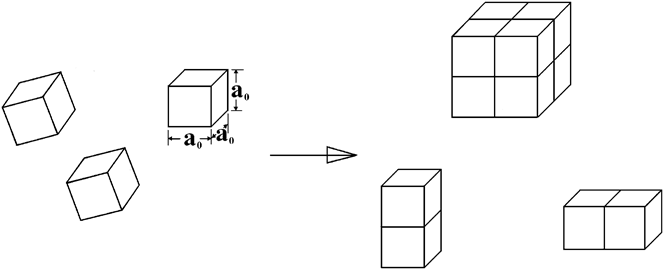
In the recent two papers,Reference Ziabicki and Misztal-Faraj1, Reference Misztal-Faraj and Ziabicki2 influence of crystallization conditions on the content of polymorphic phases and on the kinetics of polymorphic crystallization was discussed. α and β polymorphs of isotactic polypropylene were taken as an example. The probabilistic theory of Kolmogorov,Reference Kolmogorov3 Avrami,Reference Avrami4–Reference Avrami6 and EvansReference Evans7 was used, in which particles of the amorphous phase aggregate to form crystal nuclei and subsequently grow in three dimensions (Fig. 1). For the sake of simplicity, the aggregating kinetic units are assumed as cubes.
Three-dimensional aggregation of isotropic kinetic units.

The model calculations for isothermal crystallization were qualitatively consistent with experimental data on polypropylene.Reference Sajkiewicz, Gradys, Ziabicki and Misztal-Faraj8
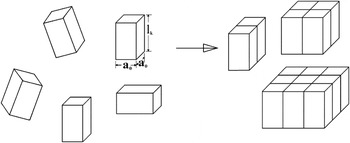
In the present paper, another model is analyzed, one involving anisotropic tetragonal units aggregating into two-dimensional plate-like crystal nuclei (Fig. 2).
Two-dimensional aggregation of tetragonal kinetic units.

The idea of plate-like crystallization of polymers was introduced by Keller,Reference Keller9 Hoffman, Lauritzen, and othersReference Hoffman and Lauritzen10–Reference Hoffman, Davis, Lauritzen and Hannay12 who described morphology of polymer crystallization in terms of folded polymer chains. The Hoffman–Lauritzen treatment was concentrated on plate growth and the overall crystallization kinetics was not analyzed. A complete kinetic model of plate-like crystallization, consisting of primary nucleation and crystal growth, will be presented. The model will admit distribution of plate thickness, which may account for distributed melting. It is assumed that each fraction of plates is created from a different precursor with a given plate thickness. This characteristic does not change in the process of crystallization. It is also assumed that polymorphic transitions between different plate-like phases are not allowed for kinetic reasons.
The plate-like model may be useful for describing crystallization of liquids consisting of rigid anisotropic molecules as well as crystallization of polymers with folded chains.
The aim of this work is to analyze effects of crystallization conditions on nucleation and growth of plate-like crystals. The results are illustrated with example calculations. The limits of nucleation-controlled crystallization are also discussed.
The model is shown to reproduce reasonably well temperature behavior of plate thickness for linear polyethylene and isothermal crystallization rate of α-polypropylene.
II. FUNDAMENTAL EQUATIONS OF THE MODEL
A. Thermodynamics
1. Ideal liquid-melt system
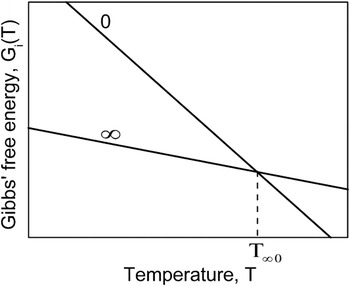
The phase diagram of an ideal two-phase crystalline-amorphous system is presented in Fig. 3.
Gibbs’ free energy versus temperature of an ideal two-phase system.

The two phases—liquid (amorphous) phase “0” and solid phase “∞”—are of infinite size. Both phases are thermodynamically stable and their coexistence is determined by a single equilibrium melting temperature, T ∞0.
For the sake of simplicity, linear dependence of the Gibbs’ free energy on temperature is assumed as follows:
 $$\eqalign{ & \,\,\,\,\,\,\,G_0 (T) = H_0 - T\;S_0 , \cr & \,\,\,\,\,\,G_\infty (T) = H_\infty - T\;S_\infty , \cr & \Delta G_{\infty 0} (T) = G_0 (T) - G_\infty (T) = 0\; \Rightarrow \;T_{\infty 0} = {{\Delta H_{\infty 0} } \over {\Delta S_{\infty 0} }}\quad. \cr}$$
Thermodynamic potentials of the stable phases (melt 0 and solid ∞) are proportional to volume of the sample, V
 $$\eqalignb{ & G_0 (T) = V \cdot g_0 (T) = V \cdot (h_0 - Ts_0 ), \cr & G_\infty (T) = V \cdot g_\infty (T) = V \cdot (h_\infty - Ts_\infty )\quad. \cr}$$
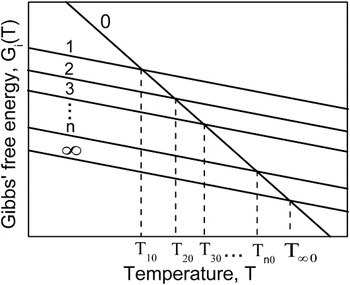
The system presented in Fig. 3 provides a reference for the “polymorphic” system containing the melt 0 and several plate-like phases k = 1, 2, . . . (Fig. 4).
Gibbs’ free energy versus temperature of a multiphase system.

2. A system including several plate-like solid phases
The kinetics of crystallization is described in terms of the many-phase model.Reference Ziabicki and Misztal-Faraj1, Reference Ziabicki13 A system containing solid phases of identical chemical and crystallographic structures, but different enthalpies, is considered. The solid phases consist of plates with different constant thicknesses, l k. In addition to the plate-like phases, k = 1, 2, 3,. . ., n, the system includes an amorphous (liquid) phase 0 and a reference solid phase ∞ composed of plate-like crystals with infinite thickness. Liquid phase 0 consists of tetragonal kinetic elements of height l k from which plates of the equivalent thickness l k are being created.
The plate-like phases exhibit different enthalpies (dependent on the plate thickness l k) and the same entropies
 $$\eqalignb{ & h_k = h_k (l_k ) = h_\infty + {\rm{\delta }}h_k (l_k ), \cr & s_k = s_\infty = {\rm{const}}\quad k = 1,\,2, \ldots \quad, \cr}$$
where h ∞ denotes enthalpy density (per unit volume) of the reference solid phase ∞. Free enthalpy of the plate-like phase k consists of two components. One component is proportional to volume V k and is identical with that of the reference solid ∞. The other one is surface energy proportional to surface area of the plate
 $$G_k (T) \cong V_k g_\infty + 2A_k {\rm{\sigma }}_e \quad,$$
 $$\eqalignb{ & A_k = a_k^2 , \cr & B_k = a_k l_k , \cr & V_k = a_k^2 l_k \quad. \cr}$$
A k denotes the area of the base face of the plate, a k × a k, and σe is interface tension on this face. Free enthalpy density of the plate-like phase reads
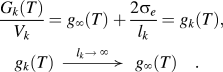 $$\eqalignb{ & {{G_k (T)} \over {V_k }} = g_\infty (T) + {{2{\rm{\sigma }}_e } \over {l_k }} = g_k (T), \cr \quad g_k (T)\buildrel {l_k \to \;\infty } \over {\hscale250%\longrightarrow} \;g_\infty (T)\quad. \cr} $$
For the infinitely thick plates, free enthalpy density reduces to that of the reference phase ∞. It is evident that in all temperatures, free enthalpy of the plate-like phases is higher than the reference value and more so the smaller is plate thickness, l k.
Formation of a plate-like phase k from the liquid phase 0 is controlled by the driving force
 $$\Delta g_{0k} = g_k - g_0 = \Delta g_{0\infty } + {{2{\rm{\sigma }}_e } \over {l_k }}\quad.$$
 $\Delta g_{0\infty }$ and
 $\Delta g_{0k}$ are negative, and the driving force for crystallization is reduced by positive surface energy. Assuming constant transition entropy crystallization/melting enthalpies and equilibrium transition temperatures are obtained as follows:
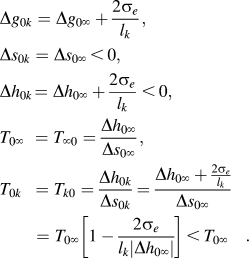 $$\!\eqalignb{\! & \Delta g_{0k} = \Delta g_{0\infty } + {{2{\rm{\sigma }}_e } \over {l_k }}, \cr & \Delta s_{0k} = \Delta s_{0\infty } < 0, \cr & \Delta h_{0k} \!= \Delta h_{0\infty } + {{2{\rm{\sigma }}_e } \over {l_k }} <0, \cr \,& T_{0\infty } \,\,= T_{\infty 0} = {{\Delta h_{0\infty } } \over {\Delta s_{0\infty } }}, \cr & T_{0k} \,\,\,= T_{k0} = {{\Delta h_{0k} } \over {\Delta s_{0k} }} = {{\Delta h_{0\infty } + {\textstyle{{2{\rm{\sigma }}_e } \over {l_k }}}} \over {\Delta s_{0\infty } }} \cr \quad\,\,\,\,\,= T_{0\infty } \left[ {1 - {{2{\rm{\sigma }}_e } \over {l_k \left| {\Delta h_{0\infty } } \right|}}} \right] <T_{0\infty } \quad. \cr}$$
B. Properties and behavior of a plate-like phase
1. Diffusion effects in phase transition processes
An important physical characteristic affecting kinetics of phase transitions is molecular mobility of aggregating/dissociating kinetic units. Transition of phase “i” into phase “j” involves diffusion factor
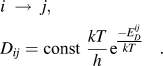 $$\eqalignb{ {\rm{}}i {\rm{}}\; \to \;{\rm{}} j {\rm{,}} \cr D_{ij} = {\rm{const}}\;{{kT} \over h}{\rm{e}}^{{\textstyle{{ - E_D^{ij} } \over {kT}}}} \quad. \cr}$$
In the case of crystallization, 0 → k, diffusion provides transport of kinetic units from the liquid phase to the growing clusters and crystals. Diffusion for direct transitions starting from the ideal liquid phase, D 0k, is controlled by molecular motions of the kinetic units, e.g., polymer chain segments, in the liquid phase. Melting of a solid is controlled by motions of small chain fragments splitting from the crystal and disorganizing the crystal structure. For such transitions, diffusion coefficients D 0k and D k0 are assumed to be finite as in our earlier paperReference Sajkiewicz, Gradys, Ziabicki and Misztal-Faraj8
 $$\eqalignb{ {\rm{crystallization}}\,{\rm{}}0{\rm{}} \to {\rm{}}k{\rm{,}} \cr D_{0k} (T) = {\rm{finite,}} \cr {\rm{melting}}\; k{\rm{}} \to \;{\rm{}}0{\rm{,}} \cr D_{k0} (T) = {\rm{finite}}\quad k = 1,\;2, \ldots ,n\quad. \cr}$$
An increase of plate thickness resulting from pulling long polymer chains through viscous medium or doubling plate thickness may require very high transport activation energies. Therefore, in the present model, plate i → plate j transitions are neglected because of high activation energy
 $$\eqalignb{ {\rm{plate}}\;{\rm{}} i {\rm{}}\; \leftrightarrow \;{\rm{plate }}\; j {\rm{,}} \cr D_{ij} = 0\quad i,j = 1,\;2, \ldots \quad. \cr}$$
2. Interface tensions
Another material characteristic that should be defined is interface tension, σ. The ranges of σ for isotactic polypropylene are given in Table I. According to TurnbullReference Turnbull14 interface tension,  ${\rm{\sigma }}_{0k}$ between the melt, 0, and the kth plate is controlled by structure of the latter. Assuming identical crystallographic structures of various plate-like phases k yields equal solid–melt interface tensions:
 $$\eqalignb{{\rm{solid}}\;{\rm{}}k {\rm{}}\; \leftrightarrow \;{\rm{melt}}\;{\rm{}} 0 {\rm{,}} \cr {\rm{\sigma }}_{0k} = {\rm{\sigma }}_e \quad {\rm{on}}\;{\rm{the}}\;{\rm{base}}\;{\rm{face}},\;a_k \times \;a_k , \cr {\rm{\sigma }}_{0k} = {\rm{\sigma }}_s \quad {\rm{on}}\;{\rm{the}}\;{\rm{side}}\;{\rm{face}},\;a_k \times \;l_k \quad k = 1,\;2, \ldots \quad, \cr}$$
σe—surface tension of the base face—is usually much higher than that on the side face, σs. Tetragonal symmetry and the surface tensions are also conserved in plate-like clusters.
Material characteristics for α-polypropylene.

C. Crystallization and melting rates
1. Formation and melting of a set of plate-like solid phases
Nucleation and growth of plate-like crystals involves reduced number of the degrees of freedom as compared with the reference solid ∞. In contrast to aggregation of isotropic kinetic units (Fig. 1), in the plate-like model, it is assumed that the aggregating units of the amorphous phase (molecules, chain segments, folded-chain units, etc) are considered as tetragonal parallelepipeds with dimensions l k × a 0 × a 0 (Fig. 2). After aggregation, primary, three-dimensional clusters with tetragonal symmetry and dimensions l k × a k × a k are obtained.
2. Primary nucleation of plate-like clusters with constant thickness
Free enthalpy of formation primary cluster with finite dimensions l k × a k × a k from single kinetic units l k × a 0 × a 0 reads
 $$\eqalignb{ v_k = a_k^2 l_k \quad l_k = {\rm{const,}} \cr \Delta g_{0k} = \Delta g_{0\infty } + {{2{\rm{\sigma }}_e } \over {l_k }}, \cr \Delta G_{0k,{\rm{nuc}}} (a_k ;l_k ) = \Delta g_{0\infty } \cdot a_k^2 l_k + 2a_k^2 {\rm{\sigma }}_e \cr+ 4{\rm{\sigma }}_{\rm{s}} a_k l_k = \;\left( {\Delta g_{0\infty } + {{2{\rm{\sigma }}_e } \over {l_k }}} \right)v_k \cr+ 4\;(v_k l_k )^{1/2} {\rm{\sigma }}_{\rm{s}}\quad . \cr}$$
Differentiation of the free enthalpy with respect to volume v k or lateral dimension, a k, yields critical characteristics of primary plate-like nucleation
 $$\eqalignb{ {\rm{\Delta }}G_{0k,{\rm{nuc}}} = \left( {\Delta g_{0\infty } + {{2{\rm{\sigma }}_e } \over {l_k }}} \right)v_k + 4(v_k l_k )^{1/2} {\rm{\sigma }}_{\rm{s}} , \cr {{{\rm{d}}\Delta G_{0k,{\rm{nuc}}} } \over {{\rm{d}}v_k }} = \Delta g_{0\infty } + 2{\rm{\sigma }}_e /l_k + 2{\rm{\sigma }}_{\rm{s}} l_k^{1/2} v_k^{ - 1/2} = \Delta g_{0k} + 2{\rm{\sigma }}_s l_k^{1/2} v_k^{ - 1/2} , \cr {{{\rm{d\Delta }}G_{0k,{\rm{nuc}}} } \over {{\rm{d}}v_k }} = 0 \Rightarrow \left\{ {\matrix{ {v_k = v_k^* } \hfill \,\,\,\,\,\,\,\,\,\,\,{v_k^* = {{4l_k {\rm{\sigma }}_s^2 } \over {(\Delta g_{0\infty } + 2{\rm{\sigma }}_e /l_k )^2 }} = {{4\;l_k {\rm{\sigma }}_s^2 } \over {\Delta g_{0k}^2 }},} \hfill \cr {a_k = a_k^* } \hfill {a_k^* = {{ - 2{\rm{\sigma }}_s } \over {\Delta g_{0k} }},} \hfill \cr {\Delta G_{0k,{\rm{nuc}}} = \Delta G_{0k,{\rm{nuc}}}^* } \,\,\quad\hfill {\Delta G_{0k,{\rm{nuc}}}^* = {{4l_k {\rm{\sigma }}_{\rm{s}}^2 } \over { - (\Delta g_{0\infty } + 2{\rm{\sigma }}_e /l_k )}} = {{ - 4l_k {\rm{\sigma }}_{\rm{s}}^2 } \over {\Delta g_{0k} }}\quad.} \hfill \cr } } \right. \cr}$$
The critical free enthalpy,  $\Delta G^*$, providing potential barrier for aggregation depends on the plate thickness, l k.. Differentiation of
 $\Delta G^*$ with respect to l k yields the minimum value of the critical energy,
 $\Delta G_{\min }^*$, and the optimum value of the parameter l k
 $$\eqalignb{ \Delta G_{0k,{\rm{nuc}}}^* (l_k ) = {{4l_k {\rm{\sigma }}_{\rm{s}}^2 } \over { - (\Delta g_{0\infty } + 2{\rm{\sigma }}_e /l_k )}} = {{ - 4l_k {\rm{\sigma }}_{\rm{s}}^2 } \over {\Delta g_{0k} }}, \cr {{{\rm{d\Delta }}G_{0k,{\rm{nuc}}}^* } \over {{\rm{d}}l_k }} = {{ - 4{\rm{\sigma }}_{\rm{s}}^2 (\Delta g_{0\infty } + 4{\rm{\sigma }}_e /l_k )} \over {(\Delta g_{0\infty } + 2{\rm{\sigma }}_e /l_k )^2 }} = {{ - 4{\rm{\sigma }}_{\rm{s}}^2 [\Delta g_{0k} + 2{\rm{\sigma }}_e /l_k ]} \over {\Delta g_{0k}^2 }}, \cr {{{\rm{d\Delta }}G_{0k,{\rm{nuc}}}^* } \over {{\rm{d}}l_k }} = 0 \Rightarrow \left\{ {\matrix{ {l_k = l_{{\rm{opt}}} } \hfill \,\,\,\,\,\,\,\,\,\,\,\,\,{l_{{\rm{opt}}} (T) = {{ - 4{\rm{\sigma }}_e } \over {\Delta g_{0\infty } (T)}},} \hfill \cr {\Delta G_{0k,{\rm{nuc}}}^* = \Delta G_{0k,{\rm{nuc}},{\rm{opt}}}^* } \,\,\,\hfill {\Delta G_{0k,{\rm{nuc}},{\rm{opt}}}^* (T) = {{32{\rm{\sigma }}_e {\rm{\sigma }}_{\rm{s}}^2 } \over {\Delta g_{0\infty }^2 (T)}}\quad.} \hfill \cr } } \right. \cr}$$
It is interesting to note that the minimum potential barrier to primary nucleation of plates is controlled by geometrically mean interface tension 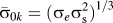 ${{\bar \sigma }}_{0k} = ({\rm{\sigma }}_e {\rm{\sigma }}_{\rm{s}}^2 )^{1/3}$.
In addition to the optimum plate thickness, l opt, which corresponds to the smallest potential barrier  $\Delta G_{0k,{\rm{nuc}}}^*$, there appear two other characteristic values of plate thickness l k. One is the thermodynamic limit, l min, appearing when the free enthalpy of aggregation density,
 $\Delta g_{0k}$, disappears
 $$\eqalignb{\Delta g_{0k} (T) = \Delta g_{0\infty } (T) + {{2{\rm{\sigma }}_e } \over {l_k }} = 0, \cr \,\,\,\,\,\,\,l_k (T) = l_{\min } = {{ - 2{\rm{\sigma }}_e } \over {\Delta g_{0\infty } (T)}}, \cr \,\,\,T(l_{\min } ) = T_{0k} \quad, \cr}$$
where T 0k = T k0 is equilibrium melting temperature for phase k. It is obvious that above T 0k crystallization of phase k is impossible.
The other (upper) limit of l k is associated with the conditions when critical volume of the plate  $v_k^* (l_k )$ is equal to the volume of two kinetic units, 2v 0k. Using Eq. (14), one obtains
 $$\eqalignb{v_k^* = {{4l_k {\rm{\sigma }}_{\rm{s}}^2 } \over {\Delta g_{0k}^2 }} = {{4l_k {\rm{\sigma }}_{\rm{s}}^2 } \over {(\Delta g_{0\infty } + 2{\rm{\sigma }}_e /l_k )^2 }}, \cr {{v_k^* } \over {v_0 }} = 2 \Rightarrow l = l_{\max } (T), \cr l_{\max } (T) = {{ - 2{\rm{\sigma }}_e a_0 } \over {\sqrt 2 {\rm{\sigma }}_{\rm{s}} + a_0 \Delta g_{0\infty } (T)}}, \cr \Delta g_{0\infty } (T) = - {{2{\rm{\sigma }}_e } \over {l_{\max } }} - {{\sqrt 2 {\rm{\sigma }}_{\rm{s}} } \over {a_0 }}, \cr T(l_{\max } ) = T_{0\infty } \left[ {1 + \left( {{{2{\rm{\sigma }}_e } \over {l_{\max } }} + {{\sqrt 2 {\rm{\sigma }}_{\rm{s}} } \over {a_0 }}} \right){1 \over {\Delta h_{0\infty } }}} \right]\quad. \cr}$$
The conditions described by Eq. (17) determine the upper limit of plate thickness l k when nucleation-controlled crystallization theory fails. Above l k = l max, all clusters are capable of infinite growth and nucleation does not play any role in the kinetics.
 $$\eqalignb{ v_k^* \;(T) \ge \;2v_{0k} \quad {\rm{nucleation {\hbox-} controlled}}\;{\rm{transition,}} \cr v_k^* \;(T)\; <2v_{0k} \quad {\rm{no \,nucleation}}\;{\rm{transition}}\quad{\rm{.}} \cr}$$
Primary nucleation rate is controlled by cluster distribution function ρ0k(v) in the vicinity of critical volume,  $v_{0k} = v_k^*$. With the “diffusion coefficient” in the form
 $$\eqalignb{ P(a_k^* ) = {{4a_k^* } \over {a_{0k} }} = {{8\sigma _{\rm{s}} } \over {a_{0k} \left| {\Delta g_{0k} } \right|}};\quad a_{0k} = (v_{0k} /l_k )^{1/2} , \cr D(a_k^* ) = P(a_k^* )v_{0k}^2 {{kT} \over h}{\rm{e}}^{{\textstyle{{ - E_D } \over {kT}}}} \cr\,\,\,\,\,\,\,\,\,\,\,\,\,\,= {{8{\rm{\sigma }}_{\rm{s}} l_k^{1/2} v_{0k}^{3/2} } \over {(\left| {\Delta g_{0\infty } } \right| - 2{\rm{\sigma }}_e /l_k )}}{{kT} \over h}{\rm{e}}^{{\textstyle{{ - E_D } \over {kT}}}} \quad, \cr}$$
steady-state distribution of plate-like clusters derived from the approximation of FrenkelReference Frenkel15 and ZeldovichReference Zeldovich16 reads
 $$\eqalignb{ {\rm{\rho }}_{{\rm{st}}} (v_k ) = {1 \over 2}{\rm{\rho }}_{0k} \;{\rm{e}}^{{\textstyle{{ - \Delta G(v_k )} \over {kT}}}} \{ 1 - erf[Z(v_k - v_k^* )]\} , \cr {\rm{\rho }}_{{\rm{st}}} (v*) = {1 \over 2}{\rm{\rho }}_{0k} \;{\rm{e}}^{{\textstyle{{ - \Delta G_{0k} } \over {kT}}}} \cr\,\,\,\,\,\,\,\,\,\,\,\,\,\,\,\,= {1 \over 2}{\rm{\rho }}_{0k} \exp \left[ {{{ - 4l_k {\rm{\sigma }}_{\rm{s}}^2 } \over {kT \cdot [\left| {\Delta g_{0\infty } } \right| - 2{\rm{\sigma }}_e /l_k ]}}} \right], \cr \left. {{{\partial {\rm{\rho }}_{{\rm{st}}} } \over {\partial v_k }}} \right|_{v = v*} = {{ - Z} \over {\sqrt \pi }}{\rm{\rho }}_{0k} \;{\rm{e}}^{{\textstyle{{ - \Delta G_{0k} } \over {kT}}}} \cr\,\,\,\,\,\,\,\,\,\,\,\,\,\,\,\,\,\,\,\,= {{ - {\rm{\rho }}_{0k} [\left| {\Delta g_{0\infty } } \right| - 2{\rm{\sigma }}_e /l_k]^{3/2} } \over {8{\rm{\sigma }}_{\rm{s}} \sqrt {{\rm{\pi }}kT} l_k^{1/2} }}\cr\,\,\,\,\,\,\,\,\,\,\,\,\,\,\,\,\,\,\,\,\,\,\,\,\,\,\times\,\exp \left[ {{{ - 4l_k {\rm{\sigma }}_{\rm{s}}^2 } \over {kT(\left| {\Delta g_{0\infty } } \right| - 2{\rm{\sigma }}_e /l_k )}}} \right]\quad. \cr}$$
Primary nucleation rate of plate-like crystals appears in the form
 $$\eqalignb{ \dot N_{0k} (T) = - D(v_k^* ){\rm{\rho }}_{0k} \left. {{{\partial {\rm{\rho }}_{{\rm{st}}} } \over {\partial v}}} \right|_{v*} \cr\,\,\,\,\,\,\,\,\,\,\,\,\,\,\,\,\,= {{( - \Delta g_{0k} )^{1/2} {\rm{\rho }}_{0k}^2 v_{0k}^{3/2} } \over {\sqrt {{\rm{\pi }}kT} }}{{kT} \over h}\;{\rm{e}}^{{\textstyle{{ - E_D } \over {kT}}}} \exp \left[ {{{4l_k {\rm{\sigma }}_{\rm{s}}^2 } \over {kT\Delta g_{0k} }}} \right] \cr \;\;\;\;\;\;\;\;\;\;\; \,\,\,\,\,\,\,\,\,\,\,\,\,\,= {{( - \Delta g_{0\infty } - 2{\rm{\sigma }}_e /l_k )^{1/2} {\rm{\rho }}_{0k}^2 v_{0k}^{3/2} } \over {\sqrt {{\rm{\pi }}kT} }}{{kT} \over h}\;{\rm{e}}^{{\textstyle{{ - E_D } \over {kT}}}} \cr\,\,\,\,\,\,\,\,\,\,\,\,\,\,\,\,\,\,\,\,\,\,\times\,\exp \left[ {{{4l_k {\rm{\sigma }}_{\rm{s}}^2 } \over {kT(\Delta g_{0\infty } + 2{\rm{\sigma }}_e /l_k )}}} \right]\quad. \cr}$$
Plate thickness l k in Eq. (21) cannot be smaller than the minimum value corresponding to zero driving force
 $$\eqalignb{ \Delta g_{0k} = \Delta g_{0\infty } + 2{\rm{\sigma }}_e /l_k \; <\;0, \cr \;\;\,\,\;l_{\min } = - 2{\rm{\sigma }}_e /\Delta g_{0\infty }\quad . \cr}$$
Plates thinner than l min cannot be created for thermodynamic reasons. It is interesting to note [Eq. (15)] that plate thickness equal to double l min corresponds to minimum energy barrier of nucleation. Primary nucleation rate is a function of temperature and plate thickness, l k.
3. Growth of plate-like clusters with constant thickness
Growth of plate-like clusters is reduced to two dimensions parallel to the a × a surface. Secondary nuclei (nuclei of growth) are attached to side faces l k × a of the plate and grow in the dimensions, a. The kinetic unit attached is l k × a 0 × a 0. The secondary cluster has a constant thickness, l k, constant width, a 0, and variable lateral dimension, a. Addition of the first kinetic element (l k × a 0 × a 0) to the side face of the crystal plate changes cluster free enthalpy by
 $$\eqalignb{ a = 0 \to a = a_0 , \cr v_{0k} = a_0^2 l_k , \cr \Delta G_{0k,{\rm{gr}}} (v_{0k} ) = \Delta g_{0\infty } l_k a_0^2 + 2{\rm{\sigma }}_e a_0^2 + 2{\rm{\sigma }}_{\rm{s}} l_k a_0 \cr \,\,\,\,\,\,\,\,\,\,\,\,\,\,\,\,\,\,\,\,\,\,\,\,\,\,\,\,\,= \left( {\Delta g_{0\infty } + {{2{\rm{\sigma }}_e } \over {l_k }}} \right)v_{0k} + 2{\rm{\sigma }}_{\rm{s}} l_k^{1/2} v_{0k}^{1/2} \quad. \cr}$$
Free enthalpy of the cluster composed of more than one element and width a reads
 $$\eqalignb{ a > a_0 , \cr v = l_k a_0 a;a = {v \over {a_0 l_k }}, \cr \Delta G_{0k,{\rm{gr}}} (v) = \left( {\Delta g_{0\infty } + {{2{\rm{\sigma }}_e } \over {l_k }}} \right)v + 2{\rm{\sigma }}_{\rm{s}} (l_k v_{0k} )^{1/2} \quad. \cr}$$
Continualized free enthalpy in the entire range of cluster sizes results in the form of two linear functions of volume, v, increasing in the range of small volumes and decreasing in the range of large v.
 $$\Delta G_{0k,{\rm{gr}}} (v) = \left\{ {\matrix{ {\left( {\Delta g_{0\infty } + {{2{\rm{\sigma }}_e } \over {l_k }} + 2{\rm{\sigma }}_{\rm{s}} l_k^{1/2} v_{0k}^{ - 1/2} } \right)v} \hfill \,\,\,\,\,\,\,\,\,\,\,\,\,\,\,\,\,\,\,\,\,\,\,\,\,\,\,\,\,\,\,\,\,\,\,\,\,\,\,\,\,\,\,\,\,\,\,\,\,\,\,\,{{\rm{for }}\,0 \,\le \,v <v_{0k} ,} \hfill \cr {\Delta G_{0k,{\rm{gr,}}\max } = \left( {\Delta g_{0\infty } + {{2{\rm{\sigma }}_e } \over {l_k }}} \right)v_{0k} + 2{\rm{\sigma }}_{\rm{s}} l_k^{1/2} v_{0k}^{1/2} } \,\,\,\,\,\,\,\,\hfill {{\rm{for }}\,v = v_{0k} ,} \hfill \cr {\left( {\Delta g_{0\infty } + {{2{\rm{\sigma }}_e } \over {l_k }}} \right)v + 2{\rm{\sigma }}_{\rm{s}} l_k^{1/2} v_{0k}^{1/2} } \hfill {{\rm{\,\,\,\,\,\,\,\,\,\,\,\,\,\,\,\,\,\,\,\,\,\,\,\,\,\,\,\,\,\,\,\,\,\,\,\,\,\,\,\,\,\,\,\,\,\,\,for }}\,v > v_{0k} .} \hfill \cr } } \right.$$
Of course, the range v < v 0k (cluster size smaller than that of a single kinetic unit) does not have physical sense.
Maximum free enthalpy of secondary clusters, providing thermodynamic barrier for crystal growth corresponds to deposition of a single kinetic unit: v* = v 0k. Formal differentiation of free enthalpy with respect to cluster volume yields different values for small and large clusters. The gradient  ${\rm{d}}\Delta G_{0k,{\rm{gr}}} {\rm{/d}}v$ is indefinite at v = v 0k
 $${{{\rm{d\Delta }}G_{0k{\rm{,gr}}} } \over {{\rm{d}}v}} = \left\{ {\matrix{ { - \left| {\Delta g_{0\infty } } \right| + {{2{\rm{\sigma }}_e } \over {l_k }} + {\rm{\sigma }}_{\rm{s}} l_k^{1/2} v_{0k}^{ - 1/2} \,\ge \,0} \,\hfill \!\!\!\!{{\rm{for }}\,v <v_{0k} ,} \hfill \cr {{\rm{Indefinite}}} \hfill \,\,\,\,\,\,\,\,\,\,\,\,\,\,\,\,\,\,\,\,\,\,\,\,\,\,\,\,\,\,\,\,\,\,\,\,\,\,\,\,\,\,\,\,\,\,\,\,\,\,\,\,{{\rm{for }}\,v = v_{0k} ,} \hfill \cr { - \left| {\Delta g_{0\infty } } \right| + {{2{\rm{\sigma }}_e } \over {l_k }} \le 0} \hfill \,\,\,\,\,\,\,\,\,\,\,\,\,\,\,\,\,\,\,\,\,\,\,\,\,\,\,\,\,\,\,\,\,\,\,\,\,\,{{\rm{for }}\,v > v_{0k}\quad .} \hfill \cr } } \right.$$
In contrast to primary nucleation, form of the free enthalpy gradient [Eq. (26)], excludes the possibility of describing plate-crystal growth in terms of the continuous cluster distribution function, ρ(v).
The problem of crystal growth has been solved by Hoffman and Lauritzen,Reference Hoffman and Lauritzen10–Reference Hoffman, Davis, Lauritzen and Hannay12 Frank and Tosi,Reference Frank and Tosi17 and other authors on the basis of a discrete system of bimolecular association–dissociation reactions. Free enthalpy of a q-element cluster formed from a × b × l k parallelepiped units
 $$\eqalignb{ \Delta F(q) = 2bl{\rm{\sigma }}_{\rm{s}} + 2qab{\rm{\sigma }}_e - qabl\Delta f, \cr \!\!\!\!\!\!\!v_{0k} = abl \cr}$$
translated to our symbols
 $$\eqalignb{ \Delta F = \Delta G(v), \cr\,\,\,\, q = v/v_{0k} , \cr \,\,\,\, b = a_0 , \cr \,\,\,\, a = a_0 , \cr \Delta f = - \Delta g_{0\infty } , \cr v_{0k} = a_0^2 l_k , \cr \,a_0 = \left( {{{v_{0k} } \over {l_k }}} \right)^{\!1/2} \cr}$$
yields free enthalpy
 $$\Delta G_{0k,{\rm{gr}}} (v) = \left( {\Delta g_{0\infty } + {{2{\rm{\sigma }}_e } \over {l_k }}} \right)v + 2{\rm{\sigma }}_{\rm{s}} (v_{0k} l_k )^{1/2}$$
identical to that derived in this paper for large volumes [Eq. (25)]. Solving a discrete system of association–dissociation reactions Hoffman et al.Reference Hoffman, Davis, Lauritzen and Hannay12 obtained the flux of secondary nuclei at v = v 0k in the form
 $$\eqalignb{ S(l)/N_0 = \,{\rm{\beta }}\exp \left[ {{{ - 2bl{\rm{\sigma }}_{\rm{s}} + {\rm{\psi }}abl\Delta f} \over {kT}}} \right] \cr\times \left\{ {1 - \exp \left[ {{{ - abl\Delta f + 2ab{\rm{\sigma }}_e } \over {kT}}} \right]} \right\}, \cr {\rm{\beta }} = {{kT} \over h}J_1 \exp \left[ {{{ - U*} \over {R(T - T_\infty )}}} \right];\quad \cr T_\infty = T_{\rm{g}} - 30,\quad {\rm{\psi }} \in \left\langle {0,1} \right\rangle \quad, \cr}$$
where ψ is a model parameter.Reference Hoffman, Davis, Lauritzen and Hannay12 For the discussion of plate-like crystallization, it will be assumed
 $$J_1 = 1;\quad \psi = 1;\quad {\rm{\beta }} = {{kT} \over h}{\rm{e}}^{{\textstyle{{ - E_D } \over {kT}}}} \quad.$$
The Williams-Landel-Ferry (WLF) formula in Eq. (30) will be replaced with an Arrhenius mobility barrier. Assumption ψ = 1 corresponds to direct attachment of kinetic elements of the amorphous phase to the cluster. With these conditions, substituted to Eq. (30), the flux is obtained in the form as follows:
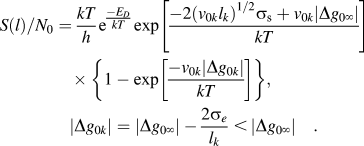 $$\eqalignb{ S(l)/N_0 = {{kT} \over h}{\rm{e}}^{{\textstyle{{ - E_D } \over {kT}}}} \exp \left[ {{{ - 2(v_{0k} l_k )^{1/2} {\rm{\sigma }}_{\rm{s}} + v_{0k} \left| {\Delta g_{0\infty } } \right|} \over {kT}}} \right] \cr\,\,\,\,\,\,\,\,\,\,\,\,\,\,\,\,\,\,\,\,\,\,\,\,\times \left\{ {1 - \exp \left[ {{{ - v_{0k} \left| {\Delta g_{0k} } \right|} \over {kT}}} \right]} \right\}, \cr \;\;\;\;\;\,\,\,\,\,\,\,\,\,\,\,\,\,\,\,\,\,\,\,\,\,\,\,\,\left| {\Delta g_{0k} } \right| = \left| {\Delta g_{0\infty } } \right| - {{2{\rm{\sigma }}_e } \over {l_k }} <\left| {\Delta g_{0\infty } } \right|\quad. \cr}$$
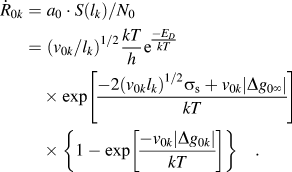
Linear growth rate,  $\dot R_{0k}$, in the direction normal to the edge face (l k × a) results as
 $$\eqalignb{ \dot R_{0k} = a_0 \cdot S(l_k )/N_0 \cr = (v_{0k} /l_k )^{1/2} {{kT} \over h}{\rm{e}}^{{\textstyle{{ - E_D } \over {kT}}}} \cr\,\,\,\,\,\,\times\exp \left[ {{{ - 2(v_{0k} l_k )^{1/2} {\rm{\sigma }}_{\rm{s}} + v_{0k} \left| {\Delta g_{0\infty } } \right|} \over {kT}}} \right] \cr\,\,\,\,\,\,\times \left\{ {1 - \exp \left[ {{{ - v_{0k} \left| {\Delta g_{0k} } \right|} \over {kT}}} \right]} \right\}\quad. \cr}$$
D. Global transition rates
1. Formation of a simple plate-like phase
Let us start with a simple plate-like crystal phase in which all plates have the same thickness, l k. Taking into account, primary nucleation rate from Eq. (21) and growth rate from Eq. (33), the progress function E(t) for sporadic nucleation results as follows:
 $$\eqalignb{ E_{0k}^{{\rm{spc}}} (t) = l_k \cdot \int\limits_0^t {\dot N_{0k} (s)\left[ {\int\limits_s^t {\dot R_{0k} (z){\rm{d}}z} } \right]^2 \;\cr {\rm{d}}s} \buildrel {{\rm{isothermal}}} \over {\hscale280%\longrightarrow} {1 \over 3}\cr\,\,\,\,\,\,\,\,\,\,\,\,\,\,\,\,\,\,\,\,\,\,\times\dot N_{0k} \cdot l_k \cdot \dot R_{0k}^2 t^3 \cr\,\,\,\,\,\,\,\,\,\,\,\,\,\,\,\,= {{\left| {\Delta g_{0k} } \right|^{1/2} v_{0k}^{1/2} } \over {3\sqrt {{\rm{\pi }}kT} }}\left( {{{kT} \over h}\;{\rm{e}}^{{\textstyle{{ - E_D } \over {kT}}}} } \right)^3 \;\exp \left[ {{{ - 4l_k {\rm{\sigma }}_{\rm{s}}^2 } \over {kT\left| {\Delta g_{0k} } \right|}}} \right] \cr\,\,\,\,\,\,\,\,\,\,\,\,\,\,\,\,\,\,\,\,\,\times \exp \left[ {{{ - 4(v_{0k} l_k )^{1/2} {\rm{\sigma }}_{\rm{s}} + 2v_{0k} \left| {\Delta g_{0\infty } } \right|} \over {kT}}} \right] \cr\,\,\,\,\,\,\,\,\,\,\,\,\,\,\,\,\,\,\,\,\,\times \left\{ {1 - \exp \left[ {{{ - v_{0k} \left| {\Delta g_{0k} } \right|} \over {kT}}} \right]} \right\}^2 t^3 \quad, \cr} $$
and the frequency function ν(t)
 $$\eqalignb{ {\rm{\nu }}_{0k}^{{\rm{spc}}} = (E_{0k}^{{\rm{spc}}} /t^3 )^{1/3} \cr \;\;\;\;\; = {{\left| {\Delta g_{0k} } \right|^{1/6} {\rm{\nu }}_{0k}^{1/6} } \over {3^{1/3} ({\rm{\pi }}kT)^{1/6} }}\left( {{{kT} \over h}\;{\rm{e}}^{{\textstyle{{ - E_D } \over {kT}}}} } \right)\exp \left[ {{{ - 4l_k {\rm{\sigma }}_{\rm{s}}^2 } \over {3kT\left| {\Delta g_{0k} } \right|}}} \right] \cr \;\;\;\;\;\;\;\,\,\,\,\,\,\,\,\; \times \exp \left[ {{{ - 4({\rm{\nu }}_{0k} l_k )^{1/2} {\rm{\sigma }}_{\rm{s}} + 2{\rm{\nu }}_{0k} \left| {\Delta g_{0\infty } } \right|} \over {3kT}}} \right] \cr\,\,\,\,\,\,\,\,\,\times \left\{ {1 - \exp \left[ {{{ - {\rm{\nu }}_{0k} \left| {\Delta g_{0k} } \right|} \over {kT}}} \right]} \right\}^{2/3} \quad. \cr}$$
E. Development of phase composition
1. Direct amorphous–solid transitions
Isothermal crystallization of an undercooled amorphous phase 0 into a single solid phase k (k = 1, 2, 3) at T < T k0 yields time-dependent composition vector, x
 $$\left( {\matrix{ {x_0 (t = 0) = x_0^0 } \cr {x_k (t = 0) = x_k^0 } \cr } } \right) = \,\left( {\matrix{ 1 \cr 0 \cr } } \right)\buildrel {E_{0k} (t)} \over {\hscale200%\longrightarrow} \;\left( {\matrix{ {{\rm{e}}^{ - E_{0k} (t)} } \cr {1 - {\rm{e}}^{ - E_{0k} (t)} } \cr } } \right)\buildrel {t \to \infty } \over {\hscale200%\longrightarrow} \;\left( {\matrix{ 0 \cr 1 \cr } } \right)\cr}$$
and isothermal melting of the solid phase k at T > T k0
 $$\left( {\matrix{ {x_k^0 = 1} \cr {x_0^0 = 0} \cr } } \right) = \,\left( {\matrix{ 1 \cr 0 \cr } } \right)\buildrel {E_{k0} (t)} \over {\hscale200%\longrightarrow} \;\left( {\matrix{ {{\rm{e}}^{ - E_{k0} (t)} } \cr {1 - {\rm{e}}^{ - E_{k0} (t)} } \cr } } \right)\cr\buildrel {t \to \infty } \over {\hscale200%\longrightarrow} \;\left( {\matrix{ 0 \cr 1 \cr } } \right)\quad.$$
2. Simultaneous isothermal crystallization of three plate-like solids from the amorphous phase
It is evident that primary nucleation rates  $\dot N_{0k}$, linear growth rates
 $\dot R_{0k}$, and global progress functions
 $E_{0k}^{{\rm{spc}}}$ depend on plate thickness, l k. For isolated direct transitions, 0 → k, starting from an undiluted amorphous phase, all single kinetic units are assumed to have the same length l k. Consequently, the concentration ρ0k of effective kinetic units is equal to reciprocal volume of the unit
 $$\eqalignb{ {\rm{isolated}}\;{\rm{transition}}\;{\rm{}} 0 {\rm{}} \to \;{\rm{}} k {\rm{,}} \cr {\rm{\rho }}_{0k} = {1 \over {v_{0k} }}\quad {\rm{for}}\;k = 1,2, \ldots ,n\quad. \cr}$$
When different plate-like transitions take place simultaneously, a mixture of plate-like crystals is obtained. It is assumed that direct plate-plate transitions i → j are excluded for kinetic reasons [see Eq. (11)]. The basic postulate of the model—constant plate thickness for each species—requires existence of different kinetic elements in the source (amorphous) phase. Such a situation may be viewed as a mixture of different amorphous phases, {“0k”} crystallizing into separate plate-like solids, l k. Kinetic elements with length l k (volume v 0k) occupy a fraction f k of the total volume of the amorphous phase
 $$\eqalignb{ {\rm{simultaneous}}\;{\rm{transitions}}\;{\rm{}} 0 _k {\rm{}} \to \; {\rm{}}k {\rm{,}} \cr {\rm{\rho }}_{0k} v_{0k} = f_k , \cr{\rm{\rho }}_{01} v_{01} + {\rm{\rho }}_{02} v_{02} + \cdots + {\rm{\rho }}_{0n} v_{0n} = \mathop\sum\limits_{k = 1}^n {f_k } = 1, \cr {\rm{\rho }}_{0k} = {{f_k } \over {v_{0k} }}\quad, \cr}$$
where  ${\rm{\rho }}_{0k}$ is the initial concentration of single elements effective in the creation of phase k, and f k is a fraction of the k-type kinetic units in the amorphous phase.
The progress function of the transition 0 → k reads
 $$\eqalignb{ E_{0k}^{{\rm{spc}}} (t) = {{\left| {\Delta g_{0k} } \right|^{1/2} {\rm{\rho }}_{0k}^2 v_{0k}^{5/2} } \over {3\sqrt {{\rm{\pi }}kT} }}\left( {{{kT} \over h}\;{\rm{e}}^{{\textstyle{{ - E_D } \over {kT}}}} } \right)^3 \cr\times \exp \left[ {{{ - 4l_k {\rm{\sigma }}_{\rm{s}}^2 } \over {kT\left| {\Delta g_{0k} } \right|}}} \right] \cr \;\;\;\;\;\;\;\;\;\;\;\; \times \exp \left[ {{{ - 4(v_{0k} l_k )^{1/2} {\rm{\sigma }}_{\rm{s}} + 2v_{0k} \left| {\Delta g_{0\infty } } \right|} \over {kT}}} \right] \cr\times \left\{ {1 - \exp \left[ {{{ - v_{0k} \left| {\Delta g_{0k} } \right|} \over {kT}}} \right]} \right\}^2 t^3 \quad. \cr}$$
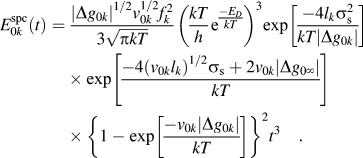
Simultaneous creation of n plate-like phases from the amorphous phase requires considering n appropriate amorphous phases 01, 02, . . ., 0n. The progress function for an isolated transition 0k → k is obtained in the form
 $$\eqalignb{ E_{0k}^{{\rm{spc}}} (t) = \,{{\left| {\Delta g_{0k} } \right|^{1/2} v_{0k}^{1/2} f_k^2 } \over {3\sqrt {{\rm{\pi }}kT} }}\left( {{{kT} \over h}{\rm{e}}^{{\textstyle{{ - E_D } \over {kT}}}} } \right)^3 \exp \left[ {{{ - 4l_k {\rm{\sigma }}_{\rm{s}}^2 } \over {kT\left| {\Delta g_{0k} } \right|}}} \right] \cr\times \exp \left[ {{{ - 4(v_{0k} l_k )^{1/2} {\rm{\sigma }}_{\rm{s}} + 2v_{0k} \left| {\Delta g_{0\infty } } \right|} \over {kT}}} \right] \cr\times \left\{ {1 - \exp \left[ {{{ - v_{0k} \left| {\Delta g_{0k} } \right|} \over {kT}}} \right]} \right\}^2 t^3 \quad. \cr}$$
where f k is a material characteristic. Square of f k appears in Eq. (41) because nucleation and crystal growth processes are controlled by bimolecular reactions of kinetic elements. Assuming, for simplicity, equal volume fractions of single elements
 $$f_k = v_{0k} {\rm{\rho }}_{0k} = {1 \over n}\quad,$$
one obtains
 $$\eqalignb{ E_{0k}^{{\rm{spc}}} (t) = {{\left| {\Delta g_{0k} } \right|^{1/2} v_{0k}^{1/2} } \over {3n^2 \sqrt {{\rm{\pi }}kT} }}\left( {{{kT} \over h}\;{\rm{e}}^{{\textstyle{{ - E_D } \over {kT}}}} } \right)^3 \exp \left[ {{{ - 4l_k {\rm{\sigma }}_{\rm{s}}^2 } \over {kT\left| {\Delta g_{0k} } \right|}}} \right] \cr\times \exp \left[ {{{ - 4(v_{0k} l_k )^{1/2} {\rm{\sigma }}_{\rm{s}} + 2v_{0k} \left| {\Delta g_{0\infty } } \right|} \over {kT}}} \right] \cr\times \left\{ {1 - \exp \left[ {{{ - v_{0k} \left| {\Delta g_{0k} } \right|} \over {kT}}} \right]} \right\}^2 t^3 \quad. \cr}$$
What is the physical basis for the existence of kinetic units with different lengths l k? In the case of long-chain polymers, one can identify kinetic units with locally ordered chain fragments (chain folds, extended chain segments, etc.). The characteristic length of rigid rod-like oligomers can be controlled by their molecular mass.
Combination of three simultaneous transitions (three amorphous phases into three solid phases) yields
 $$\left( {\matrix{ {x_{01}^0 = f_1 } \cr {x_{02}^0 = f_2 } \cr {x_{03}^0 = f_3 } \cr {x_1^0 = 0} \cr {x_2^0 = 0} \cr {x_3^0 = 0} \cr } } \right) \to \left( {\matrix{ {x_{01}^{} (t)} \cr {x_{02}^{} (t)} \cr {x_{03}^{} (t)} \cr {x_1^{} (t)} \cr {x_2^{} (t)} \cr {x_3^{} (t)} \cr } } \right) = \left( {\matrix{ {f_1 \;{\rm{e}}^{ - E_{01,1} } } \cr {f_2 \;{\rm{e}}^{ - E_{02,2} } } \cr {f_3 \;{\rm{e}}^{ - E_{03,3} } } \cr {f_1 (1 - \;{\rm{e}}^{ - E_{01,1} } )} \cr {f_2 (1 - \;e^{ - E_{02,2} } )} \cr {f_3 (1 - e^{ - E_{03,3} } )} \cr } } \right);\quad f_1 + f_2 + f_3 = 1\quad.$$
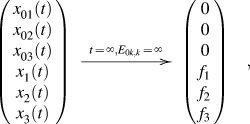
Asymptotically
 $$\left( {\matrix{ {x_{01}^{} (t)} \cr {x_{02}^{} (t)} \cr {x_{03}^{} (t)} \cr {x_1^{} (t)} \cr {x_2^{} (t)} \cr {x_3^{} (t)} \cr } } \right)\buildrel {t \,=\, \infty ,E_{0k,k} \,=\, \infty } \over {\hscale380%\longrightarrow} \left( {\matrix{ 0 \cr 0 \cr 0 \cr {f_1 } \cr {f_2 } \cr {f_3 } \cr } } \right)\quad,$$
where  $E_{0k,k}^{}$ denotes progress function of the transition 0k → k. Phase k saturates at the level f k equal to fraction of the corresponding amorphous species 0k. This corresponds to the concept of crystallization with limited amount of crystallizable amorphous phase.Reference Misztal-Faraj and Ziabicki18
III. EXAMPLE CALCULATIONS
Effects of plate thickness on the kinetics of nucleation, global transition rates, and the resulting phase composition are discussed. The example material considered is the isotactic polypropylene discussed in Refs. Reference Ziabicki and Misztal-Faraj1, Reference Sajkiewicz, Gradys, Ziabicki and Misztal-Faraj8, and Reference Misztal-Faraj and Ziabicki18. Material characteristics collected in Table I correspond to the reference solid (k = ∞, infinite plate thickness). Properties of solids with finite plate thicknesses are calculated.
It should be noted that material characteristics appearing in the model are not unique. This is illustrated in Table I showing ranges of activation energies, E D, and interface tensions σe measured by various authors. The differences may be caused by molecular structure of the polymer (average molecular mass, polydispersity), impurities, thermal and mechanical history of the sample, measuring techniques, etc. Therefore, our analysis is aimed at qualitative or semiquantitative features of plate-like crystallization rather than providing exact quantitative material data.
Numerical simulation results presented in Figs. 5–21 involve activation energy E D = 70 kJ/mol and interface tension, σe = 1.22·10−5 J/cm2.
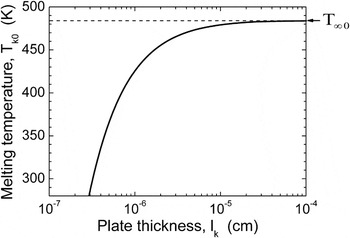
Figure 5 presents melting temperatures of plate-like solids,  $T_{k0}$, as functions of plate thickness, l k. In the range of plates thinner than 10−6 cm doubling of l k causes increase of melting temperatures by several decades. Melting temperature of thick plates (l k > 10−5 cm) is nearly insensitive to plate thickness. Asymptotically, equilibrium transition temperature T ∞0 for infinitely thick plates is obtained.
Melting temperature of plate-like crystals with constant thickness.

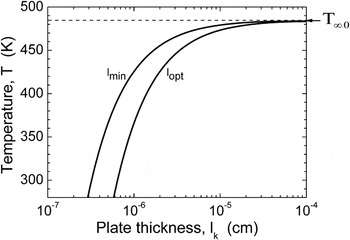
Figure 6 presents critical free enthalpy,  $\Delta G_{0k}^* /kT$, for primary plate-like nucleation as a function of plate thickness, l k. At a constant temperature, an increase of plate thickness from l min (corresponding to melting temperature, T k0) makes the potential barrier go down from infinity to a minimum at the optimum thickness, l opt = 2l min [Eq. (15)]. Further increase of thickness causes increase of the barrier. Both thickness characteristics, l opt and l min, increase with increasing temperature (Fig. 7).
Critical free enthalpy,  $\Delta G_{0k}^* /kT$, as a function of plate thickness, l k, for plate-like nucleation. Crystallization temperatures indicated.

Temperature dependence of the thickness characteristics l min and l opt for primary plate-like nucleation.

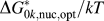
 $\Delta G_{{\rm{0}}k{\rm{,nuc,opt}}}^{\rm{*}} $ provides optimum conditions for primary nucleation. Temperature dependence of this characteristic is shown in Fig. 8. The optimum free enthalpy increases with increasing temperature and approaches infinity at equilibrium melting temperature, T ∞0.
Minimum value of the critical free enthalpy 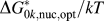 $\Delta G_{{\rm{0}}k{\rm{,nuc,opt}}}^{\rm{*}} {\rm{/}}kT$ as a function of temperature.

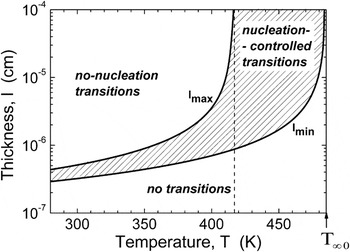
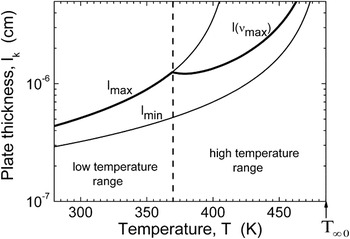
Figure 9 presents a map of nucleation behavior in the “plate-thickness–temperature” space. Minimum plate thickness, l min (T), corresponds to the situation when the total free enthalpy (including surface and bulk energies) is equal to zero [Eq. (16)]. This condition determines melting temperature of the kth species, T k0. The minimum thickness increases with increasing temperature and approaches infinity at T = T ∞0.
Characteristic thickness values as functions of temperature.

The upper value of plate thickness, l max [Eq. (17)], corresponds to bounds of the nucleation theory. In the range of thick plates, l(T) > l max(T), all molecular (atomic) clusters behave like nuclei and can grow to macroscopic dimensions. For the maximum plate thickness, l max, the critical cluster volume is equal to two single units [Eq. (17)]. The situations typical for nucleation-free crystallization include very deep undercooling and crystallization in external potential fields.
Nucleation-controlled crystallization is confined to the plate thickness range l min (T) < l k(T) ≤ l max(T). The maximum thickness increases with temperature and approaches infinity at  $T_{\max } = T_{0\infty } \left[ {1 + \left( {{\textstyle{{\sqrt 2 {\rm{\sigma }}_s } \over {a_0 \Delta h_{0\infty } }}}} \right)} \right]$.
The following analysis of the kinetics of plate-like crystallization will be limited to the range of nucleation-controlled transitions. Therefore, in Fig. 10, critical free enthalpy,  $\Delta G_{0k}^* /kT$ providing potential barrier for nucleation is truncated on the side of high l k as related to nucleation-free mechanism.
Critical free enthalpy,  $\Delta G_{0k}^* /kT$, as a function of plate thickness, l k for primary plate-like nucleation. Dash line indicates l max limit. Crystallization temperatures indicated.

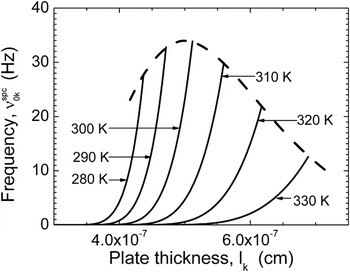
The frequency  ${\rm{\nu }}_{0k}^{{\rm{spc}}}$ involving primary sporadic nucleation and growth [Eq. (35)] is a measure of global transition rate. Isothermal frequency of crystallization from the amorphous phase into plate-like solids is presented in Fig. 11. In the range of low temperatures (280–330 K) the frequency monotonically increases with plate thickness reaching highest values at l = l max. In higher temperatures (Fig. 12), isothermal crystallization frequencies pass through maxima and then decrease with increasing plate thickness l k.
Isothermal frequency of isolated amorphous–solid transitions. Crystallization temperatures indicated. The limit l k = l max(T) at the truncation is represented by dashed line.

Isothermal frequency of isolated amorphous–solid transitions. Crystallization temperatures indicated. The limit l k = l max(T) at the truncation is represented by dashed line.

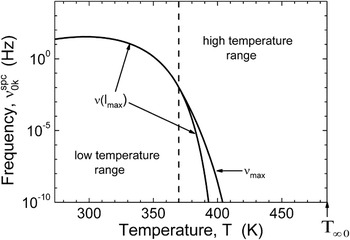
Figure 13 presents two special values of crystallization frequency,  ${\rm{\nu }}_{0k}^{{\rm{spc}}}$. ν[l max(T)] presents the frequency corresponding to maximum plate thickness on the boundary of the nucleation theory. νmax(T) is obtained directly by differentiating the function
 ${\rm{\nu }}_{0k}^{{\rm{spc}}} (T,l_k )$with respect to plate thickness, l k. Vertical line separates the low temperature region where maximum frequency is achieved for l k = l max(T) from the high temperature region with maximum frequency νmax(T). For example, for material characteristics from Table I, maximum crystallization frequency is 34 per s at T = 297 K and l k = 5.0 × 10⁻⁷ cm. With increasing temperature, the maximum frequency decreases. Above T = 390 K, νmax(T) drops down below 10−6 per s and hardly contributes to sporadically nucleated crystallization kinetics.

Figure 14 shows thickness of plate-like crystals with highest frequency of creation l(νmax). Two temperature regions are separated by a vertical line. In the low temperature region (see Fig. 11, T ∞0 − T > 140 K), maximum frequency corresponds to l k = l max(T). Thick plate-like crystals are created faster than thinner ones. In the high temperature region (T ∞0 − T < 140 K), the characteristic l(νmax) moves toward the thermodynamic limit, l min(T). In this region, crystallization frequency passes through a maximum, l(νmax).
A map of nucleation behavior for plate-like crystallization. l min(T)—minimum plate thickness corresponding to melting temperature T k0 [Eq. (16)], l max(T)—maximum plate thickness at the transition from nucleation-controlled to no nucleation transition regime, and l(νmax)—plate thickness corresponding to maximum crystallization rate. A vertical line divides low and high temperature regions.

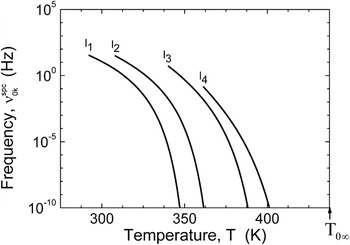
Isothermal transition rates for plates of different thicknesses, l k, are compared in Fig. 15. Creation of plates of a given thickness, l k, starts at a temperature T(l max), where plate thickness corresponds to the boundary of the nucleation mechanism [see Eq. (17)]. With increasing temperature, crystallization frequency  ${\rm{\nu }}_{0k}^{{\rm{spc}}} (T)$ drops down to very small values and disappears at the melting temperature, T k0.
Frequency of isolated isothermal transitions 0 → k versus temperature. Plate thickness: l 1 = 4.8 × 10⁻⁷ cm, l 2 = 5.5 × 10⁻⁷ cm, l 3 = 7.8 × 10⁻⁷ cm, and l 4 = 10.8 × 10⁻⁷ cm.

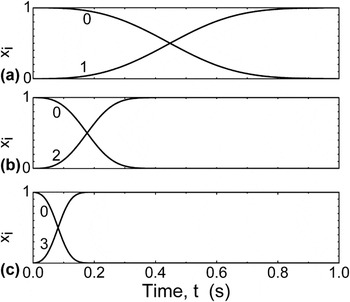
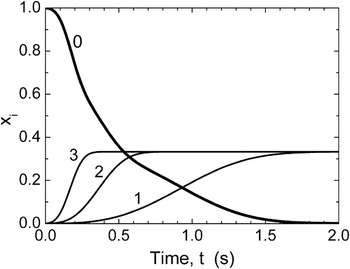
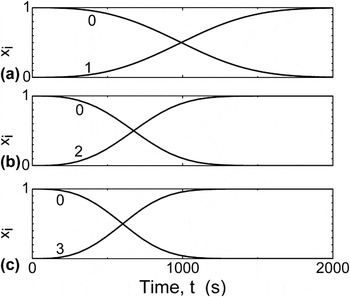
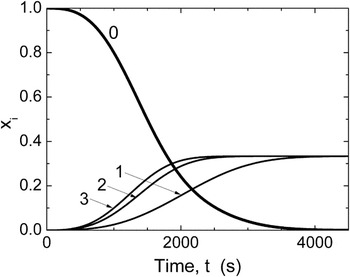
Comparison of the development of phase composition, x k(t), has been based on the sporadic nucleation mechanism [Eqs. (36) and (44)]. Figures 16, 18, and 20 present the phase content development resulting from isolated transitions 0 → k. Figures 17, 19, and 21 concern simultaneous transitions in a system composed of the “mixed” amorphous phase and three different plate-like solids. Plate thicknesses have been chosen in the region close to maximum transition frequency.
Figures 16 and 17 present development of the amorphous solid composition in the region of low temperatures (T = 305 K), where maximum crystallization frequency corresponds to l max. Consequently, creation of thicker plates is faster than that of thinner ones. Saturation of composition for the three selected plates is observed in the period shorter than 1 s.
Isothermal development of phase composition at T = 305 K in isolated two-phase systems. 0—amorphous phase, (a) Transition 0 → 1 (l 1 = 4.6 × 10⁻⁷ cm), (b) Transition 0 → 2 (l 2 = 4.8 × 10⁻⁷ cm), (c) Transition 0 → 3 (l 3 = 5.0 × 10⁻⁷ cm).

Simultaneous isothermal development of phase composition at T = 305 K for a system containing three plate-like solids. 0—sum of unconverted amorphous phases, 1, 2, 3—plate-like solids. Plate thickness: l 1 = 4.6 × 10⁻⁷ cm, l 2 = 4.8 × 10⁻⁷ cm, l 3 = 5.0 × 10⁻⁷ cm, amorphous fractions assumed f 1 = f 2 = f 3 = 1/3.

According to the model, simultaneous creation of several different plate-like phases requires considering amorphous phase 0 as consisting of a corresponding number of different amorphous components “01”, “02”, and “03.” A kth component contains tetragonal parallelepipeds of height l k and in the process of 0k → k transition is converted into plate-like crystals of thickness l k.
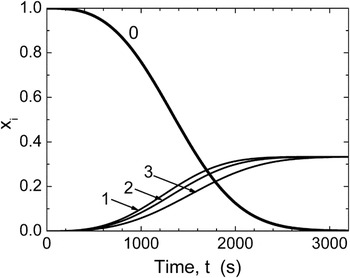
For the sake of simplicity, equal fractions of the amorphous components are assumed, f 1 = f 2 = ⋅ ⋅ ⋅ = f n. Consequently, in Figs. 17, 19, and 21 asymptotic fractions of the three plate-like solids approach the level x k = f k = 1/3 and the amorphous phases are fully converted.
In the low temperature region, thicker crystal plates are created faster than thinner ones. Comparing Figs. 16 and 17, one finds that simultaneous creation of several plate-like phases is slower because of dilution of the source (amorphous) phase (f k < 1).
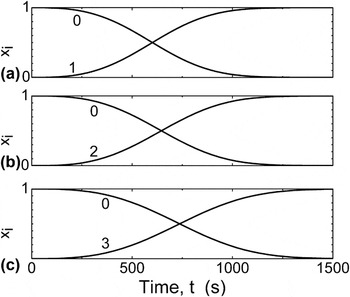
Figures 18–21 present development of phase composition in the high temperature region (T = 375 K) where there is no correspondence between maximum plate thickness, l max, and maximum transition frequency, νmax.
Three plates thinner than those created with maximum frequency were selected: At T = 375 K, l(νmax) is about 1.22 × 10⁻⁶ cm, The thicknesses selected for the kinetic computations are 1.0 × 10⁻⁶, 1.1 × 10⁻⁶, and 1.2 × 10⁻⁶ cm. Development of phase composition in isolated transitions 0k → k is shown in Fig. 18 and that in a process of three simultaneous transitions in Fig. 19. It is evident that thicker plates crystallize faster than thinner ones.
Isothermal development of phase composition at T = 375 K in isolated two phase systems in case of l k < l(νmax). 0—amorphous phase, (a) Transition 0 → 1 (l 1 = 1.0 × 10⁻⁶ cm), (b) Transition 0 → 2 (l 2 = 1.1 × 10⁻⁶ cm), (c) Transition 0 → 3 (l 3 = 1.2 × 10⁻⁶ cm).

Simultaneous isothermal development of phase composition at T = 375 K for a system containing three plate-like solids in case of l k < l(νmax). 0—sum of unconverted amorphous phases, 1, 2, 3—plate-like solids. Plate thickness: l 1 = 1.0 × 10⁻⁶ cm, l 2 = 1.1 × 10⁻⁶ cm, l 3 = 1.2 × 10⁻⁶ cm, amorphous fractions assumed f 1 = f 2 = f 3 = 1/3.

Development of phase composition in the same temperature (375 K) in a set of plates thicker than l(νmax) are presented in Figs. 20 and 21. The order of creation rates is reversed: thin plates are created faster than thick ones.
Isothermal development of phase composition at 375 K in isolated two phase systems in case of l k > l(νmax). 0—amorphous phase, (a) Transition 0 → 1 (l 1 = 1.23 × 10⁻⁶ cm), (b) Transition 0 → 2 (l 2 = 1.32 × 10⁻⁶ cm), (c) Transition 0 → 3 (l 3 = 1.40 × 10⁻⁶ cm).

Simultaneous isothermal development of phase composition at 375 K for a system containing three plate-like solids with different thicknesses l k > l(νmax). 0—amorphous phase, 1—crystals with l 1 = 1.23 × 10⁻⁶ cm, 2—l 2 = 1.32 × 10⁻⁶ cm, 3—l 3 = 1.40 × 10⁻⁶ cm, amorphous fractions assumed f 1 = f 2 = f 3 = 1/3.

Crystallization at T = 375 K is much slower than that at 305 K.
IV. DISCUSSION
The main aim of this study was description of the crystallization kinetics based on two-dimensional homogeneous nucleation of crystal plates and their planar growth (constant plate thickness). The amorphous phase was assumed to consist of kinetic units with constant width a 0 and different heights l k, giving rise to plate-like crystals of predetermined thickness. Enthalpy of a plate-like crystal phase characterized by finite thickness l k is higher than that of an ideal three-dimensional solid phase (l k = ∞) treated as a reference. Entropy of plate-like solids is assumed a constant, equal to that of the reference phase.
It was shown that thickness of plate-like crystals created in nucleation-controlled processes is limited. The lower thermodynamic limit  $l_{\min } (T) = - 2{\rm{\sigma }}_e /\Delta g_{0\infty }$ is determined by Gibbs’ free energy of the transition. The upper limit
 $l_{\max } (T) = {\textstyle{{ - 2{\rm{\sigma }}_e a_0 } \over {\sqrt 2 {\rm{\sigma }}_{\rm{s}} + a_0 \Delta g_{0\infty } (T)}}}$ corresponds to the conditions when the critical cluster volume found from the theory of nucleation is equal to two elementary units. Above that limit, all molecular clusters present in the system behave like effective nuclei and are able to grow to macroscopic dimensions. This eliminates sporadic nucleation but does not exclude crystallization involving other mechanisms not covered by the present model.
In each temperature, there is a plate thickness corresponding to highest frequency of the transition. In lower temperature range, maximum crystallization frequency is determined by the nucleation criterion [Eq. (17)]. In Figs. 11 and 12, crystallization frequency,  ${\rm{\nu }}_{0k}^{{\rm{spc}}}$, is plotted versus plate thickness at various temperatures. In the higher temperature range, the frequency functions
 ${\rm{\nu }}_{0k}^{{\rm{spc}}} (l_k ,T)$pass through maxima (Fig. 12). The frequency functions are truncated by the condition l = l max and their terminal points are connected with a dashed line. Figure 13 presents crystallization frequency in the wide range of temperatures. In lower temperatures, the highest frequencies are controlled by the nucleation criterion, νmax = ν(l max). In higher temperatures, maximum crystallization frequency νmax is higher than ν(l max). Consequently, plates thinner than l max are formed faster (Fig. 14). The l(T; νmax) characteristic deviates from the l max(T) and approaches the thermodynamic limit l min(T) [see Eq. (16)]. For a fixed plate thickness, the frequency
 ${\rm{\nu }}_{0k}^{{\rm{spc}}} (l_k ,T)$ decreases with increasing temperature [Fig. (15)]. Significant reduction of
 ${\rm{\nu }}_{0k}^{{\rm{spc}}} (l_k ,T)$ is observed well below the melting temperature, T k0.
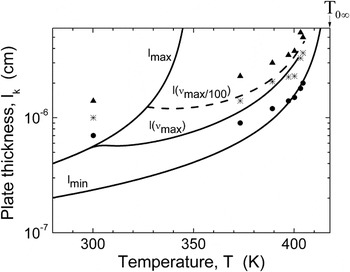
The character of plate thickness effects described by the present model is consistent with experimental data on linear polyethylene.Reference Voigt-Martin and Mandelkern22 Minimum, maximum, and average plate thicknesses increase with increasing crystallization temperature and tend to infinity in a temperature, T ∞0, characteristic of melting infinitely thick crystals. Figure 22 presents plate thickness as a function of temperature. Solid lines represent l min(T), l max(T), and l[νmax(T)] calculated from the model [Eqs. (16) and (17)] with parameters collected in Table II. The dashed line represents thickness of plates characterized by ν = 0.01·νmax which can be treated as a practical limit of the observed distribution of plate thicknesses. Points represent experimental data of polyethylene plates' thickness taken from the paper of Voigt-Martin and Mandelkern.Reference Voigt-Martin and Mandelkern22
Crystalline plate thickness versus temperature on the map of the plate-like crystallization model for linear polyethylene with parameters from Table II. Solid lines: computed l min, l max, l(νmax). Dashed line: computed l(νmax/100) at frequency νmax/100. Points: experimental dataReference Voigt-Martin and Mandelkern22 (solid circles—minimum, stars—average, and solid triangles—maximum thickness).

Material characteristics for linear polyethylene.

The calculated values of l(νmax) can be compared with average experimental thicknesses and l(0.01·νmax) with maximum thicknesses observed in the experiments.
It is evident that experimental data reasonably well fit the thickness range predicted by the model. Only in the low temperature (T = 300 K), three experimental points depart from the predicted range and lie above the l max limit. It should be noted that these points appear in the range where crystallization is not controlled by the nucleation mechanism and are beyond the scope of the present model.
Phase composition developed in isothermal crystallization strongly depends on temperature and plate thickness. Two temperature regimes can be distinguished (Fig. 13). The low temperature region is characterized by overlapping terminal transition frequency, ν(l max), and maximum frequency, νmax. In this range, thick crystals are formed faster than thin ones (Fig. 14). In the high temperature range, thick plates with thickness l min < l k ≤ l(νmax) are created faster than thin ones, while the opposite behavior applies when plate thickness lies in the range l(νmax) ≤ l k ≤ l max (Fig. 14). The above relations can be used to control plate structure of the material.
Development of crystallinity predicted by the present model in α-isotactic polypropylene at T = 396 K is compared with experimental data of Sajkiewicz et al.Reference Sajkiewicz, Gradys, Ziabicki and Misztal-Faraj8 Relative crystallinity x(t)/x(t = ∞) is plotted versus time in Fig. 23. The plate thicknesses selected for the model computations are l 1 = l[νmax(T = 396 K)], l 2 = l − (νmax/2), and l 3 = l + (νmax/2)l 1 corresponds to maximum crystallization frequency, l 2 and l3 are placed on both sides of the frequency distribution function ν(l, T) at ν = 1/2νmax. To obtain good fit with experimental data, the material parameters are chosen from Table I, with  $E_{\rm{D}}^{0k} = 70\;{\rm{kJ/mol}}$ and σe = 6.23 × 10⁻⁶ J/cm2 (Ref. Reference Mark21). The experimental data are reasonable well reproduced in Fig. 23 with the thicknesses of the crystal plates determined by the maximum frequency and the half-width of the frequency distribution.
Relative crystallinity versus time for α-polypropylene at 396 K. The line plot: computed from the model with the parameters from Table I with  $E_{\rm{D}}^{0k} = 70\;{\rm{kJ/mol}}$, σe = 6.23 × 10⁻⁶ J/cm2 (Ref. Reference Mark21), and l 1 = 6.70 × 10⁻⁷ cm, l 2 = 5.49 × 10⁻⁷ cm, l 3 = 8.61 × 10⁻⁷ cm. Points: experimental data for α-polypropylene.Reference Sajkiewicz, Gradys, Ziabicki and Misztal-Faraj8

The model shows that higher temperatures lead to longer crystallization times when sporadic nucleation is involved. To speed up the transition, an addition of predetermined nuclei is suggested.Reference Misztal-Faraj and Ziabicki2, Reference Misztal-Faraj and Ziabicki18
ACKNOWLEDGMENT
The author acknowledges helpful discussions held with Professor A. Ziabicki and Professor L. Jarecki.