INTRODUCTION
Marine fish usually have high mortality rates during the early life stages (Bailey & Houde, Reference Bailey and Houde1989; Jones, Reference Jones1990). Faster growth and larger body size increases the survival rates during early life stages (Hovenkamp, Reference Hovenkamp1992; Takasuka et al., Reference Takasuka, Aoki and Mitani2003; Takahashi & Watanabe, Reference Takahashi and Watanabe2004). Individual fish that survive the early life stages are potential candidates for the spawning stock. In order to ensure ecologically and economically sustainable fishing, it is essential to monitor age and growth rates of young of the year (YOY) fish species.
Otolith microstructure analysis is a powerful technique that provides information about the age and growth history in marine fish (Folkvord et al., Reference Folkvord, Blom, Johannessen and Moksness2000, Reference Folkvord, Johannessen and Moksness2004; Xie et al., Reference Xie, Watanabe, Saruwatari, Masuda, Yamashita, Sassa and Konishi2005). Estimating the age of individual fish larvae using otolith increments, deposited owing to alternating periods of rapid and slow growth (Williams & Bedford, Reference Williams, Bedford and Bagenal1974), has become a widely used tool in early life history (Villanueva & Molí, Reference Villanueva and Molí1997; Fox et al., Reference Fox, Folkvord and Geffen2003).
The annular seabream, Diplodus annularis (Linnaeus, 1758) is a commercially important demersal marine fish species inhabiting various types of sea bottoms, especially sand and seagrass beds, at depths ranging from 0 to 50 m (Pajuelo & Lorenzo, Reference Pajuelo and Lorenzo2002). This species is distributed along the European coasts of the Atlantic Ocean, from the Bay of Biscay to Gibraltar, and around Madeira and the Canary Islands. It is also present in the Mediterranean, Black and Azov Seas (Bauchot & Hureau, Reference Bauchot, Hureau, Hureau, Karrer, Post and Saldanha1990; Harmelin-Vivien et al., Reference Harmelin-Vivien, Harmelin and Leboulleux1995).
The different spawning periods of D. annularis, overlap in the Mediterranean, Adriatic and Aegean Seas. The spawning season of D. annularis occurs from the end of April until the end of August, with a peak in the first part of May in the eastern middle Adriatic Sea (Matić-Skoko et al., Reference Matić-Skoko, Kraljević, Dulčić and Jardas2007). There are similarities in the spawning season of this species with the studies of Bauchot & Hureau (Reference Bauchot, Hureau, Whitehead, Bauchot, Hureau, Nielsen and Tortonese1986) and of Kinacigil & Akyol (Reference Kinacigil and Akyol2001) in the Atlantic, western Mediterranean and Izmir Bay, Aegean Sea. Mouine et al. (Reference Mouine, Francour, Ktari and Chakroun-Marzouk2012) reported that annular seabream is a summer spawner in the Gulf of Tunis.
Many studies are available on the adult populations of the D. annularis focusing on the distribution, age, growth, mortality, morphological characteristics, sexuality, reproduction and feeding habits (Salekhova, Reference Salekhova1961; Quero & Gueguen, Reference Quero and Gueguen1978; Rodríguez & Rodríguez, Reference Rodríguez and Rodríguez1984; Wassef, Reference Wassef1985; Kraljevic & Jug-Dujakovic, Reference Kraljevic and Jug-Dujakovic1988; García-Rubies & Macpherson, Reference García-Rubies and Macpherson1995; Macpherson et al., Reference Macpherson, Biagi, Francour, García-Rubíes, Harmelin, Harmelin-Vivien, Jouvenel, Planes, Vigliola and Tunesi1997; Matić-Skoko et al., Reference Matić-Skoko, Kraljević, Dulčić and Jardas2007). However, very few studies are available on the larval and juvenile stages of this species (Gordoa & Moli, Reference Gordoa and Moli1997; Pajuelo & Lorenzo, Reference Pajuelo and Lorenzo2002). Although, daily growth rates have been conducted for D. vulgaris, D. sargus and D. puntazzo (Vigliola, Reference Vigliola1997; Villanueva & Molí, Reference Villanueva and Molí1997), no study on the daily growth rate has been conducted for their congener D. annularis.
The aim of this study was to determine the daily growth rates and hatching periodicity of D. annularis from Çanakkale, Turkey, by using otolith microstructure. Changes in the somatic growth rates at different seasons were also estimated.
MATERIALS AND METHODS
Study area and sampling
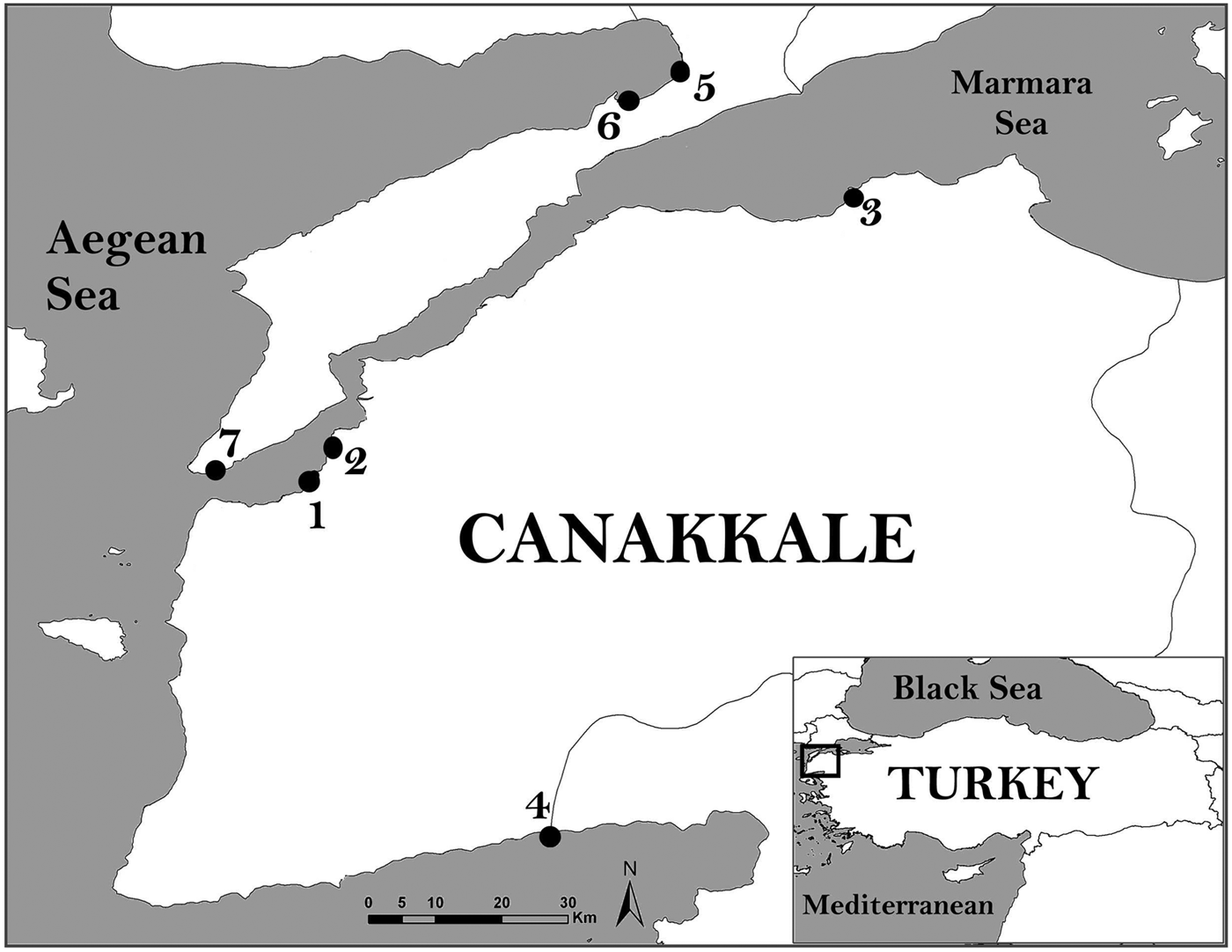
This study was carried out in the shallow waters (0–2 m) of Çanakkale, surrounded by the north Aegean Sea, Çanakkale Strait and Sea of Marmara (Figure 1). Samples were collected at seven sites with a beach seine with a total wing length of 32 m, a height of 2 m and a 2 m long bag with 13 mm mesh size at wing and 5 mm mesh at bag. Two hauls were made parallel to the shore, haphazardly and non-overlapping.
Map of Çanakkale coastline showing sampling stations of young of the year Diplodus annularis.

The surface water temperature was measured with a Hach Lange HQ40d probe during samplings. Monthly average sea surface water temperatures for the Çanakkale shallow waters during the study were recorded between 11.5oC and 29.6oC. The minimum and maximum surface water temperature values recorded along the sampled sites were 9.6oC and 32.4oC.
Laboratory procedures
Fish were killed with an overdose of quinaldine and stored in 70% alcohol. Total length (L T) of the collected YOY D. annularis was measured to the nearest 0.1 mm and weighed to the nearest 0.01 g. Sagittal otoliths (left and right) were removed, cleaned of adhering tissue, dried and stored in clean micro vials. From each pair, one otolith was randomly selected and mounted on a glass slide with a thermoplastic cement. Each otolith was ground with a series of abrasive papers of decreasing roughness, from 12 µm to 9 µm to 3 µm, and polished with 0.3 µm alumina paste on a polishing cloth until daily rings were discernible from the centre to the edge (Miller & Storck, Reference Miller and Storck1982; Secor et al., Reference Secor, Dean and Laban1991; Jones, Reference Jones, Stevenson and Campana1992; Hayes, Reference Hayes1995). The process was checked frequently under a light microscope to avoid over polishing the centre. Counts of rings in each otolith were blind-read; the information about fish length and date of capture was withheld from the reader. A light microscope with objective lenses with nominal magnifications of 20 ×, 40× and 100× were used for the counts.
Data analysis
Age was determined by counting the number of increments from the nucleus to the outer edge. The daily rings were counted from the nucleus to the dorso-posterior axis, although the readings were not always countable on a linear axis. Growth increment counts between left and right otoliths were compared by a paired t-test. An age–length key was generated to convert larger length samples from the population into ages.
Daily growth rates (mm d−1) were calculated from the slopes of a linear regression based on the following equation:
 $${L_T} = a + b \times {\rm age} \lpar {\rm d}\rpar$$
where, L T is the total fish length (mm); a is the fish size at age 0; b is the somatic growth rate of YOY D. annularis.
In order to determine seasonal changes of somatic growth rates, aged fish were grouped into cohorts based on the hatch dates. Differences in growth rates between seasons were tested using analysis of covariance (ANCOVA). In all data analyses, statistical significance level (α) was accepted as 0.05.
Hatch date distributions were back-calculated by subtracting the estimated age from the date of capture.
RESULTS
A total of 348 otoliths were processed for daily ring counts, however, 49 pairs of sagittal otoliths were over ground or cracked during the process. Thus, 299 otoliths obtained from YOY D. annularis that ranged between 20 and 85 mm L T were used in the analyses.
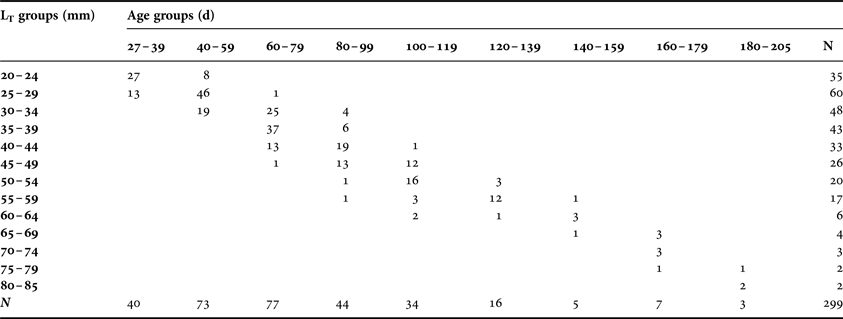
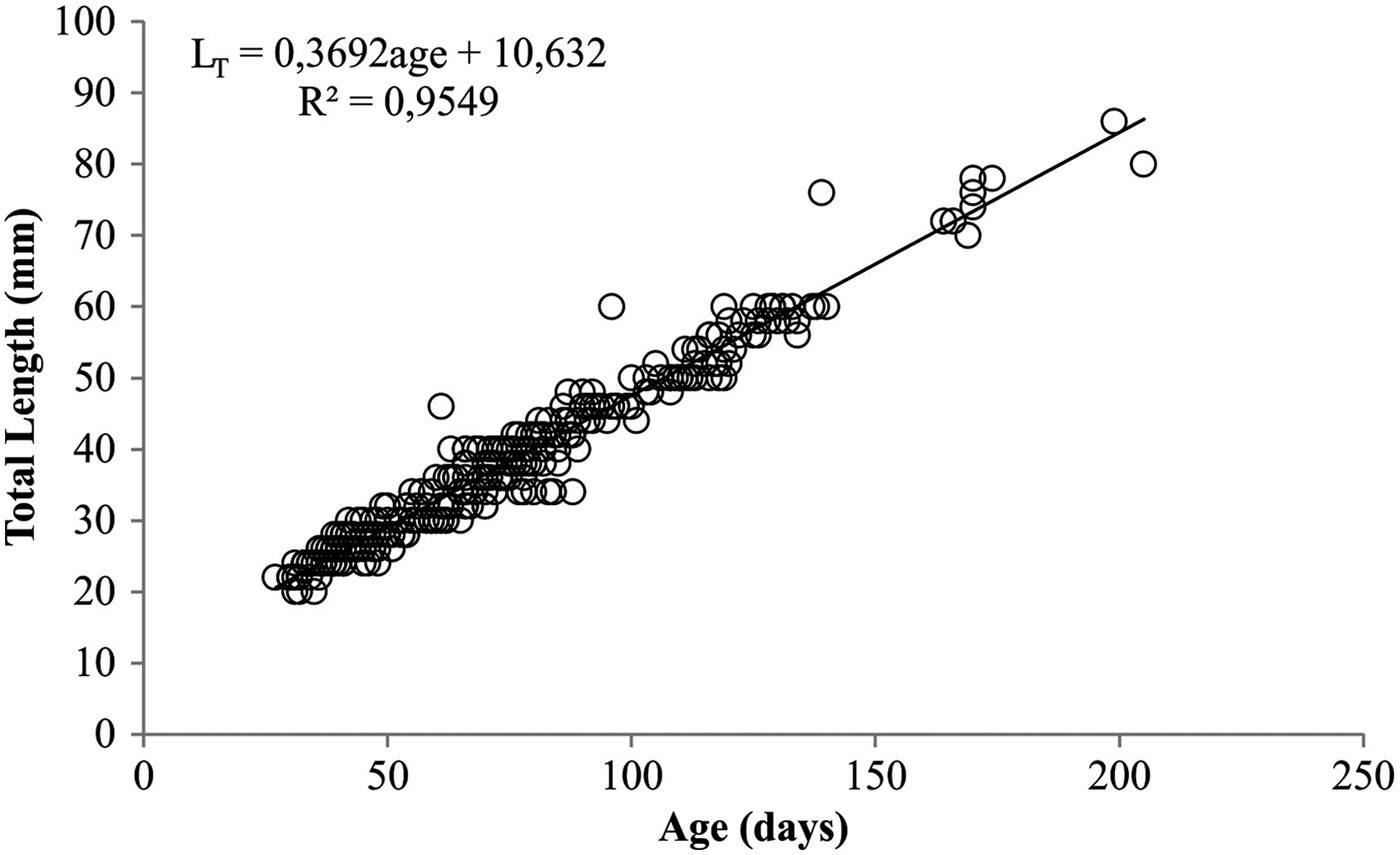
Since no significant differences in increment counts were found between left and right otoliths (paired t-test, N = 50, P = 0.5784), only one was randomly selected for daily age estimation. The estimated age obtained from the increment counts of the otoliths ranged between 27 and 205 d (Table 1; Figure 2). The largest individual (85 mm L T) was estimated to be 197 d old, whereas the smallest measured individual (20 mm L T) was estimated to be 30 d old. The age group 60–79 d (25–49 mm) was the dominant age group (25.8%). A general decline in numbers was apparent as the fish got older (Table 1).
Polished sagittal otolith of 26 mm L T young of the year Diplodus annularis aged 51 d: (A) growth increment counts were made from N (nucleus) to dorso-anterior axis (arrow); (B) N indicates nucleus.
Age–length key for young of the year Diplodus annularis. N, total number of specimens per LT/age groups.
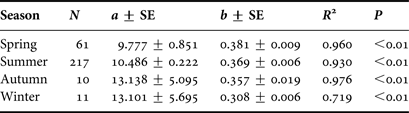
The daily growth rate of YOY D. annularis was estimated by fitting a linear regression to the entire length–age data set (Figure 3). Length–age regression analysis resulted in somatic growth rates of 0.369 mm d−1. To test for seasonal changes in the growth rate of YOY D. annularis, linear regressions were fitted age–length data for larvae hatched during each of the four seasons as defined by the hatch distribution.
Age–length relationship estimated for young of the year Diplodus annularis collected in the shallow waters of Çanakkale, Turkey.
According to the length–age regression analysis, maximum daily growth rates were found 0.381 mm d−1 in the spring hatched cohort and minimum values of 0.308 mm d−1 were seen in the winter hatched cohort (Table 2). ANCOVA indicated that there were no significant differences in either slope or adjusted mean among the equations (F = 0.7497, df = 3, P = 0.5233).
Parameters of the length-at-age linear relationships for different seasons of young of the year Diplodus annularis in the Canakkale shallow waters, Turkey. N is the number of speciemens, a is the y-intercept, b is the slope of the regression line, R 2 is the coefficient of determination and SE is the standard error.
Hatching time of the YOY D. annularis was estimated to occur between March and September with relatively higher hatching frequency in June (Figure 4).
Hatch date monthly distributions of young of the year Diplodus annularis back-calculated from age estimates and date of capture with mean surface water temperature. The line corresponds to temperature and the boxes to numbers of larvae hatched.
DISCUSSION
Validation study of otolith rings is a requirement for age and growth studies that should be applied for all ages of each species (Beamish & McFarlane, Reference Beamish and McFarlane1983). No validation study on otolith daily ring formation has been conducted for D. annularis, but studies for its congeners D. vulgaris, D. puntazzo and D. sargus have shown that the increment formations represent daily rings (Vigliola, Reference Vigliola1997; Villanueva & Molí, Reference Villanueva and Molí1997). Each daily increment formation on the D. annularis otolith was assumed to correspond to one day.
The sagittal otoliths of the YOY D. annularis showed clearly identifiable opaque and hyaline bands with regular growth increment patterns (Figure 2). The age groups 40–59 d and 60–79 d had relatively higher frequency (24.4% and 25.8%, respectively) than the older age groups (Table 1). The decline in the number of the older fish might not only be due to mortality but also partially due to movements of the larger size fish to deeper waters.
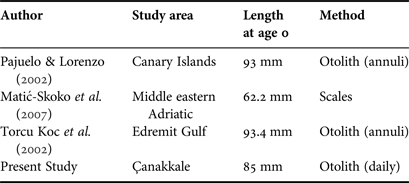
The average somatic growth rate of YOY D. annularis was estimated to be 0.369 mm d−1. Since no data of the YOY D. annularis growth rate were available for comparison with this study, data on adult D. annularis average length at the first year of life (age 0) from different regions were used (Table 3). The length of D. annularis at the first year of life that was estimated for the juvenile stage from Çanakkale was relatively similar to the estimated values for the Canary Islands (Pajuelo & Lorenzo, Reference Pajuelo and Lorenzo2002) and the Edremit Gulf (Torcu Koc et al., Reference Torcu Koc, Cakir and Aka2002). The growth results from Çanakkale differed from those of the middle eastern Adriatic (Matić-Skoko et al., Reference Matić-Skoko, Kraljević, Dulčić and Jardas2007) probably due to the different ageing methods used (scales) rather than a geographical influence.
Total length of 0 yr old* Diplodus annularis in different regions, from the period 2002–2007.
*, maximum age was estimated as 205 d.
Growth rates might change according to environmental conditions (temperature, salinity and food availability) in the different habitats (Wootton, Reference Wootton1990). Our findings showed that the maximum growth rates of YOY D. annularis were observed in spring (relatively high temperature), whereas the minimum values were determined in winter (relatively low temperature). However, ANCOVA (F = 0.7497, df = 3, P = 0.5233) indicated that the observed differences between seasons in this study were not statistically significant.
Hatching of the YOY D. annularis occurred between March and September, with relatively higher hatching frequency in June. The maximum hatching frequency in D. annularis was observed in the summer where temperature was the highest. Mouine et al. (Reference Mouine, Francour, Ktari and Chakroun-Marzouk2012) reported that the annular seabream is a summer spawner. Temperature is the most important environmental factor driving reproductive success in fish (Wootton, Reference Wootton1990). The reproductive period for this species has been reported to be between April and May in Izmir Bay, Aegean Sea (Metin & Akyol, Reference Metin and Akyol2003), in the spring season for Edremit Bay (Torcu Koc et al., Reference Torcu Koc, Cakir and Aka2002) and from the end of April until September, with a peak in May, for the eastern Adriatic Sea (Matić-Skoko et al., Reference Matić-Skoko, Kraljević, Dulčić and Jardas2007). The differences in the spawning period reported in different studies might be related to the geographical area with temperature differences.
The present study provides some insight on the daily age and growth rates of the early life stage of YOY D. annularis in Çanakkale shallow waters. However, these results are based on the assumption that the otolith rings were formed on a daily basis. Further studies focusing on the age and growth of D. annularis should take this into account to ensure accurate age and growth rate estimations.
ACKNOWLEDGEMENT
The authors would like to thank A. Oztekin for logistical support in the field.
FINANCIAL SUPPORT
This study was funded by The Scientific and Technological Research Council of Turkey (TUBITAK project number: 106T123).