The nineteenth century invention of representative government transformed our understanding of democracy.Footnote 1 It became possible to envision government “by the people” in nation-states, rather than confined to small, direct assemblies. Competitive elections could select representative policymakers and induce them to govern responsively. Through both theoretical and empirical analysis political science has devoted great energy to understanding the processes that connect citizens and policymakers in representative democracies. A perennial question for theory and practice has been which electoral institutions create this connection most successfully.
A more specific form of this very large question has juxtaposed two of the most common forms of election rules—single member district “majoritarian” rules and proportional representation rules. These investigations have clarified many aspects of the consequences of election rules and opened the way to understanding many more. One of those consequences has been the fit between the ideological preferences of the citizens and the ideological commitments of their governments. Democratic theory assumes that successful democracy will create close ideological congruence. Until recently a relatively clear-cut consensus had emerged as to which type of election rules generated closer ideological congruence. But, as is not unusual in the world of politics, the clearly emergent pattern has become less clear, forcing a reconsideration of underlying theory. The emergence of a more encompassing theory, one that takes account of critical contextual conditions in making revised explanations and predictions, is the basis of my Address today.
When Theories Fail: On the Importance of Local Context in Applying General Theories
A common frustration in political science research arises when our general theories or broad generalizations turn out to disappear over time or fail when we attempt to apply them in another country or even region. We have a broad pattern of association, reliably observed and grounded, maybe even supported by a field experiment, plausibly explained with reasonably general theories, seemingly applicable to a variety of situations. Then it seems to fade away over time or doesn't work as we move across nations, or even regions within a nation. This is disconcerting for a variety of reasons. It undermines our confidence in our observations, in our theories, even our type of explanation. Moreover, it limits our ability to perform in that rare, but exciting, opportunity to give advice to policy makers, as have many political scientists in dealing with the elites designing new legislative bodies after the Arab spring.
Of course, this is frustrating. And it leads some of us to despair of developing general theories in political science. But I want to offer a take on this problem that is more optimistic than referring to the inherent unpredictability of human affairs or the commitment to purely local and temporary explanations.
My “take” is that we can get a lot of leverage on this problem by looking for aspects of the local context that shape the working of our theories. A good reason for building our generalizations and explanations on well-grounded theory is because the theory itself directs our attention to features of the context that change the working of relationships. Of course, there is no substitute, especially for givers of advice, for deep knowledge of local conditions. But there are vast numbers of unique features in any situation; the trick is to know which ones are relevant in a new setting, or which ones have changed as we track our relationships over time. In principle, and sometimes in practice, we can then restate our theoretical expectations as conditional on specific contextual features. That is, those features are integrated into the theory itself, allowing more specific context-conditioned expectations.
I want to offer you an example of this in my own work, but let me first illustrate the general principle with one of the best known theories in comparative politics: Duverger's Law.Footnote 2 Duverger's Law, of course, asserts that a particular type of election rule, legislative elections by single-member district (SMD), first-past-the-post rules, (the ones we are familiar with in the US, Canada, and Britain), is linked to two-party systems. Another very common family of election rules, proportional representation (PR), is strongly associated with multiparty systems. Depending on just how we measure “two-party systems,” Duverger's Law does have some supportive evidence as we look at election rules and legislative party configurations in the experienced democracies across countries and time. An example is the introduction of PR in New Zealand, which was followed by a change from legislatures dominated by two political parties to ones with multiple parties and coalition governments. Recent work by Rob Moser and Ethan Scheiner introduces lovely additional implications by showing fewer parties competing in the single member district parts of legislatures in mixed systems such as Germany than in the PR part of the same legislatures.Footnote 3
Yet there are lots of exceptions and the elections in newer democracies, especially those with larger numbers of independent non-party candidates, seem particularly different from the familiar Duverger pattern.
Moser and Scheiner draw particularly on Gary Cox's theoretical explication of the logic of Duverger to identify the features of local contexts that would be expected to deviate from Duverger's Law.Footnote 4 (Brian Crisp and his colleagues make a similar contextual argument in their cross-national analysis of wasted votes.)Footnote 5 Duverger himself identified two theoretical processes, what he called a “mechanical effect” of the election laws, which advantaged locally larger parties and underrepresented smaller ones that failed to carry individual districts, and a “psychological effect,” which pointed to strategic behavior of voters in defecting from parties whom they liked but whom were expected to be unable to win.Footnote 6 The interaction of these two effects leads to expectations about the number of competing parties (at the district level at least). Cox's analysis points out that the “strategic effect” element in Duverger's Law depends on (among other things) widely shared information and expectations about parties' chances of victory. (It also depends on voters having well-developed preference orderings among parties and voters being oriented to immediate electoral victory, not long term position-building.)Footnote 7 These assumptions about information and time frame also apply to party elites and financial supporters.
A clear implication of Cox's explication of Duverger's Law is that we should not expect to find fewer parties competing in SMD election districts in the conditions of new democracies without electoral experience, especially if elections are not dominated by party candidates. Moser and Scheiner find exactly that pattern in contrasting numbers of parties competing in the SMD versus PR parts of legislative elections in new versus established democracies.Footnote 8 Crisp et al. find something similar examining wasted votes.Footnote 9 Expanding our empirical predictions to take account of local contexts (in this case, lack of common information about the prospects of the various new parties in a new democracy), we can explain when and where we expect Duverger's Law to follow and when and where we do not.
Ideological Congruence
My own experience with the need to take account of local context also involves a consequence of election laws—the representativeness of national governments in parliamentary systems, and especially the form of representation that we call ideological congruence.
Ideological congruence involves the fit between the preferences of the citizens and the committed policy positions of their representatives. Normative theorizing about democracy implies that competitive elections should systematically create a close connection between citizens and their policymakers.Footnote 10 Because of its special normative status as the position that can defeat any other in a straight vote, the position of the median citizen has particular significance. Good ideological congruence implies minimizing this distance.Footnote 11
Measurement
Of course, there are various complexities here. One of them is that the normative assumption about the preferred role of the median voter, not to mention the empirical investigation of ideological congruence, depends on whether or not we have effectively a one-dimensional issue space. Another complexity involves measurement: how to compare the positions of the citizens, even the median citizen, to the committed policy positions of the representatives, who are, of course, far more sophisticated and involved than the average citizen. Various scholars investigating this problem have taken a variety of approaches to comparing citizens and representatives.
I'll spare you a lot of details about this and concentrate on two of the most widely used approaches. One comes out of the famous “manifesto” project, which codes the policy positions taken by political parties in their formal statements during election campaigns.Footnote 12 (Manifestos correspond to what Americans call the “party platforms.”) The percentages of the manifestos devoted to different policy positions can be used to estimate the positions of the parties on a “left-right” scale that has similar meanings in different countries.Footnote 13 With the aid of some heroic assumptions, the party choices of voters can be used to estimate the citizen median on that same left-right scale.Footnote 14
Another popular approach is to use the perceptions of citizens to rate the average perceived positions of the political parties (and the governments that are composed of them) on a left-right scale and compare these to the citizens' rating of their own position. The wonderful Comparative Study of Electoral Systems project has made these ratings available across many countries in elections of the last 15 years.Footnote 15
Each of these approaches (and some others) has various comparative advantages and disadvantages—and its strong advocates and critics. In my own work I've avoided taking a strong position on this (easy for me as most of my earlier work used yet a different approach comparing expert placement of parties to citizen self-placements),Footnote 16 but rather have tried to explain ideological congruence and generate similar results using each approach.
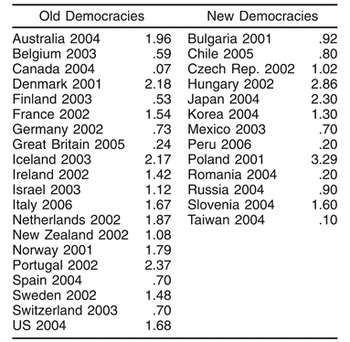
Table 1 shows some ideological congruence results from some countries covered by the CSES Module 2 research program. These are expressed as distance on a ten-point scale. The number is the distance between the median voter and the government; the larger the number, the less ideological congruence. As the median voter usually places himself or herself towards the center, the maximum possible value is usually around 5. In these countries they range from a miniscule .07 in Canada and .10 in Taiwan; the citizens on average place the parties in the government at nearly the same position as they place themselves. In Australia, Denmark, Iceland, Portugal and Japan, on the other hand, they place the government parties around two full scale points away, and in Hungary and Poland around three points (60 percent of the possible maximum) away. So, while all of these countries are identified as electoral democracies by Freedom House, and none of the governments are as far away as possible, there is a lot of variation in ideological congruence—which is what we would like to explain.
Ideological (in)congruence: Distance between the median citizen and the government in old and new democracies (10-point scale)

Source: Comparative Study of Electoral Systems, Module 2.
Theoretical Expectations
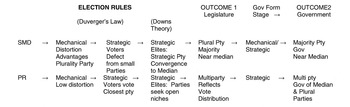
With respect to the consequences of election laws for ideological congruence, we have some theoretical expectations, at least for parliamentary democracies (on which I am going to concentrate here). (These were originally formulated, as far as I know, by John Huber and me in an article in 1994,Footnote 17 more elegantly developed by Gary Cox in Making Votes Count in 1997,Footnote 18 and further articulated by various scholars since.Footnote 19) They are based on two of the most widely discussed theories in comparative politics, Duverger's Law, associating the election rules and the number of political parties,Footnote 20 and Anthony Downs's theory of party convergence in two-party systemsFootnote 21 and non-convergence in multiparty systems.Footnote 22
The expectations under Single Member Districts are shown in the top half of Figure 1. The role of Duverger's Law and Downs's Theory of party convergence are identified above the relevant causal stages. Duverger's Law is broken down into Duverger's original mechanisms of mechanical and strategic effects, (which he called “psychological” effects.) In the bottom half of Figure 1 we see the expectations under Proportional Representation, combining theory of vote-seat representation and party strategies in multiparty competition, with widely known theories of cabinet formation in multiparty legislatures, which predict coalition governments of the median and plurality parties.Footnote 23
Ideological congruence of voters and parliamentary governments: Two paths

Note that the pathways connecting the election laws (their two main variations) to ideological congruence both lead us to expect fairly good congruence, especially under SMD. But this good ideological congruence is achieved through different causal pathways under SMD and two-party competition versus PR and multiparty competition and government formation. (Eventually we'll have to complicate this a bit more, and note that some additional features of context, such as fraud and violence, or lack of common expectations as mentioned earlier, not shown here may weaken or alter Duverger's Law expectations in new democracies.)
Research Findings
In the 1990s and early 2000s various studies by several scholars,Footnote 24 including me, using several methodologies for measuring ideological congruence found consistently the same thing in developed parliamentary democracies. They found that on average PR electoral systems were associated with better ideological congruence than SMD electoral systems; the consistent PR advantage seemed to be due to the erratic results of the Duverger-Downs mechanisms under SMD. Despite the apparent theoretical advantage of SMD, the empirical results gave the advantage to PR, leading to various explanations, typically focusing on the greater stringency of theoretical conditions for SMD and moderate legislative majorities. These studies were based eventually on the full post-war experience from 1945 to the mid 1990s in the developed democracies.
Then, just when we seemed to have a nice empirical generalization and be developing its theoretical underpinnings more completely, came a study in 2006 by Andre Blais and Marc Bodet, using a new data source and methodology (the Comparative Study of Electoral Systems program, which began in the late 1990s, as in Table 1,) which found no significant difference between ideological congruence in SMD and PR electoral systems.Footnote 25 Their work was soon replicated, and though initial suspicion fell on the different measurement methods, it became pretty apparent that there had been a distinct change in the level of ideological congruence in the SMD systems after the mid-1990s.Footnote 26 (Levels of congruence in the PR systems remained at roughly the same level, with perhaps some improvement, but not nearly as much as in SMD.) How inconvenient of the world to disrupt our nice research results with ugly new facts.
Context of Representation: Party System Polarization
You'll not be surprised, given my framing of this talk, that I have a candidate for a variable feature of the political context that can account for this change in the consequences of election laws after, roughly, the mid-1990s. What I am looking for is a variable that fits into our theoretical understanding of the causal mechanisms connecting election laws and ideological congruence, that operates the same way itself in a variety of places and times, that shapes the local context in a way that conditions the election law mechanisms, and whose changing values account for these over time changes.
My candidate is a variable that we already know affects various aspects of voter and elite behavior, such as the degree to which voters take account of ideological differences between partiesFootnote 27 and the stability of parliamentary coalition governments:Footnote 28 the ideological polarization of the party system.
By ideological polarization I mean the degree to which the parties are spread across the political spectrum (whatever the content of that spectrum in a given country). In a low polarization party system the parties, or at least the larger parties, are grouped towards the political center. In a system with greater polarization, the parties are spread apart. This is conveniently measured by the variance of the parties' ideological positions, weighted by the size of the parties.Footnote 29
Theoretical Expectations
We would expect that higher levels of party system polarization would make close ideological congruence more difficult; lower levels of party system polarization would make close ideological congruence easier. And that this operates as a contextual or conditioning effect on the election law consequences. At low levels of polarization any set of election rules will generate good ideological congruence. At high levels of polarization, any set of election rules will have difficulty, but the effects should be especially sharp under SMD rules.Footnote 30
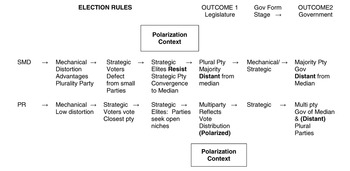
We can see why we expect these effects with a revised version of Figure 1, showing how polarization levels condition the working of the causal mechanisms of SMD and PR. At the top of Figure 2 we see the causal mechanisms of SMD, as before. Polarization of the party system sharply affects the propensity of party elites to converge; in low polarization conditions convergence is encouraged; in high polarization conditions, they resist convergence. With high polarization Downsian expectations will be confounded, even for a two-party configuration. (If this sounds vaguely familiar to you students of current American politics watching the presidential election process … well, you are the American politics experts, I'm just a comparativist.) In an SMD parliamentary system, this high polarization will produce a majority party in the legislature that forms a government far from the median voter. In a PR parliamentary system, the familiar workings of PR will reproduce the party system polarization faithfully in the legislature, where the process of government formation will tend, less systematically, to create governments whose parties are further from the median voter than in low polarization conditions. But the presence of the median legislative party in the coalitions should still help mitigate polarization consequences somewhat.
Effect of polarization context on ideological congruence of voters and governments: Two paths

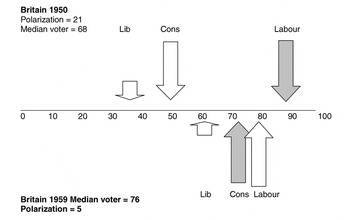
In Figure 3 we can see how this played out in Britain in two pairs of high and low polarization periods in an SMD system: 1950 and 1959 and 1983 and 2001.
Changing polarization in Britain 1950–1959

Changing polarization in Britain 1983–2001

In Figure 3a we see Britain in the 1950s. Each arrow shows the position on a 100-point right-left scale of a political party.Footnote 31 The height of the arrows is the percent of the votes won by the party. The party winning a legislative majority is grey; the others are white. In 1950 we see that the large parties are Conservative and Labour (which won the election). The Labour Party, in the full flush of its programs of building the national health service, setting up massive public housing reconstruction, nationalizing the steel industry, and so forth, is on the extreme left (right side of your figure—sorry) at 90. The Conservatives, regrouping from their startling defeat in 1945, are in the middle. But the median voter is on the moderate left at 68. The key point is that the big parties are quite far apart (40 points on the 100-point scale); and whichever one wins will be quite far from the median voter. Contrast this to the situation in 1959, at the bottom side of the figure. At this point Labour, having achieved many of its objectives, is at a slightly more moderate 80, but what is fascinating is how much the Conservatives have come to accept the popular parts of the Labour program. They're building council housing faster than the Conservatives did, working with the National Health Service, and so forth and have converged very close to the median voter and not far from Labour. The party system has depolarized. And, which ever party wins, it will be close to the median voter.
In figure 3b we see the situation in 1983 and 2001. Again, a tale of polarization and depolarization. In 1983 we see Labour again on the far left (the party having been captured by its left wing, led by Michael Foote,) and Mrs. Thatcher's Conservatives on the far right. Here the party system is even more polarized than it was in 1950, with the big parties about 70 points apart! The Conservatives won the legislative majority, but which ever large party had won, it would have been far (30 points or more) from the median voter. In such a polarized situation, the creation of a single-party majority has to have poor ideological congruence. Contrast 2001, with the parties closely bunched around the median. Labour has changed its name (to New Labour), its constitution, and its leadership, having forced the extreme left wing out of the party and converged to the median voter. The Conservatives, after hesitation in 1997, have also moderated substantially. Which ever large party wins, it will be close to the median voter.
These two sets of figures show how powerful is the resistance of party polarization against ideological congruence with a majoritarian party system. If we take a closer look at 1983 we can also see how even with this degree of party system polarization, a PR electoral system would have been helpful. Assuming—admittedly, a dubious assumption, but interesting for illustrative purposes—that the parties and voters would have been the same, but with PR election rules, neither large party would have won a majority (Mrs. Thatcher's Conservatives were the larger party with about 42 percent of the vote.) To form a majority government would have required some kind of coalition, probably with the Liberal Democrats, who were fairly close to the median voter; that coalition would have created a much more—though not entirely—centrist government, with greater ideological congruence.
Conditional Relationships
Of course, favorite examples are all very well, but how general are these effects, and do they really account for the changing levels of ideological congruence in the SMD systems? The answer, I was somewhat surprised to find, is surprisingly general and surprisingly well. (Though, of course, in all honesty, we only have a limited number of SMD systems, which limits our confidence a bit.)
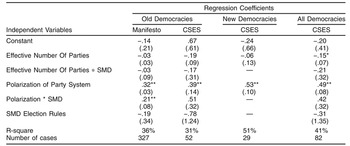
Table 2 shows some conditional regression results of equations with an interactive term for polarization. To reassure us that the results are not a consequence of the special measurement procedures, column 1 is based on the manifesto data and includes 327 cases from the end of World War II to 2003 in the developed democracies. Column 2 is based on the CSES data mentioned above, and just the similar “developed” or “old” democracies; using Modules 1, 2, and 3 now available it includes 52 elections. In both data sets the congruence measures are transformed into 10-point scales for comparability (as they were in Table 1).
Conditional regression analyses of government distance: Dependent variable is distance between median voter and government

* = significant at .05
** = significant at .01.
Notes: The 100 point manifesto data scale has been translated into a 10-point scale for comparison to CSES, and the “Dalton” version of the polarization measure is used in each. CSES includes Modules 1, 2, and 3.
“Old democracies” in CSES are Australia, Austria, Belgium, Canada, Denmark, Finland, France, Germany, Great Britain, Iceland, Ireland, Israel, Netherlands, New Zealand, Norway, Portugal, Spain, Sweden, Switzerland, US.
“New” democracies in CSES are Bulgaria, Chile, Croatia, Czech Republic, Hungary, Korea, Mexico, Peru, Poland, Romania, Russia, Slovenia, and Taiwan. SMD are Australia, Canada, Great Britain, France, US.
You'll recall that in this kind of interaction or conditional regression, the simple polarization coefficient is the effect of polarization under PR, whereas to get the effect under SMD we add together the two polarization coefficients. There are three take-away points here. First, the two columns have very similar coefficients, despite the very different measure procedures and different time periods. Second, polarization always makes close ideological congruence more difficult (positive coefficients for government distance.) Third, the effect of polarization is nearly twice as large under SMD (adding the coefficients) as under PR in both time periods and measures. (The difference from the PR effect is not quite statistically significant in the CSES, which has only 10 SMD cases.) It's also reassuring that polarization also works significantly and strongly negatively in the newer democracies covered in CSES, (not by the manifesto program), as shown in column 3, although we have no SMD election rules in the new democracies. And it works in the 82 total elections combining old and new democracies. (We could also say a word about presidentialism here—polarization is also significantly negative in presidential systems although slightly less strongly.)Footnote 32 (By the way, the negative coefficient for the election laws dummy shows that if polarization is minimal, SMD rules have slightly better congruence, although the difference is not significant.)
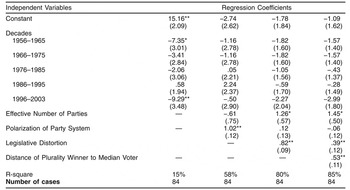
We also can use the manifesto data to examine the aggregate patterns of ideological congruence over time in the SMD systems and see whether changing polarization levels explain some or all of those differences. Table 3 does this by entering dummy variables for the various decades, keeping 1946–1955 as a reference category. These are just the 84 elections in five parliamentary SMD countries (Australia, Canada, Britain, France, New Zealand until 1996) from 1946 to 2003. We can see in the first column, which just has the constant and the decade dummies, that two decades in particular (1956–1965 and 1996–2003) have significantly less distance (more congruence) than the reference decade. The intervening 30 years have statistically similar (in)congruence. This greater congruence in the SMD systems in the most recent decade is, of course, what shocked all of us when it was first discovered using the CSES studies (all located in this period.) It's interesting that at least as measured by Manifesto data there was similarly greater congruence in 1956–65, the very period when Anthony Downs was formulating the theory of convergence to the median voter in two party dominated systems.Footnote 33
Regression analysis of government distortion in SMD parliamentary systems: Dependent variable is distance between median voter and government (Manifesto)

%Reference decade is 1946–1955.
* = significant at .05
** =significant at .01.
However, the second column introduces two features of the party system, the effective number of voted partiesFootnote 34 and the polarization of the party system. In this column only the polarization variable is statistically significant in explaining distance between government and median voter, on which it has a powerful enhancing effect. Notable, for our purposes, is that none of the variables for the decade dummies are now significant. The changing levels of party system polarization explain them away. The models in the subsequent column show that as our causal mechanism analysis expects, the polarization effect itself operates through the distances of the plurality party and the legislative median party (highly correlated in these systems, but not perfectly due to pre-election coalitions in SMD, but not plurality, systems of Australia and France.) Decade effects remain insignificant as long as polarization is in the equation.
Another way of describing this effect is that in the most recent decade the average polarization in the PR systems drops slightly (1.8 to 1.6), but the average polarization in the SMD systems drops very sharply (1.6 to 1.1.) Because polarization has so much bigger an impact on ideological congruence in SMD systems, the similar earlier levels create higher average incongruence in SMD. Now that (as Downs would have expected) polarization is much less in SMD, the two congruence outcomes are roughly equivalent.
Exploring the Causal Mechanisms
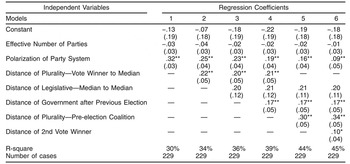
Table 4 and Table 5 show the differing roles of plurality and median parties in the two types of systems. We see that in the 229 PR cases in Table 4 the distances of a variety of parties (including the previous governing parties and pre-election coalitions and even the second largest party) play a role in government formation and in the polarization effect. In the first column we see the effect of polarization in voter-government distance in these 229 PR elections. In the subsequent columns we gradually add the distances of parties that theoretically we expect to be involved in government formation: the largest party, then also the median party, then also the previous governing parties. Then we replace the largest single party with any pre-election coalition that is bigger than the largest party. Finally, we take account of even the second largest party. Note that as we add the distances of these different parties that in various countries are involved in government formation, the polarization coefficient gradually declines. Polarization is working through the distances of this variety of parties, as we expect from the literature on government formation in parliamentary systems without a single-party majority.
Exploring the causal mechanism of party system effects in proportional representation: Dependent variable: Distance between median citizen and government (Manifesto)

* = significant at .05 **=significant at .01.
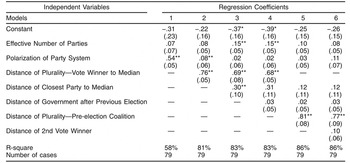
Exploring the causal mechanism of party system effects in SMD: Dependent variable: Distance between median citizen and government (Manifesto)

* = significant at .05 **=significant at .01.
In the 79 SMD elections in Table 5 the process is different. The polarization coefficient is initially much larger (as we expect from Table 2.) But as soon as we add the distance of the plurality vote winner the polarization coefficient is reduced to insignificance. We can explain somewhat more of the variance by taking account of the median party separately, where these are different, and especially by taking account of any plurality pre-election coalitions (common in Australia and France.) But none of the other parties are needed to account for the effect of polarization.Footnote 35
The main point that I would have you take away from these two tables is that polarization is a problem for ideological congruence in both PR and SMD systems, especially in SMD systems (larger coefficient initially), but that the causal mechanisms are somewhat different. They both have to do with government formation in these parliamentary systems, which operate under roughly the same formal rules, but in the PR cases it's a complex, multiparty government formation process, whereas in the SMD systems it's usually about the direct election of a legislative majority party or pre-election coalition. This exploration of the connections linking the election and the government outcome fits nicely with our expectations from theories of government formation in parliamentary systems and helps us better understand the process.
Context as a Step towards Explanation
Let us suppose, which I don't insist, that you accept that adding consideration of party system polarization as a conditioning (interactive) feature of the local political context makes it possible to explain (statistically and with respect to causal mechanisms) and predict the consequences of election laws for ideological congruence more satisfactorily (at least in parliamentary systems).
Where does that leave us in the larger question of generally taking account of local context in theories in political science? I want to leave you with several thoughts about that issue.
First is that, of course, identifying an important contextual factor and incorporating it into our theories as a conditioning variable doesn't end our search for adequate explanation. We still want to know what accounts for party system polarization, or adequate citizen information about relative strength of parties, or whatever. As usual in science, to answer one research question is to generate others. I've been doing some work on cross-national sources of party system polarization, looking at things like citizen ideological polarization, socio-economic conditions, international ideological trends, and so forth.Footnote 36 I've found some glimmers, but none of these really account for what happened in Britain between mid the 1980s and late 1990s, which seems deeply bound up in relations between activists and leaders within the political parties. This is both frustrating and fascinating, and, in my view, that's inevitable as the process of science pushes both deeper and broader into the search for explanation.
A second perspective goes in a slightly different direction and asks whether we can develop more general theories about context and election rules (and by extension, context and other generalizations and theories). At the moment we have an APSA Presidential Task Force looking into what political science knows about a variety of different consequences of adopting different election laws, and one group is looking at the effects of local context.Footnote 37 We've identified a couple of tantalizing ideas trying to get at this more generally. This is really in its infancy, but it seems so interesting that I can't resist trying to share it a bit.
Two points have emerged so far. One is that it may be constructive—or instructive—to build on Duverger's old idea of “mechanical” and strategic effects of election lawsFootnote 38 (as I did in the figures shown here). The former has to do with the interaction between the votes and rules if the latter are properly carried out. The latter has to do with the way citizen or elite anticipations of those mechanical interactions shape the consequences (by encouraging strategic defections from their first preferences if they don't seem to have a chance of winning). It looks to us as if the contextual condition that shapes the working of mechanical effects is mostly limited to rule of law—in conditions of coercion or fraud the mechanical effects may be unpredictable. (I didn't show the potential coercive element in the figures, but it is a key contextual condition for the theory, just widely assumed usually—although not always—to be absent in the developed systems.) Otherwise, they will work predictably in most contexts. The strategic effects, on the other hand, are more sensitive to variations in citizens' and elites' values and expectations, which are often quite context dependent. Here we need to take account of information availability and common assumptions about party strength (in Duverger's Law), as well as, for some consequences such as minority representation, features of the values in the political culture.
A second point is that some of the consequences of election laws are quite proximate to the election itself, while others, such as the consequences of election laws for minority representation or collective accountability or stable government, are more distant (in time, logical sequence, or both), involving more causal linkages. In the case of these more distant consequences, there are more opportunities for contextual effects to shape the various causal linkages, hence the need to take more contextual conditions into account in theory and explanation.
Thus the more causal linkages there are between the election rules and the consequences of interest to us, and the more of these linkages involve strategic processes, the more essential it is to take account of local conditions.
This is just a preliminary reading of the evidence and not well-grounded theory or observation. But there seem to be exciting possibilities in the development of theories of contextual effects, and, even more broadly, for political science theories that give us more consistent and general explanations.
Concluding Remarks
One of the exciting features of political science is its interaction with great normative issues, such as representation and democracy. I have always found that converting these issues into substantive research puzzles that can be studied objectively has been one of the fascinating challenges of political science research. In the past two decades I've been wrestling with the puzzle of election rules and ideological congruence, trying to understand the theoretical basis of the electoral connection between citizens and policymakers. This seems a puzzle at the heart of representative democracy.
The changing nature of the empirical relationship between election rules and ideological congruence poses a challenge to our ability to cope with the ever-changing world of politics. This is a familiar challenge for political science. Our theories are always being pushed by the need to respond to new, diverse conditions. Founding our generalizations on basic theories of mechanisms and processes makes it possible to rebuild them in ways that take account of critical features of local context, such as party system polarization. Taking theoretically-based account of local context, in turn, enhances our understanding of where and when we expect the generalizations to hold. Political science need not abandon its effort to find systematic answers to our empirical questions, nor must it ignore the normative concerns that gave rise to those questions.