





I. THE ORDERING OF THE PLATONIC LETTERS IN THE DIRECT AND INDIRECT TRADITIONS
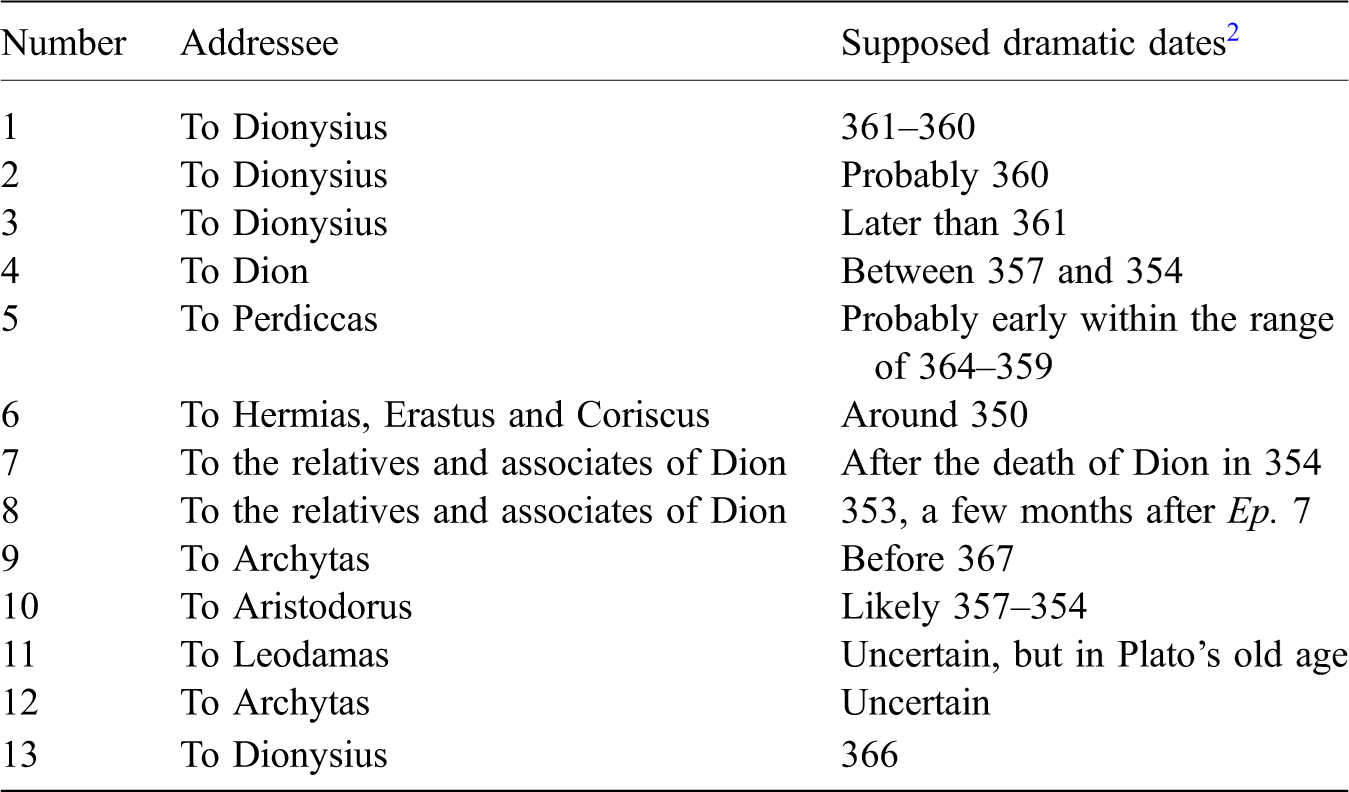
Before interpreting the thirteen extant Platonic Letters in the collection dedicated to Plato, we must first ask what the most ancient and reliable ordering of the letters is, and how it can be reconstructed from the earliest available direct and indirect evidence.Footnote 1 The relevant Byzantine manuscripts of the Corpus Platonicum transmit thirteen Platonic Letters in the following sequence (a third column indicates the presumed dramatic dates):
Order of the Platonic Letters according to the relevant Byzantine manuscripts

Table 1: Long description
A table with three columns and thirteen rows. The columns are labeled Number, Addressee, and Supposed dramatic dates. The table lists the order of the Platonic letters, their addressees, and the supposed dramatic dates. Row 1: Number, 1; Addressee, To Dionysius; Supposed dramatic dates, 361-360. Row 2: Number, 2; Addressee, To Dionysius; Supposed dramatic dates, Probably 360. Row 3: Number, 3; Addressee, To Dionysius; Supposed dramatic dates, Later than 361. Row 4: Number, 4; Addressee, To Dion; Supposed dramatic dates, Between 357 and 354. Row 5: Number, 5; Addressee, To Perdiccas; Supposed dramatic dates, Probably early within the range of 364-359. Row 6: Number, 6; Addressee, To Hermias, Erastus and Coriscus; Supposed dramatic dates, Around 350. Row 7: Number, 7; Addressee, To the relatives and associates of Dion; Supposed dramatic dates, After the death of Dion in 354. Row 8: Number, 8; Addressee, To the relatives and associates of Dion; Supposed dramatic dates, 353, a few months after Ep. 7. Row 9: Number, 9; Addressee, To Archytas; Supposed dramatic dates, Before 367. Row 10: Number, 10; Addressee, To Aristodorus; Supposed dramatic dates, Likely 357-354. Row 11: Number, 11; Addressee, To Leodamas; Supposed dramatic dates, Uncertain, but in Plato’s old age. Row 12: Number, 12; Addressee, To Archytas; Supposed dramatic dates, Uncertain. Row 13: Number, 13; Addressee, To Dionysius; Supposed dramatic dates, 366.
This order of the Platonic Letters, which is followed in most modern editions and will henceforth be referred to as the ‘conventional order’, originates in codex Parisinus graecus 1807 (designated as A), which preserves the last two tetralogies of the Corpus Platonicum, namely tetralogies VIII and IX, with the letters appended at the end of the latter.Footnote 3 The codex was written in the third quarter of the ninth century, most likely in Constantinople.Footnote 4 There is also the codex Vaticanus graecus 1 (designated as O), which preserves tetralogy IX 2–4 (including, therefore, the letters) and, being an early copy of A before correction, transmits the same thirteen Platonic Letters in the same order as A. But a corrector of O in the tenth or eleventh century (O4) inserted readings drawn from a codex of a textual tradition different from A of unknown origin.Footnote 5 All other manuscripts, which often do not preserve all of the thirteen letters, ultimately derive from A.Footnote 6 The ninth century thus provides the earliest reliably traceable reference point for the conventional order of the thirteen Platonic Letters. However, should the order preserved in the Byzantine manuscripts be regarded as the most appropriate basis for interpretation? The ancient indirect evidence suggests otherwise.
In the third book of his Lives and Opinions of Prominent Philosophers, which is dedicated to Plato, Diogenes Laertius reports on the division of Plato’s works into tetralogies realized by Thrasyllus (Diog. Laert. 3.57–61).Footnote 7 Thrasyllus, possibly of Egyptian origin, was the court astrologer of Tiberius and died in a.d. 36.Footnote 8 In his account of Thrasyllus’ edition, Diogenes lists among the works of the ninth and final tetralogy—alongside the Minos, the Laws and the Epinomis—‘thirteen letters’ and provides the names of their recipients:
Ἐπιστολαὶ τρεισκαίδεκα, ἠθικαί (ἐν αἷς ἔγραφεν εὖ πράττειν, Ἐπίκουρος δὲ εὖ διάγειν, Κλέων χαίρειν) πρὸς Ἀριστόδημον μία, πρὸς Ἀρχύταν δύο, πρὸς Διονύσιον τέτταρες, πρὸς Ἑρμίαν καὶ Ἔραστον καὶ Κορίσκον μία, πρὸς Λεωδάμαντα μία, πρὸς Δίωνα μία, πρὸς Περδίκκαν μία, πρὸς τοὺς Δίωνος οἰκείους δύο. καὶ οὗτος μὲν οὕτω διαιρεῖ καί τινες.Footnote 9
Thirteen letters, ethical (in which he wrote ‘Do well’, whereas Epicurus wrote ‘Live well’ and Cleon wrote ‘Greetings’): one to Aristodemus, two to Archytas, four to Dionysius, one to Hermias, Erastus and Coriscus, one to Leodamas, one to Dion, one to Perdiccas and two to the relatives of Dion. And he [sc. Thrasyllus] puts them in this order, as do some others.
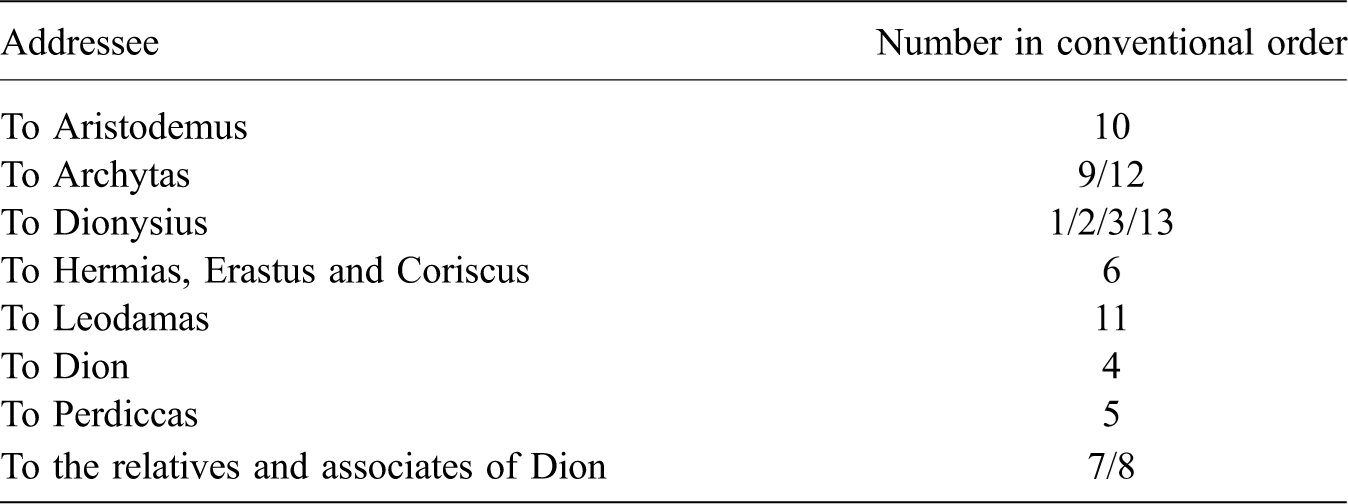
The following table illustrates the arrangement of the Platonic Letters according to Thrasyllus, as reported by Diogenes:
Order of the Platonic Letters by Thrasyllus according to Diog. Laert.

Table 2: Long description
A table listing the order of the Platonic Letters by Thrasyllus according to Diog. Laert. The table has two columns and eight rows. The first column is labeled ‘Addressee’ and the second column is labeled ‘Number in conventional order’. Row 1: To Aristodemus, 10. Row 2: To Archytas, 9/12. Row 3: To Dionysius, 1/2/3/13. Row 4: To Hermias, Erastus and Coriscus, 6. Row 5: To Leodamas, 11. Row 6: To Dion, 4. Row 7: To Perdiccas, 5. Row 8: To the relatives and associates of Dion, 7/8.
As can be seen, the addressees mentioned by Diogenes correspond to those of the letters transmitted in the manuscript tradition, with the exception of the tenth, where Diogenes transmits ‘Aristodemus’ instead of ‘Aristodorus’—either a scribal error or the original form.Footnote 10 Furthermore, Diogenes quotes the division of Thrasyllus so extensively and in such detail, including alternative titles and classifications, that it seems highly probable that he had direct access to Thrasyllus’ work and reflects his ordering accordingly.Footnote 11 Thrasyllus follows a tetralogical order of the Platonic works which, regarding the dialogues, contained the same works in the same relative order as the authoritative manuscripts of the Platonic texts.Footnote 12 Crucially, however, the ordering of the individual letters differs between Thrasyllus and the manuscript tradition.
As an important aspect of the ancient reception of the Platonic Letters (see Sections III and IV below), their classification deserves closer attention. Within the tetralogical arrangement of Plato’s works, the writings were categorized didactically according to a philosophical curriculum, with each assigned to a specific field of study. According to Diogenes, the letters were classified as ethical (ἠθικαί), as were the Critias, Clitophon, Menexenus, Erastae, Hipparchus, Phaedrus, Symposium, Philebus, Phaedo, Crito and the Apology.Footnote 13 Besides, Diogenes also mentions an alternative classification of Plato’s dialogues into trilogies, which was undertaken, among others, by the grammarian Aristophanes of Byzantium. In this system, certain letters were grouped together with Crito and Phaedo in the fifth trilogy.Footnote 14 It remains unclear whether these letters were identical in number and content to those of the ninth tetralogy and, if so, in what order they were arranged.Footnote 15 Moreover, whether the classification by Aristophanes and others mentioned by Diogenes points to distinct editions of Plato’s works remains as contested as the question of whether an edition was ever compiled by the Academy itself.Footnote 16
Returning to the initial question concerning the most ancient and reliable ordering of the Platonic Letters, one can affirm that by the time of Thrasyllus’ death in a.d. 36, an arrangement of Plato’s works (hereafter referred to as the ‘Thrasyllan order’) existed, including the same thirteen letters preserved in Byzantine manuscripts. This order is the earliest known to us and predates the conventional order—as far as it is traceable for us—by more than seven centuries. Further confirmation comes from ancient testimonia.Footnote 17 Before Thrasyllus, Nep. Dion 2–3 makes use of Pl. Ep. 7, but does not explicitly refer to letters of Plato. Cicero cites passages from Platonic Letters, considering them to be authentic works of Plato, without giving a number (Ep. 5: Fam. 1.9.18; Ep. 7: Fam. 1.9.12, Tusc. 5.100, Fin. 2.92; Ep. 9: Fin. 2.45, Off. 1.22). The only instances in which Cicero explicitly indicates that he is citing from a letter are Fin. 2.45 ut ad Archytam scripsit Plato, ‘as Plato wrote to Archytas’, and Tusc. 5.100, where he translates Pl. Ep. 7.326b–c, introducing the text as a praeclara epistula Platonis ad Dionis propinquos, ‘excellent letter of Plato to Dion’s relatives’.Footnote 18 Plutarch, who (after Thrasyllus) makes extensive use of the Platonic Letters in his Life of Dion and directly refers to Ep. 4 (Dion 8.3–4, 52.4–6), Ep. 7 (Dion 4.5–6, 11.3, 18.9, 54.1) and Ep. 13 (Dion 21.1) as well as to the Platonic Letters in general,Footnote 19 never refers to the numbers of these letters. Therefore, the most ancient authors of whom (partially) complete texts mentioning Platonic Letters have been transmitted never refer to a Platonic Letter by means of the numbering system found in Parisinus graecus 1807 and its copies, but either leave the reference unspecified or identify letters by their addressee—the same organizational principle used by Thrasyllus.
II. ORDER AND INTERPRETATION
Until the last decade of the twentieth century, classical scholarship regarded the Platonic Letters primarily, if not exclusively, through the lens of authenticity, seeking to distinguish genuine works of Plato from later ‘forgeries’. Among the first to adopt a different perspective was Müller, who, while considering the letters inauthentic, recognized their value as testimonies to the early reception of Plato. Nevertheless, Müller’s views were only hesitantly received with regard to the Platonic Letters.Footnote 20
A new perspective on these letters was introduced by Holzberg in his study of the ancient Briefroman, or ‘epistolary novel’. Holzberg identified recurring motifs across the thirteen Platonic Letters, which, in his view, support the idea that the epistles should be regarded as a single narrative.Footnote 21 Rosenmeyer was among the first to draw the attention of international scholarship to fictitious Greek letter collections.Footnote 22 In her analysis, she explores the ‘epistolary game’ at work in these letters as a literary technique that demands the reader’s active engagement in reconstructing events presented only in fragmentary form.Footnote 23
The first to apply Holzberg’s and Rosenmeyer’s concepts of epistolary fiction to the Platonic Letters extensively was Morrison. His article ‘Narrative and epistolarity in the “Platonic” Epistles’ examines the narrative strategies and the role of seriality within the collection.Footnote 24 In a more recent contribution, Morrison revisits his findings on the sequential reading of the Platonic Letters and turns his attention to the theme of love.Footnote 25 Over the past decade, scholars have employed similar approaches to other ancient letter collections, confirming the heuristic potential of Morrison’s focus on the order and grouping of letters.Footnote 26
In its application to the Platonic Letters, however, Morrison’s interpretation encounters significant challenges—particularly when considered against the internal logic of the letters themselves.Footnote 27 Plato’s break-up with Dionysius II at the end of Ep. 1 is strikingly rude and final,Footnote 28 making it artificial to assume a ‘“repair” of the relationship’, as Morrison infers from an implied ‘background’ narrative, merely on the basis that the placement of Ep. 2 would necessitate a later date—an argument that applies equally to the dramatic date of Ep. 3.Footnote 29 However, when it comes to Ep. 13, he applies a different principle, accepting an earlier dramatic date in relation to Ep. 1–3 and justifying this arrangement as ‘effective’ and ‘powerful’.Footnote 30 Moreover, Morrison must admit deep and unmotivated changes in the situation before and after Ep. 4.Footnote 31
One may also question his assumption that ‘the fact that the Dion who speaks in Epistle 8 seems not to be aware that his son is dead only serves to emphasise the impossibility of his and Plato’s advice’.Footnote 32 It is not without difficulty that Morrison ascribes the awkward change of scene and atmosphere in the last five letters (Ep. 9–13) to their being ‘heavy with a species of dramatic irony’.Footnote 33 Lastly, in Ep. 13, which contains various instances of both successful and proposed gift exchanges, Morrison sees the central message of the collection encapsulated, arguing that ‘the Epistles show us the failure of Plato’s letters to achieve what their sender wanted’.Footnote 34
Even more problematic is the hypothesis recently advanced by Helfer, who, like Morrison, argues for the ‘literary unity’ of the collection on the basis of the conventional order but then, unlike Morrison, unconvincingly concludes from this observation that all thirteen Platonic Letters were composed by the historical Plato and constitute ‘his attempt to clarify the meaning of his lifelong project of promoting and defending the reputation of philosophy’.Footnote 35
Regarding Morrison’s interpretation, the above-mentioned challenges arise chiefly from his assumption that the conventional order of the Platonic Letters, as preserved in Parisinus graecus 1807, should be regarded as ‘the ancient one also’.Footnote 36 In reality, the only discernible organizing principle behind the conventional order is the central placement of the Seventh Letter, the longest in the collection, likely intended to highlight its philosophical significance. The remaining letters are symmetrically arranged into two groups of six, as Morrison himself acknowledges, suggesting a deliberate reordering that disregards the coherence of narrative units.Footnote 37 As a result, this conventional arrangement not only disrupts the development of epistolary friendships and the overall structure of the collection—particularly in terms of opening and closure—but also fragments thematic and recipient-based groupings (for example between Ep. 9 and 12, and between Ep. 13 and 1–3). As Gibson notes, such groupings were fundamental organizing principles in ancient literary letter collections.Footnote 38 Therefore, early twentieth-century scholars who attempted a strictly chronological reordering such as Post or who, like Bury, concluded that ‘the Epistles do not seem to be arranged on any intelligible principle’ and thus abandoned the search for meaning in their conventional order, undoubtedly identified a crucial issue.Footnote 39
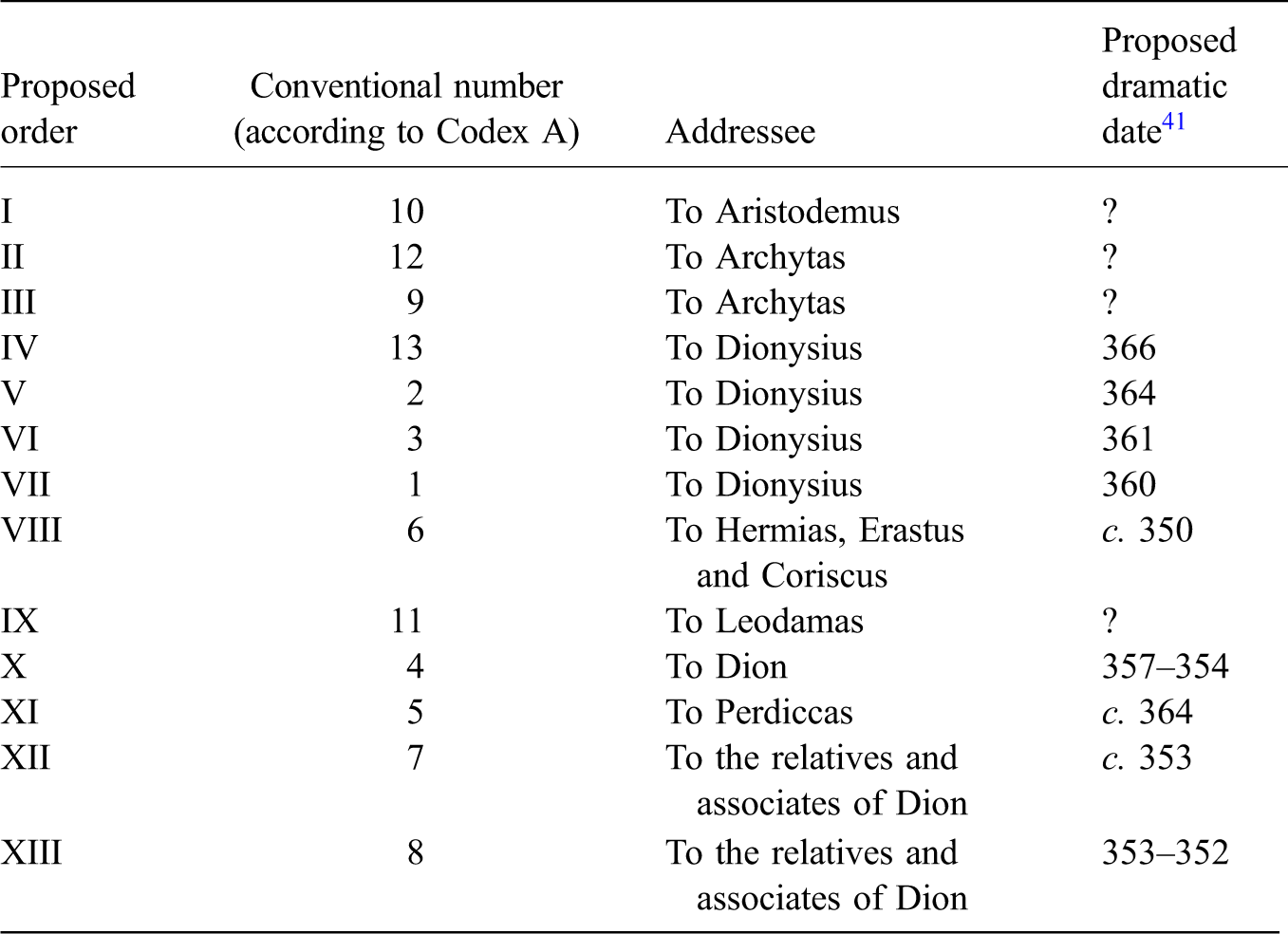
Many interpretative difficulties posed by the Platonic Letters could be resolved by adopting the Thrasyllan order—the earliest known sequence. This arrangement, which prioritizes moral instruction over alphabetical or chronological considerations, was more appropriate for students engaging with the Corpus Platonicum.Footnote 40 Unlike the conventional order, the Thrasyllan arrangement systematically groups letters by recipient: those to Archytas (II and III = Ep. 12 and 9) and Dionysius (IV–VII = Ep. 13, 2, 3, 1) are paired accordingly, while the letters addressed to the relatives and associates of Dion (XII and XIII = Ep. 7 and 8) are likewise kept together. Beyond its recipient-based organization, the Thrasyllan arrangement also promotes thematic coherence by grouping, for instance, the two letters advising Plato’s students (VIII and IX = Ep. 6 and 11) which are separated in the conventional order. Similarly, the letters to rulers newly in power and facing internal dissent (X and XI = Ep. 4 and 5) are preserved as a pair. Drawing on the testimony of Diogenes Laertius and taking into account the social development within each of Plato’s epistolary relationships, I propose the following arrangement as a basis for interpreting the Platonic Letters as an epistolary novel, as outlined in the table below.
Proposed order of the Platonic Letters based on Diog. Laert.

Table 3: Long description
A table with four columns and thirteen rows. The columns are labeled Proposed order, Conventional number (according to Codex A), Addressee, and Proposed dramatic date. The rows list the proposed order of the Platonic letters, their conventional numbers, the addressees, and the proposed dramatic dates. Row 1: Proposed order, I; Conventional number, 10; Addressee, To Aristodemus; Proposed dramatic date, ?. Row 2: Proposed order, II; Conventional number, 12; Addressee, To Archytas; Proposed dramatic date, ?. Row 3: Proposed order, III; Conventional number, 9; Addressee, To Archytas; Proposed dramatic date, ?. Row 4: Proposed order, IV; Conventional number, 13; Addressee, To Dionysius; Proposed dramatic date, 366. Row 5: Proposed order, V; Conventional number, 2; Addressee, To Dionysius; Proposed dramatic date, 364. Row 6: Proposed order, VI; Conventional number, 3; Addressee, To Dionysius; Proposed dramatic date, 361. Row 7: Proposed order, VII; Conventional number, 1; Addressee, To Dionysius; Proposed dramatic date, 360. Row 8: Proposed order, VIII; Conventional number, 6; Addressee, To Hermias, Erastus and Coriscus; Proposed dramatic date, c. 350. Row 9: Proposed order, IX; Conventional number, 11; Addressee, To Leodamas; Proposed dramatic date, ?. Row 10: Proposed order, X; Conventional number, 4; Addressee, To Dion; Proposed dramatic date, 357-354. Row 11: Proposed order, XI; Conventional number, 5; Addressee, To Perdiccas; Proposed dramatic date, c. 364. Row 12: Proposed order, XII; Conventional number, 7; Addressee, To the relatives and associates of Dion; Proposed dramatic date, c. 353. Row 13: Proposed order, XIII; Conventional number, 8; Addressee, To the relatives and associates of Dion; Proposed dramatic date, 353-352.
III. PEN PAL BREAK-UP: A SERIAL READING OF THE LETTERS TO DIONYSIUS
What interpretative consequences arise from reading the Platonic Letters in this alternative arrangement? Taking into account the central role of seriality in ancient epistolary fiction, I explore how this ordering reshapes our understanding of the collection, beginning with a distinct subgroup: the letters to Dionysius.Footnote 42 In the first letter of the series (IV = Ep. 13), the reader is put in the midst of a correspondence on everyday life topics between Plato and Dionysius. The beginning of a new series is highlighted by a commentary on the opening epistolary formula εὖ πράττειν (lit. ‘fare well’), typical of Plato, serving as a secret bond between sender and addressee: ‘Let the beginning of this letter be at the same time also a token to you that it is from me’ (IV = Ep. 13.360a). This announcement at the beginning of the series is crucial for the reader’s understanding of the references to the formula in later letters to Dionysius.Footnote 43
As implied by the opening formula of this letter, Plato and Dionysius have already met in person during Plato’s second journey to Sicily, while the hardships of the third and final journey still lie ahead. The atmosphere is friendly and connects the beginning of the series perfectly with the preceding series to Archytas (II and III = Ep. 12 and 9). Sending and receiving gifts is a common theme of both series: Plato thanks Archytas for ‘the notes that arrived from you’ (τὰ μὲν παρὰ σοῦ ἐλθόνθ’ ὑπομνήματα, 359c) and is sorry that the one Archytas asked for in his letter is not ready yet (τὰ δὲ παρ’ ἐμοὶ ὑπομνήματα, περὶ ὧν ἐπέστειλας, ἱκανῶς μὲν οὔπω ἔχει, 359d). Accordingly, Plato promises to send Dionysius ‘Pythagorean writings’ (τῶν τε Πυθαγορείων), ‘Divisions’ (τῶν διαιρέσεων) and a certain Helicon, ‘a man, just as was resolved by us then, of whom you and Archytas, if indeed Archytas has come to you, would be capable of making use’ (καὶ ἄνδρα, ὥσπερ ἐδόκει ἡμῖν τότε, ᾧ γε σὺ καὶ Ἀρχύτης, εἴπερ ἥκει παρά σε Ἀρχύτης, χρῆσθαι δύναισθ’ ἄν, 360b–c). Therefore, not only is Archytas mentioned by name—which creates a strong intertextual connection to the preceding series—but Plato also brings together in a personal meeting both of his pen friends Dionysius and Archytas.
Plato promises to send to his addressee a statue of Apollo, a gift for his wife as well as ‘twelve jars of sweet wine for your children, and two of honey’ (361a). Plato appears to know and care for the preferences of Dionysius’ closest relatives. He also asks Dionysius for money for the dowry of his nieces, the tomb of his mother (361c–e), and armour and clothing for some of his friends (363a). A large part of the letter is dedicated to the monetary affairs of both partners (361b–362d). Plato refers to Dion in merely one paragraph (362e), acting as a medium between him and Dionysius in a very diplomatic tone without criticizing the latter in the slightest manner. Paradoxically, the only reference to philosophy comes at the end of the letter: ‘Farewell, philosophize and try to interest the other young men in it’ (ἔρρωσο καὶ φιλοσόφει καὶ τοὺς ἄλλους προτρέπου τοὺς νεωτέρους, 363c–d).
The second letter of the series (V = Ep. 2) starts with the opening formula εὖ πράττειν, established as a sign of authenticity in the previous letter. An intertextual reference that makes the unity of the series clear is the inherently cryptic phrase ‘The little sphere isn’t right’ (V = Ep. 2.312d: τὸ δὲ σφαιρίον οὐκ ὀρθῶς ἔχει). With knowledge of the previous letter, the reader is able to connect the statement to greetings to ‘fellow students of the spheres’ (IV = Ep. 13.363d: τοὺς συσφαιριστάς). Since the content remains obscure—aside from geometrical studies, the allusions might pertain to ball games—the reader’s attention is directed primarily towards a shift in tone from cordial greetings to a growing sense of unease prompting the suspicion of a latent rupture in the pen friendship. Apparently, the same Polyxenus, mentioned in a negative light already in the previous letter (IV = Ep. 13.360c), now seems to have gained influence over Dionysius and plotted against Plato, as the latter criticizes him for telling Dionysius ‘that at Olympia he heard many of my companions accusing you’ (V = Ep. 2.310d: ὅτι ἀκούοι Ὀλυμπίασι πολλῶν τινων τῶν μετ’ ἐμοῦ σε κακηγορούντων; cf. 314d).
Supposedly, Plato alludes to the Olympic Games—but which ones: those of 364 or those of 360? The reader does not know and is not provided with references to other historical events that would help him decide. Although the reader gets the impression that there is much talking behind each other’s backs, Plato praises his ‘long and enduring’ friendship with Dionysius (310e), thinks that it is still possible to get their relationship right (311d–e) and entrusts to him letters which ‘must not fall into the hands of uninstructed men’ (314a). This positive attitude would be out of place after Plato’s third journey to Sicily (361), and could not plausibly occur after the rude letters following this event (VI = Ep. 3 and VII = Ep. 1) as the conventional order suggests.
With the next letter (VI = Ep. 3) the friendship between Plato and Dionysius reaches a breaking point, as it opens with the words: ‘“Plato to Dionysius, greetings!” If I sent such a letter, would I correctly hit upon the best salutation, or should I wish you to be well, as I usually do in letters to my friends?’ (VI = Ep. 3.315a–b: “Πλάτων Διονυσίῳ χαίρειν” ἐπιστείλας ἆρ’ ὀρθῶς ἂν τυγχάνοιμι τῆς βελτίστης προσρήσεως; ἢ μᾶλλον κατὰ τὴν ἐμὴν συνήθειαν γράφων “εὖ πράττειν”, ὥσπερ εἴωθα ἐν ταῖς ἐπιστολαῖς τοὺς φίλους προσαγορεύειν;). The significance of the shift from εὖ πράττειν (Plato’s usual opening formula) to χαίρειν (which Plato actually uses at the beginning of this letter) is instantly clear to a reader who knows the programmatic statement concerning Plato’s epistolary formulas at the beginning of the first letter of the series.Footnote 44
In the following, later repeated, switch to verse, Plato sarcastically wishes that Dionysius may continue his life as a tyrant (VI = Ep. 3.315b). Plato’s fear of being perceived as someone who betrays his friends for the financial favour of a tyrant (318d–e) casts a negative light on the gift exchange and monetary requests in the first letter of the series. Plato is said to have planned a coup d’état in Syracuse together with Dion (315c–e), accuses Dionysius of lying (318a–b) and directly speaks of ‘the wolf-friendship and estrangement between us’ (τὴν ἐμὴν καὶ σὴν λυκοφιλίαν καὶ ἀκοινωνίαν, 318e).Footnote 45 Yet this momentous estrangement has not led to a final break-up, as Plato tries to reconcile Dionysius and Dion (316e) and offers Dionysius a way out of the crisis by retracting his earlier statements (319e). The reader remains curious about the future course of their epistolary relationship.
The reader of the final letter in the series (VII = Ep. 1) quickly realizes that Dionysius has rejected Plato’s offer of reconciliation. What starts as mutual generosity devolves into open hostility: Dionysius’ money proves insufficient to cover Plato’s expenses, and Plato refuses to accept it (309c). The shift from prose to verse, already observed in the previous letter, continues here, with Plato mocking his addressee in three metrical passages (309d and twice in 310a). The closing formula in this final letter of the series according to the Thrasyllan order makes it unmistakably clear that Plato severs all further contact with Dionysius: ‘Farewell. May you realize how much you have lost in me and so conduct yourself better toward others’ (310b ἔρρωσο, καὶ γίγνωσκε τοσοῦτον ἡμῶν διημαρτηκώς, ἵνα πρὸς τοὺς ἄλλους βέλτιον προσφέρῃ). The epistolary relationship between Plato and Dionysius is broken, and Plato unequivocally rejects any further contact. This endpoint, however, is not adequately reflected in the conventional ordering of the letters, which allows the correspondence to continue contrary to the plausible sequence of the plot. Yet even when one reads the letters to Dionysius according to the Thrasyllan order, narrative lacunae between the texts remain—gaps that the reader must bridge by drawing on knowledge of key events in Plato’s life, most notably his journeys to Sicily.
Similarly, the letters to Archytas attain greater narrative coherence as a series when Ep. 12 is placed before Ep. 9. In the first letter of the series (II = Ep. 12), Archytas urges Plato to send him his writings, which, however, are not yet finished (359d). In the following letter (III = Ep. 9), Plato subsequently frames Archytas’ philosophical curiosity within a broader context, offering a friendly yet pointed reminder of his public responsibilities: ‘It is indeed one of the sweetest things in life to follow one’s own interests, especially when they are such as you have chosen; practically everyone would agree. But this also you must bear in mind, that none of us is born for himself alone; a part of our existence belongs to our country’ (ὅτι μὲν οὖν ἥδιστόν ἐστιν ἐν τῷ βίῳ τὸ τὰ αὑτοῦ πράττειν, ἄλλως τε καὶ εἴ τις ἕλοιτο τοιαῦτα πράττειν οἷα καὶ σύ, σχεδὸν παντὶ δῆλον· ἀλλὰ κἀκεῖνο δεῖ σε ἐνθυμεῖσθαι, ὅτι ἕκαστος ἡμῶν οὐχ αὑτῷ μόνον γέγονεν, ἀλλὰ τῆς γενέσεως ἡμῶν τὸ μέν τι ἡ πατρὶς μερίζεται, 357e–358a). This reordering restores the thematic and rhetorical progression of the exchange, which is obscured in the conventional sequence.
Furthermore, through the constant references to letters sent and received—whether by Plato, the addressee, or third parties—whose contents are either entirely withheld or only briefly hinted at, the reader gains the impression of being granted only a small glimpse into Plato’s epistolary universe: IV = Ep. 13.360b says that Dionysius had sent for Plato to come to Syracuse; IV = Ep. 13.360b mentions articles Dionysius had asked for; IV = Ep. 13.362e speaks of letters Dionysius had promised but not sent; in V = Ep. 2.312d Plato speaks of an enigmatic philosophical ‘tablet’ (δέλτος) he had given Dionysius; in V = Ep. 2.313d–e he envisages a future conversation between himself and Dionysius via letters through a certain Archedemus; V = Ep. 2.314a–315a refers to Plato’s petition for a certain Hegesippus and Dionysius’ answer; VI = Ep. 3.315c–316c mentions reports Plato received from anonymous persons about Dionysius’ behaviour towards him; VI = Ep. 3.317b–c speaks of many letters Plato received, on the one hand from Dionysius and his associates, and on the other from his own friends and associates.Footnote 46 Consequently, Plato’s social network appears both broader and more tightly woven, and his philosophical reflections deeper than the surviving letters themselves disclose. The narrator also maintains a significant knowledge advantage over the reader. As a result, despite his acknowledged misjudgements regarding individuals and political situations,Footnote 47 the figure of Plato is ultimately elevated.
The analysis of the Dionysius series reveals a key issue in modern interpretations of the Platonic Letters: the dramatic dates of the letters, often treated as established facts, are far from self-evident. Since historical references are rare, ambiguous and open to interpretation, fixed chronological placement remains uncertain. Instead, the relative positioning of letters and their atmospheric connections within subgroups provide a more natural organizing principle. This approach aligns with ancient epistolary conventions, where letters were grouped thematically or by recipient, thereby allowing for a more coherent reading of the collection.
IV. COLLECTING THE MEMORY OF DION: THE PLATONIC LETTERS AS A PROTREPTIC TO PHILOSOPHY
This dynamic of selective disclosure and authorial elevation invites a closer examination of the collection’s overall structure—particularly as it revolves around the protreptic potential of the Platonic Letters. The following section explores how the Thrasyllan order structures the collection around themes, framing and intertextuality, with the figure of Dion at its core. The first letter (I = Ep. 10), addressed to an otherwise unknown Aristodemus (‘Aristodorus’ in Parisinus graecus 1807), puzzles the reader not only because of the obscurity of the addressee and its unclear historical context. It also challenges the reader’s expectations through Plato’s anti-intellectual stance in I = Ep. 10.358c, where he identifies ‘the true philosophy’ (τὴν ἀληθινὴν φιλοσοφίαν) with ‘being steadfast, loyal and healthy’ (τὸ γὰρ βέβαιον καὶ πιστὸν καὶ ὑγιές), whereas all studies directed to any other means are merely ‘most forceful refinements’ (δεινότητας κομψότητας).
The thematic focus of the letter is the ethical allegiance to Dion attributed to the addressee in the opening line: ‘I hear that you are now one of Dion’s most trusted followers through everything and have been so from the beginning’ (ἀκούω Δίωνος ἐν τοῖς μάλιστα ἑταῖρον εἶναί τέ σε νῦν καὶ γεγονέναι διὰ παντός, 358c). Plato apparently does not know Aristodemus personally, nor does he seem to have any more information about him than his loyalty to Dion. In fact, Aristodemus could be anyone willing to adhere to the moral principles of Dion, without requiring any knowledge of esoteric teaching or philosophical literature. By lowering the threshold for identification, Plato ensures that the reader can relate to Aristodemus. This broad accessibility reinforces the didactic potential of the letters, guiding the reader toward the moral ideals embodied by Dion. His most important request is the necessity for steadfastness in character and loyalty to Dion, as expressed in his exhortation: ‘Farewell; hold fast to these very character traits that you have thus far manifested’ (ἀλλ’ ἔρρωσό τε καὶ μένε ἐν τοῖς ἤθεσιν οἷσπερ καὶ νῦν μένεις, 358c). The final sentence can thus be read as an encouragement for the reader to engage in a continuous reading of the letter collection, keeping in mind the significance of Dion as a Leitmotiv.
The topic of Plato’s loyalty to Dion recurs later in the series of letters to Dionysius (IV–VII = Ep. 13, 2, 3, 1), where Plato initially addresses Dion’s interests with diplomatic restraint. As the correspondence progresses, Dionysius’ treatment of Dion emerges as the primary cause of their estrangement, and Plato ultimately prioritizes Dion’s companionship over Dionysius’ favour.Footnote 48
Following the series of letters to his students (VIII and IX = Ep. 6 and 11), Plato directly addresses Dion in a letter (X = Ep. 4) in which he offers him political advice. While the letter contains little substantive content beyond urging Dion to maintain social peace through diplomatic conduct in the face of ambitious internal rivals (320d–e), it adds a crucial dimension to the series. Even during his rule, Dion fulfils, in Plato’s view, his expectations and thus truly embodies the model statesman. He demonstrates ‘the aspiration for noble things’ (τῆς ἐπὶ τοῖς καλοῖς φιλοτιμίας, 320a), aligns himself with ‘the men who are truly just’ (τοὺς ὄντας τῇ ἀληθείᾳ ἐπιεικεῖς, 320b) and ‘receive their due glory’ (τυγχάνειν δόξης τῆς προσηκούσης, 320b). By adhering to his philosophical principles, Dion affirms his role as the ideal ruler Plato envisioned.
Plato’s attachment to Dion’s character and his expectations regarding Dion’s adoption of philosophical principles in his rule over Syracuse serve as constant reference points in the famous Seventh Letter (XII = Ep. 7), significantly reinforcing its apologetic character.Footnote 49 The salutation formula immediately engages the reader, as the letter is unexpectedly addressed not to a specific individual but to the ‘relatives and associates of Dion’ (τοῖς Δίωνος οἰκείοις τε καὶ ἑταίροις, 323d). In fact, the text takes the form of an open letter, addressing anyone who identifies with Dion’s principles and lifestyle, much like Aristodemus in the letter that opens the series (I = Ep. 10). Moreover, Plato’s further epistolary guidance depends on whether the recipients genuinely share Dion’s views (323d–324a), making their identification with Dion a prerequisite for the continuation of the letter book.Footnote 50
In the proem of the letter, Plato acknowledges that since their first meeting, when Plato was about forty, Dion has consistently adhered to his principles and remained unchanged.Footnote 51 In contrast to Dion’s steadfastness, the letter highlights the political problems leading to stasis and the volatile nature of Dionysius, Heracleides and Callippus, whose sudden shifts stand in opposition to Dion’s unwavering constancy.Footnote 52
When the letter is read as a philosophical autobiography, as Erler proposed,Footnote 53 it becomes evident that Plato, following his initial disillusionment under the Thirty Tyrants in Athens (XII = Ep. 7.324b–326a), considered his first encounter with Dion as ‘the beginning of it all’ (πάντων ἀρχήν, 327a). Dion, who embraced a philosophical lifestyle and vowed to put his ideas into practice (327a–c), serves as the central anchor inspiring Plato’s return to practical politics and as a model for the philosophical transformation he envisioned for Dionysius II and others.Footnote 54 The advice that the addressees seemingly sought (323d–324a) and that Plato claims to have provided at the very end of the text (352a) is not explicitly stated in the letter.Footnote 55 However, the concluding section (350b–351e) portrays Dion as the ideal statesman, whose only flaw was placing too much trust in unworthy men, thereby serving as a role model for the addressees and readers.Footnote 56
Like the preceding letter, the final letter of the series (XIII = Ep. 8) is also addressed to the ‘relatives and associates of Dion’ (352b). This continuity suggests that the reader shared Dion’s principles and lifestyle, as implied by their continued engagement with the letter book, leading Plato to persist in offering political advice through his correspondence. The letter advocates the establishment of a mixed constitution, proposing a triple monarchy and the distribution of power among the various political factions in Sicily.Footnote 57
A striking feature of this letter’s final part is the use of prosôpopoeia (355a–357d), in which the deceased Dion speaks directly to the addressees.Footnote 58 At this point, Plato, the sole and omniscient narrator throughout the collection, steps back, restricting himself to interpreting Dion’s words: ‘I will interpret what he would say to you now, if he were breathing and capable of speaking’ (ἐγὼ δὲ ἑρμηνεύσω ἃ ἐκεῖνος ἔμπνους ὢν καὶ δυνάμενος εἶπεν ἂν νῦν πρὸς ὑμᾶς, 355a). This marks a significant shift in their relationship. Whereas Dion, at the beginning of their acquaintance, received philosophical guidance from Plato (cf. XII = Ep. 7.327a–b), it is now Plato who assumes the role of interpreter, conveying Dion’s final message. In this reversal, Dion emerges as an epistemic authority from the underworld, reinforcing his enduring political and philosophical significance.
This structural choice fundamentally reshapes the collection’s conclusion: its last letter does not end with a conventional formula valetudinis but with Dion’s speech. By relinquishing the final word to Dion, Plato symbolically cedes the stage to the practical politician, reinforcing Dion’s political and philosophical significance.Footnote 59 With the second letter to the ‘relatives and associates of Dion’ (XIII = Ep. 8) concluding the series, the letter book leaves an impression strikingly different from that of the conventional order, where, according to Wohl, the letters underscore the impossibility of adequately capturing philosophy in written form.Footnote 60
This shift in voice alters the epistolary dynamic, which typically consists of a one-way communication from sender to addressee: here, it is no longer Plato but Dion himself who delivers the final message from the underworld. The significance of this rhetorical device lies in its programmatic function, creating a ring composition with the first letter, in which the obscure Aristodemus is encouraged by Plato to adopt Dion’s principles. Now, at the end of the collection, it is Dion who reveals these principles to his associates—that is, the readers—urging them to follow his example in an unspecified future. This transition marks the death of the spiritus rector and the immortalization of his legacy, ensuring that Dion’s philosophical and political legacy transcends his own lifetime.
Through engagement with the Platonic Letters, the reader has, in effect, become an ‘associate of Dion’. Now, with a farewell address delivered through Dion’s voice and interpreted by Plato, the reader receives their final take-home message. The end of the collection thus marks a decisive moment: the reader is ready to leave the epistolary universe of the Platonic Letters—either to put philosophy into political practice or to continue their intellectual journey through the more straightforward philosophical dialogues of the Corpus Platonicum.
V. CONCLUSION
This study has re-evaluated the ordering of the Platonic Letters and argued that the sequence transmitted in the Byzantine manuscript tradition is neither the most ancient nor the most interpretatively fruitful. Instead, the order based on the addressees—as attested by Thrasyllus and preserved by Diogenes Laertius—offers a more coherent framework for reading the collection. Interpreting the letters within this Thrasyllan order restores the internal logic of narrative development, particularly in the correspondence with Dionysius, and resolves many of the interpretative difficulties posed by the conventional sequence.
The proposed arrangement reveals a compositional design in which Dion stands at the centre—both as philosophical exemplar and as narrative axis—linking the opening and closing of the letter book. This ring composition underscores the didactic and protreptic aims of the collection, transforming it from a set of disparate documents into an epistolary novel with an inspiring philosophical message. By foregrounding inter-epistolary themes of loyalty, failure and moral exemplarity, the Thrasyllan order enables a reading that resonates with ancient practices of epistolary storytelling. More generally, the analysis of the Platonic Letters demonstrates how the recently established focus on arrangement, reception and literary strategy can enrich the interpretation of ancient epistolary collections.
When read as a literary whole, the Platonic Letters emerge as a unique site where biographical memory, philosophical legacy and literary form converge—offering both ancient and modern readers a model for how philosophical ideals can be transmitted, challenged and sustained through the medium of the letter. As such, they offer a distinctive prelude to the more systematic philosophical exploration that awaits in the Corpus Platonicum.
With regard to the question of authenticity, which must be left to future inquiry, this study has revealed strong connections between some letters (for example IV–VII = Ep. 13, 2, 3, 1), weaker links among others (for example I and II = Ep. 10 and 12) and recurring motifs such as references to letter-writing. These findings point, on the one hand, to the composition of different series of letters by various authors and, on the other, to at least one partly successful attempt to create a letter book by shaping diverse material into a unified literary work. Thus, the Platonic Letters display significant inter-epistolary connections and, taken as a whole, fulfil a protreptic function, yet none the less appear less coherent than collections conceived from the outset as a Briefroman, such as the Letters of Chion.Footnote 61

 Open access

