

In spite of its widely acknowledged value both personally and professionally, failing to enter into higher education or to successfully complete a period of study leading to a formal qualification can add a ‘burden’ to the individual and society. For example, non-graduates compared to graduates typically earn less in salaries, contribute less in taxation, and are more likely to rely on government support (DeNavas-Walt, Proctor, & Smith, Reference DeNavas-Walt, Proctor and Smith2013; Office for National Statistics, 2011; Pew Research Center, 2010). Student failure rates also impact on the higher education budget of an institution and the government that provides funding to that institution (Dobson & Sharma, Reference Dobson and Sharma1999). According to Raisman (Reference Raisman2013), colleges and universities in the US that draw on public funds lose, on average, US$13,000,000 from student attrition alone. Most of this loss results from the non-payment of tuition fees and on-campus accommodation places being vacated and remaining empty. In the United Kingdom, and in England in particular, similar approaches to widen participation in higher education and to sustainably grow student numbers more generally, have led to many recent and controversial policy transformations, essentially diverting the cost of higher education away from the public purse and to students themselves (Augar, Reference Augar2019; Brown & Carasso, Reference Brown and Carasso2013; Department for Business, Innovation and Skills, 2010, 2011; McGettican, Reference McGettican2013). The ‘burden’ associated with recruitment, retention and achievement in higher education is not inconsiderable.
Research focusing on the factors that influence the academic achievement of students in higher education dates back many decades (Constantini & Vitale, Reference Constantini, Vitale, Attanasio and Capursi2011; Plant, Ericsson, Hill, & Asberg, Reference Plant, Ericsson, Hill and Asberg2005; Touron, Reference Touron1983; Woehr & Cavell, Reference Woehr and Cavell1993). In the systematic review and meta-analysis of 217 articles published between 1997 and 2010, Richardson, Abraham, and Bond (Reference Richardson, Abraham and Bond2012) reported up to 50 distinct correlates of Grade Point Average in particular, with five overlapping domains of interest emerging most frequently as more important than others: personality traits, motivational factors, self-regulating learning strategies, psychosocial contextual influences, and approaches to learning. Other studies examining these domains in detail can be and have been used to derive interventions aimed at improving success, with similar reviews, including a meta-analysis of available articles revealing academic boredom as a negative and disabling achievement-related emotion among those that feature prominently (e.g., Sharp, Sharp, & Young, Reference Sharp, Sharp and Young2018; Tze, Daniels, & Klassen, Reference Tze, Daniels and Klassen2016).
Surprisingly, however, only two studies reported by Trigwell, Ellis, and Han (Reference Trigwell, Ellis and Han2012) and Sharp et al. (Reference Sharp, Hemmings, Kay and Atkin2018) have looked at both academic boredom, the boredom experienced by students at university, and learning approach in tandem, despite the somewhat obvious benefits of doing so. The first of these, involving first-year Biology students at a university in Australia, was quantitative in nature and considered approaches to learning alongside a ‘negative emotion’ measure formed by scaling three boredom items and two anger items together; the second, concerning final-year Education Studies students at a university in England, was of mixed-methods design and considered approaches to learning in conjunction with academic boredom measured more directly. Both studies were instrumental in drawing attention to and discussing the positive and negative factors impacting on performance. In work presented here, and in an extension of our earlier contribution, the relationship between the various predictor variables considered is explored in more depth and by considering gender. Gender is deemed an important addition in that some academic disciplines have challenges in attracting males and/or females to higher education study and retaining them in specific courses, such as males to early childhood education and females to engineering science (e.g., Bryan & Williams, Reference Bryan and Williams2017; Welker, Nazar, & Bonfanti, Reference Welker, Nazar and Bonfati2015).
Academic Trait Boredom
Those working in the higher education sector would readily be able to attest what student boredom looks like. No doubt they would single out in-class behaviours such as yawning, finger tapping, doodling, slouching and clock watching. Apart from describing these overt physical responses, they might also suggest that academic boredom could lead to poor academic outcomes. In fact, the pertinent literature reveals that academic boredom, though not always recognised or described as such, has long been identified as a factor contributing to poor grades (Mann & Robinson, Reference Mann and Robinson2009; Moroldo, Reference Moroldo1986; Pekrun, Hall, Goetz, & Perry, Reference Pekrun, Hall, Goetz and Perry2014; Tze et al., Reference Tze, Daniels and Klassen2016; Wallace, Vodanovich, & Restino, Reference Wallace, Vodanovich and Restino2003). Moreover, academic boredom has been shown to be related to drug and alcohol abuse, internet addiction, loneliness, and feelings of anxiety (Boekaerts & Pekrun, Reference Boekaerts, Pekrun, Corno and Anderman2015; Brantley & Sutker, Reference Brantley, Sutker, Adams and Sutker1984; Brennan, Walfish, & Aubuchan, Reference Brennan, Walfish and Aubuchan1986; Skues, Williams, Oldmeadow, & Wise, Reference Skues, Williams, Oldmeadow and Wise2016).
Even though there is a wealth of recent information about academic boredom in the research literature and in other writings, it still remains a somewhat elusive concept. Belton and Priyadharshini (Reference Belton and Priyadharshini2007) contend that this degree of elusiveness is probably the result of varying definitions and disciplinary differences based on theoretical and methodological grounds. However, Mauss and Robinson (Reference Mauss and Robinson2009) argue that the term is in such common and everyday circulation that researchers and others simply misuse it, attributing boredom in general terms to all manner of things and vice versa, creating confusion as a consequence. This is also reflected in the vagueness of early definitions of boredom as a ‘state of subjective monotony’ (Perkins & Hill, Reference Perkins and Hill1985, p. 231) and ‘an unpleasant, transient, affective state in which the individual feels a pervasive lack of interest in and difficulty concentrating on the current activity’ (Fisher, Reference Fisher1993, p. 396).
Another source of confusion lies in the distinction between boredom as both state and trait. As indicated by Fahlman, Mercer-Lynn, Flora, and Eastwood (Reference Fahlman, Mercer-Lynn, Flora and Eastwood2013, p. 70), state boredom is ‘the actual experience of boredom in a given moment’; whereas trait boredom refers to ‘an individual’s propensity or disposition towards becoming bored’. Both these forms of boredom have been assessed using a variety of approaches, including interviewing and physiological testing (Vodanovich, Reference Vodanovich2003). The commonest form of assessment utilises self-reporting linked to questionnaires (Vodanovich & Watt, Reference Vodanovich and Watt2016), and the questionnaire which has been used most extensively is the Boredom Proneness Scale (BPS; Farmer & Sundberg, Reference Farmer and Sundberg1986). Despite its age and psychometric limitations (Mercer-Lynn, Flora, Fahlman, & Eastwood, Reference Mercer-Lynn, Flora, Fahlman and Eastwood2013; Sharp et al., Reference Sharp, Hemmings, Kay and Atkin2018), the BPS was designed to measure boredom as a trait, with the scale still used extensively today in its original form, as well as in a revised and academic form specifically for use in higher education contexts (Sharp, Hemmings, & Kay, Reference Sharp, Hemmings and Kay2016).
Academic trait boredom as a concept has been aligned with a number of theoretical approaches, including psychodynamic, existential, and arousal and attention (Mercer-Lynn et al., Reference Mercer-Lynn, Flora, Fahlman and Eastwood2013). However, for the purposes of this article, academic trait boredom — the propensity or predisposition of a student towards becoming bored while at university — is situated within control-value theory (C-VT; Pekrun, Reference Pekrun2006). This theory predicts the outcome direction of academic tasks or activities undertaken by students in learning situations (e.g., positive or negative) based upon the emotions aroused in relation to their perceived control over such work relative to its perceived value (Pekrun, Reference Pekrun2006; Pekrun, Goetz, Titz, & Perry, Reference Pekrun, Goetz, Titz and Perry2002). C-VT has been tested in a range of settings and has become more prominent in the field of educational psychology, advancing methodologies and the understanding of mainly academic state boredom across a range of different countries (Acee et al., Reference Acee, Kim, Chu, Kim, Cho and Wicker2010; Goetz, Frenzel, Stoeger, & Hall, Reference Goetz, Frenzel, Stoeger and Hall2010; Pekrun et al., Reference Pekrun, Hall, Goetz and Perry2014; Tze, Klassen, & Daniels, Reference Tze, Klassen and Daniels2014).
Learning Approach
Learning approach research has its genesis in the phenomenographic work of Marton and Säljö (Reference Marton and Säljö1976). These two researchers identified two discrete learning approaches, namely, deep and surface. Other researchers (e.g., Biggs, Reference Biggs1987; Entwistle, Hanley, & Hounsell, Reference Entwistle, Hanley and Hounsell1979; Ramsden, Reference Ramsden1992) have built on this work, through mainly quantitative procedures, and have added a third approach labelled as strategic (or achieving). Since the establishment of learning approach as a field of research, the overwhelming majority of studies have remained quantitative, making full use of questionnaire-based instruments such as the Approaches and Study Skills Inventory for Students (ASSIST) questionnaire adopted here and elsewhere (Abedin, Jaafar, Husain, & Abdullah, Reference Abedin, Jaafar, Husain and Abdullah2013; Kreber, Reference Kreber2003; McLaughlin & Durrant, Reference McLaughlin and Durrant2017).
What studies have tended to reveal most are the deep, strategic and surface profiles common to ‘more effective’ and ‘less effective’ learners. Learners using a deep approach study attempt to ‘understand what the author intends to say, relate the ideas and make sense of the learning material by linking it to prior knowledge’ (Rytkönen, Parpala, Lindblom-Ylänne, Virtanen, & Postareff, Reference Rytkönen, Parpala, Lindblom-Ylänne, Virtanen and Postareff2012, p. 243). According to Diseth (Reference Diseth2007), the main motive behind learners adopting a deep approach is a keen interest in ideas and the relationships among these ideas. In contrast, learners use a surface approach because they are motivated by external means and the need to avoid failure (Duff, Boyle, Dunleavy, & Ferguson, Reference Duff, Boyle, Dunleavy and Ferguson2004). As a consequence, surface approach learners focus on individual parts rather than on the whole picture, and often use rote learning memorisation strategies to learn these parts (Wilson, Smart, & Watson, Reference Wilson, Smart and Watson1996). In broad terms, a crowded curriculum and an emphasis on trivial knowledge and assessment methods, which also rely on rote learning, tend to encourage surface approach learning, whereas a deep approach is encouraged by ‘stimulating and considerate teaching, and clearly stated academic expectations’ (Diseth, Reference Diseth2007, p. 375). The third and final learning approach, known as strategic, is characterised by high achievement motivation (Wilson et al., Reference Wilson, Smart and Watson1996). It is also associated with ‘systematic organisation and cost-effective use of time and effort’ (Phan & Deo, Reference Phan and Deo2008, p. 373).
Though not universally demonstrated, most research demonstrates that strategic and deep approaches to learning are usually positively correlated with academic achievement (Duff et al., Reference Duff, Boyle, Dunleavy and Ferguson2004; Rytkönen et al., Reference Rytkönen, Parpala, Lindblom-Ylänne, Virtanen and Postareff2012). On the other hand, studies show that a surface approach is negatively related to academic performance (Chamorro-Premuzic & Furnham, Reference Chamorro-Premuzic and Furnham2008; Snelgrove & Slater, 2006). Only one study has reported a different finding. This was an Australian study carried out by Lizzio, Wilson, and Simons (Reference Lizzio, Wilson and Simons2002) with undergraduate university students. While negatively associated with perception of workload and inappropriate assessment, these researchers found a positive relationship between a surface approach to learning and academic achievement. However, the sample used was concentrated in biology, a subject area that at early undergraduate level typically requires a relatively high level of rote learning for the purposes of assessment.
Academic Trait Boredom, Learning Approach and Gender
When examining the effect of gender differences on academic boredom, published findings are inconclusive and often far from clear. Early studies, particularly those involving use of the BPS at universities within the US, seemed to suggest that not only were male students more likely to be significantly more prone to boredom than female students, these differences were also specifically identified in terms of a lack of external stimulation or sense of purpose, and a desire for excitement, challenge, variety and change (Vodanovich & Kass, Reference Vodanovich and Kass1990; Watt & Blanchard, Reference Watt and Blanchard1994). The reasons for such differences were often considered in terms of genetic factors, socialisation, mindfulness, and the ability to keep oneself entertained. Interestingly, while significant gender differences persisted in other studies involving students from within the US (and thought to be associated with differences in identity development, connectedness and relationships), the same was not always observed among student samples located elsewhere, including those from Ireland, Germany, Hong Kong and Lebanon (Sundberg, Latkin, Farmer, & Saoud, Reference Sundberg, Latkin, Farmer and Saoud1991; Vodanovich et al., Reference Vodanovich, Kass, Andrasik, Gerber, Niederberger and Breaux2011; Watt & Vodanovich, Reference Watt and Vodanovich1999). In the case of Jordanian students, the situation was found to be completely reversed, with female students exhibiting a gender difference in external stimulation, a feature explained in terms of contrasting cultural contexts and situational perspectives (Jaradat, Reference Jaradat2015). In more recent studies, adopting different instruments and methodologies but firmly rooted within C-VT, and with students from universities in Germany, Canada and China (Pekrun, Goetz, Daniels, Stupinsky, & Perry, Reference Pekrun, Goetz, Daniels, Stupinsky and Perry2010; Pekrun et al., Reference Pekrun, Hall, Goetz and Perry2014; Tze et al., Reference Tze, Klassen and Daniels2014; Tze, Klassen, Daniels, & Li, Reference Tze, Klassen, Daniels and Li2013), the importance of cultural values and norms and situational perspective has largely overtaken gender as the main focus of interest. Academic boredom has now been found to correlate negatively with intrinsic motivation, dedication, absorption, perceived effort, self-regulation and goal setting, with the relationship between academic boredom and achievement more reciprocally related than linearly and resonating with the domains of interest influencing academic achievement, as presented by Richardson et al. (Reference Richardson, Abraham and Bond2012).
Studies involving learning approaches and gender are also few, with findings equally inconclusive and clear. In a study of learning approach and gender conducted with first-year psychology students, for example, Wilson et al. (Reference Wilson, Smart and Watson1996) reported no significant differences across any of the scales and subscales of two learning approach questionnaires considered. By way of contrast, and working with a more heterogeneous sample of Portuguese students drawn from introductory accounting courses across five different institutions, Teixeira, Gomes, and Borges (Reference Teixeira, Gomes and Borges2013) reported small but significant differences between male and female respondents in the deep, strategic and surface subscales of the ASSIST questionnaire adopted here. Across the sample as a whole, female respondents were found to adopt strategic approaches over deep and surface, while male respondents favoured both deep and strategic over surface (see also Duff et al., Reference Duff, Boyle, Dunleavy and Ferguson2004), suggesting that learning behaviours might also be related to socialisation, motivation, ethnicity, maturity and constructed identity rather than simply to biological identity.
In the first of only two studies where academic boredom and learning approaches were considered together at the same time, and considering the study of performance outcomes among first-year biology students at a university in Australia using quantitative techniques alone, Trigwell et al. (Reference Trigwell, Ellis and Han2012) reported more positive emotions and the adoption of deeper over surface approaches clearly associated with higher assessment scores and vice versa, with academic boredom implicated in lower than expected achievement. Similarly, and from the mixed-methods study of Sharp et al. (Reference Sharp, Hemmings, Kay and Atkin2018) in England, the influence of academic boredom was particularly evident at the point of course delivery, with traditional lectures involving a perceived excessive and inappropriate use of PowerPoint, alongside other factors promoting generally lower levels of interest and engagement than, for example, seminars; with a greater proportion of those more prone to academic boredom than others among the most adversely affected. In accordance with C-VT, lower levels of arousal and attention resulted in a loss of concentration and focus, resulting in far from optimal conditions for learning and the actual onset of academic boredom itself.
Thus, the need for more studies examining gender effects and academic trait boredom and learning approach, across all years of study, appears to be justified. Moreover, given that only two studies have explored the relationship between academic trait boredom and learning approach, an investigation drawing together these two concepts, including a focus on gender, would seem timely and appropriate
A Theoretical Structural Model
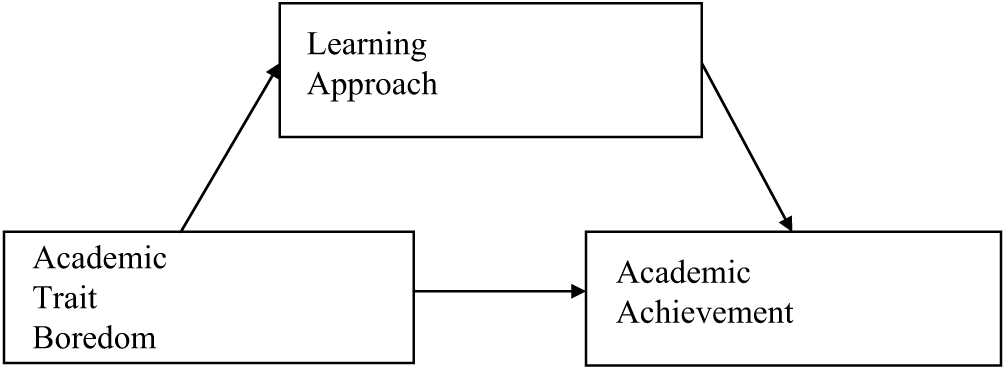
Based on the literature reviewed, a theoretical structural model linking Academic Trait Boredom, Learning Approach, and Academic Achievement was hypothesised (see Figure 1). The model posits three relationships: (1) Academic Trait Boredom has a direct influence on Academic Achievement, (2) Learning Approach has a direct influence on Academic Achievement, and (3) Learning Approach mediates the effect of Academic Trait Boredom on Academic Achievement.
Theoretical model of how Academic Achievement is influenced by both Academic Trait Boredom and Learning Approach.

Research Aim and Questions
The research that informs this article was carried out in the UK higher education context and aimed to explore the relationship between academic boredom, learning approach and academic achievement. It represents an extension of our earlier mixed-methods contribution (Sharp et al., Reference Sharp, Hemmings, Kay and Atkin2018), focusing exclusively on a more detailed and quantitative exploration of the relationships between the variables involved. This particular exploration was supported additionally by a focus on the effect of gender. In order to realise its aim, three questions were framed to guide the research:
(1) What is the relationship between Academic Trait Boredom, Learning Approach and Academic Achievement of university students?
(2) How is gender related to (a) Academic Trait Boredom, (b) Learning Approach and (c) Academic Achievement of university students?
(3) Does the inclusion of gender improve the fit of a model depicting the relationship between Academic Trait Boredom, Learning Approach and Academic Achievement of university students?
Method
Participants
Sampling was both purposive and convenient, comprising 380 final-year undergraduate students across three graduating cohorts at a small university in England. The university draws the majority of its students from the local region and offers programs in a range of disciplines while specialising in education.
Ethical approval for the research was obtained in accordance with institutional policy informed by British Educational Research Association guidelines. Since participation in the study was entirely voluntary and by self-selection, and considering sample mortality over the survey period, 224 individuals returned useable data. The reduced sample contained 167 females and 57 males, with age ranging from 21 to over 40 years (estimated sample mean 24.3 years). Approximately two-thirds of these participants were the first person in their family to pursue university studies. An examination of the reduced sample, using the background variables gender and first person in family to study at university, showed similar proportions to those in the initial, larger sample.
Procedure
The participants completed a series of questionnaires comprising demographic questions and questions pertaining to Academic Trait Boredom and Learning Approach. Academic Trait Boredom was measured by an adapted form of the BPS, referred to as the BPS-UKHE (Sharp et al., Reference Sharp, Hemmings and Kay2016). Items forming the BPS-UKHE instrument use a 5-point Likert-type scale (1 = never, 5 = always), and the instrument has three forms, namely, a full-scale (28-item) form, a five-factor (26 items) form, or a three-factor (18 items) ‘short form’. The latter was derived from the full-scale version in this study with its three factors illustrated as follows:
(1) Tedium — monotony, repetition, confinement and a lack of excitement (nine items; e.g., ‘At university, I often find myself trapped having to do meaningless things’);
(2) Time — the perception of time slowing down and the ability to manage time effectively (six items; e.g., ‘At university, I find myself sitting around doing nothing’); and
(3) Concentration — lack of focus and motivation and the need for stimulation (three items; e.g., ‘At university, I find it easy to concentrate on my work and other activities’).
Three subscales were derived by a grouping of the items as defined by the factors and were produced, following reverse score transformations where appropriate, by summing the raw scores available and then dividing by the number of items to arrive at mean values.
The Learning Approach questions were drawn from the ASSIST questionnaire (Centre for Research on Learning and Instruction, 2006). Items corresponding to Deep, Strategic, and Surface Approaches were rated by the participants on a 5-point Likert-type scale (1 = disagree, 5 = agree). Examples of items included:
(1) ‘When I am reading, I stop from time to time to reflect on what I am trying to learn from it’ (Deep Approach);
(2) ‘I think I’m quite systematic and organised when it comes to revising for assignments and exams’ (Strategic Approach); and
(3) ‘I find I have to concentrate on just memorising a good deal of what I have to learn’ (Surface Approach).
The Deep Approach subscale was derived from a grouping of items linked to the following four dimensions: seeking meaning, relating ideas, use of evidence, and interest in ideas. The Strategic Approach subscale was formed from items relating to five dimensions, namely, organised studying, time management, alertness to assessment demands, achieving, and monitoring effectiveness. Lastly, the Surface Approach subscale was produced from items concerning four dimensions (unrelated memorising, lack of purpose, syllabus-boundedness, and fear of failure). In each case, the relevant items were summed and a mean score was calculated.
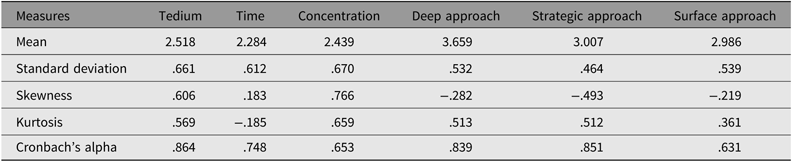
Details, including mean, standard deviation, skewness, kurtosis, and Cronbach’s alpha pertaining to the three Academic Trait Boredom subscales, as well as the three Learning Approach subscales, are presented in Table 1. Since all the skewness and kurtosis values fell within the range −1 to +1, it can be assumed that the measures were normally distributed and thus were suitable for analysis using either bivariate or multivariate procedures (Hair, Black, Babin, & Anderson, Reference Hair, Black, Babin and Anderson2010).
Descriptive statistics of the BPS-UKHE and ASSIST subscales

The measure of Academic Achievement used here was based on the participant’s degree mark. This mark, expressed as a percentage, was calculated from the arithmetic mean of the results obtained from six Year 2 and six Year 3 (final year) modules in accordance with the institution’s degree regulations. The mean and standard deviation of the degree mark were 60.24 and 7.07 respectively (degree mark range 38–80). The skewness and kurtosis values for this measure were within the range −1 to +1.
All the statistical analyses were conducted using SPSS (Version 22). A correlational analysis was run and two separate one-way multivariate analyses of variance (MANOVAs)Footnote 1 were carried out, with gender as the independent variable. In the first MANOVA, the three Academic Trait Boredom subscale measures were used as the dependent variables, while in the second MANOVA the three Learning Approach subscale measures and degree mark were the dependent variables.
In order to examine the relationships between the various measures described in Figure 1, a structural equation model was tested. Structural equation modelling (SEM) is a multivariate technique that permits a simultaneous examination of measured (or manifest) variables and latent (or unobserved) constructs (Hair et al., Reference Hair, Black, Babin and Anderson2010). It provides information about the structural relationships and potential pathways between anticipated predictor variables that correlational analysis cannot. The technique also accounts for measurement error in the manifest variables. The modelling was performed using AMOS (Version 22), an extension package within SPSS. Finally, the SEM was repeated using a two-group sample divided on the basis of gender.
Results
Correlation
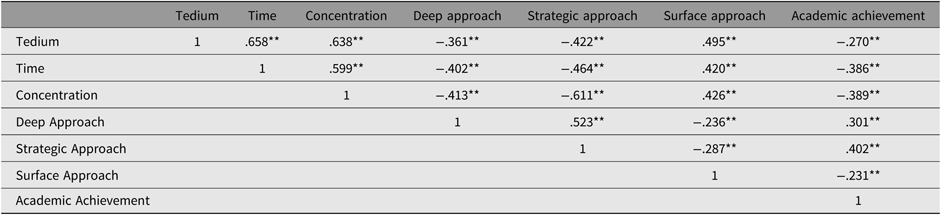
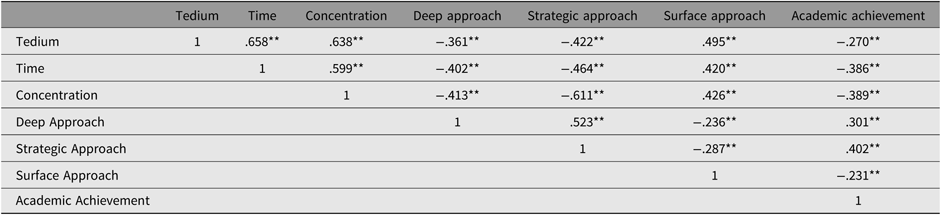
Table 2 reports the correlations between the Academic Trait Boredom subscales, the Learning Approach subscales and Academic Achievement. An inspection of these correlations shows that all the bivariate relationships were significant (p < .01) and in the direction predicted. More particularly, the Academic Trait Boredom subscale measures had negative relationships with Academic Achievement, and the Deep and Strategic Approach measures had a positive relationship with Academic Achievement. The correlation between Surface Approach and Academic Achievement was negative. Interestingly, most coefficients between Academic Trait Boredom and Learning Approach were moderate to strong, especially so between Concentration and a Strategic Approach (r = .611, p < .001) and Tedium and a Surface Approach (r = .495, p < .001), but less so between Academic Trait Boredom, Learning Approach and Academic Achievement.
Correlation matrix
Note: *p < .05, **p < .01 (2-tailed).
MANOVA
The one-way MANOVA to examine the effect of gender on the Academic Trait Boredom subscale measures produced a significant multivariate result; Pillai’s trace statistic = .940, F(3, 320) = 4.066, p = .008, η2 p = .053. The subsequent univariate tests, using a Bonferroni adjustment (p ≤ .016), revealed significant results for the Tedium subscale measure (p = .001, η2 p = .05) and the Concentration subscale measure (p = .007, η2 p = .032), but not for Time. These results demonstrated the lower Academic Trait Boredom scores (that is, less prone to academic boredom) of female respondents compared with their male counterparts.
A second one-way MANOVA exploring the influence of gender on the Learning Approach subscale measures and Academic Achievement yielded a significant multivariate result; Pillai’s trace statistic = .046, F(4, 219) = 2.621, p = .036, η2 p = .046). While females tended to have marginally higher scores on the Learning Approach measures and Academic Achievement than their male counterparts, follow-up univariate tests using a Bonferroni adjustment (p ≤ .012) were not significant. The means (by gender) for all the relevant measures are presented in Table 3.
Table of means by gender

SEM
SEM provides a means of examining the relationships between multiple measured variables simultaneously. This is achieved by constructing latent variables, akin to those produced in factor analysis, and then comparing the fit of the model to the actual data (Byrne, Reference Byrne2001). Various indices are used to measure the degree of fit.
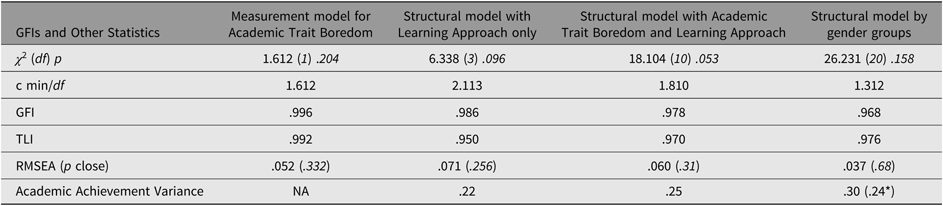
The goodness-of-fit index (GFI), Tucker Lewis index (TLI), and root mean square error of approximation (RMSEA) were chosen, alongside chi-square (χ2) statistics, to assess the fit of the models. GFI values range from 0 to 1, with values greater than .90 considered good. TLI values can fall below 0 or above 1; however, models with good fit have values near 1. And finally, RMSEA is one of the most widely used measures of fit and values less than or equal to .08 indicate acceptable fit (Byrne, Reference Byrne2001; Hair et al., Reference Hair, Black, Babin and Anderson2010). All of the indices for the models tested (refer to Table 4) and presented in this section indicate good model fit.
Goodness-of-Fit Indices (GFIs) and other statistics for the four models

Note: *Female group. NA = not applicable, GFI = goodness-of-fit index, TLI = Tucker Lewis index, RMSEA = root mean square error of approximation.
The modelling proceeded in three steps. In the first step, a structural model depicting the relationship between Academic Trait Boredom and Academic Achievement was tested. However, although it was not possible to produce an adequate structural model with Academic Trait Boredom variables (indicators) predicting Academic Achievement, a good fitting measurement model for Academic Trait Boredom was developed. In accord with standard practices, to obtain goodness-of-fit statistics, the Tedium variable items were divided into two groups, rather than a single score, so that two measures were derived (Hair et al., Reference Hair, Black, Babin and Anderson2010).
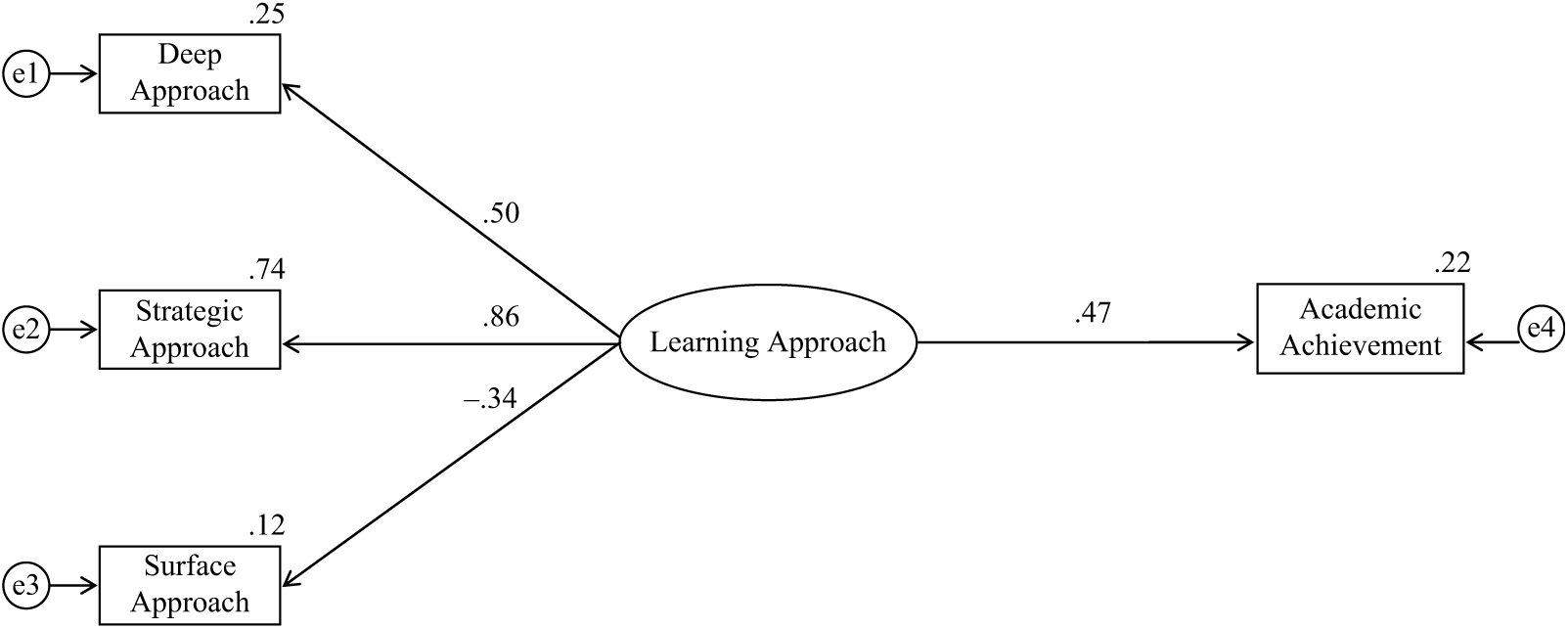
In the second step, a structural equation model was constructed between three indicators of Learning Approach, a latent variable, and Academic Achievement (see Figure 2). This model also shows that the latent variable has a direct influence on Academic Achievement, with .22 (22%) of the variance in Academic Achievement being accounted for.
Estimation of model for Academic Achievement with Learning Approach.

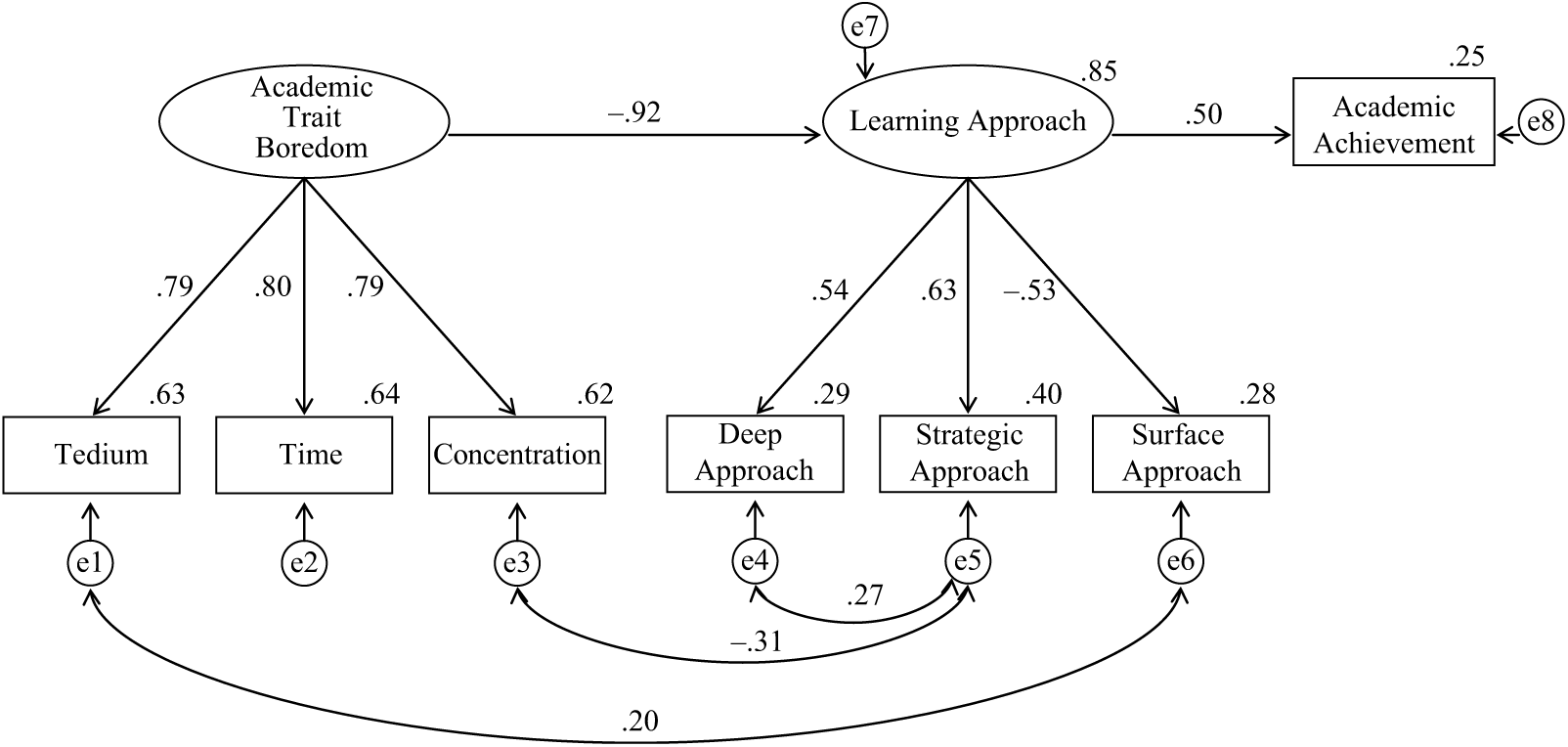
In the third step, alternative models focusing on the direct and indirect effects of Academic Trait Boredom and Learning Approach on Academic Achievement were explored. The most acceptable model on an empirical basis was found to be that presented in Figure 3. It needs to be noted that covariancesFootnote 2 between the error terms were only inserted when there was a clear conceptual link between the indicators with linked errors, and the insertion of covariances resulted in improvement to the fit statistics. This model appeared to be theoretically appropriate in that Learning Approach is mediatingFootnote 3 the effects of Academic Trait Boredom on Academic Achievement and, in so doing, the proportion of explained variance in Academic Achievement has been increased to .25 (25%).
Structural model for Academic Achievement with both Academic Trait Boredom and Learning Approach.

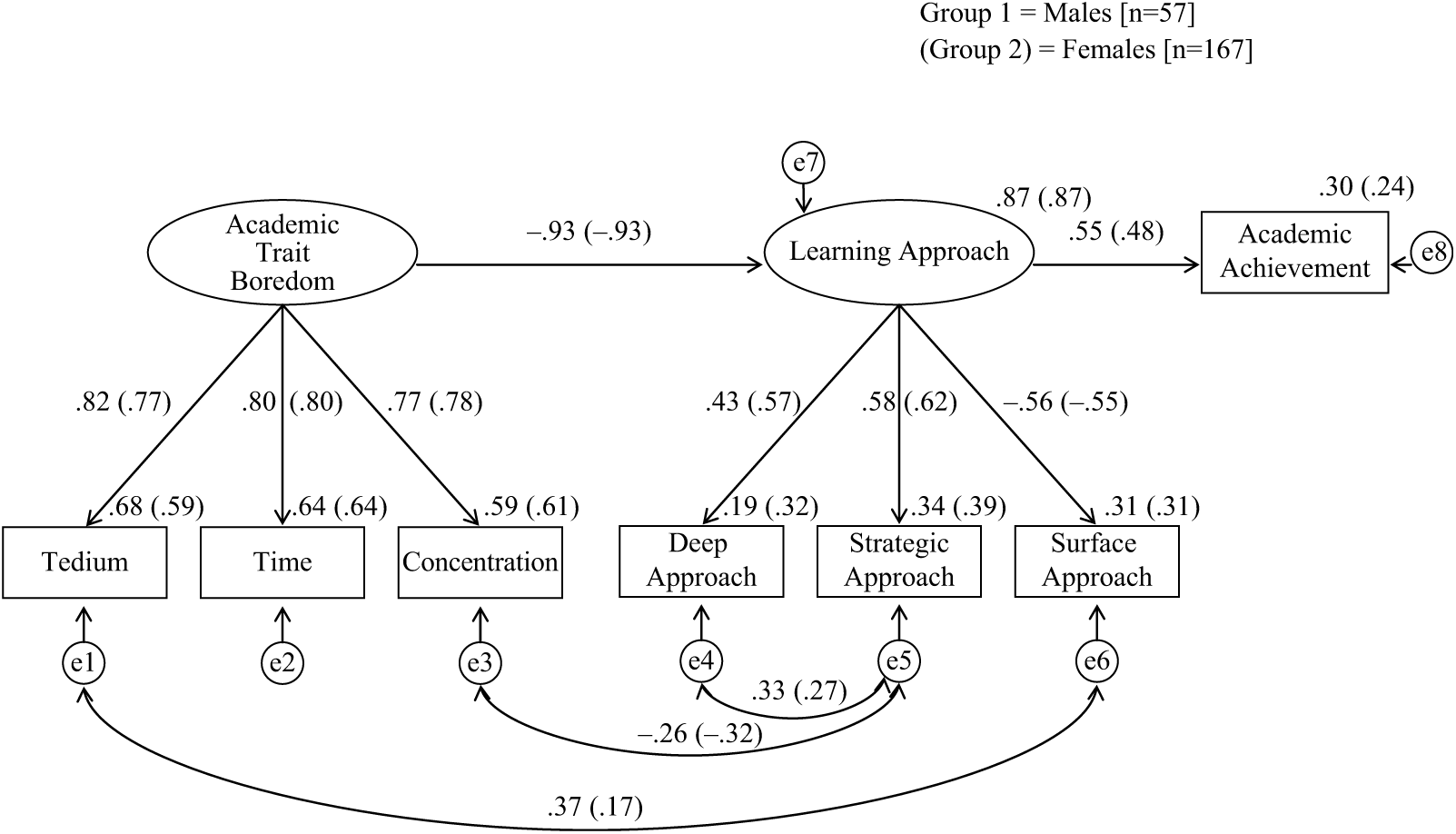
Finally, the third model was analysed using two groups based on gender. This approach was justified in view of the results obtained from the MANOVAs based on gender reported earlier. The model accepted is shown in Figure 4. In general the GFI statistics for this model were superior to those in the third model, and the proportions of variance explained were higher for males (30%) and approximately equal for females (24%). These results vindicate the decision to construct a model using separate gender groups.
Estimation of model for Academic Achievement by gender

Discussion
This section begins with a commentary on the key findings emerging from the research. These findings are aligned with the three research questions and their implications are addressed. Next, some of the study’s inherent limitations are presented. Lastly, consideration is given to how future studies could be designed to build on the results found.
In terms of addressing Research Question 1, this study helps to illustrate and confirm the overall value of investigating Academic Trait Boredom, Learning Approach and Academic Achievement quantitatively, as well as helping establish the validity, reliability and application of the research instruments or questionnaires selected and used. Both correlational analysis and SEM were initially utilised to examine the relationship between Academic Trait Boredom, Learning Approach and Academic Achievement in detail. A modelling exercise revealed that Learning Approach had a direct influence on Academic Achievement. Although all variables were significantly related, the highest individual predictor was Strategic Approach. This is readily understandable given that degree success requires management of time and effort so that maximum benefit to the student’s results is obtained, especially where a student has to work to support his/her studies (Curtis & Shani, 2001). Nevertheless, it is notable that both Deep Approach and Concentration, and to a lesser extent Tedium and Time, are all closely related to Strategic Approach. Moreover, the structural model for Academic Achievement and Learning Approach (see Figure 2) showed that Strategic Approach, and to a somewhat lesser extent Deep Approach, were important indicators of Learning Approach, which in turn explained a substantial amount of the variance in Academic Achievement. Thus, a picture of a successful student who is low in Academic Trait Boredom and high in Deep and Strategic Approaches emerges. Surface Approach, in contrast to the other measures of Learning Approach, was positively correlated to the three measures of Academic Trait Boredom. These variables have been shown to all have a negative effect on Academic Achievement.
The structural model, which included both Academic Trait Boredom and Learning Approach, as predictors of Academic Achievement (see Figure 3), revealed a very close negative relationship between Academic Trait Boredom and Learning Approach. In this sense, a very large proportion of the variance of Learning Approach was explained by Academic Trait Boredom, and in turn the former latent measure accounted for 25% of the total variance in Academic Achievement. While Learning Approach accounted for a relatively large proportion of the variance in Academic Achievement, nevertheless, the inclusion of Academic Trait Boredom increased the variance accounted for in the model. The relationships displayed suggest that Academic Trait Boredom is a more permanent attribute, while Learning Approach may be more situational in nature.
MANOVAs were used to answer the second research question. These analyses showed that there were significant multivariate differences between males and females for the Academic Trait Boredom subscales, as well as for the Learning Approach subscales and Academic Achievement. However, in the case of the Academic Trait Boredom measures, significant differences such that females had lower scores were only found for the Tedium and Concentration measures. The significant results for these measures were consistent with the directions, albeit small, for the Deep and Strategic Learning Approach measures. But for the Surface measure, contrary to predictions, the result was marginally in the other direction. These findings suggest that it may be beneficial to tailor teaching methods, particularly for male students, so that interest and deep processing are encouraged. Moreover, it needs to be pointed out that males are generally less interested in undertaking Education Studies (Trusty, Robinson, Plata, & Kok-Mun, Reference Trusty, Robinson, Plata and Kok-Mun2000), and those who do are arguably less academically inclined.
A response to the third and final research question was based on the results of additional SEM work. When gender was included to produce a two-group structural model, some of the effects of the indicator variables became obvious. While the influences of the three measures of Academic Trait Boredom were rather similar for males and females, in the case of Learning Approach, a substantial difference occurred for the Deep Approach measure. For females, 32% of the variance of Deep Approach was shared with the latent measure of Learning Approach, but the equivalent figure for males was 19%. For the other two indicators, gender appeared to make little difference. With respect to the overall explanation of Academic Achievement there was a sizeable difference, with the model explaining 30% of the variance for males and 24% for females. This indicated that particularly for males, much of their academic success could be explained by Academic Trait Boredom and Learning Approach, and even in the case of females the figure of 24% is significant.
It is worth noting that Strategic Approach and Deep Approach were both positively associated with Academic Achievement. This finding is broadly consistent with what has been found previously (see, e.g., Duff et al., Reference Duff, Boyle, Dunleavy and Ferguson2004; Rytkönen et al., Reference Rytkönen, Parpala, Lindblom-Ylänne, Virtanen and Postareff2012). As has been commonly reported, Surface Approach was negatively related to Academic Achievement (see, e.g., Chamorro-Premuzic & Furnham, Reference Chamorro-Premuzic and Furnham2008; Snelgrove & Slater, 2006).
Based on the outcome of SEM modelling here, and with reference to the research literature presented, we would propose that strategies for boredom mitigation be considered alongside other areas of higher education activity aimed at ensuring an effective transition into and throughout a student’s university life journey. This might begin by placing students themselves at the heart of a transformational process, which considers not only how courses are designed and delivered but how teaching for learning and assessment acknowledges its debilitating effects. Why different forms of academic practice and interaction at university are adopted over others could certainly be more carefully articulated when the process of academic socialisation for most students begins. This might include, for example, presenting the nature and purpose of lectures. and other teaching methods and what these set out to achieve. The emotional demands of acquiring new study skills might also be addressed at much the same time. Given the apparent lack of immunity of any student to the effects of academic boredom, coupled with weaker approaches to learning, lecturers themselves should remain mindful of the importance of when and how to introduce and sequence new content, while at the same time considering more innovative and creative methods of instruction. Lecturers might also remain mindful of the variety of personal and environmental factors that affect the motives, intentions, and adaptations of students towards specific course requirements and the impacts these have on how they approach what they have to do. In particular, orientation and study programs might focus in greater depth on gender preferences in course choice and how to maintain participation and interest in students more likely to change their courses. For example, creating a sense of community among female students and drawing on the stories of females who have succeeded in a non-traditional career have proven to be useful strategies (Welker et al., Reference Welker, Nazar and Bonfati2015).
At the same time, students need to become more personally involved in their own courses and take more responsibility for their own learning, their ongoing meta-cognitive development extending to identifying and responding to academic boredom and learning demands effectively. Embedding study skills directly into courses might certainly help, while learning support staff could be utilised more productively by taking a more front-line role in assisting with attribution retraining, goal setting and helping students to focus on the benefits of positive emotions, thereby improving resiliency and building confidence. Students for whom academic boredom and approaches to learning prove particularly troublesome and who are at risk of falling behind or terminating their studies altogether could be identified at an earlier stage of their course and directed towards the sometimes highly specialised help that many personal tutors may feel unqualified to provide. Students themselves are not always best placed to recognise their own emotions, to know of their effects or what they mean and how to self-regulate, with provision required here too.
Despite the growing number of international studies, theoretical advances and methodological developments in the field of academic boredom and approaches to learning, our work here makes no claim to fully capture the heterogeneity of higher education provision, the student population, or the complexity of human behaviour associated with being a student. It does, nevertheless, provide a valuable baseline against which future findings might be considered and compared. This should, however, be undertaken with care. Quantitative data, mainly derived from the BPS-UKHE and ASSIST questionnaires, with their own limitations and shortcomings, relied upon self-reporting from self-selecting students in the main, assuming a common reception and understanding of statements and terms. The influence of academic boredom and approaches to learning on overall performance used only final-year degree outcome as a single and summative measure and statement of achievement, with university achievement considered in the narrowest of terms and definitions.
Pointing towards future research endeavours, longitudinal, cross-sectional and experimental studies across disciplines at national and international levels would allow the anticipatory emotions students experience ahead of specific learning events and the resultant emotions that follow to be brought into sharper focus which, with a detailed knowledge of student study habits, skills and approaches, would help highlight more of the probabilistic nature of these and other variables as causal agents (e.g., influencing the nature and direction of performance indicators and achievement directly, indirectly, reciprocally or in a mutually reinforcing manner).
While qualitative data formed part of our earlier analysis (Sharp et al., Reference Sharp, Hemmings, Kay and Atkin2018), the study reported here was not designed in such a way as to explore any gendered effect at interview. It would be productive to identify how these actions and possible intentions are related to student goals, values, beliefs, abilities and interests. By considering the added effect of gender it would be possible to build a greater bank of knowledge, which at this time only has the present study, an extension of our earlier work (Sharp et al., Reference Sharp, Hemmings and Kay2016), and the Trigwell et al. (Reference Trigwell, Ellis and Han2012) study as the main reference points.
Conclusion
The higher education environment is one in which students experience strong feelings about what and how they learn and their progress including joy, disappointment and boredom. Contemporary theorists such as Pekrun (Reference Pekrun and Heckhausen2000, Reference Pekrun2006) claim that these emotions are related to outcome and how that outcome is valued by the individual and the degree of control perceived over its achievement. The models developed in this study give credence to a C-VT viewpoint in that an individual’s academic boredom appears to influence learning strategies, which in turn may affect academic achievement. This study also confirms that students who are more prone towards academic boredom than others are more inclined towards adopting a surface approach over deep and strategic and achieve less academic success as a result (and vice versa). The implications for how courses are designed and delivered, as well as how students are supported throughout higher education, together with the possibility of gendered considerations, surely cannot be ignored.
Conflicts of Interest
None.
Ethical Standards
The authors assert that all procedures contributing to this work comply with the ethical standards of the relevant national and institutional committees on human experimentation and with the Helsinki Declaration of 1975, as revised in 2008.