Surgical site infections (SSI), which represent the second most common hospital-acquired infection (22%),Reference Klevens, Edwards and Richards 1 are in most cases preventable with adherence to proper prevention practices for those patients who are known to be carriers of methicillin-resistant Staphylococcus aureus (MRSA).
S. aureus is currently the most common cause of SSIs, causing as many as 37% of SSIs in community hospitals. Moreover, MRSA has become the single most common etiologic agent of SSIs in community hospitals.Reference Anderson, Sexton and Kanafani 2
It has long been demonstrated that there is an association between preoperative colonization with S. aureus and an increased risk of developing an SSI.Reference Kluytmans, Mouton and Ijzerman 3 Known carriers of MRSA could undergo a selective decontamination regimen preoperatively. Nevertheless, the difficulty of obtaining sample results in a short period using traditional culture techniques has made this extremely difficult and therefore this practice has not been routinely performed. With the emergence of the point-of-service rapid polymerase chain reaction (PCR) identification of MRSA through bedside systems such as the GeneXpert platform (Cepheid), the capability of screening patients who are undergoing elective surgery with hardware implantation during the same clinic visit is now a reality. The objective of this study was to compare bedside PCR that identifies methicillin-susceptible S. aureus (MSSA) and MRSA from nasal and groin sites with standard microbiologic techniques in patients about to undergo elective surgery with hardware implantation.
Methods
The study was performed within the framework of a randomized controlled trial examining the effect of decontamination therapy in patients who were carriers of MRSA or MSSA undergoing elective surgery with hardware implantation. It was conducted at the Michael E. DeBakey Veterans Affairs Medical Center with the approval of the institutional review board of the Baylor College of Medicine (Houston, Texas) and the Research and Development Committee of the Michael E. DeBakey Veterans Affairs Medical Center.
Patients were prospectively screened for MRSA and/or MSSA carrier status by obtaining swab samples from the nose and groin at the preoperative clinic visit (baseline) and at the day of surgery (DOS). Patients were included provided they were older than 18 years and undergoing elective surgery with implantation of hardware for general surgery, cardiac, orthopedics, vascular, and neurosurgery. Patients were excluded if they had an invalid PCR and/or culture result, were undergoing emergency surgery, or visited the clinic less than 5 days before surgery. All patients who entered the trial were retested at DOS and constituted the DOS sample. Subsequently, a sample was obtained from grouping the baseline and DOS samples.
Samples were prospectively collected from March 1, 2011 through March 1, 2012. Two pairs of swabs (N1, N2, G1, G2) were used to collect samples from the nose and groin, respectively. N1 and G1 were analyzed by PCR after being processed according to the manufacturer’s instructions. We used the GeneXpert Xpert SA Nasal Complete real-time PCR system. This PCR assay has been validated only for the analysis of nasal samples, hence groin samples were processed the same way as the nasal ones.Reference Xpert 4 Test results were available within 75 minutes after nose and groin sampling. N2 and G2 samples were cultured in blood agar and Columbia nalidixic acid agar, respectively. Subcultures were performed on MRSASelect media (Bio-Rad) for both sites. Plates were read after 24 hours of incubation at 35°C.
The sensitivity, specificity, positive and negative predictive values, and accuracy of the PCR assay were calculated for MRSA, MSSA, nose, and groin subsamples. Culture was considered the gold standard. CIs were calculated with a significance level of.05 according to the Wilson score interval, which is used for extreme binomial proportions. Calculations were performed with Excel software (Microsoft). Stata/SE software, version 11.1 (StataCorp), was used for 95% CI computation.
Results
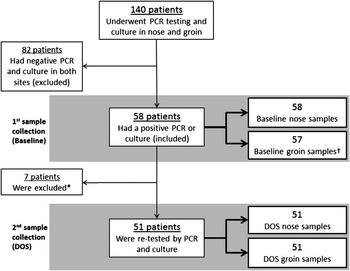
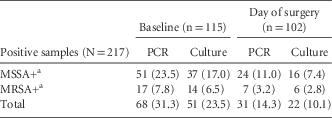
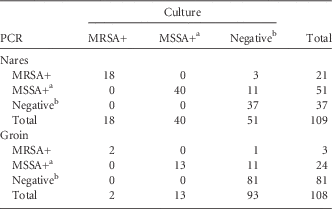
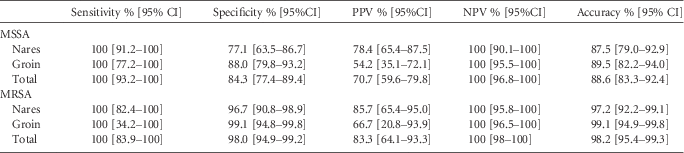
A total of 382 samples (191 from nose, 191 from groin) were taken from 140 patients (Figure 1). At baseline, 140 patients were tested, yielding 58 patients with any S. aureus positive result, independently of diagnostic technique or sample collection site (baseline group). Fifty-one of them were then retested at the DOS, constituting the DOS group. The 7 remaining patients did not undergo sample re-collection at DOS owing to either surgery cancellation or declination of intervention. A total of 109 positive nose samples, 58 from baseline and 51 from DOS, and 108 positive groin samples, 57 from baseline and 51 from DOS, were included in the analysis. One groin sample obtained from a patient at baseline was excluded because of an invalid PCR result. The patient underwent follow-up and the groin sample taken at DOS was included. Of all the positive samples combined (N=217), 73 (33.6%) yielded S. aureus by culture, 20 (9.2%) being MRSA positive and 53 (24.4%) being MSSA positive (Table 1). In comparison, PCR identified 99 (45.6%) S. aureus–positive samples, 24 (11.1%) of which corresponded to MRSA and 75 (34.5%) to MSSA. A comparison of positive nose and groin samples by diagnostic technique is shown in Table 2. PCR correctly identified all culture-positive samples, independent of sample collection site and resistance status of organism with a sensitivity of 100% in all groups (Table 3). Likewise, all 4 groups had a negative predictive value of 100%. When comparing MRSA status, MRSA samples had higher specificities (99.1% and 96.7% for the groin and nares areas, respectively) than MSSA samples (88.0% and 77.1% for the groin and nares areas, respectively). Furthermore, this difference turned out to be significant when comparing MSSA nose and groin samples to their MRSA counterparts (Table 3). PCR for MRSA groin detection had a significantly higher accuracy (99.1%) compared with both MSSA nose (87.5%) and groin (89.5%) sample groups.
Flow chart of study comparing polymerase chain reaction (PCR) to culture for identifying Staphylococcus aureus in patients about to undergo surgery with hardware implantation. Patients were screened for S. aureus carrier status at the preoperative clinic and on the day of surgery (DOS).†One patient had an invalid PCR result. *Surgery was canceled in six patients. One patient declined intervention.

Detection of Staphylococcus aureus by PCR or Culture in Samples Obtained From the Nares and Groin of Patients at Baseline and on the Day of Surgery

NOTE. Data is presented as number (% of positive samples). Fifty-eight patients were sampled at baseline and 51 on the day of surgery. Seven patients were not retested on the day of surgery owing to surgery cancellation or declination of intervention. One groin sample from baseline was read as invalid. MRSA, methicillin-resistant Staphylococcus aureus; MSSA, methicillin-susceptible S. aureus; PCR, polymerase chain reaction.
a Positive nares and groin samples.
Comparison of Sample Colonization by PCR or Culture

NOTE. MRSA, methicillin-resistant Staphylococcus aureus, MSSA, methicillin-susceptible S. aureus; PCR, polymerase chain reaction.
a MSSA positive samples were considered as negative for the calculation of MRSA sensitivity, specificity, positive and negative predictive values, and accuracy.
b A sample was considered negative when MSSA and MRSA were not detected by either PCR or culture.
GeneXpert PCR Sensitivity, Specificity, PPV, NPV and Accuracy by Organism and Body Site

NOTE. All CIs were calculated using the Wilson score interval technique, with a 95% confidence level. MRSA, methicillin-resistant Staphylococcus aureus; MSSA, methicillin-susceptible S. aureus; NPV, negative predictive value; PCR, polymerase chain reaction; PPV, positive predictive value.
Discussion
The current study sought to validate the feasibility of immediate preoperative identification by PCR of MRSA and MSSA carriers in patients undergoing elective surgery with hardware implantation, and to determine its accuracy when nose and groin samples were collected.
Our results agree with the findings of previous studies examining the accuracy of PCR for the detection of MRSA and MSSA compared with traditional culture methods (see Online Appendix). We found that overall MRSA sensitivity, specificity, positive predictive value, and negative predictive value were higher than those found for overall MSSA (Table 3). Furthermore, there was a significant difference of 9.6% between MRSA and MSSA overall accuracies. Differences among MSSA and MRSA accuracies might be explained by the higher proportion of false positives in the MSSA group compared with the MRSA group (Table 2). Of 75 positive samples for MSSA by PCR, 22 were false positives (29.3%), whereas the MRSA group had 4 false positives of 24 MRSA-positive samples (16.7%).
An explanation for the discordant results (ie, false positives) in the MRSA group could be the fact that chromogenic cultures were incubated only for 18–24 h. A meta-analysis examining 5 commercially available MRSA chromogenic media showed that when incubation time was shortened from 48 to 18–24 hours, there was a reduction in sensitivity.Reference Luteijn, Hubben and Pechlivanoglou 5 The higher false positive rate in the MSSA group might in turn be due, at least partially, to the inferior accuracy of traditional cultures compared with PCR.Reference Paule, Mehta, Hacek, Gonzalzles, Robicsek and Peterson 6 , Reference Wolk, Picton and Johnson 7 Another contributing factor could be the lower colony-forming unit inoculation threshold of PCR in comparison with direct agar culture.Reference Xpert 4 , Reference Rossney, Herra and Brennan 8
Sensitivity and negative predictive value were 100% in all sample groups, making the real-time PCR an excellent screening tool for the detection of MRSA and MSSA. Even though the Xpert SA nose assay has been approved by the US Food and Drug Administration only for nasal specimens, the sensitivity and negative predictive value in the groin were also 100% for both MRSA and MSSA. Although the anterior nares have the highest MRSA detection yield,Reference Lautenbach, Nachamkim and Hu 9 our results show a nonsignificant trend toward better accuracy when nose and groin site results are combined, supporting previous studies stating that combination and even simultaneous sample processing of different body sites can achieve even higher detection rates.Reference Lautenbach, Nachamkim and Hu 9 , Reference Hombach, Pfyffer and Malgorzata 10
The ability to accurately and quickly determine by PCR the MRSA and MSSA carrier status of a patient in a short period before surgery has epidemiologic as well as economic implications to both the patient and the institution in which it takes place. Moreover, other studies have demonstrated that active surveillance employing PCR identifies up to 91% of MRSA colonization undetected by clinical culture alone, further supporting the hypothesisReference Clancy, Graepler and Wilson 11 , Reference Calfee, Salgado and Classen 12 and suggesting the effectiveness of active surveillance testing programs that employ PCR techniques. Active surveillance testing has additional advantages including cost-effectivenessReference Hadley, Immerman and Hutzler 13 , Reference Gavalda, Masuet and Beltran 14 and reduction in turnaround time for reporting results, days of hospitalization, and indiscriminate antibiotic use for surgical prophylaxis and broad-spectrum treatment.Reference Parta, Goebel and Thomas 15 PCR-based screening could be additionally useful in situations when pre-admission assessment of carrier status by conventional methods is impractical and when the patients are admitted shortly before their procedures, such as in emergency surgeries.
Acknowledgments
Financial support. The funding for this study was part of an Investigator Initiative Grant from Cepheid.
Potential conflicts of interest. All authors report no conflicts of interest relevant to this article.
Role of sponsor. The sponsor had no role in study design, data collection, data analysis, data interpretation, or writing of the report.
Supplementary material
To view supplementary material for this article, please visit http://dx.doi.org/10.1017/ice.2015.34