Implications
Free-range pullets are reared in controlled indoor conditions before being provided outdoor access during the production cycle. Early rearing environments may be critical for hen adaptation to unpredictable outdoor conditions. Variable structural and stimulatory enrichments provided from 4 to 21 days of age affected range use in some measures and response to environmental stressors with these small experimental flocks of Hy-Line® Brown hens. Enriched hens may be more able to adapt to the free-range environment. These results highlight the importance of pullet-rearing environments for free-range production.
Introduction
The laying hen industry within Australia is rapidly increasing the proportion of free-range housing (Bray and Ankeny, Reference Bray and Ankeny2017). Pullets for free-range systems are typically reared in controlled indoor environments – floor or aviary systems, and transferred to the layer house around 15-16 weeks of age. Pop holes for range access in the laying facility are typically first opened between 21 and 26 weeks of age after which birds have regular access to the range for the duration of the flock cycle (pop holes are sometimes closed during inclement weather). Thus, for the first period of their lives, birds are kept in controlled, indoor conditions and this is suddenly changed with an option to access an environment that exposes them to variable weather, unpredictable external noise and stimuli, natural light and predators. This new environment may be stressful to the laying hens (Richards et al., Reference Richards, Wilkins, Knowles, Booth, Toscano, Nicol and Brown2011; Gilani et al., Reference Gilani, Knowles and Nicol2014), coupled with the physiological stress of coming into full laying production (Downing, Reference Downing2012).
Early rearing environments are important for optimising hens’ adjustment to layer housing systems and can have an impact on the health and welfare of adult birds (Janczak and Riber, Reference Janczak and Riber2015). For example, rearing hens in (more enriched) aviary enclosures compared with barren conventional cages, reduced their fear responses to novel objects following transfer to furnished cages as layers (Brantsæter et al., Reference Brantsæter, Nordgreen, Rodenburg, Tahamtani, Popova and Janczak2016a and Reference Brantsæter, Tahamtani, Moe, Hansen, Orritt, Nicol and Janczak2016b). Chicks provided a variety of novel stimuli in their cages (e.g. thimbles, buttons and coloured drawings on the walls changed every 3 days) showed a general reduction in fear over a series of behavioural tests conducted from 14 to 20 days of age, compared with control groups provided only feed and water (Jones and Waddington, Reference Jones and Waddington1992). In addition, chicks and pullets reared with access to environmental enrichment (brightly coloured plastic bottles, balls, rattles, handling and human voice via radio) showed reduced fear reactions and fewer strikes against cages when being pulled out during depopulation as adults (Reed et al., Reference Reed, Wilkins, Austin and Gregory1993). Finally, meat chickens provided with a variety of novel objects (plastic balls, plastic bottles, toys and mirrors changed every 3 days) from 1 to 21 days did not differ in their growth or tonic immobility fear responses when compared with control birds housed in standard floor pens with no additional objects. However, after being later subjected to acute stressors (heat, noise or crating) the enriched birds showed shorter tonic immobility duration indicating better adaptation to stressors than the non-enriched birds (Altan et al., Reference Altan, Şeremet and Bayraktar2013).
It has been recommended for best welfare that rearing environments are matched to laying environments (Janczak and Riber, Reference Janczak and Riber2015). However, there is little research regarding optimal rearing environments for free-range laying hens. Some early studies have shown that laying hens provided with outdoor experience (daily 30 min or 60 min forced outdoor exposure) and regularly handled between 12 and 20 weeks of age were faster to emerge from a familiar box into the outdoor paddock and also dispersed further than birds with either no experience of the outdoor paddock or who had only been regularly handled (Grigor et al., Reference Grigor, Hughes and Appleby1995). Krause et al. (Reference Krause, Naguib, Trillmich and Schrader2006) also showed that 1 week of access to an outdoor range at 5 weeks of age improved exploration and learning behaviour in a Y-maze task in 6-week-old chicks. Early range access may reduce fearfulness and impact range use, but such access is generally not a practical option for current pullet rearing facilities. Sensitive early periods of development, when the brain is particularly susceptible to experiential events (Knudsen, 2004) may therefore represent an opportunity to impose short-term interventions that provide long-term benefits.
For this study, newly hatched chicks were given 3 days to establish themselves in their new housing and were then provided with indoor structural, manipulable and stimulatory enrichment over 4 to 21 days of age simulating a variable, unpredictable environment. This is the same period determined to be where synaptic proliferation in the forebrain and development of thalamofugal visual projections occur and where environmental stimuli may have long-term impact (Rogers, Reference Rogers1995). The first objective of this study was to determine if the enrichments would have an impact on range use in adult life. The second and third objectives were to determine if the early enrichments affected adult hen welfare and enabled the birds to adapt better to imposed stressful events of being locked inside for 2 days and having their range area reduced. We predicted that enriched hens would show faster acclimation to the ranging environment, greater use of the range, better welfare and lower physiological stress levels in response to the stressful events.
Material and methods
Ethical statement
All research was approved by the University of New England Animal Ethics Committee (AEC 15-119) before chick arrival.
Chick housing and early enrichment
Day-old, infra-red beak-trimmed Hy-Line® Brown chicks (n=290) were obtained (November 2015) from a commercial supplier (flown to the research location) and randomly allocated into two separate rooms (4.5 m length×3 m width with no additional in-room divides) at the University of New England Animal House facilities where they were housed until 12 weeks of age. Temperature control and hours of lighting followed the recommended management guidelines (Hy-Line® International, 2014). Initial light measured at bird height in both rooms was 110 lx (Lutron Light Meter, LX-112850; Lutron Electronic Enterprise CO., Ltd, Taipei, Taiwan), and lowered to 40 lx at 2 weeks of age. Birds were provided ad libitum commercial mash formulated for specific growth stages, access to water nipples (10 birds/nipple) with wood shavings as a floor substrate. One perch rack (1.6 m height×2.2 m width with six perch bars) per room was added at 4 weeks of age.
Birds in one room (standard non-enriched conditions) had no additional interventions with personnel entering the room typically once per day after week 1 (all birds were checked multiple times per day during the first week). Birds in the second room (enriched treatment) were subjected to a novel, variable, unpredictable environment from 4 to 21 days of age. Across the enrichment period a variety of stimulation was provided including patterned wallpaper, cinder blocks, large sealed plastic tubs, novel objects attached to feeders and water nipples, coloured flashing lights and auditory playbacks that included sounds of doors opening, moving vehicles, weather, voices, machinery. Enrichments were changed every 2 to 3 days, or location shifted within the pen daily, with coloured lights and auditory playbacks on a random schedule. No behavioural or physiological measures of the birds’ responses to any of the enrichments were taken and thus we cannot conclude how the birds perceived the stimulation. The light and auditory stimulation and novel objects may have induced stress. After 3 weeks of age, all enrichments were removed and birds within both rooms were housed in the same conditions (with no added enrichments) for the remainder of the trial. Birds within both rooms were exposed to surrounding noise within the Animal House facility.
Pullet and layer housing
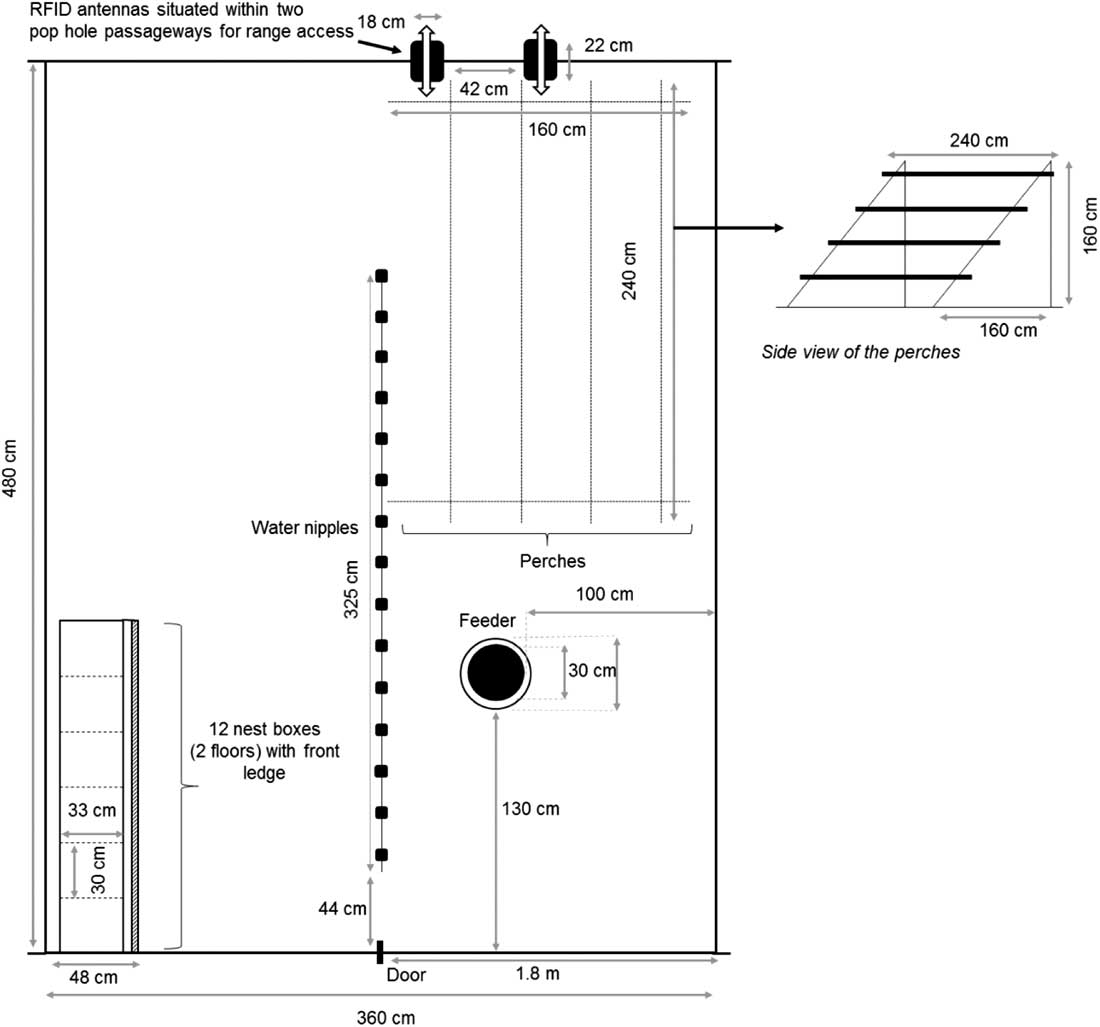
At 12 weeks of age all birds were transported (10 min vehicle drive) to the University of New England’s Laureldale experimental free-range facility located in Armidale, Australia and distributed between six identical indoor pens with 46 to 50 birds per pen at placement: three pens with hens reared enriched and three pens with hens reared non-enriched (the uneven distribution between pens was based on balancing birds across pens that had some prior behavioural tests and those that did not as part of a separate data set, additionally there were fewer enriched birds by time of placement). All pens had identical food, water, perch and nestbox resources that exceeded the Australian Model Code of Practice for the Welfare of Animals – Domestic Poultry (Primary Industries Standing Committee, 2002; Figure 1). Black plastic was hung between all pens as a visual barrier. Indoor stocking density was approximately three birds per m2 with rice hulls provided as a litter substrate. Birds were fed ad libitum commercial mashes formulated for pullet followed by layer life stages.
A top–down diagram of the free-range laying hens’ indoor pen set-up showing location of the range access pop holes (including radio-frequency identification (RFID) antennas), perches (side view included), nest boxes, feed and water. Each indoor pen had identical resources and configuration.

The shed was fan-ventilated but not temperature or humidity controlled. Incandescent lighting gradually increased to 16 h of light per day by 30 weeks of age (lights on at 0400 h, lights off at 2000 h). The light intensity inside the pens with the pop holes closed, measured at bird height in three locations within each pen (front, middle and back), ranged from 4 to 21 lx. This range increased to 5 to 35 lx measured on one sunny day when the pop holes were opened (indoor lux with the pop holes opened would be expected to vary throughout and between days with the changing position of the sun and inconsistent cloud cover).
Radio-frequency identification of range use
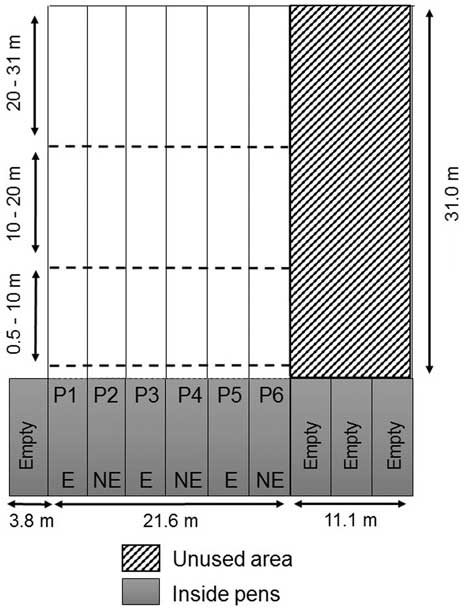
The six indoor pens linked with six separate straight outdoor runs (3.6 m width×31 m length) surrounded by 2 m high fences which before bird access, were 80% to 90% covered with a variety of grass and weeds (birds could not hide in the vegetation) but no additional trees or structures (Figure 2). Weekly photos of the range were taken for estimates of vegetation depletion. Based on the visual estimates, the vegetation coverage had declined to ~5% after 8 weeks of range access, when the birds were 29 weeks of age, and stayed at this level for the remainder of the trial. Outdoor stocking density at maximum occupancy was ~4500 hens per hectare (~2.2 birds per m2). Shade cloth (Universal Shade Cloth, 90% UV block grade; Shade Australia, Ingleburn, NSW, Australia) was placed doubled thickness, at a height of 0.9 m along the fences to minimise visual contact between birds although auditory contact was still possible. The pop holes, containing two radio-frequency identification (RFID) passageways (Figure 1), that provided range access were first opened when the hens were 21 weeks of age (April 2016) with subsequent daily access from 0900 to 1630 h across 21 weeks over the autumn and winter. Days were typically mild (average outdoor temperatures during range access hours were 15.6°C±SD 5.8; range: 1.1 to 29.5 °C; corresponding indoor temperatures across the range access weeks at all times of day were 10.43°C±SD 4.75; range: −2.45 to 25.09°C), and dry with some rain on 17% of ranging days. Birds were not forced onto the range and were trained to return inside each afternoon using a poultry grain mix (shaken in a metal tin then tossed into pens) and were held inside at all other times.
The six indoor pens (P1 to P6) for free-range laying hens and their designated outdoor range areas for the three replicates of each rearing treatment (E=enriched, NE=non-enriched). The range delimitations used during behavioural observations are indicated with dashed lines.

Before pop hole opening, all birds (at 20 weeks of age) were fitted with an adjustable numbered leg band (Roxan Developments Ltd, Selkirk, Scotland) containing a glued RFID microchip (Trovan® Unique ID 100 (FDX-A): operating frequency 128 kHz; Microchips Australia Pty Ltd, Keysborough, VIC, Australia). All microchips within leg bands were tested for functionality before being fitted to the hens and no birds lost their bands for the duration of the experiment. The RFID system was purchased from Microchips Australia Pty Ltd with equipment developed and built by Dorset Identification B.V. (Aalten, the Netherlands) using Trovan® technology and situated in the pens before bird placement. Each RFID system consisted of two passageways (36 cm height×18 cm width) situated within the pop holes (Figure 1), each with paired optical beam sensors at either side of an RFID antenna plate and all connected to an RFID decoder downloading directly to a USB flash drive. Each passageway recorded the date and time individual tagged birds passed through and in which direction (onto the range, or into the pen) with a precision of 0.024 s (maximum detection velocity 9.3 m/s). For further details on the system validation see Campbell et al. (Reference Campbell, Hinch, Dyall, Warin, Little and Lee2017).
Video recording and decoding
Six Hikvision (DS-2CD2T42WD-14 Outdoor EXIR Bullet; iCam Security, Forest Lake, QLD, Australia) cameras were used to record all outdoor range areas (excluding an ~0.5 m section directly in front of the pop holes that the cameras could not view). To assess acclimation to the range area, the resulting videos were used to count the numbers of birds outside during the first 3 weeks of range access (21 to 23 weeks of age) and the distance these birds were from the pop holes (0.5 to 10 m, 10 to 20 m, 20 to 31 m). Counts of all birds on the range at the three distances were made for each day for all the 3 weeks, 10 min after pop holes first opened, then every 20 min until pop holes closed. The videos were also used to document natural disturbance behaviours of birds on the range (possibly due to sounds, weather, overhead birds, etc.), defined as birds suddenly running towards the pop holes. Videos of all range areas were observed from pop hole opening until pop hole closing across weeks 2 and 3 following first pop hole opening (birds were 22 and 23 weeks of age). All range areas were also observed across weeks 12 and 13 following first pop hole opening (birds were 33 and 34 weeks of age). The occurrence of daily disturbance behaviours within each range area during the observation weeks and the percentage of birds on the range that were disturbed during each occurrence were documented. All hen counts on the range and observations of disturbance behaviours were recorded by a single observer that was blind to the rearing treatment of the birds, intraobserver reliability as measured by Cohen’s Kappa coefficient (McHugh, Reference McHugh2012) was κ=0.86 to 0.97.
Welfare scoring
Before pop hole opening (20 weeks of age), and then following range access at 26, 32 and 37 weeks of age all birds were weighed (BAT1; VEIT Electronics, Moravany, Czech Republic). Using a modified version of the Welfare Quality® scoring protocol (Welfare Quality®, 2009), basic health and welfare measures were also made on all hens on each weighing day. Feet were checked for broken, missing or injured toes. Footpad dermatitis was determined using a scale where 1=footpad dermatitis on one or both feet with no swelling, 2=dermatitis on one or both feet with moderate swelling, 3=footpad dermatitis on one or both feet with dorsally visible swelling. Birds were manually palpated for keel damage with the scoring being N for no damage and Y for any damage (deviations or indication of fracture) at week 20 of age but after this an additional category (Y*) was added to classify a condition where there was comparatively more severe keel damage. Birds were visually assessed for comb discolouration, comb wounds, skin pecking wounds, presence of external parasites, feather damage and feather loss. The same experimenter who was aware of the rearing treatment groups performed all visual health scoring and keel palpations.
Albumen corticosterone
At 20, 26, 32 and 38 weeks of age, 50 eggs from each pen across 2 days (25 eggs per pen per day) were randomly sampled from the nest boxes (floor eggs were sporadic and minimal) for assessment of albumen corticosterone concentrations. On the day of collection, all eggs were weighed, cracked open, the albumen was separated out into a 50 ml tube, weighed and then stored at −20°C until assayed following the procedures reported by Downing and Bryden (Reference Downing and Bryden2008). All albumen corticosterone analyses were conducted blind to rearing treatment.
Stressful events and measurements
At 39 weeks of age, all birds were locked inside the shed for 2 days to simulate a potentially stressful event. All daily morning husbandry activities remained unchanged across the 2 days but pop holes were not opened. Following this, pop holes were opened again for 1 week with range access again from 0900 until 1630 h. At 40 weeks of age, a second potentially stressful event was initiated with the available outside range area shrunk to 20% of its original size with daily access again from 0900 until 1630 h. The RFID recording continued over the 2 weeks following range area reduction. Approximately 45 eggs per pen (all eggs laid in a single day) were sampled on day 2 of bird lock-up and both day 2 and day 14 following range area reduction to assess albumen corticosterone concentrations in response to the stressor events. Egg processing occurred as stated previously with corticosterone analyses conducted blind to bird rearing treatment.
Data and statistical analyses
All analyses were conducted in JMP®13.0.0 (SAS Institute, Cary, NC, USA) with α set at 0.05. Where significant differences were present, post-hoc comparisons were made using Student’s t-tests with Bonferroni correction applied for greater than 3 post-hoc comparisons. Data transformations were applied where stated but the least squares means (LSM)±SEM of the raw values are presented in the results as there was virtually no difference between the raw and back-transformed means.
Video counts and disturbance behaviours
Counts of the number of hens on the range at the three different distances from the pop holes were averaged across each observation day for each pen. Daily data were grouped into 3-week long periods (21, 22 and 23 weeks of age) corresponding to the first 3 weeks of range access (n=378, 3 distances×21 days×6 pens). Using general linear models (GLM) with repeated measures, the effect of pen within rearing treatment, rearing treatment, distance and week of age were compared including all interactions, with non-significant interaction terms removed from the final model.
Counts of the number of disturbance occurrences on the range within each pen of birds were summed across each observation day and the proportion of birds disturbed during each occurrence were averaged across each observation day. All count and proportional data were then split into the ‘initial’ range access period (22 and 23 weeks of age, n=84, 14 days per six pens) and ‘acclimated’ range access period (33 and 34 weeks of age, n=84, 14 days per six pens). Count data were square-root transformed and proportional data were logit transformed with all data analysed using GLMs with repeated measures. The effects of rearing treatment, range access period and pen nested within rearing treatment were included in the final model, together with all interactions.
Radio-frequency identification data
The daily RFID data were filtered through a custom-made software program (Bryce Little; CSIRO, Agriculture and Food, St Lucia, QLD, Australia) that filtered out unpaired or ‘false’ readings when a hen did not complete a full transition onto the range or back inside. For each individual hen, the program provided the daily hours outside and daily number of visits to the range. These were summed across five age periods (21 to 24 weeks, 25 to 27 weeks, 28 to 30 weeks, 31 to 33 weeks and 34 to 37 weeks) to provide five data points per individual hen each for daily hours outside and daily visits to the range. The percentage of available days that each hen visited the range were calculated across the same five age periods. The proportional data of hens using the range on available ranging days were arc-sine transformed before analysis and the count data of hens daily visits were square-root transformed. GLM’s with repeated measures were applied to assess the effects of rearing treatment, week of age and pen nested within rearing treatment together with interactions.
Welfare scoring
Data from the health and welfare measures were compiled separately for each pen within each rearing treatment for each sampling age and at the individual-bird level for BW. A GLM with repeated measures was used to compare the effects of rearing treatment, sampling age and their interaction and pen nested within rearing treatment on BW. The number of birds with keel damage (including severe damage) within each treatment group were compared separately for each age point using Pearson’s χ 2 tests. The numbers of birds with severe keel damage were too small for accurate statistical tests to be applied and thus all keel damage was included together in the analyses. However, the percentages of birds with both types of damage are presented separately in the results.
Albumen corticosterone and stressor events
All albumen corticosterone concentrations from individual eggs were grouped into data from 20, 26, 32, 38 weeks of age, following the hens being locked inside, and then immediately following range area reduction and 2 weeks following range area reduction for hens within each pen from the two rearing treatments. A GLM with repeated measures was used to first compare the effect of rearing treatment, hen age (including their interaction) and pen nested within rearing treatment on corticosterone concentrations from 20 to 38 weeks of age. A GLM with the same model effects was then applied to compare corticosterone values from 38 to 42 weeks to include measures made just before and following all stressor events. The 38-week value was thus included in both models.
To compare the effects of range area reduction on range usage, 15 days of ranging immediately before the lock-in event were selected as ‘normal’ ranging days in closest proximity to the 15 days of ranging following range area reduction. There were 7 days of ranging following lock-in that were not included in the comparisons as they directly followed a potentially stressful event. Daily RFID data were summed across the 15 days to provide a single value for each individual hen of the average hours outside and the average number of visits. Count data were square-root transformed. Differences between rearing treatments were first assessed for the period before range area reduction including the effect of pen nested within rearing treatment. The difference between these measures (before and after reduction) was then calculated (positive values indicate more ranging before range area reduction) to provide a single value for each individual hen of the difference in hours spent outside and difference in the number of visits. Using GLMs, the effects of rearing treatment and pen nested within rearing treatment were compared on all difference values.
Results
Video counts and disturbance behaviours
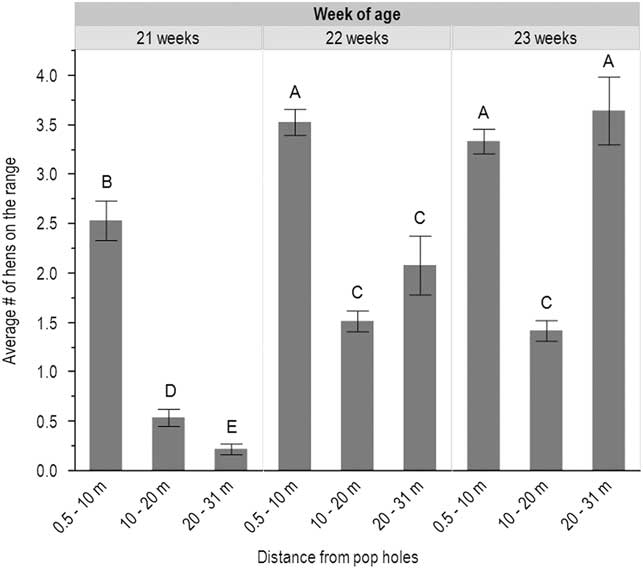
There was no significant effect of rearing treatment (F 1,364=0.32, P=0.57) on the number of hens using the range simultaneously during the first 3 weeks of range access and no interactions with week of age or distance from pop holes (all P>0.82). However, pens within treatment groups varied (F 4,364=36.70, P<0.0001). There was an interaction between week of age and distance from the pop holes with an increase in number of hens outside as the hens aged, particularly at the greatest distance from the pop holes (F 4,364=34.06, P<0.0001, Figure 3).
The mean±SEM number of free-range laying hens on the range simultaneously at three separate weeks of age following first pop hole opening (21 weeks of age) located at three distances from the pop holes (0.5 to 10 m, 10 to 20 m, 20 to 31 m). Bars with different letters differ significantly both between the distances from the pop holes and across the weeks of age (P<0.008).

There was no significant effect of rearing treatment on the average proportion of birds that were observed running during each disturbance (P=0.30) and only a trend for an effect of range access period (P=0.08, LSM±SEM enriched initial range access period: 65.25±1.47%, non-enriched initial range access period: 65.79±1.47%, enriched acclimated range access period: 61.29±1.47%, non-enriched acclimated range access period: 63.65±1.47%), with no interaction between rearing treatment and range access period (P=0.50). There were differences between individual pens within each rearing treatment (F 4,161=8.70, P<0.0001).
There was a trend for an effect of rearing treatment on the daily frequency of behavioural disturbances out on the range (P=0.09) and a significant effect of range access period (F 1,161=104.82, P<0.0001) with fewer disturbances observed when hens had already spent 11 weeks on the range (LSM±SEM enriched initial range access period: 13.71±0.79 disturbances per day, non-enriched initial range access period: 12.12±0.79, enriched acclimated range access period: 5.29±0.79, non-enriched acclimated range access period: 4.38±0.79). There was no interaction between treatment and range access period (P=0.98) and no differences between pens within each rearing treatment (P=0.16).
Radio-frequency identification tracking of range use
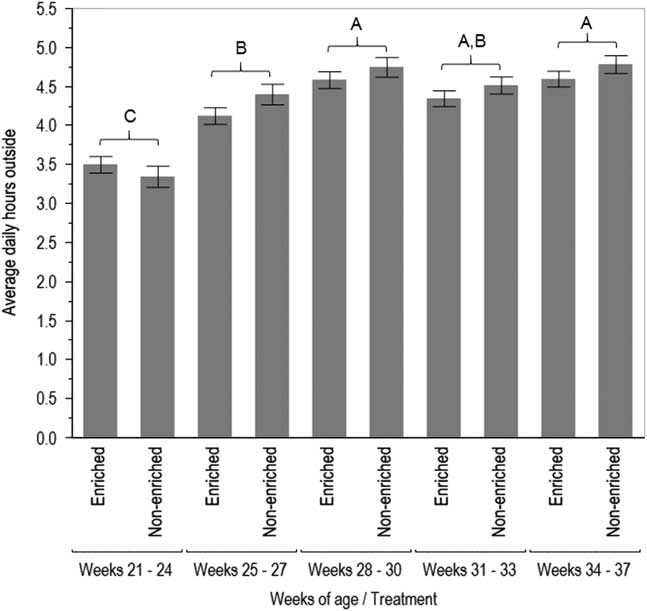
There was an effect of rearing treatment on the average number of hours hens were outside (F 1,1401=4.15, P=0.04) with enriched hens spending less time outside on average each day (LSM±SEM enriched: 4.23±0.05 h, non-enriched: 4.36±0.05 h, Figure 4). There was also an effect of age period (F 4,1401=44.77, P<0.0001) with hens generally spending more time outside as the trial progressed (Figure 4). There was no interaction between rearing treatment and age period (P=0.33) but there were differences between individual pens with the rearing treatments (F 4,1401=39.11, P<0.0001).
The mean±SEM daily hours individual free-range hens spent outside across five age periods from 21 to 37 weeks for birds from two early rearing treatments (E=enriched, NE=non-enriched). Bars with different letters indicate significant differences between age periods (P<0.01).

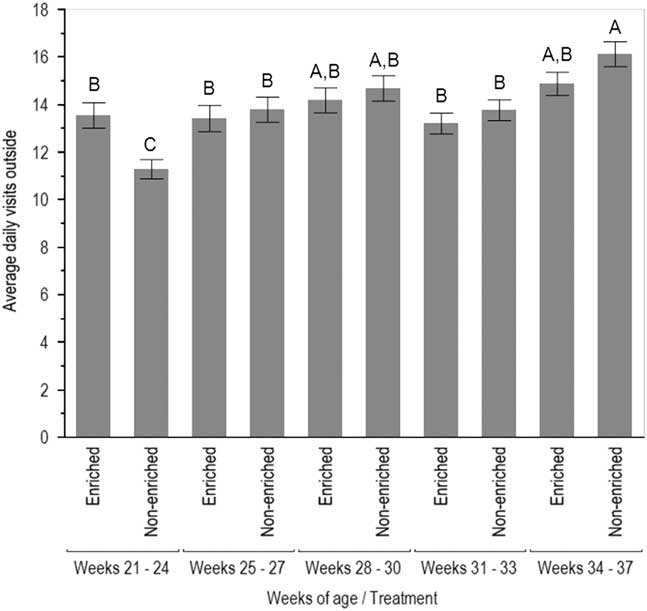
There was an interaction between rearing treatment and age period in the average number of daily visits outside (F 4,1401=3.18, P=0.01) with enriched birds showing more visits to the range than non-enriched birds from 21 to 24 weeks of age (Figure 5). There was also an overall effect of age period with the least visits from 21 to 24 weeks and the most visits from 34 to 37 weeks of age (Figure 5). There was no overall effect of rearing treatment (P=0.66) but there were differences between individual pens within rearing treatments (F 4,1401=25.29, P<0.0001).
The mean±SEM daily visits by free-range hens outside across five age periods from 21 to 37 weeks for birds from two early rearing treatments (E=enriched, NE=non-enriched). Bar with different letters indicate significant differences between treatment groups across age periods (P<0.005).

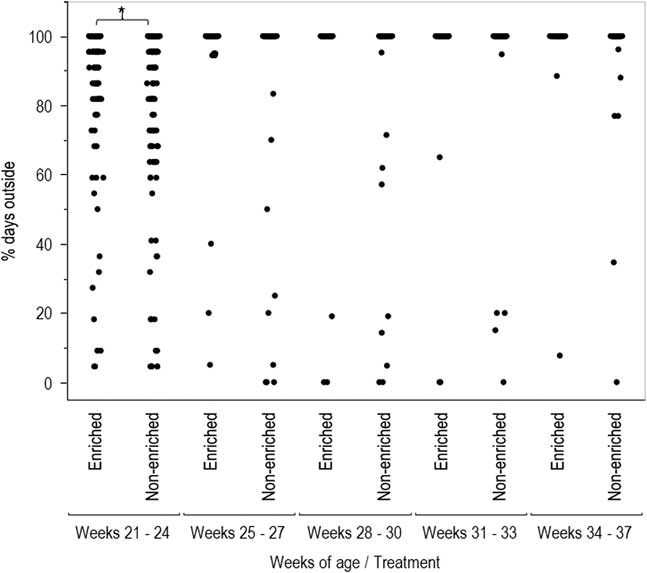
Finally there was an effect of rearing treatment on the percentage of available days that individual hens accessed the range (F 1,1401=5.19, P=0.03) with enriched hens accessing the range on more available days than non-enriched hens (Figure 6). There was an increase in the percentage of days spent on the range across the age periods (F 4,1401=72.03, P<0.0001) but no interaction between rearing treatment and age periods (P=0.89, Figure 6). There were also differences between pens within rearing treatments (F 4,1401=9.20, P<0.0001).
The percentage of available days individual free-range hens visited the range across five age periods from 21 to 37 weeks for birds from two early rearing treatments (E=enriched, NE=non-enriched). Each data point represents an individual bird and the asterisk (*) indicates the 21 to 24 weeks period differed significantly from all other age periods (P<0.01).

Welfare scoring
Only two birds died due to unknown causes across the trial period and thus were removed from final data sets, all other birds appeared to be in visibly good health. Only two non-enriched birds at 37 weeks had a broken toe, two birds (one enriched, one non-enriched) were observed with category 3 footpad dermatitis at the 37 weeks sampling age. No evidence of comb discolouration, wounds, skin pecking wounds, external parasites, feather damage and feather loss were observed (except for two enriched birds at 32 weeks and one enriched bird at 37 weeks with feather loss on underside).
There was an effect of rearing treatment on body weight (F 1,1132 =4.0, P=0.045) with the enriched birds slightly heavier (LSM±SEM: 1.88±0.005 kg:) than non-enriched birds (1.87±0.005 kg). As expected, birds increased in weight as the trial progressed (F 1,1132=183.02, P<0.0001) but there was no interaction between sampling age and rearing treatment. The LSM±SEM BW at the sampling ages were: 20 weeks 1.73±0.01 kg, 26 weeks: 1.86±0.01 kg, 32 weeks: 1.93±0.01 kg, 37 weeks: 1.97±0.01 kg. There were also differences between individual pens within each rearing treatment (F 4,1132=6.10, P<0.0001).
There was no effect of rearing treatment on the incidence of keel damage at 26 weeks (χ 2=1.09, df=1, n=286, P=0.30), 32 weeks (χ 2=1.70, df=1, n=286, P=0.19), or 37 weeks of age (χ 2=0.005, df=1, n=286, P=0.94). There was no keel damage detected at 20 weeks of age across all treatments. The frequencies of keel damage increased as the hens aged (26 weeks: Y=9.44%, Y*=0.35%, 32 weeks: Y=15.73%, Y*=2.10%, 37 weeks: 18.53%, Y*=2.80%).
Albumen corticosterone and stressor events
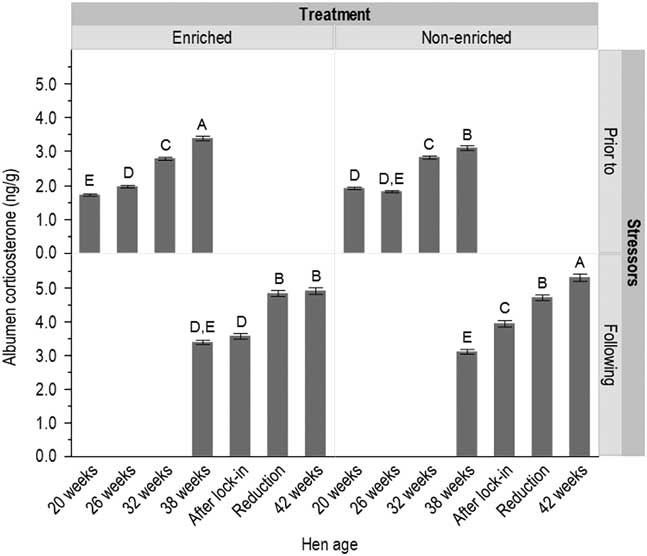
There was an interaction between the effects of rearing treatment and hen age on albumen corticosterone concentrations from 20 to 38 weeks of age (F 3,1182=10.22, P<0.0001). Eggs from enriched birds showed a difference in concentrations between 20 and 26 weeks of age but eggs from non-enriched birds had similar values between these sampling times and eggs from enriched birds had higher concentrations than eggs from non-enriched birds at 38 weeks (Figure 7). There was no overall effect of rearing treatment (P=0.13) but as expected, albumen corticosterone concentrations increased as the birds aged (F 3,1182=461.58, P<0.0001, Figure 7). There were differences between individual pens within the rearing treatments (F 4,1182=8.64, P<0.0001).
The mean±SEM albumen corticosterone concentrations (ng/g) of eggs from free-range laying hens from the two rearing treatments (enriched, non-enriched) at 20, 26, 32 and 38 weeks of age before the stressor events then 38 weeks, after lock-in, immediately following range reduction to 20% of the original size and at 42 weeks of age (2 weeks following range reduction). The 38-week value is displayed twice. Bars with different letters indicate significant differences between rearing treatments across sampling ages (‘prior to’ stressors) and between rearing treatments and sampling ages/stressor events (‘following’ stressors, P<0.006).

There was an interaction between the effects of rearing treatment and sampling age/stressor event (age and stressor event could not be disentangled) on albumen corticosterone concentrations from 38 to 42 weeks following stressor events (F 3,1062=7.85, P<0.0001, Figure 7). The eggs from non-enriched birds had higher corticosterone concentrations following lock-in and 2 weeks following range reduction compared with the concentrations within eggs from enriched birds (Figure 7). Corticosterone concentrations increased across time (F 3,1062=202.0, P<0.0001) but there was no overall effect of rearing treatment (F 3,1062=2.22, P=0.13, Figure 7). Individual pens within rearing treatments also differed in corticosterone concentrations (F 3,1062=3.72, P<0.005).
Stressor events and range use
Across the 15 days sampling days before range area reduction there was no effect of rearing treatment on the daily hours outside (P=0.14) or daily visits to the range (P=0.48) but pens within the rearing treatments varied from each other for both measures (hours outside: F 4,277=3.73, P=0.006; daily visits: F 4,277=4.47, P=0.002).
Following range area reduction, the difference between ranging behaviour before and after reduction showed no effect of rearing treatment on the difference in hours outside per day (P=0.13) and no differences between pens within treatment groups (P=0.50). For all pens, hens spent less time ranging after range area reduction (LSM±SEM enriched: 0.71±0.06 h; non-enriched 0.57±0.06 h). In contrast, rearing treatment had an effect on the number of daily visits (F 1,277=5.87, P=0.02) with enriched hens showing a greater increase in the number of visits (negative difference) following range area reduction compared with non-enriched hens (LSM±SEM E: −1.6±0.39, NE: −0.30±0.38). There were also differences between pens within rearing treatment groups (F 4,277=8.31, P<0.0001).
Discussion
This study documented effects of enriching the chicks’ environment on range use and welfare in adult free-range laying hens including their adaptation to imposed environmental stressors. While only one rearing pen per treatment group was used, the ‘excessive’ environmental stimuli encompassing visual, auditory and structural variation slightly reduced enriched hens daily hours on the range, but increased the number of available days they accessed the range. These enriched hens also showed lower albumen corticosterone concentrations in response to stress but greater behavioural change through the increase in number of range visits suggesting improved behavioural adaptability to environmental variation.
Early enrichments in the chick’s environment increased the proportion of days birds accessed the range, possibly due to reduced fear levels (Grigor et al., Reference Grigor, Hughes and Appleby1995; Campbell et al., Reference Campbell, Hinch, Downing and Lee2016). However, contrary to predictions, the enrichment did not impact acclimation to the entire range area and the range disturbance behaviours. A recent study that provided early enrichment to slow-growing free-range broilers found no effect of enrichment on fearfulness or in their use of the range but the enriched birds did spend less time standing and more time sitting and lying than the non-enriched birds (Stadig et al., Reference Stadig, Rodenburg, Ampe, Reubens and Tuyttens2017). This suggests that the enriched and non-enriched birds may have differed in the behavioural time budgets outdoors, an avenue for future observations.
On average, early enrichments slightly reduced the hours hens spent outdoors in comparison to the non-enriched birds but increased the number of individual visits in the first ranging period (21 to 24 weeks of age). It was hypothesised that if chicks were exposed to a more variable developmental environment they would spend more time in the variable unpredictable outdoor environment as adults. The enrichments may have enhanced the hens exploratory behaviour (Krause et al., Reference Krause, Naguib, Trillmich and Schrader2006), leading to increased movement between the indoor and outdoor areas. Alternatively, the enrichment may have also enhanced the chickens’ behavioural plasticity (Garner et al., Reference Garner, Mason and Smith2003), which is the ability of the individual bird to adjust their behaviour in response to stimuli and resources (Mason et al., Reference Mason, Burn, Dallaire, Kroshko, McDonald Kincaid and Jeschke2013).
Free-range birds have the choice of whether or not to venture outside and individuals greatly vary in time spent outdoors (Campbell et al., Reference Campbell, Hinch, Downing and Lee2016 and 2017). The outside environment may be more stimulating and rewarding, but typically feed and water and resting areas are located indoors (as per this current study). The ability for birds to have greater control over their behaviour with more behavioural transitions and thus more frequent visits indoors could enable better nutrition and hydration (Singh and Cowieson, Reference Singh and Cowieson2013) and potentially reduce the energy spent roaming outdoors. This is supported by the slightly higher BW in the enriched birds. Furthermore, compared with eggs from the enriched hens, eggs from the non-enriched birds showed a greater increase in albumen corticosterone after birds were locked inside, and 2 weeks after the reduction in range size. The non-enriched birds also showed less change in ranging behaviour after range area reduction. This suggests the enriched birds, as predicted, were better able to cope and adapt to stressful events in their environment, affirming some previous findings (Altan et al., Reference Altan, Şeremet and Bayraktar2013). Studies with caged birds (parrots and songbirds) show enrichments reduce stereotypic behaviour (e.g. Garner et al., Reference Garner, Mason and Smith2003; Meehan et al., Reference Meehan, Garner and Mench2004) where stereotypies also correlate with general behavioural disinhibition or lack of behavioural control (Garner et al., Reference Garner, Mason and Smith2003). The mechanisms that allow this adaptation may be via changes in brain structure (e.g. Freire and Cheng, Reference Freire and Cheng2004) or differential brain gene expression patterns (e.g. Elfwing et al., Reference Elfwing, Nätt, Goerlich-Jansson, Persson, Hjelm and Jensen2015). Further research should test measures of behavioural control such as perseveration (i.e. the repetition of a particular response despite the absence or cessation of a stimulus) in laying hens (Kjaer et al., Reference Kjaer, Würbel and Schrader2015) and look at both impacts of enrichments and correlations of perseveration with ranging behaviour.
For most of the behavioural measures of range use, groups within treatments differed. The birds had been housed within a single rearing environment until 12 weeks of age when birds were housed in pens with identical resources, and visual barriers between the ranges. This scenario could be similar to a commercial situation where birds are raised in large groups together and they may be separated into smaller groups upon re-housing in the laying facility. Homogeneity between adult groups would ensure rearing treatments are most effective in the commercial setting. Previous studies have reported farmers’ observations of varying occurrences of abnormal behaviours between free-range flocks in the same housing environments (Barrett et al., Reference Barrett, Rayner, Gill, Willings and Bright2014). Thus, more research is needed to understand the influence of flock-level dynamics on ranging behaviour and welfare assessments in this group-housed species.
Overall, enrichments provided during early rearing modified some aspects of ranging behaviour during the laying period for free-range laying hens and enriched birds showed greater behavioural change but lower physiological stress responses when faced with environmental stressors. Further research should now use multiple rearing rooms per treatment and determine optimal time windows for specific types of enrichment that could be used in a practical setting. Assessments of health and behaviour throughout the flock cycle in larger commercial flocks will determine any improvements to hen welfare through enriched-rearing.
Acknowledgements
This research was conducted within the Poultry CRC (grant 1.5.6), established and supported under the Australian Government’s Cooperative Research Centres Program. Thank you to Specialised Breeders Australia for supply of the chicks. Thank you to Tim Dyall (CSIRO, Armidale, NSW) for lead technical support and to Jonathan Campbell for preparation of the audio playbacks. The authors also thank J. Burton, A. Cohen-Barnhouse, J. Lea, D. Marini, S. Robinson (CSIRO, Armidale), G. Chaffey, M Porter, J. Whittig (University of New England, Armidale), Z. Loh (University of Melbourne, Melbourne, VIC and CSIRO, Armidale), L. Warin (AgroParisTech, Paris, France and CSIRO, Armidale, NSW) and E. Revilliod (University of Lyon, Lyon, France and CSIRO, Armidale, NSW) for technical, husbandry and data collection assistance.