INTRODUCTION
Motor neuron disease (MND), also known as amyotrophic lateral sclerosis (ALS), is a terminal neurodegenerative condition, often following a rapidly progressive course, leading to death 3 to 5 years from onset (Wood-Allum & Shaw, Reference Wood-Allum and Shaw2010). Management focuses on relieving distressing symptoms, but clear limitations exist as psychosocial effects frequently compound physical symptoms. When faced with a terminal illness like ALS/MND, there is an inclination to question the meaning of life and death (Young & McNicoll, Reference Young and McNicoll1998; Oliver, Reference Oliver2002; Grant et al., Reference Grant, Murray and Kendall2004); thoughts turn toward spirituality and faith for comfort and consolation (Oliver, Reference Oliver2002); and the importance of religion and spirituality in improving quality of life and decision making as death approaches is more greatly acknowledged (Delgado-Guay, Reference Delgado-Guay2014).
Spirituality is a domain of supportive and palliative care in some national policies, like the United Kingdom's End-of-Life Care Programme (Department of Health, 2008), in quality-of-life (QoL) measures (World Health Organization, 1998), and in ALS/MND-specific care recommendations (Mitsumoto et al., Reference Mitsumoto, Bromberg and Johnston2005). As a concept, spirituality does raise some issues for researchers and commentators. Some identify a “spiritual turn” in palliative care where perceptions of patients' needs have come to focus on privatized and self-defined meaning structures. Within clinical care, this has involved a reorientation away from explicitly religious engagement with patients and families toward acknowledgment of the wider spiritual concerns of users of palliative care services. In practice, it can be difficult to categorize as “religious” or “spiritual” patients' concerns relating to the quest for meaning in the face of illness and death or attempts to make sense of suffering and a desire to make interpersonal connections at the end of life. But this acknowledgment of a wider “postmodern” and syncretistic “spirituality” should not be at the expense of overlooking the enduring power of religious culture and experience (Clark & Centero, Reference Clark, Centeno and Lazenby2014). Recognizing this more widely, some academic commentators have expressed dissatisfaction with arbitrary distinctions between “religion” and “spirituality,” arguing for a deeper analysis of how they relate to one another (Bender & McRoberts, Reference Bender and McRoberts2012). While these discussions continue, there remains value in exploring how both “religious” and “spiritual” components relate to and shape the experiences, beliefs, and interpretations of those affected by serious illness.
Few studies, mainly using quantitative methods, have considered the influence of religiosity and/or spirituality on those affected by ALS/MND. These should be treated with caution, not least as they rarely engage with the ways in which spirituality and religiosity are shaped by culture. But they do suggest that religious well-being and QoL are positively correlated in ALS/MND (dal Bello-Hass et al., Reference dal Bello-Hass, Andrews-Hinders and Bocian2000), that people with ALS/MND who attend religious services and pray regularly use these experiences in coming to terms with the illness (Murphy et al., Reference Murphy, Albert and Weber2000), and that religious faith features strongly in coping with ALS/MND (Hecht et al., Reference Hecht, Hillemacher and Gräsel2002), particularly among practicing Catholics and Protestants (Murphy et al., Reference Murphy, Albert and Weber2000), and is protective against distress and depression (Rabkin et al., Reference Rabkin, Wagner and del Bene2000). One study showed that reliance on religious beliefs increases (Nelson et al., Reference Nelson, Trail and Van2003) as the illness progresses, and another that this, in turn, appears to influence important decisions (Murphy et al., Reference Murphy, Albert and Weber2000). A Dutch study reported that 20% of patients died from euthanasia/physician-assisted suicide, but those for whom religion was important were less likely to seek to end their lives prematurely (Veldink et al., Reference Veldink, Wokke and van der Wal2002).
Holding religious beliefs appears beneficial in coping with ALS/MND (Pagnini et al., Reference Pagnini, Lunetta and Rossi2011). There is a positive correlation between spirituality and hopefulness (Murphy et al., Reference Murphy, Albert and Weber2000) and QoL in ALS/MND (Walsh et al., Reference Walsh, Bremer and Felgoise2003); spirituality can influence patients' decision making regarding specific interventions (Veldink et al., Reference Veldink, Wokke and van der Wal2002).
Knowing that life has meaning and is productive is important to patients (Bolmsjö, Reference Bolmsjö2001). Spirituality and religiousness provide frameworks within which to interpret and understand experiences in wider existential contexts (Murphy et al., Reference Murphy, Albert and Weber2000). Evidence exists that prayer and belief in God are significant factors in coping with increasing dependence, stress, and anxiety (Nelson et al., Reference Nelson, Trail and Van2003). For some, a shift from “self-enhancement” (power, achievement, hedonism) toward “self-transcendence” (benevolence, universalism) occurs during the disease trajectory (Fanos et al., Reference Fanos, Gelinas and Foster2008), reflecting developing philosophical perspectives about life through living with ALS/MND (Young & McNicoll, Reference Young and McNicoll1998). A rare qualitative study identified the importance of faith in accepting ALS/MND and finding value in the time remaining (Foley et al., Reference Foley, O'Mahoney and Hardiman2007). ALS/MND caregivers' sense of burden, general well-being, and QoL are positively associated with religiousness (Calvo et al., Reference Calvo, Moglia and Ilardi2011) and related directly to patients' spirituality and existential well-being (Pagnini et al., Reference Pagnini, Lunetta and Rossi2011).
Past studies have generally sought to quantify experiences. A clear gap exists in understanding the role of spirituality and religious faith in coping with ALS/MND from the patient's perspective. We set out to address this omission through a detailed exploration of spirituality and faith within written accounts of living with ALS/MND.
METHODS
We adopted a qualitative methodology, as it is only possible to understand aspects of human beliefs, attitudes, or behavior by accessing personal views on “inner states” (Sullivan, Reference Sullivan and Forrester2010). We followed a novel approach utilizing unsolicited illness narratives written by those diagnosed with ALS/MND. Such accounts focus on events that narrators regard as important and are self-selected, and therefore not influenced by the researcher.
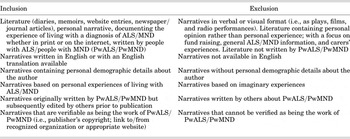
A systematic four-stage process uncovered internet and print-published narratives written by people with ALS/MND (O'Brien & Clark, Reference O'Brien and Clark2012). This began with a general scoping exercise, conducted using internet search and meta-search engines and database searches (Web of Science, CINAHL, Medline, Care Data, LexisNexis) with a range of search terms, including personal narratives, experiences, and writing together with nomenclature used (e.g., ALS, MND and Lou Gehrig's disease). Electronic searches of online bookstores and ALS/MND association websites worldwide were also carried out. Removal of duplicate/inappropriate material and assessment against specific inclusion criteria (see Table 1) completed the four-stage process. Little methodological guidance existed, but our approach had similarities to comparable studies (Hardey, Reference Hardey2002; Pitts, Reference Pitts2004). Narrative and personal accounts are used interchangeably and apply to personal stories of living with ALS/MND, regardless of genre or length of story. Those who wrote the accounts are referred to as authors, or narrators, recognizing their intellectual ownership of creative works (Pitts, Reference Pitts2004).
Inclusion/exclusion criteria applied to all narratives

Reprinted with permission from Sage Publications & Mark Allen Publishers.
Ethics
As this research formed the basis of the first author's doctoral studies, guidance was sought from the university's ethics committee, which agreed that formal ethical approval would not be required. The contention was that the study involved only the use of publicly available material; no interaction occurred between narrators and researcher, so that consent for its use was not required (Eysenbach & Wyatt, Reference Eysenbach and Wyatt2002). Furthermore, recognizing the data as creative works (Pitts, Reference Pitts2004) demanded that extracts be acknowledged and correctly attributed to the narrators, along with the use of their real names. This is required for any print-published narratives under copyright regulations, as well as internet narratives covered by creative commons deeds. We cannot know authors' reactions to their narratives being included in this study; consideration of their reasons for writing may provide clarity. Many aimed to share experiences and raise awareness of ALS/MND, and being included here allows their narratives to be shared with different audiences, often long after their deaths.
Analysis
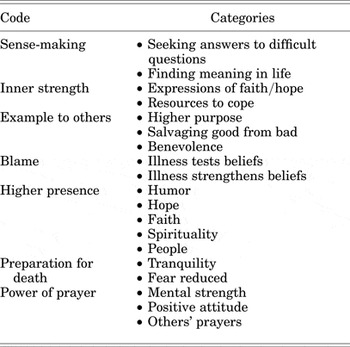
Key demographic details of the authors and bibliometric features of the narratives were identified to understand the characteristics of the authors and their stories. Thematic analysis—a means to identify, analyze, report, and interpret themes within data—was adopted (Braun & Clarke Reference Braun and Clarke2006). Analysis progressed from description to interpretation and theorizing broader meanings referring to the wider literature. Analysis was inductive, with identified themes strongly linked to the data through coding (Table 2), without attempting to apply preexisting coding frames or theoretical perspectives and not subject to our own analytic preconceptions (Braun & Clarke Reference Braun and Clarke2006). Familiarization was achieved through repeated reading of each text unit (Braun & Clarke Reference Braun and Clarke2006); NVivo software helped manage the data. The process was fluid, moving from one text to another, “checking the main features; confirming previous accounts; identifying common elements; and developing a common story” (Holloway & Freshwater, Reference Holloway and Freshwater2007, p. 85), simultaneously interpreting findings to determine which parts of narratives were thematically connected.
Examples of coding and categories identified during analysis

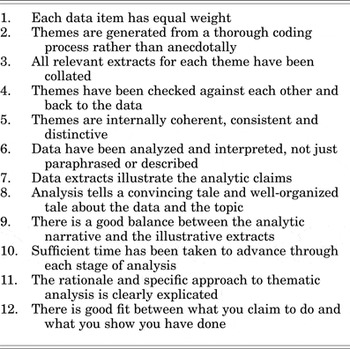
The analysis was conducted by the first author, and the second author undertook the independent review. A number of themes were identified, Our focus here is on the role of spirituality and faith in coping with ALS/MND. Elements of Braun and Clarke's (Reference Braun and Clarke2006) checklist for good thematic analysis (see Table 3) were applied to assure the trustworthiness of the data.
Elements of Braun and Clarke's (Reference Braun and Clarke2006, p. 96) checklist for good thematic analysis applied to this study

RESULTS
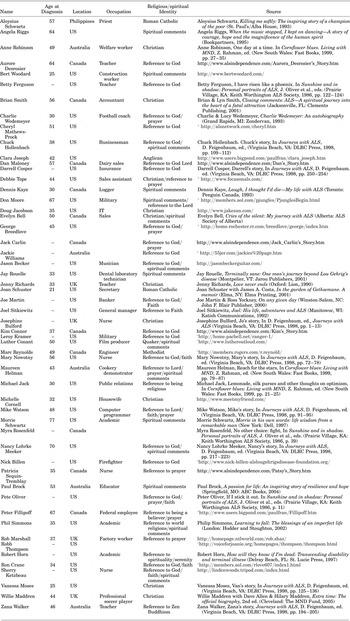
We ultimately obtained 161 narratives written between 1968 and 2005, emanating mainly from the United States, Europe, Canada, and Australia, including 64 internet and 97 print publications. The youngest author, at diagnosis, was 20, and the oldest 71. Only narratives that specifically addressed aspects of spirituality/faith are included here, and this amounts to 54 of the 161 included in the main study (see Table 4 for the demographic details of this subset). Our findings are supported with quotations from this subset, which are exemplars indicative of the viewpoints expressed.
Demographic details of authors including references to religion/spirituality

Real names of authors are used since all narratives were publicly available from internet or print-published sources.
N.B. Most authors did not specify a particular religious identity, though from the vocabulary used it could be assumed that the majority were Christians. Many authors simply refer to “God,” “Lord,” or “Faith” or mention “prayer” and/or “beliefs,” while others include spiritual comments suggesting an “exploration of meaning in life,” “connection,” “interaction,” “mediation,” or “transcending the self.” All websites accessed June 23, 2014.
° Indicates weblink is no longer functioning.
Numerous narrators refer to the strength acquired from seeking a spiritual understanding of their circumstances. This may consist of pursuing traditional religious beliefs and placing hopes for the future in their God, or it may involve a spiritual route, seeking answers to important questions about the self and life in general via a more philosophical and nontheistic route.
Religious Beliefs
Drawing strength from their faith, there is a sense that individuals' beliefs help them cope with their illness. Despite being aware that their condition is becoming progressively worse, narrators have confidence that their faith will help them tolerate the ongoing deterioration:
I know life will get tougher as my condition deteriorates, but I am assured that my Lord will sustain me.
— Ann RobinsonStrong religious views were expressed by many. They recall the inescapable nature of their illness but draw on faith, as well as friendships, to help with their ordeals:
I did not choose this journey, but my faith, my family, and my special friends enable me to cope with the challenges that I face.
— Mary NowotnyThere is often the impression of giving thanks for making these personal resources available:
I have more than my share of wonderful caregivers. It's the Lord's blessing.
— Mike WatsonFor some, there is no question that religious beliefs are vital in avoiding despair. When she writes, “to have hope you have to have Jesus in your life,” Michelle Cornell effectively means that without her religious beliefs she would be without hope. Holding similar views, others claim faith as the cornerstone of the ability to cope with ALS/MND:
Just like almost every person with ALS I know, my faith in God is the basis of my coping. When nothing else or no one else can bring back a positiveness, faith and prayer can.
— Pete OliverIt is conceivable that those with strong religious views might question their faith following diagnosis. Having pursued a religious life, to be faced with a life-limiting condition could seriously test an individual's beliefs. Narrators recall initial anger at God for their affliction:
I took a deep breath and told God exactly what I thought of him and just how much I resented being in His church; He had let me down. How could He deprive James of his mother? Going to worship was definitely off my agenda.
— Josephine BulfordHowever, others resist the temptation to blame God for their illness:
The way I cope with this is, I don't believe that this disease and death is attributed to God's will—that somehow He planned this event. I think they're just something that happened in the course of nature.
— Chuck HollenbachIt appears that, for most authors with strong religious convictions, their beliefs are maintained and often strengthened following diagnosis:
Many good things have come as a direct result of having ALS/MND . . . My Christian faith has become deeper and stronger.
— Josephine BulfordSuch authors place their trust in God, believing they will not be burdened beyond their ability to cope:
I know we all ask ourselves everyday, “Why me, Lord?” I have found faith in GOD. We are never given more than God thinks we can handle.
— Sherry KetzbeauIt is perhaps to be expected that those with strong religious convictions will draw on these to cope with approaching death:
Whatever tomorrow holds, God will give me the resources I need to deal with it. I realize the end will eventually come. But God has taken away my old fear of death.
— Charlie WedemeyerHowever, there is also evidence that some narrators' decision making is influenced by their beliefs. When viewing life as God's gift to them, there is justification for taking any actions required to sustain life, such as the use of artificial ventilation:
God offers victory over death . . . I believe victory over death is offered to us now, in the midst of life. It is a victory over fear, a victory over despair, a victory over grief, a victory over those forces that can ruin our lives.
— Joe MartinSpirituality
In describing his spiritual journey through illness, Phillip Simmons considers that traditional religions may regard God as “a god of goodness and love” preferring not to associate him with the more inclusive view: a “god of good and evil, light and darkness, sweet and bitter, harmony and discord.” It is this more comprehensive approach that Simmons adopts in coping with his condition:
A wholeness and connectedness in which all things, good and evil, are divine, all part of the sacred dance of creation . . . in facing every day the failure of my own flesh, in facing every day the reality of suffering around me, I have found my life's greatest spiritual challenge.
— Phillip SimmonsWhile trying to make sense of life, some look for a positive aspect to emerge. There is a feeling of being used for some “higher purpose,” as a spiritual example of how to live under difficult circumstances. For some, there is a sense of being blessed with a tranquil composure and a hope that, if others recognize this tranquility, they will acknowledge its origins:
I think perhaps the miracle has been the serenity of spirit that I have been given. I consider it a precious gift from God. If I am being used for a higher purpose and if people see a light in me, I hope they recognize the source.
— Nancy Lohrke-MeekerThere is a clear sense of turning misfortune into advantage. Authors comment on acquiring strength of character when faced with a deteriorating body:
When confronted with weakness, strengths are created and events shaped in ways which are never possible by sheer power.
— Brian SmithPhillip Simmons writes of spiritual life involving one's interior journey, thinking, meditating, and arranging one's own feelings and views of the world. He highlights, “for most of us, spirituality gets expressed—even transformed—only in our relationships with others.” This reflects comments on the comfort drawn from the community of people involved with them—family, friends, and caregivers:
I consciously receive the love, caring, and prayers of others into myself as healthy energy.
— Pete OliverIn his search for a personal spiritual sign Morrie Schwartz is unsuccessful, but he recognizes others' claims of spiritual connections with God or some “higher power.” He encourages others to search for spiritual comfort, but warns that it may be elusive:
Seek the answers to eternal and ultimate questions about life and death, but be prepared not to find them. Enjoy the search.
— Morrie SchwartzWhile Schwartz does not undergo the “spiritual oneness experience” he seeks, he knows that friends view him as a spiritual person. They see his example of living with a terminal illness, and producing creative works held in high esteem, as an illustration of true spirituality. For others, this notion of spirituality is evident in a greater good emerging from their illness—-the ability to share experiences with others and ease their suffering:
My misfortune in life has actually turned out to be a gift; a gift I can give to many.
— Jay RouelleFurthermore, shifting the emphasis away from their own demands toward the needs of others reflects spirituality in action:
Caring about others certainly adds meaning to my life. For a change, I'm not asking for and receiving help, but giving it, a situation that is much more satisfying.
— Myra RosenfeldHere we have people with ALS/MND revealing the strength derived from religious or spiritual beliefs. Seeking answers to life's questions at an existential level enables many to cope with their illness and experience a sense of peace with their situation as they approach death.
DISCUSSION
This qualitative study aimed to understand the effect that religious faith and personal spirituality can have for people with a diagnosis of ALS/MND as they prepare for their death. Religious faith helps them to avoid despair, while personal spirituality can help them to make sense of what is happening to them. The importance of an internal connection to a higher being among the dying was noted by Dobratz (Reference Dobratz2013). A key finding of our study supports this assertion and suggests a connectedness with God, or a higher power, demonstrated by the comfort drawn from feeling secure and reassured despite an uncertain future. However, in our study, connectedness also appears to extend to relationships with family and friends and is apparent in the consolation gained from the presence of this wider community.
In ALS/MND, religious or spiritual beliefs are significantly related to quality of life, particularly as the illness progresses (dal Bello-Hass et al., Reference dal Bello-Hass, Andrews-Hinders and Bocian2000; Pagnini et al., Reference Pagnini, Lunetta and Rossi2011). The authors in our study described how their beliefs helped remove the fear associated with death and provided the personal resources needed to face their approaching death. This lends support to Murphy et al. (Reference Murphy, Albert and Weber2000), who reported that people with ALS/MND who are more religious or spiritual are more hopeful and have fewer concerns about death.
A shift from self-enhancement toward self-transcendence is recognized (Fanos et al., Reference Fanos, Gelinas and Foster2008), which reflects the development of a more philosophical perspective about life from living with ALS/MND (Young & McNicoll, Reference Young and McNicoll1998). This was particularly evident within the current study, as narrators demonstrated their ability to use their misfortune to the benefit of others. Simply writing the story of their illness to share their experiences with others, and potentially ease their suffering, indicates the emergence of a greater good from their personal tragedy. Although life with ALS/MND is not easy, people typically maintain a holistic approach, seeking meaning and purpose from among physical weakness and emotional discomfort. Narrators demonstrated such characteristics searching for positive outcomes indicating their lives had meaning. This supports the notion that spirituality and religiousness provide a source of comfort and serenity directly impacting on quality of life (Nelson et al., Reference Nelson, Trail and Van2003). For many, meaning in life was associated with spirituality and transcendence (Fegg et al., Reference Fegg, Kögler and Brandstätter2010), which lends support to the work of Vachon et al. (Reference Vachon, Fillion and Achille2009), who identified meaning and purpose as key elements within spirituality at the end of life.
Those with ALS/MND rate self-transcendent values higher than self-enhancement ones (Fegg et al., Reference Fegg, Wasner and Neudert2005), reflecting coping strategies that appear to be inherent in terminal illness. Better-educated individuals tend to move toward self-transcendence in palliative care situations (Fegg et al., Reference Fegg, Wasner and Neudert2005). Our findings support this assertion; those who made their living from writing (e.g., academics and authors) clearly demonstrated this shift. Nowhere perhaps was this more evident than in the writings of Philip Simmons and Morrie Schwartz, both university professors. However, what is clearly apparent from our findings is that people from a variety of backgrounds (Jay Rouelle, a dental laboratory technician, for instance) also display this trait.
In similar fashion, but with reference to chronic illness, Garrett (Reference Garrett2002) regards healing not as cure and more than coping; it involves transformation of the sick person into a better individual, with an altered attitude to life focusing on others. People with multiple sclerosis can be altered by the discovery of a divine element, transforming them and the illness; losses become gains, contentment is achieved, and peace of mind obtained (Robinson, Reference Robinson1990). This personal renovation may not occur without the illness experience (Robinson, Reference Robinson1990). We have shown that there is evidence here of such a change in attitudes, indicating that transformation is also possible with terminal conditions. Authors demonstrated this through their sense of growing as an individual, acquiring inner strength and serenity. A change in focus with concern for others was indicative of spirituality in action.
CLINICAL IMPLICATIONS
Spiritual care concerns a recognition that “people can find healing within themselves, even in the midst of dying” (Puchalski, Reference Puchalski2012, p. 64), sometimes connecting to external resources—beliefs, objects, relationships—that people turn to in times of need. The importance of spiritual care in healthcare in assisting patients to understand the turmoil resulting from serious illness by helping them consider the meaning and purpose of their lives is well supported in the literature (Ming-Shium, Reference Ming-Shium2006; Dobratz, Reference Dobratz2013). To neglect the spiritual needs of patients, and their families, is both ethically and legally wrong (Fiifi-Amoah, Reference Fiifi-Amoah2011). However, the importance of spirituality within ALS/MND care is underestimated (Lambert, Reference Lambert and Oliver2006), despite recommendations for its inclusion within an interdisciplinary/multidisciplinary approach (Mitsumoto et al., Reference Mitsumoto, Bromberg and Johnston2005), encompassing the family to reduce the likelihood of prolonged grief (Pagnini et al., Reference Pagnini, Lunetta and Rossi2011).
Our study confirms the importance of faith and spirituality in coping with ALS/MND, but there is a clear need to raise awareness of this among healthcare professionals involved in providing care. The requirement to assess the spiritual and religious needs of patients should become a routine part of provision of care and is ultimately the responsibility of all members of the multidisciplinary team (Delgado-Guay, Reference Delgado-Guay2014). Helping people find an element of meaning and purpose in their lives may contribute to improving the experience of living with ALS/MND (Plahuta et al., Reference Plahuta, Mcculloch and Kasarskis2002).
LIMITATIONS
There is no claim that the views expressed are representative. Inclusion was limited to those able to compose and make their narrative available for others to read. Only those narratives that specifically addressed spirituality or religious faith were included in the analysis. While such beliefs help some people cope with illness, for others they may not be effective and can be problematic (Cobb, Reference Cobb and Lloyd-Williams2008). What is missing here are views from those who did not gain consolation from religious or spiritual beliefs, or did not document them; consequently, the findings are inevitably biased toward a positive viewpoint. However, they do confirm the place of spirituality and faith in coping with ALS/MND. Other voices missing from this study include those of family carers of people with ALS/MND and healthcare professionals involved in providing care. To gain a thorough understanding of the topic, further research involving these groups is required.
Undertaking passive analysis (Eysenbach & Wyatt, Reference Eysenbach and Wyatt2002) meant it was impossible to verify findings with the narrators; however, discussion of the themes with healthcare professionals involved in the care of people with ALS/MND—worldwide—has confirmed the credibility of our findings.
CONCLUSION
Societal attitudes frequently deny mortality, hindering the expression of existential questions about life and death (Grant et al., Reference Grant, Murray and Kendall2004). Personal illness narratives provide a vehicle for sharing deep thoughts, some of which may be spiritual or religious in nature. The availability of such illness narratives provides access to pertinent stories from an infinitely more diverse sample than could be obtained using more conventional techniques and avoids intrusions into people's lives as they cope with illness. As such, this approach can be regarded as distinctly nonintrusive. Furthermore, it allows voices to be heard, often many years after the individuals have died. This approach could ideally be utilized for other conditions and with hard-to-reach groups.
FUNDING
This research received no specific grant from any funding agency in the public, commercial, or not-for-profit sectors.
COMPETING INTERESTS
The authors have no competing interests to declare.