Introduction
Migrants have often been treated as nonmodern Others in European and North American society (Silverstein Reference Silverstein2005). More specifically, migrants’ language use has often been treated as emblematic of their Otherness (Urciuoli Reference Urciuoli1996; Gal Reference Gal2006; Dick Reference Dick2011). In this article, we examine how Portuguese migrants in France are linguistically constructed as nonmodern Others. Specifically, we explore how online participants in France and Portugal enact, interpret, and evaluate their own and others’ relative ‘modernity’ and ‘nonmodernity’, in relation to a stylization of a first generation Portuguese migrant figure in France named Antonio. Antonio is the protagonist in the extremely popular YouTube video Carglouch, performed by comedians Ro et Cut. They are otherwise known as Rodolphe Rebelo Ferreira and Mohamed Ould-Bouzid, young French men of Portuguese and Algerian descent respectively. We examine how performers and commenters construct linguistic images of Antonio as nonmodern, and position themselves in relation to him.
This article contributes to discussions in linguistic anthropology about the discursive construction of multiple modernities and nonmodernities (Spitulnik Reference Spitulnik and Knauft2002; Bauman & Briggs Reference Bauman and Briggs2003; Gal Reference Gal2006; Inoue Reference Inoue2006; Lee Reference Lee2006; Besnier Reference Besnier2011; Dick Reference Dick2010, Reference Dick2011). Rejecting evolutionist, teleological frameworks that rank groups as more or less ‘modern’, cultural anthropologists began discussing the existence of multiple, local modernities in the 1990s (Comaroff & Comaroff Reference Comaroff and Comaroff1993; Appadurai Reference Appadurai1996; Gaonkar Reference Gaonkar2001; Thomassen Reference Thomassen2012). Instead of assessing a group's relative modernity according to some etic standard, analysts then treat modernity as an ethnographic problem, which participants themselves construct and interpret (Spitulnik Reference Spitulnik and Knauft2002).
Furthermore, when participants construct modernity, they also explicitly or implicitly construct a contrasting nonmodernity (Fabian Reference Fabian1983; Trouillot Reference Trouillot and Fox1991; Bauman & Briggs Reference Bauman and Briggs2003). That is, participants may self-consciously strive to create and establish (images of) modern selves, relative to (images of) nonmodern others, casting some persons, places, and eras as more ‘modern’ and others as more ‘traditional’, ‘primitive’, or ‘uncivilized’, and so on. In this way, participants’ ideologically mediated, power-laden processes of constructing modernity along with nonmodernity became the focus of analytic attention.
By addressing how language practices and ideologies are central to local constructions of modern selves and nonmodern others, linguistic anthropologists have added precision to analysis of these processes (Spitulnik Reference Spitulnik and Knauft2002; Bauman & Briggs Reference Bauman and Briggs2003; Gal Reference Gal2006; Inoue Reference Inoue2006; Dick Reference Dick2010; Besnier Reference Besnier2011). Whether in scholarly treatises (Bauman & Briggs Reference Bauman and Briggs2003) or everyday interactions (Dick Reference Dick2010; Besnier Reference Besnier2011), discourse is often the medium through which people ‘do’ (non)modernities. For example, when participants stylize figures of first generation migrants whose ‘broken’, nonstandard speech presents them as sociolinguistically incompetent (see also Rampton Reference Rampton1995; Chun Reference Chun2004, Reference Chun2009; Reyes Reference Reyes2007; Shankar Reference Shankar2008; Jaspers Reference Jaspers2011; da Silva, this issue), they use language to do (non)modernity. To understand the linguistic doing of modernity, some have applied Bakhtin's (Reference Bakhtin1981) discursively grounded notion of chronotope (Bakhtin Reference Bakhtin1981; Gal Reference Gal2006; Agha Reference Agha2007b; Dick Reference Dick2010; Koven Reference Koven2013b; Perrino Reference Perrino, De Fina and Georgokapolou2015). Chronotopes are recurrent sets of contrasting, juxtaposable discourse-based frameworks through which participants link space, time, and person where ‘time, as it were, thickens, takes on flesh, becomes artistically visible; likewise, space becomes charged and responsive to the movements of time, plot, and history. The image of man is always intrinsically chronotopic’ (Bakhtin Reference Bakhtin1981:84–85). When participants enact and position selves and others as more or less modern social types, whom they situate in (images of) time and space, they rely on such chronotopes.
To examine how online participants entextualize and interpret chronotopes of (non)modernity, we apply Irvine and Gal's notion of semiotic differentiation (Irvine & Gal Reference Irvine, Gal and Paul2000; Irvine Reference Irvine, Eckert and Rickford2001; Gal Reference Gal2002, Reference Gal2005, Reference Gal, Heller and Duchêne2011). This notion starts with the Bakhtinian premise that the time frames, spatial realms, and images of persons and activities that make up chronotopes never occur in isolation, but in sets of dynamically co-constituted contrasts. To capture the processes through which participants always implicitly or explicitly summon up both poles of a contrast, the authors coined the term axes of distinctiveness or differentiation. We apply this approach to further illuminate how, following Bauman & Briggs (Reference Bauman and Briggs2003), Fabian (Reference Fabian1983), and Trouillot (Reference Trouillot and Fox1991), people co-constitute modern and nonmodern as dynamic and context-dependent positions. Below, we briefly review Irvine and Gal's discussion of the three linked semiotic processes through which people might interpret and produce signs of difference between modern and nonmodern.
Iconization or rhematization is the first process, which captures how participants interpret their own and others’ activities and semiotic displays as revealing contrasts (such as modern versus nonmodern) as inherent essences, rather than as indexical productions. Naturalizing the poles of a semiotic contrast may lead participants to treat modern/nonmodern as a stable, intrinsic property of persons, places, or eras, rather than contextually produced, ‘shifting’ subject positions (Schein Reference Schein1999; Gal Reference Gal2002:81). Of course, in social actors’ attempts to interpret the social world through binary categories of a particular axis, such as modern/nonmodern, they inevitably oversimplify what or who does not quite fit. Such processes of oversimplification comprise the second semiotic process of erasure (Irvine & Gal Reference Irvine, Gal and Paul2000). Third, to highlight that these semiotic processes are generative, participants may apply an axis to novel contexts, discovering and/or producing the same contrast elsewhere or at other scales. This process has been referred to as fractal recursion. For example, fractal recursion explains how participants discover and create new iconic analogic situations. One sees this in applications of a modern/nonmodern contrast across several contexts in France: people from urban Paris versus those in more rural provinces (Weber Reference Weber1977; Rogers Reference Rogers1987), those in the metropole versus those in the colonies, and ‘French people’ versus ‘migrants’. We draw from the model of semiotic differentiation to illuminate how differently positioned online participants present and position themselves and others as (non)modern.
Adding complexity to Irvine and Gal's model of semiotic differentiation, however, we examine how differently positioned participants invoke and orient to multiple, competing versions of a contrast. Connected to different intranationally and internationally oriented, interpretive frameworks, participants make relevant polycentric versions of a modern/nonmodern contrast. We then discuss how these multiple modernities, understood as multiple versions of a modern/nonmodern axis, come to ‘articulate’ with each other (Besnier Reference Besnier2011). We therefore bring a polycentric approach to semiotic differentiations between modernity/nonmodernity.
Polycentricity (Blommaert Reference Blommaert2010) captures how people orient their communicative behavior to, and/or have that behavior evaluated by multiple ‘centers’ or ‘evaluative authorities’. What happens when a social actor orients their speech to multiple centers, or when that social actor's speech is judged by those in multiple sites? Scholars of language and migration are increasingly considering the importance of transnational polycentricity for understanding the complex effects of circulation and mobility on the ‘meanings’ of social actors’ semiotic resources (Gal Reference Gal1993, Reference Gal2006; Koven Reference Koven2004, Reference Koven2013a; Mendoza-Denton Reference Mendoza-Denton2008; Blommaert Reference Blommaert2010; Dick Reference Dick2010, Reference Dick2011; De Fina & Perrino Reference De Fina and Perrino2013; Chun Reference Chun2013). For example, young people of Portuguese origin in France may sometimes interpret Portuguese as a lower-status migrant language in France, and sometimes as a national language, spoken by an urban elite in Portugal (Koven Reference Koven2004, Reference Koven2013a; Keating & Solovova Reference Keating and Solovova2011). Through attention to differently positioned social actors’ interpretations and reproductions of modern/nonmodern semiotic contrasts, we analyze both how differently positioned groups of people may orient to different ‘centers’, as well as how the same social actors may orient to more than one center.
Specifically, we see how differently positioned YouTube performers and commenters orient to multiple ‘centers’, through attention to how they interpret and align with Antonio. Those who treat Antonio as an immigrant orient to relatively more French-centered versions, whereas those who treat him as an emigrant orient to more Portuguese-centered versions. Indeed differently oriented commenters sometimes ‘miss’ each other, each engaging in parallel, distinct versions of the contrast. At other moments, however, when Portuguese-centered commenters also interpret Antonio as (problematically) representing Portugal to the rest of Europe, an international version of the contrast emerges as salient, in other words, that of Portugal's material and semiotic status as modern/nonmodern within Europe. Within and across these different frameworks, multiple, nested intra and international hierarchies are at stake. We can then also ask why certain versions of the contrast dominate, linked to participants’ different positions in local, national, and international orders.
By examining how differently positioned participants apply multiple, competing versions of a modern/nonmodern contrast, we see that the versions do not coexist separately from one other. Instead, the multiple versions (and the participants who orient to them), connected to intra and international hierarchies, confront and enter into relationship with each other on YouTube. We thus add multi-sited, transnational, and heteroglossic complexity (Glick Schiller, Basch, & Blanc-Szanton Reference Glick Schiller, Basch; and Blanc-Szanton1992; Koven Reference Koven2004, Reference Koven2013a; Blommaert Reference Blommaert2010; De Fina & Perrino Reference De Fina and Perrino2013) to scholarship on semiotic differentiation, and to scholarship on the sociolinguistic performance of multiple modernities/nonmodernities.
The rest of the article is organized as follows. We first provide ethnographic context for the video under analysis, and for the polycentric modernities through which participants interpret it. We then present and discuss the video, analyzing the modern/nonmodern voicing contrasts in the Carglouch video itself, asking how Antonio's (non)verbal demeanor contrasts maximally with that of the mainstream French, middle class figure, Olivier, shown in the original French advertisement (Carglass), which Carglouch parodies. However, voices and voicing contrasts are constructed not only by those who produce them but also by those who interpret, circulate, and reanimate them (Weidman Reference Weidman2014). To analyze mass mediated presentations of voicing contrasts, we also examine how character performances are taken up, subsequently excerpted, transformed, and (re)inserted in novel contexts (Bauman & Briggs Reference Bauman and Briggs1990). To more fully address how differently situated participants construe the video's presentation of semiotic contrasts, we analyze the positive and negative online comments about Carglouch. Although the dominant perspective presented in the video and in the comments is that of Portuguese migrants’ offspring raised in France, known as Luso-descendants (LDs), we discuss how those in contemporary Portugal may interpret the video's presentation of the Portuguese migrant. This allows us to determine how performers and commenters, with different relationships to Portuguese migration in France, use Antonio to perform, evaluate, and articulate multiple national and internationally situated visions of (non)modernity.
Who are Ro et Cut?
Ro et Cut launched their internet success with the YouTube clip, Carglouch, a parody of a well-known French ad for Carglass windshield protection. They have subsequently made and posted over twenty YouTube clips, most of which include Antonio. The video has been hugely popular. As of November 2013, Carglouch had been viewed nearly 4,000,000 times, and included 1,100 comments. In addition to their videos, Ro et Cut maintain a website, and have a significant Facebook following. Carglouch relies on viewers’ familiarity with a landscape of social types in contemporary urban France, from the perspective of those with family histories of migration. The characters in their videos evoke personas who contrast along a modern/nonmodern axis, most easily interpretable in an urban French context.
Migrants and polycentric modernities/nonmodernities
As their videos appear largely in French, with French subtitling of Portuguese speech, and no Portuguese subtitling of French speech, Ro et Cut assume and establish their largest audience to be France-based and French-speaking. Although viewers do not have to understand Portuguese, they need to recognize sociolinguistic stereotypes associated with first-generation Portuguese immigrants’ speech and personas in French contexts.Footnote 1 Viewers may not recognize stereotypes associated with Portuguese emigrants in Portuguese contexts.
France-centric interpretations of modernity/nonmodernity, Portuguese migration, and Antonio
We first discuss the France-oriented perspective most salient to the video's performers (Ro et Cut) and to the majority of commenters. The largest wave of Portuguese migration to France occurred in the 1960s and 1970s, when as much as 10% of the Portuguese population left rural Portugal for urban France, largely for economic reasons. Because of their positioning as European, Christian, and white, along with the absence of a former colonial tie, the Portuguese have often been viewed as an ‘unproblematic’ minority, rarely mentioned in politically charged discussions about immigration. However, the relative invisibility of the Portuguese from public attention in France is complex. Many Luso-descendants have contested this relative absence from the French public sphere (Cordeiro Reference Cordeiro and Dewritte1999; Pingault Reference Pingault2004; Volovitch-Tavares Reference Volovitch-Tavares and Lillo2006; Fernandes Reference Fernandes2007; Antunes da Cunha Reference Antunes da Cunha2009). Through the attention Ro et Cut bring to Portuguese migrants and their descendants, many LD viewers perceive Ro et Cut as challenging earlier perceptions of Portuguese invisibility or discretion. Commenters also see Ro et Cut as innovative, because they bring an insider perspective to performances of Portuguese migrants. Many commenters see them as inherently better (funnier, more nuanced, more authentic) than enactments from outgroup members.Footnote 2
The relevance of a modern/nonmodern contrast for Portuguese migrants in France is linked to the ideologically charged notion of ‘integration’ of immigrants in general (Noiriel Reference Noiriel1987; Schnapper Reference Schnapper1991, Reference Schnapper2004; Cordeiro Reference Cordeiro, Fourier and Vermès1994; Todd Reference Todd1994; Tribalat Reference Tribalat1995; Boucher Reference Boucher2000; Brubaker Reference Brubaker2002; Favell Reference Favell2003). Though contested and multiple, notions of integration are legacies of France's Third Republic, where national unity was sought through cultural and linguistic unity. Integration was originally evoked in relation to regional diversity, to model how peasants were transformed into Frenchmen (Weber Reference Weber1977). With echoes of the ‘civilizing mission’ of French colonialism, models of integration have been recursively adopted to describe how migrants may become part of France. Although French notions of integration shifted in the 1970s and 1980s to include discussions of migrants’ and their descendants’ ‘right to difference’, assimilationist versions have resurfaced in response to the rise of the far right (Cordeiro Reference Cordeiro, Fourier and Vermès1994; Hargreaves Reference Hargreaves1995; Brubaker Reference Brubaker2002; Favell Reference Favell2003). Although there is no postcolonial relation between France and Portugal, longstanding French images of immigrants as needing to ‘integrate’ and ‘modernize’ inform dominant French images of Portuguese immigrants.
There has been much discussion of whether to understand integration prescriptively or descriptively (Favell Reference Favell2003; Wievorka Reference Wievorka2008). In this article, we treat integration as a set of interpretive frameworks through which participants understand and evaluate their own and others’ cultural and linguistic differences. These frameworks are relevant to how members of the ‘second generation’ in general and LDs specifically negotiate the meanings of their parents’ and their own hybrid practices and ‘identities’ (Oriol Reference Oriol1984; Martinho Reference Martinho1986; Cunha Reference Cunha1988; de Villanova Reference de Villanova, Vermès and Boutet1987, Reference de Villanova and Vermès1988a; Hily & Oriol Reference Hily and Oriol1993; Pires Carreira & Tomé Reference Pires Carreira and Tomé1994; Leandro Reference Leandro1995; Charbit, Hilly, & Poinard Reference Charbit, Hilly; and Poinard1997; de la Barre Reference de la Barre1997, Reference de la Barre2006; Strijdhorst dos Santos Reference Strijdhorst dos Santos2003, Reference Strijdhorst dos Santos2010; Fernandes Reference Fernandes2007).
Dominant French notions of migrants’ integration are often chronotopic, implicitly linking ‘integration’ to notions of ‘progress’ toward modernity. As such, migrants’ relationships to homeland and to France are often treated as spatial and temporal trajectories (Schnapper Reference Schnapper1991; Cordeiro Reference Cordeiro, Fourier and Vermès1994; Gal Reference Gal2006; Dick Reference Dick2010). That is, migrants’ homeland is often understood as not only geographically, but also temporally remote. Movement to France is then interpreted as crossing space and time, from the traditional past to the modern present. If the first generation displays linguistic and cultural signs linked to the homeland, they may seem old-fashioned. Insofar as LDs distinguish themselves from their parents’ semiotic behavior through alignment with French norms, LDs may position themselves as more modern than their parents. Within a family that has migrated transnationally, this linkage of space-time to images of backward versus modern personhood may present particular dilemmas for LDs, who can view and hear their immigrant parents through a French modernist chronotope.
Nonverbal and verbal signs of nonmodern immigrant and modern French personhood
Notions of integration into the modern French Republic have often highlighted the importance of erasing visible/audible cultural and linguistic differences from public space (Schnapper Reference Schnapper1991, Reference Schnapper2004; Brubaker Reference Brubaker2002). Mastery of ‘French’, implicitly understood monolithically as standard French, is often mentioned as one among multiple signs of such ‘integration’ into French society (Gomes Sanches Reference Gomes Sanches1989; Tribalat Reference Tribalat1995). From this perspective, the only bilingualisms that count are ‘parallel monolingualisms’ (Koven Reference Koven2004; Heller Reference Heller2006). As such, audible signs of translinguistic trajectories (Bailey Reference Bailey and Heller2007; Creese & Blackledge Reference Creese and Blackledge2010; Li Reference Li2011) only count as ‘interference’ (Urciuoli Reference Urciuoli1995). Some may then read nonnative sounding French as a sign of incomplete integration.
In contrast, sociolinguistically oriented scholars have treated migrants’ and their descendants’ language use not in terms of mastery of bounded codes, but in terms of heteroglossic semiotic resources, subject to polycentric interpretations (Urciuoli Reference Urciuoli1995; Bailey Reference Bailey and Heller2007; Blommaert Reference Blommaert2010). (For France, see also de Villanova 1987; Vermès & Boutet Reference Vermès and Boutet1987; Dabène & Moore Reference Dabène and Moore1995; Lepoutre Reference Lepoutre1997; Billiez, Krief, Lambert, Romano, & Trimaille Reference Billiez, Krief, Lambert, Romano; and Trimaille2003; Deprez Reference Deprez1994, n.d.; Koven Reference Koven2004; Trimaille Reference Trimaille, Caubet, Billiez, Bulot, Léglise and Miller2004; Tetreault Reference Tetreault2008, Reference Tetreault2013; Vigouroux Reference Vigouroux2011). Following this perspective, we treat LDs’ heteroglossic language use as the medium through which they reflexively ‘do’ and understand ‘integration’. We therefore consider ‘integration’ as a language ideological framework that informs how LD participants engage with the comedy of Carglouch Footnote 3 as they enact and evaluate the social meanings of their first generation parents’ speech.
LDs are often aware of the backwardness projected on to their parents in French public space. For many, this backwardness is connected to images of their parents’ nonnative French speech. Indeed, Antonio's ‘bad’ (Portuguese-influenced) French that diverges from urban, middle-class, monolingual norms is key to his performance as a nonmodern immigrant type. Indeed, through their extensive socialization in French monolingual settings, most LDs speak French that is perceived as unmarked, ‘modern’, youthful (Boyer Reference Boyer1997), and monolingual-sounding, that is, without Portuguese influence. As such, LDs’ French is generally perceived as bearing, no inadvertent traces of hybridity that might mark immigrant, nonmodern personas.Footnote 4 That said, even if LDs can speak monolingual-sounding French, they remain intimately familiar with their parents’ hybrid speech. They may still strategically quote this verbal parental image in a number of discourse contexts (Koven Reference Koven2007; see also Chun Reference Chun2004, Reference Chun2009). Ro et Cut play upon this contrast between monolingual French and Franco-Portuguese hybrid speech in their performances of nonmigrant/migrant, modern/nonmodern characters. Carglouch most appeals to LD viewers who recognize allusions to their experiences with French-Portuguese hybrid (non)verbal behavior. When Ro et Cut perform Antonio, LD viewers can collaboratively recognize and take pleasure in this familiar, if stigmatized, nonmodern, immigrant hybrid persona. Antonio resembles family members, but LD viewers do not resemble him. They can laugh at Antonio, without imperiling their own more modern personas. In what follows, we discuss Ro et Cut's actual stylized performances, as well as commenters’ responses to those performances that reveal these complex alignments.
Portugal-centric interpretations of Antonio
Although Ro et Cut largely address Portuguese immigration in a French context, a second interpretive framework for Ro et Cut is Portuguese emigration from Portugal. From the perspective of nonmigrant Portuguese in Portugal, the first generation of emigrants is also the object of much ambivalent typification (Gonçalves Reference Gonçalves1996; Lopes Reference Lopes1998; Brettell Reference Brettell2003; Koven Reference Koven2004, Reference Koven2013a). From Portugal-centered perspectives, nonmigrants may also invoke a modern/nonmodern axis in relation to emigrants.
Nonmigrant Portuguese concerns with the image of Portuguese emigrants are linked to larger discussions of the modern/nonmodern images of Portugal in (inter)national contexts. In discussions of Portuguese emigration, there are multiple, interconnected spatiotemporally situated images of Portugal and its modernity/nonmodernity potentially at stake (Feldman-Bianco Reference Feldman-Bianco1992; de Sousa Santos Reference de Sousa Santos1995; Klimt Reference Klimt1999; Klimt & Lubkeman Reference Klimt and Lubkeman2002): (i) Portugal as an erstwhile pioneer of European expansion until the eighteenth century; (ii) Portugal as a colonial power until the 1970s; (iii) Portugal as embodying rurality and conservatism, an image cultivated and celebrated during the Salazarist regime that lasted until 1974 (Pais de Brito Reference Pais de Brito1982; DaCosta Holton Reference DaCosta Holton2005); (iv) similar to, yet critical of the previous image, Portugal as regrettably ‘behind’ other countries within Europe economically, politically, and culturally, because of the fascist regime; and (v) Portugal as ‘catching up’ to the rest of Europe, with its economic, political, social, and cultural transformations of the 80s, 90s, and early 2000s. The fifth image positions Portugal as having shed the ‘nonmodern’ legacies of the third and fourth images, aspiring to be an economic and symbolic peer of other European Union member nation states in northern and central Europe.
We can treat each of the five images as chronotopes, in relation to which social actors position selves and others as more or less (non)modern. Because the Salazarist regime overtly cultivated conservatism and rurality (the third image), there is much contemporary ambivalence about semiotic reminders of Portugal associated with the era. Many in contemporary Portugal thus seek to align with the fifth image, and distance themselves from spatial and temporal images potentially evocative of the third and fourth. This ambivalence plays out in debates around the (non)modern images conveyed by expressive cultural forms, including music (Sieber Reference Sieber2002), folklore (Klimt Reference Klimt1999; DaCosta Holton Reference DaCosta Holton2005), television (Antunes da Cunha Reference Antunes da Cunha2009), and touristic journalism (Almeida Santos Reference Almeida Santos2004). Portugal-centered evaluations of emigrants and their semiotic displays are also interwined with this ambivalence. Indeed, nonmigrants may implicitly position themselves as more modern than emigrants, whom they may perceive as anachronistically rooted in the bygone Salazarist regime (the third image) of the era of their departure.
However, a modern/nonmodern axis is not only relevant for differentiating emigrants and nonmigrants within Portugal. Because of awareness that Portugal has historically been perceived internationally as the nonmodern other by those in northern Europe, some nonmigrants fear that emigrants transfer a backward image to all Portuguese. As such, some are threatened by Ro et Cut's presentation of Antonio, afraid that internationally positioned others might liken him to all of Portugal. We thus touch on nonmigrant commenters’ deployments of these Portugal-centered and European-centered modern/backwards axes.
These multiple French, Portuguese, and European ‘centers’ and chronotopes discussed above inform how differently placed participants perform and evaluate modernity/nonmodernity of Portuguese im-/emigration.
Carglouch
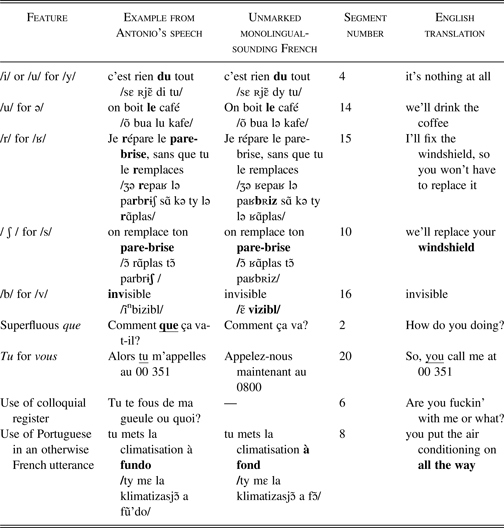
In this section, we present the Carglouch video and its (non)modern voicing contrasts. The chart below includes transcriptions and translations of the original Carglass ad and the Carglouch parody. The transcriptions and translations have been broken up into segments, to allow for easier side-by-side comparison. We then discuss the contrasting linguistic features and pragmatic strategies between Olivier's and Antonio's performances. These have also been bolded in the transcript below.
(1) Carglass Footnote 5 and Carglouch Footnote 6


Features of Antonio's language use in Carglouch
Carglouch is relatively accessible to monolingual French speakers. However, although Antonio speaks French, he uses a variety of semiotic forms that mark him as a Portuguese migrant (Urciuoli Reference Urciuoli1995), contrasting him with Olivier's monolingual-sounding variety of French. Specifically Antonio uses the occasional code-switch, Portuguese-influenced phonology, syntax, and marked pragmatic strategies. Through implicit contrast to Olivier, Antonio's speech is presented as nonnative and rude, which implicitly associates Portuguese-influenced French with impoliteness. Viewers may construe the rudeness as either inadvertent, resulting from either ignorance of ‘polite/civilized’ norms and/or from strategy, showing Antonio's deliberate disregard for his viewer. In this way, the semiotic displays in Antonio's demeanor link Portuguese immigrants with ‘bad’ French and coarseness. In Table 1 and the discussion of it below, we discuss the recurrent features in Carglouch that evoke these images.
Features and examples of Antonio's marked speech.

Phonology
/r/ for /ʁ/
Antonio consistently pronounces the uvular fricative /ʁ/ of urban Parisian French as an alveolar trilled /r/. The trilled /r/ is an emblem of non-Parisian, rural (Walter Reference Walter1976), as well as nonnative French. As shown in examples (2) and (3), there are numerous tokens of this frequent and salient emblem. The /r/ then co-occurs with other linguistic and nonlinguistic signs to cross-modally (Agha Reference Agha2007a) construct Antonio's nonmodern style.
(2) On remplace ton pare-brise (segment 10)
/ɔ̃ rɑ̃plas tɔ̃ parbrɨʃ/
‘We'll replace your windshield’
(3) Je répare le pare-brise sans que tu le remplaces (segment 15)
/ʒə repaʁ lə parbrɨʃ sɑ̃ kə ty lə rɑ̃plas/
‘I'll fix the windshield, so you won't have to replace it’
/ ʃ /for /s/
Antonio also consistently pronounces syllable final /s/ of French as / ʃ /, frequent in European Portuguese. This is another indexical icon of Portuguese immigrants that circulates widely among non-Portuguese French speakers. We see this in his pronunciation of pare-brises where Antonio adds a final / ʃ /. In fact, the very title, Carglouch, exploits this stereotype.
(4) on remplace ton pare-brise(segment 10)
/ɔ̃ rɑ̃plas tɔ̃ parbrɨʃ/
‘we'll replace your windshield’
Within Portugal, some speakers utter a bilabial stop, /b/, where standard urban Lisbon Portuguese would require a labiodental fricative, /v/ (Lindley Cintra Reference Lindley Cintra1971; Ferronha Reference Ferronha1992; Mira Mateus Reference Mira Mateus and Mateus2002). /b/ is considered an index of northern Portuguese origin. It has also been reindexicalized to index someone of lower education and literacy. As many emigrants indeed hailed from the rural north, with little formal education, both regional and educational background are signaled. This makes Antonio contrast with speakers of Lisbon standard Portuguese. This is one of the few instances of a sociolinguistic sign that may be relatively opaque to monolingual French speakers, other than merely indexing non-Frenchness.
(5) invisible (segment 16)
/ĩnbizibl/
‘Invisible’
/u/ or /i/ for /y/
Antonio also systematically pronounces French /y/ as /u/ or /i/.
(6) c'est rien du tout (segment 4)
/sε ʁjε̃ di tu/
‘it's nothing’
/u/ for /ə/
As shown in example (7), he regularly pronounces /u/ for /ə/, a marked substitution through which he might be recognized as a Portuguese speaker (Simões Marques Reference Simões Marques, Iliescu, Siller-Runggaldier and Danler2010, Reference Simões Marques, Cid, Alves, Blayer and Fagundes2013). Antonio is made to use these marked phonological forms that France-oriented audiences may interpret as differentiating him from the unmarked, monolingual-sounding speech of Olivier.
(7) on boit le café (segment 14)
/õ bua lu kafe/
‘we'll drink the coffee’
Syntax
Antonio places superfluous que in French utterances. This implicitly evokes images of Portuguese speakers, whose syntax requires que more often in interrogative and exclamatory forms. It may also evoke stigmatized sociolects of French (Gadet Reference Gadet1992).
(8) Comment que ça va-t-il? (initial opener) (segment 2)
‘How do you doing?’
Pragmatics
Use of colloquialisms in French and Portuguese
Antonio is often shown cursing. This contrasts with the speech of Olivier, who does not curse. This presents Antonio as vulgar and coarse. To Portuguese speakers, it may also evoke regional differences, where those from northwest Portugal are stereotypically believed to curse more.
(9) Tu te fous de ma gueule ou quoi? (segment 6)
‘Are you fuckin’ with me or what?’
Use of familiar tu with unfamiliar, unknown adults
Characteristic patterns of address often come to signal speaker type (Brown & Gilman Reference Brown, Gilman and Sebeok1960). In the context of an advertisement, where vous would be the unmarked norm for addressing the viewer, as used by Olivier, Antonio's overuse of tu shows his disregard for his televised interlocutor (see (10) below). Combined with French stereotypes that immigrants from North and Sub-Saharan Africa may overuse ‘T’ (Morford Reference Morford1997), Antonio's tu links an image of the nonnative immigrant with rudeness and inability to read normative demands for social decorum.
(10) Alors tu m'appelles au 00 351 (segment 20)
‘So, you call me at 00 351’
Beyond forms of address, Antonio indexes his excessive familiarity and inappropriately marked affect in other ways. For example, he quotatively enacts the perspective of an irresponsible viewer, as in (11) below.
(11) Tu crois que c'est rien du tout et que c'est pas toi qui s'en occupe? Et là tu dis comme ça, c'est bon, ça donne (segments 4–6)
‘You think it's nothing and you're not gonna be the one to deal with it? And then you go like this, it's okay, it it's fine’
While saying tu to respond to the quotative performance of the imagined thoughts of the irresponsible viewer, he also uses a very colloquial French register—tu te fous de ma gueule ou quoi? ‘Are you fuckin’ with me or what?’. He then shows his irritation at the viewer's assumed carelessness, with an exclamation (n'importe quoi ‘whatever’), and a feigned smack. These forms contrast Antonio with the affectively reserved, polite French Olivier.
Personalized, potentially corrupt, business practices
Olivier and Antonio differ in their professional self-presentation in other ways. Olivier speaks through his company's professional on ‘we/one’, or uses on to include his company and the viewer. Antonio largely alternates je ‘I’ and tu ‘you’). Antonio's occasional on (on boit le café ‘we drink coffee’) indicates a highly familiar customer and professional relationship. With these pronominal forms, Antonio suggests that he is not a representative of a larger company upholding standards, but a lone individual making a deal with the viewer. Furthermore, whereas Olivier referred the viewer to an 800 number and a website, Antonio tells the viewer to call his personal Portuguese cell phone, or that of his cousin who knows where he is. Antonio thus promises shoddy, somewhat corrupt, if personalized service.
(12) je viens à la maison (segment 14)
‘I come to your house’
Bodily demeanor
Olivier's and Antonio's speech co-occurs with nonverbal elements of dress, physical appearance and bodily comportment, as cross-modal icons (Agha Reference Agha2007a) that construct them as social types. Olivier was fair skinned, with a slight beard and mustache, dressed in a black polo shirt, tucked neatly into black pants. Antonio, by contrast, is dark-complexioned, hirsute, and unclean, with a monobrow, a cigarette dangling from his lips, oil-smudged hands, a cap, and a dirty blue coverall. Here, Ro et Cut draw from French stereotypes of immigrants (including Portuguese) and commonly recognized stereotyped signs of male working class demeanor. In these ways, the nonmodern image of a Portuguese immigrant is linked directly to social class. To some extent, Ro et Cut draw from common French sociolinguistic and physical stereotypes to present Antonio as less civilized and professional than his French counterpart, Olivier. However, they also include details that may be more opaque to a monolingual French audience, thus rewarding the LD viewer.
YouTube commentary
To understand the different ways that viewers interpret Antonio, and position themselves in relation to him, we also examine the YouTube commentaries. They are highly dialogic, yielding rich insight into commenters’ language ideologies, while also constituting a rich site for observing people's strategies of de- and recontextualization (Bauman & Briggs Reference Bauman and Briggs1990; Spitulnik Reference Spitulnik1997; Jones & Schieffelin Reference Jones and Schieffelin2009; Chun & Walters Reference Chun, Walters, Thurlow and Mroczek2011; Leppänen & Häkkinen Reference Leppänen and Häkkinen2012; Chun Reference Chun2013; da Silva, this issue). We see here how different versions of a modern/nonmodern contrast emerge among differently positioned commenters.
Dominant background of commenters
Ro et Cut do not control the viewership or uptake of the video. Viewers’ own linguistic and cultural socialization influences how they interpret Antonio and position themselves in relation to him. From the statistics available on YouTube, most viewers are in France and some in Portugal. Adolescents of both genders between thirteen and seventeen, and men between thirty-five and forty-four make up the largest viewership. What does that mean about who they are? Analysts depend on the same indexical cues as participants to speculate on commenters’ backgrounds. Such cues may signal commenters’ implicit and/or explicit positioning relative to Antonio and Portuguese migration. Cues may include overt declaration of country of residence, family history of migration, or ethnonational identification. They may also be more implicit: for example, use of the first-person plural deictic forms to refer to ‘our’ shared experiences. Language variety is a highly salient cue: exclusive use of varieties of standard and/or colloquial French, exclusive use of Portuguese, use or strategic combinations of both, such as using varieties of colloquial ‘young’ French to frame a quote that is then rendered in orthography that evokes Portuguese-influenced French. Based on these cues, it seems that many commenters use youthful varieties of French to perform their ‘own’ voice, while strategically performing bits of Portuguese-influenced speech, which they often implicitly or explicitly attribute to someone else. As such, most commenters appear to be second or third generation French LDs, who position themselves as firsthand, overhearing others (Inoue Reference Inoue2006) of their migrant parents. A handful of commenters use Portuguese in their own voice, with no allusion to sociolinguistic experience in France. We speculate that these commenters present themselves as nonmigrant Portuguese who interpret Antonio through Portugal- and Europe-oriented frameworks.
Common response strategies
Below we discuss how commenters respond to the clip, to the figure of Antonio, and to what he indexes to differently positioned viewers. People can respond by simply liking or disliking the clip. Indeed, as of February 2014, there were 9,179 likes for 274 dislikes. Among the 1,100 comments we noted in November 2013, only fifty-one were clearly negative. Although infrequent, negative comments are noteworthy for how and why they critique either the video or the social type that the video evokes.
Positive comments
Requoting the clip
Many viewers display positive appreciation of the video by (re)quoting it (see also Jones & Schieffelin Reference Jones and Schieffelin2009; Chun & Walters Reference Chun, Walters, Thurlow and Mroczek2011; Chun Reference Chun2013). Quotation does not neutrally reproduce the quoted figure's speech, but evaluates it from particular interactional and ideological positions (Bakhtin Reference Bakhtin1981). We thus examine how commenters quote social others, contending that their quotative strategies present the quoting speaker as modern and the quoted speaker as nonmodern. LDs who quote Antonio indeed often citationally presuppose and perform him as an authenticFootnote 7 icon of the nonmodern first-generation other, whom they jointly recognize and enjoy.
Quotes without framing
Even quoting Antonio without framing speech makes him a focus of shared evaluative attention as a type.
(13) et SHLAGCH louparabrische que sa a pas douné!!!!!!!!!!!!!Footnote 8
‘and SHLAGCH the windshield that it didn't hold!!!!!!!!!!!’
Although these unframed quotes are not explicitly evaluated, both what and how they quote Antonio reveal commenters’ interpretations. Orthographic presentations of nonstandard speech can be highly stigmatizing (Preston Reference Preston1985; Jaffe Reference Jaffe2000b). Commenters often quote Antonio in orthography that evokes nonstandard, Portuguese-influenced French. In this example, the commenter writes the French definite masculine article le as lou, imitating a Portuguese accent that turns unstressed schwa into /u/. Note also the spelling of donné as douné. Similarly, the commenter imitates Antonio's utterance of ‘windshield’ as parabrische, an orthographic representation of the syllable final, palatalized /ʃ/, emblematic of French stereotypes of Portuguese. Commenters’ orthographic choices thus help to construct Antonio's sociolinguistic otherness, relative to that of the implicitly more knowledgeable quoter.
Quotes with framing
When commenters frame their quoted performance of Antonio, the framing speech also reveals their complex positioning toward Antonio (Voloshinov Reference Voloshinov1973; Wortham Reference Wortham2001). Framing speech in commenters’ own voice that precede, follow, or even co-occur with the quote often appear in a young French texting language, for example, mdr, mort de rire, similar to ‘lol’.
(14) Tu Tfou Dma gueule ou Koi MDR super
‘You Fuckin'kiddin me or What LOL great’
Through these metapragmatic strategies, commenters present Antonio as a laughable, if beloved other who cannot speak French, while the quoter self-presents as a hip, youthful French speaker. Here we see the modern/nonmodern voicing contrasts quite starkly, where French is the voice of the modern quoter, and frantugais the voice of the nonmodern, first-generation other.
Explicit declarations of ethnonational identity
Positive commenters also often explicitly declare their own Portuguese ethnonational belonging, with terms from different registers of French (e.g. the very familiar ’tos for Portuguese people, an abbreviation of the also familiar ‘Portos’) and Portuguese (e.g. the very familiar tuga for Portuguese person). These declarations may serve multiple functions, highlighting images of Portuguese identity, connected to both Portuguese and French centered axes. For example, such declarations evoke longstanding tropes of Portuguese nationalism, through which those in the diaspora long for (an image of) their original Portuguese homeland to which they remain forever linked (Fernandes Reference Fernandes2007; Antunes da Cunha Reference Antunes da Cunha2009). Nonmigrants may complain that such nationalist displays celebrate a particular (nonmodern) image of Portugal, associated with the Salazarist regime.
Such declarations may also entitle the commenter to simultaneously mock and display affection for Antonio. Like Chun's (Reference Chun2004) discussion of Margaret Cho, claiming Portugueseness may allow commenters to distinguish themselves from potentially racist French mockery, by claiming insider status. Such commenters do not only differentiate themselves as unlike (more modern than) Antonio. They simultaneously claim him and their love of him as evidence and celebration of their Portugueseness.
(15) sou tuga e adurei este video hahahahahaha
‘I am Portuguese (familiar) and I luved this video hahahaha’
(16) bravo les tos moi aussi je suis portugais je raffole de ca
merci
vivaportugal
‘bravo portuguese people (fam.) I am also Portuguese I'm crazy about this
thanks
longliveportugal’Footnote 9
Declarations of authenticity and familiarity
Commenters often liked the video, because they perceive it to be authentic. They may then react with affection and/or nostalgia toward Antonio's imagined likeness to a beloved type (see also da Silva, this issue).
(17) Putain c'est vraiment un putain de vrai Portugais comme au bledd!!
‘Damn this is a really fucking true Portuguese like in the village!!’
This commenter responds in colloquial, young French to remark on the verisimilitude of Antonio to ‘true’ Portuguese, in remote/rural Portuguese locations, constructing and celebrating authentic Portugueseness as rural. By referring to their parents’ homeland with the originally North African term le bled, young people of migrant origin may also evoke their attachment to backward places, while dialogically affirming their own links to French urban modernity (Tetreault Reference Tetreault2013). Many then specifically and nostalgically note Antonio's authentic likeness not only to a general type, but to their own immigrant parents.
(18) Oh dirait mon daron qui parle
‘sounds like my old man’
(19) Super video, j’était bidonner.
Je suis Portugais et franchement c'est trop bien émité.
C'est vrai que nos parents parlent un peu comme ça, dumoin mon père et mes oncles. Mais bon en tous cas c'est des bosseurs.
Orgulho de Ser Portugues.
VIVA PORTUGAL
‘Super video, I was busting up. I am Portuguese and honestly it's totally well imitated. It's true that our parents speak a little like that, at least my father and uncles. But well, at any rate, they are hard workers.
Proud of Being Portuguese.
LONG LIVE PORTUGAL’
Through these strategies, these commenters perform Antonio as a rural, old-fashioned, Portuguese figure, iconically reminiscent of family members. They then manage to simultaneously declare their affection for him, while performing their own modernity relative to him. They are not him, but love him as a backward, familial other. These (presumably) LD commenters claim an insiderness that presents a vision of modern French-speaking selves with nostalgic gazes toward beloved Portuguese-speaking ‘authentic’ nonmodern others.
Insider authenticity relative to outsider inauthenticity
Although less frequent than the strategies mentioned above, commenters may explicitly evoke images of common French stereotypes of Portuguese, which they contrast with Ro et Cut's performance. This allows commenters to positively evaluate the video, by assessing its insider authenticity compared to less authentic outsider parodies.
(20) d'origine portugaise, je deteste que l'on se moque de mes origine mais la j ai trop rigoler, vous assurez les mecs et surtout continuer a nous faire rire comme ca encore longtemps.
‘of Portuguese descent, I hate that they make fun of my origins but there I totally cracked up, guys you are great and above all continue making us laugh like this for a long time.’
(21) TP FORT!!! Enfim une parodie qui se rapproche de la réalité (qu'on en finisse pour de bon avec les «aich» et les moustaches please!tte la famille a bien rit!!!!!!! bravo!
‘TOO AWESOME!!! Finally a parody that is close to reality (let's be done for good with the “esh” and the moustaches, please!my whole family really laughed!!!!!!! bravo!’
Such comments differ from those that merely declare their love of the video's authenticity without comparison. They explicitly assert that mediatized presentations of Portuguese could reproduce dominant devalorizing French images. In this way, they dialogically engage with the possibility of outsider (i.e. French), racist mockery, while claiming that the video somehow transcends it, through its authenticity.
Negative comments
Critical comments from those positioned as LD insiders
Written in French, some comments appear to come from LDs who, contra the trend just mentioned above, perceive Antonio as an unflattering portrait of Portuguese migrants in France.
(22) Ouais peut être fier d’être portugais en attendant je crois pas que cette vidéo les valorisent tant que ça
‘Yeah maybe/(one) can be proud of being Portuguese in the meantime I don't think this video valorizes them that much’
This commenter repeats the earlier strategy of explicitly declaring pride in ethnonational identity, but then questioning whether Carglouch shows a flattering image of ‘them’, implicitly ‘Portuguese’. That said, this declaration contrasts with the more standard formula. Positive comments often begin with interjections (bravo), intensifiers (super), and exclamation points. This comment, however, is muted, with use of the less-than-enthusiastic colloquial ouais ‘yeah’ and peut être ‘maybe’ and explicit critique. Also, by saying ‘them’, the commenter signals distance from the referent of ‘Portuguese people’. Although not directly discussing the modern/nonmodern contrast, the commenter disaligns from the image of Antonio, seen as potentially unflattering to images of Portuguese.
Negative comments from those critics positioned as nonmigrant Portuguese in Portugal
Finally we address a different perspective from which some commenters interpret and respond to the video. Because most negative comments are delivered exclusively in Portuguese, we speculate that they may come from nonmigrant Portuguese in Portugal, or those presenting themselves as such. As noted above, whereas only 3.7% of the comments delivered in French were negative (of the 32/856), 59% of the comments delivered exclusively in Portuguese (19/32) were negative. To nonmigrant commenters, Antonio is neither a beloved family member, nor a nostalgic, celebratory embodiment of rural Portugal, nor a vision of Portuguese immigrants from a mainstream bourgeois French perspective. Nonmigrant Portuguese commenters may instead position Antonio relative to Portugal-centered axes, as part of the nonmodern Portuguese past (images (iii) and (iv) above; see the section, Portugal-centric interpretations of Antonio), from which they separate themselves. Most negative comments, however, are fractally recursive of the modern/nonmodern contrast at an international scale. They decry the video and the stylized character of Antonio, because they fear that non-Portuguese viewers abroad will invoke a modern/nonmodern axis that conflates the undesirably nonmodern image of Antonio with all of Portugal. As such, some accuse LDs in France who produce and enjoy Ro et Cut of being disloyal ambassadors who damage the international reputation of the entire country. Such critics tap into earlier mentioned notions of Portuguese identity, as no longer the nonmodern place from which emigrants departed. Instead, Portugal should be presented as a modern, dynamic, urban, European, cosmopolitan society. They fervently defend Portuguese identity against the threat that they perceive in Antonio's association with stigmatized images of nonmodernity, as interpreted through a convergence of intranational and international axes.
(23) filho da puta!!! Se fosses gozar com o caralho!! Devias ser banido de vir a portugal!!!
‘son of a bitch!!! If you were making fun, fuck!! You should be banned from coming to Portugal!!!’
(24) Vozes todos que andem a fazer estas merdas de carglouch sondes uma camada de filhos da putas merda de rassistas fodasse nao tendes mais nada a fazer agusar com os portugueses para todo mundo pensar que os portugueses sao uma camada de idiotas??? filhos da puta
‘You all doing this carglouch shit are a layer of whores fucking racists fuck you not have anything else to do but make fun of the Portuguese for everyone to think that the Portuguese are a layer of idiots??? sons of bitches’
These vitriolic commenters see Ro et Cut's performance as threatening to Portuguese national and international honor. Identifying with Antonio and Portugal (see de Oliveira 2002), the first commenter responds as if both he or she and Portugal have been personally targeted and mocked by Ro et Cut. Ro et Cut are traitors, to be banned from Portugal.
The second commenter also reacts as if personally and nationally insulted, simultaneously as an individual and as a representative of Portugal. The commenter designates three referents: (i) you all (Vozes [sic] todos) who do Carglouch (the performers, and with the use of todos ‘all’ potentially other LD commenters); (ii) the Portuguese; and (iii) Todo mundo ‘everyone’, international viewers who might watch the video and subsequently view all Portuguese as similar to Antonio. These two commenters react as if personally implicated and degraded by the video.
Such comments therefore also evoke several sites for modern/nonmodern contrasts, first between emigrants and nonmigrant Portuguese, emigrants and Portugal as a whole, and finally between Portugal and imagined international observers from outside Portugal. This presumably nonmigrant commenter may self-differentiate from LD performers and commenters, while also fearing that he or she and all Portugal will be cast as the nonmodern other by those outside of Portugal.
We can go one step further and interpret nonmigrants’ Portugal-centered concerns about Antonio debasing Portugal to the outside world, relative to LDs’ more France-centered visions. Intranational French visions of Portuguese immigrants as uncivilized, and intranational Portuguese visions of emigrants as nonmodern, should be considered relative to a scale of larger international hierarchies, which, in recent history, have positioned France as economically and semiotically more modern than Portugal. LDs’ adoption of a French modernist chronotope toward their migrant parents could thus be interpreted as a further fractal recursion of international hierarchies. Those writing as nonmigrant Portuguese may particularly resent that such images are circulated in France, a place imagined as closer to the center of European modernity, to which those in contemporary Portugal may currently aspire.
As such, these multiple intra- and internationally positioned versions of a modern/nonmodern contrast, and those who orient to them, confront and are pulled into layered, hierarchical relationships with one another. Although LD commenters mostly orient to a France-centered version of the axis, their remarks can be interpreted through other versions, to include Portugal-centered versions that celebrate and/or contest rusticity as quintessentially Portuguese, and an international version that ranks the relative modernity of French versus Portuguese nation states. Differently positioned participants must then negotiate (orient to, switch between, combine, struggle over) the relative salience and dominance of the different version(s) in the comment stream, and beyond.
Conclusions
We have examined performers’ and commenters’ different constructions of Antonio and their positioning toward him, and the contested social type that he evokes, through the different axes. Antonio embodies an image of a nonmodern Other, relative to whom performers and commenters position themselves. Ro et Cut perform him through numerous semiotic forms that present him as such. Commenters then vary in how they interpret their own potential relationship to Antonio. Whether they overhear him from a safe, if affectionate remove, or whether they feel unfairly identified with him, the commenters all recognize him. However, no commenter wants to be recognized as him. For some, this is a source of playful humor, for others, a serious threat.
As we noted, none of the commenters appear to be first-generation Portuguese migrants. Most appear to be LDs in France. Some notice and respond to Antonio's supposed authentic likeness to beloved family members, nostalgically recalled from the modern youthful French present. At the same time, to some LDs, he might not evoke an insider's imagined familial Portuguese past, so much as potentially reproduce French stereotypes of Portuguese migrants that should be combated or transcended. Similar to the ambiguities others have found in parodies of recent migrants by members of a post-migrant generation (Chun Reference Chun2004, Reference Chun2009; Jaspers Reference Jaspers2011), Ro et Cut's commenters may then dispute whether Antonio re-enforces or challenges dominant French stereotypes of Portuguese immigrants as backward. And some nonmigrant Portuguese commenters fear that the image of Antonio may also contaminate them. They see him as a figure that degrades and threatens intra- and internationally circulating images of Portugal as plausibly modern.
In the context of YouTube performances and commentary, however, one perspective dominates: that of LDs who display both nostalgic loyalty to an image of a rustic Portuguese other and an image of an ‘integrated’, modern/youthful, urban French self. LDs’ performances indeed often comment on Antonio's perceived lack of semiotic blending into or (sociolinguistic) integration into French society. From this perspective, the figure of Antonio nods to outsider (French) visions of Portuguese immigrants, while evoking LDs’ insider visions of their parents to and through whom they display ongoing allegiance to their Portuguese roots. LD viewers are invited and invite each other to take an affectionate stance toward this caricatured figure from a rural Portuguese past, viewed from a modern French present.
Why is this so compelling to LD viewers? Following Jaffe (Reference Jaffe2000a) and Woolard (Reference Woolard and Heller1988, Reference Woolard1998), comedic performances often allow bilingual performers and audiences to enact and evaluate bilingual hybridity relative to monolingual ideologies. In this postmigrant context, the Portuguese in France have long encountered the tension between monolingual ideologies and questions of their own hybridity. LD viewers can hear Antonio with ambivalence borne of a type of double consciousness. They are painfully aware of dominant French beliefs about Portuguese migrants’ French, as contaminated by an often devalued, immigrant language that makes the speaker ‘stick out’ (Deprez n.d.; Koven Reference Koven2004), and linkable to longstanding stigmatizing images of immigrants. LDs can hear Antonio, as they may have heard their parents, through the ears of these ideologies. Through their own socialization in French monolingual settings, LDs can distinguish themselves from their parents. That said, despite their ability to speak Portuguese-free French when the occasion demands, they may still evoke the image of their parents’ speech in verbally artful performance. Ro et Cut excel at such performances of the persona of the Franco-Portuguese hybrid, otherwise sanctioned in noncomedic settings. Carglouch allows LD viewers shared recognition and enjoyment of this otherwise stigmatized image.
By attending to how French LD YouTube performers and commenters perform figures of immigrant personhood, we see how LDs heteroglossically reinterpret the multiple meanings of their families’ transnational, translinguistic trajectories, largely through the French language ideological framework of ‘integration’. If we attend to the more marginal nonmigrant Portuguese commenters, however, we must look beyond migrants’ and their descendants’ interpretations of migration and (non)modernity within France. As Chun (Reference Chun2013) also found, in the transnational space of YouTube, commenters may read the semiotic displays of performers through other interpretive frameworks. Nonmigrant Portuguese uptake of Antonio shows perspectives surrounding figures of migrant personhood that invoke other versions of a (non)modern opposition, resonant beyond France. Differently positioned participants then struggle to define Antonio as an embodiment of other contested images of Portugal.
We have examined several linguistically enactable modernities surrounding Portuguese migration. In their commentary on and (re)performances of Antonio, all participants implicitly or explicitly use language to metadiscursively construct and contest (non)modernity. There are multiple versions of a modern/backwards axis at stake, relative to multiple national and international scales and hierarchies. Participants orient to different versions of the axis, when they interpret Antonio, and their relationship to him as a type: an immigrant in France, an emigrant from Portugal, or an embassador of Portugal to the world. Depending on how they interpret their own positions in such hierarchies, within and across national borders and hierarchies, commenters may then view the video as recruiting others or selves to a modern or ‘savage slot’ (Trouillot Reference Trouillot and Fox1991).
These differently oriented axes, however, do not exist independently of each other. That is, intranational visions of Portuguese migrants are complexly connected to international hierarchies among nation states, so that some places are constructed as senders and others as receivers of migrants in the first place.Footnote 10 As such, the different axes are necessarily linked in multiple ways, of which differently positioned participants may be more or less aware. Our analysis of evaluations of Carglouch has shown how participants apply, and sometimes coordinate, these different axes, depending on their own placements within and across intranational and international regimes of semiotic value. As sociolinguistic scholarship examines the complexity of discursive constructions of modernity/nonmodernity, it should also document how and where different participants ‘center’ modernity/nonmodernity. Scholars should then also note how those different participants may then hierarchically organize the multiple centers at stake, and interpret the relationships among them.