1. Introduction
It has long been claimed that non-standard speech behaves in a more ‘natural’ way than standardized varieties (e.g. Kroch Reference Kroch1978), but while this is well-documented for phonological features, it has been comparatively more difficult to demonstrate the same for non-standard features of morphology. Three reasons can be given: (i) While it is relatively easy to describe universal phonological constraints in terms of articulatory (or, less frequently, auditory) economy, the same is much more difficult for morphology. In the words of Otto Jespersen, ‘no-one has ever dreamed of a universal morphology’ (Jespersen Reference Jespersen1924: 52), and proposals for features of a universal Natural Morphology were not put forward until the 1980s (Mayerthaler Reference Mayerthaler1981, Reference Mayerthaler and Dressler1987, Reference Mayerthaler1988). Complicating the matter, Wurzel (Reference Wurzel1984, Reference Wurzel and Dressler1987) has shown (at least for historical noun classes of German) that in situations of conflict, language-internal principles of naturalness always win out over universal ones, raising the question whether ‘naturalness’ can be defined in more than an ad hoc manner at all. (ii) Even where principles of universal morphological naturalness have been proposed, it can be shown that they interact with phonological naturalness in such a way that they probably always conflict. Phonological and morphological naturalness are diametrically opposed, since phonological naturalness is motivated phonetically (by ease of articulation or ease of perception – where these are strong opposites!), whereas morphological naturalness is motivated semiotically (e.g. by an optimal symbolization of grammatical categories in linguistic forms). As Wurzel says, ‘each of the two types of naturalness can only be satisfied to the detriment of the other’ (Wurzel Reference Wurzel1984: 30; my translation – LA). (iii) Where we possess data on standard vs. non-standard varieties at all, non-standard phonology is simply described much better than are features of dialect morphology or syntax. At least for English, we have quite exhaustive accounts of the (standard and) non-standard pronunciation of English around the world, certainly since the publication of Wells (Reference Wells1982), which is still the standard reference for comparative work on accents; however, no comparable account exists for non-standard morphology and syntax, or at least has not done so until very recently. The impressive Handbook of the Varieties of English (Kortmann & Schneider Reference Kortmann, Schneider, Burridge, Mesthrie and Upton2004) devotes the entire second volume to morphology and syntax, but the choice of dialect areas is comparatively large-scale for England (thus there are articles on the whole of the ‘Southeast of England’ or ‘The North’, without taking account of more finely-grained distinctions) and probably less than representative of North America, since many areas covered in the phonology volume are not covered for morphology and syntax, no doubt mirroring the asymmetrical research tradition in much dialectological work on the English language.Footnote 2 Starting from a regional overview of non-standard British English, this article will try to remedy this situation by first presenting data from the new resource FRED (the Freiburg English Dialect Corpus), and then incorporating them in an adapted model of (language-specific) Natural Morphology that can account for these forms in a principled and constrained manner.
All claims are made for English because this language still dominates the theoretical discussion; it also has a long dialectological tradition that we can draw on. The interesting point is that even though we possess such a rich repository of non-standard data, they are largely ignored by theoreticians. The situation for most other languages looks even worse, although for some, the interest in morphosyntactic variation is possibly bigger (e.g. Italian varieties are as a rule acknowledged more widely in theoretical papers, see e.g. Tortora Reference Tortora2003), and some dialectologists of other languages regularly make the case for the inclusion of dialect data in theoretical models (see e.g. Harnisch Reference Harnisch2000 for German non-standard varieties).
This paper will present a case study drawn from dialect data, evaluate the data against the historical background, interpret the patterns with the help of a modified version of Natural Morphology and briefly consider some alternative interpretations.
2. A case study
2.1 Trhe database: FRED
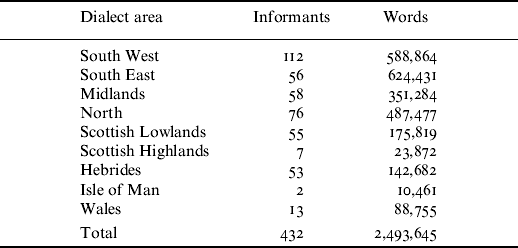
The Freiburg English Dialect Corpus (FRED) was compiled between 1999 and 2005 by a research team working on dialect grammar under the supervision of Bernd Kortmann at Freiburg University, Germany.Footnote 3 As we aimed for a large body of texts, spoken by traditional dialect speakers preferably born before World War II, from across all of Great Britain, we turned to a resource hitherto untapped: recordings and transcripts of Oral History projects mainly from the 1970s and the 1980s which were available from local British archives, folklore museums, local historians, etc. Re-transcribing the data where necessary, paying particular attention to non-standard morphology and syntax, the corpus has recently been completed. It contains almost 2.5 million words (excluding interviewers' utterances) by 430 speakers, both male and female, in electronic format. The texts are transcribed orthographically.Footnote 4 This means that standard text retrieval techniques known from corpus linguistics can be performed quickly and effortlessly on these non-standard texts. The regional affiliation of informants is detailed in Table 1.
Informants per dialect area in the FRED corpus

2.2 The dialect data
2.2.1 A synchronic perspective
One of the most striking features of non-Standard English as documented in FRED, at least in the realm of verb morphology, is the frequent occurrence of non-standard past tense forms, as documented in (1)–(4).
(1) there's eh these elderberry flowers, mash them and drink them, they didn't taste very nice but they used to, eh, stop inflammation from setting in and eh, there used to be well eh that lad of mine what eh got killed on back of a motorbike when he had measles I bathed his (trunc) ey- (/trunc) he drunk it and bathed his eyes in it, because he had them very bad they had them all in his eyes you know they're liable to blind you, eh in them the measles was very bad in them days, and ehm bathed his eyes in it and he drank it and everything (FRED NTT 006; Nottinghamshire, Midlands)
(2) They got in it, and then they picked him up, with the barge, and, ‘course, the yacht sunk. (FRED KEN 006; Kent, South East)
(3) I heard a Gospel group singing. They sung The Rugged Cross, and they sung some more, more hymns. (FRED LAN 006; Lancashire, North)
(4) He run in and rung the bell twice, stopped the trucks. (FRED GLA 005; Glamorgan, Wales)
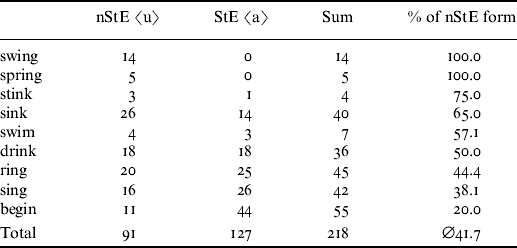
While older dialectological studies like the English Dialect Dictionary (Wright 1898–Reference Wright1905), its companion the English Dialect Grammar (Wright Reference Wright1905) or the Survey of English Dialects (published as Orton & Halliday Reference Orton and Wilfrid1962–64, Orton & Wakelin Reference Orton and Martyn1967–68, Orton & Barry Reference Orton and Michael1969–71, Orton & Tilling Reference Orton and Philip1969–71) impress the reader mainly by a bewildering number of (related or unrelated) verbal forms, in FRED variation is comparatively principled, as I have shown elsewhere (Anderwald Reference Anderwald2009). A great number of non-standard verb forms in fact cluster around the forms drunk and sung, and for most of them, a past tense form in 〈u〉 is the preferred option, as Table 2 indicates.Footnote 5 Thus, swung and sprung are used in FRED categorically (if relatively rarely), and sprung, stunk, sunk and swum are considerably more frequent as past tense forms than their standard equivalents in 〈a〉. The ‘reverse’ forms (he has drank, she has sang) occur extremely rarely, if they occur at all. Thus, there is exactly one occurrence of she had drank, from East Lothian. Variation is thus not random, as the quantitative comparison in Table 2 has shown. As a result, verbal paradigms are much simpler compared to the standard, and in the great majority tend towards levelled forms in 〈u〉 with identical past tense and past participle, resulting in paradigms like drink – drunk – drunk or sing – sung – sung.
Variable past tense verbs in the FRED corpus
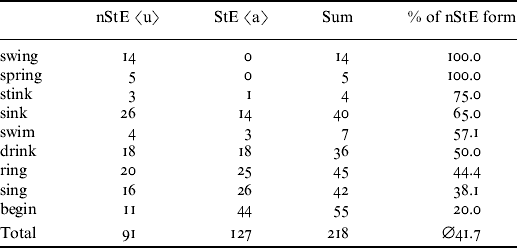
StE=Standard English; nStE=non-Standard English
2.2.2 A historical approach
The main reason why we find the past tense drunk and sung in the majority of cases, but not the past participle (have) drank or (have) sang, is historical. These verbs as a group go back to the Old English verb class III. This verb class was characterized by vowel gradation (ablaut); more specifically, different vowels were also employed to distinguish between the preterite I and preterite II stems – a distinction that is found in only a minority of Old English verb classes. (Preterite I was employed for the first and third person singular, preterite II for all other forms. It is therefore a slight simplification to speak of a singular–plural distinction, although this captures the general gist.) Two examples of Old English paradigms from this verb class with two past tense forms that are distinctive in vowel quality for singular and plural, are given in (5) and (6).
(5) drincan – dranc, druncon – druncen
(6) wringan – wrang, wrungon – wrungen
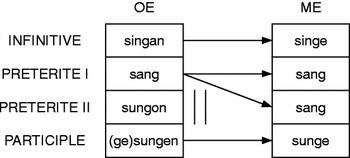
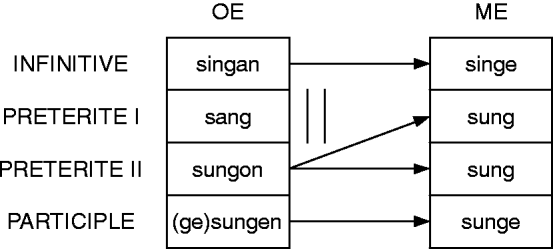
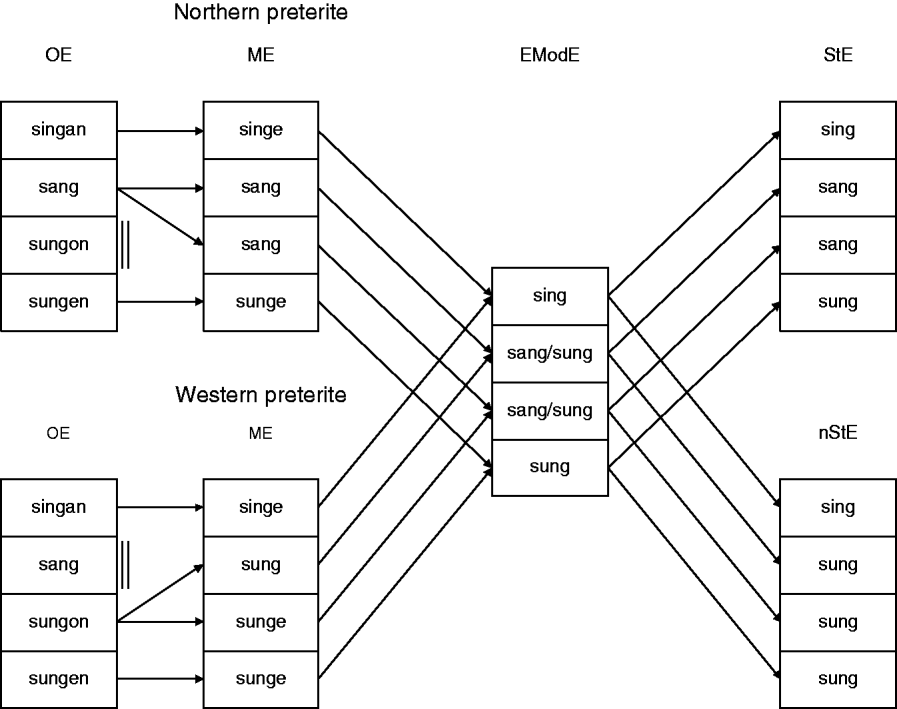
With the increasing loss of verbal inflections during Middle English, the distinction between singular and plural forms in the past tense broke down; some of the ensuing variability is in fact attested. Levelling (inside the past tense) seems to have occurred in the North first – not surprisingly, as due to extensive language contact with Old Norse, the North shows instances of levelling and simplification in many features on a great scale during Middle English. Wyld claims that levelling of the past tense paradigm under the preterite I form starts in the North around the year 1300, and calls this the ‘Northern preterite’ (Wyld Reference Wyld1927: 268). Slightly later, levelling in the opposite direction is attested in the South West of England and the South West Midlands, i.e. levelling under the preterite II form, which in these verbs is identical to the past participle. Wyld calls this the ‘Western preterite’ (Wyld Reference Wyld1927: 269; see also Lass Reference Lass, Stein and Tieken-Boon van Ostade1994). These different kinds of levelling can be diagrammatically presented as in Figures 1 and 2. A double vertical line indicates a discontinued form; a branching arrow (from left to right) the merging of forms. Straight horizontal arrows indicate historical continuity.
The Northern preterite in Middle English
OE=Old English; ME=Middle English

The Western preterite in Middle English
OE=Old English; ME=Middle English
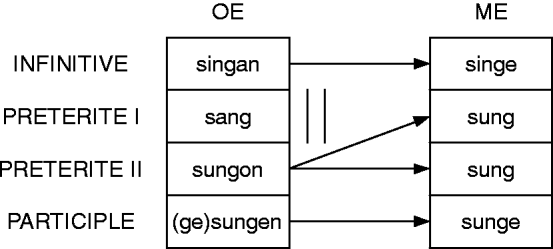
It can easily be seen that although the mechanism is quite similar, the outcomes of these regional levelling processes are quite different. In the Northern case, the new paradigm consists of three forms (instead of Old English four) and is clearly a precursor of present-day Standard English sing – sang – sung. The Western preterite, however, with the continuing loss of unstressed final syllables, results in a paradigm that only distinguishes two forms: sing – sung – sung. Again, this verb paradigm pattern has survived until today in Standard English wring – wrung – wrung and a large number of other verbs.
Although detailed documentation is scarce, we can assume that these two regional patterns of (differently) simplified verb paradigms slowly spread across the country. Where they met, more or less random variation must have ensued. This may explain why some verbs of this verb class today still have three forms in Standard English (begin, drink, (ring), shrink, sing, sink, spring, stink, swim), essentially following the Northern preterite pattern, while another group of those verbs which have survived follow the Western preterite and distinguish just two forms (cling, slink, spin, sting, swing, wring). Interestingly, this latter group has been extremely ‘attractive’ at least since Middle English times, attracting a wide variety of words, such as some weak (‘regular’) verbs (e.g. stick), verbs from other strong (‘irregular’) verb classes (e.g. strike from verb class I), or loan words entering the language only in Middle English times (e.g. dig, fling, string). In contrast, the first group of words has only ever gained one new member, ring, a former weak verb. (For individual histories, see the individual entries in the OED.)Footnote 6
This orderly picture is probably only valid for the standard, however. In non-standard varieties, on the other hand, variation must have been endemic ever since Middle English. Instead of the relatively orderly differentiation into two verb classes in Standard English, in non-Standard English today forms in 〈u〉 are in the majority in almost all cases, as we have seen in the data from FRED. Even in the standard, codification in the 〈a〉 forms was relatively late, and variation between 〈a〉 and 〈u〉 was permitted until at least the middle of the nineteenth century for many verbs, as a comparison across grammar books from the nineteenth century shows (Anderwald Reference Anderwald2010). A more accurate picture would therefore have to take into account historical dialect data, for which, however, quantitative materials and quantitative studies are lacking. Diagrammatically, the historical development can be presented as in Figure 3.
Historical development
OE=Old English; ME=Middle English; EModE=Early Modern English; StE=Standard English; nStE=non-Standard English

As we have seen above in Table 2, forms in 〈u〉 are clearly the preferred option in non-standard British dialects for most verbs. It is rather unusual, however, that the preterite II forms are as dominant as in the case of these forms in 〈u〉. As Wyld (Reference Wyld1927: 269) points out (quoting Bülbring Reference Bülbring1891), the ‘Pret[erite] Pl[ural] type is the least permanent of the various forms of the Strong Verbs, and never survives in Mod[ern] Engl[ish] unless it be the type also of the Past Participle’. I would suggest informally that analogy with the weak verbs (where past tense and past participle are always identical) would have been an argument in favour of the Western preterite forms, where past tense and past participle have also become identical after the loss of all inflectional endings. Once the class of verbs around wring – wrung displaying the Western preterite forms had become stable through analogy with the weak verbs, it could then attract new members, and this is what has been happening since Middle English. The larger verb class becomes ever more stable, attracting still other verbs, in our case those forms that were variable between 〈a〉 and 〈u〉. Finally, this ever-growing class will continue to attract members from other verb classes, and this is what we can observe in American English today with the creation of new strong verbs like sneak – snuck and drag – drug (see Hogg Reference Hogg, Nixon and Honey1998, Murray Reference Murray1998). The following section will attempt to capture this intuitive insight in the theoretical framework of Natural Morphology, enhanced by elements from Bybee's Network Model (Bybee Reference Bybee1985, Reference Bybee1995).
3. Explanations
3.1 Natural Morphology
In Natural Morphology, Wolfgang Wurzel has shown that in cases of conflict, language-specific naturalness wins out over more general principles of Natural Morphology (as detailed in Mayerthaler Reference Mayerthaler1981, Reference Mayerthaler1988) in every case.Footnote 7 For this reason, I will not give a detailed exposition of Mayerthaler's ideas, but apply Wurzel's principles to the case of the English verb system.
3.1.1 Wurzel's parameters of comparison
In a series of publications, Wurzel (Reference Wurzel1984, Reference Wurzel and Dressler1987; see also Reference Wurzel, Dressler, Luschützky, Pfeiffer and Rennison1990a, Reference Wurzel, Boretzky, Enninger and Stolzb, Reference Wurzel and Lahiri2000) has developed a systematic account of inflectional systems that allows the analyst to compare linguistic forms in one language and to determine which of two (or more) forms can be said to be more ‘natural’ than the other. In order to do so, Wurzel claims that every inflectional system of a language can be characterized along the following parameters:
(i) the inventory of category structures and categories (e.g. number: singular, plural, dual; case: nominative, genitive, accusative, dative, instrumental, vocative, etc.)
(ii) base form vs. stem inflection (e.g. English friend – friends vs. Latin amic-us – amic-i)
(iii) separate or combined symbolization of categories (e.g. Swedish kapten-er-s ‘captain’+plural+genitive vs. Russian kapitan-ov ‘captain’+genitive plural)Footnote 8
(iv) number (and manner) of formal distinctions in the paradigm (e.g. Old High German Nominative Singular is identical to the Accusative Singular, but distinct from both the Genitive and the Dative Singular)
(v) types of markers involved (e.g. affixes vs. ablaut)
(vi) existence of inflectional classes (e.g. German: yes, Turkish: no) (cf. e.g. Wurzel Reference Wurzel1984: 82).
An inventory of the inflectional system along these parameters determines the characteristic (‘system-defining’) structural properties which are dominant in a system. Inflectional classes that conform to these properties constitute dominant classes, which is reflected in their size, determined by type-frequency. Individual words can then be analysed as being more or less ‘natural’ or ‘normal’ with respect to these dominant features when we determine whether they conform to these features or not. Wurzel (Reference Wurzel1984: 87–88) further claims that inflectional classes (in those languages that have them) are cognitively real; they are functionally motivated since they aid the language user's task of storing and retrieving linguistic forms, and they simplify the task of language acquisition. The existence of these inflectional classes can be observed in particular during the incorporation of loan words and during periods of language change.
3.1.2 The English verbal system
Although Wurzel has mainly worked on German noun classes, we can quite easily extend his framework to English verbs. Along his six parameters, present-day English verbs can be characterized by the fact that only present and past tenses are expressed morphologically; a range of other tenses are expressed periphrastically with the help of the infinitive (the future) or the past participle (the range of perfect constructions) and of course employing the auxiliary verbs be and have.Footnote 9 Most English verbs are weak (‘regular’), forming the past tense and the past participle with the suffix -ed, but a sizeable number of verbsFootnote 10 has remained strong (‘irregular’), employing stem vowel change in addition to other mechanisms, or as the sole method of indicating tense distinctions. Formal distinctions here range from three distinct forms to just one (i.e. all forms are identical). It has to be noted that, as is usual in these cases, a low type-frequency (of around 150 strong verbs, as opposed to several thousands of weak verbs) goes hand in hand with a very high token-frequency; although text counts vary, English strong verbs make up between 70 and 75 per cent of verbal tokens in running text, especially in spontaneous spoken discourse (see e.g. Pinker Reference Pinker1999: 227; Dahl Reference Dahl2004: 300–301). Furthermore, English strong verbs are not only frequent in discourse but they also tend to be short and of Germanic origin (for some of the few loan words that have entered the strong verb classes, see Section 2.2.2 above).
In the group of strong verbs, we can observe some subregularities, so one could argue for the existence of inflectional classes (see the proposals in Quirk, Greenbaum, Leech & Svartvik Reference Quirk, Greenbaum, Leech and Svartvik1985: 105–114; Hansen & Nielsen Reference Hansen and Nielsen1986; Esser Reference Esser1988; Huddleston & Pullum Reference Huddleston and Geoffrey2002: 1600–1610). Broadly in line with these proposals, in my system, the present-day English strong (‘irregular’) verbs can be grouped into five classes on the basis of the three ‘principal parts’: infinitive, past tense and past participle (labelled here present, past and past participle, respectively; see Anderwald Reference Anderwald2009). If one considers quite abstractly whether these three forms are identical or non-identical for each given verb, five logical possibilities obtain, all of which are in fact attested in English.
3.1.3 English verb classes
If one distinguishes present-day English verb classes by the criterion of identity or non-identity of their principal parts, one obtains five verb classes, only three of which are of considerable size:
VERB CLASS 1:
present≠past≠past participle (three distinct forms, e.g. sink – sank – sunk, break – broke – broken)
VERB CLASS 2:
present≠past=past participle (two distinct forms, e.g. string – strung – strung, weep – wept – wept)
VERB CLASS 3:
present=pastparticiple≠past (two distinct forms, e.g. come – came – come, run – ran – run)
VERB CLASS 4:
present=past≠past participle (two distinct forms, e.g. beat – beat – beaten)
VERB CLASS 5:
present=past=past participle (one form, e.g. hit – hit – hit, put – put – put)
Verb class 2 displays the dominant pattern present≠past=past participle, identical (in its abstract form) with all weak verbs. In other words, this (strong) verb class conforms to the system-defining structural property for English verbs and is in this sense more natural (more ‘normal’) than the other four verb classes. In fact, based on the list of Standard English verbs in Quirk et al. (Reference Quirk, Greenbaum, Leech and Svartvik1985: 115–120; see also Anderwald Reference Anderwald2009), it is also the largest class of all strong verbs (almost half of all strong verb types belong to this verb class). Verb class 1 is the second largest class, containing over a third of all strong verb types. Verb classes 3 and 4 are extremely marginal; verb class 4 in fact only contains a single verb, beat. Verb class 5, finally, contains about fifteen per cent of all strong verbs, all of which end in /t/ or /d/ (Pinker (Reference Pinker1999: 60) has commented on this phenomenon; see also Bybee Reference Bybee1995: 431; Bauer Reference Bauer1997), and many of which tend to form a new past tense in -ed, effectively switching into the class of weak verbs. The last three verb classes can therefore be disregarded for the present purposes of this argument.
3.1.4 Stable marker
The strongest subregularity in all verbal classes is the past tense pattern in (7), taken from Bybee (Reference Bybee1995: 431), displayed by fourteen verb types clustering around string – strung – strung in verb class 2. This subregularity has also been noticed by several other authors, including Albright & Hayes (Reference Albright and Hayes2003: 127 et passim) who call it an ‘island of reliability’.
(7) [C (C) (C) ʌ {velar/nasal}]past
As Bybee (Reference Bybee1985, Reference Bybee1995) points out, this is a product-oriented schema: it does not link a present tense form with its past tense form (it is thus not a derivational rule,Footnote 11 and rule-based accounts typically run into problems modelling this kind of relationshipFootnote 12), nor does it connect similar present tense forms with each other, but it connects verb forms solely on the basis of similarities in the past tense. In this way, this schema can attract past tense forms even where the respective present tense forms are quite dissimilar from the other present tense forms (e.g. string, fling or sink): consider the historical case of strike (with present tense /ai/), or the American English forms sneak (/iː/) or drag (/æ/). Because Joan Bybee has worked on this phenomenon in several publications (Bybee & Slobin Reference Bybee, Slobin and Ahlqvist1982, Bybee & Moder Reference Bybee and Moder1983, Bybee Reference Bybee1985, Reference Bybee1995), I will designate all verbs comforming to the past tense schema [C (C) (C) ʌ {velar/nasal}]pastBybee verbs.Footnote 13
As we have seen, this past tense marker has expanded its territory historically, causing it to stabilize, which in turn has made it more attractive for other verb forms, in turn increasing its stability further (i.e. making its verbs more immune to switching into the weak verb class). Wurzel notes a kind of ‘avalanche’ effect: ‘jede Ausbreitung eines Markers auf eine neue Flexionsklasse erhöht seinen Stabilitätsgrad weiter’ [every extension of a marker to a new inflectional class increases its stability further] (Wurzel Reference Wurzel1984: 139; my translation – AL), in turn conferring stability on the verbal class as a whole. As Wurzel (Reference Wurzel1984: 129) points out, inflectional classes that are extra-morphologically motivated are stable.Footnote 14 While extra-morphological motivation is quite frequent for nominal classes (think of the semantic motivation of diminutives in many languages, or a phonological motivation like ‘nouns ending in -ion’), at least semantic motivation is rarely observed in verbs.Footnote 15 Phonological motivation seems to be a more plausible candidate, for, at least historically, Germanic strong verb classes seem to have been phonologically motivated.Footnote 16 Similarly, in the case of Bybee verbs, we find an extra-morphological motivation, consisting of a phonological template.
Bybee's and our own observations on non-standard data also suggest an important extension of Wurzel's framework, a kind of internal structure of categories as proposed in prototype theory (see Rosch Reference Rosch and Moore1973, Taylor Reference Taylor1989). Not only can the English strong verb class around drink – drank – drunk be characterized by a defining criterion (the past tense template in (7)), but some members are also more central than others and constitute stronger attractors, whereas other members are more marginal. This internal structure is made explicit in Bybee & Moder (Reference Bybee and Moder1983) and is also already implicit in the fact that we are dealing with output-to-output similarities here. While most verbs indeed conform to the ‘rule’ that the present tense vowel [i] is changed to the past tense vowel [ʊ], Bybee's past tense schema is also able to include as more marginal members verbs with a different present tense stem like strike and sneak, as well as impose some category-internal hierarchy on verbs depending on their consonant clusters in the rhyme and in the onset. (The most central members have /sCC/ in the onset, the less central members differ in a step-wise manner consonant by consonant; the most central members have /ŋk/ in the rhyme and again the less central members differ consonant by consonant; see Anderwald Reference Anderwald2009: 181 for details.)
3.1.5 Non-standard Bybee verbs
With the apparatus in hand provided by Wurzel and Bybee, we can now proceed to analyse the attractiveness of Bybee verbs for non-standard speakers and capture the intuitive insight from Section 2.2.2 in more technical terms. As we have seen, a rather large subclass of fourteen verbs, namely the group of Bybee verbs like cling – clung – clung, are ordered around the prototypical past tense form strung, conforming to the template [C (C) (C) ʌ {velar/nasal}]past for their past tense. This template can be regarded as a marker of this verbal subclass in Wurzel's sense. As this marker is extra-morphologically motivated (namely through its phonological shape), it is stable, conferring its stability on the verbal (sub)class. The class of Bybee verbs is thus stable through having this stable marker, in addition to following the dominant pattern present≠past=past participle.
In vernacular systems, this stable subclass now acts as an attractor for the slightly smaller subclass of nine class 1 verbs around drink (see Section 3.1.3 above), which have fluctuated historically between past tense forms in 〈a〉 and 〈u〉. By joining the verbs around strung, these nine new Bybee verbs become more ‘natural’ in Wurzel's sense: their overall pattern conforms to the system-defining structural property present≠past=past participle in not distinguishing past tense and past participle forms, and in addition the stable marker [C (C) (C) ʌ {velar/nasal}]past spreads to more verbs (23 instead of 14), in turn increasing the stability of this subclass of verbs further.Footnote 17 It should therefore not be surprising if other verbs followed suit, and indeed this is what we can observe with non-standard past tense forms like run and come, which also follow this pattern (Anderwald Reference Anderwald2009, see also example (4) above). (Recall also non-standard forms in American English like snuck and drug mentioned at the end of Section 2 above.) In other words, we can observe that a subclass of verb class 1 (drink – drank – drunk) switches in its entirety, augmenting class 2, in particular the subclass of Bybee verbs. This in turn stabilizes verb class 2, and in particular Bybee verbs, making them yet more attractive for other verbs. With every stabilizing influx of verbs, the phonological template [C (C) (C) ʌ {velar/nasal}]past becomes even more stable, eventually leading to the state of a super-stable marker (Wurzel Reference Wurzel1984: 139–142). Typically, super-stable markers expand their territory not by proportional analogy, but disregarding the base form (Wurzel speaks of expansion here) – exactly the kind of development we can observe in English varieties, both historically and dialectally, that cannot be captured easily by a rule-based model.
3.2 Functional explanation
In non-standard varieties of English where new Bybee verbs are particularly numerous, we can thus observe a considerable simplification of the verbal system. A whole subclass of verbs (drink, sing, shrink, etc. – the only verb class that has three different forms by employing only vowel change) switches from the three-part pattern present≠past≠past participle to the dominant two-part pattern present≠past=past participle, without becoming part of the dominant class of weak verbs altogether. Note that this change does not presuppose that the past participle as such is ‘taken over’ or ‘generalized’ or ‘extended’ to the past tense. Rather, the phonological template [C (C) (C) ʌ {velar/nasal}]past of other verbs in combination with the stable association with the semantic meaning PAST TENSE is the attractor that changes the past tense forms of the attracted verbs.
Taking over an abstract pattern in this way unifies and thus stabilizes the inflectional system, as we have seen (Wurzel Reference Wurzel1984: 79) – in fact making it more ‘immune’ to switches into the weak verb class. As more verbs now conform to the system-defining structural property present≠past=past participle, the non-standard verbal system can be regarded as being more ‘normal’, or more natural with respect to this criterion compared to the Standard English system. (It should be clear by now that this kind of analysis can only be language-specific, or more exactly, variety-specific.)
If we look at this non-standard system in functional terms, we can see that in English, not distinguishing past tense and past participle morphologically makes much sense. The fact that a pattern with identical forms for past tense and past participle is defining the properties of the English verbal system indicates that a two-part paradigm that preserves the morphological contrast between the two simple tenses, present and past, is fully sufficient to avoid morphological and syntactic ambiguities. The verbal constructions that employ the past participle (namely the range of perfect constructions and passive constructions) crucially always employ at least one auxiliary as well (cf. I rang vs. I have rung, the bell was rung, the bell had been rung, etc.). This auxiliary guarantees comprehensibility even if past tense and past participle are identical (cf. she hunted vs. she has hunted vs. she was hunted), or if present tense and past participle are identical (cf. we come vs. we had come). Three-part paradigms like Standard English drink – drank – drunk could therefore be regarded as ‘gratuitous luxury’ (or ‘dumb’ redundancy in Dahl's (Reference Dahl2004: 10–11) terminology) in functional terms, and it is legitimate to pose the question why these ‘superfluous’ forms were coded as the standard, rather than the more economical two-part paradigms. Since very little work has been done so far on nineteenth-century prescriptive grammars this question would open a whole new research programme and I cannot even begin to answer it within the scope of this article. However, some relevant comments in grammars of the time can be encountered and they explicitly prefer distinct 〈a〉-forms for the past tense because ‘the Preterite and Participle would thus be discriminated’ (Crombie Reference Crombie1809: 199), or ‘[the past] may be more readily distinguished from the perfect participle’ (Pinnock Reference Pinnock1830: 161), implicitly modelling their description of English on the ideal of Latin. The ideology of Latin as the perfect language (see Stein's (Reference Stein, Cheshire and Stein1998) principle 2a) in this way supported the prescriptive establishment of three-part paradigms for this (small) group of verbs that only distinguish their forms with the help of vowel change.
3.3 Alternative accounts
There are a range of alternative explanations; indeed Natural Morphology is only an outsider in the overview of morphological theories more generally, and has not played a role at all so far in the discussion of the past tense, at least not for English. The situation looks slightly different for other languages, where morphologists have at least recognized the potential of Natural Morphology to account for paradigm levelling and other processes of language change (see e.g. Wheeler Reference Wheeler1993, Maiden Reference Maiden, Schmid, Austin and Stein1998, Carstairs-McCarthy Reference Carstairs-McCarthy2001; see also the short sections in Carstairs-McCarthy Reference Carstairs-McCarthy1992, one of the few theory textbooks to include an account of Natural Morphology).
This section will briefly look at the debate in psycholinguistics in the 1980s and the 1990s, and some sophisticated rule-based algorithms, and provide some arguments why neither approach succeeds in capturing the facts displayed above.
3.3.1 The psycholinguistic debate
The English past tense is perhaps one of the hottest contenders for over-analysed item of recent linguistics; among other things it has been called the ‘fruitfly’ of linguistics (Pinker Reference Pinker1999: ix), and even the ‘single combatant’ (Pinker Reference Pinker1999: 83) which is sent into battle as a substitute for rival camps. Indeed, the controversy raging in morphology-theory circles has been fought largely on the basis of data on English past tense formation, especially over the last two decades. The main controversy used to run between the camp relying on two distinct mechanisms, namely rules for some words (typically the very frequent regular verbs) and representation (or storage, from which the verbs and their associated past tense forms would be retrieved for each occurrence) for the few irregular verbs (see especially Pinker & Prince Reference Pinker and Prince1988, Reference Pinker, Prince, Sutton and Johnson1991; Pinker Reference Pinker1998, Reference Pinker1999) and the connectionist camp on the other. Scholars in this field see morphological rules like ‘add -ed for the past tense’ – and probably the establishment of abstract morphemes in general – as an epiphenomenon of simple lower-level processes which can be modelled with the help of comparatively simple artificial neural networks, and where processes of analogy play a constitutive role (see e.g. Rumelhart & McClelland Reference Rumelhart, McClelland, Rumelhart and McClelland1986, Daugherty & Seidenberg Reference Daugherty, Seidenberg, Lima, Corrigan and Iverson1994).
The debate is also sometimes captured as one between dual-route approaches (rules and representations) vs. single-route approaches. While single-route approaches are usually thought to be synonymous with the connectionist approaches mentioned above, or neural networks more generally, another single-route approach would be constituted by researchers working in Lexical Phonology and Morphology, where all past tense forms are captured by rules (ranging from the very general to the idiosyncratic). The most extreme (and consistent) example would be the battery of ordered rules in Halle & Mohanan (Reference Halle and Mohanan1985). However, the authors here do not even touch on questions of psychological plausibility and this approach has, to my knowledge, largely been abandoned in this pure form today. (Lexical Phonology and Morphology lives on, and a more plausible account with regard to the English verb system has recently been put forward by McMahon Reference McMahon2000.)Footnote 18
Inside the dual-route camp, Pinker (probably the first linguist to write a bestseller on ‘words and rules’ alone, see Pinker Reference Pinker1999) seems to occupy a compromise position these days, and has thus taken much of the sting out of the discussion. He used to claim that we can observe a principled distinction between regular verbs that form their past tense according to the rule (‘add -ed’), and irregular verbs which do not, and therefore have to be stored, and that the rather small and insignificant area of English past tense formation ‘contain[s], in an easily visible form, the machinery that powers larger phenomena in all their glorious complexity’ (Pinker Reference Pinker1999: ix), i.e. the basic mental processes of storage vs. creative use, or representation vs. rule. However, this simple dual-route model, at least partly supported by various retrieval times and other psycholinguistic experiments, cannot account for the fact that we find clear similarities inside the group of irregular verbs: if irregular verbs are learned by heart one by one, retrieving dissimilar forms would be just as economical. Moreover, a simple dual-route model cannot account for the fact that these regular ‘islands of reliability’ (see Section 3.1.4) tend to grow, rather than be washed away by the ‘tide’ of regular verbs, which seems to have led Pinker to add in later versions of his theory a criss-crossing of categories, such that some (highly frequent) regular verbs may nevertheless be stored, whereas at least for a subcategory of irregular verbs some rules or sub-rules are also conceivable (Pinker Reference Pinker1999: 137, 225). This is also more plausible psycholinguistically, since the human brain does not seem to operate on strictly economical storage constraints, but storage seems to be ‘cheap’, so that a double representation of linguistic items is not inconsistent with what we know about the human brain. Recent modifications of dual-route approaches are thus more flexible about the dividing line between ‘rules’ and ‘representations’, but would still rely on rules to a large degree. This modification also takes care of the largest problem, the fact that the similarities between drink – drunk, sling – slung and strike – struck can only poorly be accounted for by rules. Indeed, this problem was the initial impetus behind Bybee's proposal of a product schema that can abstract from input-to-output rules. Since the input vowels are so different (the present tense vowel is /i/ in most cases, but there are also cases like strike – struck, with /ai/, and American English sneak – snuck, with /iː/), simple rules in this case fail to capture the intuitive class in its entirety. Modifying a rule-based approach by adding output-to-output similarities tries to account for these similarities in a constrained way.
3.3.2 Other approaches
While Optimality Theory will not be discussed here in detail, it should be noted that it is another example of a single-route approach that relies on its equivalent of (general or idiosyncratic) rules, but has said very little on strong or weak verb forms (see Anderwald Reference Anderwald2009 for a critical discussion).Footnote 19 We have also seen in this area the evolution of a stochastic branch of Optimality Theory (see Boersma & Hayes Reference Boersma and Hayes2001), whereas other probabilistic approaches have tried to model or advance neural networks (see Baayen Reference Baayen, Bod, Hay and Jannedy2003 on what he calls ‘memory-based morphology’).
A computer-implemented model that largely relies on rules alone has been proposed by Albright & Hayes (Reference Albright and Hayes2003). Their objective of such an approach is to modify the rules to such an extent that they match reality better than earlier models, giving overall better performance for a rule-based approach. However, Albright & Hayes concede that irregular verbs have to be stored: ‘we agree with dual mechanism theorists … that irregulars are lexically listed; this is what prevents them from being regularized’ (Albright & Hayes Reference Albright and Hayes2003: 129), and the rules they propose ‘need not … succeed in covering all forms perfectly. Rather, these rules characterize the (modest) productivity of the various irregular patterns’ (Albright & Hayes Reference Albright and Hayes2003: 129). Their approach is thus not as purely rule-based as the general gist of their argument would suggest. (However, it is true that their rule-based model is explicitly opposed to one based on analogy alone.)
Albright & Hayes essentially still propose a set of rules that derive the past tense form from the present tense form, although the sophistication of their model consists in the fact that ‘grammars may contain multiple rules with the same structural change (e.g. [i] [sic]→[ʌ]), but different confidence values’ (Albright & Hayes Reference Albright and Hayes2003: 129). However, of these competing rules, neither ‘[i]→[ʌ]’ nor ‘[i]→[ʊ]’ can account for those verbs that do not have [i] in the present tense stem. To capture this similarity, output-to-output similarities would have to be proposed (as in Bybee's model), or these exceptional verbs would be relegated to the memory – a solution that is implied by Albright & Hayes claim cited above that ‘rules need not … succeed in covering all forms perfectly’ (Albright & Hayes Reference Albright and Hayes2003: 129). However, dividing the class of Bybee verbs in this way between rules and representations destroys their intuitive similarity and is not a convincing alternative to Wurzel's model presented above.
3.3.3 Assessment of rival explanations
In sum, many rival explanations of English past tense formation presented in this paper already run into difficulties accounting for the present-day standard data. (I have discussed individual failings at length elsewhere, see Anderwald Reference Anderwald2009.) Complicating the matter, none of them has so far even tried to account for non-standard data. I would therefore maintain that Wurzel's framework of Natural Morphology, relying on inflectional classes constituted by differences in type-frequency, augmented by Bybee's refinement of token-frequency adding internal structure to these classes, is best suited to explaining the historical evolution of English strong verb classes and their current status in non-standard systems of English. In particular, it can account for the stability of some, but not others, of these classes amidst large-scale switches into the weak verb class, as well as their continuing ability to attract new members especially in non-standard systems, which are not constrained by ideals of prescriptive grammar, and where these natural tendencies can therefore be observed in an unadulterated form.
4. Comparison with present-day data
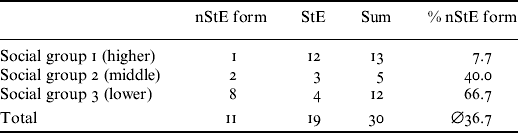
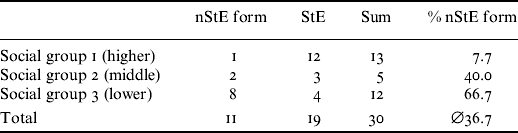
If Bybee verbs really are a strong attractor, we should be able to witness an ongoing trend of eligible verbs switching into this verb class in present-day English. Unfortunately, the perfect source for comparison, the spoken sections of the British National Corpus (BNC) cannot be regarded as being reliably transcribed where stigmatized features are concerned, and it has to be feared that especially salient non-standard features like past tense drunk would have been edited out in the transcription process (probably subconsciously) by the skilled ‘audio keyboarders’ employed (Crowdy Reference Crowdy1994: 26) – a professional group that is well-known for their prescriptive attitudes to language (and indeed trained to perform this task consistently). Especially the past tense forms in 〈u〉 – often regarded as ‘bad’ English – may have been subject to this editing process. If, unfortunately, the BNC as a whole cannot be taken as a standard of comparison, a subset of the data, the Bergen Corpus of London Teenage Speech (COLT) serves the purpose rather well, as here the rough transcripts have been re-transcribed by trained linguistic staff. The figures from COLT presented in Table 3 show that, indeed, new Bybee verbs are well-established in the speech of London teenagers today.
New Bybee verbs in the COLT corpus
StE=Standard English; nStE=non-Standard English
While the average of 36.7 per cent seems considerably lower than the relative frequency for the new Bybee verbs in the FRED corpus (see Table 2 above), this average clearly masks social differences. All FRED informants belong to the lower social group and should thus be compared only to social group 3 in COLT. Indeed, frequencies for the lower social group (group 3) of 66.7 per cent look very similar to the data from FRED (47.1 per cent), and in fact the difference is not statistically significant.Footnote 20
In the data from COLT we can also clearly see that although this non-standard feature is sharply stratified, the break-off point is not between social groups 2 and 3, but between the highest social group, where we find non-standard Bybee verbs at a very low rate, and social group 2, where non-standard Bybee verbs are also extremely frequent at around 40 per cent. In other words, we can see that non-standard Bybee verbs are still a very prominent feature of non-standard speech today, and that they seem to have gained social ground, having become a frequent feature also of middle-class speech (at least in the restricted sample of London teenagers in 1993). Bybee verbs thus do not seem to have lost any of their attraction for other verbs; quite the opposite, apart from historically, they also seem to be spreading socially today.
5. Conclusion
We have seen that highly frequent non-standard past tense forms around drink – drunk – drunk can be explained as being more ‘normal’ or ‘natural’ in Wurzel's (Reference Wurzel1984, Reference Wurzel and Dressler1987, Reference Wurzel, Dressler, Luschützky, Pfeiffer and Rennison1990) technical sense than their Standard English counterparts: they conform to the system-defining structural property of English verbs of distinguishing only present and past tense, but not past tense and past participle, morphologically. In addition, they have a past tense marker that is extra-morphologically motivated and thus stable. In Wurzel's framework, it is possible to formalize the intuitive insight that this stable marker stabilizes the verbal subclass as a whole, making it attractive also for other past tense forms independently of their present tense stems. That this marker is indeed expanding by analogy has been shown historically, geographically and socially. For this area of morphosyntax of strong verb classes, we can thus indeed see that non-standard systems, relatively unperturbed by prescriptive attempts of regulating the language, are more ‘natural’ than the standard variety.