CHD is the most common anomaly among all congenital defects with a frequency of 1%. Reference Hoffman and Kaplan1 Individuals with these anomalies often survive until reproductive age (90%). Reference Dray and Marelli2 Although the aetiology of CHD is not yet fully understood, it is seen that genetic aetiology plays a role in some of these patients. As a result, these individuals who have reached reproductive age can pass the disease on to future generations. Reference Ito, Chapman, Kisling and John3
It is important to reveal the underlying aetiology precisely, to determine the possibility of recurrence of this disease in future generations, and to provide correct genetic counselling, as well as follow-up and treatment of the patient. CHDs, which are the most common congenital anomalies, can be seen as insignificant or spontaneously healed malformations in the heart, but many different types lead to very complex and severe clinical pictures incompatible with life. Although significant advances have been made in the treatment methods used for individuals with CHD today, a better understanding of the aetiology of the disease can be a guide in terms of developing better preventive and therapeutic methods in the future. Reference Van Der Bom, Zomer, Zwinderman, Meijboom, Bouma and Mulder4
Although chromosomal abnormalities are one of the leading causes of CHDs, a small proportion of patients in this group can be diagnosed using conventional cytogenetic techniques. This can be explained by the fact that standard karyotyping can only detect losses or gains above 5–10 megabases (Mb). Chromosomal microarray or array comparative genomic hybridisation is an increasingly used diagnostic method that enables submicroscopic loss or gains (copy number variation; CNV) in the genome to be shown with high resolution. Reference van Karnebeek and Hennekam5 Although CNV was detected with a frequency of 3–10% in patients with isolated CHD, it was observed that this rate increased to 3–25% in patients with CHD accompanied by extra-cardiac anomalies. Reference Erdogan, Larsen and Zhang6 Therefore, important information about the underlying aetiology can be obtained with the use of array comparative genomic hybridisation analysis in individuals with CHD. Defining the cardiac anomaly detected in a case as "isolated" is quite difficult due to variables such as developmental delay and some dysmorphic findings that may become apparent over time. As a result, cardiac anomalies are less reported than in syndromic cases, or in other words, syndromic CHD is underreported. Reference Choi, Hwang, Kwon and Kim7 The American Heart Association clarified who should be given genetic evaluations among patients with CHD in 2016 through a published statement. Accordingly, genetic evaluation is recommended for patients with developmental delay or mental retardation accompanying the cardiac anomaly, congenital anomalies, dysmorphic findings, presence of the same cardiac anomaly in more than one close relative, three or more unexplained pregnancy losses in the parents of the individual with the cardiac anomaly, conotruncal type cardiac anomaly, supravalvular aortic stenosis, bicuspid aorta, thoracic aortic aneurysm and/or dysfunction, presence of undetermined cardiomyopathy, sudden death in the family history, and abnormal electrocardiographic findings consistent with hereditary arrhythmias. Reference Mital, Musunuru and Garg8 In light of these recommendations, the results of array comparative genomic hybridisation and karyotype analysis performed on patients admitted to our hospital with conotruncal heart anomalies in the last year were retrospectively evaluated and the findings were analysed.
Methods
The study was initiated after ethics committee approval was obtained from the local ethics committee of Toros University. A total of 37 children (individuals aged 0–18 years) who presented to the paediatric cardiology department of our hospital between July 2018 and May 2020 and were referred to our medical genetics department after being diagnosed with conotruncal heart disease were included in this study. Dysmorphologic evaluation and then chromosome analysis was performed in all patients. Patients with conotruncal heart anomaly who did not demonstrate findings consistent with dysmorphological syndrome were accepted to be non-syndromic and were included in the study. For chromosome analysis, blood was taken from the patients into a heparinised tube and a lymphocyte cell culture was prepared, and then, karyotype analysis was performed at 450–500 GTG resolution after metaphase staining using G banding. Patients with numerical chromosomal anomalies in karyotype analysis were excluded from the study. Array comparative genomic hybridisation was performed with submicroscopic deletion or duplication in patients with normal chromosome analysis. The DNA required for array comparative genomic hybridisation was obtained from a peripheral blood sample taken into an EDTA tube. Array comparative genomic hybridisation tests were performed on an Agilent Sure Print G3 Human Microarray platform, and then, the data obtained were analysed using the Agilent Cytogenomics version 4.0.3.12 software. Changes smaller than 100 KB were not been studied. The data obtained as a result of the analyses were analysed using the DECIPHER, UCSC Genome Browser, ISCA, Clingen, OMIM and Phenotype Genome Integrator databases.
Results
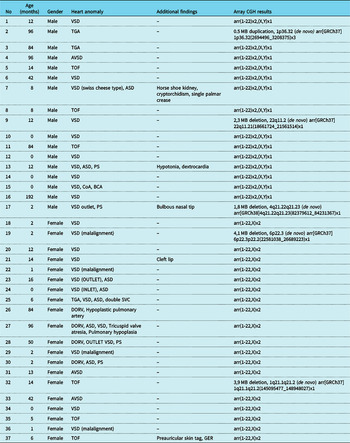
DNA samples of a total of 37 patients (17 boys and 20 girls) with conotruncal heart anomalies in the paediatric age group were analysed using array comparative genomic hybridisation. The results and clinical characteristics of the patients are presented in Table 1. The average age of the patients was 27.83 months. Deletions and duplications were found in the array comparative genomic hybridisation analysis of five (13.5%) of the patients included in the study. In patient #2, 0.5 MB duplication was detected in the region of 1p36.32 (arr[GRCh37]1p36.32(2694496_3208375)x3) (de novo). In patient #9, a 2.8 Mb deletion was observed in the 22q11.21 region (arr[GRCh37]22q11.21(18661724_21561514)x1) (de novo). As a result of the array comparative genomic hybridisation examination of patient #17, a 1.8 Mb deletion was detected in the 4q21.22q21.3 region (arr[GRCh38] 4q21.22q21.23(82379612_84231367)x1) (de novo). In the array comparative genomic hybridisation study performed on patient #19, a 4.1 Mb deletion was observed in the 6p22.3p22.2 region (arr[GRCh37]6p22.3p22.2(22581038_26689223)x1) (de novo). In patient #32, a 3.9 Mb deletion was detected in the 1q21.1q21.2 region (arr[GRCh37]1q21.1q21.2(145095477_148948027)x1) (de novo).
Phenotype, age, and sex of patients with array comparative genomic hybridisation results

ASD: Atrial septal defect; ARRAY CGH: Array comparative genomic hybridisation; AVSD: Atrioventricular septal defect; BCA: Bicuspid aorta; CoA: Coarctation of aorta; DORV: Double outlet right ventricle; GER: Gastroesophageal reflux; Mb: Megabase; PS: Pulmonary stenosis; SVC: Superior vena cava; TGA: Transposition of great arteries; TOF: Tetralogy of Fallot; VSD: Ventricular septal defect.
Discussion
The importance of genetic factors in the aetiology of CHDs is understood to a better degree each day. With array comparative genomic hybridisation, the aetiology of CHDs is enlightened as a result of the increasing knowledge about genomic variations in patients. In our study, in the array comparative genomic hybridisation analysis of 37 patients with conotruncal heart anomalies, chromosomal deletions were detected in four and duplications in one, and 13.5% of the patients had genomic changes. Although it is observed that the patients in our study were included in the definition of isolated cardiac anomalies due to the absence of distinct dysmorphic features and the absence of extra-cardiac anomalies, the fact that 22 of the patients included in the study were aged 1 year or younger made this definition difficult. Considering that the rate of deletion or duplication detection varied between 3 and 10% in genetic studies conducted with patients with isolated CHD, it was observed that the CNV frequency detected in our study was higher than in other studies. Reference Erdogan, Larsen and Zhang6
In relation to the advances in medical and surgical treatments in recent years, today, around 85% of children with CHD reach adulthood. Reference Richards and Garg9 In the study by Erdogan et al., CNVs were detected in 17% of patients with isolated CHD, and it was seen that with array comparative genomic hybridisation, a syndromic disorder in a child could be detected without the need to identify additional findings. Reference Erdogan, Larsen and Zhang6 The array comparative hybridisation technique was reported to be the testing method that should be preferred for first-line analysis in patients with apparently isolated CHD by Bachmann and colleagues. Additionally, the literature on this topic states that applying array comparative genomic hybridisation analysis only in patients with syndromic CHD may lead to missed diagnoses of possible chromosomal syndromes, and therefore, it has been suggested that array comparative genomic hybridisation analysis should be the first test applied to patients with CHD. Reference Bachman, DeWard, Chrysostomou, Munoz and Madan-Khetarpal10
In the present study, a de novo duplication of 0.5 MB was detected in the region of 1p36.32 (2694496-3208375) in patient #2 who had large artery transposition. There is no report in the literature on whether duplication in this region causes conotruncal heart disease. Although the duplication of the 1p36.32 region in databases does not explain the ventricular septal defect in the patient, the PRDM16 gene, one of the genes in the duplication region, is known to be expressed in myocytes, as well as many other tissues. In addition, it has been shown in an animal study that ectopic expression of the PRDM16 gene transforms myoblasts into adipose tissue. Reference Seale, Bjork and Yang11 Left ventricular non-compaction and dilated cardiomyopathy have been reported to be present in patients with 1p36.32 region duplication in the UCSC database (https://genome.ucsc.edu/). In addition, non-cardiac anomalies, such as intellectual delay, developmental delay, ataxia, speech delay, autism, and facial anomalies, have been reported in patients with this particular duplication. Since intellectual delay can be seen in patients with this duplication, it should be recommended that the family be careful in this respect and, if necessary, refer the patient to special education at the earliest possible stage for learning disabilities. However, since the DGV database demonstrates that healthy subjects may also have duplication in this region, it is not possible to directly attribute the cardiac anomaly in our patient to this variation. Even so, considering the possibility that the variation in our patient might show reduced penetrance, it was thought that it might have caused the disease.
In patient #9 who had ventricular septal defect, it was observed that there was de novo deletion in the 22q11.2 region. The relationship between conotruncal heart anomaly and haplo deficiency of the TBX1 gene in the region is well known. Reference McDonald-McGinn and Sullivan12,Reference McDonald-McGinn, Sullivan and Marino13 Although the renal, immunologic, gastrointestinal, palatal and behavioural findings associated with 22q11.2 deletion syndrome were not observed in the patient (except for the cardiac anomaly), they were scheduled for follow-up by the relevant departments for these aspects. 22q11.2 region deletion was detected in this patient who was thought to have an isolated conotruncal heart anomaly. The development of various complications in the perioperative and post-operative periods of cardiac surgery have been shown among individuals with this syndrome – also known as DiGeorge syndrome. For instance, due to heart failure, respiratory problems, infections, and hypocalcaemia, these patients may experience significantly prolonged time on the ventilator and could have extended need for positive inotrope support, ultimately leading to a longer length of stay in the ICU. Reference Yeoh, Scavonetto, Hamlin, Burkhart, Sprung and Weingarten14
It is observed that the parathyroid gland is underdeveloped or absent altogether in patients with DiGeorge syndrome, and as a result, hypocalcaemia may develop in patients. Reference Cuneo, Langman, Ilbawi, Ramakrishnan, Cutilletta and Driscoll15 More importantly, hypocalcaemia may develop in the perioperative period and could lead to hemodynamic instability. In addition, hypocalcaemia has been reported to be a cause of epileptic seizures in the post-operative period. Reference Flashburg, Dunbar, August and Watson16–Reference V.P.Singh, Sanyal, Waghray, Luthra and Borcar18 Epileptic seizures unrelated to hypocalcaemia have also been reported in some patients with DiGeorge syndrome. Reference Kao, Mariani and McDonald-McGinn19 Nonetheless, in these patients, parathyroid gland function usually develops within 1 year after birth, and hypertrophy of the gland is often observed. Accordingly, during this period, patients may have a period of normocalcaemia. Reference Perez and Sullivan20 However, in patients with parathyroid gland hypertrophy, there is a decreased parathyroid hormone response during physiological stress and hypocalcaemic hypoparathyroidism; in other words, latent hypoparathyroidism may occur. Reference Cuneo, Langman, Ilbawi, Ramakrishnan, Cutilletta and Driscoll15,Reference Cuneo21
Apart from hypocalcaemia, another problem encountered in the post-operative period in patients with DiGeorge syndrome is infection. In DiGeorge syndrome, infections are more common than expected due to susceptibility to bacterial and viral agents. IgG, IgA, IgM levels may be low in these patients. Reference Goldmuntz22 Graft versus host disease can be prevented by using irradiated blood products in patients with DiGeorge syndrome, in whom immune deficiency is detected. Reference Castro23 In addition, in these patients, it is recommended to prevent possible cytomegalovirus infections by using blood products that do not contain cytomegalovirus seronegative or leukocytes in the post-operative period. Reference Ljungman24
In patient #17, with outlet-type ventricular septal defect and pulmonary stenosis, a deletion of 1.8 MB in the 4q21.22q21.23 region was detected. 4q21 deletion syndrome (MIM: 613509) is characterised by apparent growth retardation, mental retardation, speech delay, cerebral hypoplasia, cerebellar anomalies, and ventricular dilatation. Reference Bonnet, Andrieux and Beri-Dexheimer25 CHD has not been reported in 4q21 deletions, except for our case. There is a need for more reports of similar cases/findings in order to determine whether the cardiac anomaly in our patient was a rare component of the 4q21 deletion syndrome.
In patient #19, a 4.1 Mb deletion in the 6p22.3 region was detected. In the literature, developmental delay, craniofacial malformations, brain, kidney, heart and, eye anomalies have been reported in patients with 6p22 deletion. In addition, dysmorphic findings such as clinodactyly, syndactyly, and short neck structure were observed in these patients. Reference Bremer, Schoumans, Nordenskjöld, Anderlid and Giacobini26 It has been established that the HIST1H1E gene mutation in the deletion region causes Rahman syndrome. The HIST1H1E gene encodes the Histone E1.4 protein, which is one of the epigenetic regulatory proteins. The main dysmorphological findings of the syndrome are high frontal hairline, full cheeks, bi-temporal narrowing, frontal bossing, and deep-set eyes. Among the clinical findings of the syndrome, intellectual disability, hypotonia, corpus callosum anomalies in the brain, and skeletal anomalies have been reported. In a study of individuals with this syndrome, cardiac anomalies were reported in 43% of patients. Reference Burkardt, Zachariou and Loveday27 No finding was observed in our patient, except for ventricular septal defect and malalignment.
Tetralogy of Fallot was detected on the echocardiography of patient #32. In the patient’s array comparative genomic hybridisation study, a 3.9 Mb deletion was observed in the 1q21.1 region. The 1q21.1 deletion (MIM: 612474) may show significant phenotypic variability. Patients may have neuropsychiatric findings such as microcephaly, mental retardation, autism, and schizophrenia, whereas some individuals may demonstrate normal neurologic development. Cardiologically, bicuspid aorta, truncus arteriosus, transposition of great arteries, and aortic coarctation are observed in these patients. Dysmorphologically, frontal bossing, deep-set eyes and bulbous nasal tip, and wide fingers and toes have been reported. Reference Mefford, Sharp and Baker28,Reference Walsh, McClellan and McCarthy29 In our patient, it was detected that there was GJA5 gene in the region where the deletion was observed. The GJA5 gene encodes a gap junction protein called Connexin40. Gap junctions are channels that allow the passage of ions and small molecules between adjacent cells. These channels are necessary for mammalian cardiomyocytes to communicate electrically, enabling rapid and coordinated propagation of the cardiac action potential. Reference Jansen, van Veen, de Bakker and van Rijen30 There are three different isoforms of connexin in the human heart, which we can count as connexin40, connexin43, and connexin45. Connexin40 is known to be expressed in atrial myocytes, the atrioventricular node, His-bundle, and ventricular conduction system (Purkinje fibres). Reference Vozzi, Dupont, Coppen, Yeh and Severs31 It has been reported that polymorphisms in the Connexin40 promoter region may increase the risk for idiopathic atrial fibrillation. Reference Firouzi, Ramanna and Kok32–Reference Juang, Chern and Tsai34 Familial atrial fibrillation type 11 (MIM:614049) is seen in humans in GJA5 heterozygous mutations. Cardiac anomalies such as the bifid atrial appendix, ventricular septal defect, tetralogy of Fallot, and aortic arch anomaly have been reported in GJA5 heterozygous knockout mice. Reference Gu, Smith, Taffet and Delmar35 In studies conducted with individuals with Velocardiofacial syndrome and Thrombocytopenia-Absent Radius syndrome associated with cardiac anomalies, it has been reported that deletion can be detected in the 1q21.1 region and may be associated with the GJA5 gene-phenotype. Reference Brunet, Armengol and Heine36,Reference Klopocki, Schulze and Strauß37 It was observed that the GJA5 gene was located in the deletion region we detected in our patient, and it was thought that the cause of the cardiac anomaly in the patient might be haploinsufficiency of the GJA5 gene.
The frequency of intellectual disability in developing countries is estimated to range between 10 and 15 per 1000 children, with 85% of these children having a mild intellectual disability. In Western societies, intellectual disability is observed at a rate of 1-3%. Precise estimation of the incidence is difficult since mild cases usually cannot be detected until late childhood. Reference Maulik, Mascarenhas, Mathers, Dua and Saxena38 Genetic factors play an important role in the aetiology of intellectual disability. Chromosomal anomalies (aneuploidies), submicroscopic deletions and duplications (copy number variations), and monogenic disorders are responsible for its genetic aetiology. Reference Sherr, Michelson, Shevell, Moeschler, Gropman and Ashwal39 It is thought that early diagnosis of intellectual disability and initiation of treatment may contribute to the prevention of learning and behavioural problems that may present during academic life in the following years. Reference Jacob, Olisaemeka and Edozie40 It has been reported that CHD adversely affects brain development in the embryological period and intellectual disability can be seen in these individuals. Reference Riehle-Colarusso, Autry and Razzaghi41 Besides structural heart disease, the possible presence of chromosomal or monogenic genetic factors that cause intellectual disability in the aetiology of the disease may increase disease severity and could cause additional problems, as demonstrated in our patients. For this reason, it was thought that performing genetic tests on individuals when they were diagnosed with CHD would help alleviate future complications. It has been seen that a significant portion of the patients can be diagnosed with array comparative genomic hybridisation testing after conventional chromosome analysis.
Conclusion
In our study, chromosomal deletions and duplications were detected in five of the 37 patients with conotruncal heart anomalies. Mental retardation and behavioural disorders or dysmorphic features that could become visible at older ages were not detected because the patients included in the study were of paediatric age, and therefore, these cases of conotruncal heart disease could be considered "isolated" today. With the array comparative genomic hybridisation analyses, we conducted based on conotruncal heart disease only, and it was seen that a significant proportion of patients (13.5%) could be diagnosed genetically. Therefore, it was thought that array comparative genomic hybridisation should be performed for individuals with conotruncal heart anomalies, even if they do not have additional dysmorphic findings. It was thought that genetic testing, especially array comparative genomic hybridisation, in children with CHD might be beneficial because diagnosing genetic diseases as early as possible in these patients will help prevent or reduce complications that may develop in the future. In addition, it will be possible to identify candidate genes responsible for conotruncal cardiac anomalies with array comparative genomic hybridisation. Besides, considering that whole-exome and genome analysis costs have gradually decreased over the years, it may be feasible to perform these tests in patients with conotruncal heart anomalies who have normal array comparative genomic hybridisation tests to be able to detect possible single-gene diseases. This approach could allow a better understanding of conotruncal heart anomalies concerning their place in relation to other genetic syndromes or diseases.
Acknowledgements
None.
Financial support
This research received no specific grant from any funding agency, commercial or not-for-profit sectors.
Conflict of interest
None.
Ethical standards
Ethics committee approval was obtained from the local ethics committee of Toros University, Mersin, Turkey.