1. INTRODUCTION
Music-making is intimately connected with materiality, as attested by the continuum uniting vibration and matter through the history of music. Organological collections from around the world portray a flourishing creativity for drawing sound out of objects, as well as for creating objects with desired sonic characteristics. Beyond the instrument, material considerations of sound have been magnified towards architecture, implemented into the designs of buildings involving aurality. On a fundamental level, musicking is linked to energy transduction; material objects mediate kinetic energy or electricity into sound waves, acting as transducers, as described by Cadoz (Reference Cadoz1999: 47–92). The objects are not transparent mediators, instead they have an essential role in shaping the sound, inherently joining acoustics and aesthetics.
Electronic music praxis has its foundations in the loudspeaker and the microphone, the emblematic electroacoustic transducers. Their particularity is the high fidelity of mediation, enabling a vast range of sounds to be recorded and reproduced with a high perceptual accuracy. In the context of high-fidelity sound reproduction, the loudspeaker is designed to minimise the transducer’s imprint on the signal, producing the much desired ‘flat response’, aimed at the ideal of a neutral medium for sound reproduction. In this sense, the high-fidelity loudspeaker’s case is radically different from musical traditions grounded in materiality. Instead of having an object that engenders the sound, the loudspeaker’s target is transparency and minimum invasiveness. The ideal loudspeaker is a cultural construction; the realities of audio equipment available on the market are driven by pragmatics related to the economy, resulting in a heterogenic set of sound reproduction qualities. However, we are culturally accustomed to be able to transfer a given sound, song or track from one audio system to another, believing that we hear the same audio item in different renditions. In this sense, the loudspeaker enables the erasure of the material mediation between sound and listener, at least on a cultural level where we tend to listen more to the sound than to the speaker. Following this, the loudspeaker can be viewed as a recipient for sound, offering sounds to be perceived as detached from the sound-emitting medium. Pierre Schaeffer coined the essence of the shift from materially mediated music-making to electronic music in his objet sonore (Schaeffer Reference Schaeffer1966), stating the emergence of a sonic object detached from its material conditioning. High-fidelity sound reproduction enables for the sound to be considered as an autonomous object, independent from the medium of diffusion. Through the loudspeaker, sounds emerge into independent entities.
More recently, in parallel with the rise of sound art as a major genre in the aural arts, electronic music practice has started to embrace a more pronounced materiality, expanding its scope from the loudspeaker paradigm towards object-mediated sound diffusion. Structure-borne sound technology can be used to transform a range of objects into sound sources, providing not only an alternative for the cone speaker but also an avenue for exploring the interface between electronic sound and matter. This field is currently being mapped by a number of electronic musicians and sound artists creating physical sound objects mixing sculptural considerations with sound diffusion. Vibrating objects with sound waves engage electronic musicianship with materiality and provide a perspective for reconsidering sound and matter.
In this article, I wish to analyse some of the artistic possibilities for electronic aural arts enabled by sound-emitting objects and surfaces. On a practical level, these imply strategies for sound diffusion, offering an experimental ground for creating a range of aural percepts not offered by the loudspeaker. A collection of approaches for materially mediated sound diffusion is presented in connection with case studies of recent works by the author and other artists. Expanding composition towards the material environment is a gesture of contextualisation of the aural work within a material and visual framework, where the sounds are perceived in connection to the appearances and spatiality of their emitting objects. Beyond the pragmatics of sound diffusion techniques, I wish to discuss the larger picture of possible cultural meanings of a materially engaged electronic musicianship, in relation to the loudspeaker paradigm as well as the embodied cognition theory. I argue that technology is inherently embedded with aesthetics, and that technological orientations constitute implicit aesthetic and philosophical vectors. Materially engaged aural creation can be viewed as a practical emanation of the contemporary themes of situatedness and hybridity.
2. CONNECTING AURALITY AND MATTER
Materially mediated sound work has gained momentum in the last decade with a new generation of artists working in-between traditional electronic musicianship, sound art and intermedia. Examples of installation works include Stimuline, an audiotactile installation by Pook and Clauss (Reference Pook and Clauss2003), and the iterations of the Resonant Architecture project by the Art of Failure Collective where large-scale constructions are driven with bass-range vibrations (Maigret and Montgermont 2009–Reference Maigret and Montgermont13). Related works in the field of concert music include Robert Platz’s Closed Loop for active acoustic guitar (Platz Reference Platz2014), Sarah Nemtsov’s Running out of Tune for two harpsichords and transducers (Nemtsov Reference Nemtsov2013), Adam Basanta’s This Machine Breathes to the Rhythms of its own Heartbeat for piano and surface transducers (Basanta Reference Basanta2014), as well as Josué Moreno’s RondóHap (Moreno Reference Moreno2008). Beyond these examples of established works, one may presently observe a vivid interest for structure-borne sound technology at the Sibelius Academy, Helsinki among electronic music students. An analytical connection can be made between the democratisation of electronic musicianship and the diversity of sonic practices observed today. As artists from outside the formal musical training track gain access to the means of digital sound production, the outcomes turn out to be as diverse as the practitioners themselves (Partti and Karlsen Reference Partti and Karlsen2010). For example, in Jukka Hautamäki’s works (Reference Hautamäki2010–15), sound is approached as a sculptural entity within a network of visual, conceptual, interactive and sonic elements, reflecting his training as a visual artist.
As recent as the structure-borne sound trend can appear, the pioneering moments of materially invested electronic sound can be found in the work of David Tudor and Gordon Mumma. Tudor’s seminal piece Rainforest (first version 1968) in its different iterations is in itself a manifesto for a re-reading of the ‘sound object’ concept. In Rainforest, diverse objects are made to vibrate and emit sounds, grounding Schaeffer’s abstracted aurality into the concrete materiality of physical objects. Rainforest is a concert installation, technically a collection of sculptural objects with surface transducers and piezo microphones, distributed in a space and performed live. Audio signals are driven into the objects, making them vibrate and emit sound. The sound radiating from the objects is picked up by piezo microphones and amplified via a regular loudspeaker system. An extensive study of Tudor’s work has been completed by Matt Rogalsky, providing a detailed account of the origins, vision and technical pragmatics of Rainforest’s different iterations (Driscoll and Rogalsky Reference Driscoll and Rogalsky2004). The related Composers Inside Electronics project has been active in producing new renditions of Rainforest after Tudor’s passing. Tudor himself expressed the core idea of the piece as follows:
My piece, Rainforest IV, was developed from ideas I had as early as 1965. The basic notion, which is a technical one, was the idea that the loudspeaker should have a voice which was unique and not just an instrument of reproduction, but as an instrument unto itself … The idea was to have a sounding outdoor sculpture, so my mind began turning around. I thought, ‘wouldn’t it be wonderful if each sculpture sounded completely different from the other and the whole could be run by one machine which would be like a commutator’. I eventually acquired some devices called audio transducers. I took these transducers and attached them to very small objects and then programmed them with signals from sound generators. (Hultberg Reference Hultberg1988)
Tudor’s strategy deconstructs the loudspeaker as a neutral medium and incorporates it into the framework of parameters that can be modified and designed as an integral part of a piece. By doing this, Tudor extends the gesture of composition towards the material environment, transforming the sound emitter into an object to be composed. In his theoretical works, Horacio Vaggione develops the notion of a ‘composable object’, describing compositional processes as weaving relations between sonic and virtual objects, themselves composed at different levels of detail (Vaggione Reference Vaggione1998). In the context of materially mediated sound diffusion, Vaggione’s composable object provides a useful concept which can be expanded towards the physical realm. Indeed, the work on morphologies and saliencies aiming to create perceptual singularities evoked by Vaggione (Reference Vaggione1991) can be transposed as strategies for constructing composed material–aural entities. The tangible sonic objects are themselves crafted as inherent parts of the composition, along with the notational, digital or gestural entities. Composing becomes an activity of designing objects, events and relationships in a hybrid space comprising material, digital, analogue, spatial, sonic and possibly visual dimensions.
Another historical dimension of sonic materiality is found in the work of Gordon Mumma, Tudor’s colleague and long-time working partner. Mumma’s work involves extending acoustic instruments with electronic sound devices, pioneering the augmented instruments paradigm. In a sense, Mumma and Tudor approached sonic materiality from opposite directions: Tudor pushing electronic sound towards material objects and Mumma expanding instruments towards the electronic domain. Quoting Mumma: ‘Whereas I explored the electronic modification of acoustical sounds, Tudor explored the acoustical modification of sounds of electronic origins, often by resonating objects to which vibrating small loudspeakers were physically attached’ (Mumma Reference Mumma2006: 6).
Emphasised room acoustics is another direction of materially mediated music practice. Alvin Lucier’s seminal I am Sitting in a Room stages a recording loop gradually revealing the resonant frequencies of the performance space. In the Audible Ecosystems project, Agostino Di Scipio devised strategies for uniting the specific acoustic properties of a given space with the rendition of a piece, the space ‘performing’ the composition with minimal input as in Feedback Study, or even without any external input at all as in Background Noise Study (Anderson Reference Anderson2005).
3. STRUCTURE-BORNE SOUND, AIR-BORNE SOUND AND AUDIOTACTILITY
Structural vibration is a universal phenomenon present in all acoustic activity, particularly noticeable in amplified music practices where high-gain subwoofers vibrating whole venues are often used. Material objects interact with air-pressure modifications and absorb, conduct, amplify or modify sound waves according to their physical properties. There is no established terminology for sonically active objects and surfaces. The technological term ‘structure-borne sound’ lacks the dimension of air-borne sound and the idea that structures can be used as loudspeakers. ‘Vibration speaker’ is a term used on the transducer market, but its tautology does not carry any additional information about the exact character of sound-emitting objects. ‘Active acoustics’ points to the vibrational activation of inert objects, but in the domain of acoustics it is also used in the context of room response correction or modification with loudspeakers. In the context of this article, I wish to emphasise the material bias of the artistic practices involving vibrating solids. Therefore the term ‘materially mediated sound diffusion’ is preferred here, signifying sound waves induced into solid elements via acoustic transducers. The resulting vibrating solids act as loudspeakers, giving rise to air-borne sound diffusion via the structures of the performance space (e.g. walls, seats, windows, scenographic elements), as well as to audiotactile perception when these elements are brought in direct physical contact with the spectators.
4. AESTHETICS OF A TECHNOLOGY
A wide range of solids can be turned into sound sources with structure-borne sound drivers. A sound wave induced into a solid object is affected by the acoustic properties of the material as well as its physical dimensions, the material responding to the induced vibration according to its resonant modes. In a signal processing analogy, the material sound object can be seen as a physical filter with its specific impulse response characteristics. The spatial radiation of sound is also determined by the object’s shape and structure. For example, panel speakers radiate as dipole sources with a strong high-pass filter effect growing with the angle towards the sides.
The interest of materially mediated diffusion techniques can be articulated in relation to traditional loudspeakers. The traditional cone speaker is the universal sound actuator in the present cultural context, although alternatives to the cone design exist, such as the Quad Electrostatic Loudspeaker and the Distributed Mode Loudspeaker. The cone speaker’s technology has been perfected over a century, resulting in spectacular refinement in spectral, spatial and dynamic reproduction of sound. The current high-fidelity loudspeaker is able to offer a quasi-transparent medium for actuating sounds. Beyond the pragmatics of loudspeaker technology, the ideal of a perfect reproduction aims towards the disappearance of the speaker-interface altogether. A perfect speaker would not translate a given signal into sound waves, rather it would flawlessly transduce the signal in every detail, becoming a transparent recipient for sounds. The loudspeaker is so universal that it has blended into being an inherent part of our hearing culture, somehow becoming physically transparent as well. When listening through speakers, one often focuses on the sound itself, discarding the interface. The speaker’s function is precisely that: to allow the listener to reach out to a purely sonic realm by fading away the transmitting medium. At the same time, and in parallel to its universality, the cone speaker is also an object with defined characteristics such as radiation pattern, frequency and dynamic response, as well as material and visual attributes.
In parallel to the high-fidelity paradigm, the electroacoustic transducers have given rise to more materially engaged practices and aesthetics, such as electric guitar pickups, amplifiers and speakers, which are fundamental elements in the construction of the sound. Also, in numerous electronic music practices, alternative microphone techniques such as contact microphones and intentionally biased loudspeakers are widely used. The traditional electroacoustic composition and performance practice has given rise to refined strategies for using loudspeakers as instruments for creating complex aural and spatial percepts, complementing the speaker’s basic sound reproduction function with a creative one where the speaker becomes an effective part of the composition and/or the performance. Jonty Harrison has suggested that the art of sound diffusion in the electroacoustic context uses loudspeaker arrays to ‘sculpt the sound in the space and to sculpt the space with the sound’ (Harrison Reference Harrison1998: 126). These approaches differ from the basic high-fidelity reproduction enabled by the loudspeaker technology in order to pursue a specific aesthetic agenda. In these cases the loudspeaker regains its materiality and its function as a sound producer – as opposed to reproducer – is emphasised.
Including materially mediated sound diffusion within the scope of electronic musicianship presents two sides: on one it restricts the fidelity of audio diffusion by a non-neutral interface, on the other it offers possibilities for artistic strategies and poetics by expanding the compositional gesture towards the material environment. The interest of alternative sound diffusion techniques lies within the possibility to engage the physical environment into the compositional process, as well as into the performative event or sound installation.
The coincidence of a physical object and sound radiation has important perceptual and aesthetic consequences, which differ radically from the loudspeaker. First, the material object and its aural imprint are crafted as a part of the overall artistic gesture. The filtering effect, frequency range, radiation pattern, spatial localisation and material resonances are brought within the compositional process, offering a terrain for experimentation and innovation. Moreover, physical sonic objects have a distinct physicality and appearance, which likewise become parameters for composition. Composing for an array of glass panel speakers, metal sheets or active acoustic instruments has not only sonic, but also visual and scenographic implications. Another important affordance of materially mediated sound diffusion is the audiotactile channel (Merchel, Altinsoy and Stamm Reference Merchel, Altinsoy and Stamm2012). Surface vibrators enable the sound to come into direct physical contact with the listener, offering some modalities of the haptic channel as additional material for the composer. Section 5.2 provides an example of a composition involving audiotactility, where the presence/non-presence of tactile vibration was used to provide a perceptual zoom into the live playing of the solo instrument, as well as a means to work on the felt ‘densities’ of sound.
Expanding electronic musicianship towards physical objects links the creative process to the material environment. The approach can be flexible in relation to materiality: objects can be sonically activated ‘as they come’, producing entirely situated artwork with the sonic characteristics of the materials present on location. Objects can also be designed and fabricated with specific acoustic, spatial and visual characteristics in mind, and made transposable to different locations. Regarding the strategies of sound diffusion, physical sonic objects are not to be seen in opposition nor as a challenge to traditional cone speakers, rather a complement, offering broader possibilities for artwork. One fruitful perspective is the establishment of composite aural spaces using spatial loudspeaker techniques such as ambisonics in combination with sound-emitting objects and architectural elements carefully located in the diffusion space.
5. STRATEGIES FOR MATERIALLY MEDIATED MUSICIANSHIP
This section presents some possible compositional and aesthetic strategies afforded by a materially mediated approach to sound work. Four case studies from the genres of concert music, performing arts and sound art are introduced, each illustrating a specific point of artistic research with physical sonic objects.
5.1. An orchestra of sonic objects: the Shake-ousmonium project
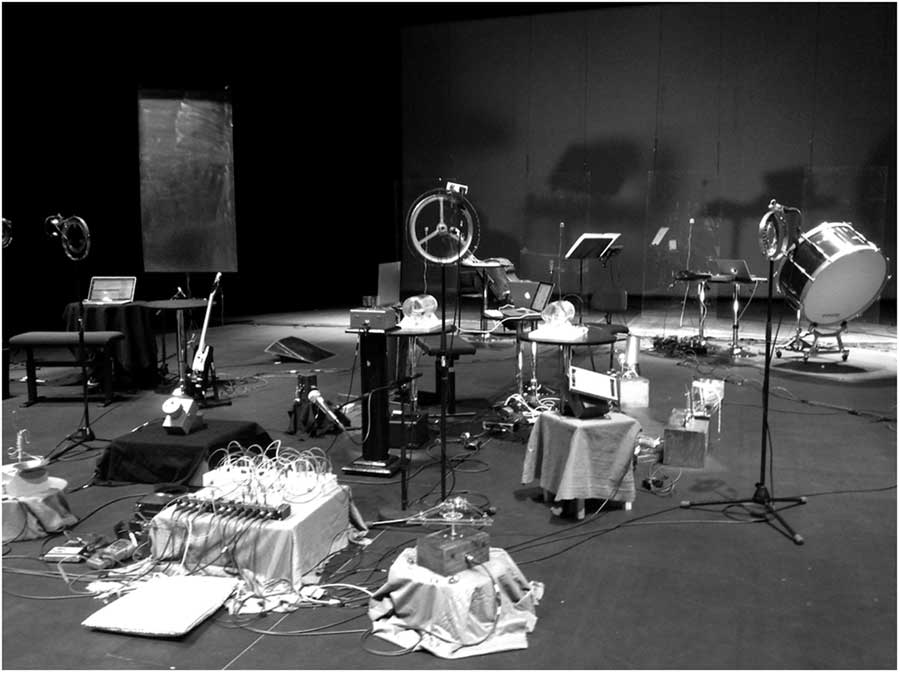
One possible strategy for using sound-emitting physical objects in a concert setting is to organise them into a spatial array in a similar way as one would with multichannel loudspeaker set-ups. The ‘Shake-ousmonium’ project was developed at the Sibelius Academy Centre for Music and Technology during autumn 2015 as a collective effort to build an orchestra of sonic objects and to compose and perform music for it (Figure 1). Named in reference to the Acousmonium, the Shake-ousmonium explores the artistic possibilities emerging from an orchestra of physical objects emitting sound. The project brought onstage a collection of miscellaneous DIY sound objects: vibrators, tactile transducers, motors, prepared instruments and loudspeakers, vibrating seating, paper, metal and plastic. The project was developed during 2015 and culminated in a concert on 19 November of the same year. Five pieces with very different approaches and aesthetics were completed and performed at the final concert, authored by Andrew Bentley, Kalev Tiits, Alejandro Olarte, Andrea Mancianti and Otso Lähdeoja. A specific guideline for the project was to avoid using traditional loudspeakers.
The Shake-ousmonium orchestra of sonic objects during the concert set-up. The concert featured a set of acoustically activated objects, electromechanical devices and augmented instruments.
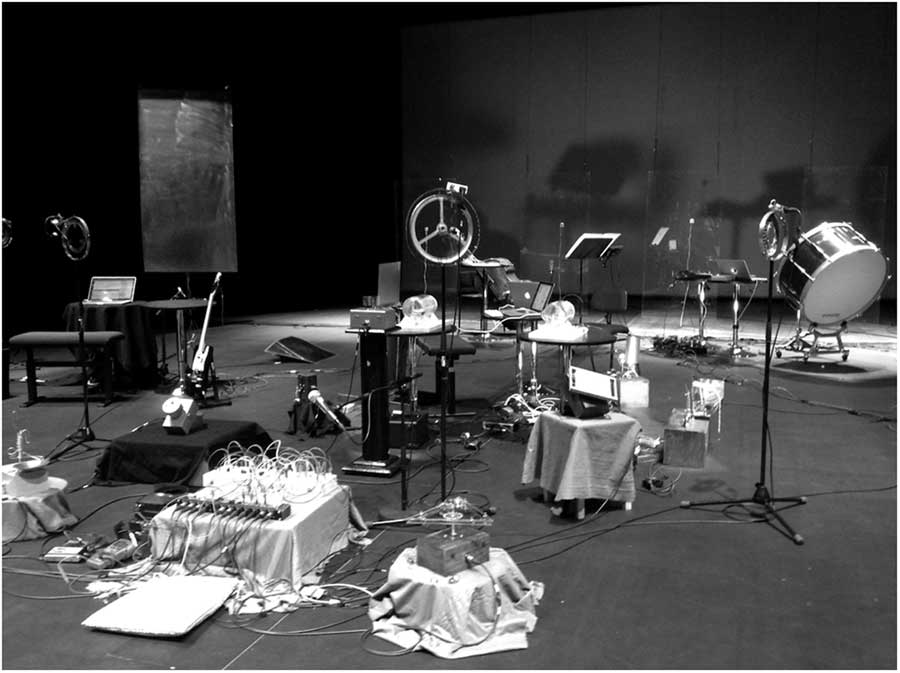
Three different technological approaches emerged from the works, comprising a) full-range audio signals driving ‘inert’ solids via structure-borne sound drivers, b) electromechanical activation of solids via motors and solenoids, and c) augmenting traditional instruments with sound drivers. These orientations were adopted by each artist according to a specific aesthetic aim. Different approaches to the interplay between material and sound gave rise to a diverse collection of audiovisual poetics. For example, the approach developed by Olarte in Hephaestus Song (2015) involved a network of structure-borne sound drivers and piezoelectric pick-ups mounted on suspended metal sheets. The piece established a sonic ecosystem between the signals driven into the metal and the pick-ups producing feedback, as well as the performer controlling the process. Looping signals through the metal became a performative exploration of the material’s sonic character. Olarte’s piece can be read as a materially oriented derivative of Agostino Di Scipio’s ecosystemic approach to signal processing and composition (Di Scipio Reference Di Scipio2003). In this case, Di Scipio’s interrelation between man, ambience and machine is transposed to man, object and machine, with a feedback-through-a-medium loop comprising material analogue and digital stages. Tiits’s Music Without Computers (2015) and Bentley’s Improvisation for Shake-ousmonium Instruments (2015) emphasised self-made sculptural objects activated sonically by motors and mechanical devices. In these pieces, the visual element acquired a special signification, as the spectator would marvel at the strange devices producing sounds, in an analogous manner to the musical robots of Pierre Bastien (Reference Bastien2016). The sonic and the visual were made to coincide, with an aesthetic outcome of perceptual merging. Seeing the sound being produced – or performed – by these robot-like machines was an important part of the aesthesis.
Mancianti’s piece Preparatory Studies for Controlled Autophagia (2015) explored the acoustic activation of an instrument by staging a bass drum and two electric guitars mounted with vibration speakers. The performer is equipped with a self-built glove-microphone using a physiotherapy palm support. The piece uses resonating behaviour of an object set inside a feedback loop, and at the same time the performer tries to find strategies to perform and improvise with it. With the hand-held microphone, the performer is able to ‘ignite’ and manipulate the feedback while playing the instrument with the free hand, allowing for an intuitive performativity. The piece makes use of a current trend in instrument augmentation, where loudspeakers are bypassed in favour of local acoustic activation on the instrument itself (Overholt, Berdahl and Hamilton Reference Overholt, Berdahl and Hamilton2011; Lähdeoja Reference Lähdeoja2015). Furthermore, the piece explores a hybrid type of instrument augmentation by expanding the drum’s sound to guitars used as loudspeakers. In summary, the Shake-ousmonium project investigated the practice and aesthetics of materially mediated electronic musicianship. The outcomes point towards fertile perspectives in sound spatialisation via an array of sonic objects, in the superposition of aural and visual elements, sonic ecosystems embedded into the materiality of the sounding objects, as well as in instrument augmentation using the instrument as a speaker.
5.2. Audiotactile dimension in a concert context
The Shake-ousmonium project included a piece by the author: Tapage Nocturne for double bass, video and electronics that explores the possibilities of the audiotactile channel in a concert setting. The Shake-ousmonium set-up comprised a system for driving bass frequencies into the audience’s seats, providing a distinct sensation of vibration, texture and attacks on the lower parts of the body, especially on the soles of the feet. Twelve bass-range structure-borne sound drivers were used to cover the area under 70 seats mounted on stage risers, dispatched from a mono source. The ‘audiotactile public address’ system was used in Lähdeoja’s piece as a extension of the double bass via two distinct compositional strategies. First, being a mixed piece, the live bass suffered initially from a lack of perceptual parity with the pre-recorded sources and was perceived as submerged into the mix of electronic sounds. Driving the live bass to the audience seating enhanced the felt presence of the instrument, giving rise to a perceptual zoom effect; the bass seemed to be nearer, in direct contact with the listener and clearly in relief in relation to the solely air-borne diffused sounds. Second, audiotactility was used as a compositional element for creating narration and dramaturgy within the piece. Tactile vibration intensity was in some parts coupled with the bass’ level of playing energy, and at other moments its loudness variations were composed as an internal ‘respiration’ of the piece. Depending on the audiotactile presence, the system could effectively create a feeling of density and intensity, or on the contrary, of distance and lightness.
A survey of 20 selected audience members was conducted after the concert in order to scan the subjective perception of audiotactile excitation used in a concert setting. The responses concurred with Altinsoy’s observations about the perceptual enhancement of music listening when audiotactile signals were present (Altinsoy Reference Altinsoy2006). Furthermore, the respondents noted that the audiotactile system was able to provide the physical effect of ‘touching’ the listener at low decibel levels, as opposed to the high gain levels customary in air-borne subwoofer systems. Also, a difference of corporeal reception was noted. With the vibrotactile system, the bass vibrations were perceived through the feet and lower abdomen, whereas the sub-bass woofer is more perceived in the chest, giving rise to two distinct sensations. The respondents agreed that the perception of an instrumental sound source was enhanced by the audiotactile system. The live bass playing conducted to the audience seats felt closer, more precise and clearer than the sounds diffused solely via speakers. There was no feeling of latency or perceptual gap between the double bass’s acoustic sound and the tactile perception. While audiotactility constitutes a trend in present sound art production, it is still little explored in concert settings. The experience gained from Tapage Nocturne points towards rich compositional possibilities with the haptic channel combined with an aural work.
5.3. Sonic scenography and composite aural spaces
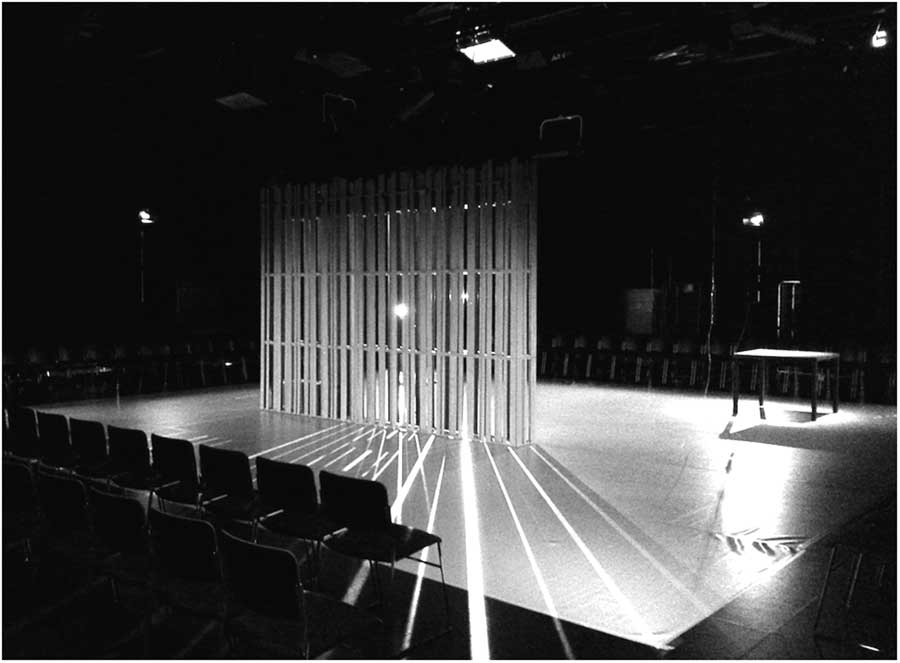
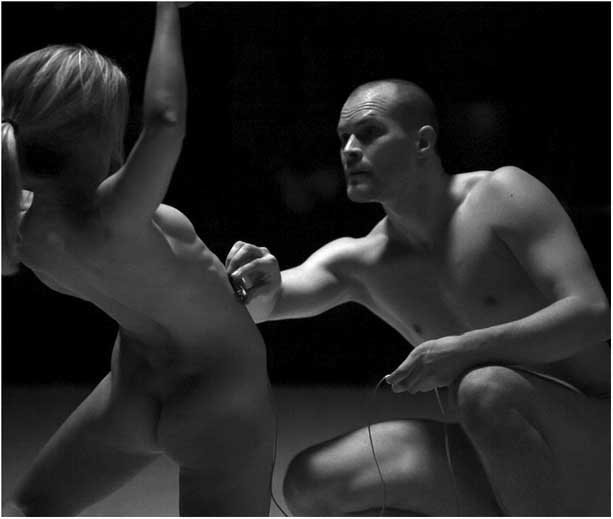
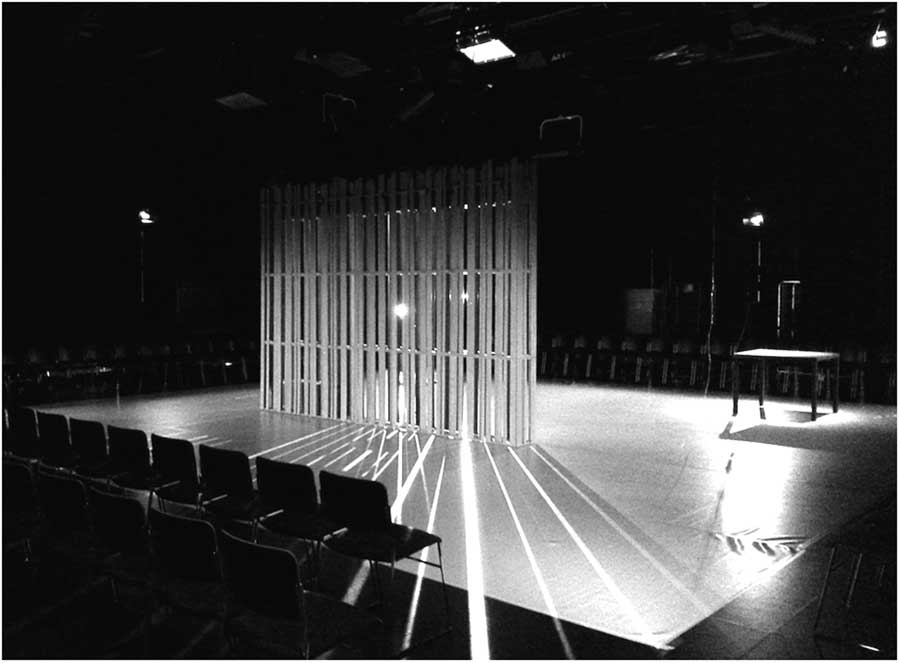
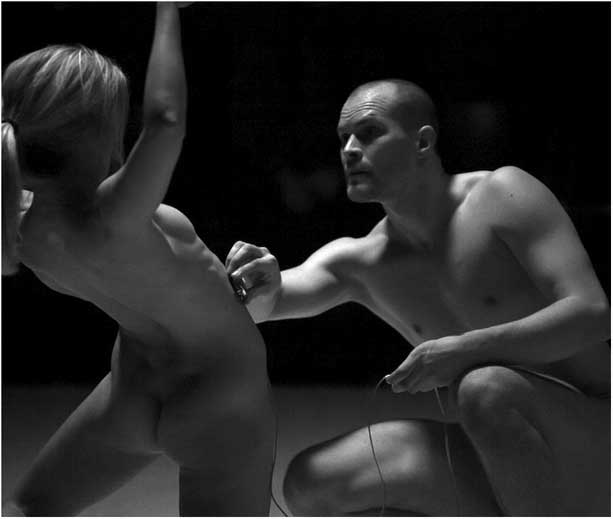
Another strategy for working with materially mediated sound is to combine physical sonic objects with loudspeakers, creating a composite aural space. An example of this approach was explored in Bare – a contemporary dance piece choreographed by Satu Tuomisto featuring composition and sound design by the author. The piece was premiered at the Oulu City Theatre, Finland, in March 2014. Bare features a custom-built plywood stage set, forming a modular wall at the centre of the stage (Figure 2). The plywood elements are embedded with structure-borne sound drivers, enabling radiated sound from different parts of the scenography. Full-spectrum audio signals are driven into the structure-borne sound system, with additional low-end presence added via two traditional subwoofers placed behind the audience. In addition, regular public address loudspeakers are placed in the four corners of the hall. The audience is seated around the stage, between the sound-emitting scenography and the speakers. The set-up was used for spatial rendering of sound between the loudspeaker array and the scenography. Simple four-channel panning was used on the loudspeakers to create a sound space where spatial trajectories could be implemented. This ‘virtual’ sound space was complemented with sound-emitting objects on stage. For example, a sound could originate at a distant spot behind the spectators, then dynamically move into a specific material element at the centre stage. This was used in the piece with kinetic cues from the dancers who could move sound masses with their gestures around the space and into the objects on stage. As a literal transposition of the ‘embodied sound’ idea, Bare featured a section where sound was driven into the dancers’ bodies, taking advantage of the thoracic cage as a resonant chamber. Male breathing noise was resonated in a female dancer’s thorax, producing an audiovisual superposition of gender (Figure 3).
Plywood structure at the centre stage of the Bare contemporary dance performance. The structure is modular, comprising six independent parts equipped with structure-borne sound drivers. The sonically activated scenographic structure is combined with a loudspeaker array surrounding the public.
The human body as a loudspeaker. A structure-borne sound driver is used to induce electronic sounds in a dancer’s body during the Bare performance, producing a literal rendition of the embodied sound concept.
In the light of the experience provided by composing the audio in Bare, a materially mediated approach can be particularly adequate for sound work in the area of performing arts, since the stage space already features visual elements, be it objects, humans or light. The acoustic activation of these elements can be used as a dimension of the narrative or poetic process, as well as for creating composite aural spaces comprising loudspeakers and sound-emitting physical objects.
5.4. Object-sound association and dissociation
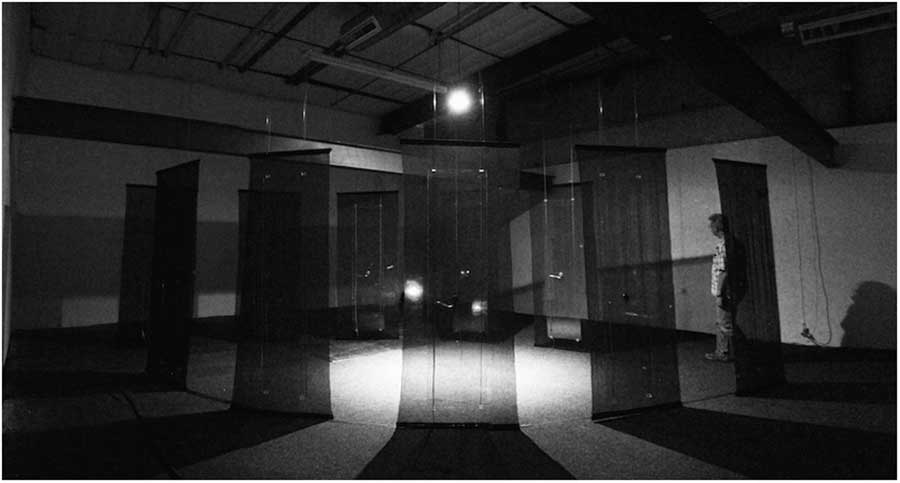
A fourth possible strategy enabled by acoustically activated objects creates visual–aural dialectics of object–sound association and dissociation. This approach plays with the spectator’s learned habits of how objects sound and what kind of sound they normally emit. One illustration of this perspective may be provided by the audiovisual installation O V A L, by Lenka Novakova and Otso Lähdeoja (Novakova and Lähdeoja Reference Novakova and Lähdeoja2013). O V A L was created at the Hexagram, Centre for Research-Creation in Media Arts and Technologies in Montreal, and has been exhibited at the Currents New Media Festival, Santa Fe in 2014 and at the SibaFest, Helsinki in 2016. The installation is composed of ten large sheets of glass hanging in a dark room, forming a large oval, each equipped with a structure-borne sound drivers (Figure 4). Video footage of the spectators themselves is projected onto the glass sheets, creating a maze of self-portrait reflections and transparencies.
O V A L, audiovisual installation, comprising ten large glass panels equipped with structure-borne sound drivers, constituting an immersive and transparent sonic space.
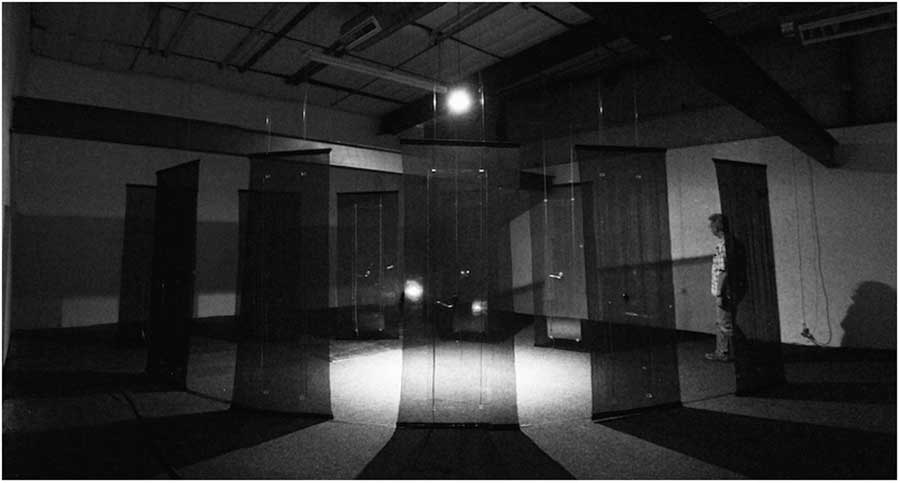
The audio composition of the piece is based on a spatial polyphony of aurally active glass sheets, designed to play with the spectator’s expectations of sonic behaviour in materials and in space. Ten independent channels of audio-rate signals are driven into the glass sheets, emphasising the upper part of the spectrum, where the acoustic response of the glass was found to be the most effective. A single additional channel is used for low frequencies, rendered either by a bass-range tactile driver mounted under the floor, as in the Hexagram version, or a traditional subwoofer as used in subsequent versions of the piece. O V A L implements a spatio-sensorial dissociation between the visual transparency of the glass sheets and the sound’s situatedness within the panels. Within the glass oval, the spectator is surrounded by a close-range 360° sound field radiating from the glasses, but is visually confused by the absence of evident physical objects where the sound would be expected to emanate from. Another perceptual device used in the piece includes sounds emanating at the threshold of hearing and moving fast within the ten-panel sound system, contributing to warping the percepts produced for the spectator inside the oval even more.
The compositional work also features an interplay between sounds that evoke glass and sounds with clearly different timbres, such as recordings of wood and cello. The aim was to create a shift of perception for the spectator: watching a glass emitting ‘glassy’ sounds produces a perceptual concordance; however, when a dissociation between the acoustic expectations and the actual sound is introduced, the spectator experiences a feeling of ‘unnaturalness’ which can be employed as an aesthetic strategy. Material vibration is a widely used element in sound art installations, and the interest of embedding sound in installation pieces is evident by its ability to include sound in a sculptural framework.
6. ON THE MEANINGS OF MATERIAL ENGAGEMENT IN ELECTRONIC MUSCIANSHIP
Engaging electronic musicianship into the materiality of physical sound objects provides numerous ways for constructing strategies, meanings and narratives for the aural arts. As seen in the case studies presented above, these strategies may include sound spatialisation, sculpturality at the interface of material and sound, augmented instruments and material-sonic ecosystems. The field of possible approaches extends well beyond these examples and numerous new works with materially mediated sound are currently emerging. Underlying the pragmatic level of compositional or technological practice, materially mediated music-making appears to be pregnant with cultural and philosophical signification.
Working with solid objects ties the creative process to its environment. In this sense, all works across genres involving acoustically activated objects acquire a situated dimension. Sound emanating from objects is inherently linked to the object’s physicality and spatiality. Object and sound are tied together into a composite and inseparable entity, which, unlike acoustic instruments, has no predictable timbral footprint. Upon seeing a traditional instrument we have strong expectations about how it will sound, but in the case of acoustically activated objects, the scope of possible sounds and timbres is virtually unlimited. Materially mediated electronic musicianship is inherently a situated and contextualised approach. This may seem paradoxical in an era of pervasive digitality, but it can also be seen as a familiar counter-movement in culture. In a situation where computation is the mainstream cultural vector, it comes with little surprise that some artists find ways to engage in materiality.
The dialectics of materiality and virtuality are a recurrent theme in music. In Membres Phantomes des corps musiciens, Peter Szendy presents a history of human bodies shaped by musical instruments, on the background of a medieval ideal of ‘pure’ music not to be actuated by corporeal contact (Szendy Reference Szendy2002). The ideal of ethereal purity can be thought to continue in the tradition of score-based music where the paradigmatic score is a superior reference to the actuated concert rendering. Furthermore, the same ideal continues in loudspeaker practice: loudspeakers are (still imperfect) mediators to the pure domain of unmediated sounds – the idealised sonic essence of electronic music. On the other hand, music is inherently material and situated, being conveyed by waves in a medium. Materiality has been emphasised in music-making across ages and cultures. In Western music, one may observe a kaleidoscope of practices and currents constructing ideologies and aesthetic programmes on either pronounced virtuality or underlining material engagement. As an example, some virtually oriented currents include mathematical approaches such as dodecaphonism or Xenakis’s formalism (Xenakis Reference Xenakis[1963] 1992), and materially engaged practices may be found in the areas of improvised and rock music (Nettl and Russell Reference Nettl and Russell1998; Berliner Reference Berliner2009). The issue can also be viewed from the perspective of mediality – the relation of form and matter in music. Sterne suggests that studying music’s mediality in the contemporary context involves viewing technology as a social phenomenon, as well as considering ‘plural materialities’ and ‘differential embodiments’ in the construction of the research object (Sterne Reference Sterne2014). This view effectively mirrors the complexity and plurality of a practice at the interface of the digital, the material and the human. A materially oriented mediality of electronic music can also be relevantly approached via material studies, where the things that are used to create, organise and emit sounds are given analytical priority (Miller Reference Miller2010). Recent research in the music technology area has brought up a trend of embodied interaction, as a means of response to the elusive virtuality of digital tools (Godøy Reference Godøy2006; Leman Reference Leman2008). This orientation can be viewed as a novel phase in the dialectics of materiality and virtuality of music-making. I see the recent rise of interest in material mediation of electronic sound as linked to the current concept of embodiment, as an effort to construct a situated context for electronic musicianship.
The current state of electronic musicianship being characterised by the recent establishment of digitality as the major paradigm for cultural creation (Manovich Reference Manovich2001), material engagement provides a necessary alternative for artistic enquiry. However, the contemporary situation is not characterised by strong polarities and oppositions; it is rather a turbulent mixture of coexisting, parallel and superposed thought patterns, technologies and aesthetics. Bruno Latour discusses the current context in We Have Never Been Modern, proposing the term ‘hybrid’ as an essential characteristic of contemporaneity (Latour Reference Latour1993). Hybridity appears indeed to be at the centre of materially engaged electronic musicianship, as the actual practice portrays a network of humans, computers and solids, the human extending towards the computer and the computer expanded towards the material. An acoustically active sound object requires an analogue signal network, (more often than not) linked to a digital environment, operated by a human musician. The operations take place at the interface of numerous possible medialities of music and the area of operations cannot be situated in one specific mediality. Materially mediated electronic musicianship works with an aggregate of objects and technologies on which operation and relations are conducted. It is an inherently situated approach, which merges real-world contexts with established tools of electronic musicianship in the creation of artistic meaning.
7. CONCLUDING REMARKS
In the electroacoustic music context, sound diffusion via solid objects is sometimes regarded with a sense of disdain, the rationale being that traditional loudspeakers portray superior acoustic properties and thus there is no interest in a practice that does not render electronic sounds with the same fidelity. Although this view is technically correct, it fails to consider diversity as a value and asset for artistic creation. Loudspeaker diffusion of electroacoustic music is an established genre with its traditions, schools and codes, often practised in a mind-set that celebrates the purity of sonic rendering. Room acoustics can be viewed as a distortion of the original sound quality, and tools have been developed in order to minimise its influence (Harker and Tremblay Reference Harker and Tremblay2012). Stronger material inferences are regarded as highly undesired. The present situation is one of a quasi-monopoly of electronic sound actuation held by the loudspeaker, be it high or low fidelity. Trading away sonic reproduction qualities, material engagement of electronic sounds creates vast spatial and multimodal possibilities which remain largely yet to be explored. The underlying aesthetic stance is one of finding the imperfection and impurity inherent to matter to be artistically fertile. Materially mediated electronic musicianship might resonate with a distant echo of the ‘affective turn’, investigating the pre-representational worldly inscription of our condition. Acoustic activation of the environment offers a possible avenue of expression for aural artists aiming to affirm their engagement in a visceral, embodied relationship with sound.