The cuticles of insects are coated with complex and often taxonomically specific blends of long-chained hydrocarbons that can play important roles in insect chemical communication (Singer Reference Singer1998). These cuticular hydrocarbons function as contact pheromones used in mate recognition by at least some parasitic Hymenoptera (Ruther et al. Reference Ruther, Döring and Steiner2011; Stökl et al. Reference Stökl, Dandekar and Ruther2014). However, no studies to date have investigated geographic variation in cuticular hydrocarbon sex pheromones within a species of parasitic wasp. Roptrocerus xylophagorum (Ratzeburg) (Hymenoptera: Pteromalidae) is a generalist ectoparasitoid of the larvae and pupae of certain species of bark beetles (Coleoptera: Curculionidae: Scolytinae) and is native to both North America and Europe (Bushing Reference Bushing1965; Mills Reference Mills1983). Reproductive behaviour by male R. xylophagorum is triggered by contact with or close proximity to a cuticular hydrocarbon sex pheromone from females (Sullivan Reference Sullivan2002). When applied to a solvent-washed female cadaver or a female-sized glass bulb, female cuticular extracts elicit a sequence of stereotyped behaviours from the male, which include mounting of the object, wing-fanning, antennal palpation, extrusion of the genitalia, and attempts to copulate (Sullivan Reference Sullivan2002). Evidence from morphological studies and cursory crossing experiments indicates that R. xylophagorum from California and Georgia, United States of America may consist of two distinct species (Samson Reference Samson1984). We conducted the following experiment to determine whether males of R. xylophagorum derived from either its western (California) or southeastern (Mississippi) ranges in the United States of America could discriminate the cuticular hydrocarbon sex pheromones of females from these respective regions.
Roptrocerus xylophagorum for experiments were derived from populations at either Blodgett Experimental Forest in northern California (38°54'N, 120°40'W) or the Homochitto National Forest in western Mississippi (31°25'N, 90°59'W). California R. xylophagorum were reared from bolts of Pinus ponderosae Lawson and Lawson (Pinaceae) infested in the laboratory with Ips paraconfusus Lanier (Coleoptera; Curculionidae) and exposed to ovipositing female R. xylophagorum. These R. xylophagorum parents had been reared from bolts of P. ponderosae that had been naturally infested in the field by I. paraconfusus and contained parasitised beetle brood. Mississippi R. xylophagorum were reared from bolts of Pinus taeda Linnaeus naturally infested in the field by Dendroctonus frontalis Zimmermann (Coleoptera; Curculionidae) and various species of Ips De Geer (Coleoptera; Curculionidae). California and Mississippi wasps were collected every one to three days as they emerged from bolts confined within rearing enclosures (located at laboratories in Berkeley, California, United States of America and Pineville, Louisiana, United States of America, respectively). Collected wasps were housed in foam rubber-stoppered Erlenmeyer flasks (250 mL) provisioned with honey and water and were used in experiments 6–17 days later. Within five days of collection, the California parasitoids were shipped overnight chilled with ice to the Pineville laboratory for experiments. Flasks from both sites were generally maintained at 4–8 °C to enhance the longevity of the wasps. To obtain cuticular hydrocarbon extracts, females were killed in a −80 °C freezer and then steeped in groups of 20 in 2 mL redistilled hexane (to give 0.1 female equivalents per 10 µL extract) for 15 minutes at room temperature with occasional gentle shaking. Ten microliters of extract of females of either population were applied with a glass pipette to glass bulb decoys (3–4-mm long×1.5-mm diameter; Sullivan Reference Sullivan2002). Decoys were allowed to dry and stored at room temperature for two to three days prior to trials. Males were isolated from females into acetone-rinsed Erlenmeyer flasks provisioned with honey and water and maintained at room temperature one to three days prior to bioassays. For each trial, a single male was confined into a glass tube (15 long×5-mm interior diameter) into which the glass decoy was suspended on the point of an insect pin. The male was observed under a dissecting microscope for two minutes and we recorded whether the male (1) mounted the decoy, (2) fanned its wings, and (3) attempted to copulate. Males from either location were tested with decoys treated with female extract from either location (i.e., all four possible combinations), with individual males being tested twice (once with either extract in random order but on different days). The treatment order was randomised with equal numbers of tests of each extract with either California or Mississippi males on each test day. Decoys were used in four different trials (all with males of the same origin) and then replaced with new ones. Tests were performed at room temperature at 0930–1800 hours on 29 September to 19 October 2002. For each of behaviours 1–3, the proportions of responses by males from each location to either female extract were compared by a Fisher exact test. Because males were isolated from females and associated semiochemicals for one day between trials with either extract, the two trials with each male were treated as independent replicates (five to nine hours isolation from females is apparently sufficient for males to recover full responsiveness following exposure to female pheromone; Sullivan Reference Sullivan2002).
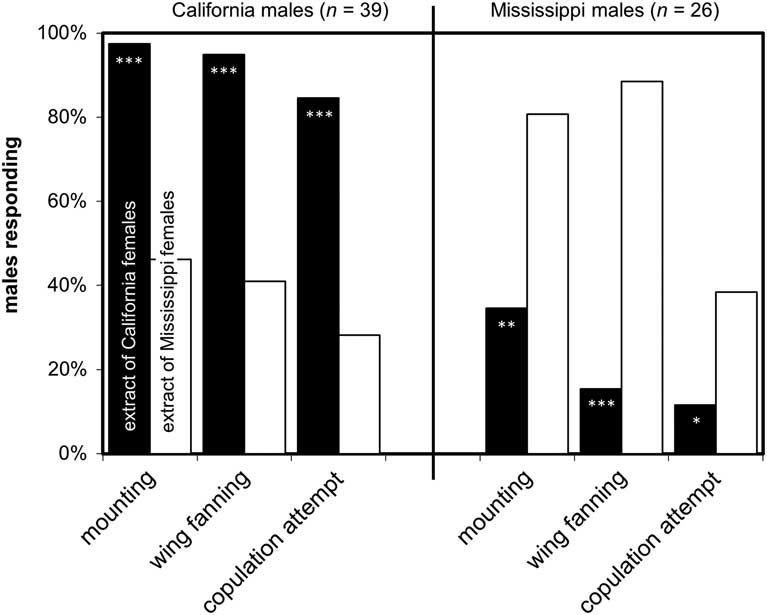
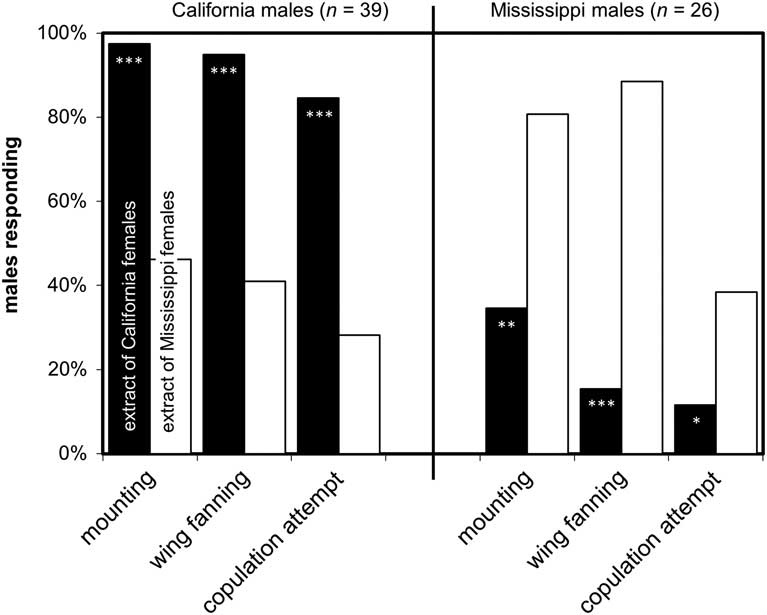
California-derived R. xylophagorum males mounted, fanned their wings, and attempted copulation with significantly greater frequency in response to decoys treated with extract of California females rather than Mississippi females; Mississippi males displayed the reciprocal response (Fig. 1). The result shows that the cuticular hydrocarbon sex pheromone of R. xylophagorum differs between populations sampled in California and Mississippi, with males showing a clear preference for the pheromone produced by females of the same population. Previously identified differences in the composition of the cuticular hydrocarbon blend of R. xylophagorum from the western United States of America (California) and the southeastern United States of America (Georgia) could presumably be mediating male discrimination of the extracts (Espelie et al. Reference Espelie, Berisford and Dahlsten1996; Jennings et al. Reference Jennings, Etges, Schmitt and Hoikkala2014). Attempts to cross R. xylophagorum derived from these same two areas failed to produce female brood (i.e., evidence of fertilisation; Samson Reference Samson1984). In combination with evidence of divergence in cuticular hydrocarbon composition (Espelie et al. Reference Espelie, Berisford and Dahlsten1996) and the sex pheromone (this study), these data show that eastern and western R. xylophagorum may have split or are splitting into different species. A largely host-free zone spanning the Great Plains (Bushing Reference Bushing1965; Wood Reference Wood1982) likely prevents significant gene flow between eastern and western populations and thus enhances the possibility of genetic differentiation and speciation. Our observations of both (1) attempts by male R. xylophagorum from either California or Mississippi to copulate with living females from the other population and (2) male responses to the pheromone blend of the distant population (Fig. 1) indicate that the pheromone differences would not alone be a sufficient reproductive isolation mechanism were the populations to come into contact.
Responses of Roptrocerus xylophagorum males derived from populations in either northern California or western Mississippi to glass female decoys treated with hexane extract (0.1 insect equivalents) of the cuticles of females from either population. Fisher exact test contrasts were performed within behaviour type and origin of male (***P⩽0.001; **P⩽0.01; *P⩽0.05).
Geographic variation in pheromone composition within an insect species and within continuous distributions of single species is not uncommon (Piston and Lanier Reference Piston and Lanier1974; Groot et al. Reference Groot, Inglis, Bowdridge, Santangelo, Blanco and Lopez2009; Dyer et al. Reference Dyer, White, Sztepanacz, Bewick and Rundle2014). Furthermore, it is possible for cuticular hydrocarbon compositions of insects to vary due to diet and environmental temperatures, and this may alter the composition of the sex pheromone produced by the female (Fedina et al. Reference Fedina, Kuo, Dreisewerd, Dierick and Yew2012; Ingleby et al. Reference Ingleby, Hosken, Flowers, Hawkes, Lane and Rapkin2014). Thus, geography-associated differences in the composition of a cuticular hydrocarbon pheromone may not necessarily be heritable or evidence of incipient speciation.
Acknowledgements
Ray Arnold and Erich Vallery provided technical assistance and Cavell Brownie and William Shepherd gave helpful suggestions on earlier versions of the manuscript. Voucher specimens are housed at the University of Georgia Museum of Natural History, Athens, Georgia, United States of America.