Complete blood count tests are widely used, fast and cheap tests that include various blood cell indices. Platelet indices (platelet count, mean platelet volume, platelet distribution width, and plateletcrit) have been utilised by physicians to diagnose and manage many different medical conditions. Reference Gasparyan, Ayvazyan and Mikhailidis1-Reference Bain, Bates, Lewis, Bain and Bates4
Research has shown that platelet indices are affected by bacterial and viral infections, vascular inflammatory diseases, and malignancies. Mean platelet volume, which indicates the platelet size and the response of the bone marrow to infections and inflammation, was the most commonly investigated index. Reference Ruixi, Fang, Junming and Qijian5-Reference Mukker and Kiran9 Platelets and plateletcrit are effective in inflammation, thrombosis, and cardiovascular pathologies. The plateletcrit actually shows the amount of circulating platelets in a unit volume of blood. As for functionality, it is similar to the haematocrit for erythrocytes. Reference Maluf, Barreto and Vidigal3-Reference Oylumlu and Yuksel7
In this study, we aimed to determine the relationship between platelet indices and myopericarditis in a paediatric population. To the best of our knowledge, this is the first study of platelet indices in patients with paediatric myopericarditis in the literature.
Material and methods
We retrospectively analysed the platelet indices of 20 children diagnosed with acute myopericarditis in our hospital within a 5-month period between October 2019 and March 2020. Myopericarditis was diagnosed based on anamnesis, physical examination, cardiac markers, as well as electrocardiographic and echocardiographic evaluations according to the European Society of Cardiology Working Group on Myocardial and Pericardial Diseases.
Diagnosis criteria for myopericarditis
Clinical presentations included acute chest pain, dyspnea, palpitations, signs of heart failure, syncope, and arrhythmia symptoms. Diagnostic criteria included ECG atrioventricular block, ST/T wave change, low voltage, frequent pre-mature beats, supraventricular/ventricular tachycardia and myocardiocytolysis markers, elevated troponin T/troponin I levels, and functional abnormalities on echocardiography. The information regarding diagnostic criteria for suspected myopericarditis was clinically evaluated as ≥1 for clinical presentation and ≥1 for other diagnostic criteria. Reference Caforio, Pankuweit and Arbustini10 Patients with a history of viral disease and no other underlying cause for myocardial damage were included in the study with a diagnosis of myopericarditis.
This study included three groups of patients who applied the paediatric emergency department during the time interval of the study. Each group included 20 patients aged between 1 month and 18 years. The complaints of the first and second groups were fever and respiratory symptoms. The first group included patients diagnosed with myopericarditis, the second included the patients who were diagnosed with only respiratory tract infection without myopericarditis. The third control group was chosen cross-sectionally to comprise 20 sex- and age-matched children from the emergency department and the outpatient clinic. Age/gender-appropriate patients who were admitted due to non-infectious and non-inflammatory conditions such as vitamin deficiency and constipation were eliminated from the control group. Patients with bone marrow disease, cancer, immune thrombocytopenic purpura, immunodeficiency diseases, inflammatory bowel disease, and arthritis or who were using drugs to affect the number of platelets were excluded from the study.
All the patients’ demographic characteristics, comorbidities, signs, and symptoms were recorded retrospectively. Age, gender, white blood cell count, haemoglobin levels, neutrophil and lymphocyte counts, mean corpuscular volume, red cell distribution width, plateletcrit, mean platelet volume, platelet distribution width, platelet count, C-reactive protein, and troponin values were recorded for the first and second groups. For the third group, all of these parameters, except troponin and C-reactive protein, were recorded. Patients diagnosed with myopericarditis were clinically symptomatic and elevated troponin values were recorded at the time of diagnosis. All patients were treated with intravenous immunoglobulin therapy. After treatment when the patients were clinically asymptomatic and troponin and cardiac echocardiograph controls were normal, they were discharged. Laboratory, electrocardiographic, and echocardiographic findings were recorded in the second week after discharge. This study was approved by the university ethics committee.
Statistical analysis
Statistical Packages for the Social Sciences 18.0 was used for all statistical analyses. Statistically, p-values less than 0.05 were considered significant. The Kolmogorov–Smirnov test was performed on all groups. The Student’s t-test was used for tests with parametric distribution and the Mann–Whitney U-test was used for those with non-parametric distribution to examine the differences between the parameters in the groups. Data between multiple groups were compared using the one-way ANOVA test. For determining the relationship between the parameters examined in the groups, the Pearson and Spearman correlation analysis was used. Paired t-test and Wilcoxon signed-rank tests were used to evaluate the parameters before and after the treatment. The ROC analysis was applied to evaluate the sensitivity and specificity of the parameters that were found to be statistically significant.
Results
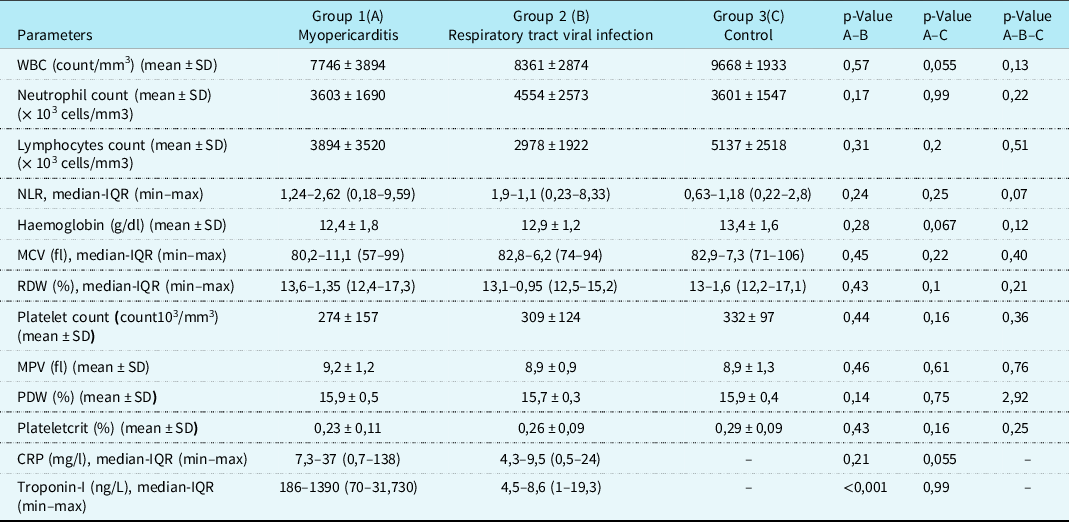
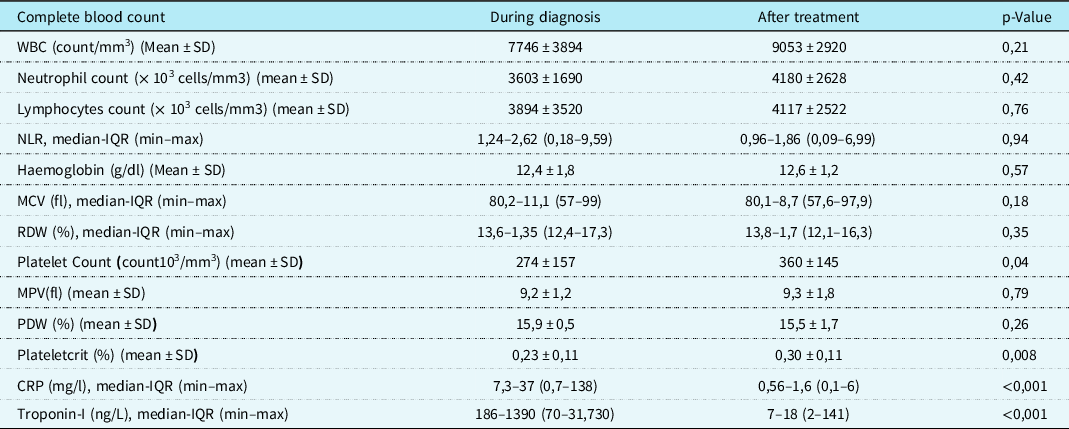
No statistical difference existed between the groups in terms of age and gender (p = 0.94). The median age of patients was 36 months (inter quartile range: 129 months) (2–204 months). The demographic characteristics and laboratory parameters of the study population and control groups at the time of diagnosis are given in Table 1. There was no statistically significant difference between the groups in terms of demographic characteristics and laboratory parameters, except for troponin levels (Table 1). In the myopericarditis patients, two patients who were admitted to the ICU with a diagnosis of fulminant myocarditis and encephalitis died during follow-up. The comparison of the blood test parameters recorded during the diagnosis and after treatment in patients with myocarditis revealed that the platelet count and plateletcrit values were significantly increased after treatment (p < 0.05). C-reactive protein and troponin levels were found to be significantly lower after the treatment compared to those during the diagnosis, as was expected. The remaining laboratory parameters were not statistically different during the acute illness and after the treatment (Table 2).
Baseline characteristics and laboratory parameters of study population and healthy control subjects

Data presented as number (%) and mean ± SD.
CRP = C-reactive protein; IQR = inter quartile range; MCV = mean corpuscular volume; MPV = mean platelet volume; NLR = neutrophil–lymphocyte ratio; PDW = platelet distribution; RDW = red cell distribution width; WBC = white blood cell
Distribution of laboratory parameters during diagnosis and after the treatment of patients diagnosed with myopericarditis

Data presented as number (%) and mean ± SD
CRP = C-reactive protein; IQR = inter quartile range; MCV = mean corpuscular volume; MPV = mean platelet volume; NLR = neutrophil–lymphocyte ratio; PDW = platelet distribution; RDW = red cell distribution width; WBC = white blood cell
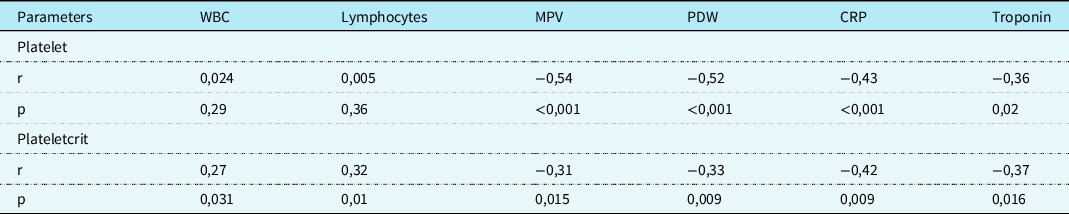
The platelet count–plateletcrit was found to be lower after treatment due to an acute inflammatory process at the time of diagnosis. We also found that there was a strong negative correlation between the platelet–plateletcrit and C-reactive protein–troponin values. There was no statistical difference between mean platelet volume and platelet distribution width values during illness and after treatment (Table 3).
Platelet indicies and correlation analysis in complete blood count of patients with myopericarditis

Data presented as number (%) and mean ± SD
r: The Pearson correlation coefficient, r, can take a range of values from +1 to −1. A value of 0 indicates that there is no association between the two variables. A value greater than 0 indicates a positive association; that is, as the value of one variable increases, so does the value of the other variable. A value less than 0 indicates a negative association; that is, as the value of one variable increases, the value of the other variable decreases. If this probability is lower than the conventional 5% (p < 0.05), then the correlation coefficient is called statistically significant
p: The p-value is the probability that you would have found the current result if the correlation coefficient were in fact 0 (null hypothesis). If this probability is lower than the conventional 5% (p < 0.05), then the correlation coefficient is called statistically significant
Data presented as number (%) and mean ± SD
CRP = C-reactive protein; IQR = inter quartile range; MCV = mean corpuscular volume; MPV = mean platelet volume; NLR = neutrophil–lymphocyte ratio; PDW = platelet distribution; RDW = red cell distribution width; WBC = white blood cell
The ROC analysis was performed to predict the occurrence of myopericarditis by the serum platelet and plateletcrit levels. The increase in platelet and plateletcrit values were not found as significant predictors for the occurrence of myopericarditis. Their AUC values were 0.67 (0.50–0.84) and 0.63 (0.45–0.81) with p-values of 0.006 and 0.18, respectively.
Discussion
Our results indicated that platelet count and plateletcrit were suppressed in the active phase of inflammation in children with myopericarditis. In some studies, parameters such as platelet count, leucocyte count, mean platelet volume, and plateletcrit have been used to predict mortality and morbidity in patients with inflammatory diseases. Reference Golwala, Shah and Gupta11-Reference Sezgi, Taylan and Kaya14 Our aim in this study was to reveal platelet index parameters previously found to be statically significant but have never studied in children with myopercaditis that can be used as inflammatory markers.
The data on platelet indices have been accumulating. The negative correlation between platelet count and mean platelet volume is well known. This is thought to reflect the tendency to achieve haemostasis by forming a fixed platelet mass. Mean platelet volume has been studied with regard to diseases such as rheumatoid arthritis, hypertension, diabetes mellitus, Kawasaki disease, acute coronary syndrome, and myocardial infarction. Reference Chu, Becker and Berger15-Reference Efe, Asker and İnal18 Another useful parameter is the plateletcrit, which is used for predicting platelet aggregation and as a marker of cardiovascular disease. Reference Sezgi, Taylan and Kaya14 Similarly, in the study by Liu et al., 309 Kawasaki patients and 160 healthy controls were analysed to determine whether mean platelet volume and platelet distribution width values have any correlation with coronary artery disease. In that study, patients diagnosed with Kawasaki were found to have a decrease in mean platelet volume and width of platelet distribution as well as an increase in white blood cells, the platelet count, and C-reactive protein. Reference Ruixi, Fang, Junming and Qijian5 However, in our study, there was no significant difference in platelet indices between myopericarditis and the healthy groups. This result was thought to be due to the limited number of patients.
In terms of the severity of the disease, platelet indices are thought to be a guide in inflammatory conditions before and after treatment. There have been some studies on this subject. In the study of Ozdemir et al. on rheumatic carditis, while the number of leucocytes and platelets was statistically high before treatment, there was no statistically significant difference in mean platelet volume and red cell distribution width. Reference Ozdemir, Karadeniz and Doksoz6 In another study, red cell distribution width and platelet values were reported to be high in patients with acute rheumatic carditis, both at the time of diagnosis and after treatment. Reference Kucuk, Ozdemir and Karadeniz16 On the other hand, Zhang et al., in their study on intensive care patients showed that low platelet count, high mean platelet volume, and high platelet distribution width are associated with more serious diseases. Reference Zhang, Cui and Diao12 In our study, it was found that the number of platelets and plateletcrit values increased after treatment, which was considered statistically significant. No statistically significant difference was found in other platelet index parameters.
In another study evaluating platelet indices as mortality markers in paediatric intensive care patients, mortality was higher in patients with low plateletcrit. Reference Golwala, Shah and Gupta11-Reference Sezgi, Taylan and Kaya14 That study, however, showed that mean platelet volume and platelet distribution width values were not statistically different between the cases and the controls. Reference Golwala, Shah and Gupta11 In fact, mean platelet volume and platelet distribution width values were similar to those found in our study. In our patients with myopericarditis, we detected lower platelet count and plateletcrit values during the acute inflammatory process before treatment. This could be useful in monitoring the disease. A strong negative correlation between platelet–plateletcrit and C-reactive protein–troponin values was also determined.
In our study, according to the ROC analysis, platelets count and plateletcrit values were not found to be predictive of possible myopericarditis. However, the increase in platelet and plateletcrit after treatment was observed to be consistent with clinical improvement. We think that the fact that the predictive value is not significant may be due to the limited number of patients.
Conclusions
To conclude, platelet and plateletcrit values were observed to increase after the treatment of myopericarditis. We found that mean platelet volume and platelet distribution width values were not significant for myopericarditis. We think that it might be useful in the follow-up of the disease, especially in the inflammatory phase suppression of platelet and plateletcrit. In addition, strong negative correlations between platelet count–plateletcrit and troponin were found to be consistent with the literature.
Study limitations
The major limitation of this study is the small sample size of patients. Furthermore, this study is a cross-sectional, single-centre, retrospective study.
Financial support
This research received no specific grant from any funding agency, commercial or not-for-profit sectors.
Conflict of interest
The authors disclose no conflict of interest.
Ethical standards
This paper did not involve human or animal experimentation.