

Introduction
In the Middle East, with the rapid digital transformation, it is now globally necessary to incorporate artificial intelligence (AI) and cyber law into the educational curriculum. As countries struggled with the legal and technological ramifications of AI, global policy-making organizations like the United Nations Educational, Scientific and Cultural Organization (UNESCO),Footnote 1 the Organization for Economic Cooperation and Development (OECD)Footnote 2 and EdTech standard bodies (World Economic Forum 2024) have become important in harmonizing educational responses to these challenges.
These organizations offer rights-based approaches. They also promote normative and technical frameworks that impact national curriculum designs. The 2021 publication of the UNESCO Recommendation on the Ethics of Artificial Intelligence demonstrated a proactive approach, marking an important step in guiding nations toward responsible and inclusive AI governance (UNESCO 2021). The OECD, through its AI guidelines and robust educational policy insights, has emphasized the need for data-driven policy-making and equitable digital competencies. Organizations that establish standards, such as the International Society for Technology in Education (ISTE),Footnote 3 the Institute of Electrical and Electronics Engineers (IEEE)Footnote 4 and the World Economic Forum (WEF),Footnote 5 have developed scalable frameworks and certification benchmarks for embedding AI, cybersecurity and digital ethics into the K-12 (publicly supported primary and secondary education) curriculum.
In recent years, due to the quick adoption of AI technologies, there has been a corresponding increase in cyber risks. As emerging generations are increasingly exposed to data-centric platforms, algorithmic decision-making and privacy-invasive systems, educational policy must respond by embedding foundational concepts of AI and cyber law into the school curriculum. This integration cannot occur in isolation. Instead, it must be contextualized through the Sustainable Development Goals (SDGs) (United Nations Department of Economic and Social Affairs n.d.a), especially SDG 4 (United Nations Department of Economic and Social Affairs n.d.b), which emphasizes universal access to high-quality education and opportunities for lifelong learning, as well as international human rights standards and inclusive pedagogies. The governments can create age-appropriate, future-ready digital education systems by using the global frameworks offered by UNESCO and the OECD, which serve as links between intangible ethical commitments and concrete curriculum strategies. Additionally, the concept of “digital empowerment” as a fundamental right has gained traction in international discourse, aligning with the broader objective of fostering inclusive, democratic and resilient knowledge societies. The need for AI education to include civic engagement, algorithmic accountability and awareness of digital rights, in addition to technical expertise, is becoming increasingly acknowledged by the international policy community. For example, the UNESCO framework emphasizes human agency, transparency, fairness and sustainability in AI systems, in addition to the development of AI literacy. The OECD adds by offering policy diagnostics, comparative tools and actionable recommendations that guide nations in aligning educational content with economic and social responsibilities. Such policy coherence is essential for developing AI-ready citizens who are legally aware, ethically grounded and digitally skilled.
Meanwhile, these visions have been implemented by EdTech standard bodies by translating normative goals into modular teaching standards, teacher training rubrics and curriculum blueprints. Organizations like ISTE and IEEE offer internationally recognized frameworks for digital citizenship, computational thinking and cybersecurity awareness that national education boards can seamlessly adopt. The WEF’s reports further help contextualize AI and cyber education in future skills mapping, equity concerns and public–private collaboration. Together, these bodies create the global management ecosystem that enables policies from various legal and educational traditions to converge (World Economic Forum 2025).
India’s National Education Policy (NEP) 2020 (Government of India Ministry of Human Resource Development 2020) emphasizes high priority on digital education, coding and ethical reasoning. However, there are still policy gaps in converting these objectives into measurable curriculum outcomes and enforceable rights, particularly in the areas of responsible AI usage and cyber law awareness. Comparative models, such as Finland and Singapore, demonstrate how international frameworks can be effectively localized through interdisciplinary curriculum design, teacher capacity building and strong political will. Finland integrates AI education across school subjects with a focus on critical thinking and democratic values. AI education across school subjects, with an emphasis on critical thinking and democratic values, is a key focus. In contrast, Singapore has developed a curriculum with special modules on data protection, digital law and making smart, ethical choices with AI. These models demonstrate how national contexts can be adapted by global normative guidance without sacrificing local relevance.
This paper, however, examines how UNESCO and the OECD shape the global policy discourse on AI and cyber law education. Furthermore, EdTech standard bodies and their implications for curriculum design in various educational ecosystems are also studied. The paper adopts an extensive approach, examining key international frameworks, comparing national implementations and highlighting challenges in emphasizing difficulties with localizing policies. By analysing the normative, technical and pedagogical dimensions of digital education, the study aims to offer a rights-based, future-oriented model for adopting AI and cyber law into K-12 education. By doing this, it contributes to the growing global dialogue on how to prepare youth not only for digital workforces but also for digitally empowered citizenship.
International Frameworks for AI and Cyber Law Education
The evolution of AI and cyber-related technologies has outpaced traditional educational models, creating an urgent need for a structured, ethical and rights-based approach to digital literacy in schools. In response, global institutions have crafted normative, policy and technical frameworks to guide national governments in integrating AI and cyber law into their curriculum policies. These frameworks provide not only ethical anchors but also pedagogical tools and cross-national comparatives, shaping the future of the education system. This section explores the contributions of three major global stakeholders: UNESCO, the OECD and leading EdTech standard-setting organizations such as ISTE, IEEE and the WEF.
UNESCO’s Recommendation on the Ethics of Artificial Intelligence
In 2021 UNESCO adopted the historic Recommendation on the Ethics of Artificial Intelligence, the first normative document that seeks to govern and regulate the creation and application of AI through human rights and ethical perspectives. The Recommendation is extremely relevant to educational policy, especially when it comes to curriculum design (UNESCO 2023).
Four broad ethical principles serve as the foundation for UNESCO’s framework. These key principles are:
-
1. Human rights and human dignity;
-
2. Inclusiveness and equity;
-
3. Transparency and explainability;
-
4. Environmental and social well-being.
These guidelines aim to help nations develop inclusive, responsible and equitable AI ecosystems, including those in the education sector. The focus of K-12 education is on equipping students with the tools they need to understand challenges and influence AI systems that impact their daily lives.
The recommendations call for national education systems to incorporate data literacy, cyber law awareness and ethical oversight of AI into the curriculum. Most importantly, they encourage the creation of interdisciplinary learning frameworks that integrate values, law and technology as well as teacher training programmes.
By encouraging schools to model safe and moral digital practices in addition to teaching cyber law and artificial intelligence, UNESCO’s framework emphasizes the protection of children’s rights in digital environments. These directly connect to curriculum modules on data protection, consent and cyber law awareness, and these are all essential components of an education system prepared for the future.
The OECD’s AI Principles and Educational Policy Insights (OECD 2019)
The OECD is a significant international body. In 2019, it adopted cross-sectoral AI guidelines recognized by 40 countries. These principles are broad in scope, and the ideas directly impact educational systems and curriculum innovation. The key principles are:
-
1. Inclusive growth, sustainable development and well-being;
-
2. Accountability;
-
3. Transparency and explainability;
-
4. Robustness, security and safety;
-
5. Human-centred values and fairness.
Through its Education 2030 Framework, Future of Education and Skills Reports and Digital Education Outlook (OECD n.d.), the OECD offers detailed policy roadmaps for adding AI, digital skills and cyber awareness into national education strategies. These include comparative data on the gaps in digital skills, teacher preparedness assessments, indicators of infrastructure readiness and curriculum coordination for the Fourth Industrial Revolution. The OECD’s strength lies in its data-driven analysis, offering countries like India clear benchmarks for evaluating their curriculum readiness for integrating AI and cyber law. Policymakers can utilize these tools to identify gaps in legal literacy, resource constraints and teacher training needs.
Role of Global EdTech Standard Bodies (ISTE, IEEE, WEF, etc.)
While UNESCO and the OECD provide normative and policy-level frameworks, global EdTech standard-setting bodies provide the technical framework required to incorporate AI and cyber education into classroom settings successfully.
ISTE (International Society for Technology in Education) (ISTE n.d.)
ISTE’s Standards for Students are internationally recognized frameworks that promote:
-
1. Empowered digital citizenship;
-
2. Computational thinking;
-
3. Knowledge construction;
-
4. Innovative design and problem-solving.
Their AI Explorations programme presents educators and students with practical, age-appropriate AI modules that address ethical consequences, bias in datasets and privacy rights, directly aligning with cyber law themes.
IEEE (Institute of Electrical and Electronics Engineers)
IEEE’s Ethically Aligned Design and the application of AI in educational systems initiatives support the incorporation of human-centric AI concepts into the learning environment. Their focus includes:
-
1. Ensuring algorithmic fairness;
-
2. Building critical reasoning about AI systems;
-
3. Supporting standards for AI-infused learning environments.
World Economic Forum (WEF)
The WEF encourages twenty-first-century skills, highlighting cyber awareness, digital norms and adaptability as essential elements of future-ready education. Through its “Schools of the Future” report, it recommends curricular models that incorporate empathy, creativity, collaboration and techno-legal education.
Comparative Analysis – Case Study of Finland, Singapore and India
Global standards, including those of UNESCO, the OECD, ISTE and IEEE, must interpret and incorporate the countries’ unique socio-economic, legal and cultural contexts. There is no one-size-fits-all approach to the successful incorporation of AI and cyber law education in the national curriculum. This section presents a comparative study of Finland, Singapore and India, three diverse nations that respectively represent innovative, performing and developing digital education standards within their systems. Each country demonstrates unique local strategies that reflect variations in infrastructure, policy priorities, teacher preparedness and civic goals.
Finland: Integrating AI and Cyber Literacy through Phenomenon-Based Learning
Policy Vision and Curriculum Model
Finland’s progressive and learner-centred education system has been recognized for a long time. The country was among the first in the European Union (EU)Footnote 6 to formally incorporate AI education into the curriculum of its educational institutions. Guided by the EU Digital Education Action Plan (European Commission 2025) and the OECD’s education benchmarks, Finland’s National Core Curriculum emphasizes “phenomenon-based learning” – an interdisciplinary approach that combines digital skills with contemporary themes like climate change, democracy and now emerging technologies like AI. Finland’s model reflects strong consistency with UNESCO’s AI ethics principles (UNESCO n.d.) (human rights, inclusion, transparency). Moreover, the OECD’s education indicators, while retaining their decentralizing pedagogical autonomy, adopt a governance model (Kangas and Rasi Reference Kangas and Rasi2021):
-
1. AI in upper secondary education: since 2021, Finland has been offering elective courses in AI literacy for upper secondary students. These courses cover the fundamentals of machine learning, algorithmic decision-making and the ethical implications of these fields.
-
2. Cybersecurity awareness: cybersecurity is integrated into civics and social studies courses, where students learn about data privacy, digital identity and laws related to cyberbullying. Legal concepts are embedded without requiring a separate “Cyber Law” subject.
-
3. Teacher training: The Finnish National Agency for Education collaborates with the University of Helsinki (notably the “Elements of AI” project) to build teacher capacity in AI-related pedagogy.
Singapore: Strategic Curriculum Reform under National AI and Cybersecurity Roadmaps (Tony Blair Institute for Global Change 2025)
Policy Vision and Management
Singapore has adopted a top-down, government-driven model for digital transformation, characterized by strong regulatory and policy alignment. Its Smart Nation Initiative, AI Singapore Strategy and National Cybersecurity Strategy 2021 all emphasize the importance of education in creating a technology-ready society. AI and cybersecurity are not treated as optional topics; they are embedded as mandatory subjects.
Singapore demonstrates an example of how to use policy localization through strategic planning. It closely follows the OECD’s benchmarking, UNESCO’s ethical AI framework and WEF’s Schools of the Future initiative. Most importantly, Singapore’s curriculum aligns legal, ethical and technical aspects smoothly from primary education onwards:
-
1. Digital Literacy Programme (DLP): launched in schools under the Ministry of Education, the DLP integrates ethical use of AI, computational thinking and responsible online behaviour from primary to secondary levels.
-
2. Cyber wellness curriculum: unique to Singapore, this curriculum is a compulsory part of Character and Citizenship Education (Ministry of Education Singapore 2021), covering cybercrime laws, cyberbullying, personal data protection and ethical technology use.
-
3. Utilizing AI in technological and vocational training: the Institute of Technical EducationFootnote 7 and polytechnics offer AI modules linked to actual legal and moral issues, in accordance with ISTE and IEEE standards.
India: Emerging Integration under NEP 2020 and Digital India Initiatives
Policy Framework and Gaps
The NEP 2020 (Government of India Ministry of Human Resource Development 2020) acknowledges the importance of teaching digital literacy, coding and AI, designed to embed them in the school curriculum from Grade 6 onward. The Digital India campaignFootnote 8 and the National AI Strategy (NITI Aayog Reference Aayog2018) also emphasize the importance of AI literacy readiness. However, India’s strategy is still in the first phase of piloting, in contrast to Finland and Singapore.
Although UNESCO’s ethical principles and OECD recommendations are cited in India’s educational curriculum reforms, the implementation is still in the pilot phase. Although the NEP 2020 (Government of India Ministry of Human Resource Development 2020) provides a vision consistent with international standards, and in the absence of cyber law integration, shared principles and best practices for AI, legal digital rights integrated with the main subjects remain a major gap. Additionally, EdTech platforms are on the rise, but standard harmonization and regulatory clarity (e.g. ISTE or IEEE) are still evolving. The implementation landscape is as follows:
-
1. Central Board of Secondary Education AI Curriculum (classes IX–XII) (Central Board for Secondary Education n.d.): The Central Board of Secondary Education,Footnote 9 in collaboration with IBMFootnote 10 and Intel, has introduced an AI-driven elective subject that covers the fundamentals of AI and its impact on society. However, it lacks a legal or cyber law component.
-
2. Cyber awareness campaigns: initiatives include “Cyber Jaagrookta Diwas” (Central Institute of Educational Technology 2023) and the National Council of Educational Research & Training’sFootnote 11 collaboration with the Ministry of Electronics and Information Technology (MeitY).Footnote 12 We have created awareness modules, but these are not yet integrated into the national curriculum.
-
3. Challenges in localization:
-
a. Infrastructure gaps: many rural and government schools lack access to computers and the Internet, making AI education more aspirational than practical.
-
b. Teacher capacity: most teachers are not trained in AI pedagogy
-
c. Legal component missing: while cyber law awareness is included in extracurricular campaigns, it has not been formalized into curriculum units.
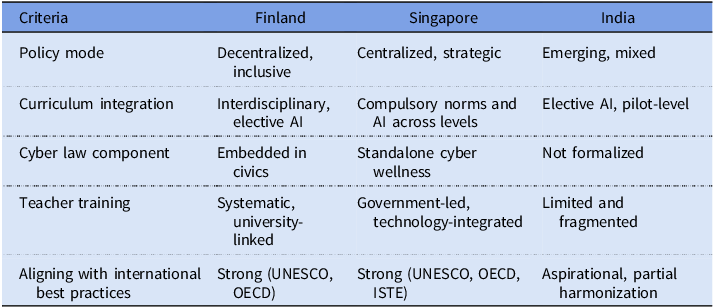
For a comparative summary, see Table 1.
Comparative summary

AI, artificial intelligence; UNESCO, United Nations Educational, Scientific and Cultural Organization; OECD, Organization for Economic Cooperation and Development; ISTE, International Society for Technology in Education.
K-12 Rights Curriculum AI Framework for Cyber Law and AI Education
To actualize the vision of digital empowerment as a fundamental right, it is important to translate global norms and national mandates into an actionable and age-appropriate curriculum for schools.
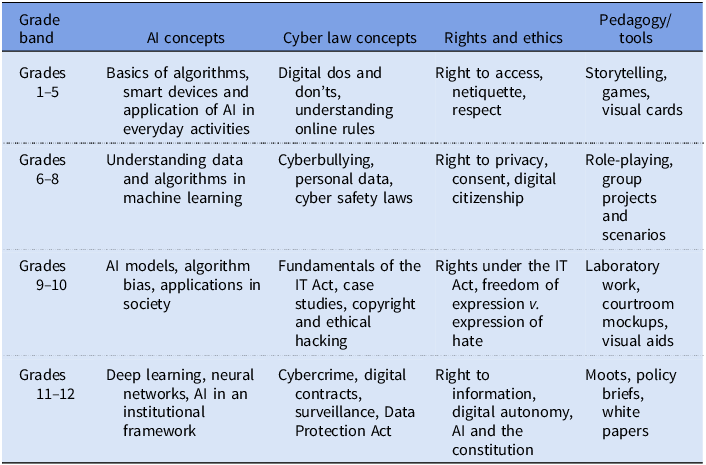
The proposed curriculum (see Table 2) is a practical model for incorporating AI and cyber law into the K-12 education system through a rights-based perspective. It ensures student-centred pedagogy, upholds constitutional values and promotes digital values, thereby ensuring safety, inclusiveness and preparedness for the future. In addition to considering global best practices, this framework takes into account regional socio-technological conditions.
Proposed curriculum

AI, artificial intelligence.
Research Questions
Research questions include:
-
1. Which key UNESCO and OECD policy guidelines and regulatory frameworks issued by UNESCO and the OECD promote digital literacy, AI-driven educational technologies and cyber law awareness at the school level?
-
2. How are global EdTech standards, such as the ISTE Standards and UNESCO’s AI Competency Framework, conceptualizing the safe usage of AI, digital values and cyber legal awareness for K-12 learners?
-
3. To what extent have these international frameworks influenced national curriculum policies in selected countries, particularly in India, Finland and Singapore?
-
4. How are Indian educational policies, such as the NEP 2020 and the National Curriculum Framework for School Education 2023, incorporated into the guidelines set forth by UNESCO, the OECD and leading EdTech standards?
-
5. What are the gaps and possibilities that emerge when cross-mapping India’s AI and cyber law education efforts against the benchmarks set by the international bodies?
-
6. Can UNESCO’s and OECD policy insights be integrated with the priorities of local learning centres in India to create a rights-based digital curriculum model?
Methodology
Our study employs a qualitative, doctrinal and comparative policy analysis approach to examine the impact of global organizations, such as UNESCO and the OECD, as well as selected global EdTech bodies, on shaping AI and cyber law curriculum frameworks globally and in India. This method combines a systematic review of content, normative legal evaluation and documentary research to generate findings that are both academically sound and practically relevant to policy.
Nature and Source of Data
This study is based on secondary data drawn from many international, governmental and supporting literature, including:
-
1. UNESCO reports;
-
2. OECD frameworks;
-
3. EdTech industry standards from ISTE, Digital Promise and EdSafe AI Alliance;
-
4. Governmental policies;
-
5. Judicial precedents (relevant Indian Supreme Court and High Court rulings);
-
6. Peer-reviewed journals, policy briefs, United Nations General Assembly documents, and conference papers.
Methods of Analysis
A systematic evaluation of the legal, policy and curricular dimensions of adopting AI and cyber law into the Indian K-12 education system employed a multi-method analytical approach. The main strategies used to guarantee doctrinal depth, policy benchmarking and grounded practical understandings are generated from national and international context frameworks.
Data Interpretation Framework
Cross-National Comparative AI Trends and Cyber Curriculum Development
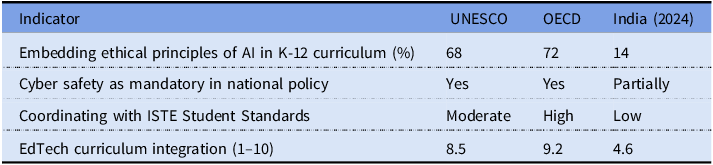
To understand India’s global positioning in terms of digital curriculum development, it is crucial to benchmark primary measures of ethical AI use, cyber safety and EdTech integration against international standards.
The comparative framework (see Table 3) draws upon available policy reports and education technology standards, highlighting how India fares alongside global leaders, namely UNESCO and OECD nations. This data provides a clearer picture of how to assess the level of urgency and direction for adopting AI and cyber law education into India’s K-12 education system.
Comparative framework

UNESCO, United Nations Educational, Scientific and Cultural Organization; OECD, Organization for Economic Cooperation and Development; AI, artificial intelligence; K-12, publicly supported primary and secondary education; ISTE, International Society for Technology in Education.
Conclusion and Suggestions
The research examined how global EdTech frameworks, UNESCO and the OECD have shaped curricula, cyber law and AI regulations in K-12 educational systems. The findings indicate that global organizations are now the most essential in establishing normative standards, influencing national education policies, and leading to improved and innovative educational curricula through data-guided principles, AI preparedness and digital literacy.
The study found that UNESCO’s 2021 Recommendation on the Ethics of Artificial Intelligence, the OECD’s AI guidelines and the Digital Education Outlook collectively provide a value-based and skill-oriented roadmap. These instruments prioritize digital inclusion, algorithmic transparency, and thoughtful and accountable innovation in addition to accessibility and fairness. Countries integrating these models, such as Finland and Singapore, have improved synchronization between AI, cybersecurity and foundational education, although issues persist at the local and adaptation levels.
India, while responsive through the NEP 2020 and Digital India Initiatives, lacks a structured mandate to integrate AI and cyber law uniformly into the curriculum design. There also exists a policy practice gap, especially in state implementation and teacher preparedness. The following suggestions can be made:
-
1. Mandate AI and cyber law literacy at all educational stages through national curriculum guidelines, drawing from UNESCO and OECD frameworks.
-
2. Localize global standards to reflect India’s legal system, constitutional values and digital inclusion goals.
-
3. Establish a national AI and cyber law curriculum taskforce with representation from law, academic and technology domains.
-
4. Prioritizing teacher training is vital for guaranteeing that these difficult courses are implemented successfully.
-
5. Coordinating policies are needed between the Ministry of Education, the National Council of Educational Research & Training and the MeitY to avoid any divided implementation.
Competing interests
Neither of the authors has a conflict of interest.
Bharti Thakur is a legal researcher and PhD scholar with a focus on digital rights and education policy. Her research explores the integration of artificial intelligence and cyber law into the K-12 curriculum, advocating for digital empowerment as a fundamental right. She is dedicated to advancing equitable access to technology and legal literacy for the next generation.
Neeru Mittal is Head of Department at the School of Law, Lovely Professional University with over 14 years of experience, 11 years in teaching and three years in litigation. A Gold Medallist in BCom (Hons) and LLB, she specializes in constitutional and criminal law.