

The first European Marine Biology Symposium (EMBS) was initiated by Otto Kinne, Director of the Biologische Anstalt Helgoland, and held on Helgoland in the early autumn of 1966. The meeting was such a success that the EMBS has continued to be held annually ever since, moving around various locations. To date the EMBS has been organized in about 20 different European countries (Hummel & Hummel, Reference Hummel and Hummel2016). The overall aim of the EMBS is to advance the science of Marine Biology within Europe. The EMBS provides a forum for the presentation of current marine biological research through a combination of oral and poster presentations, to encourage a wider interest in Marine Biology, an awareness of the need for the proper management of European seas and coasts, and the fostering of inter-European links and cooperation between researchers in Marine Biology. The scientific topics usually reflect the interest of the organizing institution, time series research in the case of the 50th EMBS.
As the EMBS conference series was initiated at Helgoland, it was an obvious choice to return there for the 50th meeting. Nostalgia is not the main reason for holding the symposium on Helgoland however: it also has one of the longest marine biological histories in Europe, if not the world. The Biologische Anstalt Helgoland (since 1998 part of the Alfred-Wegener-Institut Helmholtz-Zentrum für Polar und Meeresforschung, BAH-AWI) will turn 125 in 2017 and even before its inception in 1892 the island attracted marine scientists which used this rocky outpost in the German Bight, that is Helgoland, for their studies (Werner, Reference Werner1993). The famous physiologist Johannes Müller for instance elucidated the life cycles of starfish and other echinoderms, while his student Ernst Haeckel came to Helgoland to investigate protozoa such as Radiolaria, eventually compiling several monographs with outstanding biological artwork (e.g. Haeckel, Reference Haeckel1862).
Ever since these early pioneers arrived, scientists on Helgoland have worked on cutting-edge topics from fisheries science, to foodweb ecology and harmful algae, to taxonomy, with a large number of species of zooplankton, phytoplankton and invertebrates owing their names to their discovery on or near Helgoland (e.g. von Stosch, Reference von Stosch1969; Hagmeier, Reference Hagmeier1998). More recently applied topics such as the investigation of the effects of microplastics have also increased considerably in importance.
However, the Biologische Anstalt Helgoland is probably most famous for its Helgoland Roads time series which were initiated in 1962 (Wiltshire & Dürselen, Reference Wiltshire and Dürselen2004; Wiltshire et al., Reference Wiltshire2010, Reference Wiltshire2015), with much older contextual datasets even dating back to the start of the 20th century (Kraberg et al., Reference Kraberg2015). The Helgoland Roads time series has been in operation continuously since 1962 and not only provides work-daily phytoplankton and thrice-weekly zooplankton counts but also nutrient, temperature, salinity and Secchi depth data, making Helgoland Roads one of the most detailed and highly resolved time series in the world, also augmenting the marine macroalgal and physiological work at Helgoland. As with all other branches of science at Helgoland, the BAHs long-term data experts investigate not only past trends and changes but also evaluate the value and suitability of emerging technologies, e.g. molecular and imaging tools for application in a time series context. These technologies hold great promise as they can greatly increase the frequency of observations although there are challenges as they are not automatically comparable to data generated in a more conventional manner. Considerable effort is required to integrate the respective datasets and the BAH-AWI is at the forefront of such efforts, working towards ensuring that our existing data remain as valuable as ever but harnessing the benefits of new technologies wherever possible.
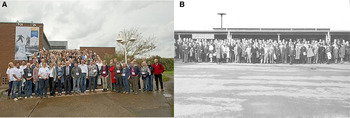
Group photos of the (A) EMBS 50 in front of the Nordseehalle and (B) EMBS 1 at the Landungsbrücken on Helgoland.
The data generated by our time series experts are available to the scientific community and have been used by hundreds of external scientists in the past 10 years alone. The Helgoland Roads datasets also form the basis for a large number of collaborations with scientists visiting the station, supported by the BAH-AWIs guest scientist programme.
The Biologische Anstalt was therefore very happy and grateful to accept the invitation to hold the 50th European Marine Biology Symposium on Helgoland and it was not difficult to choose a suitable overarching theme for the event, namely ‘Long-term changes in the marine Environment’, accepting contributions on all aspects of time series research from core scientific analysis to data archival and analytical methodologies. In keeping with EMBS tradition, a wide range of additional topics was also covered, from physiology to marine policy and management issues with a selection of key papers provided in this special issue.


