1 Introduction
The primary purpose of this paper is to present evidence for a disyllabic output constraint on multiple independent sound changes in Austronesian, and to demonstrate a positive correlation between anti-antigemination and satisfaction of this constraint. The term ‘anti-antigemination’ (AAG) was coined by Odden (Reference Odden1988) to refer to the deletion of a vowel only between identical consonants, as in Mussau (Blust Reference Blust2001b) /ai gagali/∼/ai ggali/ ‘razor’, /kikiau/∼/kkiau/ ‘megapode’ and /mumuko/∼/mmuko/ ‘sea cucumber’, where the shorter forms are used exclusively by younger speakers and the longer forms exclusively or generally by older speakers. This paper will show that this type of syncope is widespread in Austronesian languages, and is motivated by a preference for a disyllabic canonical shape. AAG is one of several methods by which a disyllabic canonical target is satisfied. Furthermore, it will be argued that the limitation of syncope to deletion between identical consonants follows from avoidance of heterorganic consonant sequences, which do not occur in the languages in question.
I will not offer a formal treatment of this interaction, but the disyllabic canon, along with pre-existing phonotactics, might be modelled as attractors in the dynamic systems approach of Kelso (Reference Kelso1995: 53), or as system-internal attractors, as modelled by Wedel (Reference Wedel2007). I argue that restorative disyllabism is a product of inherited canonical constraints that are particular to the Austronesian language family. This contrasts with several recent proposals concerning other sound patterns (e.g. de Lacy Reference De Lacy and McCarthy2004, Ussishkin Reference Ussishkin2005), where a disyllabic maximal word constraint is claimed to be part of Universal Grammar.
Before proceeding, it will be useful for the non-specialist to have an overview of the size and structure of the Austronesian language family. Austronesian is the second largest language family on earth, with an estimated 1,268 languages (Gordon Reference Gordon2005). Its internal structure is broadly outlined in (1), which gives the ten primary branches of the family (branches that cannot be combined with others on the basis of unambiguous exclusively shared innovations).
(1) Internal structure of the Austronesian language family

Of the ten primary branches, the first nine in (1) are represented by 15 surviving languages on the island of Taiwan. The Malayo-Polynesian branch includes all Austronesian languages outside Taiwan. Western Malayo-Polynesian (Philippines, western Indonesia, Chamic, Malagasy, Palauan and Chamorro) is not innovation-defined, and may represent more than one primary branch of Malayo-Polynesian. Central Malayo-Polynesian includes about 150 languages spoken in the Lesser Sundas and central and southern Moluccas in eastern Indonesia. South Halmahera-West New Guinea contains some 30 languages spoken in the northern Moluccas and coastal portions of the Bird's Head peninsula of New Guinea, and Oceanic contains 466 languages in coastal portions of New Guinea, island Melanesia, Micronesia and Polynesia (Lynch et al. Reference Lynch, Ross and Crowley2002). More fine-grained details of subgrouping will be mentioned as the need arises in connection with the issue of convergence vs. common inheritance.
The most salient structural feature of the lexicon of Proto-Austronesian and of many of its daughter languages, both reconstructed and attested, is probably the predominance of a disyllabic canonical shape. Based on the foundational work of Dempwolff (Reference Dempwolff1938), Chrétien (Reference Chrétien1965) compiled statistics relevant to this point, and although much better and fuller data is now available, the major statistical relationships remain unaffected. Of 2,216 reconstructed word bases in Dempwolff's Uraustronesisch dictionary, Chrétien (Reference Chrétien1965: 244) found 33 monosyllables, 98 trisyllables and four quadrisyllables. He recognised 1,950 disyllables that are not historical reduplications, 130 disyllables that are historical reduplications (*bejbej ‘tie, wind’, *tuktuk ‘knock’, etc.), and one form that he classified as ‘two-syllable miscellaneous’. In all, then, he found that 2,081 of 2,216 lexical bases reconstructed by Dempwolff, or 94%, are disyllabic. Affixed words are naturally longer, but the overwhelming preponderance of disyllabic bases (many of which do not take affixes) is almost certainly implicated in a conspiratorial pattern of restorative disyllabism that pervades the historical phonology of Austronesian languages.
Not all historical changes that convert longer words to disyllables are necessarily motivated by inherited structural pressures, and one of these (medial vowel syncope) will be mentioned later. The clearest evidence for conspiratorial disyllabism comes from changes that occur only under conditions of canonical restoration, whether this is achieved by processes of reduction, or by processes of expansion. A number of these are reported in §§2 and 3.
2 Canonical restoration
Several mechanisms have been employed in the historical phonology of Austronesian languages to reconstitute a lost disyllabism. In general these processes affect only content morphemes, which are independent, stress-bearing units. All known monosyllables in Proto-Austronesian and other early Austronesian proto-languages fall into one of two word classes: (i) what, for want of a better term, will be called ‘particles’ (ligatures *a and *na linking head and modifier, genitive markers *ni, *na, *nu, the generic locative marker *i, etc.) and (ii) onomatopes (e.g. *tuk ‘the sound “knock!”’, as opposed to *tuktuk ‘knock’, both of which are onomatopoeic). Since grammatical particles attach to adjacent stress-bearing units, they form part of larger phonological words, and are exempt from the pressures of canonical restoration that affect free, or content morphemes. The mechanisms that restore a lost disyllabism to free morphemes will be described below.
Two aspects of the numerous shifts towards disyllabism detailed below are noteworthy. First, as illustrated in this section, independent types of change result in a common disyllabic output. Changes of this type exemplify the notion of a ‘conspiracy’ in language change (Hock Reference Hock1991: 159–164, Crist Reference Crist2001): many changes in Austronesian conspire to yield disyllabic output forms. Since conspiracies have also been recognised in synchronic phonologies (Kisseberth Reference Kisseberth1970), and constitute ‘the single biggest phonological influence on the emergence of Optimality Theory’ (McCarthy Reference McCarthy2002: 54), a better understanding of historical conspiracies could further illuminate the nature of conspiracies in the synchronic domain. Second, as exemplified by the cross-linguistic study of vowel loss between identical consonants in §3, anti-antigemination in Austronesian is a striking case of parallel (non-contact-induced) independent sound change among genetically related languages. These parallel sound changes exemplify instances of ‘drift’, as first described and labelled by Sapir (Reference Sapir1921), and are all the more interesting since, outside of Austronesian, anti-antigemination is rare. Understanding the multiple factors which play a role in this recurrent Austronesian sound pattern may help explain its low frequency outside of this language family.
Keeping in mind the fact that some 94% of all early Austronesian base morphemes were disyllabic, I will now briefly survey the mechanisms which seem to conspire to restore a disyllabic canonical form to free morphemes that have come to have other than two syllables. Once the pervasiveness of this conspiracy is recognised, it will be possible to place the drift-like status of anti-antigemination in a larger explanatory context in which this mechanism is only one of several that operate to satisfy a common disyllabic canonical target.
2.1 Restorative reduplication
In Javanese, Proto-Austronesian *R (probably an alveolar trill that became uvular before undergoing other changes in the separate histories of many languages) normally disappeared. When this happened intervocalically, two vowels came into contact and underwent subsequent changes. If the vowels were identical, crasis produced contrastive length in Old Javanese (known primarily from palm-leaf manuscripts produced in east Java between roughly the 9th and 15th centuries). In Modern Javanese, which lacks contrastive vowel length, long vowels were shortened. Where the derived vowel sequence was *ia or *ai it contracted to /e/, and where the derived vowel sequence was *ua or *au it contracted to /o/. (2) shows the expected and attested reflexes of a number of words that became monosyllabic content morphemes as a result of regular sound change in pre-Old Javanese:
(2) Restorative reduplication in Javanese monosyllabic content morphemes
Observers disagree on whether all Modern Javanese forms in (2) must be reduplicated. Pigeaud (Reference Pigeaud1938: 455), for example, gives /pe/, but Dempwolff (Reference Dempwolff1938: 111), following Jansz (Reference Jansz1899), gives /pepe/ ‘stingray’. Moreover, some content morphemes that have reduced to monosyllables are not given as reduplicated in any source, as with *baReq>/woh/ ‘abscess’, *buRuk>/wuk(-an)/ ‘rotten’ and *zaRum>/dom/ ‘needle’. Despite this variation, content morphemes that have become monosyllabic through regular sound change show a clear tendency to subsequently reduplicate. Several observations are worth making in connection with this material. First, the beginnings of restorative reduplication are already apparent in the Old Javanese texts, but this process has been carried further in the modern language. Second, reduplication in these forms has no identifiable semantic or grammatical value. Third, Old Javanese bases that did not reduce to monosyllables show no tendency to undergo base-extending reduplication. Finally, since vowel length was phonemic in Old Javanese, forms such as Old Javanese /tut, tuut/, Modern Javanese /tutut/ ‘follow’ and Old Javanese /wa, waa/, Modern Javanese /wawa/ ‘ember’ suggest that the canonical target was a base with two syllables rather than two moras (cf. Old Javanese /tutuut, tuutuut/ ‘following’, /maawaa/ ‘bright’).
2.2 Loss of a morpheme boundary
Old Javanese (Zoetmulder Reference Zoetmulder1982) had a stative verb prefix /a-/, seen in examples such as /bwat/ ‘weight’, /a-bwat/ ‘heavy’<*beRat, /doh/ ‘distance’, /a-doh/ ‘distant’<*zauq, /lon/ ‘slowness’, /a-lon/ ‘slow’<*laun, /twas/ ‘hardness’, /a-twas/ ‘hard’<*teRas and /wor/, /silih wor/ ‘confused (of a battle)’, /a-wor/ ‘mingled’<*bahuR. In Modern Javanese (Horne 1974), many of these forms have weakened or lost the boundary between the stative prefix and the base: /abot/ ‘heavy’ (given as a dictionary entry, but a few forms also listed separately under /bot/), /adoh/ ‘distant’ (given as a dictionary entry, but a few forms also listed separately under /doh/), /alon/ ‘slow’ (not /lon/), /atos/ ‘hard’ (not /tos/), /awor/ ‘mingled’ (given as a dictionary entry, but a few forms also listed separately under /wor/). No examples are known of fossilisation or semi-fossilisation of /a-/ in Modern Javanese bases that did not reduce to a monosyllable. Again, this appears to be a change that has been completed with some bases, but is in progress with others. As with restorative reduplication, the loss of morpheme boundary in bases that have become monosyllabic through regular sound change functions to restore a lost disyllabism.
2.3 Epenthesis
A number of Austronesian languages have added initial schwa either to content morphemes that were first reduced to monosyllables as a result of regular sound change, or to monosyllabic loanwords. Schwa epenthesis is absent with bases that do not have a history of secondary monosyllabism. Examples from Tiruray in the southern Philippines and Kelabit of northern Sarawak are given in (3).
(3) Epenthesis as repair in Tiruray and Kelabit
Javanese also shows apparent cases of restorative epenthesis with schwa: *duRi>Old Javanese /rwi/>Modern Javanese /əri/ ‘thorn’, *paRi>/əpe/ ‘stingray’ (variant of /pepe/), /əbuk/ ‘notebook’ (Dutch boek), /əgaŋ/ ‘passage’ (Dutch gang), /əsop/ ‘soup’ (Dutch soep). In Tarakan, Sesayap and Sibuku of northeast Kalimantan (Ray Reference Ray1913: 113–154), bases that became monosyllabic through regular sound change restored the lost disyllabism through schwa epenthesis followed by regular *e>/a/. Examples include Proto-Malayo-Polynesian *buhek>*buk>/abuk/ ‘hair’, *daqan>*dan>/adan/ ‘branch’, *paqa>*pa>/apa/ ‘thigh’ (cf. *telu>/talu/ ‘three’, *enem>/anam/ ‘six’ and *beRas>/bagas/ ‘husked rice’, with *e>/a/ in all three languages). Finally, a virtually identical series of changes is found in the distantly related Isneg of northern Luzon, which also underwent a subsequent change *e>/a/. For Isneg, we find *bahaR>bag>/abaːg/ ‘loincloth’, *dahun>don>/aˈdon/ ‘leaf’, *tuhed>/atˈtud/ ‘stump of a tree’, *wahiR>weg>/awˈweg/ ‘small creek’. Since epenthesis is restricted to monosyllabic content morphemes, it appears once again that this recurrent sound change is motivated by inherited structural pressures that arise from the predominant disyllabism of inherited base forms.
2.4 Laryngeal deletion and contraction
The examples just considered show restoration of a historically secondary monosyllable to the preferred canonical shape through syllable addition. The examples that follow produce similar outputs for historically derived trisyllables, and consequently involve some type of syllable loss.
Tagalog often reduplicates disyllabic bases with no subsequent change, as in /ma-basag/ ‘get broken’, /magka-basag-basag/ ‘get thoroughly broken’ and /mag-sugat/ ‘have sores’, /magka-sugat-sugat/ ‘thoroughly covered with sores’ (Schachter & Otanes Reference Schachter and Otanes1972: 339–340). However, reduplicated disyllables with a medial / / or /h/ between like vowels often undergo laryngeal deletion and syllable contraction (Blust Reference Blust1976), as shown in (4). Note that /u/ and /o/ were originally allophones of a single phoneme that have come to contrast as a result of loanwords from Spanish and English, and that primary stress, which is phonemic, falls on either the final or penult, though only rarely on closed penults.
(4) Laryngeal deletion and contraction in Tagalog reduplications
Contractions of this type never occur in non-reduplicated bases such as /daˈan/ ‘road’ or /buˈhok/ ‘hair’, nor (as already noted) do they occur in reduplicated disyllables that do not contain a laryngeal consonant between like vowels. In apparent contradiction of the thesis advanced here, reduction does not occur in affixed forms of disyllabic bases that contain /h/ or // between like vowels: /buˈhok/ ‘hair’, /ma-buˈhok/ ‘hairy’; /saˈad/ ‘said’, /i-saˈad/ ‘to say’. However, this difference of treatment is consistent with a hypothesis that the preferred disyllabism generally applies to bases rather than to morphologically complex words. With reduplications, the two halves of the reduplicated form may each independently satisfy the requirement, but also offer the opportunity to reduce the structure to a single disyllable concordant with inherited reduplications such as /bidˈbid/ ‘twine’ or /tukˈtok/ ‘knocking’.
2.5 Prefix truncation
The Proto-Malayo-Polynesian active verb prefix *maŋ-, which triggered nasal substitution in certain obstruent-initial bases, has been reduced to /ŋ-/ in a number of the languages of the Philippines and western Indonesia. Consequently, the pattern of disyllabic stem vs. trisyllabic affixed form seen in Malay pairs such as /pukul/, /me-mukul/ ‘to hit’ has been transformed into a pattern of uniform disyllabism, as in Javanese /pajuŋ/ ‘umbrella’, /majuŋ/ ‘shelter with an umbrella’ (Blust Reference Blust2004: 90–91). For reasons that can be ignored here, an analysis as *ma-+ŋ is problematic, and the simplest hypothesis appears to be that this development involves prefix truncation through loss of the initial CV- sequence. Nearly a century and a half ago Hardeland (Reference Hardeland1858: 48) described Ngaju Dayak /n-/, /ŋ-/ and /ɲ-/ as ‘abbreviations’ of /man-/, /maŋ-/ and /maɲ-/, implying that the longer forms were then undergoing reduction. Fieldnotes collected by the writer in 1971 from speakers of the Long Anap dialect of Kenyah in northern Sarawak show a similar reduction in progress, suggesting that the truncation of *maŋ- to /ŋ-/ is yet another change conspiring toward a disyllabic base in which the driving force is a predominant disyllabic canonical pressure.Footnote 2
3 Anti-antigemination
The preceding discussion of canonical restoration in Austronesian languages leads naturally to the topic of anti-antigemination. Based on data from several language families, McCarthy (Reference McCarthy1986) proposes that otherwise general syncope processes are suspended between identical consonants. Since this happens even in languages with tautomorphemic geminates, the explanation for ‘antigemination’, as he calls it, cannot be sought in an avoidance of geminate consonants. Rather, he argues, the ‘antigemination effect’ is motivated by a putative phonological principle that transcends language-specific constraints, the Obligatory Contour Principle, defined as follows:
(5) Obligatory Contour Principle
At the melodic level, adjacent identical elements are prohibited.
In McCarthy's words (Reference McCarthy1986: 221) ‘the explanation for the … antigemination effect is … a universal one: syncope of a vowel between identical consonants would produce a configuration that violates the OCP and is therefore blocked’. Let us refer to this as the Antigemination Hypothesis.
Odden (Reference Odden1988) argues against the Antigemination Hypothesis, objecting that: (i) it is too powerful, allowing potential counterevidence to be arbitrarily swept aside, (ii) the OCP does not entail the antigemination effect, (iii) antigemination is falsified in a number of languages and (iv) McCarthy's argument implies that consonants may not delete between identical vowels, but this is patently false, and the topic is never broached. Central to Odden's critique of the antigemination hypothesis is a consideration of the six logically possible relationships that syncope or epenthesis can have in creating or separating geminate consonants. These are illustrated in (6).
(6) Vocalic operations affecting geminate sound patterns (after Odden 1988)
a. Delete a vowel unless flanking Cs are identical.
b. Delete a vowel blindly.
c. Delete a vowel only if flanking Cs are identical.
d. Insert a vowel unless flanking Cs are identical.
e. Insert a vowel blindly.
f. Insert a vowel only if flanking Cs are identical.
As Odden points out, (a) is antigemination, and ‘cases (c) and (f) would (along with (b)) be the most troublesome’. Because (c) is essentially the antithesis of antigemination, Odden calls it ‘anti-antigemination’, and he documents this process in several languages, including the Austronesian languages Nukuoro and Yapese.
Debate over the status of antigemination has continued to the present day. Blevins (Reference Blevins, Frajzyngier, Hodges and Rood2005) argues that McCarthy overlooked morphological explanations that provide a better account for the original data without recourse to antigemination or the OCP. Rose (Reference Rose2000), Reiss (Reference Reiss2003), Blevins (Reference Blevins2004) and Baković (Reference Baković2005) all acknowledge the existence of vowel∼zero alternations between identical consonants, but differ in their understanding of its causes. Blevins (Reference Blevins2004: 170, 172) recognises this type of historical vowel loss as one of seven pathways to geminate evolution, accepting it as an unmediated change. Working within the general framework of Optimality Theory, Rose (Reference Rose2000), Reiss (Reference Reiss2003) and Baković (Reference Baković2005), on the other hand, see AAG as a product of constraint ranking in which NoGem is at the bottom of the hierarchy. Though there is no evidence that sound changes involving vowel loss between identical consonants are subject to universal phonological constraints during or after phonologisation (Blevins Reference Blevins2004, Reference Blevins, Frajzyngier, Hodges and Rood2005), my purpose here is not to debate this, but to highlight a novel relationship between synchronic and diachronic systems relating to this precise type of vowel loss. Anti-antigemination, in Austronesian, like the five distinct processes discussed in §2, moves a synchronic system towards disyllabism, suggesting a direct relationship between lexical/base frequency effects in the proto-language and the output of this sound change.
3.1 The form of anti-antigemination
Syncope only between identical consonants has been recognised by Austronesian specialists at least since Milner (Reference Milner1958), who argued that phonemically aspirated consonants in the Polynesian Outlier languages Kapingamarangi and Tuvaluan arose through this process. As the list of languages that exhibit this trait has grown longer, it has become increasingly clear that AAG is found in Austronesian languages reaching from mainland Southeast Asia to Polynesia, and that even in closely related languages there is evidence that this is sometimes the result of parallel historical changes. The following is a brief but fairly comprehensive survey of known cases. In all languages syncope produces word-initial geminates. And in all languages except descendants of Proto-Western Micronesian, initial geminates have only one known source.
3.2 Case studies
Eleven case studies are presented here, in separate subsections. Some attested languages are grouped together under an immediate common ancestor, as Western Micronesian, since they probably have inherited a syncope process from a proto-language in which the change had already taken place. Others, such as the Ellicean Outlier languages, are also placed together because of their close interrelationships, but probably innovated processes of vowel syncope between identical consonants after their separation from a common ancestor.Footnote 3
3.2.1 Iban
Iban (also known as Sea Dayak) is a Malayic language spoken in southwest Sarawak, Malaysian Borneo (Adelaar Reference Adelaar1992). It has four vowels, /a i u ə/, and 18 consonants, /p t c k b d ɟ g m n ɲ ŋ s l r w j/. Consonant clusters are limited to medial position, and consist only of homorganically prenasalised obstruents /mp mb nt nd ns ɲc ɲɟ ŋk ŋg/.
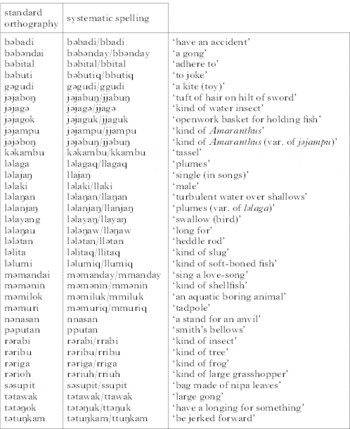
Although it is fairly closely related to Malay, this language has a syncope process that is unknown in standard Malay or most other languages of western Indonesia. In his Iban–English dictionary, Scott (Reference Scott1956: vii) distinguishes between the standard orthography and what he calls a ‘systematic spelling’ that provides more phonetic (and sometimes more phonemic) detail. Systematic spellings are provided only where they differ significantly from the ordinary orthography, as with bok (buuk) ‘head hair’ and ulu (ulu?) ‘meaning’. About one-third of the roughly 6,500 entries in Scott (Reference Scott1956) are given both in the standard orthography and the systematic spelling. Of interest here is the alternative pronunciation of some trisyllabic words as disyllables with an initial geminate consonant. Table I lists all known examples.
Iban anti-antigeminatiom.

The following observations are noteworthy. First, Iban geminates have no other source than the one shown here, and syncope is not reported as an optional phonetic feature of the language between non-identical consonants. Second, in nearly all known cases, this vowel loss occurs between consonants which are tautomorphemic. Third, the deletion of a vowel between identical consonants does not apply to disyllables. Fourth, the only vowel that deletes is schwa. Fifth, geminates are created only word-initially. Sixth, and most trivially, Scott indicates that deletion of a vowel between identical consonants creates initial geminates for all consonants except /c ɲ ŋ/, an accidental gap that has no structural significance.
The first point allows us to classify this as an instance of (6c), and a clear case of AAG. Not only is this result unexpected given the antigemination hypothesis, but it is surprising from the standpoint of general processes of schwa syncope in Malayic languages. Malay has penultimate stress unless the penultimate vowel is schwa followed by a single consonant, in which case stress is final. Richards (Reference Richards1981: xiv–xv) reports an identical stress rule for Iban, and although Asmah (Reference Asmah1981: 41) claims that the language has fixed final stress, under either interpretation the schwa (which occurs only in pre-final syllables) is never stressed in open syllables in either language. In Malay this vowel commonly deletes between an initial stop and a following liquid, particularly in trisyllables, so that /bəras/ ‘husked rice’ may be heard as [bəˈras] or [bras], and the schwa in a longer form such as /bəlajar/ ‘to study’ is rarely heard in normal colloquial speech. Scott's ‘systematic spelling’ of Iban, however, shows no schwa deletion in forms such as belaboh /bəlabuh/ ‘to anchor’, Berunai /bərunaj/ ‘Brunei’, kelapa /kəlapa/ ‘coconut palm’ and terima /tərima/ ‘receive’, or for that matter in disyllables such as beras /bəras/ or gela /gəla/ ‘nickname’.
The second point is important within the parameters of the original theory, since McCarthy's claim is that antigemination holds ‘at the melodic level’, hence between elements that occupy the same ‘tier’. Since the morphemes in an affixed word are said to appear on different tiers, the intervention of a morpheme boundary is sufficient to nullify the antigemination effect. As in most Austronesian languages, the majority of Iban free morphemes contain two syllables, and this raises questions about whether the forms in Table I might be bimorphemic. The only examples found that are likely to be morphologically complex are /bəbadi/∼/bbadi/ ‘have an accident’ (cf. /badi/ ‘sudden attack of illness’), /ləlaki/∼/llaki/ ‘male’ (cf. /laki/ ‘husband’), /ləlajaŋ/∼/llajaŋ/ ‘swallow’ (cf. /ŋə-lajaŋ) ‘make flat things skim’, /mə-lajaŋ/ ‘skim’) and /tətəŋuk/∼/ttəŋuk/ ‘have a longing for something’ (cf. /təŋuk/ ‘love to do something’). These forms suggest that some trisyllables in which the first two consonants are identical arose historically through CV-reduplication. However, the great majority of examples (at least 31 of the 35 forms in Table I) are monomorphemic in the contemporary language, and even among the four possible exceptions there appears to be no productive process of reduplication relating disyllabic and trisyllabic variants.
As will become apparent, the third point is particularly important. All Iban bases which undergo AAG are trisyllabic, and all but three are given with two pronunciations, one with and one without antepenultimate schwa. Scott also lists ten bases of the same canonical shape without a syncopated variant (/bəbəlat/, /bəbəndar/, /cəcamaŋ/, /ɟəɟaga/, /ləlambaj/ (×2), /ləlambak/, /lələgup/, /lələpu/, /rərəŋkap/). Given 32 bases of the type /bəbadi/∼/bbadi/, three of the type /llaɟaŋ/ and ten of the type /bəbəlat/, it is a reasonable supposition that all trisyllabic bases with identical first and second consonants have two pronunciations, and that apparent exceptions are due to transcriptional inconsistencies. In contrast, although some 229 CVCV(C) bases with identical initial and medial consonants and at least 350 CəCVCV(C) bases with non-identical first and second consonants are listed in the dictionary, none shows a variant with schwa syncope.Footnote 4
The fourth point may give the initial impression that syncope is sensitive to particular vowels, but this is not the case, since Iban historically neutralised all vocalic oppositions in antepenultimate syllables. As a phonotactic consequence, with rare exceptions in forms derived by recent processes of suffixation (/puput-an/∼/pəputan/, /putan/ ‘smith's bellows’), the only vowel that appears in antepenultimate position is schwa. Since AAG targets only the first vowel of trisyllables, schwa is the only vowel that can be deleted.
The fifth point is typologically interesting. Despite claims that initial geminates always imply medial geminates (Thurgood Reference Thurgood, Nevis, McMenamin and Thurgood1993: 131), there are clear counterexamples, as with Sa'ban of northern Sarawak (Blust Reference Blust and Thurgood2001a), or other cases discussed in this paper. Iban can now be added to the growing list of languages known to have geminates only word-initially.
With regard to the sixth point, the gaps for /cc- ɲɲ- ŋŋ-/ appear to be accidental, as only one form is given for /cəc-/ and none for /ɲəɲ-/ or /ŋəŋ-/ (likewise, neither /j/ nor // occurs in initial position, and /w-/ is very rare). Similarly, despite Scott's statement, no examples of /dədVCV(C)/ appear in the dictionary. In Iban, then, AAG appears to operate between successive syllable onsets provided that these are identical, that the first is word-initial and that the word contains exactly three syllables.
3.2.2 Ellicean Outliers
Milner (Reference Milner1958) reported a series of innovative consonants in two Polynesian Outlier languages: Ellicean (now called Tuvaluan), and Kapingamarangi. Most of the information that he gives is for the first of these languages. He described the new stop series in Tuvaluan as aspirated /pʰ tʰ kʰ/, and argued that it had arisen (i) in words formed by CV reduplication, and (ii) in nouns that begin with a dental stop and take the preposed common noun article /te/. Examples of (i) are Samoan /totolo/, Tuvaluan /tʰolo/ ‘crawl’ and Samoan /pipili/ ‘lame’, Tuvaluan /pʰili/ ‘paralysed’, and of (ii) /taku tao/ ‘my spear’, /e a i tʰao teːnei/ ‘whose spear is this?’ (note the aspiration in /tʰao/); cf. /taku puaka/ ‘my pig’, /e a i te puaka teːnei/ ‘whose pig is this?’ (note the article /te/ and absence of aspiration in /puaka/, from which we can conclude that /te/ is realised as aspiration before nouns that begin with /t/).
Besnier (Reference Besnier2000) provides a much more detailed and modern description of Tuvaluan, based on the dialect of Nukulaelae atoll. According to him (2000: 608), the phonological inventory of Tuvaluan includes eleven consonants, all of which may appear geminated: /p t k m n ŋ f s h v l/. Besnier's geminate consonants correspond to Milner's aspirates, a discrepancy that presumably is due to dialect differences rather than recent change, since the historical transition from geminate to aspirate is known in other languages (e.g. some Italian dialects, languages of northern New Caledonia), but the reverse is not (Blevins & Garrett Reference Blevins and Andrew1993). Stress usually falls on the penultimate mora, and when this is part of a geminated (long) vowel, stress is distributed evenly over the entire syllable. Besnier (Reference Besnier2000: 612) notes further that ‘geminated consonants are always the result of the deletion of an unstressed vowel between two identical consonants’, implying that they are derived rather than underlying, as seen in (7), which gives the base form (*vavae, etc.) and its syncopated counterpart:
(7) Tuvaluan base forms and their syncopated derivatives (Besnier 2000: 618)
According to Besnier (Reference Besnier2000: 618) the base form is ‘both a synchronic abstraction and a diachronic reconstruction’. As evidence supporting this statement he notes that syncope is absent in the northern dialects of Nanumaga and Niutao and among some speakers of Nanumea, and that ‘in many cases the environment of vowel deletion results from reduplication or from word formation processes’ (e.g. /va-vae/, /faka-kaa/). In view of this qualification and the data in (7) it is possible to clarify some aspects of AAG in Tuvaluan that are not made explicit in Milner (Reference Milner1958). First, in the Nukulaelae dialect, AAG applies without respect to any type of boundary: /mamao/, /mmao/ ‘far’, /ananafi/, /annafi/ ‘yesterday’ (morpheme-internal), /vinivini/ ‘crow repeatedly’, /vvini/ ‘to crow’ (across morpheme boundary), /uto/ ‘kernel’+/tanu/ ‘buried’, /uttanu/ ‘germinated coconut’, /ttiti/ ‘the dancing skirt’ (across word boundary; cf. /se titi/ ‘a dancing skirt’).Footnote 5 Second, as seen in some of these examples, syncope between identical consonants creates geminates both word-initially and word-medially. Finally, as in Iban, AAG does not affect disyllables, but here it can be argued that disyllables are excluded because stressed vowels may not be deleted.
A similar AAG process is also found in the Polynesian Outliers of Kapingamarangi and Nukuoro in Pohnpei State of Micronesia, where it probably represents a single historical innovation. Although Milner (Reference Milner1958) described the merging new series of consonants in Kapingamarangi as aspirates, more recent writers describe them either as geminates (Carroll & Soulik Reference Carroll and Soulik1973: xv) or as ‘heavily aspirated long consonants’ (Lieber & Dikepa Reference Lieber and Dikepa1974: xvii, 375). Even without reference to cognate forms in other Polynesian languages, there are structural clues that gemination in these languages has arisen from CV-reduplication. Full reduplication is quite common in both languages, for example, but partial reduplication is almost non-existent, a structural gap that would be expected if CiV-CiVCV prototypes had provided the major historical input to consonant gemination via vowel deletion. Some of the reconstructions given here are perhaps better labelled ‘pre-Kapingamarangi-Nukuoro’.
(8) Sources of initial geminates in Kapingamarangi and Nukuoro
Observations relevant to the typology and history of consonant gemination in these languages include the following. First, long vowels are immune from AAG: *moomona>Kapingamarangi /moomono/, Nukuoro /moomuna/ ‘fatty’. Second, although CiVCiV bases in which the two syllables are identical do not undergo syncope, when they are reduplicated the (unstressed) last vowel of the first iteration drops, as with Kapingamarangi /popo/ ‘rotten’, /poppopo/ ‘decayed’ (< /popo-popo/), /toto/ ‘blood’, /tottoto/ ‘bleed profusely’ (< /toto-toto/), /lele/ ‘run’, /lellele/ ‘run’ (< /lele-lele/), /lulu/ ‘jerk a fishline’, /lullulu/ ‘jerk a fishline’ (< /lulu-lulu/), /mama/ ‘chew’, /mammama/ ‘chew’ (< /mama-mama/) and /mimi/ ‘urinate, urine’, /mimmimi/ ‘urinate’ (< /mimi-mimi/). Although these can be seen as cases of syncope in the environment VC_CV, it is clear that a vowel is deleted only between identical consonants, and so exemplifies AAG rather than a more general syncope process (cf. e.g. /pala/ ‘to decay’, /pala-pala/ ‘grown soft’, /loŋo/ ‘news, to hear’, /loŋo-loŋo/ ‘to hear’, /midi/ ‘to dream’, /midi-midi/ ‘to dream about something’). Finally, for reasons that remain unclear, both Kapingamarangi and Nukuoro generally suspend AAG between the causative prefix /haka-/ and bases that begin with /k/, as with Kapingamarangi /kai/ ‘eat’, /haka-kai/ ‘to feed workers’ (not /hakkai/), /kono/ ‘drunk’, /haka-kono/ ‘get drunk’ (not /hakkono/), Nukuoro /kaehala/ ‘immature breadfruit’, /haka-kaehala/ (not /hakkaehala/) ‘cause to have immature breadfruit’ and /kupeŋa/ ‘large fishnet’, /haka-kupeŋa/ (not /hakkupeŋa/) ‘teach someone to use a gubeŋa’; cf. Nukulaelae *faka-kaa>/fakkaa/ ‘light a fire’, etc.). The absence of syncope in these forms cannot be related to the number of syllables in the word, since /popo-popo/, etc. are underlying quadrisyllables which are reduced by loss of the unstressed vowel in the first iteration. It also cannot be related to the morpheme boundary (which in any case is an environment in which the ‘antigemination effect’ is supposed to be suspended), since syncope occurs at a morpheme boundary in reduplicated forms and apparently in words that are formed with different prefixes. Juliette Blevins (personal communication) has pointed out that Nukuoro words containing the causative prefix /haka-/ do show AAG in some cases, as with /hakkake/</haka-kake/ ‘climb’ or /hakkahu/</haka-kahu/ ‘put on’: ‘the (historical) generalization seems to be that AAG occurred with the /haga-/ prefix when it would give rise to /ha/+disyllable’.
Although Tuvaluan and the Polynesian Outliers of Kapingamarangi and Nukuoro belong to a single subgroup of Polynesian (Ellicean Outlier), then, the evidence indicates that AAG has developed independently in Tuvaluan as against the other languages. This inference is supported both by the observation that AAG is absent in the northern dialects of Tuvaluan, and by differences of detail in the way the process is implemented in different languages (e.g. in constructions that contain the causative prefix before a base that begins with a velar stop). The evidence for a drift-like development of AAG in Ellicean Outlier languages becomes even clearer in looking at Takuu, spoken on a small atoll east of the main Solomons chain.
In Takuu geminates have arisen exclusively by deletion of a vowel between identical consonants, either across a morpheme boundary, or morpheme-internally: Proto-Polynesian *faka-kaha>/fakkaa/ ‘light up’, *faka-kila>/fakkila/ ‘polish’, *faka-kapi>/fakkapi/ ‘draw in the sheet of a sail’, *fafine>/ffine/ ‘female’, *fafie>/ffie/ ‘firewood’, *fofonu>/ffonu/ ‘deep (of water)’, *lalaku>/llaku/ ‘scratch’, *mamafa>/mmafa/ ‘heavy’, *tu-tuŋi>/ttuni/ ‘set fire to’ (cf. /faka-tafe/ ‘drift’, /faka-fiti/ ‘climb over’, etc., without syncope). Takuu material is drawn from the unpublished vocabulary of Howard (Reference Howard1982), which contains some useful information on phonology and morphology, although its primary aim is lexical documentation. To judge from the slender evidence available, where identical consonants are separated by a long vowel syncope is blocked, as it is in Kapingamarangi and Nukuoro: *moomona>/moomona/ ‘grease’.
What is unique about Takuu is that AAG applies not only to words longer than two syllables, as in other languages, but also to some disyllables. Although one or two exceptions were recorded, the general pattern in disyllables, shown in (9), is for AAG to take place only where the syllables are segmentally identical (although they may differ in vowel length); otherwise the usual exclusion of disyllables holds.
(9) Disyllables with and without anti-antigemination in Takuu
For convenience we can call the contrast in behaviour between (a) and (b) forms the ‘/fafa/ vs. /fafo/ distinction’. Apart from /popo/, which is unexplained, two factors appear to determine this difference of treatment. First, as already noted with /moomona/, long vowels block syncope. Second, if the vowels differ in quality, syncope does not take place. By any reckoning, the /fafa/ vs. /fafo/ distinction is an unexpected basis for conditioning syncope, and we might therefore consider the possibility that the forms in (a) are products of metathesis rather than syncope. Although this possibility cannot be ruled out on empirical grounds, it gains us nothing. If the /fafa/ vs. /fafo/ distinction is an unusual basis for conditioning syncope, it is an equally unusual basis for conditioning metathesis. In either case a vowel that receives primary stress is removed from its position between identical consonants within a CVCV base if and only if the two vowels are identical. Whether this result is a product of syncope or of metathesis, it is a flagrant violation of antigemination.Footnote 6
As noted earlier, all of the Polynesian languages mentioned in this section are members of a single subgroup, which Marck (Reference Marck2000: 129) calls Ellicean Outlier. However, since not all dialects of Tuvaluan show this process, and since there are important differences of detail in the form that AAG has taken in Takuu as against the other languages, it appears that this innovation has happened at least three times within this one branch of Polynesian, once in the immediate common ancestor of Kapingamarangi and Nukuoro, another time in Takuu and a third time in Tuvaluan.Footnote 7
3.2.3 Mele-Fila
Clark (Reference Clark1998) is a short dictionary of the Mele dialect of Mele-Fila, a Polynesian Outlier language in central Vanuatu. Although Mele-Fila does not subgroup closely with the Ellicean Outlier languages (Marck Reference Marck2000: 3), it shows a similar pattern of vowel deletion between identical consonants. As in the Ellicean Outliers, syncope occurs both within a base and across morpheme boundary in words that take the causative prefix /faka-/: Proto-Polynesian *fafie>/ffie/ ‘firewood’ (with plural form /fafie/ presumably<*faafie), *fafine>/ffine/, /fine/ ‘woman, wife’, *kakala>/kkara/ ‘sting’, *mamao>/mmao/ ‘be far away’; /fakkaina/ ‘sharpen a knife’ (< /faka-kai-na/ (/kai/ ‘blade’), /fakkaakea/ ‘train up on a trellis’ (< /faka-kaakea/ (/kaakea/ ‘to climb’). Likewise, syncope does not apply between unlike consonants (*matua>/matua/ ‘old’, *taliŋa>/tariŋa/ ‘ear’) or between like consonants in words of two syllables (Proto-Polynesian *fafo>/fafo/ ‘outdoors’, Proto-Polynesian *lolo>/roro/ ‘coconut oil’, Proto-Polynesian *toto>/toto/ ‘blood’, etc.). Given its isolated position within the Nuclear Polynesian group, the change in this language must be regarded as historically independent from the cases of AAG discussed in §3.2.2.
3.2.4 Bellonese
Rennellese and Bellonese are dialects of a single Polynesian Outlier language spoken in the central Solomons. With regard to the Bellona dialect (but not the Rennell dialect), Elbert (Reference Elbert1988: 17ff) notes that in rapid speech it is common for an antepenultimate vowel to delete between identical consonants, as in /babaŋe/∼/bbaŋe/ ‘to play’, /hahatu/∼/hhatu/ ‘to fold’, /kakata/∼/kkata/ ‘to laugh’, /loloŋi/∼/lloŋi/ ‘weak’ and /pipiki/∼/ppiki/ ‘to keep’. Seventeen examples of this process are given, all of which involve the deletion of an unstressed antepenultimate vowel. Geminates have no other source, and may occur either initially (where they usually result from syncope in words formed by CV-reduplication) or medially. One example of syncope across word boundary is given (/noko kiu/>/nokkiu/ ‘were ten thousand’), and one word shows alternative deletion patterns: /ɣaɣiɣasa/>/ɣɣiɣasa/∼/ɣaɣɣasa/ ‘kind of limpet’. In Marck (Reference Marck2000), Rennell-Bellona forms a primary branch of Nuclear Polynesian, and hence is not closely related either to the Ellicean Outliers, or to Mele-Fila. Since Elbert states that AAG is absent in the Rennell dialect, this change appears to be a relatively recent development.
3.2.5 Colloquial Samoan
Milner (Reference Milner1958) shows that initial aspirates in the Ellicean Outlier languages often correspond to words formed by CV-reduplication in Samoan, but Samoan itself appears to show some evidence of AAG in rapid speech forms. McClintock (Reference McClintock1999: 182) cites a personal communication from Peter Tovey to the effect that Samoan ‘has synchronic vowel deletion processes that result in voiceless geminates on the surface … . According to Tovey, both reduplicated and monomorphemic forms are susceptible to the deletion process and the specific environment for vowel deletion is CxViCxViCV>CxCxViCV. I assume that stress is on the penult and that the deleted vowel bears no stress’. As will be seen, this observation may be significant in showing that several of the Polynesian languages of western Polynesia, Micronesia and the Solomon islands are at different stages of advancement in the degree to which a phonetic change that begins in rapid speech has penetrated the phonology of the language.
3.2.6 Western Micronesian
Like the Polynesian languages, the languages of Micronesia, apart from Palauan and Chamorro, belong to the Oceanic subgroup, which includes about 466 Austronesian languages (Lynch et al. Reference Lynch, Ross and Crowley2002). A change that resembles AAG is attested in a number of Micronesian languages belonging to the Chuukic, Pohnpeic and Marshallese groups, and probably had already taken place in their immediate common ancestor, Proto-Western Micronesian. Goodenough (Reference Goodenough1963) showed that geminate consonants in Chuukese of the eastern Carolines have arisen through several processes, including place or manner assimilation, and syncope between identical consonants. Since his focus was the origin of geminates rather than syncope as such, the latter topic is treated only in passing.
Goodenough & Sugita (Reference Goodenough and Hiroshi1980) identify two sources of geminate consonants that are historical or synchronic products of vowel syncope. The first of these gave rise to initial geminates, as in /ffɒt/ ‘be planted’, /fɒtu-ki/ ‘plant it’, and was a product of AAG: ‘comparison with other Pacific languages shows that such doubling of initial consonants reflects an old doubling of the first syllable with subsequent loss of the unstressed first vowel’ (1980: xxiii). The second source of long consonants gave rise to medial geminates through a process similar to that already described for the Polynesian Outliers Kapingamarangi and Nukuoro; when a disyllabic base with identical consonants was doubled:
the unstressed stem vowel was dropped … and the first of the resulting adjacent consonants assimilated to the second, if they were not already identical, to produce a double consonant, e.g., nannan ‘chatter’ (from *nananan …), rarrar ‘be trampled down’ (from *rararar …), tetten ‘line, row’ (from *teniten …) (1980: xv).
As the last example shows, the identity requirement for syncope in Chuukese full reduplications differs from that of the languages considered so far in specifying place but not manner.
In a section on ‘Historical formation of geminates in Trukic, Ponapeic, and Marshallese’, McClintock (Reference McClintock1999: 129–158) provides a richly documented survey of AAG in Western Micronesian languages. Both McClintock's discussion and the data in Bender et al. (Reference Bender, Goodenough, Jackson, Marck, Rehg, Sohn, Trussel and Wang2003a, Reference Bender, Goodenough, Jackson, Marck, Rehg, Sohn, Trussel and Wangb) confirm that AAG is common to most or all Chuukic languages, with scattered evidence of a similar process in Pohnpeic and Marshallese suggesting that this innovation had already taken place in Proto-Western Micronesian. This is shown by the following etymologies: Proto-Oceanic *raRaq>Proto-Micronesian *caa, cacaa>Chuukese, Satawal, Puluwat, Saipan Carolinian /ʈʂʈʂa/, /ʈʂʈʂaa-/, Mortlockese /ʂʂaa/, Woleaian /ʈʂʈʂaa/, Pulo Annian /ssa/, Sonsorolese /ssaa/, Pohnpeian /nta/, /ntaa-/ (with geminate-destroying nasal substitution; cf. Rehg Reference Rehg1981, Blevins & Garrett Reference Blevins and Andrew1993), Mokilese /insa/, /insaa-/, Marshallese /ɽˠah/, /ɽˠɽˠah/ ‘blood’, Proto-Micronesian *kakaŋi>Chuukese /kken/, Mortlockese /kkaŋ/, Puluwat, Saipan Carolinian, Satawal /kkæŋ/, Saipan Carolinian Tanapag /kkeŋ/, Woleaian, Pulo Annian /kkaŋi/, Pohnpeian /kʵŋ/, Mokilese /iŋkɔŋ/, Marshallese /kkaŋ/ ‘sharp’, Proto-Western Micronesian *leleki ‘a fish’>Chuukese /nnis/ ‘a reef fish’, Puluwat /llek, lleki-n/ ‘young stage of a reef fish’, Saipan Carolinian /llex/ ‘an edible fish with poisonous spines’, Woleaian /nnexi/ ‘a fish’. Syncope does not occur between non-homorganic consonants in trisyllables, nor does it usually occur between homorganic consonants in disyllables (cf. reflexes of *makua ‘regurgitate’, *pʷulaka ‘a fish’, *taliŋa ‘ear, mushroom’, *tañifa ‘a small fish’, *taraki ‘to sail’, *tarawa ‘barracuda’ and *lalo ‘deep’, *mami ‘sweet’, *papa ‘board’, etc. in Bender et al. Reference Bender, Goodenough, Jackson, Marck, Rehg, Sohn, Trussel and Wang2003a). Where syncope does occur between identical consonants in a disyllabic base, it is because the base is normally suffixed, as with Chuukese /kkɯ-(n)/ (< *kuku-ña ‘his/her fingernail’; cf. /wɯɯk/<*kuku ‘fingernail’).Footnote 8
3.2.7 Yapese
Along with Nukuoro, Yapese is one of the two Austronesian languages that Odden (Reference Odden1988) cites as exemplifying AAG. However, the facts in Yapese do not strictly conform to the definition of AAG. Jensen (Reference Jensen1977: 90), who groups the phonological rules of Yapese into classes labelled by letter, calls rules of syncope ‘N rules’, and notes that ‘the N rules cause certain short vowels to be dropped between homorganic consonants under certain conditions’. This deliberately vague statement is then clarified by specifying the conditions for syncope in the form of two rules, called Rule N1 and Rule N2. Rule N1 ‘causes a short vowel to be dropped … at the beginning of a word if the first of the two consonants is a voiced obstruent (b, d, j or g), a nasal (m, n or ng) or a liquid (l or r) and the second consonant is homorganic to the first’. Rule N2 is said to be similar to rule N1 ‘except that rule N2 applies to short vowels between pairs of consonants in the middle of words rather than at the beginnings of words’ (1977: 91). Examples include /ba puw/>/bpuw/ ‘it's a bamboo’, /ba maab/>/bmaːb/ ‘it's a door’, /gaeg ea gu feek/>/ggeː gufeːk/ ‘I'm the one who took it’, /mu feek/>/mfeːk/ ‘take it’, /ni teel/>/nteːl/ ‘it was pulled’, /radaan/>/rdaːn/ ‘its width’ and /qalit+e+na/>/qalteːn/ ‘its dirt’.
The available information thus suggests that Yapese resembles Chuukese and apparently other Nuclear Micronesian languages (Kenneth L. Rehg, personal communication) in having an identity requirement for syncope that specifies place but not manner (cf. Chuukese /tetten/ ‘line’<*teniten). However, Yapese syncope differs from syncope in languages such as Chuukese in two important respects. First, in Chuukese, even when a vowel deletes between non-identical consonants the result is always a geminate, whereas in Yapese syncope between consonants of identical place is not followed by manner assimilation. As a result, forms subject to syncope in Yapese contain many sequences of consonants that are homorganic but non-identical. For this reason it must be asked whether the term ‘anti-antigemination’ is appropriate in the Yapese case, since the process is not the antithesis of antigemination, but rather the antithesis of a process that would block syncope between consonants of identical place without respect to manner. Second, to the extent that available information permits us to judge, syncope between non-identical consonants with identical place features is common in Yapese, but appears to be rare in Chuukese (where syncope between identical consonants is the norm).
3.2.8 Mussau
Mussau is spoken in the St Matthias archipelago north of New Ireland in Western Melanesia. Some information on the language can be found in Ross (Reference Ross1988) and Lynch et al. (Reference Lynch, Ross and Crowley2002), but the most extensive data relevant to the question at hand appears in Blust (Reference Blust1984, Reference Blust2001b). Geminates are reportedly used in this language by speakers born since about 1930, but not by their elders. These occur both in initial and in medial position, as seen in (Reference Blevins10).
(10) Generationally distinct anti-antigemination in Mussau (after Blust Reference Blust2001b)
As noted in Blust (Reference Blust2001b), Mussau stress is penultimate. Since forms such as /biliki/ ‘skin, body’, /kalasi/ ‘to peel’ and /posona/ ‘wet’ do not lose the first vowel, it is clear that syncope in (10a) affects vowels only between identical consonants. The conditions governing Mussau syncope become even clearer in (10b) (and other examples cited in the original source), since the medial geminates of forms such as /gagga/ or /gorru/ must have resulted from loss of a stressed vowel in the same environment. Finally, disyllabic bases with identical consonants never show syncope, nor does syncope affect geminate vowels (which belong to separate syllables) between identical consonants: /bibi/ ‘to push’, /gaga/ ‘manta ray’ (cf. /gagga/</gagaga/ ‘tidal wave’), /kaka/ ‘carrying basket’, /keke/ ‘foot, leg’, /kiki/ ‘small red cockatoo’, /koko/ ‘fish’, /ai lala/ ‘mast’ (cf. /ai kkala/</ai kakala/ ‘broom’), /lalu/ ‘lionfish’, /mama/ ‘kind of seaweed’ (cf. /mamma/</mamama/ ‘yawn’), /mami/ (1pl excl), /meme/ ‘urine’, /rare/ ‘coral limestone’, /rari/ ‘to rub’, /rarum/ ‘water’, /rere/ ‘seek’, /rira/ ‘sand’, /roro/ ‘thorn’, /susu/ ‘breast’, /toto/ ‘grasshopper’, /totu/ ‘wake up (intr)’, /looloo/ ‘to fly’. The form /susu/ was recorded both in isolation and in the expression /areare susu/ ‘nipple of the breast’. Since possessed forms with /-na/ (3sg) would be trisyllabic, the first vowel presumably would syncopate. However, these longer forms were not collected, and the question whether some syncopating alternations exist in the language remains open.
3.2.9 Northern New Caledonia
Citing Haudricourt (Reference Haudricourt1968), Haudricourt & Ozanne-Rivierre (Reference Haudricourt and Ozanne-Rivierre1982: 27ff) claim that a series of aspirated consonants found in some of the languages of northern New Caledonia and the corresponding high-tone syllables of cognate forms in languages of central New Caledonia originated in CV-reduplication. Although the evidence they present is sketchy and in some cases questionable, this proposed evolution of aspirated consonants and contrastive pitch in New Caledonia shows clear parallels to the conditions on syncope in Polynesian Outlier languages: syncope produced initial geminates in CV-reduplications, these geminates evolved into aspirates, and aspiration gave rise to contrastive high pitch. If this interpretation is correct, it suggests that AAG was a fairly early change in the history of New Caledonian languages, and as a result of exceptionally rapid sound change in those languages, the resulting geminates have evolved further than in any other group of Austronesian languages.
Possible Oceanic cases masked by reduction
Many languages within the Oceanic branch of Austronesian exhibit a pattern of transitive–intransitive verb pairing in which the intransitive verb is reduplicated and the transitive verb is not. There are various indications that this correlation arose repeatedly in the history of the Oceanic languages through a process of haplology in the suffixed forms of reduplicated monosyllables. Some 37 examples of this change are documented in Blust (Reference Blust1977). Briefly, the argument can be summarised as follows:
(i) Proto-Austronesian and Proto-Malayo-Polynesian had many disyllabic bases formed by reduplicating a monosyllabic morpheme at some pre-Proto-Austronesian stage, as with *butbut ‘pluck’. Proto-Oceanic merged Proto-Malayo-Polynesian *b/p to *p, *g/k to *k and *e/-aw to *o. In addition, with a minor qualification that is irrelevant to the present argument, -C1C2- was reduced to C2. Finally, most Oceanic languages have lost final consonants. Twelve Proto-Malayo-Polynesian reconstructions and their expected Proto-Oceanic reflexes are shown in (11).
(11) Some Proto-Malayo-Polynesian reconstructions and their expected Proto-Oceanic reflexes
(ii) A number of languages in fact reflect the expected Proto-Oceanic form regularly, as with Lau /fufu/ ‘pick fruit’ (< *puput), Tongan /koko/ ‘press’ (< *kokom) and Samoan /tutu/ ‘beat mulberry bark on a special anvil’ (< *tutuk). However, many more languages reflect unexpected forms like Proto-Oceanic *puti ‘pluck’, *komi ‘hold in the fist’ and *kasi ‘scrape’, as with Nggela /vuti/ ‘pull up’, Rennellese /komi/ ‘clasp firmly’ and Nukuoro /dugi/ ‘punch’. Because this pattern of partial similarity between expected and attested forms is recurrent it cannot be considered accidental.
(iii) A Proto-Oceanic suffix *-i (close transitive) was reconstructed by Pawley (Reference Pawley1973), and provides a basis for interpreting the final vowel of a form such as Nggela /vuti/ ‘pull up’, Rennellese /komi/ ‘clasp firmly’ and Nukuoro /dugi/ ‘punch’ as a fossilised suffix. Tentative Proto-Oceanic reconstructions such as *puti, *komi and *tuki must therefore be reinterpreted as *put-i, *kom-i and *tuk-i.
(iv) In other Oceanic languages, the cognates of Nggela /vuti/, Rennellese /komi/, Nukuoro /dugi/ and the like are trisyllabic, as with Lau /fufusi/, Sa's /huhusi/ ‘pluck’, Tongan /kokomi/ ‘press’ and Manam /ˈtutuki/ (trans sg), /tuˈtuki/ (trans pl) ‘crush’. Since *-i has been identified as a suffix, and the Proto-Malayo-Polynesian forms ancestral to these sets were C1V1C2C1V1C2 bases, the Proto-Oceanic etyma of these sets must have been *puput-i, *kokom-i and *tutuk-i (and so on for all 37 sets identified in Blust Reference Blust1977).
Given this reconstruction, it follows that many Oceanic languages have reduced, or are in the process of reducing trisyllabic words of the type *puput-i, *kokom-i to disyllabic bases /puti/, /komi/. This observation raises several points. First, the process of reduction by haplology is very widespread but not universal. In this way, it resembles the other conspiratorial changes examined in §2. Second, the resulting disyllable (/vuti/, /komi/, /dugi/, etc.) almost always appears to be monomorphemic. Finally, the process is not fully regular (possibly because it is still in progress in some languages).
One result of this process of reduction is the emergent correlation of reduplicated forms with intransitive verbs and of unreduplicated forms with transitive verbs, a relationship that has been transposed to English morphemes in Tok Pisin, as with /waswas/ ‘bathe’, /was-im/ ‘wash something’, /tiŋtiŋ/ ‘think’, /tiŋ-im/ ‘think of something’ and /lukluk/ ‘look around’, /luk-im/ ‘look at something’. In the present context, however, there is a more important result, namely that the mechanism of reduction may not be the single-step process that was originally proposed. Although the result of satisfying a disyllabic canonical target appears to involve a process of haplology, the loss of a CV-sequence when followed by an identical CV-sequence may have taken place in two steps: (i) AAG, (ii) degemination, hence *puput-i>/pputi/>/puti/ (> /futi/, /huti/, etc.) ‘pluck’. In other words, what appears to have been a process of haplology may have been a process of AAG that has been masked by subsequent geminate reduction. If degemination has occurred in many of the languages that show reductions of the type *puput-i>/puti/, then AAG may have had a far more extensive history in Oceanic languages than can currently be demonstrated on the basis of attested forms with geminate consonants.
Tomini-Tolitoli
Himmelmann (Reference Himmelmann2001) surveys the previously almost unknown languages spoken around the Tomini Gulf, north-central Sulawesi. He calls this the Tomini-Tolitoli group, but recognises that it may not be a single genetic unit. Twelve Tomini-Tolitoli languages are identified (Taje, Ampibabo Lauje, Tajio, Balaesang, Pendau, Lauje, Dampelas, Dampal, Dondo, Tialo, Boano and Totoli), and a rather extensive comparative vocabulary is given for them.
In a very brief statement regarding geminate consonants, he states (2001: 71) ‘in Totoli and Boano, two identical CV syllables may be reduced to a geminate consonant plus vowel as in Totoli sasaakan→ssaakan ‘all’, molili→molli ‘yellow’, *kuku→kku ‘foot’, etc.’. Two pages later Himmelmann notes that stress ‘regularly falls on the penultimate syllable in all Tomini-Tolitoli languages’. Despite its brevity, then, it is fairly clear that this description corresponds closely to the pattern of AAG in several distantly related languages of the Pacific. One puzzling detail in Himmelmann's statement is that syncope is said to occur in *kuku>/kku/ ‘foot’. However, in personal communications (September 2004), he clarifies this point: for disyllabic bases such as /kuku/ ‘the reduction only appears to occur in phrasal contexts’. In illustration he cites Boano /baa kku/ ‘footprint’ (< kuku), Totoli /amaŋ ddek/ ‘small uncle’ (< /dedek/), /tau ddek mata/ ‘pupil of the eye [person small eye]’ and /buku ppi/ ‘cheekbone’ (< /pipi/). By contrast, he notes that ‘reductions of trisyllabics were given in isolation/citation forms spontaneously’.Footnote 9
Eastern Peninsular Malay
Collins (Reference Collins1983: 53ff) describes a number of innovative features in the non-standard dialects of the Trengganu river basin in the northeast corner of the Malay peninsula that are of interest to general linguistic theory. One of these is a morphological process that reduplicates a base-initial consonant, as seen in (Reference Blust12).
(12) Anti-antigemination in Eastern Peninsular Malay
Collins illustrates this reduplication process only for the dialects of the upper Trengganu river, but he notes (1983: 53) that a similar process is ‘rather general’ in the dialects of the eastern Malay peninsula. Little published material is available for most of this region, but initial consonant gemination that appears to have the same origin is seen in a study of fish names in Kelantan Malay by Yamada & Faisal (Reference Yamada and Faisal1999).
Collins describes initial consonant doubling as the most common affixation process in his corpus, and speculates that it derives from CV-reduplication, with reduction of the antepenultimate vowel to schwa and then full deletion. This sounds very much like the syncope process described above for Iban. However, since other dialects of peninsular Malay and other Malayic languages are not known to have such a process, the agreement in the form of syncope between Eastern Peninsular Malay and Iban must be regarded as convergent, even if suspiciously so, much as with AAG in the Ellicean Outliers. Moreover, Eastern Peninsular Malay shows two other syncope processes that are not reported in Iban. In the first of these, consonants that share place features but differ in voicing also provide an environment for syncope, as in /dətəŋɐh/>/ttəŋɐh/ ‘in the middle’ (Standard Malay /di teŋah/). While this is not so surprising, the other is: geminate-producing schwa syncope in Ulu Trengganu Malay (UTM) also occurs between heterorganic sonorants that arise through prefixation with /məŋ-/ (prefix of intransitive verbs), as in Standard Malay /me-neŋgala/, UTM /ŋŋalʵ/ ‘to hoe’ (cf. Standard Malay /teŋgala/ ‘a hoe’); Standard Malay /meŋ-irik/, UTM /ŋŋiɣaj/ ‘thresh grains by stamping’; Standard Malay /me-rumput/, UTM /ŋŋupu/ ‘pull up grass’ (cf. Standard Malay /rumput/ ‘grass’). Finally, although the point receives no discussion, it is clear from the data in Collins (Reference Collins1983) that syncope between identical consonants does not affect disyllables. While further information is needed to clarify this development, then, it appears to represent another variation on expanded types of AAG. In particular, while Western Micronesian languages and Yapese relax the condition for syncope to specify only place features, Eastern Peninsular Malay appears to relax the condition to specify either identical place features, as with /dVt/>/tt/, identical manner features (‘delete a vowel between sonorants’) or both. It is unknown whether syncope between nasal consonants in a trisyllabic base also occurs within a morpheme, as such forms would be exceedingly rare.
To summarise, AAG is a recurrent change that has affected Austronesian languages at different times and in slightly different ways, and is rare outside of the Austronesian language family. In this respect it has features typical of a drift. The syncope processes that violate AAG in Western Micronesian languages, Yapese and Eastern Peninsular Malay allow vowel deletion in environments other than between identical consonants, and strictly speaking are therefore not cases of AAG (although they may have begun that way). However, for the other languages described here, vowel syncope is the precise antithesis of antigemination, and so corresponds in general terms to Odden's (Reference Odden1988) definition of ‘anti-antigemination’.
4 Residual problems
Within the context sketched here, AAG can be seen as one of several alternatives for satisfying the pervasive disyllabic canonical constraint that is so prominent in the historical phonology of Austronesian languages. If these changes are motivated by a disyllabic canonical target, however, why does syncope take place only between identical or nearly identical consonants? Wouldn't a less constrained deletion process be more effective in producing the desired result? A second problem is why – if the process is indeed motivated by a disyllabic canonical constraint – the output of AAG is sometimes a trisyllable, as in Mussau /kabitto/</kabitoto/ ‘nit’. A third problem concerns the deletion of apparently stressed vowels in at least three of the languages (Takuu, Mussau and one or more of the Tomini-Tolitoli languages). Finally, Takuu presents special problems that require a separate discussion.
4.1 Medial vowel syncope
In addition to AAG, there is another common syncope process in Austronesian languages that converts trisyllables to disyllables by deleting a vowel in the environment VC_CV, yet does not appear to be motivated by a disyllabic canonical constraint. This process can be called ‘medial vowel syncope’. In most languages medial vowel syncope (MVS) is a deletion process that primarily affects schwa, although this is sometimes obscured by subsequent sound change.Footnote 10 The inherited Austronesian schwa is extra-short, and in general cannot hold a stress unless it geminates a following consonant. If gemination does not occur, stress generally shifts one syllable to the right (Blust Reference Blust1995). This process has been recorded in at least seven historically independent cases: (i) Proto-Philippines, (ii) Kelabit and perhaps other languages of northern Sarawak (Blust Reference Blust1974), (iii) Chamorro (Blust Reference Blust2000), (iv) languages of the eastern Admiralty islands, (v) Bunun, (vi) Amis and (vii) Malay and various other languages of western Indonesia, where it probably results from a single change in a still undefined proto-language of some antiquity, with subsequent cluster reduction (Blust Reference Blust1982).
In Philippine languages, where phonemic stress is widespread, oxytone bases shift stress to a suffix and so leave the last base vowel of a CVCVC-VC word vulnerable to deletion. Alternations resulting from syncope of original schwa are found in languages of northern Luzon such as Ilokano, Bontok, Ifugaw and Casiguran Dumagat, and in languages of the central Philippines such as Hanunóo, Tagalog, Bikol and the Bisayan complex. Some base forms exhibit the same alternations under suffixation (or in some cases prefixation) in many different languages, as with Bontok /aˈtəp/ ‘roof made of cogon grass’, /atˈp-an/ ‘to roof’; Ifugaw /aˈtop/ ‘roof’, /atˈp-an/ ‘to roof’; Tagalog /aˈtip/ ‘roof, thatch’, /apˈt-an/ ‘to roof’;Footnote 11 Hanunóo /aˈtup/ ‘roofing thatch’, /atˈp-an/ ‘to thatch’; Cebuano /aˈtup/ ‘roof’, /atˈp-an/∼/apˈt-an/ ‘to roof’. Other languages either show no evidence of MVS or syncopate inconsistently, with the result that cognate forms differ in their behaviour, as seen in Ilokano /aˈtəp/ ‘roof’, /a-atəˈp-an/ ‘scheduled to be roofed’; Bikol /aˈtop/ ‘roof’, /atoˈp-an/ ‘to roof’; Tausug (which has automatic final stress but no evidence of MVS) /atup/ ‘roof’, /atup-an/ ‘provide with a roof’.
It is possible that languages like Tausug once had MVS but reversed the innovation, since the underlying vowel in the environment VC_CV was recoverable from the bare stem. Languages such as this, and exceptions to expected syncope in languages that otherwise exhibit the process, suggest that MVS spread gradually through Philippine languages. On the other hand, no major Philippine language retains the non-alternating *e of original trisyllables such as Proto-Malayo-Polynesian *baqeRu ‘new’ or *tuqelan, tuqelaŋ ‘bone’, and among the 43 minor languages listed by Reid (Reference Reid1971), only Kotabato Kalamansig Manobo shows evidence of retaining *e in the environment VC_CV (*tuqelan>/tuqɨlan/ ‘bone’). Taking all relevant observations into account, then, it appears likely that MVS was a single innovation in Proto-Philippines, which led to restructuring in some forms and syncopating alternations in others. Following the break-up of Proto-Philippines, some languages (e.g. Tausug) fully restored the deleted vowel where it was recoverable from alternating forms, while other languages allowed lexically specific restoration, as in Tagalog /itiˈm-an/ ‘blacken’, with restored medial /i/; cf. Cebuano /iˈtum/ ‘black’, /itˈm-an/ ‘large black freshwater shrimp’ (< *qitem-an) or non-etymological deletions, as in Tagalog /ma-saˈkit/ ‘painful’, /ma-sakˈt-an/ ‘to be hurt’ (< *ma-sakiˈt-an, with syncope of /i/ from *i).
Outside the Philippines, phonological alternations arising from MVS are found in Kelabit of northern Sarawak (/riər/ ‘roll’, /b-in-ə-riər/ [bɪnˈdrijər] ‘was rolled by someone’), and Chamorro of western Micronesia (/atuf/ ‘roof’<*qatep, /aft-ə/ (with metathesis] ‘to roof a house’<*qatep-i). However, most examples of MVS outside the Philippines involve historical restructuring, as in Proto-Malayo-Polynesian *baqeRu ‘new’>Chamorro /pago/ ‘now, today’, *tuqelaŋ>/tolaŋ/ ‘bone’, *saleR-i>/satgə/ ‘install a floor’ and Proto-Austronesian *baqeRu>Bunun /baqlu/ ‘new’, *bineSiq>/binsiq/ ‘seed rice’. Other types of syncope are found in various Austronesian languages, of course, but unlike AAG and MVS, which are recurrent, these are not widespread, and differ from one another in many details.
Two observations are noteworthy in regard to MVS. First, the two syncope processes never co-occur in the same language at the same period in its history.Footnote 12 Second, MVS seems clearly to be motivated by the extra-shortness of the inherited Austronesian schwa, a vowel that is unique in not having sufficient duration to carry stress, or in automatically geminating a following consonant when it does carry stress. If MVS were motivated by a disyllabic canonical constraint, we would have to ask why the process in most languages affects only the historical schwa. This observation leads us back to the question why syncope is so restricted in AAG, if its motivation is to satisfy a disyllabic canonical target.
Languages with active MVS, as most languages in the Philippines, retain the heterorganic consonant clusters of Proto-Austronesian reduplicated monosyllables such as *butbut and *tuktuk (Ilokano /butˈbut/, /tukˈtok/, Tagalog /butˈbot/, /tukˈtok/, etc.). For this reason, the deletion of schwa between heterorganic consonants does not introduce novel tautomorphemic consonant clusters. All languages showing AAG, however, have reduced the inherited heterorganic clusters in such forms, as with Iban, Malay /tutok/ ‘knock’. In languages of this type, which either have no consonant clusters, or limit consonant clusters to homorganically prenasalised obstruents or /-rC-/, syncope that was blind to the features of adjacent consonants would have produced many novel heterorganic clusters, and was consequently avoided. This view of why AAG is preferred to a more general form of syncope is essentially identical to a proposal of Blevins (2005: 226–227) that the output of syncope must be something already ‘pronounceable’ – i.e. part of the articulatory score for speakers of these languages, although its point of reference is consonant clustering rather than syllable type.
4.2 Failure to satisfy a disyllabic target
In the great majority of cases, the canonical consequence of AAG is the reduction of a longer word to a disyllable. However, in some languages, not all words that are affected by AAG are reduced to the hypothesised target. This is particularly the case in Mussau, where all known words with initial geminates are disyllabic, but about half of all words with medial geminates contain three or more syllables (/ninanana/>/ninanna/ ‘to think’, /malalalake/>/malallake/ ‘thin’, /pararaŋisi/>/parraŋisi/ ‘shrimp’, etc.). The reasons for this skewing are not entirely clear, but it seems unlikely that a syncope process that is motivated by canonical considerations could be ‘turned off’ in just those cases where the result would fail to satisfy the disyllabic target. It should not be too surprising, then, that a motivated deletion process might overapply in a minority of forms where no motivation for the change was present. In general, this overapplication in longer words stands in sharp contrast to disyllables, where AAG is almost universally excluded. Again, from a structural standpoint this is not surprising, since monosyllabic content morphemes are rare or absent in many Austronesian languages, while trisyllabic bases are permitted.
4.3 Deletion of stressed vowels
From a general typological perspective, one of the strangest features of AAG in Austronesian languages is that it appears to delete vowels between identical consonants even if they are stressed. This is seen most clearly in Takuu, Mussau and the Tomini-Tolitoli languages.
Biggs (Reference Biggs and Sebeok1971: 469) notes that in Polynesian languages generally ‘stress is usually on the penultimate vowel of a stress unit, which is variously defined’. So far as is known, primary stress in all Polynesian languages falls either on the antepenult (Mele-Fila, Maori), or on the penultimate mora (most others). No Polynesian language has ever been reported with stress on a final short vowel. Although it is sometimes stated that consonant gemination in Polynesian languages ‘always results from loss of an unstressed vowel between identical consonants’ (Biggs Reference Biggs and Sebeok1971: 469), Takuu appears to be exceptional. The placement of stress in Takuu is unknown, but so long as it is not final, we are forced to conclude that AAG has deleted some stressed vowels. If stress is antepenultimate, AAG in trisyllables such as *fafine>/ffine/ ‘female’ has deleted a stressed vowel; if stress is penultimate, changes such as *lele>/llee/ ‘to fly’ lead to the same conclusion. There appear to be only two ways to avoid the recognition of stressed vowel deletion in Takuu. One is to assume that stress is final in all forms, which would be unprecedented for a Polynesian language. Another is to assume that stress was final or that final vowels were lengthened prior to AAG only in /fafa/-type disyllables and not in /fafo/-type disyllables, but a proposal of this kind appears to be completely ad hoc.
The Mussau facts are discussed at greater length in Blust (Reference Blust1984, Reference Blust2001b). Since Mussau stress is invariably penultimate, AAG in forms such as /ai gagali/∼/ai ggali/ ‘razor’, /kikiau/∼/kkiau/ ‘megapode’ and /mumuko/∼/mmuko/ ‘sea cucumber’ deletes an unstressed vowel. Where neither of the consonants that flank a syncopated vowel is initial, however, this option is not open, as with /gagaga/∼/gagga/ ‘tidal wave’, /katoto/∼/katto/ ‘star’ and /mumumu/∼/mummu/ ‘suck’. Again, there is an escape route if we assume that stress is penultimate except in bases such as /gagaga/ or /katoto/, where the medial vowel deletes. However, this is not the stress pattern that was recorded in fieldwork on the language.
Finally, the facts in Totoli and Boano appear to be very similar to those in Mussau: since stress is penultimate, the syncope in Totoli /sasaakan/>/ssaakan/ ‘all’ can be seen as deletion of an unstressed vowel between identical consonants, but the syncope in /molili/>/molli/ ‘yellow’ cannot. It thus does not appear possible to avoid the inference that stressed vowels in at least Totoli can also be deleted by AAG.
4.4 The special case of Takuu
Setting aside Yapese, in which the form of AAG is more general than the canonical case, the one language that clearly allows AAG to apply to disyllables is Takuu, where syncope targets the first vowel of two successive identical syllables: *fafa>/ffaa/ ‘ride on the back’, *lele>/llee/ ‘to fly’, *lulu>/lluu/ ‘sheltered from the wind’, *pipi>/ppii/ ‘kind of bivalve mollusc’, *toto>/ttoo/ ‘blood’, but not *fafo>/fafo/ ‘outside’, *kake>/kake/ ‘climb’, *loli>/lori/ ‘sea cucumber’. This extension of AAG to a subset of disyllables is puzzling. In words of more than two syllables a vowel deletes between identical consonants whether the next vowel is the same or different: *mamafa>/mmafa/ ‘heavy’, *fafine>/ffine/ ‘female’. Why, then, would AAG (i) affect disyllables, and (ii) be restricted to disyllables with identical vowels?
To address the second question first, one possibility is that a pattern that has become salient as a result of frequency begins to overapply. This is similar to the explanation suggested for AAG in Mussau, where syncope sometimes falls short of satisfying the disyllabic canonical target. In other words, what began as a structurally motivated change begins to exert pattern pressure that allows, or even favours, an extension of the change into environments where a structural motivation for AAG never existed. As noted already, vowel deletion between identical consonants in words of three or more syllables is not sensitive to the quality of vowels in successive syllables. Nonetheless, if Takuu is like the other Ellicean Outliers, the great majority of trisyllables which undergo AAG are products of CV-reduplication, and hence restrict syncope to the first vowel in a sequence of two identical syllables. Frequency data are not available, but syncope in CV-reduplications almost certainly affects many more forms and has higher token frequency than syncope between identical consonants in the first of two successive syllables that differ in vocalism. Given a high-frequency pattern of syncope that drops a vowel between identical consonants in sequence of two identical syllables in a trisyllable, the overgeneralisation of AAG to disyllables would be most likely in bases that contain identical vowels, since it would involve the extension of a well-established pattern.
This hypothesis suggests why certain disyllables would be affected by AAG while others would not. However, it does not explain why AAG would be overgeneralised to disyllables in the first place. Since forms such as /ffaa/, /llee/ and /lluu/ all have long vowels, it seems clear that they are bimoraic. It is thus possible that Takuu, which inherited phonemic vowel length from Proto-Polynesian, has altered an earlier disyllabic target to a bimoraic target. Given a change of this type, a psychologically salient pattern of syncope that generally deletes the first vowel in a sequence of two identical syllables would be allowed to continue applying even in C1V2C1V2 bases, so long as the surviving vowel was lengthened.
5 Conclusions
It seems clear from the general phonological literature that both antigemination and anti-antigemination are found in natural languages, although attributing antigemination effects to the Obligatory Contour Principle seems misguided. However, the Austronesian data suggests that AAG is far more common in at least this large language family, and that the motivation for this change is likely to be rooted in structural features that are family-specific rather than universal. The most important of these seems to be a preponderance of lexical disyllabic bases. It now appears pointless to find further flaws in the original argument for antigemination, but one last point is perhaps worth making. McCarthy (Reference McCarthy1986: 251) was aware of cases of AAG, but he dismissed them by appeal to an ill-founded distinction between ‘phonological rules’, which govern processes that are firmly embedded in the grammar of a language, and ‘rules of phonetic implementation’, which govern fast speech. In effect, AAG was allowed in rules of phonetic implementation, where it could conveniently be ignored as outside the domain of phonology. Odden (Reference Odden1988) saw this as a dismissive ploy, and most historical linguists would be likely to agree with him, since it is clear that in many cases the phonological processes of a language have arisen historically from innovations that were initially subphonemic and optional (Labov Reference Labov1994, Blevins Reference Blevins2006). Whether a language shows AAG only in fast speech or as a phonological fait accompli seems to reflect little more than how advanced an innovation is, rather than some basic distinction between phonetics and phonology. As Biggs (Reference Biggs and Sebeok1971: 469) has stated for Polynesian, ‘in those languages without long consonants loss of unstressed vowels between like consonants is sometimes noted as part of the morphophonemics of fast speech’. Samoan shows AAG only in rapid speech, and this syncope process has never been reported as part of the grammar of the language. In Tuvaluan the process has advanced further, affecting some dialects but not others. Finally, in Kapingamarangi and Nukuoro, AAG has led to full restructuring. In short, the Polynesian cases occupy a continuum from incipient subphonemic variation to full restructuring, and in this sense AAG is no different from many other phonological innovations in natural languages.
The shift of variable pronunciation to categorical vowel loss between identical consonants is one which, like many others, demands complex modelling of linguistic systems and language change, taking into account word/stem prosody, phonotactics, morphological structure and phonetic motivation. At the same time, its recurrence in Austronesian and rarity in other language families highlights the increasing relevance of careful studies of sound change for synchronic typology, and the role of language-specific attractors in sound change more generally.