




No CrossRef data available.
The development and maintenance of anxiety symptoms from infancy through adolescence in a longitudinal sample
Published online by Cambridge University Press: 28 March 2006
Abstract
This study examined the etiology and course of anxiety symptoms from infancy through adolescence in a longitudinal high-risk community sample. One hundred fifty-five subjects were assessed using a variety of observational, projective, and objective measures. Results of path analyses revealed the following: (a) anxiety symptoms showed moderate stability during childhood and adolescence; (b) heightened neonatal biobehavioral reactivity and poor regulation predicted emotion regulation difficulties in preschool, which predicted anxiety symptoms in childhood; (c) developmental incompetence in childhood predicted anxiety symptoms in preadolescence, and anxiety symptoms in preadolescence predicted incompetence in adolescence; (d) insecure attachment relationships in infancy predicted negative peer relationship representations in preadolescence, and these representations predicted anxiety symptoms in adolescence; (e) compared to males, females showed similar rates of anxiety symptoms in childhood but greater and more stable rates in adolescence; however, males and females showed similar patterns of association between risk factors and anxiety symptoms across childhood and adolescence; and (f) the model tested was specific in predicting anxiety symptoms and not psychopathology in general. The results support a developmental model of the etiology and maintenance of anxiety symptoms in childhood and highlight factors to consider in efforts to prevent and treat childhood anxiety.
This article is based on a doctoral dissertation completed by the first author. The research was supported by a Philanthropic Educational Organization Scholarship to the first author and by funds provided by grants to the second author from the Maternal and Child Health Service (MC-R-270416); the William T. Grant Foundation, New York; and the National Institute of Mental Health (MH-40864). This study is currently supported by the National Institute of Mental Health (MH-40864-18). The authors thank Manfred van Dulmen for the invaluable statistical guidance he provided in the preparation of this manuscript and the families and teachers whose generation donation of time made this project possible.
Information
- Type
- REGULAR ARTICLE
- Information
- Copyright
- 2006 Cambridge University Press
Epidemiological studies suggest that anxiety disorders are the most common childhood and adolescent psychiatric disorders (Beidel, 1991; Fergusson, Horwood, & Lynskey, 1993; Verhulst, van der Ende, Ferdinand, & Kasius, 1997). Evidence also indicates that anxiety symptoms show moderate stability in childhood and adolescence (Gullone, King, & Ollendick, 2001; Keller et al., 1992; Verhulst & van der Ende, 1992). However, despite the considerable data amassed on the prevalence and correlates of anxiety symptoms and disorders, relatively little is known about the developmental origins of anxious symptomatology or the factors responsible for the maintenance, exacerbation, or reduction of symptoms. Furthermore, although a number of sophisticated models of childhood anxiety have been posited (e.g., Barlow, 2002; Chorpita & Barlow, 1998; Ollendick, 1998; Ollendick & Hirshfeld-Becker, 2002; Rapee, 2002), few studies have attempted to integrate the various identified risk factors into a longitudinal, multivariate model (Vasey & Dadds, 2001). The goal of this paper was to design a developmental model including the roles of various risk factors in the etiology and maintenance of anxiety symptoms from infancy through adolescence, and then test it.
Risk Factors for Anxiety
Data from various studies suggest several possible factors that may influence individuals' risk for developing anxiety symptoms in childhood and adolescence.
Emotion regulation
Eisenberg and Spinrad (2004) defined emotion regulation as “the process of initiating, avoiding, inhibiting, maintaining, or modulating the occurrence, form, intensity, or duration of internal feeling states, emotion-related physiological, attentional processes, motivational states, and/or the behavioral concomitants of emotion in the services of accomplishing affect-related biological or social adaptation or achieving individual goals” (p. 338). Anxiety states, as described by Ekman (1984), are characterized by “flooded” emotions that, by definition, the individual cannot easily regulate. Therefore, the failure to develop competent emotion regulation skills may be an important precursor to the development of anxiety difficulties in childhood. Both psychophysiology and attachment history have been associated with the development of regulatory abilities. Furthermore, these factors have been linked to risk for anxiety in childhood.
Physiological reactivity, emotion regulation, and anxiety
According to several developmental models (e.g., Barlow, 2002; Ollendick, 1998; Rapee, 2002), a biological vulnerability may underlie the development of anxiety disorders. In children, much of the evidence of an association among anxiety and physiological and emotional reactivity and regulation has emerged from the temperament literature. According to several temperament researchers, biologically based emotional reactivity and regulation are at the core of temperament (Fox & Calkins, 1993; Rothbart & Derryberry, 1981). Two temperamental profiles, “difficult” temperament and behavioral inhibition, have been identified as involving both (a) heightened physiological and emotional reactivity and poor regulation and (b) increased risk for the development of anxiety symptoms and disorders in later childhood (Biederman et al., 1990, 1993; Calkins, Fox, & Marshall, 1996; Feldman, Greenbaum, Mayes, & Erlich, 1997; Garcia-Coll, Kagan, & Reznick, 1984; Hirshfeld et al., 1992; Kagan, Reznick, & Gibbons, 1989; Kagan, Reznick, & Snidman, 1987; Kagan & Snidman, 1991a; Reznick, Hegeman, Kaufman, Woods, & Jacobs, 1992; Reznick et al., 1986; Rosenbaum et al., 1988; Sameroff, Seifer, & Elias, 1982; Shaw, Keenan, Vondra, Delliquadri, & Giovannelli, 1997). These findings suggest that infants who demonstrate heightened physiological reactivity and poor regulation may be at increased risk for emotion regulation difficulties and the development of anxiety problems.
Attachment, emotion regulation, and anxiety
According to attachment theorists, the caregiver–child relationship provides the context in which the young child develops emotion regulation abilities (Sroufe, 1995; Thompson, 2001). Infants who have a history of responsive, sensitive caregiving tend to develop secure attachment relationships that allow them to regulate their arousal, seeking comfort when distressed and recovering easily from an aroused, disorganized state to a calm organized state when comforted (Sroufe, 1995). Infants with an insecure attachment relationship, however, tend to have a history of inconsistent, rejecting and hostile, or incoherent or threatening care that interferes with their ability to seek comfort from their caregiver and to modulate their arousal appropriately when distressed (Sroufe, 1995). Numerous studies have documented links between insecure attachment in infancy and later difficulties with emotion regulation (Erickson, Sroufe, & Egeland, 1985; Kochanska, 2001; Sroufe, 1995; Sroufe, Schork, Motti, Lawroski, & LaFrenier, 1984).
Attachment theory posits that the attachment relationship has a most critical role in helping the child to regulate fear and anxiety (Bowlby, 1973, 1979; Cassidy, 1995; Thompson, 2001). Bowlby (1973) hypothesized that the degree to which an individual is susceptible to fear and anxiety is largely dependent upon the degree to which one's attachment figures are physically and emotionally available and responsive. Common to the different types of insecure attachment relationships is the caregiver's inability or unwillingness to offer comfort and proximity in response to the infants' signals of fear and attachment behaviors. Experiences that cause a child to question the availability of his or her attachment figure often lead to chronic anxiety and exaggerated responses to frightening situations because, regardless of the sources of threat, the child does not believe that the attachment figure will be available to protect him or her (Bowlby, 1973; Cassidy, 1995). Emerging data support a link between insecure attachment relationships in infancy and anxiety difficulties in later childhood and adolescence (Bohlin, Hagekull, & Rydell, 2000; Kochanska, 2001; Manassis, Bradley, Goldberg, Hood, & Swinson, 1994, 1995; Warren, Huston, Egeland, & Sroufe, 1997). Further, anxiety disorders in adults have been found to be associated with “loss of secure base events” in childhood, particularly during early childhood, including parental separation, divorce, illness, and death (Kendler, Neale, Kessler, Heath, & Eaves, 1992; Laraia, Stuart, Frye, Lydiard, & Ballenger, 1994; Torgersen, 1986; Tweed, Schoenbach, George, & Blazer, 1989; Zahner & Murphy, 1989).
Developmental incompetence
According to developmental psychopathology theory, development consists of a number of stage-salient tasks that must be negotiated for competent development (e.g., affect regulation and attachment in infancy; management of impulses in preschool; adjustment to the school environment and the development of friendships in middle childhood; transition to secondary schooling and the development and maintenance of same-gender and heterosexual friendships during adolescence; Cicchetti & Lynch, 1995; Hartup, 1983; Masten & Braswell, 1991; Parker, Rubin, Price, & DeRosier, 1995; Waters & Sroufe, 1983). Failure to achieve competence at one or more developmental tasks may contribute to psychopathology, and psychopathology may interfere with the attainment of competence in subsequent developmental tasks (Ialongo, Edelsohn, Werthamer-Larsson, Crockett, & Kellam, 1995; Kellam, 1990; Masten & Coatsworth, 1995).
Evidence has begun to accumulate in support of associations between developmental incompetence and anxiety. As noted above, poor affect regulation and a history of insecure attachment have both been related to anxiety symptoms in childhood. Anxiety has also been associated with concurrent measures of scholastic and social incompetence (Benjamin, Costello, & Warren, 1990; Bowen, Vitaro, Kerr, & Pelletier, 1995; Chansky & Kendall, 1997; Hymel, Rubin, Rowden, & LeMare, 1990; Ialongo et al., 1995; Ialongo, Edelsohn, Werthamer-Larsson, Crockett, & Kellam, 1996; Kellam, 1990; Morison & Masten, 1991; Olson & Rosenblum, 1998; Rubin, Hymel, & Mills, 1989; Rubin & Lollis, 1988; Strauss, Frame, & Forehand, 1987), and a few longitudinal studies have shown that social incompetence predicts later anxiety difficulties (Bowen et al., 1995; Rubin et al., 1989). Both social incompetence and school failure may lead to anxiety through negative self-perceptions (Ialongo et al. 1995; Ialongo, Edelsohn, Werthamer-Larsson, Crockett, & Kellam, 1994; Rubin & Lollis, 1988). In addition, the quality of peer relationships may contribute to the maintenance of anxiety symptoms in anxious children. For example, Rapee (2001) suggested that protective and unchallenging peer relationships, such as relationships with other anxious peers who encourage avoidance and social withdrawal, may maintain or increase anxiety in later childhood and adolescence. Finally, limited evidence suggests that anxiety difficulties may lead to incompetence (Hymel et al., 1990). For example, Vasey and Dadds (2001) noted that anxious children may cope with their anxiety by avoiding anxiety-provoking situations, thereby decreasing their opportunities to master the skills necessary for competent development, further exacerbating their own incompetence and increasing the likelihood that they will remain on a deviant developmental pathway.
Cognitive–affective representations
Various theories have posited a role for cognitive–affective representations in the etiology and/or maintenance of anxiety. Beck (1976) proposed a cognitive content-specificity hypothesis, which purports that different types of emotional problems are associated with unique cognitive profiles, and several models of anxiety include a role for cognitive distortions and information processing biases (e.g., Chorpita & Barlow, 1998; Ollendick & Hirshfeld-Becker, 2002; Rapee & Heimberg, 1997). Emerging research with children and adolescents has begun to document evidence of particular cognitions associated with anxiety, including thoughts of lack of control, threat, and negative evaluation and views of the self as helpless and incompetent (Chorpita & Barlow, 1998; Muris, Rapee, Meesters, Schouten, & Geers, 2003; Rapee & Heimberg, 1997; Schniering & Rapee, 2004; Thompson, 2001; Weems, Berman, Silverman, & Saavedra, 2001; Weems, Silverman, Rapee, & Pina, 2003). These associations are different from those found with other disorders, including depression (thoughts of loss or personal failure), and disruptive behavior disorders (thoughts of hostility or revenge) (Schniering & Rapee, 2004). However, the large majority of research emerging out of this area has focused on cross-sectional studies with subjects with diagnosable disorders, and therefore cannot elucidate whether certain cognitive tendencies are a risk factor for developing or maintaining anxiety or simply a symptom of the disorder (Lonigan & Phillips, 2001). Furthermore, the data do not indicate how these cognitive profiles may originate.
Attachment theory provides testable hypotheses as to the origins of cognitive–affective representations. According to attachment theory, “cognitive–affective schemas” or “representational structures” are established through interpersonal interactions throughout life, beginning within the context of the primary attachment relationship (Blatt, 1995). Early attachment experiences become a central cognitive–affective structure by forming the foundation of the child's representations or inner working models of relationships, the self, and the world, that is, whether one will expect others to be available and responsive, whether one will feel confident or vulnerable and helpless, and whether one will see the world as a trustworthy or dangerous place (Bowlby, 1973; Bretherton, 1995). According to Carlson, Sroufe, and Egeland (2004), representational processes and their associated affect and biological substrates serve a regulatory function by guiding individuals in the selection and interpretation of experiences and their behavioral responses in ways that are consistent with their earlier experiences, thereby providing continuity across experiences and relationships.
Several attachment theorists (e.g., Bowlby, 1973; Cassidy, 1995; De Ruiter & van IJzendoorn, 1992; Shear, 1996) have suggested that insecure inner working models play a critical role in the etiology of several anxiety disorders, including childhood phobias, Separation Anxiety Disorder, Agoraphobia, Panic Disorder, and Generalized Anxiety Disorder. In addition, numerous theories of childhood anxiety include a central role of early negative attachment experiences (e.g., Chorpita & Barlow, 1998; Ollendick, 1998; Rapee, 2002). For example, Schniering and Rapee (2004) noted that the cognitive biases and information processing styles found in studies with anxious children are similar to those found among anxious adults. They concluded that such cognitive–affective patterns may be established at an early age and influence functioning across development by contributing to both the development and maintenance of emotional distress. Chorpita and Barlow hypothesized that early insecure attachment experiences contribute to the development of cognitive styles characterized by increased probability of interpreting events as out of one's control, and that such cognitive styles are a psychological vulnerability for anxiety. Further support for these theories comes from data showing that children with insecure attachment relationships have representations of the self as incompetent and vulnerable and the world as threatening and hostile (Cassidy, 1988, 1995; Solomon, George, & De Jong, 1995), similar to representations of anxious children and adults (Beck, Brown, Steer, Eidelson, & Riskind, 1987; Cassidy, 1995; Chorpita, Albano, & Barlow, 1996; Di Nardo & Barlow, 1990; Warren, Emde, & Sroufe, 2000).
Although cognitive–affective schemas are hypothesized to first emerge in the context of the primary attachment relationship, data indicate that they may be modified and elaborated over time in a dynamic process of successive transactions between the individual and the environment to accommodate new experiences (Blatt, 1995; Carlson et al., 2004). Evidence suggests that the quality of peer relationships may have important transactional associations with cognitive–affective representations, particularly as the child spends increasing amounts of time away from the family and with peers during middle childhood and adolescence (Parker et al., 1995). Data indicate that the quality of early attachment relationships directly influences later peer-related representations, and that the quality of peer relationships and relationships with other adults may modify individuals' representational models (Carlson et al., 2004; Cassidy, Kirsh, Scolton, & Parke, 1996; Greenberg, 1999; Larose & Boivin, 1997; Main, Kaplan, & Cassidy, 1985; Suess, Grossman, & Sroufe, 1992).
Indirect evidence for associations among attachment experiences, cognitive–affective representations, peer relationships, and anxiety has emerged from Rubin and colleagues' longitudinal research on associations between social withdrawal and internalizing difficulties (Rubin, 1993; Rubin et al., 1989; Rubin & Lollis, 1988). Based on the results of their studies, they proposed that children who have insecure attachment histories with their primary caregivers are at significant risk for extreme social withdrawal due to a heightened sense of “felt insecurity.” As such children begin to recognize their social failures in relation to peers, they may develop negative self-perceptions about their own social competencies and consequently be at risk for anxiety. Social anxiety and negative self-perceptions may lead to further social withdrawal and peer rejection. Concurrent experiences of social anxiety, negative self-perceptions, and peer rejection may interact to exacerbate all three problems; interactions between each of these problems may increase the risk for subsequent major anxiety disorders as well as depression.
Gender and anxiety in childhood and adolescence
Few studies have examined gender differences in the etiology, course, and consequences of anxiety in childhood and adolescence. The data are mixed as to whether there are gender differences in the number, content, and stability of anxiety symptoms or in the patterns of association among risk factors, anxiety symptoms, and developmental outcome (Bell-Dolan, Last, & Strauss, 1990; Bowen et al., 1995; Fischer, Rolf, Hasazi, & Cummings, 1984; Hymel et al., 1990; Ialongo et al., 1996; Keller et al., 1992; Masi, Mucci, Favilla, Romano, & Poli, 1999; Olson & Rosenblum, 1998; Verhulst & van der Ende, 1992). However, the data are more consistent in demonstrating that, in adolescence, females show greater rates of anxiety disorders than males following a pattern of similar rates between the genders in childhood (Cohen et al., 1993; Schniering, Hudson, & Rapee, 2000). These findings suggest that there may be gender-related factors involved in the etiology and/or maintenance of anxiety and that males and females may demonstrate different patterns of associations between risk factors and outcome, particularly in adolescence.
Present Study
The major goal of this paper was to test a model of the development and maintenance of anxiety symptoms from infancy through adolescence. Based on the literature described above, the following hypotheses were proposed and tested:
- Neonatal biobehavioral dysregulation and an insecure attachment history will be associated with emotion regulation difficulties in the preschool period.
- Emotion regulation difficulties and developmental incompetence in preschool will be associated with anxiety symptoms in childhood.
- Anxiety symptoms will show moderate stability across development.
- Anxiety symptoms and incompetence will show bidirectional associations across development such that incompetence in one developmental stage will predict anxiety symptoms in the following stage, and anxiety symptoms in one stage will predict developmental incompetence in the following stage.
- A history of insecure attachment during infancy will predict negative peer relationship representations in preadolescence, and these representations will be associated with anxiety symptoms in adolescence.
- The model will specifically predict anxiety symptoms and not other psychopathological outcomes (externalizing or depressive symptoms) in adolescence.
- Males and females will show similar patterns of risk for anxiety in childhood but divergent patterns in adolescence.
Methodological issues
To accomplish these goals, a number of methodological issues needed to be addressed. The first issue is the decision to employ a dimensional or categorical approach when operationalizing anxiety (Dobson & Cheung, 1990). Compared to categorical approaches, dimensional approaches better capture symptom severity (Bell-Dolan et al., 1990; Schniering et al., 2000; Wadsworth, Hudziak, Heath, & Achenbach, 2001) and subclinical anxiety conditions, the latter of which have been associated with impaired functioning and the development of anxiety disorders (Beidel, Fink, & Turner, 1996; Gurley, Cohen, Pine, & Brook, 1996; Masi et al., 1999). However, individuals who meet diagnostic criteria for a particular disorder may be categorically different from individuals with subclinical symptoms in their symptom presentation, associated risk factors, and course of symptoms (Rapee, 2001). Therefore, both dimensional and categorical approaches were used in this study.
A second issue concerned whether the different anxiety disorders should be studied separately. Numerous researchers have concluded that there is evidence for an overall construct of anxiety disorder in children, but only weak evidence for the delineation of separate childhood anxiety disorders (Angold, Costello, & Erkanli, 1999; Cantwell & Baker, 1989; Schniering et al., 2000). Therefore, for this paper, anxiety scales were created that included items that characterize the different anxiety disorders, including generalized anxiety disorder/overanxious disorder, separation anxiety disorder, panic disorder, agoraphobia, obsessive–compulsive disorder, social phobia, and specific phobias.
A third, related issue is that of the ability of the proposed model to differentially predict the development of anxiety symptoms compared to other types of symptoms. Given the high correlations typically found across syndromes, Hinshaw (1987) noted the difficulty in finding independent criterion measures in child psychopathology, a situation that he stated “clearly hinders progress in the field” (p. 444). To demonstrate that the proposed model differentially predicts the development of anxiety symptoms compared to symptoms within the other broad category of externalizing symptoms and within the same narrow category of internalizing symptoms, analyses were run comparing the ability of the model to predict anxiety symptoms versus disruptive behavior disorder symptoms and depressive symptoms in late adolescence.
The fourth and final issue is that researchers must consider how to weigh information from multiple reporters, as there is no agreed upon approach. Numerous studies have noted low interreporter agreement among parent, teacher, and child reporters for child anxiety (Benjamin et al., 1990; Klein, 1991; Manassis, Mendlowitz, & Menna, 1997; Mesman & Koot, 2000a, 2000b; Schniering et al., 2000). However, several researchers have noted that parents, teachers, and children may each provide valid information from unique viewpoints important to our understanding of children's internalizing symptoms (Achenbach & Edelbrock, 1989; Kolko & Kazdin, 1993). Therefore, for this study, all available reporters' scores of the participants' anxiety symptoms were used at each time period.
Method
Participants
Participants (N = 155) were drawn from the ongoing Minnesota Longitudinal Study of Parents and Children, a prospective longitudinal study of adaptation in families and children considered at high risk. Primiparous pregnant women were recruited from the Minneapolis Public Health Clinic from 1975 through 1977 during the third trimester of pregnancy and were considered to be at high risk due to poverty and associated risk factors, such as low educational level (41% had not completed high school at the time of the infant's birth), young age (mean age at delivery = 20.52, SD = 3.63, range = 12–34 years), lack of support (65% were single at delivery), chaotic living conditions, and significant life stress. The original sample consisted of 267 mothers. The majority of participant attrition occurred during the first 2 years of the study (to N = 190). One hundred seventy-five participants completed the 17.5-year assessment, the final assessment of the current study. Twenty participants could not be included in the analyses due to critical missing data at earlier time points, leaving a final sample of 155 participants. Examination of basic demographic data showed no differences between the 175 participants who completed the 17.5-year assessment and those who dropped out of the study before 17.5 years. In addition, the 20 excluded participants did not differ from the 155 included participants on any of the variables used in this study. The racial/ethnic background of the current sample is 70% Caucasian, 9% African American, 2% Native American or Hispanic, and 16% multiracial; in 4% of the cases, the father's ethnicity was not reported. Fifty-four percent of the participants are male.
Procedures and measures
Assessments included objective and projective psychological tests, interviews, questionnaires, and observations of child behavior and mother–child interactions. For this study, assessments that occurred during the following periods were used: neonatal period, 12 months, 18 months, 42 months, kindergarten, first grade, sixth grade, 16 years, and 17.5 years.
Neonatal biobehavioral reactivity and regulation
The Neonatal Behavioral Assessment Scale (NBAS; Brazelton, 1973) was administered to the infants in their homes at approximately 7 and 10 days by trained examiners (average reliability r = .93). The NBAS consists of 27 behavioral items (e.g., habituation to sensory stimulation; irritability, activity, and consolability; physiological response to stress; state control) rated on 9-point scales and 17 reflex items (e.g., Babinski, moro, rooting) rated on 3-point scales. Studies have demonstrated moderate associations between scores on the NBAS and temperament assessed up to 12 months later (Green, Bax, & Tsitsikas, 1989). For this study, a NBAS summary score was calculated by first defining a range of optimal scores for each NBAS item, then recoding the raw score on each item (1–9) to an optimal/nonoptimal dichotomy (0/1), and, finally, calculating the total number of items scored nonoptimal for each participant (Waters, Vaughn, & Egeland, 1980). The criteria used for determining optimal performance were adapted from Als (1978). The scores from the two assessment sessions were averaged to create one NBAS summary score. Results from a previous study using the current sample suggest that the NBAS summary score reflects problems with physiological and state regulation and predicts later maladaptation (Waters et al., 1980).
Insecure attachment history
Quality of attachment was assessed using the Strange Situation procedure when the infants were 12 and 18 months of age (Ainsworth, Blehar, Waters, & Wall, 1978). The Strange Situation assessments were videotaped and coded by independent experienced coders. Two additional coders were used to establish coding agreement. Agreement on attachment type (A/B/C) with independent rescoring of the entire 12-month sample was 89%. Agreement with independent rescoring of 25 randomly selected 18-month assessments was 92%. Disagreements were resolved by the more experienced coder reviewing the videotape. Available tapes were later scored for disorganization by a coder trained by Mary Main; a second coder rated 35 cases, with 85% agreement (κ = .72). An attachment insecurity score was computed by summing the number of times that the infant was insecurely attached (0–2). Infants who received a classification of D were coded as insecure for that assessment. Thirty-nine percent of dyads were coded as secure at both assessments; 32% were coded as insecure at one assessment; and 29% were scored insecure at both assessments.
Preschool emotion regulation
When the children were 42 months old, they participated in the Barrier Box task (Harrington, Block, & Block, 1978), a videotaped procedure during which the child is observed in a potentially frustrating situation without the mother present. Two observers scored the sessions on a variety of 5- and 7-point scales. The preschool emotion regulation score was the sum of the standardized scores of the negative affectivity (reverse scored), self-esteem, and ego control scales (average reliability r = .88). The negative affectivity scale assessed the child's distress, crying, anger, frustration, and general negativity expressed during the session. The self-esteem scale assessed the degree to which the child was able to stay organized and constructive and involved in the face of frustration. The ego control scale assessed the child's ability to exercise an optimal level of control over his or her impulses and emotions during the task, that is, not undercontrolled or overcontrolled.
Competence measures
Preschool period. At 42 months, the children and their mothers were videotaped engaged in four tasks that were difficult enough to require the mothers to use some teaching strategies to enable the child to complete the tasks. Two observers coded maternal and child behaviors on a variety of 7-point scales. The preschool competence scale was the sum of the standardized scores of the persistence, enthusiasm, and reliance on mother (reverse scored) scales (average reliability, intraclass correlation r = .85). The persistence scale assessed the extent to which the child was problem oriented in the session. The enthusiasm scale assessed the child's vigor, confidence, and eagerness in approaching the tasks. The reliance on mother scale assessed the extent to which the child expected the mother to provide direction and help, displaying low personal initiative.
Childhood period. A composite competence score was created from several measures administered to the participants' teachers in kindergarten and first grade. At both assessment points, teachers were asked to rank order the children in the participant's classroom on social competence and on emotional health/self-esteem. Social competence referred to the child's effectiveness in the peer group, including sociability, wide acceptance among other children, friendship, social skills, and leadership qualities. Emotional health/self-esteem referred to the child's ability to take advantage of what the classroom offered, to enjoy social and academic activities, and to engage in new experiences and challenges. Teachers were unaware of which of the students was the study subject when they completed the rankings. Reliability statistics could not be computed, as a single teacher completed each rank order; however, in a separate study with this sample, children participating in a summer camp were rank ordered on emotional health by multiple camp counselors, and the interrater reliability coefficients among the observers ranged from .63 to .81.
Teachers were also administered an interview about the participant that covered numerous topics. They were asked to rate the child on several 5- and 6-point scales. A childhood work-habits scale was created by adding the standardized scores of the following scales obtained from the interview: enjoyment of learning, persistence, ability to work independently, ability to express self, needs teacher's approval (reverse scored), needs encouragement and reassurance (reverse scored), and becomes easily frustrated (reverse scored).
The standardized scores of the social competence, emotional health/self-esteem, and work habits scales in kindergarten and first grade were highly correlated (kindergarten: social competence–emotional health r = .80, p < .001; social competence–work-habits competence r = .65, p < .001; emotional health–work-habits competence r = .65, p < .001; first grade: social competence–emotional health r = .64, p < .001; social competence–work-habits competence r = .67, p < .001; emotional health–work-habits competence r = .73, p < .001). The scores were summed to create a childhood competence measure.
Preadolescent period. The same procedure described above in the childhood period was used to create a total competence score in the preadolescent period based on sixth grade teacher ratings. The three competence measures were highly correlated: social competence–emotional health r = .77, p < .001; social competence–work-habits competence r = .60, p < .001; and emotional health–work-habits competence r = .80, p < .001.
Adolescent period. The competence score in adolescence was created from measures administered to participants' English teachers as well as participants at 16 years. As in the earlier assessment periods, teachers ranked the participants' social competence and emotional health/self-esteem relative to their peers. Comparable self-report scores (a social competence score and a scholastic competence score) were taken from the Harter Self-Perception Profile for Adolescents (Harter, 1988). The Harter is a 45-item paper and pencil measure that assesses the participant's sense of adequacy and competence in several specific domains as well as their global perception of self-worth. The teacher- and self-rated social and scholastic competence scores were moderately to highly correlated; teacher social competence–teacher emotional health r = .73, p < .001; teacher social competence–self-social acceptance r = .19, p < .05; teacher social competence–self-scholastic competence r = .37, p < .001; teacher emotional health–self-scholastic competence r = .33, p < .001; teacher emotional health–self-social acceptance r = .12, p = .15; self-social acceptance–self-scholastic competence r = .15, p = .08. The teacher and self-rated scores were standardized and summed to create an adolescent competence score.
Peer relationship representations
Peer relationship representations were assessed using a battery of narrative projective tasks administered to participants when they were in the sixth grade (Carlson et al., 2004). The tasks included a storytelling task, a sentence completion task, and a friendship interview. The storytelling task consisted of four pictures showing ambiguous social situations; two were from the Tasks of Emotional Development (TED1 and 3; Cohen & Weil, 1971) and two were from the Thematic Apperception Test (TAT 3BM and 16; Murray, 1938/1943). For each picture, participants were asked to tell a story with a beginning, middle, and end and describe how the characters were thinking and feeling. The sentence-completion task consisted of 28 ambiguous sentence stems intended to assess perceptions and attitudes around various developmental issues, including peer relationships. The friendship interview was a semistructured, open-ended interview developed for the project to assess participants' expectations, perceptions, feelings, and attitudes regarding friendships and close relationships. A previous study with the current sample that used a composite score from the projective tasks as a measure of relationship representations found that the measure was significantly associated with measures of representation in earlier developmental periods (e.g., Preschool Interpersonal Problem-Solving Assessment; family drawings at age 8) and later developmental periods (e.g., friendship interview at age 16; Adult Attachment Interview at age 19), as well as with measures of concurrent social behavior and social behavior in earlier and later developmental periods, lending validity to the use of the described tasks as an assessment of relationship representations (Carlson et al., 2004).
In Carlson et al.'s (2004) previous study, they found more robust associations for representational scores comprised of multiple levels of assessment (e.g., including sentence completion, storytelling, and interview assessments for preadolescent representational measure) than measures including only one level of assessment. For the current study, a composite peer relationship representation score was created from various scales coded from the three tasks by two trained coders (average reliability r = .76). Scales were chosen that were hypothesized to reflect the child's sense of “felt security” within peer relationships. The scales included measures of the degree to which the child invested in peer relationships (r = .79); the extent to which the child expected to feel accepted and valued or rejected in peer relationships (r = .84); the degree to which the child approached interpersonal situations with ambivalence (r = .76); the extent to which the child expected and/or engaged in negative aspects of relationships, such as abuse, neglect, aggression, and isolation (r = .72); the expectation that the child's closest friend would be trustworthy, reliable, and supportive in times of distress (r = .78); and the degree of reciprocity and symmetry within the child's closest friendship (r = .70). Coding disagreements were conferenced. The standardized scores of each of the scales were summed to create a peer relationship representation score, with higher scores reflecting more positive peer representations. Cronbach's alpha for the representation scale was .63.
Anxiety measures.
Childhood period. The Child Behavior Checklist (CBCL; Achenbach & Edelbrock, 1983) was administered to parents at 64 months and again when the children were in first grade. In addition, the participants' kindergarten and first-grade teachers completed the CBCL: Teacher's Report Form (Achenbach & Edelbrock, 1986) in April or May of kindergarten and first grade. The different report forms show high test–retest reliabilities for the various problem scales (Achenbach & Edelbrock, 1983, 1986). The Anxious/Depressed Scale has been found to distinguish child patients with and without simple phobias, separation anxiety disorder, overanxious disorder, generalized anxiety disorder, major depressive disorder, and dysthymia (Kasius, Ferdinand, van den Berg, & Verhulst, 1997).
Because the stated goal of this paper was to examine the development of anxiety symptoms, not internalizing symptoms (i.e., anxiety + depressive symptoms), an anxiety scale was created from items on the CBCL. Wadsworth et al. (2001) distinguished between the anxious and depressed items on the Anxious/Depressed Scale. They described the following as anxious items: fears he or she might think or do something bad; feels he or she has to be perfect; feels others are out to get him or her; nervous, highstrung, or tense; too fearful or anxious; self-conscious or easily embarrassed; suspicious; and worries. In addition to these items, the following items from other scales on the CBCL were included: fears going to school; fears certain animals, situations, or places other than school; cannot get mind off certain thoughts/obsessions; repeats certain acts over and over/compulsions. Cronbach's alphas for the different reporters at the different time periods ranged from .69 to .79. The standardized scores of the maternal and teacher reports in kindergarten and first grade were averaged to create a childhood anxiety measure (mother kindergarten–mother first grade r = .59, p < .001; teacher kindergarten–teacher first grade r = .27, p = .001; mother kindergarten–teacher kindergarten r = .08, p = .36; mother first grade–teacher first grade r = .12, p = .15; mother kindergarten–teacher first grade r = .20, p < 05; mother first grade–teacher kindergarten r = .16, p = .05). For 15% of the subjects, one of the four data points was missing; for these cases, the anxiety score was based on the three available scores.
Preadolescent period. The CBCL was administered to participants' sixth grade teachers. The same anxiety items used in childhood, described above, were used to create an anxiety score in sixth grade. Cronbach's alpha was .69.
Adolescent period. Anxiety symptoms were assessed at 16 years using the CBCL (Achenbach, 1991; Achenbach & Edelbrock, 1983, 1986) and at 17.5 years using the Kiddie Schedule for Affective Disorders and Schizophrenia (K-SADS; Puig-Antich & Chambers, 1978).
The relevant CBCL forms were administered to the participants and to their parents and teachers at 16 years. The same anxiety items described above were used to create anxiety scales from mother, teacher, and self-reports. Cronbach's alphas were .78 for maternal and self-report and .67 for teacher report. The standardized scores of the maternal, teacher, and self-reports were averaged to create an adolescent anxiety scale (mother–self r = .25, p < .01; teacher–self r = .02, p = .82; mother–teacher r = .06, p = .52).
The K-SADS (Puig-Antich & Chambers, 1978) was administered to the participants at age 17.5 years by advanced graduate students under clinical supervision (κ = .93, n = 30). The K-SADS is an interview designed to obtain information on DSM-III-R past and present symptoms and disorders. A 17.5-year anxiety score was created by summing the total number of current symptoms present, weighted for severity, for the following diagnoses: overanxious disorder, separation anxiety disorder, specific phobias, obsessive–compulsive disorder, and panic disorder. Cronbach's alpha was .81. The K-SADS data were also used to create a lifetime anxiety diagnosis score, with participants who met criteria for a past and/or present diagnosis of overanxious disorder, separation anxiety disorder, panic disorder, social phobia, and/or obsessive–compulsive disorder receiving a rating of “1” and those who did not a rating of “0.”
Depressive symptoms in adolescence
A depressive symptoms score at 17.5 years was created from the K-SADS. The following items were included: depressed mood, anhedonia/boredom, fatigue, psychomotor agitation, psychomotor retardation, insomnia, hypersomnia, anorexia, weight loss, increased appetite, weight gain, and suicidal ideation (Chambers et al., 1985). Chambers et al. reported both the test–retest reliability and Cronbach's α = .72 for this scale. Cronbach's alpha in this sample was .76. Because the depressive symptoms scores were positively skewed, the data were subjected to logarithmic transformation before being included in analyses; the skewness and kurtosis were reduced from 2.60 and 8.58 to .21 and −.36, respectively (Curran, West, & Finch, 1996).
Disruptive behavior disorder symptoms in adolescence
A disruptive behavior disorder symptoms score at 17.5 years was created from the K-SADS. Symptoms for oppositional defiant disorder and conduct disorder were included. The score was the total number of symptoms present, weighted for severity. Cronbach's alpha was .93.
Data analysis plan
A path analysis model was developed to reflect the hypothesized relations among the stated variables. Path analysis was chosen because it allows for the simultaneous consideration of the effects of various predictor variables and the ways in which the variables interrelate, and it provides a way to examine relations of variables across time (Maruyama, 1997).
The proposed model (see Figure 1) shows the expected associations of the variables over development. Neonatal biobehavioral reactivity and regulation difficulties and an insecure attachment history were hypothesized to predict emotion regulation difficulties in the preschool period. An insecure attachment history was further hypothesized to be negatively associated with competence in preschool. Emotion regulation difficulties in preschool were hypothesized to predict anxiety symptoms in childhood. Anxiety symptoms in childhood were hypothesized to predict anxiety symptoms in preadolescence, and anxiety symptoms in preadolescence to predict anxiety symptoms in adolescence. Competence at each age was also hypothesized to contribute to the prediction of anxiety symptoms at the following age period. Finally, insecure attachment history was hypothesized to be associated with negative peer relationship representations in preadolescence, which were hypothesized to be related to anxiety symptoms in adolescence.

The Model 1 path analysis examining the prediction of anxiety symptoms across childhood, preadolescence, and adolescence.
Because research and theory suggest that not only might incompetence predict anxiety symptoms, but that anxiety difficulties might lead to further incompetence (Vasey & Dadds, 2001) a second path model (see Figure 2) was tested that included an examination of the direct effects of preschool emotion dysregulation on childhood competence, childhood anxiety on preadolescent competence, and preadolescent anxiety on adolescent competence.

The Model 2 path analysis examining the prediction of anxiety symptoms across childhood, preadolescence, and adolescence.
As noted above, one of the stated hypotheses of this paper was that the model would specifically predict anxiety symptoms and not psychopathology in general. Therefore, the model that emerged as the better fit for the data (see Figures 1 and 2) was used to predict disruptive behavior disorder symptoms and depressive symptoms at 17.5 years. It was predicted that the model would not account for disruptive behavior disorder or depressive symptoms as well as it accounted for anxiety symptoms at 17.5 years.
In addition, a modified version of the better fitting model that included only variables from middle childhood through adolescence was run separately for males and females to examine possible gender differences. Four variables were removed from the original model to accommodate the reduction in sample size from splitting the sample by gender. The earliest variables were excluded because previous research suggests that gender differences in anxiety are most likely to emerge during adolescence (Cohen et al., 1993; Schniering et al., 2000).
With the exception of the gender analyses, all path analyses involved 155 cases. Missing data points (5.38%) for the cases were estimated by using estimation maximization in PRELIS (Schafer, 1997). For the gender analyses, path analyses involved 84 cases for the males and 71 cases for the females (6.70 and 6.34% missing data points, respectively). The path analyses were tested using LISREL 8.5.
Following testing of the path analysis models, which relied on continuous measures of anxiety, analyses were conducted to examine the extent to which the proposed risk variables were associated with lifetime clinical diagnostic status.
Results
Descriptive data are presented in Table 1.
Descriptive statistics (N = 155)

Correlations
To examine the relations among the variables in the path analyses, Pearson product-moment correlations were calculated, presented in Table 2. As predicted, neonatal biobehavioral reactivity/regulation and insecure attachment history were negatively correlated with preschool emotion regulation, and preschool emotion regulation was negatively correlated with childhood anxiety. Anxiety symptoms were moderately correlated across development. Measures of competence showed robust associations across development. Furthermore, at each age, competence and anxiety were negatively correlated, and poor competence in preschool and in childhood were associated with anxiety symptoms in the following age period. Conversely, emotion regulation/anxiety symptoms in preschool, childhood, and preadolescence were significantly correlated with competence in the following age period. As predicted, insecure attachment history was negatively correlated with peer relationship representations. Also as predicted, the peer relationship representation measure showed a moderate negative correlation with anxiety symptoms at 16 and 17.5 years but was not related to depressive or disruptive behavior disorder symptoms at 17.5 years. Disruptive behavior disorder symptoms were associated with competence at every age period, and depressive symptoms were associated with poor competence in the preschool period. Anxiety, depressive, and disruptive behavior disorder symptoms at 17.5 years were all significantly correlated with each other and with anxiety symptoms at 16 years. Anxiety and depressive symptoms at 17.5 years were also significantly correlated with anxiety symptoms in childhood.
Zero-order correlations for variables in path analyses

Path analyses
The results of the path analyses for the entire sample are shown in Figures 3, 4, and 5. Figure 3 shows the results for predicting anxiety symptoms at 17.5 years. Figures 4 and 5 depict the results for predicting 17.5-year disruptive behavior disorder symptoms and depressive symptoms, respectively. The unstandardized, standardized, and statistical significance levels for the path model estimates are included in Table 3. The model as a whole accounted for 20% of the variance in anxiety symptoms, 7% of the variance in disruptive behavior disorder symptoms, and 7% of the variance in depressive symptoms at 17.5 years.

The results of the path analysis examining the prediction of anxiety symptoms across childhood, preadolescence, and adolescence. The heavy line paths are significant at p < .05.

The results of the path analysis examining the prediction of disruptive behavior disorder symptoms at 17.5 years. The heavy line paths are significant at p < .05.

The results of the path analysis examining the prediction of depressive symptoms at 17.5 years. The heavy line paths are significant at p < .05.
Unstandardized and standardized path coefficients and significance levels for models in Figures 3, 4, and 5 (standard errors)

The results from the model supported the majority of the study hypotheses. As predicted by Hypotheses 1 and 2, both neonatal biobehavioral reactivity/regulation and insecure attachment history were significantly associated with emotion regulation in preschool (β = −.16, t = −2.02; and β = −.21, t = −2.61, respectively), and emotion regulation in preschool was negatively associated with anxiety symptoms in childhood (β = −.25, t = −3.03). However, in the correlational analyses, only the NBAS score, and not attachment, was associated with childhood anxiety symptoms. As predicted by Hypothesis 3, anxiety showed moderate stability across childhood: anxiety symptoms in preadolescence were associated with anxiety symptoms at 16 years (β = .32, t = 3.94), and anxiety symptoms at 16 years were associated with anxiety symptoms at 17.5 years (β = .38, t = 4.81). Anxiety symptoms in childhood and preadolescence were not significantly associated in the path analysis (β = .11, t = 1.46), although they were significantly correlated in the correlational analyses (r = .27, p = .001). There was limited support for Hypothesis 4, in that competence at one age was associated with anxiety symptoms at the subsequent age period in only one instance: competence in childhood was negatively associated with anxiety symptoms in preadolescence (β = −.39, t = −5.10). As predicted by Hypothesis 5, insecure attachment history was negatively associated with peer relationship representations (β = −.25, t = −3.12), which were negatively associated with anxiety symptoms at 16 and 17.5 years (β = −.23, t = −2.83, and β = −.17, t = −2.16, respectively).
The results of the path analysis depicted in Figure 2 revealed that including the associations between anxiety at one developmental stage and competence at the next developmental stage did not add significantly to the overall fit of the model, χ2 (3, N = 155) = 6.74, p > .05. Specifically, only the association between preadolescent anxiety and adolescent competence was significant (β = −.16, t = −2.03), providing limited support for Hypothesis 4. Therefore, the simpler model depicted in Figure 1 was chosen for presentation (see Figure 3) and use in further analyses.
Figures 4 and 5 show that, as predicted by Hypothesis 6, the model did not work as well in accounting for disruptive behavior disorder symptoms or depressive symptoms as it did anxiety symptoms at 17.5 years. Compared to the 20% of variance in anxiety symptoms explained by the model, the model accounted for only 7% of the variance in disruptive behavior disorder symptoms and 7% of the variance in depressive symptoms. Neither anxiety symptoms at 16 years nor peer relationship representations were significantly associated with disruptive behavior disorder symptoms at 17.5 years (β = .13, t = 1.51, and β = −.03, t = −.41, respectively). Competence at 16 years, however, was negatively associated with disruptive behavior disorder symptoms at 17.5 years (β = −.22, t = −2.76). Neither peer relationship representations nor adolescent competence was significantly associated with depressive symptoms at 17.5 years (β = −.04, t = −.46, and β = −.03, t = −.38, respectively). Anxiety symptoms at 16 years were associated with depressive symptoms at 17.5 years (β = .26, t = 3.07).
The follow-up analyses results supported the specificity of associations between the predictor variables and 17.5-year outcomes. First, regression analyses in which comorbid symptoms at 17.5 years were statistically controlled were run. After controlling for depressive and disruptive behavior disorder symptoms at 17.5 years, 16-year anxiety symptoms (β = .31, p < .001) and peer relationship representations (β = −.15, p < .05) continued to be significant predictors of anxiety symptoms at 17.5 years. Competence at 16 years continued to predict 17.5-year disruptive behavior disorder symptoms (β = −.25, p < .01) after controlling for anxiety and depressive symptoms at 17.5 years. However, 16-year anxiety symptoms no longer predicted 17.5-year depressive symptoms (β = .11, p > .10) after controlling for 17.5-year anxiety and disruptive behavior disorder symptoms.
Comparison of beta weights from the path analyses, following transformation to z scores, also demonstrated some specificity. The beta score for 16-year anxiety → 17.5-year anxiety was significantly greater than the beta score for 16-year anxiety → 17.5-year disruptive behavior disorder symptoms (z = 3.13, p = .002). However, the beta score for 16-year anxiety → 17.5-year depressive symptoms was not significantly different from the beta score for 16-year anxiety → 17.5-year anxiety (z = 1.50, p = .13). The differences between the beta score for peer relationship representations → 17.5-year anxiety and the beta scores for peer relationship representations → 17.5-year disruptive behavior disorder symptoms and depressive symptoms both approached significance (z = 1.75, p = .08, and z = 1.63, p = .10, respectively). The difference between the beta score for adolescent competence → 17.5-year anxiety and for adolescent competence → 17.5-year disruptive behavior disorder symptoms was significant (z = 3.38, p = .0008). The difference between the beta score for adolescent competence → 17.5-year anxiety and for adolescent competence → 17.5-year depressive symptoms was not significant (z = 1.00, p = .32).
Gender analyses
The t-test analyses showed that, consistent with Hypothesis 7, males and females did not differ on scores for preschool emotion regulation, t (143) = .10, p = .92, or anxiety in childhood, t (124) = −.30, p = .76, or preadolescence, t (136) = 1.43, p = .16, but females had higher anxiety scores than males at both 16 years, t (131) = 2.36, p < .05, and 17.5 years, t (114.09) = 4.29, p < .001. Females also had higher competence scores than males in preadolescence, t (147) = 4.15, p < .001, and tended to have higher scores in preschool, t (149) = 1.79, p < .10, and childhood, t (134) = 1.80, p < .10. Males and females did not differ on any of the other variables in this study.
In general, there were no significant differences between males and females in the path analyses, with two exceptions: the association between childhood anxiety and preadolescent anxiety was stronger for males than females, χ2 (1, N = 155) = 6.43, p < .05, and the association between 16-year anxiety and 17.5-year anxiety was stronger for females than males, χ2 (1, N = 155) = 5.03, p < .05. There were no gender differences in the magnitude of association between any of the predictor variables and disruptive behavior disorder or depressive symptoms at 17.5 years.
Diagnostic analyses
At the 17.5-year assessment, 14 participants met criteria for a current diagnosis of one or more anxiety disorders, 14 met criteria for one or more past anxiety disorders, and 24 met criteria for a lifetime diagnosis of one or more anxiety disorders. Past and present diagnoses had similar average ages of onset: past = 9.32 years, present = 9.08 years.
Participants with and without a lifetime diagnosis of one or more anxiety disorders were compared on the risk variables presented in the path model. The t tests and Mann–Whitney U tests (for nonnormally distributed data) revealed that, compared to participants who did not meet criteria for an anxiety disorder, participants who met criteria demonstrated higher scores on preadolescent anxiety, Mann–Whitney z statistic = −2.68, p = .007; 16-year anxiety, Mann–Whitney z statistic = −2.51, p = .01; and 17.5-year anxiety, Mann–Whitney z statistic = −4.40, p = .000; and lower scores on childhood competence, t (134) = 2.36, p = .02; and adolescent competence, t (138) = 2.97, p = 004. Participants with a lifetime history of an anxiety disorder also tended to have a history of insecure attachment, t (153) = −1.72, p = .087, and lower scores on peer relationship representations, t (144) = 1.92, p = .057. Participants with and without lifetime anxiety diagnoses did not differ on the remaining variables: neonatal biobehavioral reactivity/regulation, Mann–Whitney z statistic = −.20, p = .84; preschool emotion regulation, t (143) = −.61, p = .55; preschool competence, t (149) = 1.13, p = .26; childhood anxiety, t (124) = −1.05, p = .30; and preadolescent competence, t (147) = .64, p = .53. Table 4 presents risk variable z score means by lifetime anxiety diagnostic status.
Mean z scores on anxiety risk variables by lifetime anxiety diagnostic status at 17.5 years

Discussion
The purpose of this study was to examine the development and maintenance of anxiety symptoms from infancy through adolescence in a high-risk longitudinal sample, with specific attention to the roles of neonatal biobehavioral reactivity and regulation, emotion dysregulation, insecure attachment, negative peer relationship representations, and developmental incompetence. The findings of this study support and extend the literature on anxiety in youth.
In general, the results were consistent with the proposed model of childhood and adolescent anxiety and supported the majority of study hypotheses. As predicted, there was moderate stability in emotion dysregulation and anxiety symptoms from infancy through adolescence. These results are consistent with a previous study that found moderate stability in anxiety symptoms in children and adolescents over the course of 3 years (Gullone et al., 2001), and this is the first study to show correlates in anxiety from early childhood through adolescence.
The pattern of results suggests different pathways for anxiety that have implications for understanding risk during different developmental periods. First, heightened biobehavioral reactivity and poor regulation in the neonatal period, as assessed by the NBAS (Brazelton, 1973), was associated with anxiety symptoms in childhood. The data suggest that neonatal biobehavioral reactivity and regulation may influence risk for anxiety through their impact on the development of emotion regulation abilities. Associations between the NBAS score and anxiety ratings diminished by preadolescence. These findings are consistent with research showing that temperament is a better predictor of anxiety when the two constructs are assessed close in time and that temperament at a young age loses its ability to predict anxiety as the child develops (Rapee, 2002). This pattern is expectable given the significant role that the environment is hypothesized to play in modifying the expression of temperament and consequent risk for emotion regulation difficulties and the expression of anxiety across development (Kagan & Snidman, 1991b; Lonigan & Phillips, 2001). It is possible that later measures of temperament/physiology would have predicted anxiety symptoms in preadolescence and adolescence; however, such measures were not available for the current study. Nevertheless, the fact that a measure assessed during the first 2 weeks of life was predictive of anxiety symptoms 6 years later is noteworthy and consonant with other studies that have used the NBAS to predict later emotional and behavioral outcomes (Ohgi, Takahashi, Nugent, Arisawa, & Akiyama, 2003). Our results suggest that it may be possible to identify reactivity and regulation difficulties in the newborn period that may be indicative of an underlying physiological vulnerability to later emotion regulation difficulties and anxiety symptoms in childhood.
Our results also showed that an insecure parent–child attachment relationship in infancy was associated with anxiety symptoms in adolescence but not necessarily in earlier periods of development. The data further indicated that an insecure attachment history may have increased risk for anxiety difficulties in adolescence through its impact on the child's representations of relationships: An insecure attachment history was predictive of preadolescent negative peer relationship representations, which were predictive of adolescent anxiety symptoms. As noted in the introductory section, evidence from multiple sources suggests that anxiety disorders are associated with negative internal representations and cognitive biases and distortions in children and adults (Beck et al., 1987; Cassidy, 1995; Chorpita et al., 1996; Di Nardo & Barlow, 1990; Schniering & Rapee, 2004; Warren et al., 2000; Weems et al., 2001, 2003). However, this work has been largely cross-sectional and correlational in nature, so it has not been possible to determine if these negative internal representations and biases are a premorbid risk factor for anxiety or a symptom of the disorder. Several researchers have theorized that the quality of early relationship experiences in general, and early attachment relationships in particular, may play a critical role in the development of cognitive–affective representations and expectations (Blatt, 1995; Bowlby, 1973; Cassidy, 1995; Chorpita & Barlow, 1998; Greenberg, 1999). As demonstrated in the correlational and path analyses, attachment history was significantly associated with the representational score. Post hoc hierarchical regression analyses showed that, even after including all of the current and prior anxiety and competence scores (preschool emotion regulation, childhood anxiety, preadolescent anxiety, preschool competence, childhood competence, preadolescent competence), inclusion of attachment history resulted in a significant increase in F in the prediction of the peer relationship representation score, ΔF (1, 147) = 7.13, p = .008. These regression analyses suggest that the association between early attachment experiences and later peer relationship representations was not mediated solely by the impact of attachment on developmental competence (i.e., children with secure histories are more likely to be competent in peer relationships, and therefore more likely to have positive peer relationship representations) or on anxiety (i.e., children with insecure histories are more likely to become anxious, and anxious children are more likely to have negative peer relationships and representations). Rather, the regression and path analysis results suggest that (a) the quality of early attachment relationships may have direct influences on the development of relationship representations that generalize to other relationships, including peer relationships, and that (b) these relationship representations contribute to risk for the development of anxiety difficulties, even after accounting for prior developmental competence and anxiety. In addition, the fact that an insecure attachment history was not predictive of anxiety symptoms until adolescence is consistent with findings that cognitive styles that arise from early experiences do not appear to have stable effects on emotion until after middle childhood when the cognitive style becomes more stable (Chorpita & Barlow, 1998).
The data also suggest associations between developmental incompetence and anxiety that are moderated by developmental stage. Although correlational analyses indicated that anxiety symptoms and developmental competence were significantly negatively correlated at each time point, the path analyses revealed that only incompetence in childhood predicted later (preadolescent) anxiety symptoms. These findings are consistent with those of Rubin and colleagues (Rubin, 1993; Rubin et al., 1989), who found that shyness and passive withdrawal in kindergarten and in second grade predicted perceptions of low self-worth and teacher-rated anxiety at age 11. Links between childhood incompetence and preadolescent anxiety symptoms may be attributable to normative cognitive changes occurring over development. By preadolescence, children are able to evaluate themselves relative to others in more global terms (Higgins, Loeb, & Moretti, 1995). Therefore, preadolescents are able to recognize their own social and academic difficulties relative to their peers, and those individuals who tend to focus on negative self-attributes may generalize such an evaluation (e.g., having poor social skills) to a global negative self-view (Higgins et al., 1995). Consequently, preadolescence may be the first developmental stage when children can recognize their developmental difficulties relative to their peers, and this recognition may lead to anxiety symptoms, possibly through global negative self-evaluations. Adolescents, however, are able to recognize different self-systems and therefore may be able to distinguish their view of themselves in relation to peers versus in relation to other people in their lives, such as parents (Higgins et al., 1995). Therefore, adolescents may be able to recognize difficulties in one area of life without allowing this recognition to distort their view of their entire self and cause psychological symptoms.
Previous studies have found evidence for a negative impact of childhood anxiety on later developmental competence. Ialongo et al. (1994) and Rubin and Lollis (1988) have suggested that anxiety may lead to social incompetence when anxious children withdraw from social interactions. Although we found that anxiety was correlated with later competence at each developmental stage in our study, there was limited support in the path analyses for an association between anxiety and later developmental incompetence. These results are consistent with those of Ialongo et al. (1995), who did not find that early anxiety (in the first grade) predicted later social competence (in the fifth grade). Nevertheless, there may be some evidence for a negative impact of anxiety on competence in the current findings. In the path analyses, the association between anxiety and later developmental incompetence was significant when predicting from preadolescent anxiety to adolescent incompetence. The impact of anxiety on developmental adaptation may be strongest between preadolescence and adolescence, when youth are becoming increasingly more independent and able to make more decisions involving their academic and social activities. Anxious children may be more likely to withdraw from social and academic challenges, increasing the likelihood of developmental incompetence and decreasing chances for corrective experiences (Vasey & Dadds, 2001). In addition, the diagnostic analyses showed that a positive lifetime diagnosis of an anxiety disorder was associated with lower competence ratings in adolescence but not preadolescence. As the mean age of onset of an anxiety disorder among those affected was approximately 9 years of age, it is likely that the anxiety disorder preceded the adolescent developmental difficulties for many of the participants. Possibly, anxiety does not have a negative impact on developmental competence unless it reaches clinically significant levels where, by definition, functional impairment occurs in social and/or occupational functioning.
Overall, the diagnostic analyses revealed complementary findings to the path analyses. Specifically, incompetence in childhood and anxiety in preadolescence and adolescence were significantly associated with one or more lifetime anxiety disorders by 17.5 years. In addition, the associations between lifetime diagnostic status and both insecure attachment history and peer relationship representations approached significance. However, the NBAS and preschool emotion regulation measures were not associated with the lifetime anxiety diagnostic variable. Perhaps these variables would have emerged as significant predictors of anxiety disorders if the analyses had focused on anxiety disorders with a young age of onset, as the path analyses demonstrated that these predictors were associated with anxiety in childhood but not later development. However, sample size restrictions did not allow for such subgroup analyses.
It is interesting to note that the diagnostic status findings are more similar to the pattern of correlations between the study variables and the 16-year anxiety measure than the study variables and the 17.5-year anxiety measure. In addition, the 16-year anxiety measure was more often related to the predictor variables than the 17.5-year anxiety measure. These findings suggest that the 16-year continuous measure of anxiety created from CBCL items may be a more valid measure of clinical anxiety problems than the 17.5-year scale created from K-SADS items. Considering how commonly the CBCL is used in clinical and research settings, validating an anxiety scale from the CBCL (as opposed to an anxiety/depression scale) may be worth pursuing in future studies. In addition, the 16-year anxiety measure may have performed better than the 17.5-year anxiety measure because the former was based on data from multiple informants (self, mother, teacher), whereas the latter was based on data from one informant (self). Although internalizing symptoms are frequently conceptualized as most accurately reported by the individual being assessed, outside reporters such as parents and teachers may be able to provide valuable information regarding children's and adolescents' anxious behaviors (Achenbach & Edelbrock, 1989; Kolko & Kazdin, 1993).
Being able to differentially predict the development of anxiety symptoms compared to externalizing disorder symptoms as well as depressive symptoms was an important goal of the current study. Uncovering different risk factors for different disorders is important for clinicians and researchers interested in treating and preventing psychological disorders and critical to designing effective, targeted interventions. The pattern of results suggests some success in identifying risk factors specifically associated with risk for anxiety. The model accounted for 20% of the variance in anxiety symptoms at 17.5 years compared to only 7% in disruptive behavior disorder symptoms and 7% in depressive symptoms. There were also some specific associations between the independent variables and anxious, depressive, and disruptive behavior disorder symptoms.
The results of the path analyses and follow-up analyses suggest that adolescent anxiety symptoms were predictive of anxiety and depressive but not disruptive behavior disorder symptoms at 17.5 years. These results are not surprising given the frequent findings in the literature of high comorbidity between anxiety and depression and a temporal relationship between anxiety and depression, with anxiety often preceding depression (Angold et al., 1999; Dobson, 1985; Strauss, Last, Hersen, & Kazdin, 1988; Watson & Kendall, 1989).
The data suggest that developmental stage may moderate associations between developmental incompetence and emotional/behavioral symptoms. Incompetence at all developmental stages assessed (preschool, childhood, preadolescence, adolescence) was associated with disruptive behavior disorder symptoms at 17.5 years. These findings are consistent with the literature in this area. For example, as noted by Masten and Coatsworth (1995), the definition of conduct disorder implies competence problems in rule-governed behavior and compliance, and the conceptualization of the disorder overlaps with developmental psychopathologists' definition of incompetence. There is evidence from multiple studies that developmental incompetence both precedes and follows the development of conduct disorder (Masten & Coatsworth, 1995). Harsh, inconsistent parenting and parental rejection combined with childhood hyperactivity and impulsivity are hypothesized to contribute to social incompetence that is often met by peer rejection, which leads to more serious antisocial behaviors (Masten & Coatsworth, 1995; Sroufe, Egeland, Carlson, & Collins, 2005).
Associations between developmental incompetence and anxiety are less firmly established in the literature. In the current study, the path analyses showed that only incompetence in childhood was predictive of later (preadolescent) anxiety symptoms. As discussed above, this specific pattern of associations may be attributable to important developments in cognition that occur during this developmental period that allow the child to make self-evaluations relative to peers and, therefore, developmental incompetence may hold particular relevance in the etiology of anxiety during middle childhood/preadolescence.
Correlational analyses showed few associations between incompetence and adolescent depressive symptoms. These findings are not consistent with developmental models of childhood depression that hypothesize that developmental incompetence contributes to depression (Cicchetti & Schneider-Rosen, 1986). It is possible that if depression had been assessed at multiple points, associations between symptoms and competence would have emerged. For example, as with anxiety, preadolescent depression may have been associated with earlier incompetence. In addition, there is some evidence that incompetence in peer relations may be particularly salient in the etiology of depression (Patterson & Stoolmiller, 1991), and therefore incompetence measures that were focused solely on functioning with peers may have been more successful in predicting depression.
Finally, the preadolescent peer relationship representation score appeared to be a somewhat stronger predictor of anxiety than either depressive or disruptive behavior disorder symptoms at 17.5 years. The representation measure used in the current study was designed to assess the participants' feelings of “felt security” within the context of their peer relationships. Such representations are hypothesized to be involved in the etiology of anxiety (Rubin & Lollis, 1988) and to originate from the quality of early attachment relationships (Blatt, 1995; Bowlby, 1973; Bretherton, 1995). The results provide support for the role of “felt security” in the etiology of anxiety and for some specificity in peer relationship representations, consistent with studies that have documented differences in the cognitive biases and informational processing styles of children with anxiety compared to those with depression and externalizing disorders (Schniering & Rapee, 2004; Sroufe et al., 2005; Weems et al., 2001).
It deserves mention that, in the current analyses, the attachment rating was collapsed across insecure attachment categories. Attachment history was hypothesized to impact risk for anxiety via its impact on three mediating variables: emotion regulation abilities, developmental competence, and relationship representations. Based on the literature reviewed above, it was hypothesized that all forms of insecure attachment would be associated with these mediating variables and therefore with risk for anxiety. That the strongest evidence was found for a pathway from insecure attachment to anxiety via negative peer relationship representations deserves highlighting. These findings are consistent with Bowlby's and other attachment theorists' contentions that (a) all types of insecure attachment share in common internal representations of others as unreliable/unavailable, particularly during times of need; (b) expectations that others will be unavailable are “intimately linked” to susceptibility to respond with fear to potentially alarming situations in normal life and to experience “intense or chronic fear” (Bowlby, 1973, p. 202–203); and (c) attachment relationships play a particularly critical role in regulating fear and anxiety, such that insecure attachment histories are involved in the etiology of anxiety disorders (Bowlby, 1973, 1979; Cassidy, 1995; Chorpita & Barlow, 1998; De Ruiter & van IJzendoorn, 1992; Shear, 1996; Thompson, 2001).
It is possible that if specific insecure categories were examined, pathways from attachment to anxiety via emotion dysregulation and/or developmental incompetence would have emerged more clearly. For example, although insecure attachment was associated with preschool emotion dysregulation, and preschool emotion dysregulation was associated with childhood anxiety, insecure attachment was not associated with childhood anxiety. However, research suggests that early attachment experiences help to program children's developing physiological systems for regulating stress and anxiety (Chorpita & Barlow, 1998; Nachmias, Gunnar, Mangelsdorf, Parritz, & Buss, 1996). Insecure–resistant attachment (C) in particular is associated with a low threshold for arousal, extreme displays of emotionality, and difficulty regulating distress (Schore, 1996). Therefore, C attachment may increase risk for anxiety through its impact on emotion regulation abilities, and these associations may have been obscured in the current analyses. In fact, a previous study using the current sample found a significant relation between C attachment history and anxiety disorders at 17.5 years (Warren et al., 1997), although mediating variables (e.g., emotion regulation) were not included in those analyses. Also of note, in the current analyses insecure attachment was associated with developmental incompetence in preschool and childhood, and childhood incompetence was associated with preadolescent anxiety; however, insecure attachment was not correlated with preadolescent anxiety. Again, subgroup analyses may have revealed pathways from specific insecure attachment classifications to anxiety via developmental incompetence (e.g., avoidant attachment to anxiety through social isolation; Sroufe et al., 2005). In the current study, sample size precluded pathway analyses for specific insecure attachment categories, but this is an important area for future research.
An examination of specific insecure categories of attachment also may have revealed expected associations between attachment and depression and disruptive behavior disorders. Numerous studies using the current sample as well as other samples have demonstrated associations between specific insecure attachment categories and these forms of psychopathology (Cicchetti & Toth, 1995; Dozier, Stovall, & Albus, 1999; Sroufe et al., 2005). For example, a previous study using the current sample suggests that insecure–avoidant (A) and C attachment histories may increase risk for depression, although via different routes: A through its association with feelings of alienation, and C through its impact on feelings of helplessness and anxiety (Duggal, Carlson, Sroufe, & Egeland, 2001). Externalizing problems have been associated with A and disorganized/disoriented (D) attachment histories, and both of these attachment categories have been associated with developmental incompetence, particularly poor peer relationships (Sroufe et al., 2005). As noted above, incompetence across development was consistently associated with adolescent disruptive behavior disorder symptoms in the current study. The combination of these findings suggests that A and D attachment histories may increase risk for externalizing symptoms through their impact on developmental competencies.
The current study revealed gender findings worth noting. Consistent with previous work (Cohen et al., 1993; Schniering et al., 2000), males and females showed similar rates of anxiety symptoms until adolescence, when females showed greater rates. However, path analyses revealed few gender differences in the associations between risk factors and outcome across development. Specifically, the only significant gender differences were that anxiety symptoms appeared more stable between childhood and preadolescence among males and between mid- and late adolescence among females. These results suggest that although males and females may be equally likely to develop anxiety symptoms in childhood, females may be more vulnerable to developing and maintaining anxiety symptoms in adolescence. Therefore, although the rates of anxiety symptoms differed by gender in adolescence, the mechanisms by which males and females developed symptoms appeared similar in this study. However, these findings do not preclude the possibility that there were risk factors not assessed in this study that differentially affect males' and females' risk for anxiety symptoms. In fact, the differing rates in adolescence suggest the existence of such risk factors, such as hormonal changes that accompany puberty and/or exposure to differing societal expectations for expression of emotional distress (Vasey & Dadds, 2001). It is also important to note that the reduced sample sizes for the gender analyses may have decreased the power to detect differences. Further study of the role of gender in the developmental psychopathology of anxiety is needed.
Strengths, Limitations, and Directions for Future Research
This study offers several significant methodological improvements to the study of anxiety in children and adolescents. First, few studies have the data available to examine risk factors and stability of symptoms beginning in infancy and continuing with regularly scheduled assessments through adolescence. Second, many studies examining the etiology of childhood anxiety focus on one or two risk factors; in this study, the roles of multiple risk factors were examined. Third, the majority of studies examining associations between anxiety and competence measure both constructs concurrently, disallowing examination of direction of effects. In this study, independent variables were assessed at earlier assessment periods than dependent variables. Fourth, many of the studies that assess competence and anxiety in childhood and adolescence use the same raters to rate both constructs; therefore, untangling the effects of reporter bias from the true associations between competence and anxiety is impossible. However, in this study, different raters rated most of the predictor and dependent variables. Fifth, this study tested the ability of the proposed model to differentially predict anxiety symptoms compared to other forms of psychopathology. Sixth, this study examined both dimensional (normative to clinically significant) and categorical (clinically significant) measures of anxiety.
A number of methodological issues affecting the analyses in this paper deserve mention. The unconventional use of the CBCL should be noted. This paper attempted to look specifically at the pathway of anxiety symptoms in childhood by creating an anxiety scale from items from the CBCL, largely from the Anxious/Depressed Scale. However, some researchers have questioned if anxious and depressive symptomatology and disorders can truly be separated, especially in childhood (Finch, Lipovsky, & Casat, 1989; Gurley et al., 1996; Wadsworth et al., 2001). Therefore, it could be argued that our results show predictions to internalizing symptoms, but not anxiety symptoms specifically. Although we acknowledge the high comorbidity between anxiety and depression, several findings in the literature suggest that the two disorders may be separable, even in childhood. For example, studies on cognitive content specificity among different disorders have found evidence for specificity between the types of cognitions characteristic of anxiety versus depression, among adults as well as children (Schniering & Rapee, 2004; Weems et al., 2001). That our peer relationship representation measure was a somewhat stronger predictor of anxiety than depression is consistent with these findings. In addition, previous data indicate that anxiety may precede depression in the course of internalizing disorders such that, although depression without symptoms of anxiety is relatively uncommon, anxiety without depression is relatively common (Di Nardo & Barlow, 1990; Dobson, 1985). Our results showed correlations between early anxiety and later depressive symptoms, supporting this developmental relation between anxiety and depression. Although modest and in need of further replication, our findings suggest possible differentiability between anxiety and depressive symptoms in youth.
The results of this study may have been impacted by the difficulties inherent in assessing anxiety in children, and therefore be an underestimation of the strength of associations between anxiety symptoms across development and between risk factors and anxiety symptoms. The manifestation of anxiety symptoms changes during development and is influenced by context (e.g., home vs. school). In addition, anxiety symptoms are not as readily observable or recognizable as externalizing symptoms and, as noted above, different observers (e.g., parent, teacher, self) may be more sensitive to reporting different types of anxiety symptoms at different ages (Achenbach, Conners, Quay, Verhulst, & Howell, 1989; Hinshaw & Park, 1999; Mesman & Koot, 2000a). Furthermore, evidence indicates that the correlates of childhood disorders vary, depending on who is rating the child's symptomatology and the predictor variables (Hinshaw 1992; Hinshaw & Park, 1999). An informant effect may explain why, for example, in the path analyses childhood incompetence but not anxiety was associated with preadolescent anxiety, for which only teacher ratings were available. Previously, Benjamin et al. (1990) found that teachers, but not parents, of 7- to 11-year-old children with an anxiety disorder rated the children as more impaired on measures of social functioning than parents of children with no diagnosis. Therefore, social incompetence may be a more salient indicator of psychological problems to teachers and/or teachers may be better able to observe social anxiety, because it may be easily elicited in the classroom setting. In addition, teachers may be biased in their perceptions of children who are functioning poorly in the school setting, inflating their reporting of psychological problems. (However, it should be noted that lower competence scores in early childhood was associated with self-report of lifetime anxiety disorders, suggesting that the association between early childhood competence and teacher report of preadolescent anxiety was not solely due to biased teacher reporting.) Future studies may explore whether the pattern of associations reported here are dependent upon the informants used to assess child anxiety.
It is important to note that this study utilized a predominantly Caucasian, nonclinical sample, although 15% of the current sample met lifetime diagnostic criteria for one or more anxiety disorders. More research is needed to determine if the proposed model is valid in populations that differ in ethnicity and clinical severity. In addition, as noted elsewhere, sample size restricted the ability to conduct certain analyses and reduced the power to detect effects in other analyses; therefore, the results of the current study should be confirmed with larger samples.
Several potentially important risk factors in the etiology of childhood anxiety were not included in the present study due to lack of available data and/or sample size restrictions. For example, a number of models of childhood anxiety posit an important etiological role for an underlying physiological vulnerability (Barlow, 2002; Ollendick, 1998; Rapee, 2002), a direct measure of which was not available for this study. Also not included in this study was the role of parenting style. Data from several studies suggest a link between parental overprotection/overcontrol and childhood anxiety (Chorpita & Barlow, 1998; Ollendick & Hirshfeld-Becker, 2002; Rapee, 2002). There is also evidence that parents may influence the development of anxiety in their children by modeling social avoidance and avoidant coping strategies in ambiguous social situations (Barrett, Rapee, Dadds, & Ryan, 1996; Chorpita et al., 1996; Dadds, Barrett, Rapee, & Ryan, 1996). Such modeling may impact developmental competence and relationship representations, which may in turn impact risk for anxiety (Ollendick & Hirshfeld-Becker, 2002). The roles of vicarious or instructional learning (Rapee, 2002) and specific environmental/conditional experiences (Bitran & Barlow, 2004; Ollendick & Hirshfeld-Becker, 2002) and the ways in which such experiences may interact with physiological (e.g., temperament) and psychological (e.g., cognitive–affective representations) vulnerabilities were also not included in the current study. Finally, there may be protective factors (e.g., supportive parenting style that discourages avoidant coping behaviors) that moderate associations between risk factors and outcome that should be incorporated into future studies. Such protective factors may explain why some participants with the noted risk factors in this study did not develop anxiety or developed transient symptoms. Inclusion in the current study of the variables described above may have resulted in greater prediction of variance in anxiety symptoms across development. Future studies would benefit from including measures of the constructs included in the present study in addition to the constructs noted above.
Conclusions and Implications
In conclusion, this study makes several important contributions to the study of anxiety in childhood and adolescence. The data indicate moderate stability in anxiety symptoms throughout childhood and adolescence and suggest that the impact of specific risk factors may differ at different developmental stages. Risk for anxiety in early childhood was associated with earlier physiological/temperamental reactivity/regulation variables. In preadolescence, anxiety was associated with a history of developmental incompetence during the transition into the school and peer environment. Anxiety in adolescence was associated with an insecure attachment history in infancy that appeared to exert its influence via negative relationship representations. Finally, anxiety in preadolescence was associated with developmental incompetence in adolescence.
These results have significant implications for research and clinical work. The moderate stability in anxiety symptoms suggests that, for some children, anxiety symptoms may not resolve without intervention. Furthermore, anxiety may negatively impact the negotiation of stage-salient tasks of development, particularly during adolescence. That the relative contribution of various risk factors to the development of anxiety appeared to be moderated by developmental stage indicates that, when designing clinical interventions, researchers and clinicians need to consider carefully the developmental stage of the intended group and tailor the interventions appropriately. For example, the results of this study suggest that promoting academic and social competence during the transition to school in childhood may prevent the development of anxiety disorders in at-risk children, and treating anxiety in preadolescence may reduce the risk for later developmental maladaptation. Although the model presented here is surely a simplification of the complex processes that underlie the development and maintenance of anxiety symptoms in childhood, it is an attempt to test a broader model of childhood anxiety than has previously been examined. The results provide support for several theoretical developmental models of anxiety, including those of Barlow (Chorpita & Barlow, 1998), Ollendick (1998), and Rapee (2001, 2002). Finally, the data indicate that clinicians involved in designing interventions for the prevention and treatment of childhood and adolescent anxiety should consider including the identification of reactive and poorly regulated physiological profiles early in development and the promotion of sensitive early parental care, emotion regulation abilities, positive cognitive–affective representations, and developmental competencies.
References
REFERENCES
Achenbach, T. M.
(1991).
Manual for the Youth Self-Report and 1991 profile.
Burlington, VT:
University of Vermont Department of Psychiatry.
Achenbach, T. M.,
Conners, C. K.,
Quay, H. C.,
Verhulst, F. C., &
Howell, C. T.
(1989).
Replication of empirically derived syndromes as a basis for taxonomy
of child/adolescent psychopathology.
Journal of Abnormal Child Psychology,
17,
299–323.CrossRefGoogle Scholar
Achenbach, T. M., &
Edelbrock, C.
(1983).
Manual for the Child Behavior Checklist and Revised Child Behavior
Profile.
Burlington, VT:
University of Vermont, Department of Psychiatry.
Achenbach, T. M., &
Edelbrock, C.
(1986).
Manual for the Teacher's Report Form and teacher version of the
Child Behavior Profile.
Burlington, VT:
University of Vermont Department of Psychiatry.
Achenbach, T. M., &
Edelbrock, C.
(1989).
Diagnostic, taxonomic, and assessment issues. In
T. H. Ollendick &
M. Hersen (Eds.),
Handbook of child psychopathology
(2nd ed., pp.
53–69).
New York:
Plenum Press.
Ainsworth, M. D. S.,
Blehar, M.,
Waters, E., &
Wall, S.
(1978).
Patterns of attachment.
Hillsdale, NJ:
Erlbaum.
Als, H.
(1978).
Assessing an assessment: Conceptual considerations, methodological
issues, and a perspective on the future of the Neonatal Behavioral
Assessment Scale.
Monographs of the Society for Research in Child Development,
43(5–6, Serial No. 177),
14–28.CrossRefGoogle Scholar
Angold, A.,
Costello, E. J., &
Erkanli, A.
(1999).
Comorbidity.
Journal of Child Psychology and Psychiatry,
40,
57–87.CrossRefGoogle Scholar
Barlow, D. H.
(2002).
Anxiety and its disorders: The nature and treatment of anxiety and
panic.
New York:
Guilford Press.
Barrett, P. M.,
Rapee, R. M.,
Dadds, M. M., &
Ryan, S. M.
(1996).
Family enhancement of cognitive style in anxious and aggressive
children.
Journal of Abnormal Child Psychology,
24,
187–203.CrossRefGoogle Scholar
Beck, A. T.
(1976).
Cognitive therapy and the emotional disorders.
New York:
Basic Books.
Beck, A. T.,
Brown, G.,
Steer, R. A.,
Eidelson, J. I., &
Riskind, J. H.
(1987).
Differentiating anxiety and depression: A test of the cognitive
content-specificity hypothesis.
Journal of Abnormal Psychology,
96,
179–183.CrossRefGoogle Scholar
Beidel, D. C.
(1991).
Social phobia and overanxious disorder in school-age
children.
Journal of the American Academy of Child and Adolescent
Psychiatry,
30,
545–552.CrossRefGoogle Scholar
Beidel, D. C.,
Fink, C. M., &
Turner, S. M.
(1996).
Stability of anxious symptomatology in children.
Journal of Abnormal Child Psychology,
24,
257–269.CrossRefGoogle Scholar
Bell-Dolan, D. J.,
Last, C. G., &
Strauss, C. C.
(1990).
Symptoms of anxiety disorders in normal children.
Journal of the American Academy of Child and Adolescent
Psychiatry,
29,
759–765.CrossRefGoogle Scholar
Benjamin, R. S.,
Costello, E. J., &
Warren, M.
(1990).
Anxiety disorders in a pediatric sample.
Journal of Anxiety Disorders,
4,
293–316.CrossRefGoogle Scholar
Biederman, J.,
Rosenbaum, J. F.,
Bolduc-Murphy, E. A.,
Faraone, S. V.,
Chaloff, J.,
Hirshfeld, D. R.,
et al.
(1993).
A 3-year follow-up of children with and without behavioral
inhibition.
Journal of the American Academy of Child and Adolescent
Psychiatry,
32,
814–821.CrossRefGoogle Scholar
Biederman, J.,
Rosenbaum, J. F.,
Hirshfeld, D. R.,
Faraone, S. V.,
Bolduc, E. A.,
Gersten, M.,
et al.
(1990).
Psychiatric correlates of behavioral inhibition in young children of
parents with and without psychiatric disorders.
Archives of General Psychiatry,
47,
21–26.CrossRefGoogle Scholar
Bitran, S., &
Barlow, D. H.
(2004).
Etiology and treatment of social anxiety: A commentary.
Journal of Clinical Psychology/In Session,
60,
881–886.CrossRefGoogle Scholar
Blatt, S. J.
(1995).
Representational structures in psychopathology. In
D. Cicchetti &
S. L. Toth (Eds.),
Rochester Symposium on Developmental Psychopathology: Vol. 6.
Emotion, cognition, and representation (pp.
1–33).
Rochester, NY:
University of Rochester Press.
Bohlin, G.,
Hagekull, B., &
Rydell, A.
(2000).
Attachment and social functioning: A longitudinal study from infancy
to middle childhood.
Social Development,
9,
24–39.CrossRefGoogle Scholar
Bowen, F.,
Vitaro, F.,
Kerr, M., &
Pelletier, D.
(1995).
Childhood internalizing problems: Prediction from kindergarten,
effect of maternal overprotectiveness, and sex differences.
Development and Psychopathology,
7,
481–498.CrossRefGoogle Scholar
Bowlby, J.
(1973).
Attachment and loss: Vol 2. Separation: Anxiety and anger.
New York:
Basic Books.
Bowlby, J.
(1979).
The making and breaking of affectional bonds.
London:
Tavistock.
Brazelton, T.
(1973).
A neonatal assessment scale.
Philadelphia, PA:
J.B. Lippincott.
Bretherton, I.
(1995).
Attachment theory and developmental psychopathology. In
D. Cicchetti &
S. Toth (Eds.),
Rochester Symposium on Developmental Psychopathology: Vol. 6.
Emotion, cognition, and representation (pp.
231–259).
Rochester, NY:
University of Rochester Press.
Calkins, S. D.,
Fox, N. A., &
Marshall, T. R.
(1996).
Behavioral and physiological antecedents of inhibited and
uninhibited behavior.
Child Development,
67,
523–540.CrossRefGoogle Scholar
Cantwell, D. P., &
Baker, L.
(1989).
Stability and natural history of DSM-III childhood
diagnoses.
Journal of the American Academy of Child and Adolescent
Psychiatry,
28,
691–700.CrossRefGoogle Scholar
Carlson, E. A.,
Sroufe, L. A., &
Egeland, B.
(2004).
The construction of experience: A longitudinal study of
representation and behavior.
Child Development,
75,
66–83.CrossRefGoogle Scholar
Cassidy, J.
(1988).
Child–mother attachment and the self in six-year-olds.
Child Development,
59,
121–134.CrossRefGoogle Scholar
Cassidy, J.
(1995).
Attachment and generalized anxiety disorder. In
D. Cicchetti &
S. L. Toth (Eds.),
Rochester Symposium on Developmental Psychopathology: Vol. 6.
Emotion, cognition, and representation (pp.
343–370).
Rochester, NY:
University of Rochester Press.
Cassidy, J.,
Kirsh, S. J.,
Scolton, K. L., &
Parke, R. D.
(1996).
Attachment and representations of peer relationships.
Developmental Psychology,
32,
892–904.CrossRefGoogle Scholar
Chambers, W. J.,
Puig-Antich, J.,
Hirsch, M.,
Paez, P.,
Ambrosini, P. J.,
Tabrizi, M. A.,
et al.
(1985).
The assessment of affective disorders in children and adolescents by
semistructured interview.
Archives of General Psychiatry,
42,
696–702.CrossRefGoogle Scholar
Chansky, T. E., &
Kendall, P. C.
(1997).
Social expectancies and self-perceptions in anxiety-disordered
children.
Journal of Anxiety Disorders,
11,
347–363.CrossRefGoogle Scholar
Chorpita, B. F.,
Albano, A. M., &
Barlow, D. H.
(1996).
Cognitive processing in children: Relation to anxiety and family
influences.
Journal of Clinical Child Psychology,
25,
170–176.CrossRefGoogle Scholar
Chorpita, B. F., &
Barlow, D. H.
(1998).
The development of anxiety: The role of control in the early
environment.
Psychological Bulletin,
124,
3–21.CrossRefGoogle Scholar
Cicchetti, D., &
Lynch, M.
(1995).
Failures in the expectable environment and their impact on
individual development: The case of child maltreatment. In
D. Cicchetti &
D. J. Cohen (Eds.),
Developmental psychopathology: Vol. 2. Risk, disorder, and
adaptation (pp.
32–71).
New York:
Wiley.
Cicchetti, D., &
Schneider-Rosen, K.
(1986).
An organizational approach to childhood depression. In
M. Rutter,
C. Izard, &
P. Read (Eds.),
Depression in young people: Clinical and developmental
perspectives (pp.
71–134).
New York:
Guilford Press.
Cicchetti, D., &
Toth, S. L.
(1995).
Developmental psychopathology and disorders of affect. In
D. Cicchetti &
D. J. Cohen (Eds.),
Developmental psychopathology: Vol. 2. Risk, disorder, and
adaptation (pp.
369–420).
New York:
Wiley.
Cohen, P.,
Cohen, J.,
Kasen, S.,
Velez, C. N.,
Hartmark, C.,
Johnson, J.,
et al.
(1993).
An epidemiological study of disorders in late childhood and
adolescence—I. Age- and gender-specific prevalence.
Journal of Child Psychology and Psychiatry,
34,
851–867.CrossRefGoogle Scholar
Cohen, H., &
Weil, G. R.
(1971).
Tasks of emotional development: A projective test for children and
adolescents.
Lexington, MA:
Heath.
Curran, P. J.,
West, S., &
Finch, J. F.
(1996).
The robustness of test statistics to nonnormality and specification
error in confirmatory factor analysis.
Psychological Methods,
1,
16–23.CrossRefGoogle Scholar
Dadds, M. R.,
Barrett, P. M.,
Rapee, R. M., &
Ryan, S.
(1996).
Family process and child anxiety and aggression: An observational
analysis.
Journal of Abnormal Child Psychology,
24,
715–734.CrossRefGoogle Scholar
De Ruiter, C., &
van IJzendoorn, M. H.
(1992).
Agoraphobia and anxious-ambivalent attachment: An integrative
review.
Journal of Anxiety Disorders,
6,
365–381.CrossRefGoogle Scholar
Di Nardo, P. A., &
Barlow, D. H.
(1990).
Syndrome and symptom co-occurrence in the anxiety disorders.
In
J. D. Maser &
C. R. Cloninger (Eds.),
Comorbidity of mood and anxiety disorders (pp.
205–230).
Washington, DC:
American Psychiatric Association.
Dobson, K.
(1985).
The relationship between anxiety and depression.
Clinical Psychology Review,
5,
307–324.CrossRefGoogle Scholar
Dobson, K. S., &
Cheung, E.
(1990).
Relationship between anxiety and depression: Conceptual and
methodological issues. In
J. D. Maser &
C. K. Cloninger (Eds.),
Comorbidity of mood and anxiety disorders (pp.
611–632).
Washington, DC:
American Psychiatric Association.
Dozier, M.,
Stovall, K. C., &
Albus, K. E.
(1999).
Attachment and psychopathology in adulthood. In
J. Cassidy &
P. R. Shaver (Eds.),
Handbook of attachment: Theory, research, and clinical
applications (pp.
497–519).
New York:
Guilford Press.
Duggal, S.,
Carlson, E. A.,
Sroufe, L. A., &
Egeland, B.
(2001).
Depressive symptomatology in childhood and adolescence.
Development and Psychopathology,
13,
143–164.CrossRefGoogle Scholar
Eisenberg, N., &
Spinrad, T. L.
(2004).
Emotion-related regulation: Sharpening the definition.
Child Development,
75,
334–339.CrossRefGoogle Scholar
Ekman, P.
(1984).
Expression and the nature of emotion. In
K. R. Scherer &
P. Ekman (Eds.),
Approaches to emotion (pp.
319–343).
Hillsdale, NJ:
Erlbaum.
Erickson, M. F.,
Sroufe, L. A., &
Egeland, B.
(1985).
The relationship between quality of attachment and behavior problems
in a high-risk sample.
Monographs of the Society for Research in Child Development,
50(1–2, Serial No. 209),
147–166.CrossRefGoogle Scholar
Feldman, R.,
Greenbaum, C. W.,
Mayes, L. C., &
Erlich, S. H.
(1997).
Change in mother–infant interactive behavior: Relations to
change in the mother, the infant, and the social context.
Infant Behavior and Development,
20,
151–163.CrossRefGoogle Scholar
Fergusson, D. M.,
Horwood, L. J., &
Lynskey, M. T.
(1993).
Prevalence and comorbidity of DSM-III-R diagnoses in a
birth cohort of 15 year olds.
Journal of the American Academy of Child and Adolescent
Psychiatry,
32,
1127–1134.CrossRefGoogle Scholar
Finch, A. J., Jr.,
Lipovsky, J. A., &
Casat, C. D.
(1989).
Anxiety and depression in children and adolescents: Negative
affectivity or separate constructs? In
P. C. Kendall &
D. Watson (Eds.),
Anxiety and depression: Distinctive and overlapping features
(pp.
171–202).
New York:
Academic Press.
Fischer, M.,
Rolf, J. E.,
Hasazi, J. E., &
Cummings, L.
(1984).
Follow-up of a preschool epidemiological sample: Cross-age
continuities and predictions of later adjustment with internalizing and
externalizing dimensions of behavior.
Child Development,
55,
137–150.CrossRefGoogle Scholar
Fox, N. A., &
Calkins, S. D.
(1993).
Multiple-measure approaches to the study of infant emotion.
In
M. Lewis &
J. M. Haviland (Eds.),
Handbook of emotions (pp.
167–184).
New York:
Guilford Press.
Garcia-Coll, C.,
Kagan, J., &
Reznick, J. S.
(1984).
Behavioral inhibition in young children.
Child Development,
55,
1005–1019.CrossRefGoogle Scholar
Green, J.,
Bax, M., &
Tsitsikas, H.
(1989).
Neonatal behavior and early temperament: A longitudinal study of the
first six months of life.
American Journal of Orthopsychiatry,
59,
82–93.CrossRefGoogle Scholar
Greenberg, M. T.
(1999).
Attachment and psychopathology in childhood. In
J. Cassidy &
P. R. Shaver (Eds.),
Handbook of attachment: Theory, research, and clinical
applications (pp.
469–496).
New York:
Guilford Press.
Gullone, E.,
King, N. J., &
Ollendick, T. H.
(2001).
Self-reported anxiety in children and adolescents: A three-year
follow-up study.
The Journal of Genetic Psychology,
162,
5–19.CrossRefGoogle Scholar
Gurley, D.,
Cohen, P.,
Pine, D. S., &
Brook, J.
(1996).
Discriminating depression and anxiety in youth: A role for
diagnostic criteria.
Journal of Affective Disorders,
39,
191–200.CrossRefGoogle Scholar
Harrington, D.,
Block, J. H., &
Block, J.
(1978).
Intolerance of ambiguity in preschool children: Psychometric
considerations, behavioral manifestations, and parental correlates.
Developmental Psychology,
14,
242–256.CrossRefGoogle Scholar
Harter, S.
(1988).
Manual for the Self-Perception Profile for Adolescents.
Denver, CO:
University of Denver.
Hartup, W.
(1983).
Peer relations. In
P. Mussen (Ed.),
Handbook of child psychology: Vol. 4. Socialization, personality,
and social development (pp.
103–196).
New York:
Wiley.
Higgins, E. T.,
Loeb, I., &
Moretti, M.
(1995).
Self-discrepancies and developmental shifts in vulnerability: Life
transitions in the regulatory significance of others. In
D. Cicchetti &
S. Toth (Eds.),
Rochester symposium on developmental psychopathology: Vol. 6.
Emotion, cognition, and representation (pp.
191–230).
Rochester, NY:
University of Rochester Press.
Hinshaw, S. P.
(1987).
On the distinction between attentional deficits/hyperactivity
and conduct problems/aggression in child psychopathology.
Psychological Bulletin,
101,
443–463.CrossRefGoogle Scholar
Hinshaw, S. P.
(1992).
Externalizing behavior problems and academic underachievement in
childhood and adolescence: Causal relationships and underlying
mechanisms.
Psychological Bulletin,
111,
127–155.CrossRefGoogle Scholar
Hinshaw, S. P., &
Park, T.
(1999).
Research problems and issues: Toward a more definitive science of
disruptive behavior disorders. In
H. C. Quay &
A. E. Hogan (Eds.),
Handbook of disruptive behavior disorders (pp.
593–620).
New York:
Plenum Press.
Hirshfeld, D. R.,
Rosenbaum, J. F.,
Biederman, J.,
Bolduc, E. A.,
Faraone, S. V.,
Snidman, N.,
et al.
(1992).
Stable behavioral inhibition and its association with anxiety
disorder.
Journal of the American Academy of Child and Adolescent
Psychiatry,
31,
103–111.CrossRefGoogle Scholar
Hymel, S.,
Rubin, K. H.,
Rowden, L., &
LeMare, L.
(1990).
Children's peer relationships: Longitudinal prediction of
internalizing and externalizing problems from middle to late
childhood.
Child Development,
61,
2004–2021.Google Scholar
Ialongo, N.,
Edelsohn, G.,
Werthamer-Larsson, L.,
Crockett, L., &
Kellam, S.
(1994).
The significance of self-reported anxious symptoms in first grade
children.
Journal of Abnormal Child Psychology,
22,
441–455.CrossRefGoogle Scholar
Ialongo, N.,
Edelsohn, G.,
Werthamer-Larsson, L.,
Crockett, L., &
Kellam, S.
(1995).
The significance of self-reported anxious symptoms in first grade
children: Prediction to anxious symptoms and adaptive functioning in fifth
grade.
Journal of Child Psychology and Psychiatry,
36,
427–437.CrossRefGoogle Scholar
Ialongo, N.,
Edelsohn, G.,
Werthamer-Larsson, L.,
Crockett, L., &
Kellam, S.
(1996).
Social and cognitive impairment in first-grade children with anxious
and depressive symptoms.
Journal of Clinical Child Psychology,
25,
15–24.CrossRefGoogle Scholar
Kagan, J.,
Reznick, J. S., &
Gibbons, J.
(1989).
Inhibited and uninhibited types of children.
Child Development,
60,
838–845.CrossRefGoogle Scholar
Kagan, J.,
Reznick, J. S., &
Snidman, N.
(1987).
The physiology and psychology of behavioral inhibition in
children.
Child Development,
58,
1459–1473.CrossRefGoogle Scholar
Kagan, J., &
Snidman, N.
(1991a).
Infant predictors of inhibited and uninhibited profiles.
Psychological Science,
2,
40–44.Google Scholar
Kagan, J., &
Snidman, N.
(1991b).
Temperamental factors in human development.
American Psychologist,
46,
856–862.Google Scholar
Kasius, M. C.,
Ferdinand, R. F.,
van den Berg, H., &
Verhulst, F. C.
(1997).
Associations between different diagnostic approaches for child and
adolescent psychopathology.
Journal of Child Psychology and Psychiatry,
38,
625–632.CrossRefGoogle Scholar
Kellam, S. G.
(1990).
Developmental epidemiological framework for family research on
depression and aggression. In
G. R. Patterson (Ed.),
Depression and aggression in family interaction (pp.
11–48).
Hillsdale, NJ:
Erlbaum.
Keller, M. B.,
Lavori, P. W.,
Wunder, J.,
Beardslee, W. R.,
Schwartz, C. E., &
Roth, J.
(1992).
Chronic course of anxiety disorders in children and
adolescents.
Journal of the American Academy of Child and Adolescent
Psychiatry,
31,
595–599.CrossRefGoogle Scholar
Kendler, K. S.,
Neale, M. C.,
Kessler, R. C.,
Heath, A. C., &
Eaves, L. J.
(1992).
Childhood parental loss and adult psychopathology in women.
Archives of General Psychiatry,
49,
109–116.CrossRefGoogle Scholar
Klein, R. G.
(1991).
Parent–child agreement in clinical assessment of anxiety and
other psychopathology: A review.
Journal of Anxiety Disorders,
5,
187–198.CrossRefGoogle Scholar
Kochanska, G.
(2001).
Emotional development in children with different attachment
histories: The first three years.
Child Development,
72,
474–490.CrossRefGoogle Scholar
Kolko, D. J., &
Kazdin, A. E.
(1993).
Emotional/behavioral problems in clinic and nonclinic children:
Correspondence among child, parent and teacher reports.
Journal of Child Psychology and Psychiatry,
34,
991–1006.CrossRefGoogle Scholar
Laraia, M. T.,
Stuart, G. W.,
Frye, L. H.,
Lydiard, R. B., &
Ballenger, J. C.
(1994).
Childhood environment of women having panic disorder with
agoraphobia.
Journal of Anxiety Disorders,
8,
1–17.Google Scholar
Larose, S., &
Boivin, M.
(1997).
Structural relations among attachment working models of parents,
general and specific support expectations, and personal adjustment in late
adolescence.
Journal of Social and Personal Relationships,
14,
579–601.CrossRefGoogle Scholar
Lonigan, C. J., &
Phillips, B. M.
(2001).
Temperamental influences on the development of anxiety
disorders. In
M. W. Vasey &
M. R. Dadds (Eds.),
The developmental psychopathology of anxiety (pp.
60–91).
New York:
Oxford University Press.
Main, M.,
Kaplan, N., &
Cassidy, J.
(1985).
Security in infancy, childhood, and adulthood: A move to the level
of representation.
Monographs of the Society for Research in Child Development,
50(1–2, Serial No. 209),
66–104.CrossRefGoogle Scholar
Manassis, K.,
Bradley, S.,
Goldberg, S.,
Hood, J., &
Swinson, R. P.
(1994).
Attachment in mothers with anxiety disorders and their
children.
Journal of the American Academy of Child and Adolescent
Psychiatry,
33,
1106–1113.CrossRefGoogle Scholar
Manassis, K.,
Bradley, S.,
Goldberg, S.,
Hood, J., &
Swinson, R. P.
(1995).
Behavioral inhibition, attachment, and anxiety in children of
mothers with anxiety disorders.
Canadian Journal of Psychiatry,
40,
87–92.CrossRefGoogle Scholar
Manassis, K.,
Mendlowitz, S., &
Menna, R.
(1997).
Child and parent reports of childhood anxiety: Differences in coping
styles.
Depression and Anxiety,
6,
62–69.3.0.CO;2-7>CrossRefGoogle Scholar
Maruyama, G. M.
(1997).
Basics of structural equation modeling.
Thousand Oaks, CA:
Sage.
Masi, G.,
Mucci, M.,
Favilla, L.,
Romano, R., &
Poli, P.
(1999).
Symptomatology and comorbidity of generalized anxiety disorder in
children and adolescents.
Comprehensive Psychiatry,
40,
210–215.CrossRefGoogle Scholar
Masten, A. S., &
Braswell, L.
(1991).
Developmental psychopathology: An integrative framework. In
P. R. Martin (Ed.),
Handbook of behavior therapy and psychological science: An
integrative approach (pp.
35–56).
New York:
Pergamon Press.
Masten, A. S., &
Coatsworth, J. D.
(1995).
Competence, resilience, and psychopathology. In
D. Cicchetti &
D. J. Cohen (Eds.),
Developmental psychopathology: Vol. 2. Risk, disorder, and
adaptation (pp.
715–752).
New York:
Wiley.
Mesman, J., &
Koot, H. M.
(2000a).
Child-reported depression and anxiety in preadolescence: I.
Associations with parent- and teacher-reported problems.
Journal of the American Academy of Child and Adolescent
Psychiatry,
39,
1371–1378.Google Scholar
Mesman, J., &
Koot, H. M.
(2000b).
Child-reported depression and anxiety in preadolescence: II.
Preschool predictors.
Journal of the American Academy of Child and Adolescent
Psychiatry,
39,
1379–1386.Google Scholar
Morison, P., &
Masten, A. S.
(1991).
Peer reputation in middle childhood as a predictor of adaptation in
adolescence: A seven-year follow-up.
Child Development,
62,
991–1007.CrossRefGoogle Scholar
Muris, P.,
Rapee, R.,
Meesters, C.,
Schouten, E., &
Geers, M.
(2003).
Threat perception abnormalities in children: The role of anxiety
disorders symptoms, chronic anxiety, and state anxiety.
Anxiety Disorders,
17,
271–287.CrossRefGoogle Scholar
Murray, H. A.
(1943).
Thematic Apperception Test.
Cambridge, MA:
Harvard University Press.
(Original work published 1938)
Nachmias, M.,
Gunnar, M.,
Mangelsdorf, S.,
Parritz, R. H., &
Buss, K.
(1996).
Behavioral inhibition and stress reactivity: The moderating role of
attachment security.
Child Development,
67,
508–522.CrossRefGoogle Scholar
Ohgi, S.,
Takahashi, T.,
Nugent, J. K.,
Arisawa, K., &
Akiyama, T.
(2003).
Neonatal behavioral characteristics and later behavioral
problems.
Clinical Pediatrics,
42,
679–686.CrossRefGoogle Scholar
Ollendick, T. H.
(1998).
Panic disorder in children and adolescents: New developments, new
directions.
Journal of Clinical Child Psychology,
27,
234–245.CrossRefGoogle Scholar
Ollendick, T. H., &
Hirshfeld-Becker, D. R.
(2002).
The developmental psychopathology of social anxiety disorder.
Biological Psychiatry,
51,
44–58.CrossRefGoogle Scholar
Olson, S. L., &
Rosenblum, K.
(1998).
Preschool antecedents of internalizing problems in children
beginning in school: The role of social maladaptation.
Early Education and Development,
9,
117–129.CrossRefGoogle Scholar
Parker, J. G.,
Rubin, K. H.,
Price, J. M., &
DeRosier, M. E.
(1995).
Peer relationships, child development, and adjustment: A
developmental psychopathology perspective. In
D. Cicchetti &
D. J. Cohen (Eds.),
Developmental psychopathology: Vol. 2. Risk, disorder, and
adaptation (pp.
96–161).
New York:
Wiley.
Patterson, G. R., &
Stoolmiller, M.
(1991).
Replications of a dual failure model for boys' depressed
mood.
Journal of Consulting and Clinical Psychology,
59,
491–498.CrossRefGoogle Scholar
Puig-Antich, J., &
Chambers, W.
(1978).
The Schedule of Affective Disorders and Schizophrenia for
School-Aged Children.
New York:
New York Psychiatric Institute.
Rapee, R. M.
(2001).
The development of generalized anxiety. In
M. W. Vasey &
M. R. Dadds (Eds.),
The developmental psychopathology of anxiety (pp.
481–503).
New York:
Oxford University.
Rapee, R. M.
(2002).
The development and modification of temperamental risk for anxiety
disorders: Prevention of a lifetime of anxiety?
Biological Psychiatry,
52,
947–957.Google Scholar
Rapee, R. M., &
Heimberg, R. G.
(1997).
A cognitive–behavioural model of anxiety in social
phobia.
Behaviour Research and Therapy,
35,
741–756.CrossRefGoogle Scholar
Reznick, J. S.,
Hegeman, I. M.,
Kaufman, E. R.,
Woods, S. W., &
Jacobs, M.
(1992).
Retrospective and concurrent self-report of behavioral inhibition
and their relation to adult mental health.
Development and Psychopathology,
4,
301–321.CrossRefGoogle Scholar
Reznick, J. S.,
Kagan, J.,
Snidman, N.,
Gersten, M.,
Baak, K., &
Rosenberg, A.
(1986).
Inhibited and uninhibited children: A follow-up study.
Child Development,
57,
660–680.CrossRefGoogle Scholar
Rosenbaum, J. F.,
Biederman, J.,
Gersten, M.,
Hirshfeld, D. R.,
Meminger, S. R.,
Herman, J. B.,
et al.
(1988).
Behavioral inhibition in children of parents with panic disorder and
agoraphobia.
Archives of General Psychiatry,
45,
463–470.CrossRefGoogle Scholar
Rothbart, M. K., &
Derryberry, D.
(1981).
Development of individual differences in temperament. In
M. E. Lamb &
A. L. Brown (Eds.),
Advances in developmental psychology
(Vol. 1, pp.
37–86).
Hillsdale, NJ:
Erlbaum.
Rubin, K. H.
(1993).
The Waterloo Longitudinal Project: Correlates and consequences of
social withdrawal from childhood to adolescence. In
K. H. Rubin &
J. B. Asendorpf (Eds.),
Social withdrawal, inhibition, and shyness in childhood (pp.
291–314).
Hillsdale, NJ:
Erlbaum.
Rubin, K. H.,
Hymel, S., &
Mills, R. S. L.
(1989).
Sociability and social withdrawal in childhood: Stability and
outcomes.
Journal of Personality,
57,
237–255.CrossRefGoogle Scholar
Rubin, K. H., &
Lollis, S. P.
(1988).
Origins and consequences of social withdrawal. In
J. Belsky &
T. Nezworski (Eds.),
Clinical implications of attachment (pp.
219–252).
Hillsdale, NJ:
Erlbaum.
Sameroff, A. J.,
Seifer, R., &
Elias, P. K.
(1982).
Sociocultural variability in infant temperament ratings.
Child Development,
53,
164–173.CrossRefGoogle Scholar
Schafer, J. L.
(1997).
Analysis of incomplete multivariate data (Monographs on statistics
and applied probability, no. 72).
Boca Raton, FL:
Chapman & Hall/CRC.CrossRef
Schore, A. N.
(1996).
The experience-dependent maturation of a regulatory system in the
orbital prefrontal cortex and the origin of developmental
psychopathology.
Development and Psychopathology,
8,
59–87.CrossRefGoogle Scholar
Schniering, C. A.,
Hudson, J. L., &
Rapee, R. M.
(2000).
Issues in the diagnosis and assessment of anxiety disorders in
children and adolescents.
Clinical Psychology Review,
20,
453–478.CrossRefGoogle Scholar
Schniering, C. A., &
Rapee, R. M.
(2004).
The relationship between automatic thoughts and negative emotions in
children and adolescents: A test of the cognitive content-specificity
hypothesis.
Journal of Abnormal Psychology,
113,
464–470.CrossRefGoogle Scholar
Shaw, D. S.,
Keenan, K.,
Vondra, J. I.,
Delliquadri, E., &
Giovannelli, J.
(1997).
Antecedents of preschool children's internalizing problems: A
longitudinal study of low-income families.
Journal of the American Academy of Child and Adolescent
Psychiatry,
36,
1760–1767.CrossRefGoogle Scholar
Shear, M. K.
(1996).
Factors in the etiology and pathogenesis of panic disorder:
Revisiting the attachment–separation paradigm.
American Journal of Psychiatry,
153(Suppl),
125–136.Google Scholar
Solomon, J.,
George, C., &
De Jong, A.
(1995).
Children classified as controlling at age six: Evidence of
disorganized representational strategies and aggression at home and at
school.
Development and Psychopathology,
7,
447–463.CrossRefGoogle Scholar
Sroufe, L. A.
(1995).
Emotional development: The organization of emotional life during the
early years.
New York:
Cambridge University Press.
Sroufe, L. A.,
Egeland, B.,
Carlson, E. A., &
Collins, W. A.
(2005).
The development of the person: The Minnesota study of risk and
adaptation from birth to adulthood.
New York:
Guilford Press.
Sroufe, L. A.,
Schork, E.,
Motti, F.,
Lawroski, N., &
LaFrenier, P.
(1984).
The role of affect in social competence. In
C. Izard,
J. Kagan, &
R. Zajonc (Eds.),
Emotions, cognition, and behavior (pp.
289–319).
Oxford:
Oxford University Press.
Strauss, C. C.,
Frame, C. L., &
Forehand, R. L.
(1987).
Psychosocial impairment associated with anxiety in children.
Journal of Clinical Child Psychology,
16,
235–239.CrossRefGoogle Scholar
Strauss, C. C.,
Last, C. G.,
Hersen, M., &
Kazdin, A. E.
(1988).
Association between anxiety and depression in children and
adolescents with anxiety disorders.
Journal of Abnormal Child Psychology,
16,
57–68.CrossRefGoogle Scholar
Suess, G. J.,
Grossman, K. E., &
Sroufe, L. A.
(1992).
Effects of infant attachment to mother and father on quality of
adaptation in preschool: From dyadic to individual organization of
self.
International Journal of Behavioral Development,
15,
43–65.CrossRefGoogle Scholar
Thompson, R. A.
(2001).
Childhood anxiety disorders from the perspective of emotion
regulation and attachment. In
M. W. Vasey &
M. R. Dadds (Eds.),
The developmental psychopathology of anxiety (pp.
160–182).
New York:
Oxford University.
Torgersen, S.
(1986).
Childhood and family characteristics in panic and generalized
anxiety disorders.
American Journal of Psychiatry,
143,
630–632.Google Scholar
Tweed, J. L.,
Schoenbach, V. J.,
George, L. K., &
Blazer, D. G.
(1989).
The effects of childhood parental death and divorce on six-month
history of anxiety disorders.
British Journal of Psychiatry,
154,
823–828.CrossRefGoogle Scholar
Vasey, M. W., &
Dadds, M. R.
(2001).
An introduction to the developmental psychopathology of
anxiety. In
M. W. Vasey &
M. R. Dadds (Eds.),
The developmental psychopathology of anxiety (pp.
3–26).
New York:
Oxford University Press.CrossRef
Verhulst, F. C., &
van der Ende, J.
(1992).
Six-year developmental course of internalizing and externalizing
problem behaviors.
Journal of the American Academy of Child and Adolescent
Psychiatry,
31,
924–931.CrossRefGoogle Scholar
Verhulst, F. C.,
van der Ende, J.,
Ferdinand, R. F., &
Kasius, M. C.
(1997).
The prevalence of DSM-III-R diagnoses in a national sample
of Dutch adolescents.
Archives of General Psychiatry,
54,
329–336.CrossRefGoogle Scholar
Wadsworth, M. E.,
Hudziak, J. J.,
Heath, A. C., &
Achenbach, T. M.
(2001).
Latent class analysis of Child Behavior Checklist
Anxiety/Depression in children and adolescents.
Journal of the American Academy of Child and Adolescent
Psychiatry,
40,
106–114.CrossRefGoogle Scholar
Warren, S. L.,
Emde, R. N., &
Sroufe, L. A.
(2000).
Internal representations: Predicting anxiety from children's
play narratives.
Journal of the American Academy of Child and Adolescent
Psychiatry,
39,
100–107.CrossRefGoogle Scholar
Warren, S. L.,
Huston, L.,
Egeland, B., &
Sroufe, L. A.
(1997).
Child and adolescent anxiety disorders and early attachment.
Journal of the Academy of Child and Adolescent Psychiatry,
36,
637–644.CrossRefGoogle Scholar
Waters, E., &
Sroufe, L. A.
(1983).
Social competence as a developmental construct.
Developmental Review,
3,
79–97.CrossRefGoogle Scholar
Waters, E.,
Vaughn, B. E., &
Egeland, B. R.
(1980).
Individual differences in infant–mother attachment
relationships at age one: Antecedents in neonatal behavior in an urban,
economically disadvantaged sample.
Child Development,
51,
208–216.CrossRefGoogle Scholar
Watson, D., &
Kendall, P. C.
(1989).
Common and differentiating features of anxiety and depression:
Current findings and future directions. In
P. C. Kendall &
D. Watson (Eds.),
Anxiety and depression: Distinctive and overlapping features
(pp.
493–508).
New York:
Academic Press.
Weems, C. F.,
Berman, S. L.,
Silverman, W. K., &
Saavedra, L. M.
(2001).
Cognitive errors in youth with anxiety disorders: The linkages
between negative cognitive errors and anxious symptoms.
Cognitive Therapy and Research,
25,
559–575.CrossRefGoogle Scholar
Weems, C. F.,
Silverman, W. K.,
Rapee, R. M., &
Pina, A. A.
(2003).
The role of control in childhood anxiety disorders.
Cognitive Therapy and Research,
27,
557–568.CrossRefGoogle Scholar
Zahner, G. E. P., &
Murphy, J. M.
(1989).
Loss in childhood: Anxiety in adulthood.
Comprehensive Psychiatry,
30,
553–563.CrossRefGoogle Scholar
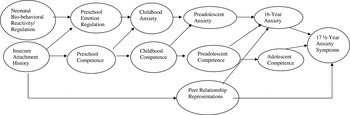
The Model 1 path analysis examining the prediction of anxiety symptoms across childhood, preadolescence, and adolescence.
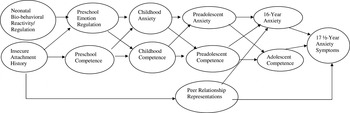
The Model 2 path analysis examining the prediction of anxiety symptoms across childhood, preadolescence, and adolescence.
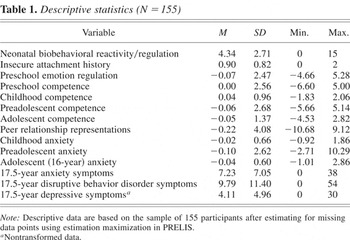
Descriptive statistics (N = 155)
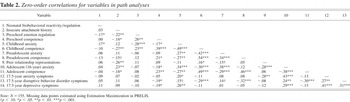
Zero-order correlations for variables in path analyses
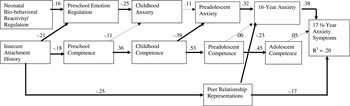
The results of the path analysis examining the prediction of anxiety symptoms across childhood, preadolescence, and adolescence. The heavy line paths are significant at p < .05.
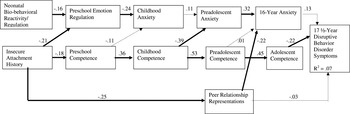
The results of the path analysis examining the prediction of disruptive behavior disorder symptoms at 17.5 years. The heavy line paths are significant at p < .05.
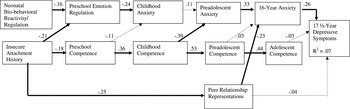
The results of the path analysis examining the prediction of depressive symptoms at 17.5 years. The heavy line paths are significant at p < .05.
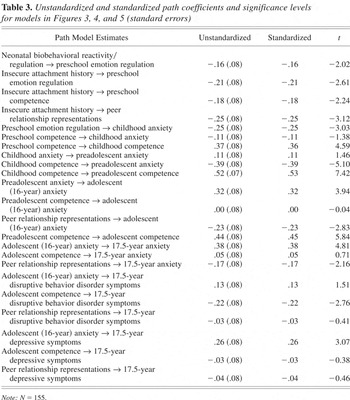
Unstandardized and standardized path coefficients and significance levels for models in Figures 3, 4, and 5 (standard errors)
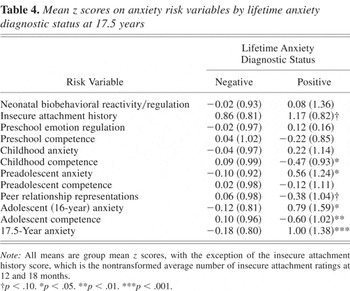
Mean z scores on anxiety risk variables by lifetime anxiety diagnostic status at 17.5 years
 You have
Access
- 208
- Cited by