From 1400 onwards, various political and economic developments had a profound impact on the shape and volume of trade and connections within the Indian Ocean basin.Footnote 1 Some of these developments, such as the role of silver, the rise in commercial activity, and changes in patterns of consumption, were Asian in origin, but were further transformed by the entry of Europeans into this commercial zone at the end of the fifteenth century. Initially, these merchants and missionaries were mostly Portuguese, but toward the end of the sixteenth century and during the early seventeenth century, other European states and mercantile institutions joined the Portuguese. One of the newcomers in the Indian Ocean world were Jesuit missionaries, who sailed aboard Portuguese and, eventually, other European ships. Even though Jesuit record-keeping is meticulous, it is still not clear how many missionaries died en route to Asia from the fifteenth to the eighteenth centuries. This article analyses the data from two databases: one of all missionaries travelling from Lisbon to Asia between 1541 and 1758, and one of all missionaries travelling from Europe to China between 1552 and 1800.Footnote 2 This data makes it possible to calculate precisely the human cost of the maritime and overland connections between the ends of the Eurasian continent. Based on this data, it becomes clear that dying en route was not the main reason missionaries failed to reach their desired end destination; the data demonstrates that more missionaries were redirected to places they did not originally intend to go. To explain why these missionaries were redirected, I use qualitative sources such as Jesuit and merchant travel accounts and Jesuit letters and annual reports. This second type of source can further help in analysing and interpreting the data, adding human detail—the drama of shipwrecks, pirates, and stories of miraculous survival—to the statistical and inanimate character of the raw data. I argue that the need to swear allegiance to multiple imperial patrons tested the unity and “international” character of the Jesuit network to the breaking point. This ultimately resulted in multiple, personalized networks that overlapped and could be co-opted, or, depending on the Jesuit’s national background, could find themselves in direct competition with each other and, consequently, obstruct passage between Europe and China.
Jesuit historiography focuses predominantly on the religious dimension of the people working for or in the Society of Jesus. This is not surprising since the Jesuits were a religious order and their ultimate goal was of a religious nature. However, the Jesuit religious network was also a material and financial network that operated on a global scale. The wealth of their missions not only generated myths among scholars and critics of the time, but it also inspired modern scholars such as Charles Boxer to playfully compare Jesuit economic activities to the Dutch and English East India Companies, at least with respect to their scope and international makeup.Footnote 3 As such, if only to debunk myths of perceived wealth or Jesuit iterations of their own poverty, it is necessary to study the financial and material conditions of these missionaries. Several Jesuit scholars have correctly recognized that one of the least studied aspects within the realm of Jesuit studies remains Jesuit financial operations.Footnote 4
The study of Jesuit networks contributes to the sub-field of Jesuit finances: the Jesuits continually sought new and safe routes between their missions and Rome, the institutional centre of their order. Once these routes were established or the necessary imperial or mercantile carriers of these networks were on board, Jesuits were keen to move missionaries, mail, and, eventually, material goods and money via these channels. The study of these Jesuit networks is significant for the larger field of early modern European networks: there were few places that no Jesuits ever crossed, and Jesuits pioneered or followed closely along what were, for Europeans at least, new maritime and overland passages. Depending on what political and economic understandings they reached with the Portuguese, Dutch, and other European and Asian states and individual actors, Jesuit networks became part of those existing networks.
As for the survival rate of missionaries travelling between Europe and Asia, one might argue that the missionaries themselves were the order’s most economically valuable resource. Managing the network and the missionaries whom it transported was one of the tasks of Jesuit procurators, the people responsible for Jesuit temporal affairs, which included the management of material resources, personnel, and finances. In the case of mission procurators or visitor-procurators, the Jesuit manager would travel back and forth between the mission and Rome to act as “part ambassador, part fund-raiser, and part recruiter.”Footnote 5 The Jesuit procurator cared particularly about the safety and reliability of networks and the passages between them. When it comes to maritime travel, this was one of three factors contributing to the financial cost of an individual missionary: training in Europe, transportation to a mission, and the costs associated with the missionary’s work in his mission. Every Jesuit went through rigorous training with the purpose of building a set of mental and linguistic tools. While demanding, this difficulty of training should not be exaggerated, as this could add to the stereotype that “a uniquely talented set of men . . . had been handpicked by their superiors in Europe to confront the challenges of China.”Footnote 6 The training did include instruction in maintaining the mission-residence, teaching skills, and some exposure to pastoral techniques used by fellow missionaries in Europe.Footnote 7 However, whether each missionary was a highly trained scientist, the order had invested time and money in his training before he ever set sail for his mission.
The price and method of maritime transport did not undergo significant change before the nineteenth century.Footnote 8 In theory, thanks to royal patronage (such as the Portuguese padroado), missionaries did not have to pay for their passage.Footnote 9 However, multiple archival references indicate that travel costs could still be significant. A French document in the Royal Belgian Archives calculates that roughly 1,400 livres were needed for two people to travel to India during the seventeenth century.Footnote 10 In 1702, the Italian Charles-Thomas Maillard de Tournon recorded a price of 9,915.60 pieces of eight for the passage to China.Footnote 11 Because of the costs, the dangers of maritime travel, and the additional difficulties associated with, for example, French Jesuits travelling to China aboard Portuguese ships, French Jesuits repeatedly argued that they should either travel aboard French ships or travel from France to China via the overland passage. Travel logs of the late seventeenth century, such as the one written by Philippe Avril (1654–1698), argued with passion that, even with perfect winds, overland travel was shorter and safer than a sea voyage circumnavigating Africa.Footnote 12 The overland passage was not necessarily cheaper: father Arnoldus Ryckewaert travelled overland to China in 1707–1708 and recorded 4,305.11 florins of expenditures.Footnote 13 It is difficult to precisely calculate who secured the cheapest transport in the three examples above, due to variables such as the metallic content of the coins, the changing value of the coins depending on the market and region they were used in, and the lack of details in how the total price for passage was calculated. It is safe, however, to state that travel, maritime or overland, was rarely cheap.
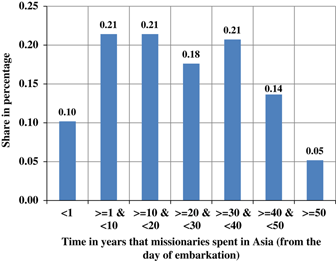
The costs of training and travel were still less than the costs of maintaining a missionary once he had reached his mission. Missionaries, on average, lived and worked twenty-two years in Asia.Footnote 14 The average annual cost for a missionary living in China in 1675 was 231 taels, which would mean that a missionary needed 5,110 taels to maintain himself in China.Footnote 15 The maximum costs were more than 15,000 taels for missionaries such as Martin Correa (1699–1786) or Niccolò Longobardo (1565–1655), who stayed about sixty years in Asia. From an economic point of view, keeping alive the human investment was of course the end goal of all costs incurred during training and transport.Footnote 16 So, relying on the data, travel logs, and additional Jesuit and non-Jesuit sources, where did the Jesuits lose most money and missionaries and why?
Time missionaries spent in Asia (based upon Dehergne’s data).

Data
Thanks to the significant secondary literature on the Jesuit missions, the data used in this article did not have to be compiled from the wealth of primary Jesuit sources in archives all over the world. Rather, it is based on an electronic processing of prosopographical and bibliographic works by Joseph Dehergne and Joseph Wicki.Footnote 17 The difference between Dehergne’s and Wicki’s data is one of scope: Dehergne provides biographies of missionaries sent from Europe to China between 1552 and 1800, whereas Wicki lists all missionaries sent to Asia from 1541 to 1758.Footnote 18 Wicki only catalogues missionaries who embarked in Lisbon aboard Portuguese ships, whereas Dehergne includes missionaries who sailed from France, or who travelled overland via the expanding Muscovite empire or the Middle East. Dehergne’s and Wicki’s lists result in 843 and 2,192 data entries or passages, respectively, between Europe and Asia. In Wicki’s case, I have included entries of missionaries who travelled multiple times between Lisbon and Asia. Wicki himself did not include these people but rather made a reference to their first entry and then noted their second voyage with a number followed by a letter. For example, Nicolas Trigault was missionary number 531, who embarked with ten other Jesuits from Lisbon on 5 February 1607.Footnote 19 Eleven years later, when Trigault embarked once more from Lisbon, Wicki lists him as number 645a. Wicki does not give a second number for Trigault; he simply inserts him between number 645 (brother Manuel de Figueiredo) and number 646 (father Francisco Furtado). In my database, Trigault has two entries, numbers 542 and 659, because I am interested in the absolute number of successful passages from Europe to Asia. Trigault is of particular interest since the second time he travelled between Europe and China, he acted as a mission procurator or visitor-procurator (although he was not officially recognized as such by certain China missionaries). More so than most other Jesuits, Trigault was invested in transporting as many new missionaries as possible from Europe to China after he recruited them all over Europe. Trigault’s mission (1618) was not a success: he was ordered to bring fifty new Jesuits to the China mission, but only received permission to embark with twenty-two in Lisbon. Of these, only eight reached China. Some died just before reaching the Cape of Good Hope, for example Quentin Cousin on June 3 (1582-1618), Humbert Saint-Laurent on June 8 (1588-1618), and Jean de Celle on June 13 (1578-1618). Others died at unspecified places at sea, such as Johann Alberich (1586-1618). Trigault watched his older brother die six months after embarking, and he himself committed suicide in 1628, a death covered up by the Society.Footnote 20 Relying solely on the statistical information does not do justice to the drama of Trigault’s life and mission, which is why this article hopes to contextualize the particularities of the voyages.
Data from Wicki makes for a list of over 2,000 voyages. Dehergne only catalogues 920 missionaries, even though he, just like Wicki, includes extra numbers, marking them similarly to Wicki (30a, 278a, 278b, 278c, and so on.).Footnote 21 Dehergne states that he enters these missionaries with this type of notation because he could not always identify them, and it adds an extra 69 entries to the original 920.Footnote 22 In categorizing Dehergne’s data some people were excluded, such as those labelled macaïste, Jesuit brothers or fathers born in Macau of either Japanese (or Asian?) or Portuguese descent.Footnote 23 As these missionaries rarely travelled between Asia and Europe, they were excluded from my database. In contrast to Nicolas Standaert’s earlier statistical work using Dehergne’s data, this article includes Jesuits who died on their way to China (fifty-seven entries), Jesuits who travelled to China before 1580 but who did not work in mainland China (twenty-one entries), Jesuits destined for China but redirected somewhere along the way, and Jesuits who travelled to and worked in Macau or “in neighboring missions, though structurally they belonged to the China mission.”Footnote 24 Using this data, it is easy to compute when and how many missionaries were sent to which places, as illustrated in the tables below.
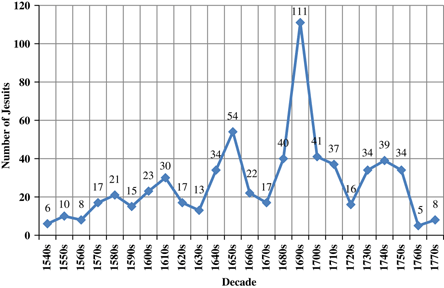
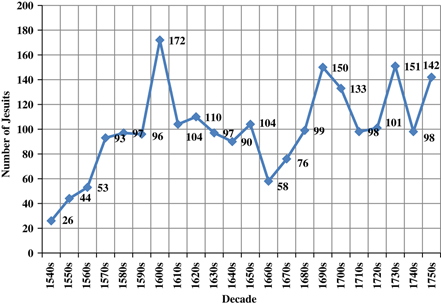
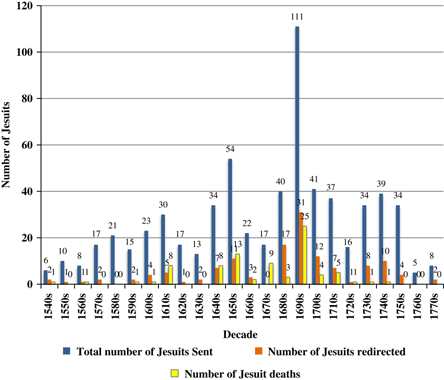
Tables 2 and 3 illustrate the mercurial character of missionaries sent to both China and Asia during the period of the 1540s until the 1760s. Table 3, with data from Wicki, is more precise with respect to time—numbers are given for every decade—because Wicki lists over 2,000 voyages, whereas Dehergne’s information yields fewer than 900 entries. There is only one obvious overlap in the fluctuating number of missionaries sent, and that is the peak towards the end of the seventeenth century. During the 1690s, 111 Jesuits were sent to China; this peak is also the only time that missionaries sent to China were a majority of missionaries sent to all of Asia. It is interesting that this peak in the 1690s was not caused by groups of procurator-accompanied missionaries, which was the case for the smaller peak in the 1650s (table 2), when Jesuit procurators Michał Boym and Martino Martini sought to bring new recruits to China. Procurator missions do not always explain peaks in missionaries sent to China. Prospero Intorcetta’s efforts in the 1670s did not reverse a downward spiral, but rather represented a low point. Similarly, the 1690s peak was not the result of procurator missions, but the result of the combined efforts of the Portuguese and French kings increasing their patronage of the Society of Jesus and sending several large groups of missionaries as religious and political envoys. Standaert calls this the “Golden Period of 1692–1706.” It was Ferdinand Verbiest’s letter to send more Jesuits to China (delivered by procurator Philippe Couplet to the French king) that resulted “especially [in] . . . opening up . . . the mission to more French Jesuits.”Footnote 26 During that decade, France did send thirty-two missionaries (twenty-nine of them on French ships or overland), but Portugal was equally committed and sent forty-three missionaries. Verbiest’s plea spurred on more than just Louis XIV. Based on these numbers, Portugal’s Asian network, while suffering tremendously from the mid-seventeenth century onwards, maintained its ability to send missionaries to China and, in this sense, did remarkably well during the eighteenth century.
Number of Jesuits sent to China (based upon Dehergne’s data).

Number of Jesuits sent to Asia (based upon Wicki’s data).Footnote 25

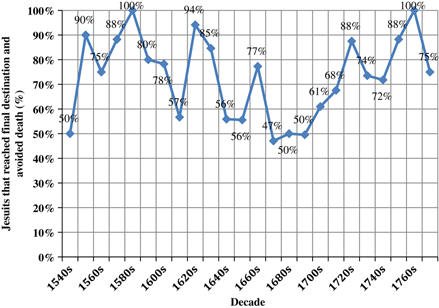
Not all 111 missionaries sent in the 1690s survived the passage. Table 4 below provides the percentage of those sent around the 1680s and 1690s who reached China: exactly 50 percent. In view of the total number of missionaries, this is a very low percentage. In the 1540s, only half the Jesuits sent to China made it as well, but only six missionaries were sent in total. The impact on the China missions of two redirected missionaries and one death were much less than those in the 1690s. Additionally, the survival and non-redirection rates during the decades that large groups of missionaries accompanied by procurators travelled more often than not overlapped with periods in which few missionaries reaching China. Trigault brought eight of twenty-two missionaries (36 percent) back to China in 1618, Boym landed with three out of eight missionaries (38 percent) in 1656, Martini managed to deliver five out of seventeen (29 percent) in 1657, Intorcetta was able to transport only one out of twelve (8 percent) in 1673, and, finally, Couplet only four out of fifteen (26 percent) in 1692. In the case of Prospero Intorcetta, all but one missionary died in April while crossing the equator.Footnote 27 Apart from random bad luck, the only way to make sense of these percentages is that Jesuit superiors or colonial administrators in places along the way to China were more likely to recruit for themselves members of large groups of missionaries destined for China than they would from smaller groups or individual Jesuits. Based on these numbers, on average, in the seventeenth century, 27 percent of Jesuits brought to China by procurators ended up living and working there.Footnote 28 To what extent does the data on all Jesuit voyages from the databases confirm this picture? How many missionaries died? Where and in what ways?
Percentage of Jesuits who reached China.

Survival Rates
Historians of the Jesuit mission in Asia and Jesuit procurators themselves have wanted to know how many missionaries died en route. This may seem like a straightforward question, but there is no simple answer. Based on his own statistical research, Nicolas Standaert maintains that “it is difficult to know how many Jesuits died . . . but their number seems to have been quite considerable.”Footnote 29 In line with Standaert’s numbers (which are provided by two other Jesuit historians, Louis Reference PfisterPfister, S.J., and Felix A. Plattner), Liam Brockey estimates that close to half of all the Jesuits who sailed were lost at sea.Footnote 30 Both Brockey’s and Standaert’s work are part of more recent secondary literature investigating the precise human costs of early modern sea voyages; studies by Jesuits in the late seventeenth and eighteenth centuries suggested even lower survival rates.
The first estimate was based on the combined efforts of Philippe Couplet—the Jesuit procurator travelling between China and Europe—and Philippe Avril—the French Jesuit who sought to travel to China using an overland passage. Both Philippes died on sea voyages in Asia; one crushed by displaced luggage, the other in a shipwreck close to his destination. Before their dramatic deaths in 1693 and 1698, respectively, the two had met in Europe—most likely at court in Paris—and in his 1692 work entitled Divers voyages en divers Etats d’Europe et d’Asie, Avril claimed that Couplet had put the survival rate of Jesuit fathers at 105 of the 600 sent thus far.Footnote 31 A marginal note to Avril’s main text repeated that nearly 500 Jesuits perished on their way to China. If Avril had directly copied this number from Couplet’s reports in 1684, then the first survival rate from primary sources is 17.5 percent. It is curious that Couplet could not narrow this estimate, especially since he was a seasoned traveller and procurator, who had built “a catalogue with a curriculum vitae of each of the Society’s priests who worked in China during the century after 1581.”Footnote 32 Upon examination of this catalogue, it becomes clear that Couplet’s work was developed to support requests for European private patrons, heads of state, and the Jesuit Father General to send more missionaries and money to the missions in China. While it listed each missionary’s name, country of origin, date admitted into the Society, a short biography, and works published, Couplet’s catalogue did not differentiate between Jesuits who survived the passage and those who did not.Footnote 33 Despite Couplet’s specialist knowledge as bibliographer and procurator, or human resource manager, his catalogue’s aim was not to calculate survival rates but to bolster the case for sending more resources of all kinds to China. About a hundred years later, in 1789, George Pray (1723–1801) put forward his own estimate in one of his works on Jesuit history: out of 249 Jesuits sent, 122 (49 percent) survived.Footnote 34
My research reveals much higher survival rates in contrast to all these estimates. Without adjustments or corrections by cross-examining Dehergne’s and Wicki’s data, the survival rate for missionaries was as high as 92 percent (or 1,849 Jesuits out of 1,993) according to Wicki. Even after adjusting this rate with more precise biographical information from Dehergne, Wicki’s survival rate remains strangely high, 91 percent. This is mostly because Wicki does not consistently record which Jesuits died during the passage, but rather which Jesuits left Lisbon. The adjustments based upon Dehergne’s data (forty-four Jesuits died in Dehergne’s data, but “survived” in Wicki’s list) may give the impression that all of them died after reaching the first stop in Asia, India. However, this is not the case. Wicki’s list is simply not adequate to calculate a survival rate, because his data is not intended to answer this question. As Dehergne points out, using catalogues made by European Jesuit clerks is part of the problem: Jesuit provincials operated sometimes according to the principle of “out of mind, out of heart.”Footnote 35 European Jesuit bookkeepers would make note of these coveted human resources leaving for far off missions, and then lose interest; or if they did not, they were unable to find out whether missionaries survived the passage. Keeping Couplet’s catalogue in mind, Chinese primary sources and catalogues are sometimes equally hard to use. Even the best lists were still full of inaccuracies and omissions.Footnote 36 Dehergne cross-examined primary sources, catalogues, and secondary lists, so his data is the best tool for calculating the most accurate survival rates for Jesuits sent from Europe all the way to China.
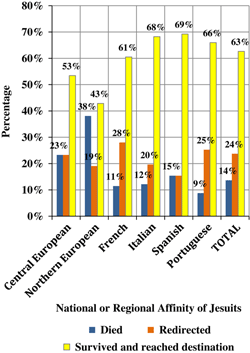
Based upon Dehergne’s data, which updates biographical and bibliographical information from information provided by Couplet, Pray, Reference PfisterPfister, Wicki, and many others, the survival rate for Jesuits travelling between Europe and China stands at 86 percent. While this is the most accurate estimate, this percentage still seems remarkably high compared to any of the earlier appraisals. This article argues that this number is correct, if one makes the distinction between Jesuits dying on their way to China and Jesuits who never reached China because they ended up working elsewhere or were redirected by force or their own desire. This number of redirected Jesuits was even higher than the number of Jesuits who died while travelling between continents: 167 missionaries out of 704, or 24 percent, survived the passage but wound up living and working in places different from their intended destination. Combined with the Jesuits who died en route, this brings the rate of Jesuits reaching China down to 62 percent, or 441 out of 704.
Survival and Redirection
Surviving the maritime and overland passage—a fair number of missionaries travelled both on ships and by foot, depending on the timing, political context, and availability of ships—was the second most important factor cutting into each group of travellers. When examining the circumstances and places of each missionary’s demise, a certain pattern emerges explaining the where and how of casualties en route. The data in this article confirms Plattner’s identification of four places where missionaries were more likely to meet an untimely end.Footnote 37 The first dangerous region was in the Atlantic Ocean from north of the equator to the Cape of Good Hope. In this “region of death”, temperatures reached a maximum, ships entered a zone of calm winds, which in turn caused a great deal of fever and disease among the crew. The Portuguese changed their route to Asia in an effort to avoid the West African coastline by sailing closer to the Brazilian coast and picking up cross-Atlantic winds, yet even there, Jesuits, such as Adam Weidenfeld, would die of disease. The deadliness of the equatorial climate aside, Jesuit travel accounts report on a heightened nervousness in the northern Atlantic as well. Plattner describes how Portuguese ships “sailed in close formation as far as the Azores,” while the journal of the first French embassy to China in 1698 (with many Jesuits aboard) demonstrates that in certain spots in the southern Atlantic Ocean the same anxiety existed depending on inter-European competition at that time.
To navigate the Atlantic Ocean and, more importantly, to arrive at the right time on the edge of the Indian Ocean determined the date of departure in Lisbon. Ideally, ships would leave in “the second half of March until the first ten days of April.”Footnote 38 Leaving within this period ensured entrance into the monsoon system somewhere between the months of May and July. According to Ernst Van Veen, July 20 was the cut-off date for using the Mozambique channel to arrive safely in Goa. April storms along the Portuguese coast also decided when exactly to leave Lisbon. Plattner states that “the traditional day for departure of the Indian fleet was March 25th, the Feast of Annunciation.”Footnote 39 Thanks to Wicki’s data, which includes the precise date of embarkation, the day on which most Jesuits left on India bound ships was 4 April. Despite its importance in the Christian calendar, 25 March was only the third most likely day on which missionaries embarked for the East. Corsairs and competing European states also knew the ideal time of departure, which meant that depending on the political situation and likelihood of conflict, it paid not to embark at a predictable time, or, at least, to weigh the dangers of disease and meeting contrary winds versus the likelihood of attacks by corsairs and pirates.
Entering the Indian Ocean basin with its monsoon system was, according to Plattner, the second “death trap.” Both maritime historians such as Felipe Fernández-Armesto and Jesuit travellers such as Nicolas Trigault have commented on the huge difficulties entering the monsoon system, and both refer to the entire region of the Mozambique Channel and the seas south of Madagascar as a notorious “seaman’s grave.”Footnote 40 Trigault reported that there were two ways through this region: following the African coast and sailing around the island of Madagascar.Footnote 41 The first route was conceived by some as the more dangerous, because it included rocks, named bairos de India, on which many experienced pilots had perished.Footnote 42 The second possibility, on the other hand, passed a group of rocky islands named Isles d’Angoisse, “Islands of Anxiety.”Footnote 43 Neither way was appealing and travellers had to choose between Scylla and Charybdis. On his own particular voyage through this area, Trigault reported how the wind changed thirty-seven times during one night. Trigault, just like other procurators who travelled back and forth between Asia and Europe, also knew that reversing the route (from India to Europe) did not change the severity of the storms, and that, once again, it was critical to arrive at the right time in this region. It was not unusual for ships to winter in South Africa or Mozambique if they missed the southwest monsoon. While this may sound like a respite from the deadly oceans, places like Mozambique were far from healthy. The risk of disease made it such that “even more people died in this ‘Portuguese cemetery’ than on the ships themselves.” Jean-Simon Bayard (1662–1725) called Mozambique “the most pestilent place in the whole world.”Footnote 44
If travellers survived the first two deadly regions, chances were high that the severity of the deprivations they experienced during this period left them vulnerable to disease as they arrived in Goa, which was for the majority of the European fathers the first place in Asia where they lived for a long period of time, if they did not die upon arrival, as many did despite the Jesuits’ hospital and other amenities for healing in the city. Statistics make clear that travel-induced weakness and death contributed to the fate of the fifty-nine people who died within their first year in Asia. Finally, the last section of the voyage from India to China, took “between sixty and eighty days under normal sailing conditions.”Footnote 45 However, the data shows a remarkably high number of shipwrecks, most of which occurred in the South China Sea. Besides typhoon-induced shipwrecks and natural dangers, the barriers upheld by the Dutch colonial empire could also stop missionaries in their tracks: Gil d’Abreu, for example, died in Batavia after spending one year and a half in Dutch prison. Peering carefully at Dehergne’s data, sickness was seemingly less of an issue in this last region.
However, what remained an issue in this region, and as in all the others, was the travellers reliance on wind. Take for example the case of Pieter Thomas Van Hamme, who travelled on Spanish ships to Mexico, walked from Vera Cruz across Mexico towards the Pacific ocean, when he found out that he was readmitted to travel to China. He then sailed across the Pacific from Acapulco to Manila in the late 1680s. Van Hamme was lucky to arrive in Acapulco on 28 March 1689. One day later and he would have had to wait a whole year for the next fleet to Manila. From Acapulco, the ship that took him and eight other fathers sailed over 6,000 nautical miles to the Marianos Islands in sixty-seven days.Footnote 46 They completed their crossing of the Pacific in three months and six days, arriving in Cavite (two miles from Manila) on 6 July. Here, Van Hamme’s luck ran out: the roughly 600-mile crossing from Manila to Macau aboard a Chinese ship should have taken twelve to fifteen days, but took them seventy-six days due to adverse winds. While it took Van Hamme five and a half years to travel from Belgium to China, it was the unexpected delays and contrary winds that dictated the different speeds of travel during his voyage across the early modern world.
Redirection: The Most Important Factor in (Dis-)Connecting Jesuits
There was one factor even more important than shipwrecks and tropical diseases in preventing missionaries from reaching the destination of their choice: redirection.
As the earlier data indicated, Jesuits destined for China had close to a 10 percent greater chance of being redirected away from their intended destination than of dying during the sea voyage (24 percent versus 14 percent). Table 5 shows the peak of missionary departures during the 1690s, consistent with tables 2 and 3, but it is also consistent in the sense that at no time from the 1540s until the 1770s were more Jesuits redirected than during this decade (thirty-one in total). Whereas many Jesuit publications or travel journals mention the human and natural dangers of journeying across oceans and continents, few make reference to the fact that nearly one in four who applied and was given permission to work as a Jesuit missionary in China was redirected either by his own will or forcibly. One reason for not mentioning this systemic occurrence was that it could be interpreted as a critique of specific national groups within an international organization. During the 1690s, when redirection reached a peak (which had been building during the 1680s as well), travel accounts of missionaries such as Philippe Avril and Pieter Thomas Van Hamme, and reports of French Jesuit procurators such as Antoine Verjus, start complaining about the difficulties that certain Jesuits had in using certain parts of the global Jesuit network. Avril was the most dramatic victim of redirection: his three attempts to reach China spanned over a decade, and he was denied access twice in India and Moscow, before dying aboard an English ship off the coast of Taiwan. Avril had stuck to his argument that overland travel was a safer and faster alternative to sea voyages, but he emphasized repeatedly that the Muscovite empire needed to recognize his passport and papers provided by various European rulers.Footnote 47 Van Hamme’s biographer similarly discussed at length the various oaths and clashes of loyalties behind them that prevented Van Hamme from travelling to China with Couplet, as he had initially been permitted to do.Footnote 48 Van Hamme was required to take an oath to the Portuguese king, but he was at the same time reminded that it would offend the cardinals and Pope in Rome. An earlier example sought to make the point that one Jesuit could not swear an oath to both the French and the Portuguese kings, and that a passport issued by one was not necessarily recognized by the other. However, in Van Hamme’s case, there was a conflict between the church authorities and the Portuguese king as well. It is telling that the need to swear an oath went back to 1680, as more European states took an interest in Asia, in particular France’s Louis XIV, who would send Jesuits to the Kangxi emperor directly in 1685.Footnote 49 The clash between the Portuguese and French rulers would play out within the Society of Jesus as well. Indeed, the conflict between French and Portuguese Jesuits was so intense in the China missions that the Jesuit General Tyrso Gonzalez de Santalla (1624–1705) decided to divide the China mission into separate Portuguese and French missions in 1700. The decade before that, French procurator Antoine Verjus, who had been in contact with Philippe Couplet and Philippe Avril, argued that the reliability of the French network to Asia stood in sharp contrast to the declining network sponsored by the Portuguese king.Footnote 50 In addition to that, Verjus stated that Jesuits with a French background or national affinity did not enjoy the same protection from the Portuguese state as Portuguese Jesuits.Footnote 51 Verjus was upset about the dropped connections in the Portuguese network in Asia, and wanted to convince others that, since the Portuguese state could perhaps no longer reverse this decline, France should assume the role of “promoting the Catholic banner in the East” from Portugal.Footnote 52 He further claimed that the French fathers suffered more from the dilapidating state of the Portuguese network than the Portuguese fathers. Verjus feared that this nationalistic divide was going unnoticed by Jesuit superiors in Rome because they were only informed by Portuguese Jesuits and because the Portuguese Jesuits and administrators in control of the Portuguese maritime network would read and intercept letters complaining about this issue. Thus, he wrote his letters in code.Footnote 53 While Verjus may have had a personal vendetta against certain Portuguese Jesuits, the rivalry between the two groups was real, and it is confirmed by the data showing which Jesuits were more likely to be redirected.
Number of Jesuits sent to China, number of Jesuits redirected, and Jesuit deaths (on their way to China).

Table 6 confirms Verjus’s complaints: no other group of Jesuits had a higher redirection rate than the French. The difference with the next group, Portuguese, is only three percent, so relying solely on the data may give the impression that this was not a significant difference. However, when one examines reports, letters, and travel accounts of French Jesuits, and if one studies which French Jesuits were redirected where and when, it becomes clear that the data confirms the French-Portuguese conflict when it comes to Eurasian networks used by Jesuits. French Jesuits were more likely to be redirected during the period that the competition between France and Portugal peaked. Twenty-three out of twenty-six Jesuit attempts to establish an overland alternative to the sea route took place during this same period.Footnote 54 French Jesuits, while only representing 19.5 percent of all Jesuits sent from Europe to China, were responsible for nearly half—eleven of those twenty-three—expeditions. Avril was one of them, as were Patrice Comilh (1686), Antoine de Beauvollier (1688), Claude de Bèze (1691), Jean de Ressin (1692), Louis Archambaud (1693), and François-Albert de Soüastre (1694). All were turned back by either the Portuguese in Goa, the Dutch in Siam, or the Muscovites.
Survival, death, and redirection rates of Jesuits sent to China, according to groups of national affinity.

Meanwhile, not all redirections were forced ones, as the high rate of Portuguese Jesuits’ redirections attests. As Portuguese Jesuits travelled through the nodes of the Portuguese maritime network, their supervisors in Goa or Macau would often ask them to take up a mission in places other than China. These requests must not have been perceived as a forced redirection, which could explain the lack of a paper trail of complaints about ending up in a region where one did not intend to remain. This was not the case for other Jesuits. As shown by table 6, the Spanish Jesuits, for example, have the lowest redirection rate. The Spanish presence in China was, however, very discreet: Jean-Pierre Duteil asserts that after the union of the Portuguese and Spanish kingdoms (1580–1640), Spanish Jesuits “did not account for even 5% of the total.”Footnote 55 Dehergne’s data suggests that it was even less (3.7 percent). As for redirection, more than a few Spanish Jesuits circumvented the Portuguese network by travelling to China via the Americas and the Philippines. Duteil states that twenty out of the twenty-eight missionaries who reached China via the Americas were Spanish, which is not surprising given a completely Spanish trans-Atlantic and trans-Pacific logistical network.Footnote 56 An example was Francisco Gayoso, who arrived in Manila in 1676 and entered China via Amoy in 1678. He worked in Shanxi for five years, and then returned to Manila in 1686.Footnote 57 Not all were successful: Spanish brother coadjutor Gonzalo de Velmonte and Spanish father Leandro Phelippe tried for eight years to enter China via Macau. Eventually they gave up and went back to Peru. The peak in the attempts to reach China via the Americas suggests that the inter-European competition during the end of seventeenth century took its toll on the connectivity of the Jesuits’ Eurasian network. At the same time, non-Portuguese Jesuits understood that the increasing pressure on the Portuguese network limited the likelihood of travelling quickly and without interruption from Lisbon to Goa and on to Macau. Manila became a viable alternative, and it was both a place of refuge and contestation for different groups of Jesuits.Footnote 58
Initially, at the time Francis Xavier travelled to Asia in 1541, fathers of the Jesuit enterprise were tied solely to the Portuguese patronage or padroado, since the Portuguese were the only ones sailing to Asia. As more and more European states pushed for trade and political connections to Asia during the seventeenth century, the close connection between the Portuguese network and the Society of Jesus decreased in importance. Tensions increased sharply when in 1685 the first French missionaries embarked on a diplomatic and religious mission to the Chinese emperor. Missionaries, depending on their national background, investigated alternatives to transport via the Portuguese network or Estado da Índia. The Acapulco–Manila route and overland passage via the Muscovite Empire were two of those alternatives. However, there were more networks that could be used. The Italian priest Giovanni Donato Mezzafalce (1661–1720), for example, wrote a report on four networks that he, as an Italian, found most functional in 1700.Footnote 59 As Mezzafalce set up a mission in southern China, he commented on how it was impossible to ship wine for Mass from Rome every year; it was much easier to buy it from the Spanish missions in the Philippines.Footnote 60 Other instruments for Mass as well as books, images, and European curiosities he acquired via the French network. The downside of using the French was the long time they took to deliver. The best connection to nurture, however, was one via England, and Mezzafalce emphasized that there was no substitute for having a correspondent in England through which one could send letters every October and January. The French network was second best during the 1690s and 1700s, while the Spanish were third. The fourth channel of preference was the Dutch network.
Jesuit procurators also sought to develop some relationship of trust with the Dutch, however paradoxical that may sound. Of all the European state-sponsored networks, the Dutch had without a doubt the most destructive impact on the Portuguese maritime empire during the seventeenth century. Since the Jesuits routinely travelled aboard Portuguese ships and had established missions and institutional centres in Portuguese port cities, they suffered each time the Dutch attacked one of these nodes. Jesuit fathers dragged several cannons up the hill behind their college in defence of Macau during a Dutch attack in 1622. One of father Giacomo Rho’s calculated shots hit a Dutch powder keg and may have been partially responsible for turning the odds. The Jesuits were not so fortunate when Malacca fell to the Dutch in 1640; the loss of Malacca endangered the connection between Goa and Macau, so that groups of missionaries accompanied by Jesuit procurators in the 1650s walked across Thailand to avoid the Dutch, who controlled the Strait of Malacca.Footnote 61 One of these missionaries was Philippe Couplet. This was not the first time Couplet walked across large stretches of land to avoid the Dutch; when he arrived from Lisbon in November 1656, his voyage to China was interrupted by a Dutch blockade of Goa for a whole year. Rather than waiting for the Dutch fleet to break its hold on the city, Couplet walked across southern India, and was cordially received by the Dutch in Ceylon as he sought a way across the Bay of Bengal!Footnote 62
After these initial negative experiences with the Dutch network, Couplet became arguably the Jesuit missionary closest to the Dutch during the next thirty years. John Wills describes him as “the most active Jesuit in seeking contact with the Dutch.”Footnote 63 Couplet repeatedly offered his services to the Dutch, asked Dutch East India Company (VOC) officials for their help in sending packages of letters to Europe, and consistently referred to himself as a Dutchman in his letters to them (he had been born in the Spanish Netherlands).Footnote 64 Couplet also shared information on the commercial efforts of the English in Macau with the Dutch, and would not hesitate to call on them when other Jesuit procurators such as Prospero Intorcetta could use Dutch hospitality in Malacca on their journey to Europe.Footnote 65 Eventually, when he himself travelled from China to Europe as a procurator, Couplet was able to use the Dutch network “in Macau, in Batavia, and all the way to Amsterdam.”Footnote 66 Couplet was not the first: even in the 1650s, Martino Martini, another Jesuit procurator, travelled from China to Europe on Dutch ships.Footnote 67 Verjus, the French Jesuit procurator operating from Paris, similarly acknowledged that the letters sent via the Dutch (and English) networks arrived earlier than those sent via any other network.Footnote 68 It is interesting to note that thanks most likely to the good contacts with Jesuit informers, the Dutch were well aware of the French-Portuguese Jesuit rivalry in China. Dutch reports correctly analysed that after the death of Ferdinand Verbiest and with the arrival of large groups of French Jesuits, the order’s internal disputes were coming to a climax.Footnote 69
The Result of Multiple Jesuit Networks and the Diversity of the Late Seventeenth Century
What was the result of all these interacting networks? To what extent did cooperation and conflict between these networks benefit the overall connectivity of the Jesuit network? The data suggest that the end result was negative; overall, the absolute number of Jesuits redirected was never as high as it was during the 1680s and 1690s. Despite Avril’s travel account on his diverse voyages throughout Asia with all its embedded propaganda in favour of the overland passage, the Muscovite empire would not officially allow access to Jesuits until all other European states had dissolved the Society of Jesus. Despite Couplet’s personalized network with the Dutch and other Jesuit procurators’ close relationships and free passages aboard Dutch ships, the networks of these Protestant merchants and Roman Catholic missionaries would not systematically become more integrated. The competition between French and Portuguese Jesuits and the availability of more than one network and royal sponsor did not improve Jesuits’ chances of avoiding death at sea or redirection away from their desired missions in China. Being redirected remained the most important factor for not reaching China; the data confirms Anthony Disney’s case study of the fates of forty-one Jesuits leaving Lisbon for Asia in 1629.Footnote 70 When it came to redirection, Jesuit personal accounts “all suggest that in the eyes of the missionaries themselves their greatest difficulty was not the hardships of the voyage, which they were prepared to endure with Christian fortitude, but the crippling burden of the extra work they were so reluctantly obliged to shoulder.”Footnote 71 Whereas Disney’s article focused on the extra work aboard the ships, this article has argued that the extra missionary work throughout the Portuguese missions in Asia might have been an even more significant factor cutting into each group of Jesuits travelling to the furthest missions in Asia. Superiors along the way would urge Jesuits to help out with their under-staffed missions, and this type of pressure resulted in delays of months and years, or indefinite stays, before reaching China, if they ever did. This particular reason for redirection also blurred the line between forced and voluntary redirection: perhaps Portuguese missionaries simply did not complain about this practice. They may have been much younger and as such less determined about working specifically and only in China, or they saw it as their duty as missionaries and Portuguese subjects to serve in any of Portugal’s Asian missions.
Suffice it to say, there were different opinions within the Jesuit order about these choices: different groups of Jesuits approached the challenge of balancing their relationships with competing networks and competing loyalties to royal patrons in the interest of successfully completing their missions. After 1685, the French Jesuits no longer accepted the exclusive connection between the Jesuit network and the Portuguese government. They established their own exclusive network with the French government, which resulted in a union that faded away within three decades. Missionaries who were not directly invested in the Portuguese-French competition, such as Italian fathers, wrote on the pros and cons of using English, Dutch, Spanish, Danish, and even Turkish ships and networks between Europe and Asia. Though the characterization of the Society of Jesus as a single organism had no basis even before the arrival of the French Jesuits in China, this article has argued that the late seventeenth century ushered in an era of competing jurisdictions and loyalties to state networks within the Society of Jesus that further fragmented the overall structure of an organization struggling to link Europe and Asia.Footnote 72
The aftermath of the turbulent 1690s and the availability of so many networks to the Jesuits—some of them personalized, dependent on region, or with a limited time span—left an imprint on the “international” character of the missionaries working in China. Even though Jesuits themselves celebrated the international disposition of their Society and urged members to abandon whatever national affinity they had when they entered the Jesuit organization, the same diversity could clearly cause severe fragmentation and conflict. The data allows us to calculate and track changes in this national diversity when it comes to Jesuit missionaries sent to China. It is possible to count the number of Portuguese, French, Italian, Spanish, German, and other Jesuits by year or decade. Portugal sent 286 Jesuits, or 44 percent of the total, to China; its ships continually sent large groups of Jesuits, with two peaks during the 1690s (43) and the 1740s and 1750s (26 and 27, respectively). France sent 127 Jesuits (19.5 percent) but, apart from its peak during the end of the seventeenth century established by “political will,” its presence and support petered out during the eighteenth century.Footnote 73 Italy sent 102 missionaries (15.7 percent), and while it started with a “brilliant debut,” its presence also declined significantly after the 1710s.Footnote 74 Missionaries from Spain, Ireland, England, the Netherlands, Belgium, Germany, Poland, Lithuania, South Tirol, and Switzerland can be added to these three main groups.
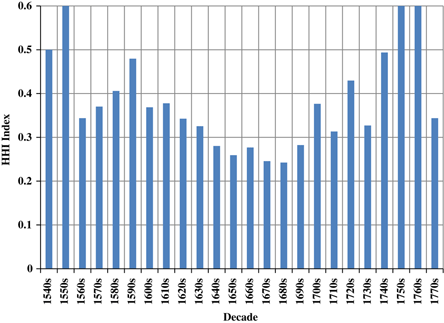
The changes and diversity in percentage rate of different national or regional groups is quite hard to represent graphically. One way of doing so may be using the Herfindahl-Hirschman Index (HHI), which calculates the percentage of the market share of each firm or competitor, or in this case, each Jesuit’s region or state of origin. Prior to adding all market shares (which would amount to 100 percent) the values are squared, which gives additional weight to groups with a larger market share. The sum of these numbers adds up to a range from 0 to 1. A lower number indicates a greater diversity in which a lot of small firms share the market (for example 0.12). A higher number, for example 0.76, is a sign of the presence of a single monopolistic producer (or provider of Jesuits). As illustrated by table 7 (below), the overall diversity of Jesuits sent was highest from the 1640s to the 1690s, when it dropped below 0.3. Before the 1640s the diversity was less, similar to the eighteenth century (except during the 1710s and 1730s). The difference between these two periods is that fewer missionaries were sent prior the 1640s. This data confirms that, overall, the diversity or international character of the Jesuits sent to China declined after a period of many nationalities, travelling mainly aboard Portuguese ships, and many Jesuit networks during the mid to late seventeenth century. The lack of diversity was one final long-term consequence of the 1690s, a period of intense nationalistic rivalry within the Society of Jesus, fractured Jesuit networks, and frustrated missionaries working in places they had never intended to go.
Herfindahl-Hirschman Index (HHI), illustrating the changes in diversity of European regions sending Jesuits to China