1. Introduction
Late Cretaceous marine amniote fossils are generally scarce in Germany. The majority of finds derive from Campanian strata, including those in the Münsterland (Caldwell & Diedrich, Reference Caldwell, Diedrich, Schulp and Jagt2005; Sachs, Hornung & Reich, Reference Sachs, Hornung and Reich2015) and near Hannover (Sachs, Reference Sachs2011; Frerichs & Hornung, Reference Frerichs, Hornung and Schneider2013), as well as from Lägerdorf (Hornung & Reich, Reference Hornung and Reich2015; Sachs, Hornung & Reich, Reference Sachs, Hornung and Reich2015) in NW and northern Germany, respectively. In contrast, comparable remains are virtually unknown in eastern Germany, with only a few mosasaurid specimens from the Maastrichtian deposits of the Isle of Rügen in Mecklenburg-Vorpommern (Lips & Ladwig, Reference Lips and Ladwig2014; Sachs, Hornung & Reich, Reference Sachs, Hornung and Reich2015) and the Campanian strata of Blankenburg in Saxony-Anhalt (Sachs, Reference Sachs2006). Substantially older earliest Late Cretaceous marine amniote material has otherwise been recorded from Cenomanian–Turonian sequences in the Saxonian Cretaceous Basin (SCB) of SE Germany. These historical discoveries date back to the nineteenth century, and were reported in a series of landmark papers by Professor Hanns Bruno Geinitz (1814–1900), the then director (1857–1894) of the Royal Mineralogical and Geological Museum in Dresden (now the Senckenberg Naturhistorische Sammlungen Dresden). Geinitz (Reference Geinitz1847) initially described a turtle humerus from Strehlen (Dresden-Strehlen), and later (Geinitz, Reference Geinitz1849) listed several ‘saurian’ teeth from the same locality. However, his cumulative essay (Geinitz, 1871–1875) was published as a twin volume monograph ‘Das Elbthalgebirge’, synthesizing the Cretaceous palaeontology of Saxony. This work was divided into separate treatises on fossils from the ‘untere Quader’ or Cenomanian (Geinitz 1871–1875), versus ‘mittlere und obere Quader’ or Turonian (Geinitz, Reference Geinitz1872–1875) strata respectively, incorporating individual chapters devoted to specific taxonomic groups. The release dates for these subsections corresponded to their illustrative plates (Niebuhr, Reference Niebuhr, Niebuhr and Wilmsen2014), meaning that the formally established species nominals of Geinitz (Reference Geinitz and Geinitz1875 a, b) can be readily correlated with traceable type material. Moreover, coeval marine amniote assemblages have been documented from the Bohemian Cretaceous Basin (BCB) in the Czech Republic (Fritsch & Bayer, Reference Fritsch and Bayer1905; Ekrt et al. Reference Ekrt, Košťák, Mazuch, Valíček, Voigt and Wiese2001; Kear et al. Reference Kear, Sachs, Ekrt, Hornung, Polcyn and Jacobs2013, Reference Kear, Ekrt, Prokop and Georgalis2014), allowing for broader regional comparisons. The BCB incorporates a rich fauna of protostegid marine turtles, various plesiosaurians including elsmosaurids, a possible polycotylid and the large-bodied pliosauromorph Polyptychodon, as well as tethysaurine mosasauroids (Kear et al. Reference Kear, Ekrt, Prokop and Georgalis2014). Geinitz (Reference Geinitz and Geinitz1875 a, b) reported similar groups from the SCB, but his descriptions are very brief and most of his taxonomic assignments are open to question. It is therefore the purpose of this paper to re-evaluate all of the available Cenomanian–Turonian marine amniote fossils from the SCB, and provide an updated faunal list relative to existing records from the Czech Republic and NW Germany. Particular emphasis is placed on the systematic placement of diagnostic remains, together with their palaeobiogeographical implications.
2. Institutional abbreviations
FG – Geowissenschaftliche Sammlungen, Technische Universität Bergakademie Freiberg, Germany; MMG SaK – Senckenberg Naturhistorische Sammlungen Dresden, Museum für Mineralogie und Geologie, Germany.
3. Geological setting and lithostratigraphy
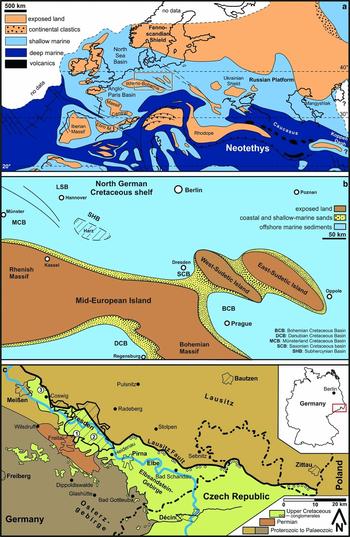
During late Cenomanian – Turonian time, the SCB formed part of a narrow strait between the West Sudetic Island in the NE and the Mid-European Island (=Rheno-Bohemia) to the south (Fig. 1a; Philip & Floquet, Reference Philip, Floquet, Dercourt, Gaetani, Vrielynck, Barrier, Biju-Duval, Brunet, Cadet, Crasquin and Sandulescu2000; Vejbaek et al. Reference Vejbaek, Andersen, Dusa, Herngreen, Krabbe, Leszczynski, Lott, Mutterlose, van der Molen, Doornenbal and Stevenson2010). It therefore constituted an important biotic corridor linking the Boreal shelf with the BCB and the northern Tethyan margin (Fig. 1b). Today the SCB is bounded by the Lausitz Fault (Fig. 1c), which has influenced the depositional thickness and facies conditions of its constituent strata with increasing importance since the Turonian stage (T. Voigt, unpub. Ph.D. thesis, Freiberg University of Mining and Technology, 1994; Voigt, Reference Voigt2009). Nominally defined as the Elbtal Group, these sedimentary successions are dominated by marine siliciclastics (nearshore sandstones), marly-silty limestones (Pläner) and hemipelagic marls that reflect both changing energy and water depth across a grain-size graded shelf (T. Voigt, unpub. Ph.D. thesis, Freiberg University of Mining and Technology, 1994; Voigt, Reference Voigt1999; Janetschke & Wilmsen, Reference Janetschke and Wilmsen2014; Janetschke, Niebuhr & Wilmsen, Reference Janetschke, Niebuhr and Wilmsen2015). The litho-biofacies show marked similarities to coeval sequences in the BCB but, because of their discrete palaeogeographical setting, they are usually treated as a separate basinal system.
Palaeogeographical and geological overview. (a) Palaeogeography during the late Cenomanian timeframe along the northern Tethyan margin (modified from Philip & Floquet, Reference Philip, Floquet, Dercourt, Gaetani, Vrielynck, Barrier, Biju-Duval, Brunet, Cadet, Crasquin and Sandulescu2000). (b) Enlargement of the Cenomanian–Turonian central Mid-European Island, indicating various Cretaceous basins and major fossil localities. (c) Distribution of lower Upper Cretaceous Elbtal Group (green) strata in Saxony and the NE Czech Republic with indication of marine reptile localities (1, Dresden-Plauen; 2, Dresden-Strehlen; 3, Weinböhla).

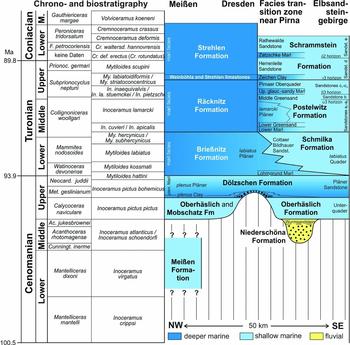
Marine transgression arrived in the SCB during late early – early middle Cenomanian time (Meißen Formation), but only reached the area NW of Dresden (Fig. 2). Two successive transgressive pulses during late Cenomanian time (=naviculare and plenus transgressions) subsequently submerged a topographic relief of valleys and highs in the Elbe zone. The rugged pre-transgression topography and diverse depositional settings are further reflected in the variable thicknesses and facies characteristics of the upper Cenomanian Mobschatz, Oberhäslich and Dölzschen formations (Fig. 2). The late Cenomanian transgressions led to more homogeneous sedimentation patterns of a graded, storm-influenced shelf during Turonian – early Coniacian time (T. Voigt, unpub. Ph.D. thesis, Freiberg University of Mining and Technology, 1994; Voigt, Reference Voigt1999, Reference Voigt2011), when an open seaway directly connected the SCB with the BCB. This gave way to sandy nearshore settings (Schmilka, Postelwitz and Schrammstein formations) in the Elbsandsteingebirge area, whereas offshore marls and Pläner persisted around Dresden-Meißen (Brießnitz, Räcknitz and Strehlen formations). A transitional series of interfingering Pläner and sandstone occurs in the Faziesübergangszone near Pirna (Fig. 2; see T. Voigt, unpub. Ph.D. thesis, Freiberg University of Mining and Technology, 1994; Tröger, Reference Tröger2003; Janetschke & Wilmsen, Reference Janetschke and Wilmsen2014). Sedimentation in the SCB likely continued in the Late Cretaceous epoch, but its traces were obliterated by Cenozoic erosion.
Chrono-, bio- and lithostratigraphy of the Elbtal Group (modified after Janetschke & Wilmsen, Reference Janetschke and Wilmsen2014).

4. Survey of the diagnostic marine amniote remains
Most marine amniote fossils from the SCB derive from rocky nearshore palaeoenvironments within the uppermost Cenomanian Dölzschen Formation, as well as offshore settings of the Strehlen and Weinböhla limestones (middle part of the upper Turonian succession) in the lower Strehlen Formation (Fig. 2). None of the presently documented elements have been found in association, and many show evidence of surface abrasion and breakage consistent with post-mortem transport via currents and/or wave action; this is similar to marine amniote material from the BCB (Kear et al. Reference Kear, Ekrt, Prokop and Georgalis2014).
4.a. Plesiosaurians
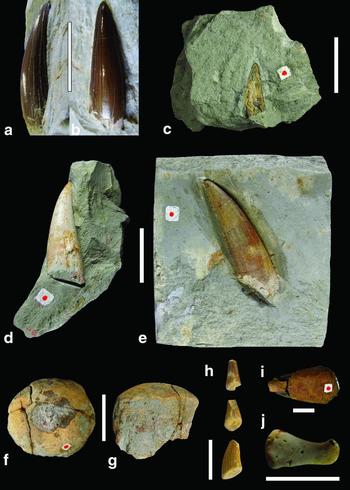
Geinitz (Reference Geinitz and Geinitz1875 a, b) referred the SCB plesiosaurian specimens to either Plesiosaurus constrictus Owen, Reference Owen and Dixon1850 (the Cenomanian material; Geinitz, Reference Geinitz and Geinitz1875 a) and Plesiosaurus bernardi, Owen, Reference Owen and Dixon1850 (the Turonian specimens; Geinitz, Reference Geinitz and Geinitz1875 b). These taxa are nomina dubia based on isolated vertebrae (Welles, Reference Welles1962), and have been elsewhere reinterpreted as indeterminate elasmosaurids or pliosauromorphs (Welles, Reference Welles1962; Bardet & Godefroit, Reference Bardet and Godefroit1995). Owen (Reference Owen and Dixon1850, p. 399) also originally attributed tooth crowns to both these taxa, which presumably provided the basis for Geinitz’ (Reference Geinitz and Geinitz1875 a, b) classifications. Critically though, not all of the documented SCB plesiosaurian remains have been correctly identified, and some obviously belong to other groups (e.g. MMG SaK 10587). However, a well-preserved plesiosaurian tooth is known from the upper Turonian strata of Dresden-Strehlen (FG 18/2010, Fig. 3a, b). Its lingual surface is still embedded in matrix but it does reveal a slender conical shape with gentle lingual curvature. The enamel is ornamented by seven coarse, apicobasally running ridges, which are widely spaced and distinctly undulating. Four of these ridges extend to the apex, while the remainder terminate within the basal half of the crown. The enamel is otherwise smooth. The conical form and coarse, undulating enamel ridges of FG 18/2010 preclude assignment to the Elasmosauridae (see Bardet & Pereda Suberbiola, Reference Bardet and Pereda Suberbiola2002, fig. 2D; Sachs, Reference Sachs2011, fig. 3; Lomax & Wahl, Reference Lomax and Wahl2013, fig. 8), but are similar to Turonian pliosauromorphs including Brachauchenius lucasi Williston, Reference Williston1903, Megacephalosaurus euleri Schumacher, Carpenter & Everhart, Reference Schumacher, Carpenter and Everhart2013 and Polyptychodon interruptus Owen, 1841 (in Owen 1840–1845), the last-named taxon possibly being invalid (Madzia, Reference Madzia, Jagt, Hebda, Mitrus, Jagt-Yazykova, Bodzioch, Konietzko-Meier, Kardynał and Gruntmejer2015). FG 18/2010 is not as massive as the tooth crowns of B. lucasi and M. euleri (Albright, Gillette & Titus, Reference Albright, Gillette and Titus2007, fig. 3; Schumacher, Carpenter & Everhart, Reference Schumacher, Carpenter and Everhart2013, fig. 6), and more closely resembles the dentition of polycotylids (e.g. Dolichorhynchops tropicensis Schmeisser McKean, Reference Schmeisser McKean2012, fig. 4). Druckenmiller (Reference Druckenmiller2002) likewise reported undulating enamel ridges on the teeth of the Albian polycotylid Edgarosaurus muddi Druckenmiller, Reference Druckenmiller2002.
Probable polycotylid plesiosaurian tooth crown (FG 18/2010) from the upper Turonian sequences of Dresden-Strehlen in (a) side and (b) labial views, (c) indeterminate reptilian tooth fragment (MMG SaK 10589) from the upper Turonian deposits of Weinböhla. (d, e) Elasmosaurid plesiosaurian tooth crowns (MMG SaK 10583) from the upper Turonian sections at Dresden-Strehlen. Possible proximal end of a plesiosaurian propodial (MMG SaK 1748) from the upper Cenomanian horizon at Dresden-Plauen in (f) articular and (g) dorsal views. (h) Potential plesiosaurian teeth from the upper Cenomanian horizon at Dresden-Plauen (MMG SaK 1744). (i) Indeterminate element identified elsewhere as a plesiosaurian propodial from the upper Cenomanian horizon at Dresden-Plauen (MMG SaK 1746). (j) Indeterminate element attributed to a dolichosaur from the upper Cenomanian horizon at Dresden-Plauen (MMG SaK 1749). (a–g) Scale bars 20 mm, (h, j) 5 mm and (i) 10 mm).

Two additional isolated teeth from the upper Turonian of Dresden-Strehlen (MMG SaK 10583; see Fig. 3d, e) were referred to the fish Hypsodon lewesiensis Agassiz, 1843 in 1833–1843. Geinitz (Reference Geinitz and Geinitz1875 c) based his identification on a figure published in Agassiz (1833–1845, volume 5, pl. 25a, fig. 3), showing a specimen that has later been referred to the ichthyodectid Xiphactinus Leidy, 1870 (see Bardack, Reference Bardack1965). However, the large teeth of Xiphactinus are usually more straight, labiolingually compressed and may bear prominent carinae (see Schwimmer, Stewart & Williams, Reference Schwimmer, Stewart and Williams1997). The crowns of MMG SaK 10583 are lingually curved with slender tapered apices. Fine apicobasally running ridges are present in one tooth (Fig. 3e) but much of the enamel is missing from the accompanying specimen (Fig. 3d), perhaps as a result of diagenesis (comparable preservational damage is evident in plesiosaurian teeth from the BCB; Kear et al. Reference Kear, Ekrt, Prokop and Georgalis2014). The size, shape and delicate ornamentation of MMG SaK 10583 are consistent with elasmosaurids. The distinctive oval cross-section is also characteristic within this clade (Druckenmiller & Russell, Reference Druckenmiller and Russell2008).
Geinitz (Reference Geinitz and Geinitz1875 b, p. 230) described another tooth as P. bernardi. This specimen (MMG SaK 10589; see Fig. 3c) derives from the upper Turonian sediments of Weinböhla and, although longitudinally broken and still embedded in matrix, has a curved conical profile and excavated pulp cavity that extends to the apical third of the crown. Although generally similar to plesiosaurian teeth, it cannot be assigned to this group with certainty. Likewise, three small teeth from the upper Cenomanian deposits of Dresden-Plauen (MMG SaK 1744; see Fig. 3h), referred to P. constrictus by Geinitz (Reference Geinitz and Geinitz1875 a), are indeterminate. Nevertheless, their conical curving profile and enamel ridges on the lingual surface are similar to leptocleidids, polycotylids and other small pliosauromorphs (e.g. Kear, Reference Kear2006; Kear & Barrett, Reference Kear and Barrett2011; Schmeisser McKean, Reference Schmeisser McKean2012).
Plesiosaurian postcranial elements from the SCB include the proximal head of a propodial (MMG SaK 1748, Fig. 3f, g) from the upper Cenomanian horizons of Dresden-Plauen (Geinitz, Reference Geinitz and Geinitz1875 a, p. 304). Geinitz (Reference Geinitz and Geinitz1875 a) suggested that MMG SaK 1748 resembled either the proximal part of a ‘saurian’ humerus or the cotylar end of a mosasaur dorsal vertebra (noted elsewhere by Kear et al. Reference Kear, Sachs, Ekrt, Hornung, Polcyn and Jacobs2013; Sachs, Hornung & Reich, Reference Sachs, Hornung and Reich2015). However, the occurrence of a rugose facet adjacent to the convex articular surface of MMG SaK 1748 is more compatible with an incompletely ossified plesiosaurian propodial trochanter (e.g. Kear, Reference Kear2007, fig. 5). Another putative plesiosaurian propodial (thought to be a humerus by Geinitz, Reference Geinitz and Geinitz1875 a) found in the upper Cenomanian strata of Dresden Plauen (MMG SaK 1746; see Fig. 3i), and listed as ‘Plesiosaurus’ by Geinitz (1871–1875, p. 303), lacks its articular ends and might be part of a marine turtle femur. Rib fragments from the upper Turonian deposits of Dresden-Strehlen (referred to P. bernardi, MMG SaK 10584) cannot be assigned to any group with certainty.
4.b. Squamates
Geinitz (Reference Geinitz and Geinitz1875 a) briefly discussed a small, elongate bone (MMG SaK 1749; see Fig. 3j) from the upper Cenomanian sequence of Dresden-Plauen. The specimen is seemingly corroded and lacks obvious articular structures. Geinitz (Reference Geinitz and Geinitz1875 a) compared MMG SaK 1749 with Dolichosaurus longicollis Owen (Reference Owen and Dixon1850, pl. 39, fig. 4), suggesting that it might be a pelvic element (cf. Dolichosaurus longicollis see Geinitz, Reference Geinitz and Geinitz1875 a, caption to pl. 65). However, only the sacral ribs of Dolichosaurus longicollis are potentially similar in shape, but otherwise much more slender (see Caldwell, Reference Caldwell2000, fig. 10b) making the original identification of MMG SaK 1749 uncertain.
Geinitz (Reference Geinitz and Geinitz1875 b) also reported three incomplete mosasaur teeth (MMG SaK 3402, MMG SaK 7818) from the uppermost Cenomanian deposits of Dresden Leubnitz/Kauscha that resembled those of Leiodon anceps Owen, 1841 in Owen (1840–Reference Owen and Bailliere1845; considered a nomen dubium by Schulp et al. Reference Schulp, Polcyn, Mateus, Jacobs, Morais and Everhart2008). These are labiolingually compressed with smooth enamel and distal carinae. Kear et al. (Reference Kear, Sachs, Ekrt, Hornung, Polcyn and Jacobs2013) and Sachs, Hornung & Reich (Reference Sachs, Hornung and Reich2015) proposed alternative affinity with enchodontid teleosts.
4.c. Marine turtles
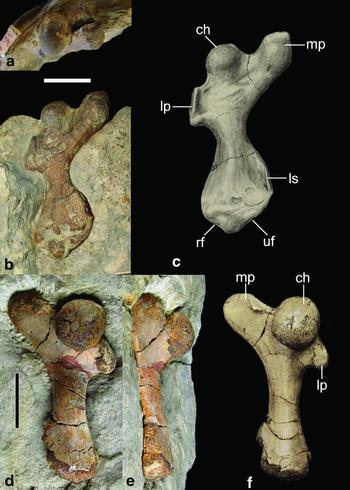
Geinitz (Reference Geinitz1847, fig. 1) illustrated a complete turtle humerus (FG 193/4; Fig. 4a–c) from the upper Turonian strata of Dresden-Strehlen that he (Geinitz Reference Geinitz and Geinitz1875 b) later named Chelonia carusiana. A second humerus was subsequently recovered from equivalent strata at the same locality (MMG SaK 10585; see Fig. 4d–f). Although Geinitz (Reference Geinitz and Geinitz1875 b) considered these specimens to be conspecific, they are not identical. For example, the processus medialis of FG 193/4 is elevated above the caput humeri but relatively less so in MMG SaK 10585, in which it is also distally rounded. Likewise, the humeral shaft of MMG SaK 10585 is more gracile and the processus lateralis comparatively rounded. Irrespectively, both elements are attributable to the Protostegidae because the processus medialis is clearly pronounced and the processus lateralis located adjacent to the caput humeri (see character state distributions in Hirayama Reference Hirayama, Callaway and Nicholls1997, Reference Hirayama1998; Kear & Lee, Reference Kear and Lee2006; Cadena & Parham, Reference Cadena and Parham2015). Diedrich & Hirayama (Reference Diedrich and Hirayama2003) concluded that FG 193/4 and MMG SaK 10585 belonged to indeterminate protostegids (see also comparative discussion in Kapuścińska & Machalski, Reference Kapuścińska and Machalski2015), and emended earlier attributions to the Albian–Cenomanian genus Rhinochelys Seeley, Reference Seeley1869 (see Diedrich, Reference Diedrich1999 a, in which the nominal was misspelled ‘Rhinochelis’). Other bone fragments from the upper Turonian beds of Dresden-Strehlen comprise broken remnants of marine turtle peripherals (MMG SaK 10586) and part of a caput humeri (MMG SaK 10587).
Protostegid humerus (holotype of Chelonia carusiana) from the upper Turonian deposits of Dresden-Strehlen (FG 193/4) in (a) proximal and (b) ventral views with (c) interpretive drawing. Second protostegid humerus from the upper Turonian deposits of Dresden-Strehlen (MMG SaK 10585) in (d) dorsal and (e) caudal views with (f) interpretive drawing. ch – caput humeri; lp – lateral process; ls – lappet-like structure; mp – medial process; rf – radius facet; uf – ulna facet. Scale bars 20 mm.

5. Discussion
Early Late Cretaceous sea-level highstands, especially during Turonian time (e.g. Haq, Reference Haq2014), are likely to have permitted biotic interchange between the palaeogeographically continuous SCB and BCB, as well as the north German (=Münsterland, Lower Saxony and Subhercynian Cretaceous basins) and eastern European shelves via the BCB and seaways around the Sudetic islands (Fig. 1b). Certainly, the SCB and BCB preserve compatible elements in their marine amniote assemblages: elasmosaurids, polycotylids and protostegid turtles (see Kear et al. Reference Kear, Ekrt, Prokop and Georgalis2014 for the BCB faunal list). Curiously though, large-bodied Polyptychodon-like pliosauromorphs, which are a prominent element of the BCB fauna (Kear et al. Reference Kear, Ekrt, Prokop and Georgalis2014), are as yet unknown in the SCB, as are unequivocal mosasauroid remains. The BCB Polyptychodon tooth crowns (historically documented in Fritsch, Reference Fritsch1878, Reference Fritsch1905; Bayer, Reference Bayer1896, Reference Bayer1897, Reference Bayer1898; Fritsch & Bayer, Reference Fritsch and Bayer1905) are characteristically robust, conical and the enamel surface is markedly ridged (see Kear et al. Reference Kear, Ekrt, Prokop and Georgalis2014, fig. 3). Similar teeth have been recovered in conjunction with a partial skeleton of Polyptychodon from the upper Turonian sections of Anröchte in NW Germany (see Sachs, Reference Sachs2000); this implies that large predatory pliosauromorphs, although as yet unknown from the SCB, probably inhabited the seas transecting the region. Similarly, the occurrence of tethysaurine mosasauroids in the middle–upper Turonian units of the BCB (Kear et al. Reference Kear, Ekrt, Prokop and Georgalis2014) is paralleled by dolichosaurids in the upper Cenomanian strata of Halle in the Münsterland Cretaceous Basin of Westfalen (Diedrich, Reference Diedrich1997, Reference Diedrich1999 b). Both a jaw fragment referred to Coniosaurus crassidens (correct Coniasaurus crassidens Owen, Reference Owen and Dixon1850) and an incomplete vertebra of Dolichosaurus longicollis Owen, Reference Owen and Dixon1850 have been described. These fossils attest to the presence of various European marine squamate taxa within northern Germany during early Late Cretaceous time (Bardet et al. Reference Bardet, Houssaye, Rage and Pereda Suberbiola2008). In fact, almost all of the identifiable marine amniote genera and species seem to have been ubiquitous across the northern/eastern European platforms during this interval (see summative lists in Welles, Reference Welles1962; Persson, Reference Persson1963; Bardet & Godefroit, Reference Bardet and Godefroit1995; Storrs, Arkhangel'skii & Efimov, Reference Storrs, Arkhangel'skii, Efimov, Benton, Shishkin, Unwin and Kurochkin2000; Karl, Reference Karl2002; Bardet et al. Reference Bardet, Houssaye, Rage and Pereda Suberbiola2008; Karl, Nyhuis & Schöllmann, Reference Karl, Nyhuis and Schöllmann2012), with some distribution further south onto the contiguous North African rim of the Mediterranean Tethys (e.g. Tong et al. Reference Tong, Hirayama, Makhoul and Eescuille2006). This concurs with records of other coeval marine vertebrates (e.g actinopterygian fishes: Ekrt et al. Reference Ekrt, Čech, Košťák, Mazuch, Voigt and Wiese2008), suggesting that palaeogeographically broad distributions among northern Boreal lineages might be linked to latitudinally uniform warm-water conditions (Jacobs et al. Reference Jacobs, Polcyn, Taylor and Ferguson2005; Bardet et al. Reference Bardet, Houssaye, Rage and Pereda Suberbiola2008) and uninhibited dispersal of active pelagic vertebrates across the entire peri-Tethyan margin during the Late Cretaceous period.
Acknowledgements
We thank Birgit Gaitzsch and Frederik Spindler (Technische Universität Bergakademie Freiberg) for access to specimens and their hospitality during research visits. Márton Rabi (University of Tübingen) contributed to discussions of the turtle remains. John Jagt (Natuurhistorisch Museum Maastricht) and a second anonymous reviewer provided constructive comments.