Introduction
Patients diagnosed with cancer often face several life disruptions associated with symptoms, treatments, and financial burdens (Graves et al., Reference Graves, Arnold and Love2007; Ellis, Reference Ellis2012; Girgis et al., Reference Girgis, Lambert and McElduff2013a). The impact of a cancer diagnosis extends well beyond patients and affects the entire family (Ross et al., Reference Ross, Mosher and Ronis-Tobin2010; Stenberg et al., Reference Stenberg, Ruland and Miaskowski2010; Gröpper et al., Reference Gröpper, van der Meer and Landes2016). As most cancer treatments are given in outpatient settings, family caregivers (FC) have become key supports for their relative, providing a lot of care for their health and well-being (McMullen et al., Reference McMullen, Schneider and Alstchuler2014). They witness and share much of the illness experience of their loved one (Kershaw et al., Reference Kershaw, Ellis and Yoon2015). FC of lung cancer patients are particularly vulnerable (Zabora et al., Reference Zabora, Brintzenhofeszoc and Curbow2001; Wadwa et al., Reference Wadwa, Burman and Swami2013) and likely to be distressed (Siminoff et al., Reference Siminoff, Wilson-Genderson and Baker2010), because the severity and rapid evolution are most often associated with this type of cancer (Persson and Sundin, Reference Persson and Sundin2008; Murray et al., Reference Murray, Kendall and Boyd2010; Ellis, Reference Ellis2012; Fujinami et al., Reference Fujinami, Otis-green and Klein2012). Lung cancer is highly prevalent both in women and men around the world which warrants that researchers study how patients and their family cope with it.
FC have to deal with their own emotions related to their relative's diagnosis and prognosis, and they are frequently putting their own life aside, focusing more on their loved one (Stenberg et al., Reference Stenberg, Ruland and Miaskowski2010; Van Ryn et al., Reference Van Ryn, Sanders and Kahn2011). They can experience high distress (Plant et al., Reference Plant, Moore and Richardson2011) that may impact on their physical, social, and emotional health (Stenberg et al., Reference Stenberg, Ruland and Miaskowski2010; Wadwa et al., Reference Wadwa, Burman and Swami2013; Kershaw et al., Reference Kershaw, Ellis and Yoon2015). Even though many FC are coping quite well, some studies have shown that their distress is often more severe than patients’ distress (Price et al., Reference Price, Butow and Costa2010; Chambers et al., Reference Chambers, Girgis and Occhipinti2012; Lambert et al., Reference Lambert, Harrison and Smith2012a; Girgis et al., Reference Girgis, Lambert and McElduff2013a; Merckaert et al., Reference Merckaert, Libert and Lieutenant2013; Wadwa et al., Reference Wadwa, Burman and Swami2013). Several personal factors are known to influence FC distress, including a younger age, a female gender, their own health status, their relation to the patient, and their sense of competence (Melin-Johansson et al., Reference Melin-Johansson, Henoch and Strang2012; Lee et al., Reference Lee, Liao and Liao2013; Gröpper et al., Reference Gröpper, van der Meer and Landes2016; Kent et al., Reference Kent, Rowland and Northouse2016). Factors related to patients’ characteristics can also affect FC distress, like the presence of metastases, the functional status of their relative, or the severity of their symptoms (Given et al., Reference Given, Wyatt and Given2004; Stenberg et al., Reference Stenberg, Ruland and Miaskowski2010; Gröpper et al., Reference Gröpper, van der Meer and Landes2016).
Most studies reporting a higher prevalence of significant distress in FC than in patients were cross-sectional and could not inform on the evolution of FC distress over time during the cancer care trajectory (Fletcher et al., Reference Fletcher, Paul and Dodd2008; Winterling et al., Reference Winterling, Wasteson and Arving2010; Lee et al., Reference Lee, Liao and Liao2013). This cohort study compares distress experienced by lung cancer patients and their FC during the first year of their cancer journey. It was hypothesized that: (1) more FC would report significant distress than patients (confirming the prior studies); (2) the proportions of patients and FC with significant distress would decrease overtime as an effect of better coping with the situation, and (3) the difference in proportions of distressed patients and FC would remain throughout the study.
Methods
Study design and participant selection
This cohort study was conducted between June 2010 and December 2014 in a pulmonary oncology outpatient clinic at the Institut universitaire de cardiologie et de pneumologie de Québec (IUCPQ), in Quebec City, Canada. Patients newly diagnosed with an inoperable lung cancer (representing 85% of all cases) and with an estimated life expectancy of at least 6 months were invited to participate to this study by nurses in the oncology clinic. Patients identified their principal FC and they were also recruited to participate to the study. This study was approved by the IUCPQ Research Ethics Committee.
Data collection and study instruments
Patients and FC completed validated questionnaires at baseline and every 6 months for a maximum of 12 months or until the patient's death. All data were collected during a regular patient appointment at the oncology clinic or at the patient's or the family caregiver's home, depending on their preference. All participants signed an informed consent form. At baseline, patients and FC responded to basic personal questions. Patients also provided information related to their lung cancer and their medical file was reviewed. At each data collection point, patients’ functional status based on the Eastern Collaborative Oncology Group (ECOG) scale (Bowling, Reference Bowling1995) was assessed. Patients and FC also completed the Hospital Anxiety and Depression Scale (HADS) containing two 7-item subscales assessing, respectively, anxiety and depression during the past week (Zigmond and Snaith, Reference Zigmond and Snaith1983; Savard et al., Reference Savard, Laberge and Gauthier1998; Roberge et al., Reference Roberge, Doré and Menear2013). Score on each subscale ranges from 0 to 21, with scores of 8–10 indicating suspected anxiety or depression and scores equal or higher than 11 denoting clinically significant anxiety or depression. A global score of the 14-item scale (range from 0 to 42) over 15 identifies clinically significant distress (Roberge et al., Reference Roberge, Doré and Menear2013).
Analysis
As distress was the primary outcome, the HADS global score served to calculate the sample size. Considering a baseline score of 10.8 ± 7.4 (range 0–42) found in a similar population of French-speaking respondents (Roberge et al., Reference Roberge, Doré and Menear2013), a level of significance of α = 0.05, and a power of 80%, a baseline number of 96 persons per group (FC and patients) were necessary to detect a 3-point difference in the HADS score between the groups. Considering an expected high attrition rate because of the vulnerability of this population, the sample size was increased to 130 per group. It was anticipated that 60 persons per group at the end of the study would still allow the detection of a 3.8-point difference in the HADS score between the groups.
Baseline sociodemographic characteristics for patients and their FC were summarized with descriptive statistics. Results on distress, anxiety, and depression (based on the HADS) were analyzed as continuous (scores) and categorical (proportions of patients and FC with anxiety, depression, and distress) variables. Linear mixed models were performed to compare distress, anxiety, and depression between patients and FC throughout the study. They used two fixed factors, group and time, with an interaction term. Subjects were linked to a random effect. The normality assumption was verified with the Shapiro–Wilk tests using residuals from the statistical models and transformed by the Cholesky's metric. The Brown and Forsythe's variation of Levene’s test was used to verify the homogeneity of variances. Different variables related to patients’ characteristics (gender, age, functional status, type and stage of cancer, type of treatment, and working status) and to FC characteristics (gender, age, relation to the patient, working status, and cohabitation) were integrated into these models to control their respective influence on anxiety, depression, and distress. Missing data for patients who died (N = 88) were not imputed, as their participation stopped at their death. Similarly, missing data for FC who withdrew because of their relative's death (N = 59) were not imputed. For patients and FC who withdrew (N patients = 10; N FC = 10), their last data collected was carried over to conduct intention-to-treat analyses. Results were equivalent with or without imputing missing data, so only results without imputation are presented. An α level of 0.05 was used as significance threshold. All statistical analyses were performed using the SAS software, version 9.4 (SAS Institute Inc., Cary, NC).
Results
Participants
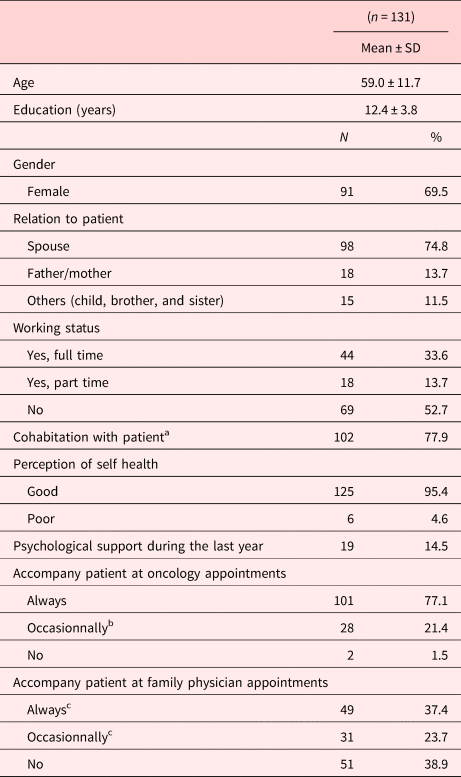
From the 259 eligible patients, 206 were recruited (participation rate: 79.5%) and from that group, 131 of their FC agreed to participate (63.6%) (Figure 1). Patients had been aware of their diagnosis for 2 months on average (9.4 ± 8.1 weeks) and half of them already had metastasis at baseline. Most patients received some form of treatment (94.7%) (Table 1). A majority of FC were women (69.5%), with a mean age of 59 years. More than three quarters of FC were living with the patient and those not cohabiting reported spending 26 h per week on average with their relative (Table 2).
Flow diagram.

Baseline patient characteristics

a These patients had a “small cell carcinoma” for which there is no TNM classification.
b Functional status measured by the ECOG scale.
Baseline family caregiver characteristics

a FC not living with the patient spend on average 26.0 h/week with their relative.
b Stay with the patient during the oncology appointment (n = 127; 98.4%).
c Stay with the patient during the appointment with the family physician (n = 68; 85%).
Distress in patients and FC
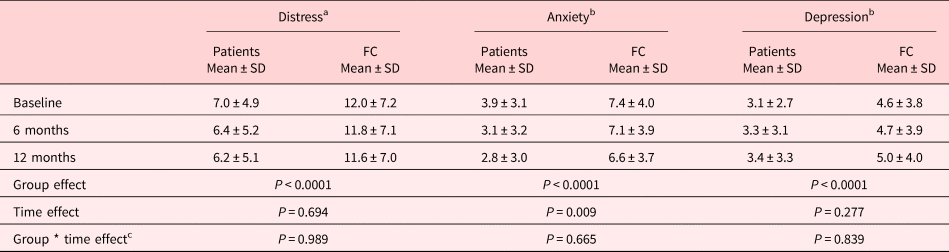
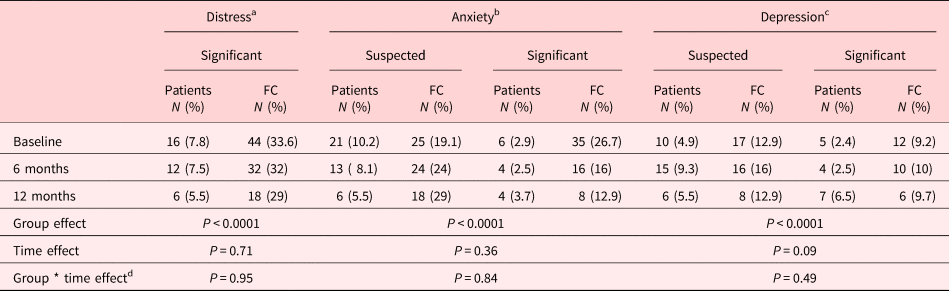
At baseline, near the diagnosis of lung cancer, the mean distress score was higher in FC than in patients (Table 3). Less than 10% of patients reported clinically significant distress compared to almost a third of family caregivers (Table 4). At 6 months, the mean distress score tended to drop in both groups, but remained higher in FC than in patients. This reduction observed in distress was not statistically significant between baseline and 6 months, and the distress score remained stable from 6 to 12 months in both groups, but always higher in FC (Table 3). Similarly, the proportion of patients and FC with distress remained stable at 6 and 12 months, with always a higher proportion of FC being distressed compared to patients. The same pattern described for distress was observed for the outcomes of anxiety and depression (Tables 3 and 4), except that anxiety scores were significantly reduced in both groups from baseline to 6 months and from 6 to 12 months.
Distress, anxiety, and depression (HADS) scores in patients and FC at baseline, 6, and 12 months

HADS, Hospital Anxiety and Depression Scale.
a Distress = HADS global score; range 0–42.
b Anxiety and Depression = HADS,specific subscale scores; range 0–21.
c Group * Time = interaction between group and time from mixed models for repeated measures.
Proportion of patients and family caregivers reporting distress, anxiety, and depression (HADS) at baseline, 6, and 12 months

HADS, Hospital Anxiety and Depression Scale.
a Distress = HADS global score; range 0–42; significant distress: score >15.
b Anxiety = HADS-specific subscale scores; range 0–21; suspected anxiety: score 8–10 and clinically significant anxiety: score ≥11.
c Depression = HADS-specific subscale scores; range 0–21; suspected depression: score 8–10 and clinically significant depression: score ≥11.
d Group * Time = interaction between group and time from mixed models for repeated measures.
Several factors had a significant influence on the proportion of patients with distress, anxiety, and depression. Patients who were female (P = 0.003), younger (P = 0.02), and still working (P = 0.003) experienced anxiety more frequently. Patients with a worse functional status (ECOG 3 or 4) reported being depressed more often (P < 0.0001) and experienced distress more frequently (P < 0.0001). Regarding FC, none of their personal characteristics significantly influenced the proportion of those with distress, anxiety, or depression (P > 0.05 for gender, age, working status, relation to patient, and cohabitation). Similarly, their relative's functional status or stage of cancer was not significantly associated with their psychological status (P > 0.05).
Discussion
This cohort study provides valuable information on the psychological status of patients with lung cancer and their FC during the first year after their diagnosis. These results confirm those of cross-sectional studies, showing that more FC experience distress than their relative with cancer (Price et al., Reference Price, Butow and Costa2010; Chambers et al., Reference Chambers, Girgis and Occhipinti2012; Girgis et al., Reference Girgis, Lambert and Johnson2013b; Wadwa et al., Reference Wadwa, Burman and Swami2013), but they go beyond that, as they inform not only on the respective prevalence of psychological symptoms among patients and FC, but also on how these symptoms evolve over time. Very few longitudinal studies have been conducted in that field and most of those found were limited to a 6-month follow-up (Milbury et al., Reference Milbury, Badr and Fossella2013; Halkett et al., Reference Halkett, Lobb and Shaw2017).
Interestingly, proportions of patients and FC with significant distress and depression stayed relatively stable throughout this 1-year study, and the differences found between these two groups remained the same. Findings are almost equivalent when comparing patients’ and FCs’ scores of distress and depression. However, looking at the evolution of anxiety scores in both groups over time, there was a significant reduction between baseline and 6 months as well as between 6 and 12 months. Proportions of patients and FC with significant anxiety tended to decrease over time, but it was not statistically significant. As FC always report higher distress, anxiety and depression than their relative with cancer throughout the study, this highlights the importance of paying attention to their psychological status and not only to the one of patients.
At the IUCPQ ambulatory oncology clinic, the organization of care includes nurse navigators who see all patients at least once and serve as resource persons throughout their cancer care trajectory. Most often, FC accompany their relative to their appointments at the oncology clinic. So, they may receive some support from the nurse navigator or from other members of the oncology team if they request it, or if they express some needs. But there is no systematic mechanism to identify FC with significant distress, and they are not included in the distress screening program offered routinely to patients. It is well known that health professionals working in cancer care settings often underestimate distress in patients (Mitchell et al., Reference Mitchell, Hussain and Grainger2011; Xiao et al., Reference Xiao, Polomano and Bruner2013), so they may do so even more frequently with FC, as they are not considered as “patients” when they attend to their relative's oncology appointments. In addition, FC often put their emotions aside and try to focus on their relative's needs (Stenberg et al., Reference Stenberg, Ruland and Miaskowski2010; Van Ryn et al., Reference Van Ryn, Sanders and Kahn2011), so very few seek help for themselves or accept to participate to support group sessions (Mosher et al., Reference Mosher, Champion and Hanna2013; Dionne-Odom et al., Reference Dionne-Odom, Applebaum and Ornstein2018). This reinforces the need to expand to FC in addition to patients, the distress screening programs implemented in cancer centers. Other authors have also recommended a family approach in cancer care because of the interdependence of patients’ and their family caregivers’ mental health (Shaffer et al., Reference Shaffer, Kim and Carver2016; Caruso et al., Reference Caruso, Nanni and Riba2017). Moreover, some authors have shown that FC reporting distress near the cancer diagnosis of their relative had a decline in their physical health 1 year later (Kim et al., Reference Kim, Shaffer and Carver2014).
Relatively few patients reported clinically significant distress throughout the study even though they had a serious cancer. This finding seems quite surprising, considering that lung cancer is often associated with high distress (Zabora et al., Reference Zabora, Brintzenhofeszoc and Curbow2001; Siminoff et al., Reference Siminoff, Wilson-Genderson and Baker2010; Ellis, Reference Ellis2012; Wadwa et al., Reference Wadwa, Burman and Swami2013). The organization of care at the IUCPQ ambulatory oncology clinic with nurse navigators may have contributed to this result, as they act as resource persons for patients and they are available when needed to provide support, information, and referral to respond to patients’ needs. Moreover, all patients participated to the routine distress screening program implemented at the IUCPQ oncology clinic at the time of the study, which may have also contributed to this result. In addition, most patients receive chemo with or without radiation therapy, so they are “in action” to fight against their cancer, as opposed to their FC who may feel like helpless witnesses. This may also explain why more FC than patients report high distress. However, nurse navigators had the possibility of helping FC if they express some needs, as they usually accompanied their relative at their appointments in oncology. But, in the current practice, their interventions mainly target patients. Also, FC may have been reluctant to express their distress and concerns in front of their loved one. FC frequently forget themselves to concentrate on their relative (Stenberg et al., Reference Stenberg, Ruland and Miaskowski2010; Van Ryn et al., Reference Van Ryn, Sanders and Kahn2011), so one can assume that they probably do not frequently seek help from nurse navigators.
Contrary to what was hypothesized, the mean scores of distress for both patients and FC remained relatively stable over time, as well as their respective proportion with clinically significant distress. These findings suggest how difficult it is to cope with this severe type of cancer. Also, it echoes some other recent study results, indicating that patients and FC who report high distress around the time of diagnosis of cancer show prolonged elevations in distress over time (Lambert et al., Reference Lambert, Jones and Girgis2012b; Milbury et al., Reference Milbury, Badr and Fossella2013; Kim et al., Reference Kim, Shaffer and Carver2014; Kershaw et al., Reference Kershaw, Ellis and Yoon2015; Halkett et al., Reference Halkett, Lobb and Shaw2017).
This study had the advantage of being prospective. The patient participation rate was high and few deliberately withdrew, even though they did not get a direct benefit from the study. However, this study has some limitations. The high attrition rate, mainly due to patient death, may have reduced the external validity of these results. Although inevitable, such high attrition rate is well recognized in palliative care studies (Higginson et al., Reference Higginson, Evans and Grande2013; Dussel et al., Reference Dussel, Orellana and Soto2015). Also, this study was conducted in a single center and limited to lung cancer patients, which precludes a generalization to other types of cancer. However, patient characteristics related to distress, such as a younger age and a female gender, are consistent with other study findings (Morrison et al., Reference Morrison, Novotny and Sloan2017). Finally, data from this cohort study were collected several years ago, but the integration of psychosocial care into routine oncology practice has not changed considerably since the study took place. In most centers, distress screening programs continue to target patients only and FC are not included. So, these results probably reflect the actual reality.
Nevertheless, these results support the need to implement a systematic distress screening program not only for patients, but also for FC. It would also be relevant for cancer centers to offer to FC some coaching to help them play their role with their relative throughout their cancer journey. Future research should include the integration and evaluation of such programs of distress screening and coaching for FC into different oncology practice settings treating patients with varied types of cancer.
Acknowledgment
The authors thank M. Serge Simard, biostatistician at the IUCPQ Research Center for the statistical analyses, and the members of the IUCPQ ambulatory pulmonary oncology team, the patients with lung cancer, and the family caregivers who participated in this study.
Funding
This study was funded by the Canadian Cancer Society-Ontario Division (Grant # 020097).
Prior publication of an abstract
These study results have been presented at two international congresses (one in French and one in English). The abstracts were only published in the congress booklets:
• Aubin M, Vézina L, Verreault R, Fillion L, Hudon É, Lacasse Y, Simard S, Tourigny A, Dumont S, Daneault S. Évolution de la détresse reliée au cancer du poumon chez les patients et leurs aidants. 20th Annual Congress of the Société française d'accompagnement et de soins palliatifs (SFAP) in Montpellier, France, June 19, 2014.
• Aubin M, Vézina L, Verreault R, Fillion L, Hudon É, Lacasse Y, Simard S, Tourigny A, Dumont S, Daneault S. Distress experienced by lung cancer patients and their family caregivers in the first year of their cancer journey. 16th World Congress of Psycho-Oncology, Lisbon, Portugal, October 23, 2014.
Conflict of interest
All authors have no conflict of interest to declare.