I stand facing the mirror that covers one of the long walls of the dance studio. It is what we call the Merce Cunningham Studio, though in fact, the “real” Cunningham Studio is gone. That beloved space, perhaps the most beautiful dance venue in New York City for forty years—a great swath of pale-floored, high-ceilinged openness, eleven flights up, two walls lined with windows situating us within the vast and undisciplined architectural landscape of downtown Manhattan and flooding us with sunlight, one short wall mirrored to reflect dancers’ images, Merce's barre in the corner—has been lost to a tangle of real estate, politics, and grief.Footnote 1 We are mere (and admittedly grateful) tenants now, one among many, in this windowless studio at City Center, in the wrong neighborhood, its floors too hard, its lighting harsh, its scheduling of classes subject to the landlord's calendar.
So in this space that is not really what we call it, I stand toward the back, positioned to face my reflection in the mirror, fifth panel from the left, my most slender double, the shape of my body already narrowed by my perpetual black costume and a lifetime of dance techniques designed to produce a body that not only does particular things but has the visual appearance announcing that it can. We have not yet begun to move, the pianist has not yet begun to play, the teacher has not yet arrived at his or her position, center front, signaling us to get in place, as it were: to choose a spot in the room and line up the parts of our bodies according to the ballet-derived, vertically organized script: head floating atop the long neck, chin lowered a bit, chest open, energy going up and down through the torso, weight down through the legs and feet, tailbone dropped, hips over knees over toes, arms ever-so-slightly rounded. We have begun the minutely detailed and endless cataloguing of our bodies’ components, in movement and stillness, in this moment of prelude—this moment that is, of course, only seemingly still—and that continues, consciously and otherwise, throughout the class and throughout our dancing lives.Footnote 2
As a choreographer, dancer, teacher, and writer, I am typically immersed—that is, I immerse myself—in movement: doing it, seeing it, experiencing it, exploring it, and reflecting on or otherwise discursively articulating—“coming to terms with”—it. My own dance life has historically been an idiosyncratically integrated mix of formalism and everything outside it, equally informed by Cunningham's movement and choreography and a range of (M)ovement (R)esearch–based and somatic practicesFootnote 3 ; by dances derived from scores and structures and from intuition,Footnote 4 image, and impulse; by the presence of expression in abstract or formalist, as well as theatrical or worldly, dance; by autobiography in performance; and by the role of embodied experience—joining movement itself to the material circumstances in which it is produced—as a way of knowing.Footnote 5
I consider here these elements of dance in the context of the work of Georges Perec, the experimental French writer of the mid- to late twentieth century. Perec is known for his committed attention to the quotidian, his ingenious interventions into personal and collective experience, his dexterous interactions with the formal materials (letters, words, sentences) of his art, his poetic clarity of presence, and his adroit and artful inquiries into memory and history, especially his own life as it had been shaped by the Holocaust. I was first drawn to his writing for the simple reason that as a choreographer as well as a “civilian,” I love lists, games, puzzles, and grids, all of which figure prominently in Perec's work. I have stayed with the work not only for those pleasures, but for its depth and beauty, for the ways that Perec's literary strategies, even at their most radical, extend beyond cleverness and even brilliance to produce texts evocative of the inexhaustible complexity of human lives.
Perec is not, of course, the only author of this period to write to such effect.Footnote 6 He is, though, the one whose work has most impressed me—most touched me, most marked me—in its connections to dance. My engagement with Perec emerges from a range of affective as well as intellectual experiences, and I have found choreographic inspiration and personal resonance as well as critical stimulation in his texts. Reflecting this multiple engagement, rather than tracing a single argument connecting dance and Perec or mapping out a one-to-one correspondence of dances with Perec's writings, I instead consider the relationship in several, often overlapping, ways.
I address elements of Perec's work as they variously connect to dance, specifically Western concern dance and especially early and contemporary post-modern dance.Footnote 7 These include ways that they share certain compositional processes (most notably the strategies that push both the artist's imagination and the form's boundaries) and concerns (such as time, attention, and exhaustion); aspects of autobiography, such as acts of disclosure and mystification, and resistance to conventions of self-representation; the central place of the body, and the ways his work and dance so differently express, suggest, or evade what cannot be said in words.
Moving among these perspectives throughout the piece, I write from the position and experience of a dancer. I explore the significance of Perec's writing to my own ideas and experiences of dancing, including the circumstance of cataloguing introduced in the opening of this article, where sensation, thought, vision, and feeling are joined, bringing together dance, Perec, and the critical literature on his work. This essay, in fact, is part of a larger project that comprises several performances as well as writings, which together construct, articulate, and illuminate the interactions of dance and Perec, demonstrating ways that dance may be created and viewed through a critical Perec-ian lens and bringing all of Perec's genres into contact with dance.Footnote 8
The breadth of Perec's writing is remarkable, for its range of genres including novels, stories, autobiography, poetry, puzzles, screenplays, and games, and for the dazzling level of invention and experimentation that characterizes all of it. These qualities reflect Perec's membership, since 1967, in OuLiPo—Ouvroir de littérature potentielle, or Workshop for Potential Literature. Founded in 1960 and still extant, this literary organization was and is composed of writers and mathematicians devoted to devising radical challenges to the creative process, specifically those based on some kind of structural constraint.Footnote 9 Perhaps the most widely known example of OuLiPian literature is Perec's: his 1969 La Disparition (“the disappearance”), which translates into English as A Void. This novel, as dictated by its lipogrammatic structure, is distinguished by the absence—which is reiterated as a theme in the novel itself—in both the original French and in the English translation of the letter “e.”Footnote 10
Georges Perec was born in Paris in 1936 to Polish Jewish parents. Both of them were killed during World War II. His father, an enlistee in the French army, died in battle in 1940; his mother died either in or on the way to Auschwitz after being deported in 1943. Left an orphan at age seven, Perec attended a Catholic boarding school and was raised by an aunt and uncle. He attended the Sorbonne, where he studied sociology, and lived in Paris for most of his life until he died of cancer in 1982, just before turning forty-six. For many years, he worked as an archivist in a science laboratory; his archival inclinations are evidenced in his writing, which is marked not only by its overall sense of abundance but, differently in each piece, by its sense of the desire to capture, classify, and describe every observable physical detail—and, by extension, to acknowledge it as meaningful, as precious.
Notably, the work's emotional currents are not nearly as evident or apparent. John Sturrock, who writes that “Perec is not … the writer to turn to if it's the warm, uninhibited airing of serious feelings that you want,” refers to Perec's coolness, his “reticence,” “humor,” and “lightness” (in Perec Reference Perec and Sturrock1997, x–xi). However, they ground the writing, color it, haunt it. In the case of La Disparition, for example, the subtext emerging from the literary strategy radically reframes the writing. The missing letter is more than a structural quirk or a demonstration of the author's facility with self-imposed linguistic limitation. As Warren Motte writes, “the absence of a sign is always the sign of an absence”; “each ‘void’ … points toward the existential void that Perec grappled with throughout his youth and early adulthood” and reminds the reader of “the struggles of a Holocaust orphan trying to make sense out of absence” (Reference Motte2002). Motte and numerous other Perec scholars have noted this most vivid (and obvious) of Perec's copious iterations of loss, the eponymous “void” that permeates his work, variously recalling, through suggestion, omission, and other literary acts, the loss of his parents and, more broadly, the erasure of the Jews of wartime Europe. Moreover, the missing “e” marks Perec as positioned—even through absence—within that period of Jewish history, and within Jewishness as a phenomenon, both of identity and its artistic self-representation.Footnote 11
Much of Perec's writing crosses genre lines, especially in weaving autobiographical material or dropping autobiographical allusions into fiction. A Void, which is a novel, exemplifies this crossover, while dramatically resisting the basic conventions of autobiography. Even Perec's own name (whose lack of an accent mark over the first “e” announces its/his non-Frenchness, his outsider status)—as well as the male definite article (le) and the words for mother and father (mère, père)—is exiled from the pages of this literary tour de force.Footnote 12
Four Fields
Perec acknowledged his unusual output and textual versatility, writing in his 1978 “Notes on What I'm Looking For” that he had “never written two books the same, [had] never wanted to repeat in one book a formula, a system or a manner developed in an earlier book”; he recognized that some people even saw him as a “sort of computer, a machine for producing texts.” His own analysis was more personal, less technological—he preferred, he wrote, to “liken [him]self to a peasant cultivating several fields.” In that same essay, he divided his writing into “four different fields, four modes of interrogation”—“sociological: how to look at the everyday”; “autobiographical”; “ludic”; and “fictive”—and linked each one to examples of his writing. Though the divisions are “arbitrary” and the areas overlap (Reference Perec and Sturrock1978/1997, 141–142), this categorization is a useful way of seeing Perec's work systematically.
These four fields offer models for creating and viewing dances, connections to circumstances of dance history, and a world view that supports dance—the form as typically or traditionally wordless as Perec's is word-ful, so to speak—for what it might do, how it might make meaning. And while in dance, as in literature, the divisions may seem random, the element of overlap is potentially useful in seeing how a dance, the process of making a dance, and the dance-in-process itself cross perhaps unlikely lines of lineage or lexicon.
The discussion that follows notes some of the ways Perec's fields apply to his own work and articulates some of the parallels to those fields in dance. I do not want to over-literalize the case, or enter into debates or digressions about equivalencies of dance and language. As dancer Daniel Squire said with a shrug, “What would a choreographer do? Leave out pliés?” True enough, that wouldn't work the same way as, say, leaving out a letter. One question would be whether “the absence of a sign” that Warren Motte wrote of would be as evident or as significant in dance, in which the options of movement are, if not unlimited, less strongly tied to a commonly agreed-upon and understood vocabulary and in which the modification of movement vocabulary might be too subtle to pick up or to clearly affect the dance's meaning-making qualities.
Certainly, though, there are many dances from early post-modernism through today that demonstrate or suggest parallels to Perec's categories. I include here both earlier work and some contemporary examples that come to mind and memory. As with Perec's own work, there is significant overlap, with the dances fitting into multiple categories.Footnote 13
Sociological/Everyday
For Perec, the “sociological/everyday” category refers to novels such as Things (Reference Perec, Bellos and Leak1965), which focuses on the actual and coveted possessions of the couple at the book's center; to Species of Spaces (Reference Perec and Sturrock1974), which describes in great detail a range of spaces, from the miniscule to the enormous, in which Perec situates himself; to his work with a review, Cause Commune, which aimed to “undertake an anthropology of everyday life” (Reference Perec and Sturrock1978/1997, 141–142). Critically, it refers to the many books and essays in which Perec reports those details of everyday life that we typically bypass, ignore, assume to be inconsequential.
This category is aligned with dance in several ways. It suggests parallels to aspects of the early 1960s post-modernism of the Judson Dance Theater, in which choreographers made dances using a vocabulary based on vernacular and un-stylized movement, and dancers demonstrated similarly conceived and executed performance qualities. These elements, which came into being at roughly the same time that Perec was beginning his own work, have continued, through many evolutions and developments, to be important to contemporary dance practice. This aspect of Perec's writing also ties in to the exploration of experience in dance scholarship and practice (for instance, to phenomenological and autoethnographic investigations of movement, alone and with others, in a particular place, time, and cultural circumstance). It suggests the emphasis on spatial and environmental awareness central to the experiences of performers and viewers in site dance. It is linked to contemporary scholarship on the everyday, to the interest of dancers and artists working in other forms to the idea of practice, to paying attention as the most basic attribute of generating art and living a meaningful life.
Many of the works made by the early post-modern dancers were constructed from the sparest of everyday movements, often performed over and over, with or without apparent inflections, variations, and developments. Examples include the richly casual, periodically interrupted ambulations of Steve Paxton's 1967 Satisfyin Lover Footnote 14 ; the orchestrated floor patterns of Yvonne Rainer's 1963 We Shall Run; and much of Lucinda Childs's 1970s/1980s work, which featured complex ostinatos of walking, stepping, leaping, and turning.
Improvisers such as Simone Forti, Jon Kinzel, and K. J. Holmes have made everyday movement central in their work. Cathy Weis creates extravagant, determinedly low-tech productions by pushing video equipment across the floor, deconstructing technological “tricks” in performance, using her living area as a performance space. Dancenoise filled theaters with tacky objects accumulated in junk shops and built performances around them.
Yve Laris Cohen's work puts the focus on the theatrical space itself. Drawing attention to the venue, to what typically takes place unseen by an audience, and to the experience of duration filtered through viewer expectation, the dance is the execution (or contemplation) of a task, in which the choreographer makes a stage, or a platform, sometimes hammering until the audience has cleared out.
Autobiographical
Perec's “autobiographical” writing includes pieces that specifically describe and recall his “life story,” most notably W, or The Memory of Childhood (Reference Perec and Lowenthal1975) or La Boutique Obscure: 124 Dreams (Reference Perec and Becker1973).Footnote 15 More significantly, as I mentioned regarding A Void, Perec's life is a constant presence in his work, whether through anecdotes and episodes—the “traces of the autobiographical” mentioned in passing (Reference Perec and Sturrock1978/1997, 142)—or in the reminders throughout of him, writing, absorbed in the composition over time of a self-portrait. His writing exemplifies both what I think of as “explicit autobiography,” work that is drawn from a person's actual life, and “implicit autobiography,” work that otherwise conveys attributes of who the person is, how the person sees her- or himself.
Perec's writing dances through the terms of Philippe Lejeune's Reference Lejeune and Leary1989 definition of traditional autobiography: “a retrospective prose narrative written by a real person concerning his own existence, where the focus is his individual life, in particular the story of his personality” (4), and in which the “identicalness” of the teller and the text are assured by the “Autobiographical Pact” (5).Footnote 16 In fact, stretching and breaking all these conventions, and in particular acknowledging the overlap of autobiography and fiction, has been important in post-modern dance and performance as well as other art forms. Choreographers use movement, imagery, sound, and language to produce narratives and intimations of explicit autobiography; they create movement and productions, often non-verbal and/or non-narrative, deeply imbued with a sense of self, however they understand and embody that concept, in works of implicit autobiography.Footnote 17
Autobiography applies to the choreography of several Judson dancers, including Yvonne Rainer, Carolee Schneemann, and Deborah Hay, as well as Sally Gross, who said to me in contemplating her poetically minimalist body of work, “I don't think I've left any of my history out” (Satin Reference Satin1992, 52). In One and Another, made in 1983 after the death of her mother, Gross improvised while speaking in Yiddish (which the audience presumably couldn't understand) about the unsettled meanings of movement; at the end of the dance, she said, in English, “English is my second language.” In Rope Dance (Reference Perec and Sturrock1976), she repeatedly walked a square with her long-time dance partner, her daughter Sidonia, the distance between them growing (and the mechanics of tracing the square adjusted, especially by Sidonia) as Sally released more and more of the skein of rope joining and separating them; harmonicas in their mouths, the two dancers created a soundscape of breathing, the rhythms announcing the shifts in speed and effort. The dance, a précis on the basic materials of choreography, resonated, too, with its implications of the mother–daughter relationship. And significantly, like most of Gross's dances, it is composed of the most familiar and unembellished human movements, especially walking, clearly positioning her work, too, in Perec's “everyday” category.
Numerous contemporary choreographers have tweaked the possibilities of self-representation in dance. Some have foregrounded the sociocultural aspects of personal life (race, gender, sexuality, heritage, class) while remaining committed to pushing the compositional options of post-modern dance. A few examples, among many, are Ishmael Houston-Jones, Juliette Mapp, Ralph Lemon, Okwui Okpokwasili, and Dean Moss.
Ludic
Perec's “ludic” category includes the vast volume of work based on the OuLiPian strategies of constraint and on what he called “feats of skill” in carrying out the devices and games invented by the group's members. Perec, in addition to his famous lipogram, wrote “palindromes, … pangrams, anagrams, isograms, acrostics, crosswords” (Reference Perec and Sturrock1978/1997, 142) and other works of literature exploring how far he could take a linguistic or semantic ideal and simultaneously retain his writing's accessibility and its sense of being rooted in the chairs and tables of everyone's lives.Footnote 18
The ludic mode offers an especially rich and immediate link between Perec and certain practitioners of historic and contemporary dance and choreography, tying the generation of movement material via a huge range of playful scores and structures to the “OuLiPian” scores that limited writers’ choices and opened up their imaginations. Among these are Merce Cunningham and John Cage's extensive use of chance operations and indeterminacy to create and organize movement and sound in ways that resisted habitual or familiar choices; the conceptual blueprints and choreographic rule-games of the Judson Dance Theater; the RSVP Cycles—a system of articulating the creative process developed in the 1960s by urban planner Lawrence Halprin and choreographer Anna Halprin; and the vast array of instructions for variously defined improvisations.
Probably the best-known of individual score-based dances is Trio A (Reference Perec and Bellos1966), in which Yvonne Rainer performatively and systematically dissolved the hierarchies of the body and its parts; resisted the traditions of energy, phrasing, and overall structure; and refused the reciprocal gaze linking viewer and doer. Many past and present dances built on scores and structures have employed the strategy of repetition (which Rainer, as it happens, eschewed in Trio A). These include the dances named in the sociological/everyday category, in which repetition focuses us on movement we might not otherwise do or watch with attention.
In other works, repetition is performed with barely any alterations at all or redefined as a single unchanging action. Two dances of Douglas Dunn fit here: his long slow slide on his back around the periphery of the Cunningham Studio in 1979's Gestures in Red and his four-hour-long supine posture in 1974's 101. In this last vein, dances by Maria Hassabi and Eiko and Koma have taken extreme slowness or stillness as their compositional point of departure, often guiding viewers, through the upsetting of conventions of performative duration and structure, toward complex emotional, psychological, and kinesthetic experiences.
John Jasperse's 2003 Just Two Dancers was guided by a spatial score. The dancers moved everywhere in the space (Dance Theater Workshop) except the performance area; spectators held little mirrors to accommodate their viewing choices. In one section, Jasperse and Juliette Mapp just jumped, in parallel, about 250 times, close to each other, sometimes changing facings. The impact, so to speak, of that intimate, exhausting segment, the empathy it encouraged, was heightened by viewers’ experience in the newly unfamiliar space.
The collaborative work of choreographer Jonathan Burrows and composer Matteo Fargion puts the score up front and center. Especially compelling—awesome, really, in their complexity and humor—are Both Sitting Duet (Reference Motte2002), in which, doing just that, the two men followed their own movement scores (which lay at their feet), derived from Morton Feldman's 1982 musical score, For John Cage; and Cheap Lecture (2009), in which the components (speed, rhythm, pauses, interruptions) of their material—mostly speech—are plotted out based on Cage's 1959 “Lecture on Nothing.”
Fictive
For Perec, the “fictive” category is applied to stories, to the kind of narratives read for sheer pleasure. Interestingly, the example he offers is Life: A User's Manual (Reference Perec and Bellos1978), which in addition to being a completely compelling page-turner is a huge hulk of a puzzle whose structure urges the reader to regularly interrupt her reading to figure out how the pieces fit. The category applies, in terms of dance, to the revisions of narrative in contemporary choreography—the dances whose “stories” are “told,” with and without language, through strategies of fragmentation, suggestion, chronological scrambling, blurry-edged characters and personae, and other elements of de/construction. These are the same strategies through which choreographers (and writers) create works in which autobiography—a specific kind of story—figures.
In May 1982, choreographers Marjorie Gamso, Jane Comfort, and Tim Miller co-founded a Paranarrative Festival at PS 1 (now MOMA/PS 1). These performances featured the efforts of dance-makers who were interested in deconstructing narrative in dance with the same rigor as those writers—such as Perec and his OuLiPo colleagues—un-doing literary conventions of storytelling. Gamso's stories, like Perec's, joined an insistence on secrecy and privacy to an artistic inclination toward expansion, as well as a commitment to the thoroughness of her ludic efforts. Her choreographic tales include the riveting Inside Story: Your Life in Storage Your Life on Hold (2009), made while she was ill and essentially homeless, and performed originally in the storage area where she kept her possessions; its spoken text used only the fifteen letters of the title, its eerie images lightly brushing her delicate dramatic gestures. Comfort, too, has continued to make narrative work, theatrical dances whose stories develop through overlapping and intersecting acts of language and movement. Yasuko Yokoshi, RoseAnn Spradlin, Susan Rethorst, Sally Silvers, and Vicky Shick offer variously fractured and mysterious narratives, often in collaboration with or emerging from literary, visual art, or technological elements.
Scores
Some choreographers have indeed made dances that coincidentally duplicated, more or less, Perec's missing letter formula: strategically omitting or exaggerating a physical element. In 2014, Daniel Squire took up the challenge intentionally, choreographing a dance in which he bent neither his arms nor legs. The score for this solo, These Then Were the Perverse—Perverse's the Werd—Steps He Deveyesed, is based on Perec's Reference Perec and Monk1972 novella Les Revenentes (translated in English as The Exeter Text), in which there is only a single vowel—again, “e.”Footnote 19 Noting that the book's spelling “becomes increasingly unorthodox,” Squire chose to perform “a series of tasks during which one would be increasingly likely to bend one's limbs if that were permitted” (in Cigánková Reference Tereza2014); the additional “dance-equivalent challenge” he wrote, was “to remain as diverse as possible in terms of scale of movement, complicated rhythms, tempi, articulation, and weight shifts” (in Cigánková Reference Tereza2014). Those elements, which, like the elegant vocabulary and style reflect Squire's years in the Merce Cunningham Dance Company, are apparent; the limbs appear especially extended because of the no-bending rule, and even with the movement's built-in tension, the dance looks virtuosic. The arms seem mostly to be stretched into space rather than held near the torso, creating an image, along with the dancer's calm, intense presence, charged costume (underwear and necktie), and dramatic lighting, of a solitary man, even A Solitary Man.
I mentioned to Squire that his dance appeared to reflect A Void's score rather than Exeter's, noting that it was possible to conflate the scores. He replied that he was responding to the strangeness of Exeter's spelling, and that the straight limbs felt more like “only ‘e’ as a vowel” than “everything but ‘e’ as a vowel.” And, he continued, “Of course it's all just really an excuse to dance” (Squire, personal communication, July 29, 2015).
This little conversation is a reminder of the malleability of the score (which OuLiPo members typically call a constraint) as a compositional device. One especially valuable discussion of scores is Lawrence Halprin's Reference Halprin1969 RSVP Cycles: Creative Processes in the Human Environment. Collective and individual, these cycles, made up of “resources,” “scores,” “valuaction,” and “performance,” encourage people to find richness in their human and material resources, especially those of the everyday. Squire's dance, which allowed for improvisational choices within the framework, is made from what Lawrence and Anna Halprin called an open score, in which the performance would be different every time. Burrows's and Fargion's dances, however manic their tone, are essentially derived from closed scores, allowing for performative “asides.” (Cunningham's movement was often, like most OuLiPo work, and certainly Perec's ludic writing,Footnote 20 generated by a score—often derived from chance operations—and then set, closed; its organization and its relationship to music, lighting, and other elements was sometimes determined by indeterminacy, an open score form.)
A specific kind of score malleability applies to OuLiPo's and Perec's principles and practices. OuLiPo functions as a kind of collective, and has sometimes made group decisions about individual compositional choices. Those odd spellings of Les Revenentes (a factor apparent in La Disparition as well) reflect the permission Perec received from his colleagues to soften the rules somewhat, i.e., to simply omit the “u” following the “q” in many basic French words (Schwartz Reference Schwartz1988, 41). This seriousness with which OuLiPians treated their scores reflects the seriousness of their mission: “to uncover what [literature] could be, either in theory or practice,” through the “invention and possible deployment of new writing constraints” (my emphasis); under Perec's leadership, the creation of writing from these constraints became more important (Gallix Reference Gallix2013). That is, just coming up with the constraints, especially early in OuLiPo's history, was enough.
Thus, we have the title of a Reference Beha2006 essay by Christopher Beha, lifted from a comment by Paul Fournel, “Oulipo [sic] ends where the work begins.” OuLiPo participants recognized that literature always has constraints, and that it was to a writer's advantage to acknowledge and then build on them. This is not unlike the experience of early postmodern dancers, who followed the templates offered by workshop leader Robert Dunn, and of course developed their own, in devising ways to answer the questions, what is dance?, and, by extension, what could it be?, and what do we not want, or need, it to be? I'm thinking here of Rainer's Reference Rainer1965 “No Manifesto” (Rainer Reference Rainer1974) and more generally of the Judson's move away from the modern dance values that were still being played out in the early 1960s, just as modernism in literature coexisted with OuLiPian experimentation.Footnote 21
I recall my own early studies with James Waring, whose work had earlier interacted with and influenced the Judson dancers, and who insisted that the student choreographers in his composition classes adhere entirely to the chance operations scores we had carefully accumulated; as he admonished those who complained about their scores, he taught choreography, not “liking.” But Waring, who in his actual dance-making was guided largely by intuition, was not driven by a love of scores but by a love of dance and a love of making art. Squire's score-based work, “just really an excuse to dance,” is at one end of the continuum; the OuLiPians focus on the score, or constraint, itself is at the other. Working, variously, with scores has been a way to expand the potential of the choreographic process as well as of the result itself, to most fully join the conceptual and the embodied elements of dance-making.
Embodiment, Object-Ness, Present-Ness
However complex the experience of embodiment, at its root is the material body and its parts, whose object-like qualities and capability for functional, unadorned movement were central to the Judson project of re-thinking dance.Footnote 22 The object-ness of the body, though, especially the female body, is loaded in Western dance history. The implications of the word “object” include, in addition to structures of sexualizing and display, the dehumanizing of bodies, the reducing of bodies and dancers to their mechanics. Notably, these terms of objectification were up-ended by Judson choreographers, who swapped out performance's representational containment of women—their connoting “to-be-looked-at-ness,” as Laura Mulvey would say soon after (Reference Mulvey1975, 11)—with the more physical, material framing of the parts of the body and their intrinsic functions: the arm, for example, as a cylinder that one can raise and lower. This still important way of considering dance's meaning-making, for dancer and viewer, has itself been multiply rethought—not as a way to return to obsolete power structures but as a way to recognize the layers of meaning through which the dancing body expresses cultural conventions as well as individual aesthetics and personalities, through which dance is embodied.
Just as some early postmodernists explored the object-ness of movement and bodies, some more pointedly played up the other stuff—sounds, words, props—of choreography. In Rainer's early talking pieces, such as Ordinary Dance (1962), bits of spoken autobiography were manipulated just as were bits of movement; all the elements were equalized as, simply, material. This sense of words as things in Perec's writing is what Sturrock refers to as his “unregenerate materialism” (xv): words as objects and as instruments of play. The materiality of his writing contributes to the presentness intrinsic to Perec's work, and in literature as in dance, presentness is a complicated phenomenon.Footnote 23 Perec's writing situates the reader in a time in which the present moment is suffused with memory of the past and suggestions of the future, and in a place both where one is and where one is not.
This overlap and layering occur as well, but differently, in the act of moving and in the conscious awareness of stillness: the catalogue with which this essay opens. When I dance, I am repeating movements that I have done thousands of times, or I am searching for new ones born of my embodied history. I am constantly tracking my process, charting each instant of muscular and skeletal activity, holding up actions and choices for inspection as physical fact and as act of art. Even in stillness, waiting and preparing to move, I fall into or urge my bones and muscles toward known alignments; I notice my discomfort with newer, unfamiliar, patterns; I recognize my lingering attachment to my mirror image, at odds with deeper knowledge of somatic and feminist principles. Writing, I construct a narrative that may describe or imply or suggest my body. Cataloguing, somatically focused, I am the subject, the agent, of the narrative, and at the same time—this is the difference, the constant underlying productive tension of dancing—I am seeking to transcend that encyclopedic, analytical, deconstructive, cognitive overlay and find myself, lose myself, in embodiment.
Perec's work, his histories- and reveries-by-accumulation, moves me; and what is most deeply affecting about it is what moves me in dance. I experience the integration of the artist's rigorous formal practices with a deep sense of his own humanity—the humanity in which his project is based, and the humanity pervading the lives of his characters, actual or fictional, as they are framed within a narrative or imagined into relational being through the paragraphs and pages of objects, the lists of dishes, shoes, candlesticks, garments, the Things that gave Perec's first published novel its name.
When I used the term “particular things”—actually the title of one of my dances—early in this article, I was referring to actions rather than objects, to something temporal as well as spatial. Some of Perec's cataloguing of present tense objects is contextualized by a kind of freeze-frame, in that the objects, actually or seemingly, remain still for as long as it takes to record or contemplate their existence. In his essay “Notes Concerning the Objects that Are on My Work-table” (Reference Perec and Sturrock1976/1997), for example, Perec describes each stone, ashtray, pencil, as it is both particular unto itself and the potential generator of a memory or a new story. He notes, too, that there is a context for this recounting, from the opening sentence laying out the scene—“There are a lot of objects on my work-table” (144)—to the various narrative links of these objects with his actions and experiences, such as the methodical “rearrangement of [his] territory” (144), or the teleology of the cups and papers and stones associated with specific tasks and practices (writing, smoking, puzzles) or desires (memory, sensation) (145), to the closing acknowledgment that the archival project is also an act of self-representation describing his “history” and “preoccupations” as well as his “work”: “an attempt to grasp something pertaining to my experience, not at the level of its remote reflections, but at the very point where it emerges” (147).
Perec's Reference Perec and Sturrock1974 Species of Spaces (SOS) Footnote 24 most deliberately and systematically foregrounds this complex layering. Here, Perec maps out the spatial grid of his existence. Beginning with a Figure (attributed to Lewis Carroll), “Map of the Ocean,” an empty square, SOS moves on to a Foreword claiming:
The subject of this book is not the void exactly, but rather what there is round about or inside it…. To start with, then, there isn't very much: nothingness, the impalpable, the virtually immaterial; extension, the external, what is external to us, what we move about in the midst of, our ambient milieu, the space around us. (5)
From there, Perec proceeds, through language, to make that nothingness palpable, material. Linking the everyday to the elevated (metaphysical, even spiritual), he builds a scenario, an archive-as-autobiography, of poignancy as much as of architecture. He meticulously categorizes, documents, and annotates the spaces of his life, moving from small to large, from the beds he slept in to the rooms in which those beds were situated to the apartments made up of those rooms to the buildings, streets, city, country, continent, and so on—mapping out the spatial grid of his existence and, by extension, finding his proverbial place in the world. In each essay, he recreates, re-imagines, relocates the spaces of his life, and vividly calls attention to the play of time in lists of things drawn from memory or identified as future, or potential.
Seeing, Attention, Exhaustion
One SOS chapter in particular, “The Street” (1974/1997), speaks to an “assumption” that Rainer pointed to in 1966: “Dance is hard to see” (Reference Perec and Sturrock1974, 68). Perec, acknowledging that everything is hard to see, suggests both that difficulty of seeing dance and the ways that acknowledging it key in to the richness that really looking and really seeing offer us as choreographers, dancers, and viewers. Of course, this poignant project goes beyond its implications for dance: Perec chooses, as Ben Highmore writes, “to insist on the significance of the insignificant, to describe and name that which falls below the horizon of the significant” (Reference Highmore, Weiss and Wheeler2014, 208). He exhorts his readers to really look, to be aware of what's happening at any moment, even when “nothing” is happening.
Following a detailed description of some of the many things one might see in a given street, Perec shifts to “Practical Exercises”:
Observe the street, from time to time, with some concern for system perhaps.
Apply yourself. Take your time.
Note down the place: the terrace of a café near the junction of the Rue de Bac and the Boulevard Saint-Germain
the time: seven o'clock in the evening
the date: 15 May 1973
the weather: set fair
Note down what you can see. Anything worthy of note going on.
Do you know how to see what's worthy of note? Is there anything that strikes you?
Nothing strikes you. You don't know how to see.
You must set about it more slowly, almost stupidly. Force yourself to write down what is of no interest, what is most obvious, most common, most colourless. (50)
A few pages later, having moved on to more specific categories of things to look at, to notice, Perec shifts again, this time to an experience, the act of composing a Rough draft of a letter. This time, he watches himself:
I think of you, often
Sometimes I go back into a café, I sit near the door, I order a coffee….
I spend a long time stirring my cup of coffee with the teaspoon (yet I don't put any sugar in my coffee…)….
I pretend to be preoccupied….
I write slowly, very slowly, as slowly as I can, I trace, I draw each letter, each accent, I check the punctuation marks (1978, 54)
This last passage speaks to me, has possessed me for months. I've made it into a score, a non-mimetic word-to-movement score, from which I made a little solo, part of a longer dance. This kind of score is something I've used often, asking each time, will I have a particular experience, somehow linked to the original language, when I move? As is usually the case, I don't seem to experience an especially charged connection—and because the passage is so brief, I don't literally need to keep the score in my mind to recall and perform the material—but it strikes me as significant (hopeful? stubborn? obsessive?) that I still do it, and still wonder what will happen.
In fact, something more profound and tender happened in making this little dance. Right before taking it to Europe, where I would perform it twice, I showed it to my friend, choreographer Sally Gross, who responded that it was clearly constructed and well performed. The next day, though, she told me what she had realized was amiss: I needed to perform it not necessarily more slowly but more softly, more from the heart, especially because I was heading to Perec's home. However tightly I held to the score, to the formal rigor of the dance, I needed to allow space for the personal, the poetic, for the dance itself. This was a powerful lesson—even more so because it was the last time I would have the artistic guidance of this treasured friend, who died weeks later.Footnote 25
The kind of close attention Perec urges on his readers reminds me of Cunningham's advice to students, “You must love the daily work,” and the insistence of my ballet teacher, Peter Saul, that “There is no such thing as warming up—it's all dancing.” Choreographer Susan Rethorst's Reference Rethorst2012 A Choreographic Mind: Autobodygraphical Writings, a mix of memoir, reflection, and research, urges dance makers toward daily practice and immersion into the experience of generating and organizing movement. Tracing the long, patient process of working, alone and in company, on the making and unmaking and remaking of material, the placement of an action before this one and after another, next to something or far away, she lays out the gradual development of what we come to call “instinct,” or knowing when something “works.” Rethorst links this process to the integration of seeing and embodied knowledge. She writes of
this mind, this watching physicality, this sensing perception, this inclination to feel the sight of it…. I interview my body to find the next just-right thing for my dance. I move in a particular way and repeat that particular, and ponder it in the doing and re-doing. I feel the sight of it, and see the feel of it as I hold it next to another of its kind, and feel the two in tandem. (Rethorst Reference Rethorst2012, 55)
This same kind of close and nuanced attention is apparent in Perec's An Attempt at Exhausting a Place in Paris (Reference Perec and Bellos1975), which also draws our attention to the project of seeing. Shorter and seemingly slighter than some of Perec's other writings, it is in its own way a poignant act of making three days in October 1974, which he spent sitting with pen and paper in several cafés, come alive through the minutely detailed observation and enumeration of what he saw. The super-realist, super-materialist evocations of time and place, like the panoply of buses, cars, and glasses in An Attempt … Paris, move the reader even more to recognize the sense of time in which Perec's writing occurs. Significantly, while these descriptions and observations celebrate how much Perec sees, they also suggest how much, despite his valiant efforts, he doesn't, how much he simply can't absorb or disgorge, how much he selects from the infinite detail available in any scene, intimate or spectacular.
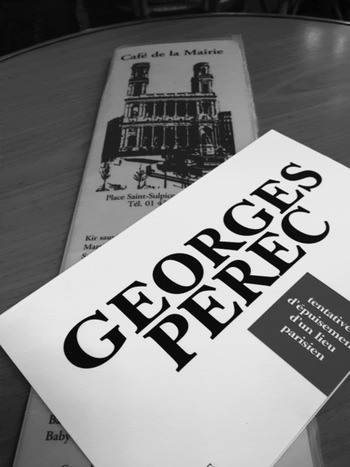
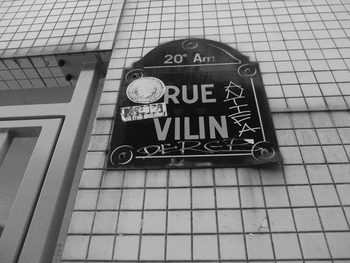
This summer (2015), I re-staged Perec's Attempt; perhaps it's more accurate to say that I staged an “attempt” at his Attempt. In Paris for only a few (brutally hot) days, I went to the Place Saint-Sulpice, where Perec had spent his three days, and sat at an outdoor table at the Café de la Mairie, one of his stations. I ordered a sandwich, and later a coffee, and I drank multiple glasses of water. I sat for what seemed like a long time with my notebook and pen, working without much success at eavesdropping and taking notes on everything I saw, near and far. I tried to capture detail (“A chubby man in a blue t-shirt”) and pattern (“Most people are in twos”), singularity (“A woman in a white dress takes a photo of the Église”) and repetition (“The no. 70 bus has just stopped in front of the café … Another # 70 bus is stopping … another # 70”). I tried not to speculate (“To my right: a trio of, I think, a mother and 2 sons in their 20s, v. cute”) or judge (“She's smoking, 3 inches from me and my sandwich!”) or arbitrarily toss out anything I'd noticed. I tried—in vain, of course—to keep up. I felt a little self-conscious, and distracted by my own feelings of being “out of place.” I took a few photographs of the book (Photo 1), which I'd just bought in the original French (my first Tentative), and my menu, and the café awning, and parts of my own face. I recognized what I'd already known—that Perec had taken on and succeeded at a monumental task. I hadn't done that, nor had I channeled him through reportage or, the next day, through an exasperating but engaging effort to locate buildings in Belleville he'd lived in or written about (Photo 2). As when I tried to experience his words through movement, I failed, but I'd had a new, vivid experience.
Georges Perec's Tentative d’épuisement d'un lieu parisien atop Café de la Mairie menu. Place Saint-Sulpice, Paris 2015. Photo by Leslie Satin.

Rue Vilin, former street of Georges Perec. Paris 2015. Photo by Leslie Satin.

Perec's fiction, like his descriptions and lists, demonstrates this urgency of seeing and identifying. In the short early Things, he tells without dialogue the tale of a couple—a sad tale marked by emptiness and estrangement—largely through the recitation of the objects they own or desire. And at the far reaches of length and density in his 1978 Life: A User's Manual, he creates a wildly imaginative and minutely organized novel of intertwining stories, each a world stuffed with vivid detail. At both compositional extremes, and the range of works between, he articulates his desire to display the materials of his personal nature morte and living memories, and to use similar strategies, some autobiographically derived, some not, to create scaffoldings for imaginary lives; he enacts his drive to continually re-arrange these props for the lives they collectively portray and produce, and to acknowledge that these things are moved, altered, replaced, lost, erased.
These things are sometimes “pure”: entries in a list; generally, they are the stuff of something larger: actions, events, musings. Whether written elaborately or in passing, in wide or narrow focus, they are embedded, always, in narratives of pathos, loss, and death. Traveling through the realm of Perec's writing takes us through what Harry Matthews called “hills of sorrow” (Reference Matthews2009, 9). At the most explicit level of autobiography, his work is haunted by what is rarely or never said, by what is unbearable. Perec, writes David Bellos,Footnote 26 “made gap or absence the constitutive device of all his writing…. [His] work is explicitly built on nothing, on the absence that lies at the heart of language, and which is the truest expression of the self” (Reference Bellos2009, 18). Perec's writing hovers above pain and suffering—the irretrievable central loss of his life: the death of his own parents when he was a small child, and, more broadly, the death of the Jews among whom they numbered. Implicitly, even some of Perec's more humorous writing, such as The Art of Asking Your Boss for a Raise (Reference Perec and Bellos2011/1968), suggests a hole, a gap: what we can never know, can never fully comprehend, can or will never say no matter how many words we deploy.
Dance is the art form alternately prized and dismissed for moving into just that sphere—the body—“beyond language.” These matters of the unknown and the unspoken figure differently in dance. For one thing, there is the real-time, real-space presentness of dance, which makes the thoroughness of the body catalogue—itself always relational, linked to other bodies, spatial surroundings—at once entirely necessary and entirely impossible. Put another way, it's how the dancer negotiates the webs of time and space, whatever she is or is not doing. “A body still,” wrote Cunningham in Reference Cunningham1952, “is taking up just as much space and time as a body moving” (150).
How much space and time a body takes up is only part of how we “get” it—how we understand it as making meaning within its multiple choreographic worlds. Seeing that still or moving body, experiencing it in light of its circumstances—like Species of Spaces’ smallest-to-largest areas, beds to planets, in which Perec sets his life—is contingent on layered webs of contextual information that encompass the material properties of the production as well as the personal and aesthetic history and perspectives we bring to the task. We change our minds: Mulvey came to see her historic “male gaze” as reductively binary (Sassatelli Reference Sassatelli2011); Rainer modified the notion of the “Neutral Doer” she had proposed (Phelan Reference Phelan and Rainer1999).
Even so, Rainer's early elucidation of that proposal, Trio A, opened up the experience of seeing. It presaged Perec's call to readers to notice what is around them, even if they have been there, looked there, before. Paralleling Perec's lists of things, it laid out a chain of everyday-ish movement, simply “done” rather than “performed,” letting viewers simply, “flatly,” just look, take it all in, notice the detail of the ordinary, the specificity and particularity of the everyday, consider it as dance. Doing the dance makes the challenge of seeing it even clearer: In two recent workshops taught by Pat Catterson, I learned about 1 ½ minutes of the 4 ½-minute long dance which I had viewed many times on video and quite a few times live; I was awed by how much I had missed, nuances of movement events and qualities, “midst the plethora.”Footnote 27
Understanding art and everyday life is complicated by the ways we comprehend and experience, over time, “our bodies, ourselves,” as that manual of resistance proclaimed not long after the Judson dancers had staked out its territory (Boston Women's Health Book Collective 1973). At the same time … it is not the same time, and the ideas and bodies have changed. Those dancers, most of them quite young, were full of brilliant ideas and energy and strategies for rethinking what dance could be; they had before them seemingly limitless space and time to make innumerable dances with their strong, healthy bodies, and to find depth and pleasure in conceiving those bodies as impeccably designed systems of movement. There was a kind of pedestrian glory in the notion of “the body as object” that permeated the Judson experiments.
Some of this glory has been recast as the dancers, and even the next few generations, have gotten older. In 1994, Performing Arts Journal ran a series, “Ages of the Avant-Garde,” in which artists over fifty reflected on how “the passage of time [had] altered their work and their perception” (Marranca and Dasgupta Reference Marranca and Dasgupta1994, 9). Like Perec's haunted writing, these artists’ accounts included—along with inspiring testimony of developing work and vigorous lives—elements of lack, loss, and failure; of public and private humiliations; of infirmity, illness, and death. Reading this series of essays when it was published, more or less comfortably distanced from the age cut-off, I first saw that “the body as object” had become somewhat less glorious, neither parts nor whole entirely or endlessly dependable; this framework had come to seem contingent, not simply a matter of aesthetic option but of biography and fortune. Twenty years down the road, I realize that contingency itself is only, as they say, a matter of time. I dance nearly every day, like almost every other working dancer I know, the dailiness suffused with dance's merging of the physical, physiological, intellectual, emotional, and spiritual dimensions of experience, its gifts of intensity, stimulation, and presentness—and with the distant awareness that any leap could be my last.
This raises for me the multiple meanings of the term “exhaustion,” which Perec uses in terms of space, most pointedly in An Attempt at Exhausting a Place in Paris but really in all of the works that lay out his dedicatedly materialist approach to representing life and lives. To exhaust is not only to know or use thoroughly, but to use up, to deplete, to empty out, to destroy. What does it mean, then, when not only a place is exhausted but a concept, an art form, a body? (How) does the thorough, or relentless, naming of things produce or resist exhaustion?
In dance, the answers to these questions are both multiple and contradictory, conceptual and corporeal.Footnote 28 Joining the body to consciousness and identity figures into understanding exhaustion in a more literal, physical sense. Readers of Perec are struck by his massive project of language—the pointed thoroughness of his documentation. In dance, as I have said, this is simultaneously desirable and problematic, an avenue to and a distraction from presentness, and, in any event, out of reach. Contemporary dancers in particular, schooled in somatics as well as anatomy, are aware of a range of bodily systems as well as pedagogies of dance technique. Some systems and practices assume each dancer's struggle to attain unattainable perfection; others shift the focus to working with one's own body. I recall my introduction, after years of ballet and modern dance training, to Klein Technique—one of the movement forms associated with alternatives to traditional Western practices. I felt lost in the space of my own body, no longer knowing how to stand, sit, or lie down, ignorant of how my bones and joints and muscles fit together, embarrassed to realize that I tensed my quadriceps when I turned my head, and that when I tried to relax them, something else slipped out of place.
Steve Paxton, founder of Contact Improvisation and famously eloquent about embodied experience, recounts two telling stories. In one, a blind woman washing dishes drops a soapy plate and catches it before it hits the floor, all her senses—principally those we identify as proprioceptive—collaborating to produce a series of integrated actions way faster than any cognitively thought-through problem-solving could (Reference Paxton, Dils and Albright1987/2001, 422). In the other, Paxton describes figuring out how to teach a difficult Aikido roll to students whose execution of the movement involves a gap in consciousness; at the scary moment of spatial disorientation, they automatically close their eyes. How, he asks, can we remain fully conscious for every moment of movement (Reference Paxton, Albright and Gere2003, 181)?
This question figures into systems of dance study and professional life that involve a deep experience of the body as a way of knowing, and a lifelong commitment to creating and retaining a fully knowing body. Each dance form has its own definitions of what that means and how to achieve it. Whatever the specifics, every dancer takes on the fascinating and forbidding task of seeing one's internal self-portrait, naming and activating its uncountable parts, understanding the map of its every intra- and inter-action, cells and blood and organs and all the moveable parts. She links this information to the image in the mirror, a complex weave of gender, psychology, and sensation. I must know and recall the numberless actions of my own dance history—today's performance, all the movements of my life that have come before it, all the spatial circumstances that contextualized those movements. I will never, of course, be able to literally name these the way Perec counted beds and buses—no one, living his or her everyday life, can keep a conscious tether to our breathe-in, breathe-out, every-second corporeality—but I am humbled by the depth, reach, and implicativeness of his lists.
I already have what I consider a grateful practice, in which I get to spend a part of every day learning something new about the very small field of my own body. I encounter both the sweaty, achy, “regular” exhaustion that follows strenuous activity and the long-term, slow-acting depletions of getting older—the more potent exhaustion built into the work. Of course, all of this is true for any physical activity, pedestrian and beyond. But for dancers, it is at the center of the work and of the individual and collective cycles of consciousness and identity as well as, simply, human life. I don't travel in choreographic circles where your career ends when your tour en l'air droops. But there's no denying the bloom of young dancing bodies, or the sweeping in of the new and vigorous avant-garde, so we figure out daily ways to maintain our energy, momentum, strength, and passion, to stay in the game.
I am struck that Perec, with all his words, his brilliantly composed lists, palindromes, lipograms, and other responses to the games he invented, kept the body at the center of his writing. In a Reference Perec and Adair1965 interview, he said that the happiness of the characters in Things is “a very ‘bodily’ value,” emerging from “an almost technical relationship … to the world” of objects (Bénabou and Marcenac Reference Bénabou and Marcenac2009, 25–26). More broadly, his own body is always implied in the traces we read: the lists of his stuff, the naming of his actions, the citing of his memories, so many of them, especially in W, honed in on a body or part—its appearance, its history, gauged from photographs, memories, fantasies. He writes there of the little scar above his lip, a lasting marker of injustice at the hand of a schoolmate during the War, the stated reason for his refusal years later to wear a moustache, a prompt to a painting that shows up in several novels and a film.Footnote 29 He writes into being the mother and father whose faces and bodies he knows only from photos, their suggestions imagined into stories, relationships, caresses.
Writing oneself into being is central, even seminal, to the literary autobiographical impulse. For many authors—and for the performers who have moved into self-representational terrain—there is considerable play, choice, and aesthetic positioning in the project, as is clear from the decades-long explorations of personal and cultural identity, of autobiographical and aesthetic conventions, and of performativity itself, in contemporary Western practice. There is also the deep desire to make ourselves known, to ourselves and to others: to be seen, to be read, to be integrated into a world that makes some kind of sense. For Perec, I think, that desire charged even his most materialist, most ludic, most adventurous experiments in writing. For dancers and choreographers, everyday practice and movement itself offer endless opportunities to experience ourselves and others in embodied mindfulness and to (re)situate ourselves in time, in space, and in our own bones.