Although the prevention and management of malignancy-associated hyperuricemia is well described in children, there is no consensus for the optimal management of acute hyperuricemia in other populations, particularly among paediatric cardiology patients. Prior investigations have associated elevated uric acid level with worse outcomes including acute kidney injury and higher incidence of mortality; however, these findings are inconsistent and primarily in different, largely adult populations.Reference Anker, Doehner and Rauchhaus 1 – Reference Zhang, Dierckx, Mohee, Clark and Cleland 5 The aetiology of hyperuricemia in patients with cardiac disease is often multifactorial and may include decreased elimination due to lower urinary output in acute kidney injury associated with the underlying cardiac disease.Reference Baldree and Stapleton 6 Alternatively, insults such as cardiopulmonary bypass, heart failure, and sepsis which lead to up-regulation of inflammatory cytokines, oxidative injury, and haemolysis are known to cause acute kidney injury and may simultaneously result in increase in the generation of uric acid.Reference Cooper, Kwiatkowki, Goldstein and Krawczeski 7 – Reference Fathallah-Shaykh and Cramer 8 Conversely, it is believed that hyperuricemia may lead to the development of acute kidney injury through multiple mechanisms, including the crystallisation of uric acid and its by-products.Reference Baldree and Stapleton 6
Hyperuricemia can be treated with pharmacologic agents that lower serum uric acid levels or reduce formation of new uric acid. Rasburicase is an intravenous recombinant urate oxidase that converts uric acid to water-soluble allantoin for renal excretion, and does not lead to accumulation of intermediate metabolites. It is approved for treatment of tumour lysis syndrome as a weight-based dose daily for 5 days, 9 although single and fixed-dose regimens have been reported to be effective in lowering uric acid levels.Reference Boutin, Blackman, O’sullivan and Forcello 10 , Reference Vadhan-Raj, Fayad and Fanale 11 Allopurinol, available in both enteral and parenteral forms, is an inhibitor of xanthine oxidase, which blocks further synthesis of uric acid from urate. However, allopurinol does not affect existing serum uric acid levels and thus may require a longer treatment course. 12
Although many studies exist to guide hyperuricemia management in adults and children with oncologic disease processes, studies in other medical and surgical populations are limited. Hyperuricemia is often observed in critically ill children with cardiac disease, possibly related to inflammatory states, low cardiac output states, or other conditions that disrupt renal perfusion. In order to mitigate additional preventable risk factors for acute kidney injury, critically ill patients with hyperuricemia often undergo treatment; however, it is unknown whether rasburicase or allopurinol should be used. In this study, we aimed to determine if rasburicase or allopurinol was more effective at decreasing uric acid level in children with hyperuricemia in the cardiovascular ICU and to evaluate the cost effectiveness of each course of therapy. Our hypothesis was that the use of rasburicase may lead to shorter treatment course and faster normalisation of serum uric acid levels compared to IV allopurinol.
Materials and methods
We conducted a single-centre retrospective chart review of patients treated for acute hyperuricemia in the cardiovascular ICU at a quaternary referral paediatric hospital (Lucile Packard Children’s Hospital Stanford) between January, 2015 and July, 2017. The study was approved by the Stanford University Institutional Review Board. Pharmacy records of inpatient medication history of rasburicase and intravenous allopurinol were queried. Patients were excluded for the following: outpatient prescription for enteral allopurinol prior to admission, concomitant rasburicase and allopurinol therapy, renal replacement therapy within 3 days of medication, or pre-treatment uric acid level less than 8 mg/dl, which is common institutional practice and has previously been used as a threshold for hyperuricemia.Reference Hobbs, Steinke, Chung, Barletta and Bunchman 13 – Reference De Angelis, Noce and Di Renzo 15 We collected demographic information including age, gender, weight, primary cardiac diagnosis, and surgical history. We evaluated all serum uric acid and creatinine levels prior to treatment and for 7 days after initiation of therapy, as well as the number of doses administered per treatment course for each medication. We staged degree of acute kidney injury using the KDIGO criteria, using the lowest serum creatinine within 3 months of medication administration as the patient’s baseline.Reference Kellum and Lameire 16
The primary objective was to determine if treatment modality was associated with the percentage of patients with a uric acid level less than 8 mg/dl on the day after treatment initiation. Secondary outcomes included determining the association with: change in uric acid level between baseline and post-treatment day 1, changes in serum creatinine level 3 and 7 days after initiation of therapy, time to normalisation of serum creatinine level according to reference ranges for age and gender, and average cost of treatment. Comparison of cost of treatment course was normalised to a 20 kg patient, which was the median weight of this cohort, and based on the average wholesale price of each medication: $964 for 1.5 mg vial of rasburicase and $4680 for a 500 mg vial of allopurinol injection, 17 and median number of doses per treatment course.
All data were tested for normality and were presented either as mean with standard deviation or median and interquartile range as appropriate. Non-parametric group data were compared using Fisher’s exact test, and the Wilcoxon rank sum test as appropriate. All statistical testing was performed using SPSS version 23.0 (IBM SPSS Statistics, NY, United States of America). All differences in statistical analysis were considered significant if p value was less than 0.05.
Results
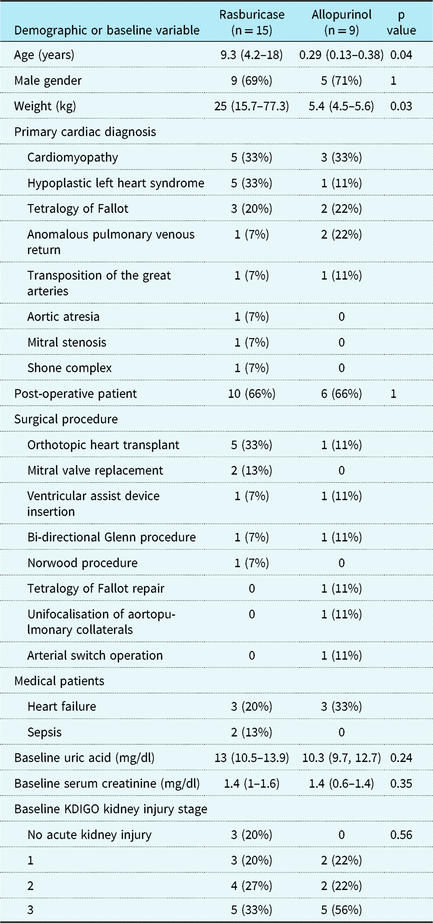
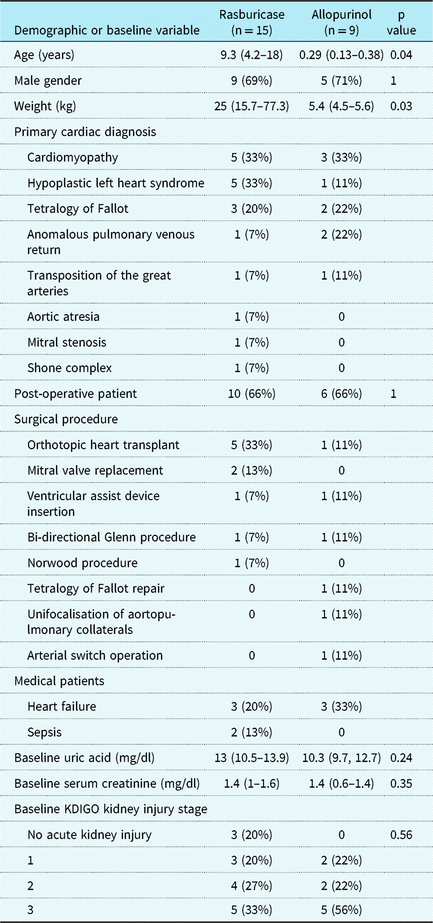
A full description of the cohort’s patient characteristics is shown in Table 1. Initially, 59 treatment courses of rasburicase or IV allopurinol were identified. Of the 37 doses of rasburicase, 18 were excluded: 13 for receiving renal replacement therapy, 3 for a pre-treatment uric acid level less than 8 mg/dl, and 2 for receiving chronic allopurinol therapy. In the allopurinol group, 22 treatment courses were identified, with 9 patients excluded: 4 for receiving renal replacement therapy, 3 receiving allopurinol prior to hospital admission, and 2 for a pre-treatment uric acid level less than 8 mg/dl. Four patients were excluded for having received both therapies within 7 days. A total of 20 unique patients were identified meeting inclusion criteria: 13 patients received 15 doses of rasburicase and 7 patients received 9 treatment courses of IV allopurinol. The median age for rasburicase group was 9 years (IQR 4–18 years) and median age for allopurinol group was 3 months (IQR 1–4 months). There was no difference in pre-treatment uric acid or serum creatinine levels (Table 1). One patient who received rasburicase and two patients who received allopurinol did not have a uric acid measured on post-treatment day 1, resulting in a final cohort of 14 treatment courses of rasburicase and 7 courses of intravenous allopurinol for interrogation of the primary objective.
Baseline demographics
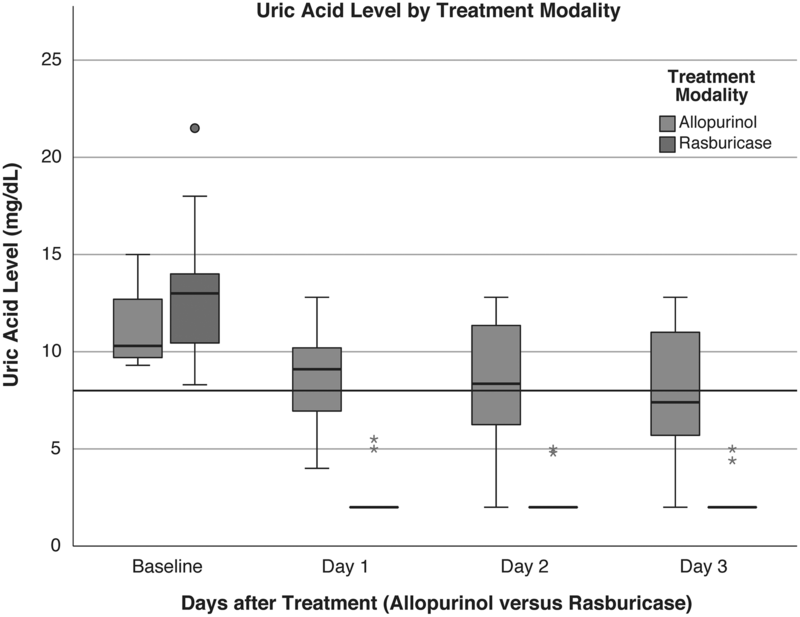
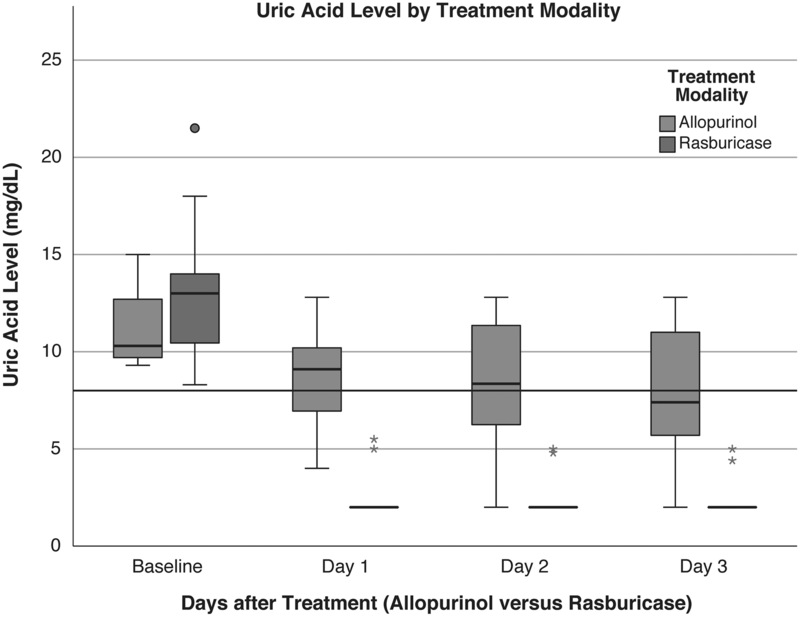
Fourteen patients who received rasburicase had a post-treatment day 1 serum uric acid level measured. The serum uric acid level was less than 8 mg/dl in all 14 patients (100%). Seven patients who received allopurinol had a post-treatment day 1 uric acid measured, which was less than 8 mg/dl in three patients (43%; p = 0.0058). The decreasing uric acid level trend also resulted in a greater absolute reduction in uric acid (Fig 1). Uric acid values repeated within 7 days of rasburicase administration remained within the normal range in 13/14 patients (93%). One patient had a level of 8 mg/dl on post-treatment day 6 and was subsequently redosed with rasburicase on post-treatment day 7, resulting in a serum uric acid level of less than 2 mg/dl on day 8.
Time course of uric acid with rasburicase and IV allopurinol.
Twelve of 15 (80%) patients in the rasburicase group and all 9 (100%) patients in the allopurinol group had an acute kidney injury prior to the intervention. There were no differences in changes in serum creatinine on post-treatment day 3 or 7, or the time for the serum creatinine to decrease to the normal range (Table 2). On post-treatment day 7, nine (60%) patients in the rasburicase group and four (44%) patients in the allopurinol group had a serum creatinine within the normal reference range for age and gender (p = 0.68).
Patients receiving rasburicase were administered a median of 1 dose per treatment, while patients receiving IV allopurinol were administered a median of 4.5 doses. The average cost for a single normalised treatment course was significantly less for rasburicase compared to IV allopurinol ($1928 versus $18,720; p < 0.001).
Changes in uric acid and serum creatinine

Discussion
Our study suggests that critically ill paediatric cardiology patients who receive rasburicase have a greater probability of achieving a normal uric acid compared to patients who receive intravenous allopurinol. The greater reduction between baseline serum uric acid level and post-treatment day 1 serum uric acid level is consistent with the mechanism of action of each medication and the literature in other populations that describe a more rapid onset and increased effect of rasburicase. The uric acid-lowering effect of rasburicase persisted for up to 7 days in the majority of patients. Patients who were continued on allopurinol continued to experience unchanged or decreased serum uric acid levels over the 7-day study period. No difference was seen between the groups with respect to serum creatinine levels, although our study was not powered to detect this difference and therefore future prospective studies should analyse these results.
Prior to this study at our institution, the decision to monitor for hyperuricemia and pharmacologically manage elevated levels had been inconsistent and provider-specific. Although uric acid levels that prompted treatment varied, 8 mg/dl was a commonly used threshold. The chosen medication for treatment varied among provider, occasionally with the assistance of nephrology or pharmacy consultation. A significant increase in the price of intravenous allopurinol in 2015–2016 prompted this investigation. We hope to use these results and potential future studies to develop treatment standards.
Four patients who were not included in the analysis were initially treated with IV allopurinol for at least 1 day and then subsequently received a dose of rasburicase, while no patients who received rasburicase were subsequently administered IV allopurinol. This population was not included in our study analysis. Although the reason for transition in medication is unknown in this retrospective study, potential reasons include perceived treatment failure with persistently elevated uric acid levels, concerns for the adverse effects associated with allopurinol such as hypersensitivity reactions or renal or hepatic toxicity, or provider concerns related to the associated costs.
The association between serum uric acid and clinical outcomes in critically ill paediatric cardiac patients remains controversial. Serum uric acid has previously been associated with acute kidney injury in adult patients, including in patients undergoing cardiac surgery.Reference Xu, Hu, Song, Chen, Zhang and Ding 18 , Reference Ejaz, Kambhampati and Ejaz 19 Ejaz and colleagues demonstrated that in adults with moderate renal dysfunction and hyperuricemia, rasburicase administered prior to cardiac surgery did not affect post-operative serum creatinine but decreased urine neutrophil-associated lipocalin – a specific marker of renal tubular injury.Reference Ejaz, Dass and Lingegowda 20 The association between uric acid and risk of acute kidney injury in the paediatric cardiac population has not been well studied. In addition, a recent paper demonstrated that hyperuricemia in adult patients with CHD may have significantly higher risk of cardiovascular death,Reference Rodríguez-Hernández, Rodríguez-González, Riaño-Ruiz and Martínez-Quintana 21 suggesting the increasing importance of hyperuricemia treatment in cardiac patients.
The mechanism by which elevated levels of uric acid predispose acute kidney injury is incompletely understood and likely multifactorial. The most commonly referenced mechanism is the increase of urate load on the kidney and precipitation of crystals in the acidotic environment of the distal nephron.Reference Conger 22 However, additional potential pathways include uric acid activation of the renin–angiotensin system, Reference Nakagawa, Mazzali and Kang 23 inhibition of the nitric oxide synthase pathways,Reference Mazzali, Hughes and Kim 24 oxidative stress,Reference Corry, Eslami, Yamamoto, Nyby, Makino and Tuck 25 stimulation of vascular smooth muscle cell proliferation,Reference Corry, Eslami, Yamamoto, Nyby, Makino and Tuck 25 and up-regulation of injurious inflammatory cytokine pathways.Reference Kang, Nakagawa and Feng 26 , Reference Nakagawa, Mazzali, Kang, Sanchez-Lozada, Herrera-Acosta and Johnson 27 Although studies have investigated therapies to decrease uric acid levels, it remains unknown if interventions to decrease the uric acid levels have any impact on the likelihood for development of acute kidney injury and this must be a focus of future studies, especially in this population.
Notably, the converse relationship exists, such that acute kidney injury is associated with higher levels of uric acid. Urate must be continuously excreted to prevent accumulation and 75% is excreted through urine.Reference Baldree and Stapleton 6 Oliguria due to acute kidney injury will lead to a decrease in uric acid elimination. Additionally, it is also possible that hyperuricemia is due to mechanisms that cause increased generation of uric acid and independently cause acute kidney injury, such as the cardiopulmonary bypass-induced inflammatory processes and induced haemolysis.Reference Cooper, Kwiatkowki, Goldstein and Krawczeski 7 – Reference Fathallah-Shaykh and Cramer 8 , Reference Christen, Finckh and Lykkesfeldt 28
The utility of uric acid-lowering therapies has been evaluated in children and adults with haematologic malignancies and acute kidney injury. In a case series of seven infants with hyperuricemia secondary to acute kidney injury, rasburicase was associated with a significant decrease serum uric acid levels and serum creatinine and increase in urine output.Reference Hobbs, Steinke, Chung, Barletta and Bunchman 13 Several studies have also compared rasburicase to allopurinol, including in the paediatric population. In a study of 52 children with haematologic malignancies and high risk for tumour lysis syndrome, rasburicase was associated with a 2.6-fold greater decrease in uric acid levels compared to oral allopurinol. This trend was particularly pronounced in uric acid level 4 hours after treatment. Serum creatinine improved in the rasburicase group but not the allopurinol group, suggesting a potential protective effect of uric acid-lowering therapies on renal function.Reference Cortes, Moore and Maziarz 29 Other studies in adults with haematologic malignancy and those with renal failure have shown that rasburicase was more likely to decrease uric acid level than allopurinol.Reference De Angelis, Noce and Di Renzo 15 , Reference Cortes, Moore and Maziarz 29 Ours is the first study to look at treatment of hyperuricemia in a critically ill paediatric cardiac population.
The cost of each medication treatment used for comparison is dependent upon patient weight, number of doses required per treatment, vial size, and vial cost. Each vial of intravenous allopurinol contains 500 mg and costs $4680. Treatment requires use of one vial, regardless of size. Patients were administered a median of 4 doses per treatment for a total cost of $18,700 regardless of size. Rasburicase vials each contain 1.5 mg and cost $964 per vial. Given rasburicase dosing of 0.15 mg/kg, the cost per dose is $96.4 per kg, which must be rounded up to the nearest $964 mg due to vial size. For illustration, this would result in a cost of $964 for a 4 kg infant, $964 for a 10 kg child, and $7712 for an 80 kg adult. Comparative analysis utilised a median weight of 20 kg; however, regardless of patient size treatment with rasburicase is cost advantageous compared to allopurinol.
There are several limitations to the results and generalisability of this study. The lack of standard medication administration times or laboratory monitoring creates challenges in evaluating the time course of changes in uric acid. However, our results are consistent enough over time that we believe this is unlikely to affect our findings. The heterogeneous population in our paediatric cardiovascular ICU may have responded differently to interventions or resulted in a selection bias in prescribing based on patient characteristics or acuity. Notably, those treated with allopurinol were younger and weighed less. Although the reason for variation in weight and age among the treatment arms is unknown, it was likely influenced by provider preference. Notably five of six patients with hyperuricemia after heart transplant utilised rasburicase, and all of these patients were relatively older. Selection bias by the heart transplant service may have existed, thereby skewing the median age and weight of this cohort. Additionally, it is possible that the decision to use allopurinol in smaller patients was influenced by fluid volume of therapy. It is recommended that rasburicase be dissolved in 50 ml of solution, which may represent a significant fluid volume for smaller patients. Additionally, serum creatinine is only a surrogate for renal function and may be influenced by other factors such as fluid overload and muscle mass. Urine output, fluid status, and diuretic administration were not reviewed in this study to predict excretion of uric acid. Replicating this study using more specific biomarkers in a randomised controlled trial may improve the ability to detect the effects of interventions on renal function. Although the cost savings associated with rasburicase were notable, it should be noted that oral allopurinol is significantly less expensive than the IV formulation and therefore may be cost effective in the appropriate patient population. Finally, given the retrospective nature and small cohort size, we were also unable to account for confounding factors such as significant clinical events, exposure to nephrotoxic medications, and other ongoing renal insults.
Our study is the first to demonstrate that in a critically ill paediatric cardiac population, rasburicase was associated with a higher probability of achieving a normal uric acid level and a lower overall level after treatment as compared to IV allopurinol. A single dose of rasburicase was also associated with a lower cost compared to a treatment course of IV allopurinol. These data could be used to guide management of acute hyperuricemia in paediatric cardiac patients. Prospective studies should be conducted to confirm causation and assess the effect of hyperuricemia treatment on clinical outcomes.
Author ORCIDs
David Kwiatkowski 0000-0003-3331-9280
Acknowledgements
None.
Financial Support
This research received no specific grant from any funding agency, commercial, or not-for-profit sectors.
Conflicts of Interest
None.