

The Santiago Principles, or Generally Accepted Principles and Practices (GAPP) for sovereign wealth funds (SWFs), were agreed upon by the International Working Group of Sovereign Wealth Funds (IWG) in Santiago, Chile, in October 2008. The IWG consists of twenty-six International Monetary Fund (IMF) member countries with SWFs, including the People's Republic of China, the Republic of Korea, and Singapore, and was set up in April/May 2008 to identify and draft a set of generally accepted principles and practices that suitably reflected their investment practices and objectives. The GAPP is based on the recognition that it is important to demonstrate to home and host countries and the international financial markets that the SWF institutional framework is properly set up and investments are made on the basis of economic and financial criteria. The GAPP is underpinned by the following guiding objectives for SWFs: (1) to contribute towards global financial stability and the free cross-border flow of capital and investment; (2) to comply with the regulations and disclosure requirements of the host countries; (3) to invest purely on the back of financial and economic risk and return; and (4) to set up a transparent and sound governance structure which ensures adequate operational controls, risk management, and accountability.
The establishment of the Santiago Principles was a direct response to the fears and concerns about the alleged risks and dangers posed by the investment activities of SWFs. Those activities were viewed as potentially threatening to and compromising the national security, economic interests, and, more broadly, national welfare of the host countries. The fact that the SWFs were primarily from developing countries with different political systems while the host countries were often industrialized countries further intensified hostility towards SWFs. The general lack of transparency and disclosure about their governance structure and investment strategy raised suspicions in the host countries that SWFs were motivated by ominous non-commercial political or strategic objectives. Those suspicions were heightened due to the state-owned nature of the SWFs. The overall stereotype of SWFs in the host countries was one of opaque, well-endowed state-owned organizations from countries with different political systems seeking to take over firms and industries vital to the national interest. Host-country politicians stirred the pot and called for strict regulations against investments by SWFs. While such hostility contained elements of legitimate concern, it also had more than a hint of financial protectionism. An additional underlying factor behind host-country fears about SWFs and their investment activities was their sheer size—the collective size of the assets under the management of SWFs had reached around US$3 trillion by 2007 and could reach US$12 trillion by 2015—and explosive growth, especially evident in the emergence of new SWFs in developing Asia.
One of the most significant developments in the global economic landscape since the Asian financial crisis of 1997–98 is the transformation of developing Asia from a net capital importer to a net capital exporter. This development was to a large extent driven by the large and persistent current account surpluses developing Asia has run since that crisis. It is important to note that before the Asian crisis, the region as a whole ran current account deficits. Therefore, contrary to popular perception, current account surpluses are a relatively new phenomenon in the region. A significant consequence of those surpluses has been an unprecedented accumulation of foreign exchange (FX) reserves by the central banks of the region. The reserves have increased so fast that there is a growing consensus that they now exceed all plausible estimates of what are required for traditional liquidity purposes. The emergence of surplus reserves, in turn, has prompted widespread calls for more active management of FX reserves with a view towards maximizing risk-adjusted returns rather than preventing unexpected shortages of international liquidity.
SWFs provide a natural blueprint for the proposed shift of surplus FX reserves from passive liquidity management to active profit-seeking investment. Unlike central banks, which traditionally manage reserves for liquidity purposes, SWFs are state-owned institutions which use reserves to pursue commercial profits. The predictable response of regional policy-makers to the emergence of large and growing surplus reserves has been to set up SWFs as a means of using those resources more productively. Although SWFs have been largely under the radar until quite recently, they have been around for a long time. In fact, the commercial success of some well-established SWFs has been a major motivation behind the establishment of SWFs in developing Asia. In particular, due to their strong investment track records, Temasek Holdings and the Government of Singapore Investment Corporation (GIC)—the two Singaporean SWFs—have attracted the attention of regional policy-makers as a potential benchmark model. In short, Asian countries are setting up SWFs as a policy tool for coping with the relatively new phenomenon of surplus reserves.
The central objective of this article is to examine the consistency between the Santiago Principles or the GAPP and the commercial self-interest of the SWFs. To the extent that the two are consistent, the GAPP are redundant in the sense that SWFs would have adopted them on their own purely out of self-interest even in the absence of the GAPP. Put differently, even though the GAPP is a voluntary code of conduct without any binding force, its provisions are likely to be complied with by SWFs if it is in their self-interest to do so. Answering our central question—whether the Santiago Principles and SWF commercial self-interest are mutually consistent—requires delving into the origins of the SWFs, i.e. why they were created in the first place. The underlying rationale behind their creation will go a long way towards informing us about whether or not SWFs are likely to conduct themselves along the lines outlined by the GAPP. More specifically, we delve into the origins of SWFs in developing Asia to identify the primary drivers of their creation. Crucially, as explained in full detail in Park,Footnote 1 developing Asia's SWFs are fundamentally commercial entities which have been created to make more productive use of the region's large and growing surplus FX reserves. The essentially commercial character of the SWFs implies an intrinsic alignment between the interests of the SWFs and host countries and is discussed in more detail in this article.
The rest of this article is organized as follows. In Section I, we provide the background for the emergence of the SWFs in developing Asia. In Section II, we evaluate the consistency between the commercial self-interest of the SWFs and the Santiago Principles. Section III concludes the article with some final thoughts and observations.
I. Surplus foreign exchange reserves and the rise of sovereign wealth funds in developing Asia
Prior to the 1997–1998 Asian financial crisis, developing Asia as a whole had run a current account deficit vis-à-vis the rest of the world, but since the crisis the region has run a large and persistent surplus. This reversal of the current account position explains much of the region's unprecedented accumulation of FX reserves in the post-crisis period. In some countries such as the People's Republic of China and the Republic of Korea, substantial amounts of net capital inflows have further added to the reserve build-up. There are two main explanations for the build-up—the precautionary and the mercantilist motives.
According to the precautionary explanation, in response to the economic and social devastation wrought by the financial crisis, Asian countries sought to protect their economies against sudden shortages of international liquidity by accumulating large reserves. It is difficult to exaggerate the deep impact of the crisis on the collective psyche of the region. According to the mercantilist explanation, developing Asia's soaring reserves are definitive proof of the region's over-dependence on exports as an engine of growth. Asian central banks purchase foreign exchange to keep their currencies weak and thus promote exports.
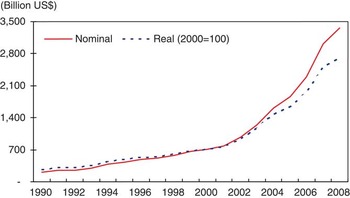
Whatever the motive behind the accumulation of reserves, given that both probably played some role, what is beyond doubt is that the accumulation has been truly phenomenal in its scale and speed. Figure 1 shows the growth in developing Asia's total FX reserves between 1990 and 2008 in both nominal and real terms. During this period, developing Asia's reserves surged from US$202 billion to US$3,370 billion in nominal terms and from US$267 billion to US$2,695 billion in inflation-adjusted terms. During the subperiod of 1990–2000, the region's reserves rose from US$202 billion to US$709 billion in nominal terms and from US$267 billion to US$709 billion in real terms. During the more recent subperiod of 2000–2008, the growth of regional reserves has further picked up, rising from US$709 billion to US$3,370 billion in nominal terms and from US$709 billion to US$2,695 billion in real terms. In nominal terms, the average annual growth rate of the reserves was 16.9, 13.4, and 21.5 percent for the periods of 1990–2008, 1990–2000, and 2000–08, respectively. In real terms, the average annual growth rate was 13.7, 10.3, and 18.2 percent, respectively, during the same periods. The overall picture is one of secular growth in developing Asia's reserves since 1990, punctuated by a noticeable acceleration of growth since 2000. As reserve accumulation hastened after the financial crisis, some analysts argue that the self-insurance motive may have played a more important role than the mercantilist motive. Moreover, high export growth, on which the mercantilist explanation is anchored, is not a phenomenon that occurred only after the crisis but has been the experience for the past three to five decades of high-reserve-holding economies in East Asia. Aizenman and Lee provide extended discussions of the reasons for holding reserves and find strong empirical support for the self-insurance motive.Footnote 2
Nominal and real foreign exchange reserves of developing Asia, 1990–2008. sources: Authors’ estimates based on data from CEIC Data Company and International Monetary Fund, International Financial Statistics online database: www.imfstatistics.org (both accessed 15 June 2009).

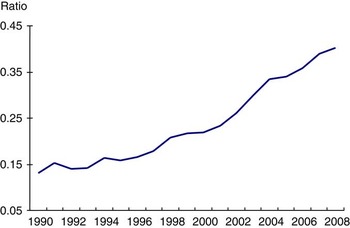
The growth of FX reserves in absolute terms over time partly mirrors developing Asia's economic growth over time. Therefore, to put the region's reserve build-up in better perspective, we scale its absolute reserves by its GDP. Figure 2 shows the amount of reserves relative to GDP. The reserves–GDP ratio shows a similar pattern as the amount of reserves—an uninterrupted increase. Developing Asia's reserves–GDP ratio rose from 13.1 percent in 1990, to 21.9 percent in 2000, and further to 40.2 percent in 2008.
Ratio of foreign exchange reserves to GDP, developing Asia, 1990–2008. sources: Authors’ estimates based on data from CEIC Data Company and International Monetary Fund, International Financial Statistics online database: www.imfstatistics.org (both accessed 15 June 2009).

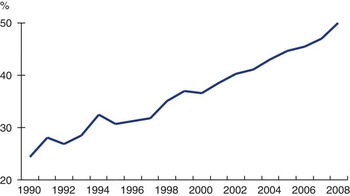
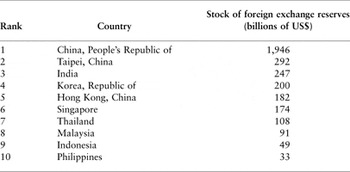
Yet another measure worth looking at to bring the region's FX reserve accumulation into sharper focus is the share of the region's reserves in relation to total world reserves. A tangible rise in the region's share would give further credibility to the global significance of developing Asia's reserve growth. Figure 3 shows that the region's share of global reserves rose from 24.4 percent in 1990, to 36.6 percent in 2000, and 50.2 percent in 2008. This suggests that developing Asia has indeed been accumulating reserves at a faster pace than the rest of the world, in fact more than twice as fast. However, the region's reserve accumulation is an integral part of a broader trend of accelerated reserve accumulation by developing countries, whose share of global reserves has risen from 30.2 percent to 67.6 percent in 2008. China accounts for more than fifty percent of developing Asia's total reserve growth between 1990 and 2008. Therefore, while the contribution of China to the reserve build-up is notable, the build-up is a region-wide rather than a China-specific phenomenon. Table 1 lists the region's top ten reserve holders as of the end of 2008.
Developing Asia's share of world reserves, 1990–2008. source: Author's estimates based on data from CEIC Data Company, International Monetary Fund (IMF), International Financial Statistics online database: www.imfstatistics.org, and IMF, Currency Composition of Official Foreign Exchange Reserves, online: www.imf.org/external/np/sta/cofer/eng/index.htm (all accessed 15 June 2009).

Developing Asia's top 10 reserve holders, 31 December 2008

sources: CEIC Data Company; International Monetary Fund, International Financial Statistics online database: www.imfstatistics.org (both accessed 15 June 2009).
FX reserves held by a central bank provide a range of possible benefits. Most immediately, liquid foreign currency assets are believed to provide an important source of self-insurance against the consequences of future financial crisis. Indeed, it has been argued by Hviding, Nowak, and Ricci,Footnote 3 and by Frankel and Wei,Footnote 4 that a sufficiently large stock of FX reserves might actually lower the probability of such a crisis occurring. This motive for developing Asia accumulating reserves has possibly been accentuated by their experience in the financial crisis, when a shortfall in dollar liquidity pushed many countries into deep economic trouble. It is possible, too, that an ample supply of FX reserves can improve a country's sovereign credit rating and, in this way, lower its overseas borrowing costs through the sovereign ceiling.
The second main reason for a central bank to purchase FX reserves is to lower the price of the domestic currency, or at least slow its rate of appreciation. Indeed, some of the region's central banks seem to have been purchasing foreign currency to slow rates of domestic appreciation, even though nominal exchange rates of North-East and South-East Asian countries have become more flexible in the post-crisis period. Such currency market intervention is frequently justified by a variety of reasons, but government concerns about the impact of a rapidly appreciating currency on macroeconomic stability and on the export sector often loom large. It is empirically difficult to assess the relative importance of the two main benefits of holding reserves, and it is likely that both played a role in developing Asia's FX reserve build-up.
Yet reserve accumulation also entails costs—some combination of higher inflation, expanded fiscal liabilities, and a higher interest rate. A central bank's issuance of domestic currency to purchase foreign exchange lifts reserve money, which may percolate into inflation. So, in order to “sterilize” the potential inflationary impact of reserve accumulation, central banks typically attempt to withdraw domestic liquidity by selling debt (in the form of bonds) to the non-bank public. But such sterilization operations entail fiscal costs when, as is often the case, the interest rate the central bank pays on its outstanding domestic bonds exceeds the yield on its foreign reserve assets. Higher interest rates may also follow, since central banks may be required to persuade the non-bank public to hold a larger stock of (sterilization) bonds. It is only an unusually favourable constellation of factors, such as the benign global inflationary environment and ample global liquidity, which has so far limited the costs of the recent run-up of reserves in Asia, according to Mohanty and Turner.Footnote 5
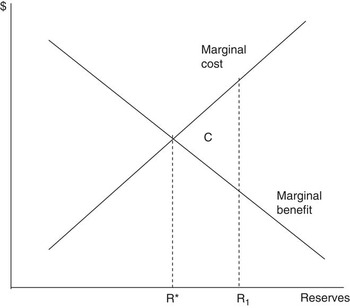
So what is the central bank's optimal reserve level? Clearly, this is neither infinite (since reserves entail costs) nor zero (since they yield benefits). Reserves are at their optimal level when the marginal benefit of a dollar of extra reserves equals its marginal cost, provided that the reserves are in the range where benefits exceed costs. At least beyond a certain level, the marginal benefit of reserves is likely to diminish as they increase. Beyond a point, the level of reserves may do little to reduce the likelihood of crisis or the capacity to cope with one. Likewise, beyond a certain level, the marginal cost of reserves is likely to rise as they increase, as sterilization operations become more expensive, complicating monetary policy.
Figure 4 presents a stylized illustration of the optimal reserve level R*, where the marginal benefit of reserves (i.e. the benefit of an additional dollar of reserves) equals their marginal cost (i.e. the cost of an additional dollar of reserves). Beyond R*, which is where many of the region's central banks are thought to be, accumulating reserves reduces social welfare, since the cost of a dollar exceeds the benefit. If, for example, the actual reserve level was R1, the amount of “excess reserves” is (R*−R1) and the total cost due to the excess is the triangle C. Reducing excess reserves would thus theoretically increase social welfare.
Optimal level of foreign exchange reserves.

Evidently, if a central bank has accumulated more reserves than is theoretically optimal, one must ask why, and what policy adjustments are needed to improve welfare. The most obvious solution to the problem of welfare-reducing excess reserves is to avoid accumulating them to begin with. But such a response will necessarily entail structural adjustments and the rebalancing of the economy, and as such has greater relevance over the longer run. More flexible exchange rate policies may also help, but they offer no guarantees of reversing reserve accumulation. For example, the Korean won has appreciated sharply since early 2002, yet its reserves have continued to grow.
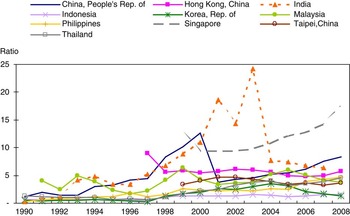
There is a growing consensus that developing Asia's reserves now exceed the optimal level, hence the surplus savings. To estimate the magnitude of developing Asia's surplus reserves, we now turn to some well-known measures of reserve adequacy.Footnote 6 While these measures are informal rules of thumb based on intuition rather than rigorously derived theoretical concepts, they perform quite well in empirical studies of reserve adequacy and thus provide useful guidance for policy-makers. Many such studies find one such rule of thumb—the ratio of reserves to short-term external debt—to be a particularly significant determinant of an economy's vulnerability to financial crisis. According to the so-called Greenspan–Guidotti rule, the critical value of this ratio is one, with a value below one signalling danger. The underlying idea here is that a country which has reserves equal to or more than all external debt falling due within one year should be able to service its immediate external obligations even during a financial crisis. Figure 5 clearly reveals that developing Asia comfortably passes the Greenspan–Guidotti test of reserve adequacy. The implication is that the region has substantial amounts of surplus reserves.
Ratio of foreign exchange reserves to short-term external debt in developing Asia's top 10 reserve holders, 1990–2008 (see online for a colour version of this figure). source: Authors’ estimates based on data from CEIC Data Company, Deutsche Bank Research, online Deutsche Bank Research: 〈www.dbresearch.de/servlet/reweb2.ReWEB?rwsite=DBR_INTERNET_EN-PROD〉, International Monetary Fund, International Financial Statistics online database: www.imfstatistics.org, and World Bank, Global Development Finance online database: http://databank.worldbank.org (all accessed 15 June 2009).

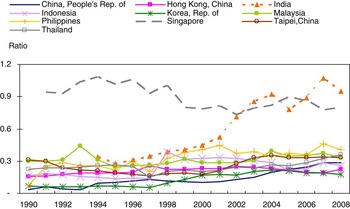
Another widely used indicator of reserve adequacy is the ratio of reserves to broad money (M2). This ratio is especially relevant for countries which are subject to a significant risk of capital flight. The underlying intuition is that the higher the ratio, the greater the confidence of the general public in the value of the local currency and hence the lower the likelihood of crisis-provoking flights into other currencies. While there is no general consensus on the critical value of the reserves–M2 ratio, which is understandable given the inherent difficulty of measuring capital flight, the suggested values range from five to twenty percent. Figure 6 shows that the reserves–M2 ratio falls comfortably within this range for the major reserve holders of developing Asia. In fact, the ratio is above twenty percent for most of the countries in many years. A look at the reserves–M2 ratio confirms that developing Asia's reserve build-up may have resulted in substantial amounts of surplus reserves.Footnote 7
Ratio of foreign exchange reserves to M2 in developing Asia's top 10 reserve holders, 1990–2008 (see online for a colour version of this figure). source: Authors’ estimates based on data from CEIC Data Company, International Monetary Fund, International Financial Statistics online database: www.imfstatistics.org, and World Bank, Global Development Finance online database: http://databank.worldbank.org (all accessed 15 June 2009).

The presence of large and growing surplus reserves suggests that the region would be better off by investing those reserves more actively to maximize risk-adjusted returns. The alternative of continuing to use excess reserves to purchase safe and liquid but low-yielding traditional reserve assets is indeed a costly waste of valuable resources. Therefore, the notion that developing Asia should manage at least some of its growing stockpile of reserves more actively is not only politically popular but economically sound. SWFs have a long history of using publicly owned FX to pursue commercial profits. In contrast to central banks, which manage foreign exchange assets largely to protect the country from sudden shortages of international liquidity, SWFs use FX assets to maximize risk-adjusted returns. As Rozanov highlights,Footnote 8 a major part of official reserves is being shifted from classic risk-averse liquid assets to more diversified and risk-tolerant sovereign wealth. Such a shift gives governments a much wider choice of asset classes, instruments, and tools to achieve more efficient portfolios and better risk-adjusted returns. As such, the shift from the passive to more active, profit-oriented management of excess reserves is analytically equivalent to a shift from central banks to SWFs.
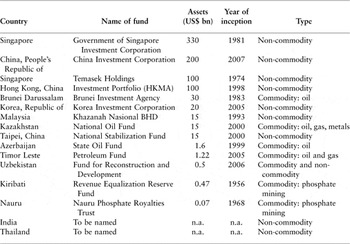
Hence, SWFs provide a natural institutional model for the more active, profit-oriented management of developing Asia's excess reserves. This is especially true when a number of existing SWFs have established solid track records for consistently successful investment performance. Within the region, Singapore is widely seen as a role model in the light of the extraordinary success of Temasek Holdings and GIC. New SWFs are already emerging in Asia and many more are in the planning stages.Footnote 9 Korea set up the Korea Investment Corporation (KIC) in 2005 and China followed suit with the China Investment Corporation (CIC) in 2007. Table 2 lists the major SWFs of developing Asia.
Sovereign wealth funds of developing Asia

note: A number of trust funds in the Pacific region, which have been financed by government and donor funds, are not included in the above list and have an aggregate size of about US$500 million. Due to lack of official information from the funds themselves, asset sizes are largely estimates from unofficial sources such as Stephen JEN, “How Big Could Sovereign Wealth Funds be by 2015?” Morgan Stanley Perspectives (22 June 2007); Rozanov, supra note 8; Brad SETSER and Rachel ZIEMBA, “What Do We Know About the Size and Composition of Oil Investment Funds?” RGE Monitor (April 2007).
There are other potential institutional frameworks for managing surplus international reserves besides the establishment of SWFs. In particular, central banks may manage both traditional reserves and surplus reserves. In fact, some central banks such as the Hong Kong Monetary Authority are already doing this, managing both a liquidity tranche, i.e. traditional reserves, and an investment tranche, i.e. surplus reserves. Each institutional framework has its benefits and costs, and each country must tailor the framework to suit its own unique circumstances. At a broader level, the emergence of surplus FX reserves in developing Asia is leading to a shift in reserve management from passive liquidity management to active profit maximization. Such a shift can take place within the context of SWFs, central banks, or other institutions, but in all cases, such a shift signals the arrival of more active reserve management and will require strong governance structures in order to be effective.
II. The Santiago Principles and their consistency with SWF commercial self-interest
Before discussing the consistency between the Santiago Principles and the commercial self-interest of the SWFs, it is useful to briefly outline the Principles themselves. The Principles were set up in October 2008 by the IWG, whose twenty-six members are primarily developing countries which have SWFs.Footnote 10 The Santiago Principles include twenty-four guidelines that cover the legal framework, objectives, co-ordination with macroeconomic policies, institutional framework, governance structure, and investment and risk management framework of SWFs. The Principles were prepared by IWG members with the assistance and co-ordination of the IMF, and are the result of several months of work by the IWG. The Principles are strictly voluntary and do not have any binding force but are nevertheless expected to be implemented by SWFs in all of the IWG member states.
Underlying the Santiago Principles are four guiding objectives for the conduct of SWFs: (1) to help support a stable global financial system and free flow of capital and investment; (2) to comply with the regulatory and disclosure requirements of the countries in which they invest; (3) to invest on the basis of economic and financial risk and return-related considerations; and (4) to erect and maintain a transparent and sound governance structure that provides for adequate operational control, risk management, and accountability. The Santiago Principles cover three general areas: (1) Principles 1–5 cover the legal framework, objectives, and co-ordination with macroeconomic policies; (2) Principles 6–17 cover the institutional framework and governance structure; and (3) Principles 18–23 cover the investment and risk management framework. The last Principle calls for a process of regular review of the implementation of the principles.
In principle, SWF investments can bring a great deal of benefit to both home and host countries. For home countries, SWFs provide a vehicle for a more productive use of surplus reserves, which would add to the fiscal resources of their owner—the government. The consequent expansion of fiscal space will enable developing country governments to better tackle the vast array of developmental challenges which they typically face. For host countries, the benefits of SWF investments are those usually associated with all forms of foreign investment, i.e. the stimulation of economic activity and the creation of jobs. While SWFs may bring potential benefits to host countries, there are some who view SWFs with scepticism and distrust.
The Principles are largely a response of SWF home countries to the concerns of Western governments about the activities of SWFs and the growing spectre of financial protectionism in host countries. A main criticism of SWFs is that it is unlikely that the only motivation of governments in establishing SWFs is to maximize risk-adjusted returns, as they may also want to pursue political goals, for example, “to see their national companies compete effectively, or to extract technology or to achieve influence”.Footnote 11 Hence, a number of countries have tightened rules or widened the coverage of regulated industries considered critical to national security. For example, Canada, France, Germany, Japan, and the United States have either introduced or amended legislation related to foreign investment in the last five years or so.Footnote 12 But even among developed countries there is a broad range of views about SWFs.Footnote 13 Although antagonism towards SWFs was most pronounced in developed countries, it was also evident to a lesser extent in developing countries.Footnote 14
The general view of the OECD and the EU is that host countries should be open to the investments of SWFs while at the same time recognizing that they have a legitimate right to protect their national security. For example, in June 2008, OECD ministers adopted a declaration that acknowledges the benefits that SWFs bring to home and host countries, calls for fair treatment when dealing with the investments of SWFs, and appeals for restraint when applying the national security clause in the context of foreign investment.Footnote 15 Similarly, addressing the issues posed by SWFs, the EU has reaffirmed its commitment to an open investment environment, while maintaining that investments by SWFs in the EU are subject to the same rules and controls as any other form of investment.Footnote 16
At this juncture, it is important to consider whether the Santiago Principles are broadly sufficient in allaying apprehensions over SWFs. The general lack of transparency among SWFs, with the notable exception of Norway's Government Pension Fund, has contributed a great deal to the negative perception of SWFs in host countries. Recognizing this, the Santiago Principles advocate transparency among SWFs on several fronts: (1) legal basis, structure, and relationship with other government bodies; (2) policy purpose; (3) arrangements regarding funding, withdrawal, and spending; (4) governance framework and objectives; (5) financial performance; (6) investment policy; and (7) risk management approach. Furthermore, if SWFs are to operate like private funds, they “should aim to maximize risk-adjusted financial returns in a manner consistent with its investment policy, and based on economic and financial grounds” (Principle 19). The Santiago Principles, however, do not preclude SWFs from pursuing goals subject to other than economic and financial considerations, such as social or environmental goals—they can do so as long as these “other objectives” are clearly specified in their investment policy and made publicly known. As Kelly and O'Keefe highlight, the Principles aim to ensure that the SWFs will operate with an appropriate level of independence from other government entities, and that public disclosure should provide some reassurance regarding the independence of SWFs.Footnote 17 Critics have pointed out, though, that since the code is strictly voluntary, there is no assurance that the Principles will actually be honoured. Nonetheless, the Principles are likely to be honoured because it is in the commercial self-interest of SWFs to do so.
As will be explained below, there is a great deal of overlap between the Santiago Principles and the commercial self-interest of SWFs. The broad basic thrust of the Santiago Principles is that SWFs should: (1) have well-defined strategic objectives or goals which are widely known among the general public; (2) have operational autonomy and invest purely on the basis of commercial criteria subject to the broad parameters set by the government; (3) become transparent about governance structure, investment policy and practice, and investment performance; (4) establish a sound governance structure which ensures adequate operational control, risk management, and accountability; and (5) abide by the rules and regulations of host countries. While the Santiago Principles were established primarily to reassure host countries about the impact of SWF investment activities on their economies and welfare, in fact they also provide a concrete road map for SWFs to achieve their central objective of maximizing risk-adjusted returns. That is, profit maximization by SWFs and their compliance with host-country rules and regulations are mutually consistent. Governance structure and investment conduct which are conducive to profits are also conducive to allaying the fears and concerns of host countries.
Upon closer thought, the consistency between the commercial self-interest of the SWFs and the Santiago Principles is hardly surprising. The analysis of Section I should make it abundantly clear that the creation of developing Asia's SWFs was driven by popular pressures for more active, profit-orientated management of the region's large surplus reserves. The continued investment of surplus reserves in safe and liquid but low-yielding traditional reserve assets such as US government securities was widely viewed as a waste of valuable national resources. The fundamental insight here is that the search for yield is what motivated the emergence of new SWFs in developing Asia. In other words, developing Asia's SWFs are essentially commercial entities which were created with the explicit purpose of making as much as money as possible for their governments. In view of this, there are certainly some legitimate grounds for anxiety about the ulterior motives of developing country SWFs in host countries, for instance national security. In retrospect such fears and concerns were probably exaggerated. It is difficult to see how non-commercial geopolitical or strategic objectives can dominate the inherently commercial objective of maximizing risk-adjusting returns when the very rationale for the creation of SWFs lies in investing surplus reserves more profitably.
Gauging how SWFs have operated so far, there is no strong basis for apprehension about the underlying motives of these funds. There is not much evidence that any SWF has “actively sought to lever its investment positions for either political or collateral business purposes”.Footnote 18 Rarely have SWFs acquired controlling stakes in companies or sought a formal role in decision-making in companies.Footnote 19 SWFs have typically not been acquiring controlling stakes in strategically important industries, but are mostly engaged in sectors with abundant competition, and are subject to national anti-trust, reporting, and corporate governance requirements.Footnote 20 SWFs have helped recycle savings internationally and generally have a good track record as long-term investors. Even the OECD's “Freedom of Investment” project did not find any serious issues against investments by foreign government-controlled investors.Footnote 21 There are those who will argue that past experience is no guarantee that SWFs will not pursue non-commercial objectives inimical to host countries. However, it is unlikely that SWFs will pursue such non-commercial objectives in the future since such efforts will prove counter-productive. A number of countries have long had laws that regulate investment in industries considered critical to national security,Footnote 22 thus limiting the scope of SWF investments to less controversial industries. Even though there is no compelling evidence that SWFs have carried out non-commercial objectives, the issue has generated such hype that large multilateral organizations like the IMF, EU, and OECD have undertaken efforts to induce SWFs to commit to some accountability and governance standards.Footnote 23
In any case, the distinction between commercial and geopolitical and strategic objectives is not always clear-cut. For example, when CIC acquires oilfields or other commodity assets in Africa, such an acquisition may serve strategic purposes—enhancing China's energy security and its long-term strategic need for natural resources—as well as commercial purposes: the acquisition may very well turn out to be profitable even in the absence of any non-commercial benefits. Furthermore, whether or not the acquisition of an asset has strategic or geopolitical implications may differ from the viewpoints of home and host countries. For example, CIC may acquire a US firm which has sophisticated telecommunications technology purely out of profit-seeking motives, but if such technology can potentially be used for military purposes, the acquisition will run into serious opposition from the US. There is inevitably a lot of ambiguity in separating out commercial from non-commercial motives, but the broader point here is that the underlying impetus for the creation of SWFs is predominantly commercial. As such, while host countries have every right to consider the possible adverse effects of SWFs on their markets and economies, they would do well to keep in mind the commercial origins of SWFs.
Just as with non-commercial objectives, concerns about lack of transparency and accountability may also be overblown. It is certainly true that SWFs, as a group, provide far less information about their investment practices than most of their private sector financial industry counterparts, with the exception of hedge funds, private equity firms, and the like. However, this should not obscure the fact that there is a great deal of domestic political pressure for transparency and accountability and, more generally, good governance. Precisely because they are government-owned institutions entrusted with managing national wealth, they are answerable to the whole population rather than just shareholders, as is the case for private sector institutions. For example, CIC drew wide criticism in China when it suffered heavy losses on its investments in US companies,Footnote 24 the private equity company Blackstone Group and the Wall Street bank Morgan Stanley.Footnote 25 The fact that Temasek Holdings increased its investment in the troubled US financial company Merrill Lynch at the height of the 2008 global financial crisis drew much public criticism in Singapore.Footnote 26 Temasek Holdings was compelled to explain before the Singapore Parliament how it had “performed respectably” despite losses incurred during the 2008 global crisis.Footnote 27
It would be a serious mistake to presume that SWFs in countries with less pluralistic systems do not face tough questions at home about their investment strategy or performance. On the contrary, even in the absence of external pressures from host countries, powerful domestic pressures for better governance will encourage SWFs to become more transparent and accountable. The fact that SWFs are perceived as custodians of national wealth will further intensify such pressures. As noted earlier, however, transparency may come at a cost in terms of investment performance, especially if it leads to a myopic short-term investment outlook at the expense of a long-term investment horizon.
A current limitation of the Santiago Principles is that they do not sufficiently address the unfair competitive advantage which SWFs may derive from their government ownership. While in order to promote fair competition, Principle 20 compels SWFs not to take advantage of government access to privileged information and broad influence, there are other aspects in which government-owned entities may have a competitive advantage over private companies. Subsidies and an implicit guarantee of a government bailout in the case of bankruptcy are two clear advantages. These factors induce state-owned enterprises to become less efficient than their private sector counterparts, who are more exposed to the discipline of the market. By the same token, in the financial sector, state-owned financial institutions such as SWFs may enjoy a competitive advantage over their private sector counterparts. For example, they may be spared from having to pay the full costs of excessive risk-taking due to the implicit guarantee of a government bailout should investments go wrong. This, in turn, may encourage them to take excessive risks in the first place, and thus expose them to the types of risk and level of risk which they are ill-prepared to handle. The consequent increase in risk appetite may put private sector financial institutions at a competitive disadvantage in some situations. For example, the implicit guarantee amounts to a reduction in purchase cost and can thus enable SWFs to make a higher bid than their private sector counterparts when bidding for the same asset. The issues mentioned so far are not adequately addressed by the Santiago Principles. This is perhaps due to a notion that such issues may be covered under the umbrella of a risk management framework covered by Principle 22. This Principle is not sufficient though, since government assistance can help institutions avoid heavy investment losses due to excessive risk-taking. Some rules of the game which would explicitly restrict governments from supporting SWFs in the case of failed investments would encourage SWFs to better manage their risks and, more generally, to become better investors.
Undoubtedly, domestic political pressures for more transparency and accountability in SWFs will contribute towards good governance. At the same time, however, domestic pressures could force SWFs to adopt investment decisions that are biased towards short-term gains. The challenge for government owners of these funds is obtaining wider support for investment decisions that maximize gains over the longer term.
Political pressures to adopt a myopic investment outlook are likely to intensify and magnify during a financial crisis, compromising the SWFs’ ability to take a longer view and thus depriving them of the often substantial returns associated with a long-term investment horizon. This is because the public will call for SWFs to liquidate their investments and cut short their losses even if waiting and absorbing the short-term volatility can lift investment performance. If SWFs succumb to such political pressures, they will contribute to global financial instability and thus forfeit their substantial potential as a stabilizing force with a longer-term outlook than private sector investors. The solution is not for SWFs to become less transparent but to educate the public about the benefits of a long-term investment horizon for long-term investment performance. This will not only benefit the SWF itself but also contribute to global financial stability.
More generally, it is fundamentally in the self-interest of developing country SWFs to refrain from activities which invite financial protectionism in the host countries. Financial protectionism restricts the investment universe of a SWF and, as such, amounts to a substantial cost to business from the viewpoint of SWFs. It is, therefore, profitable for SWFs to comply with the rules and regulations of the countries in which they invest. SWFs which fail to do so risk being singled out for protectionist measures in the future and in other countries. Assuming that SWFs can behave arbitrarily in any way they want, without due regard for the national interest and welfare of the host countries, amounts to implicitly attributing an inordinate amount of market power to the SWFs. In fact, SWFs not only compete with each other but also with a multitude of private sector financial institutions. Host countries will be more welcoming towards SWFs which make every effort to comply with their rules and regulations than those that flout them. Pure self-interest and competitive pressures are thus two powerful forces which help to bring the actual behaviour of SWFs in line with the behaviour prescribed by the Santiago Principles. The fact that the world's major SWFs have voluntarily signed up to those principles is further evidence that the conflict between the interests of the SWFs and host countries is more apparent than real. Finally, it is true that the global financial crisis has weakened financial protectionism since host countries have come to view foreign investors, including SWFs, as sources of much-needed capital for their battered financial institutions. However, financial protectionism is likely to reassert itself as the world economy recovers, rekindling the need for SWFs to engage with host countries.
III. Concluding observations
The climate of fear and hostility towards developing country SWFs in developed countries reached a crescendo in the second half of 2007 and first half of 2008. This unfavourable climate was driven by the fact that the SWFs were state-owned institutions from distant countries with different political systems and values, which had access to large and growing pools of capital, and tended to have low levels of transparency and disclosure. They were viewed as serious threats to the markets, economy, interests, and welfare of the countries in which they invested. Given their sheer size and lack of transparency, they were also viewed as a major threat to global financial stability.Footnote 28
After the bankruptcy of Lehman Brothers intensified the global financial crisis, many Western financial institutions have come under significant stress. In particular, they found themselves facing severe balance sheet problems and an acute shortage of capital. There has been a sea change in the attitude of host countries towards SWFs and their investment activities, from outright hostility to enthusiastic welcome. More realistically, they were viewed as sources of much-needed capital for distressed Western financial institutions. In truth, SWFs are a large and growing part of the global financial system, but their potential for both harm and good tends to be exaggerated. Nevertheless, some rules of the game which would reassure host countries that SWFs are not inimical to their interests would benefit not only the host countries but also the SWFs themselves.
The Santiago Principles are essentially a collective response of developing country SWFs to the increasingly vocal opposition and even hysteria which characterized the attitude of host countries, especially developed countries, to the emergence and growth of SWFs from developing Asia and the Middle East in 2007–08.Footnote 29 In particular, they commit the SWFs to invest on the basis of purely commercial considerations, set up a sound governance structure, and become more transparent about their governance structure and investment policies. Even though the Santiago Principles basically spell out the type of investment behaviour that developing country SWFs would have engaged in anyway, that does not make them useless or unnecessary. In fact, the Santiago Principles serve a highly valuable role as a mechanism which signals and crystallizes the commitment of SWFs to comply with the basic rules and regulations of the countries in which they invest. Just as WTO membership signals a commitment to free trade and non-discriminatory trade policies, signing up to the Santiago Principles signals a commitment to refrain from behaviour which harms the interests and welfare of host countries. Conversely, a SWF's failure to sign up may signal to host countries that the SWF does not intend to comply with the rules and regulations of the host countries, and thus invite protectionist measures. Therefore, the primary value of the Santiago Principles may be more informational than prescriptive. Compliance to the Principles is fundamentally in the commercial self-interest of the SWFs for the reasons outlined in the previous section. This implies that even though the Santiago Principles are a voluntary code of conduct, there is a good chance that they will be implemented by the SWFs, at least in spirit if not to the exact letter.
Upon closer reflection, while the Santiago Principles play a highly valuable role in creating a more conducive and friendly environment for SWF investments by allaying the fears and suspicions of host countries toward SWFs, they can at best be only one half of the solution toward a free and open system for cross-border capital flows. In order for SWFs to fulfil their underlying potential as major contributors to global financial stability and efficiency, host countries must also do their part to ensure a free and open system for capital flows. In particular, they must commit themselves to not use the state-owned nature of SWFs as an excuse to adopt protectionist policies which seek to keep out foreign capital for political and nationalistic reasons. The OECD has already begun some work in spelling out an appropriate and desirable policy framework for host countries towards SWF investments.Footnote 30 Such a policy framework must safeguard the legitimate national interests of the host country, for instance national security, while at the same time prevent unfair discrimination against foreign investors. Just as the Santiago Principles formalize and crystallize the commitment of SWFs to refrain from conduct detrimental to the interests of host countries, a similar set of principles which commit the host countries to treat SWFs in a fair and non-discriminatory manner will go a long way towards maximizing the benefits of SWF investments for both home and host countries.
Much of the fear and hostility aroused by the emergence of developing country SWFs as major players in the global financial system has subsided as a result of the global financial crisis. The worst of the crisis seems to be now over and a semblance of normality has returned to global financial markets. The big risk for SWFs is that as both financial markets and the real economy regain their momentum, pressures for financial protectionism may reassert themselves. Such an outcome would benefit neither the SWFs, nor the host countries, nor the global financial system. In this sense, the Santiago Principles are a welcome development that institutionalizes the promise of good corporate citizenry by SWFs to host countries. Such an institutionalized commitment is permanent and will withstand the ups and downs of the global business cycle. A form of Santiago Principles for host countries, which similarly institutionalizes their commitment to avoid financial protectionism, will further consolidate a conducive investment environment for SWFs on a permanent structural basis.
Finally, there are a number of practical ways in which the community of SWFs in the Santiago Principles “club” can improve the investment environment facing SWFs. For one, a shared commitment to responsible investment behaviour and best investment practices will improve the reputation of SWFs as a group. Host countries will become more receptive to the investments of SWFs as a group if the Santiago Principles member institutions evolve towards more transparency and accountability and, at a broader level, higher levels of governance. They can also enhance the effectiveness of their investment operations by discussing and sharing their experiences, monitoring the investment behaviour of members, and imposing sanctions on those that engage in activities which compromise the reputation of the group as a whole. Furthermore, the SWFs will have much greater clout collectively as a group than individually in opposing financial protectionism. All these considerations complement and in fact reinforce the highly valuable role of the Santiago Principles as a mechanism which signals the commitment of SWFs to avoid investment behaviour and activities which harm the interests and welfare of host countries.