Maths education necessarily relies on language, both for the teaching and for the expression of mathematical concepts (Harris, Reference Harris1991; Jorgensen, Reference Jorgensen, Wyatt-Smith, Elkins and Gunn2011, p. 321). For all students, maths education at school requires learning new language items, as well as new abstract applications of familiar language. For children learning the language of instruction as a second language, there is a mismatch between what teachers and the curriculum assume to be familiar language, and the language actually used for these concepts by the children at home. This mismatch brings particular challenges for maths teaching and learning.
Remarks from teachers quoted in a recent study (Edmonds-Wathen, Reference Edmonds-Wathen2015) express their experiences of this in a multilingual community in the remote Northern Territory, where several Indigenous languages are spoken (Edmonds-Wathen, Reference Edmonds-Wathen2015, p. 51), but where Standard Australian English (SAE)Footnote 1 is the language of both teaching and educational materials at school. One teacher, for example, stressed the importance of sharing the language of instruction with students, but found that the extra ‘leap forward’ to new mathematics language and concepts was difficult without a shared language. Another teacher expressed uncertainty about the extent to which language differences or other unknown factors led to a lack of success in many lessons, such as what had been happening at home, or students being tired. One thought it might be ‘just a combination of everything’ (Edmonds-Wathen, Reference Edmonds-Wathen2015, p. 54).
Much of the research into language and mathematics education in the Australian Indigenous context has been in communities such as the one reported by Edmonds-Wathen, where students come to school speaking language varieties explicitly recognised as either traditional languages or varieties of Kriol (Harris, Reference Harris1991; Jorgensen, Reference Jorgensen2015; Wilkinson & Bradbury, Reference Wilkinson and Bradbury2013). In some Indigenous communities, however, the home variety is not clearly identified as a separate language from English, but is one of a group of language varieties often called Aboriginal English (Eades, Reference Eades, Koch and Nordlinger2014). These varieties vary regionally and have distinct phonological, morphological and syntactic features and vocabulary, but also share features with SAE (Eades, Reference Eades, Koch and Nordlinger2014). As a result, it can erroneously be assumed by teachers that students already speak and understand SAE. The needs of these students as second dialect learners are often ignored, a language ‘invisibility’ problem that has been brought to attention in recent years (Angelo, Reference Angelo2013; McIntosh et al., Reference McIntosh, O'Hanlon, Angelo, Gitsaki and Baldauf2012; Sellwood & Angelo, Reference Sellwood and Angelo2013).
The effects of this invisibility can start at enrolment if children are reported as speaking English at home. It permeates education policy at both a national and state level, where little attention has been paid in the design of curricula and pedagogy to the Aboriginal English-speaking backgrounds of many Aboriginal students (McIntosh et al., Reference McIntosh, O'Hanlon, Angelo, Gitsaki and Baldauf2012).Footnote 2 In assessment too, the Aboriginal English home language variety of students is not taken into account in standardised testing (Angelo, Reference Angelo2013, Dixon, Reference Dixon2013). The lack of visibility and awareness of the needs of Aboriginal English-speaking children in SAE-instructed classrooms presents a particular challenge for children as learners of this additional dialect, as without explicit support, learning of the second dialect is likely to remain incomplete (Siegel, Reference Siegel2010).
In a mathematics education context, teachers may assume that these children already have an active vocabulary of SAE terms to express more precise mathematical meanings (e.g. words and phrases such as subtract, triangle, more than/less than, equals, above), and indeed this is the starting point that the curriculum assumes in the early years of school. There is, however, evidence that for some Aboriginal English-speaking children, familiar ways of talking about these concepts used in maths differ from the terms used by SAE speaking teachers, affecting how these teachers evaluate the students’ level of understanding. For example, Mushin, Gardner, and Munro, (Reference Mushin, Gardner and Munro2013) examined one-on-one maths assessment tasks with year 1 students at a Queensland community school, where children speak a local Aboriginal English variety. They found evidence of difficulties with the mathematical terms size, shape and same. This suggests that issues identified by teachers in Edmonds-Wathen (Reference Edmonds-Wathen2015), of second language acquisition co-occurring with the learning of curriculum content, may also apply in a classroom where children speak an ‘invisible’ variety such as Aboriginal English, as they do in classrooms where children are speaking languages more transparently acknowledged as ‘not Standard Australian English’.
The concerns raised by teachers in Edmonds-Wathen (Reference Edmonds-Wathen2015) also show the complexities in identifying the challenges relating to language differences from an array of other factors affecting how students behave and learn at school. Many of these challenges are faced by all children as they become school learners, so there is a need for substantive research into the details of how these play out in the classroom. To begin to address this, we present a detailed analysis of one maths lesson in a Queensland Aboriginal Community school, with a focus on the use of prepositions to express location, and in particular a subset of these. We show how, over the course of a lesson, there is evidence that some points of confusion can be linked to unaddressed language differences between these students and their teacher, and the curriculum materials, as the students engage with unfamiliar SAE vocabulary and grammatical structures to express familiar spatial concepts.
Our recording methodology enables us to examine in detail what is happening in the classroom. Because we do not have direct access to the mental processes by which the children are acquiring and consolidating knowledge, we look at how they display their understanding in real time as they interact with the teacher, other students and tasks. This kind of detailed reflection is difficult for teachers to do in the course a lesson, where they have many demands on their attention. This approach also provides a different perspective to that gained through formal assessment, which has been shown to be problematic in accurately revealing what Aboriginal students understand of the curriculum knowledge they are being taught (Angelo, Reference Angelo2013; Dixon, Reference Dixon2013; Mushin et al., Reference Mushin, Gardner and Munro2013; Wigglesworth, Simpson, & Loakes, Reference Wigglesworth, Simpson and Loakes2011).
The rest of the paper is structured as follows: in the next section we present an overview of the data we have used for this study. We then discuss how the language for talking about locations differs between ordinary talk and mathematical language. This is followed by a close analysis of three phases of the lesson itself, with a particular focus on how the children responded to instructions, and their use of location words during the lesson, as evidence for their understanding of the language of location. In the final section, we discuss the implications of our observations for teaching maths language to Aboriginal learners of English as a second dialect.
Our Study
In order to explore how learning SAE as an additional dialect impacts on the learning of maths, we have selected a year 2 lesson, where the objective is to learn ‘the language of location’, specifically the use of prepositions that indicate the relation between an object and a landmark. Our methodology provides a way to pick apart how the students in this class as second dialect learners deal with low-frequency SAE prepositions, listen to and understand instructions, and locate objects in two or three dimensions. To illustrate these points, we focus on prepositions that express relations on the vertical axis, as these were the ones that led to the greatest difficulties for the children.
This lesson was recorded at a primary school in an Aboriginal community in Queensland.Footnote 3 Students in this class are 7–8 years old, all Aboriginal and most have grown up in this community, or in communities with similar histories and language varieties. The teachers at the school are mostly non-Indigenous and not from the community, and are speakers of SAE. Teacher aides from the community are present in most classes, including this one. In our recordings, they speak with the students in both the community language and SAE, with variation between teacher-aides as to which language variety is used in which situations.
Students wore individual voice recorders for the duration of the recorded lessons to capture the voices of all speakers clearly regardless of the level of classroom noise. Up to three cameras were used, depending on the size of the group, to record nonverbal communication while providing as little distraction as possible and allow the class to progress as it would have if the researchers had not been present. We recorded the entire session, capturing the range of activities that happened over an hour and a half, including whole class, small group, pair and individual work.
We have used Conversation Analysis as our analytical approach (Gardner, Reference Gardner, Davies and Elder2004). Conversation Analysis allows us to look closely at interactions as they unfold, and find evidence from linguistic, paralinguistic and embodied responses for participants’ engagement in the tasks and understanding of the topic. Conversation Analysis methods have about a thirty-five year history of application to classroom settings, both in analysing the structure of interaction in these institutional contexts, and more recently in considering what close observation can show about learning, through tracking changes in understanding over time (Gardner, Reference Gardner, Sidnell and Stivers2012).
The data presented in this paper are transcribed according to Conversation Analysis conventions (Hepburn & Bolden, Reference Hepburn, Bolden, Sidnell and Stivers2013), simplified to show relevant aspects for this analysis. The symbols used capture overlap, lengths of silences, intonation, volume and lengthening of sounds. (See Appendix for a glossary of symbols). We listened separately to the voice recorder worn by each child to create transcripts that were as accurate as possible.
The lesson that forms the basis of our analysis occurs as part of the Mathematics Location and Transformation unit, where by the end of Year 2 students are expected to ‘interpret simple maps of familiar locations and identify the relative positions of key features’, elaborated as ‘understanding that we use representations of objects and their positions, such as on maps, to allow us to receive and give directions and to describe place’ (ACARA, 2015b). The application of location language to a mapping context engages with this part of the curriculum. However, the focus on language bears more similarity to the Foundation (in Queensland called ‘Prep’) curriculum, which contains the outcome, ‘describe position and movement: interpreting the everyday language of location and direction, such as “between”, “near”, “next to”, “forwards”, “towards”’ (ACARA, 2015a).
The lesson consisted of a number of teacher-led and self-directed activities designed to allow the students to identify the correct location word corresponding to a particular relation between an object and a landmark (e.g. on top of indicating a relation where the object is higher on a vertical axis than the landmark, and touching it). The nature of the relation between two objects is expressed in a sentence template that situates one object in relation to another object (the landmark): ‘the X is [location preposition] the Y’ (e.g. the lightning is above the boat).
The students engaged in activities which afforded opportunities to display their understanding of these relations in two dimensions, using a map with pictorial landmarks (e.g. under the mountain, next to the pirate ship), and in three dimensions using themselves as the objects to be positioned with reference to landmarks around the classroom (e.g. underneath your table, near the whiteboard).
In the next section, we show how this location language as maths language differs from ordinary language uses of prepositions and how the language being taught in this class relates to the kind of location language children and teachers use in the classroom more generally. We then examine the extent to which children displayed trouble in understanding the ‘language of location’ and where this could be attributed to divergences between their vernacular uses of location language and the formal mathematical language required in this lesson.
Location Language as Maths Language
In order to talk about spatial relations in a precise mathematical way, students draw on language already acquired for locating things in space in everyday settings (Jorgensen & Dole, Reference Jorgensen and Dole2011, p. 362) when they are talking about where objects and people are situated in their environment. To apply this language to mathematical concepts students must formalise the use of this ordinary language (Sarama & Clements, Reference Sarama and Clements2009, p. 161), for example in mapping, and to describe more abstract relationships, such as, ‘the numerator is above the denominator’ (Jorgensen, Reference Jorgensen, Wyatt-Smith, Elkins and Gunn2011, p. 324).
These formulations are based on the syntax and vocabulary of SAE and so the curriculum must assume proficiency in SAE, such that both the location words and the syntax used in mathematical formulation will already be familiar. However, for Aboriginal English-speaking children the mathematical formulation may not be building on forms already familiar (e.g. Jorgensen & Dole, Reference Jorgensen and Dole2011).
For children from all backgrounds, the context and practices in which particular lexical items are used at home shapes their understanding of their meanings and associations between them. For example, Walkerdine (Reference Walkerdine1988, pp. 19–27) found that the more/less contrast of mathematics education was not the most relevant contrast for preschoolers at home. Instead more was used primarily in regulating intake of food and drink, in opposition to no more, or not as much. Children were able to compare quantities and learn new terminology to do this, but didn't necessarily use the more and less contrast before beginning school. Similarly, Wilkinson and Bradbury (Reference Wilkinson and Bradbury2013) found that it was important to teach comparative terms explicitly in their program for early maths concepts in Yolŋu communities in northeast Arnhem Land, as the language used for this in maths classes (bigger, smaller, same) did not align directly with ways of talking about these things in the children's first language, Djambarrpuyŋu.
In the lesson, we examine here, children must formalise the use of a set of prepositions indicating relations on the horizontal and vertical axes by using a fixed expression. While no recent linguistic description has been made of the language of this community, we explored two aspects of location language within the corpus of classroom recordings, in which we hypothesised the children's home language and familiar practices of talking about location might differ from the formalised fixed expression that is the focus of this lesson. These two aspects were (a) the set of prepositions presented in this lesson, and whether these were used frequently by the children in other contexts and with the same domain of meaning as used by the teacher, and (b) the syntax of the formulaic expression, and the frequency with which this was used in the classroom. Our particular focus is on the first of these aspects, the prepositions.
To investigate the extent to which the ‘language of location’ being taught in this lesson involved novel language use, we examined the entire corpus of some 30 h of classes from the same school across three years to see how location words were used when they were not the object of the lesson. All talk in these classes has been transcribed regardless of whether it was task-related or undirected, and whether it involved teacher-child or child-child interactions. As reported elsewhere (e.g. Fraser, Mushin, Meakins, & Gardner, forthcoming; Gourlay & Mushin, Reference Gourlay and Mushin2015), we found complexity in defining which language variety the students are speaking at any particular moment, as the language variety they speak at home overlaps substantially in form with SAE. As a result, it is not always clear whether matching linguistic forms are targeting SAE or home varieties.
A focus on specific areas of language can, however, provide insight into where students are using SAE forms with SAE meanings. For example, Fraser et al.'s (forthcoming) study of articles separated SAE uses (such as the and a/an) from non-SAE uses assumed to reflect their home variety (such as da and dat). They found that the only classroom context that significantly favoured the use of SAE articles was when students were addressing an SAE speaking teacher during a literacy task such as reading aloud, where SAE was both the language of instruction and the object of learning. If these results are indicative of a general pattern, they show that children in this community were predisposed to use their home variety in the classroom in their first three years of schooling, except in contexts where the object of learning was a SAE form. The language of location, the focus of the current study, would be one such object of learning, but we cannot assume SAE location language in other recorded contexts.
The location language used in this lesson included words on both the horizontal and vertical axes. In the interest of space, we have restricted our analysis to words that indicated relative heights on the vertical axis only. The words used by the teacher in the lesson were: above, on top of, below, under and underneath. Above and on top of indicate that the object is higher on the vertical axis than the landmark, but only on top of allows for the object to be touching the landmark (e.g. The pen is (resting) on top of the desk vs. ?the pen is (resting) above the desk). Below, under and underneath all indicate that the object is lower on the vertical axis than the landmark. Under and underneath appear to be synonymous and can only be used when the object maintains the same horizontal position as the landmark (e.g. The pen is under/underneath the desk). Below can also be used when the object is not at the same horizontal position as the landmark (e.g. The pen is below the desk is possible when the speaker is holding a pen lower than the desk but without the desk being directly above the pen).
When we examined all uses of location language, we found that the act of locating objects in space is very common in the ordinary talk of the classroom. However, there were very few utterances at all by the students or the teacher that matched the formalised language of location being taught in the target lesson. Instead when communicating the location of some object, both students and teachers predominantly used pointing and related gestures, and deictic words like here and there (teachers) or ere and dere (children) that indicate the proximity of the object to be located with reference to the speaker. Where location words were used, they often came after pointing or deictic strategies had failed. For example, in (1), the child has two attempts to point out the location of a coloured straw to her peer before resorting to locating the straw with reference to the location of a more salient red straw using the preposition under.
(1) ‘En dese ere la. En dat dere. Under dat red’ (120605-Yr1-4A-Titania)
The teachers made more use of prepositions as a means of locating than students, but often without explicit reference to a landmark, illustrated in (2 a–c). In these cases, the missing explicit reference to a landmark occurs because it is already known to both the teacher and children.
(2)
(a) ‘Alright Malky, have a go at writing them underneath’ (130508-Yr3-2A: T-Mary)
(b) ‘And make sure you push your chairs under’ (120604-Yr2-1B: T-Leanne)
(c) ‘So we gotta add a little . . . on top’ (120604-Yr2-1A: T-Leanne)
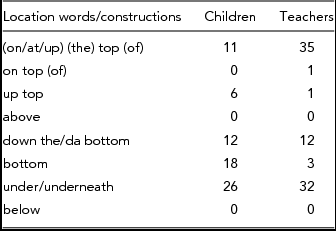
We examined the frequency and distribution of the target location words (above, on top of, below, under and underneath) when they were used. We found that top was frequently used as a noun indicating the intrinsic upper part of a landmark (e.g. the top of the page), and in this construction was paired with bottom (e.g. the bottom of the page), so we have included bottom in our analysis, although it was not one of the mathematical location words included in the lesson. Table 1 summarises the number of tokens of each word in the corpus for children and for teachers. We have not done a similar precise count for other ways of indicating location such as pointing and deictic words, but these run into hundreds.
Uses of Location Words by Children and Teachers

The word top was more frequently used as a noun by both teachers and children to indicate that an object was located in an intrinsic upper part of a landmark (e.g. The writing is at the top (of the page), rather than as a locator for the object with respect to a landmark (e.g. the pen is on top of the desk), supporting our earlier observation that the formulaic mathematical expression the ‘X (object) is [location preposition] the Y (landmark)’ is rarely found in ordinary language use.
The prepositional construction on top was used only once by one teacher (so we gotta add a little on top) and never by the children. The children however used a prepositional construction up top that is not typical for SAE, although not with an explicit landmark:
(3)
(a) ‘I can see sharpener an rubber. Rub(ber) up top’ (111115-Prep-Gp2-Titania)
(b) ‘Ere. Superman up top dere’ (120223-Yr2-Gp2-Harry)
The most commonly found location word whose use corresponded closely with the way they were used in the maths lesson was under (underneath was also used).
(4)
(a) ‘It's under da ding’ (120605-Yr2-1B-Jeffrey)
(b) ‘E ‘ide under la cup’ (121114-Yr2-5-Kenny)
(c) ‘When we say that, our tongue goes under our teeth’ (120222-Yr1-1A: T-Adira)
(d) ‘It was food under the desk’ (130605-Yr3-3: T-Mary)
In contrast, above and below, which were both regularly used as location words in the maths class, were never used by either the teacher or the children in the classes we recorded. The absence of these terms in our corpus suggests that if above and below are used outside the classroom, it is likely to be at a low frequency. As we shall see, there is confusion around precisely these two prepositions in this lesson.
The data from classroom talk by teachers and students, where location was not being explicitly taught indicate a number of differences between the use of location language for these children in their ordinary talk in the classroom and the use of location language that they were being taught in the maths lesson. These can be summarised as follows:
a) The children do not use above and below in our classroom recordings, neither are they exposed to it by SAE speaking teachers. Above and below are prepositions acquired later by SAE speaking children (Coventry & Garrod, Reference Coventry and Garrod2004; Durkin, Reference Durkin1980), and so we hypothesise that these are probably not words that are familiar to the children, except in mathematical contexts.
b) Where the children do use top as a relational locator, they use the up top construction rather than on top, which is the formulation used in the maths lesson.
c) The children appear to use under and underneath in similar ways to the teacher's use in both general classroom talk and in the maths lesson.
d) While the mathematical formulation being taught as the ‘language of location’ is grammatical in SAE, its use in ordinary interaction in our classroom recordings is vanishingly rare. This is because most locating is done in situ where objects can be seen and pointed to, and where the identity of objects and landmarks may already be established for participants, and therefore able to be left unsaid. The maths language requires that students make both the object and the landmark explicit.
With these linguistic differences identified between the SAE template, ‘the X (object) is [location preposition] the Y (landmark)’, and common ways of talking about location for these children at school, the next section considers how students and teacher approach a sequence of activities around language for spatial relationships. We look at how these language differences are addressed, and at how the process of acquiring SAE as a second dialect intersects with showing understanding of the mathematical concepts, and carrying out tasks as instructed by the teacher.
Topic and Structure of the Lesson
The school had recently introduced the Explicit Instruction (EI) pedagogical framework, with the assistance of the Australian educator John Fleming (Fleming & Kleinhenz, Reference Fleming and Kleinhenz2007). In the lesson we analyse in this paper, the lesson structure follows the ‘I do’, ‘we do’, ‘you do’ format associated with EI (similar models also described in Archer & Hughes, Reference Archer and Hughes2011; Hollingsworth & Ybarra, Reference Hollingsworth and Ybarra2009). In this structure, lessons begin with an explicit statement of the goal of the lesson ‘We Are Learning To’ (WALT), and the teacher's expectations ‘What I'm Looking for’ (WILF). This is followed by a ‘Warmup’, revising relevant material learnt previously, and then the introduction of the new topic, which is first demonstrated by the teacher (‘I do’), then carried out as a class guided by the teacher (‘We do’), and performed individually by the students (‘You do’). The lesson ends with a ‘Ploughback’, where the new skill or lesson content is reviewed. Behind this structure are a number of principles, including scaffolding instructions, sequencing skills logically and breaking them down into small units (Archer & Hughes, Reference Archer and Hughes2011).
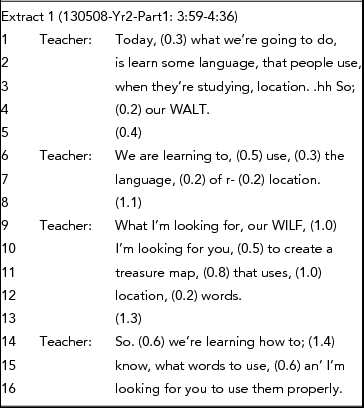
This lesson begins with an outline of the goals of the lesson, the WALT and the WILF. We can see how the teacher accomplishes this in the following extract.

The goal of the lesson is explicitly introduced as to learn to ‘use the language of location’ (lines 1–7), and the task the teacher expects the students to do is to use this language when working with a map (lines 9–12), which they will create during the lesson.
The lesson consists of seven phases:
1. ‘Warm up’. The class counts in unison in ones, fives and tens, and identifies two-dimensional shapes shown on the smart board.
2. ‘I do’. The teacher introduces the content of the lesson, beginning with outlining the WALT and WILF (as shown in Extract 1 above). The teacher shows a treasure map she had prepared earlier on the smart board, and uses the template ‘I've put my X [location preposition] my Y’ to describe the location of symbols on the map relative to landmarks. The students repeat after the teacher. For example, ‘I've put my sun below the boat.’
3. ‘We do’. Three dimensional interpretation. The teacher asks every student in the class individually to go to a different location in the classroom and position themselves in relation to an object. For example, the teacher says, ‘Dirk, can you please go and sit underneath your table’.
4. ‘We do’. The focus is again on the treasure map, with the class still sitting together on the floor. The teacher chooses individual students to pick a symbol and a location for it on the map. Students say where they would like the teacher to place the symbol on the smartboard map in relation to another object. The teacher places the symbol on the map and asks the class whether it is in the correct location.
5. ‘You do’. Students work individually on making their own maps, by drawing landmarks on a map template. A few minutes before the end of this phase, the teacher shows five symbols on the smart board, and asks the students to add these symbols to their maps.
6. ‘You do’. Pair work. Student pairs describe locations of symbols on maps, exchanging the maps they have made and describing the locations of the symbols on their partners’ maps.
7. ‘Ploughback’. For this revision phase, the students are sitting at their desks and are holding ‘lollipops’ (cardboard disks on sticks). The teacher instructs them to hold the lollipops in different positions in relation to their desks, e.g. below, above and up in the air.
Tracking Children's Understanding of the Language of Location
The following examples from the lesson demonstrate how students engaged with the language of location during a selection of these lesson phases, with a focus on spatial relations on the vertical axis. We examine how the explicit goals of the lesson outlined above are translated into the sequence of activities, and how the specific language learning needs of this class, as second dialect learners, are revealed and addressed in these activities. These examples also show how language issues are interwoven in a complex way with other factors influencing what students understand, and how they demonstrate what they understand.
I Do: Reproducing the Language of Location
In the ‘I do’ phase, the teacher introduces the format that she uses throughout the lesson for describing location. This is the format, ‘I've put my X [location preposition] my Y’, or later in the lesson ‘The X is [location preposition] the Y’.
The first instance of the teacher using this format takes place just after the outline of the lesson goals in the WALT and WILF (Extract 1 above), and an initial introduction to the teacher's map, which she opens on the electronic whiteboard. Note that locations on the map are two dimensional. She and the students name some of the landmarks. Next, the teacher models the structure that will be at the core of the lesson, saying, ‘Alright, have a look where I've put my love heart. I've put my love heart (0.3) next (0.3) to my pirate flag. Can you say “next to my pirate flag”?’ Note the pauses that draw attention to the key terms in the sentence. Thirteen of the sixteen students say in chorus, ‘Next to my pirate flag’, thereby demonstrating that the majority of them have no trouble reproducing the language of location using the template. The teacher evaluates this choral repetition as ‘fantastic’. She follows this with three more examples that the children repeat in chorus; the prepositions that the teacher uses in these examples are next to, above and below. Note that above and below were not used by children and teachers outside this lesson in our corpus of recordings at this school. As we will see, there is some confusion around these prepositions later in the lesson. In the course of these four choral repetitions, every child but one joins in successfully at least once – the last child has a sore eye which probably accounts for her silence. Thus, there is almost full demonstration that the children are able to reproduce the language of location, and at this point in the lesson there is no indication that the children are having problems with this language of spatial relations.
We Do: Displaying Understanding of the Language and Concepts of Location
The next activity in the class has the children being instructed to go to specific locations around the classroom. The teacher uses formulations such as, ‘Harrison, can you go and sit on your desk.’ As in the previous phase of the lesson, the children have hardly any problems in completing the task. The children's responses show that they understand the location language, positioning themselves as instructed.
A few instances when a child hesitates to go to the location indicated do not seem to stem from misunderstanding the spatial relationships, but may be because they are asked to do things they are not usually allowed to do, such as sit underneath their tables. Two points are noted here. First, this is an activity in three dimensions, unlike the pirate's map activity with the whiteboard. Second, the prepositions used in this activity are next to, under and underneath, on top of, near and outside. This activity does not include the prepositions above and below; words that are probably unfamiliar to the children, and with which they later have trouble. But note also that all the instructions are to position their bodies at a certain location, so it would not be possible for them to ‘stand above your table’.
In the next phase, while they are still sitting on the mat in front of the smartboard, the teacher asks the children to select a shape and tell her to put the shape at a specific position on the map, using the template sentence. She then places the symbol on the map, and asks the class if she has placed it correctly. Most of the children's responses are accepted by the teacher as correct, but one pair of prepositions is confused: above and on top of. One of the boys asks the teacher to put the sun ‘on top of the money’. After getting some contradictory responses to her questions, the teacher manipulates the sun to positions that are either on top of (i.e. touching) or above (i.e. with space between) the money. Again, some children give ‘yes’ responses and some ‘no’ as to whether the sun is ‘on top of the money’. In the end, when most children, in chorus, respond with ‘yes’ when the sun is not touching (‘above’) the money, she says, ‘Ah, but that's above. That's above.’ She then moves the sun down to touch the top of the money and says, ‘On top of. If we are standing on top of our shape. . .we're standing right on top.’ This is the only time she explicitly differentiates on top of and above in the lesson, but as we shall see, there remains some confusion between these terms.
You Do: Pair Work Using Maps and the Location Template
The students are given a map template and instructed to draw some landmarks on it, and then five symbols that will serve as the objects to be located (phase 5 of the lesson). They are then instructed to swap maps with a partner and describe the location of the symbols on their partner's map, using the template phrase for describing spatial relations introduced earlier in the lesson.
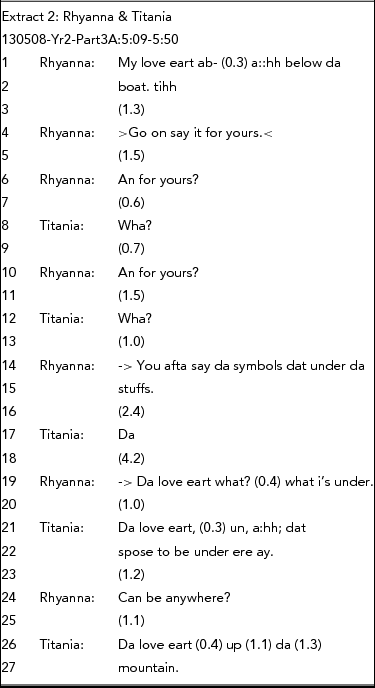
There are six pairs and one group of three in this phase, with each engaging somewhat differently with the task. Two pairs complete the task using the location template language and appropriate location word to situate their symbol with respect to a landmark on the map. Two others are able to use the template at least once, and two others do not use it, focusing instead on trying to identify the objects that their partners have drawn on their maps. The final group of three children is eventually able to use the template sentence, working with the teacher. Extract 2 shows that one girl, Rhyanna, has understood the task, and she peer teaches her partner, Titania, who is having difficulty. Rhyanna uses her home language to formulate a general version of the teacher's target examples.

Note that after providing a sentence describing the location of a symbol on the map in front of her, Rhyanna pursues a location statement from Titania, first with ‘Go on, say it for yours’ (line 4), followed by two partial repeats in lines 6 and 10. When this is still met with confusion, Rhyanna formulates a general version of the teacher's target examples, ‘You hafta say da symbols, dat under da stuffs’ (line 14–5). Titania still hesitates, so Rhyanna prompts her again with two questions, ‘Da love eart what? (0.4) what i's under.’ (line 19), which provides Titania with the first two parts of the sentence, a symbol and a preposition. Titania begins ‘Da love eart, (0.3) un,’, then questions Rhyanna again, ‘dat spose to be under ere ay.’ because she finds her map does not conform to this pattern – the love heart on her map is not under any landmarks. Rhyanna replies ‘can be anywhere?’, and Titania describes its location ‘Da love eart (0.4) up (1.1) da (1.3) mountain.’
In this extract, we see that Rhyanna has a strong understanding of the task, and is able to lead her partner through to completing it. She uses one preposition, below, from the teacher directed ‘I do’ and ‘We do’ phases, as per the target SAE mathematical usage. Titania does not appear to have the same immediate comprehension of the task, but produces a target location statement when led through by Rhyanna. We see Rhyanna abstracts from the instructions given by the teacher, which were all in the form of examples, to state a general pattern for the location statements. Note that in her formulation of this pattern and her repeated prompts she substitutes under for the below used in her initial statement from her own map. This use of under gains more traction with Titania who begins to attempt a sentence (line 20). Rhyanna's switch from below to under for her explanation of the task suggests that she thinks below may be a source of trouble in comprehension for Titania. Titania's final formulation of a location statement uses one of the prepositions, up, noted earlier as being used by the children in a different way to SAE.
Extract 2 occurs at the beginning of the pair work phase. Rhyanna and Titania continue to take turns formulating location statements about the symbols on their maps. Rhyanna makes four more location statements, all of which use either above (three times) or below (once). All of Titania's remaining location statements use under (seven times), except for one use of next to, ‘My sun (0.2) un:: (0.3) ah; (0.3) next to da (0.9) boat.’ In this sentence, the sound un:: followed by hesitations suggests that Titania first attempted to use under, but switched to next to, perhaps finding this did not appropriately describe the spatial relationship on the map. Interestingly, in one of her location statements, Titania uses the preposition below, but immediately switches to under, ‘ma (0.5) my star u- (.) ma star below, (0.2) under da boat.’ Rhyanna and Titania's continued focus on this set of prepositions on the vertical axis suggests they have specifically oriented to these terms in this lesson, perhaps noticing above and below in particular as new terms. In line with the interaction in Extract 2, Rhyanna has enthusiastically adopted above and below for this task, wheras Titania prefers under, with her switch from below to under providing further evidence that this may have been a source of confusion for her.
Ploughback: Consolidating the Language of Location
Recall that of all the prepositions used in this lesson, above and below were the ones predicted to constitute the greatest challenge for students based on the lack of exposure to these terms in general classroom interaction. The structure of the lesson itself affords us an opportunity to examine this in some detail through analysis of the final ‘ploughback’ phase of the class, where children are expected to demonstrate to the teacher what they have learned. In fact, we find that many of them are still having trouble with above and below.
The children are all provided with ‘lollipops’, disks on sticks, which they will be asked to place at some location in relation to their desks (e.g. on, above, next to). The teacher begins by asking for volunteers to demonstrate the location language they have been learning. She chooses Seamus.

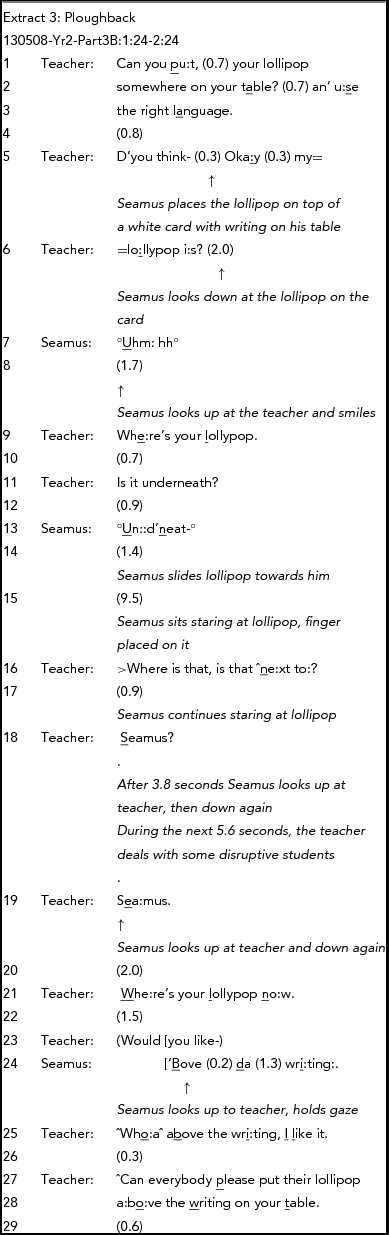
Seamus demonstrates that he can put his lollipop somewhere on the table, and he places it between himself and a card with writing on his table. However, he has a lot of difficulty over the next 37 sec in describing where he has put it. One issue he has to deal with is whether he describes the position in two dimensions (as in describing a position on a page) or in three dimensions. At first, he places the lollipop resting on and covering the card, but does not say anything as he does this. When the teacher prompts him with ‘Is it underneath?’ (line 11), Seamus repeats this softly, and slides the lollipop a few centimetres towards himself, so that it is now between him and the writing. It seems he has taken the teacher's question as a prompt to move the lollipop to ‘underneath’ the card in two dimensional space, which is where the lollipop now is from his perspective. Seamus does not respond to the teacher's next question, ‘Where is that, is that next to?’ (line 16), reselecting him in line 18 with ‘Seamus?’. There is then some disruption in the class that the teacher deals with over then next 9 sec or so, and then she reselects him again in line 19. The teacher perseveres and asks ‘Where's your lollipop now?’ (line 21), and finally Seamus answers with ‘above the writing’. As the lollipop is between him and the writing on his table, this answer is not correct for his perspective, but note that for the teacher, who is facing him from the front of the class, the lollipop is, in two dimensional space, ‘above’ the writing. In three dimensional space, Seamus would have to say something like, ‘In front of the writing’, not a preposition that they had used during the lesson, or perhaps from the teacher's perspective, ‘on top of the writing’, as the lollipop is in fact touching the card.
Seamus receives positive feedback from the teacher, who then instructs the whole class to put their lollipops ‘above the writing on your table’. What follows is confusion. Remember, above is a word they have had no exposure to in our recordings. . Of the fifteen children in the class, not one hovers their lollipop ‘above the writing’, i.e. in three dimensional space, which is how the teacher construes above, when she says, ‘hover it above’. Almost all place the lollipop either on (or ‘on top of’) their writing, and a few place it somewhere else that cannot be construed as ‘above’. Nevertheless, the teacher accepts and praises their efforts.
She next asks them to put their lollipop ‘below your table’, and at first only one child puts her lollipop in a position that can be construed as ‘below’ her table. Most of the others appear to be thinking in two dimensional space, as they place their lollipops on their table between themselves and the writing on the table, that is, ‘below’ from their perspectives. A few others do nothing. A second child then holds his lollipop below and next to his table, which could be seen as correct (as in ‘the lake is below the mountain’, compared with ‘the lake is under the mountain’). However, the teacher does not accept this, saying ‘Ooh, that's not below.’ This child responds sotto voce with ‘I don't know what's this.’ What follows is that three children hold their lollipops vertically below their tables or place them on the floor. Eight other children notice this, and follow suit with their lollipops, so most of the children have now placed their lollipops ‘below the table’ to the teacher's satisfaction, as she says ‘Fantastic’. Similar to their problems with above, these children have difficulty with below, in line with our prediction that these might be unfamiliar terms, based on their low frequency in the classroom recordings. In addition to their rarity as linguistic forms for these children, there is an added conceptual difficulty in that above and below are different in two-dimensional and three-dimensional space.
To finish the ploughback, the teacher asks them to put their lollipops ‘next to’ and ‘under’ their tables, and ‘up in the air’. Almost all of the children have no problems with these three prepositions.
Discussion
As the learning goals of this lesson were expressed clearly, we can consider how the teacher translated these goals into explanations and activities in the lesson, and what the students’ understanding of this content seems to be through the course of the activities. We were particularly interested in how second dialect acquisition factored into this process, as it has been shown that for Indigenous learners of SAE as a second dialect, language learning needs can be invisible (Angelo, Reference Angelo2013; McIntosh et al., Reference McIntosh, O'Hanlon, Angelo, Gitsaki and Baldauf2012; Sellwood & Angelo, Reference Sellwood and Angelo2013).
The learning goals conveyed to the students at the beginning of the lesson were to ‘learn some language that people use when they're studying location’, ‘create a treasure map that uses location words’ and to learn ‘how to know what words to use..and use them properly’. These goals are explicitly concerned with learning and using language. Through the course of the lesson, it becomes clear that the language teaching is oriented to using known vocabulary (although detailed analysis raised questions as to whether above and below were already known) in a specific template, ‘the X is [location preposition] the Y’, and applying this vocabulary and template to a map context.
The early ‘I do’ and ‘We do’ phases collect an inventory of prepositions supplied by the teacher, and practice these in the template. This is repeated and enacted by the students. There is no indication that these prepositions are being presented as new (and the students responses suggest that they are familiar with most of them).
We do not know if these aims as stated explicitly fully represent the goals of the teacher for this lesson. The teacher may have had a number of additional aims in mind when choosing these activities. In terms of language instruction, it may be that fluency in verbal expression of location using full prepositional phrases took priority over using SAE syntax (such as using the verb BE in the template, and SAE articles), and using prepositions with the same precise meanings as an SAE speaker.
We see the teacher encouraging children to participate, responding positively to all utterances from the students that attempt to use the preposition template. We see the students engaged in each of the different activities, repeating after the teaching in the ‘I do’ phase, showing their understanding of the concept verbally and through their embodied responses in the ‘We do’ phase. We see students targeting the template used by the teacher, orienting to producing these statements as the goal in the pair work. We also see students adopting the intonation pattern used by the teacher, speaking more slowly, and breaking the phrase into three parts (the symbol, the preposition and the landmark on the map).
But looking deeper, there is evidence in this lesson that students are grappling to reconcile home language vocabulary (as well as syntactic structures) with the prepositions and template presented by the teacher.
We see how this plays out in the case of above and below with Rhyanna and Titania's pair work, and in the ploughback. Rhyanna's substitution of under for below suggests that she may be associating Titania's hesitation to produce a location statement with unfamiliarity with this preposition. Titania's use of up in ‘Da love eart up da mountain’, (and another student's use of up top in a different pair, with ‘My love eart up top da boat’) provides evidence that there are other ways of expressing these spatial relationships in the children's home language. Learning to associate options for expressing the same meanings with different language varieties is part of the task of second dialect acquisition.
In the ploughback, we see there remains confusion at the end of the lesson as to the meanings of above and below, with hesitation and conflicting responses as the children are asked to represent these locations in relation to their desks.
For the teacher, the specific vocabulary that needs explicit teaching is likely to be difficult to identify in real time. Access to what students are understanding comes from what they say and do in classroom activities. The detailed methodology we have used for exploring what the students and teachers do as this lesson progresses provides insight into the complexity of how factors intertwine in affecting how students engage in these classroom activities.
For this class of second dialect learners, we see an important layer of language learning intersecting with layers of understanding lesson content and understanding the instructions and tasks set by the teacher. Understanding SAE is of course vital in understanding the teacher's verbal explanations and instructions for tasks, which are delivered in SAE. In the extract with Rhyanna and Titania, we saw that Titania did not appear to immediately comprehend how to carry out the map task, possibly related to the unnaturalness of using the prepositional template to locate objects that could be seen by both interlocutors, where deictics would more commonly be used. In the ploughback, we saw how conflicting two- and three-dimensional conceptualisations of space may have contributed to the apparent confusion.
The teachers in Edmonds-Wathen (Reference Edmonds-Wathen2015) reported challenges from the need for a shared language before adding new mathematical language, and the difficulty in distinguishing the effects of language issues in a complex situation. We show these issues are relevant in a second dialect acquisition setting, where language learning needs can be invisible.
Conclusion
In this lesson, the students demonstrate that they understand the concept of relating the location of objects to landmarks, expressing these relationships with prepositions, and using this language to locate items on a map. The teacher was in her third year in the community at the time of this recording, so she was familiar with the community, the language and the children. We see that she understands and accepts home language formulations of this location language.
However, there were specific and complex language teaching points that were not addressed in this lesson, presenting strong evidence of the invisibility of the second dialect learning needs of these students. The question of whether the students understood the meanings of above and below, and how the meanings of these prepositions overlap with other prepositions, remained unaddressed at the end of the lesson.
As others have noted (e.g. McIntosh et al., Reference McIntosh, O'Hanlon, Angelo, Gitsaki and Baldauf2012; Sellwood & Angelo, Reference Sellwood and Angelo2013), without explicit teaching of SAE as a second dialect, children in community schools such as this one have little opportunity to gain proficiency in what is the standard language of Mainstream Australia. While this particular teacher was familiar with the language variety used by the children, their future teachers may be entirely new to the community. Children from remote communities frequently attend high schools away from the community where they must engage with the curriculum in both a new cultural environment as well as an SAE environment. As children emerge from their early years of schooling, they are increasingly assessed with standardised national tests, such as NAPLAN, where teachers are not at hand to recognise children's understanding of maths concepts if they are not able to express them in SAE.
Acknowledgments
The media data for this paper were recorded as part of the ARC Linkage project “Clearing the path towards literacy and numeracy: language for learning in Indigenous schooling” (ARC LP100200406). We are grateful to the school and the community for allowing us to record. We thank the two anonymous reviewers whose comments and suggestions have made this a better paper.
Appendix: Transcription Conventions
- (0.0)
silences measured in tenths of a second
- ((Words))
descriptions of actions of speakers are placed between double parentheses
- =
latching: adjacent turns with no gap and no overlap between them
- ?
‘question’ intonation (i.e. rising pitch)
- .
‘period’ intonation (i.e. falling pitch)
- ,
‘comma’ intonation (i.e. level pitch)
- underline
syllables delivered with stress or emphasis by the speaker
- CAP
stretches of speech delivered more loudly than the surrounding talk
- °word°
stretches of speech delivered more softly than the surrounding talk
- wo:rd
the lengthening of a sound is marked through colons: each colon represents approximately the length of a beat
- >words<
talk that is faster than its surrounding talk
- <words>
talk that is slower than its surrounding talk
About the Authors
Janet Watts is a PhD candidate at Griffith University. Her research focuses on Aboriginal children's language in the early years of school, and the impact of language differences on interactions between students and teachers. Janet holds a BA (Hons.) in Linguistics from the University of Sydney, with her Honours thesis investigating silence in interactions between teachers and Aboriginal English speaking students using a conversation analysis approach.
Rod Gardner is Honorary Associate Professor at the University of Queensland. His major field of research is conversation analysis, in particular of response tokens and second language conversation. More recently, he has collaborated with Ilana Mushin in analysing Indigenous Australian conversational practices, as well as in ARC funded investigations of early-years classroom interaction and engaging with the curriculum using CA methodology. This latter work has a major focus on Indigenous learners.
Associate Professor Ilana Mushin is in the Linguistics Program in the School of Languages and Cultures at the University of Queensland. She is author of A grammar of (Western) Garrwa (De Gruyter Mouton, 2012), and Evidentiality and Epistemological Stance (John Benjamins, 2001) and is co-editor (with Brett Baker) of Discourse and Grammar in Australian Languages (John Benjamins, 2008). Her current research focuses on the role that the status of knowledge plays in the way people design their conversational turns in ordinary social interaction and in early years schooling.