Introduction
Since their creation in the late 1960s, US Emergency Medical Services (EMS) agencies have seen steadily increasing levels of use. The National Ambulatory Medical Care Survey conducted by the Centers for Disease Control and Prevention (Atlanta, Georgia USA) reveals that the number of patients arriving at emergency departments (EDs) by ambulance has increased 26% between 1999 and 2005.Reference Tangherlini, Villar, Brown, Rodriguez, Yeh, Friedman and Wada 1 , Reference McCaig and Burt 2 While there is little data that specifically examine EMS use patterns, recent findings suggest that much of the increased demand for EMS and ED care is driven by frequent users of emergency services.Reference Niska, Bhuiya and Xu 3 - Reference Tangherlini, Pletcher, Covec and Brown 5 Frequent users have been shown to be more costly than non-frequent usersReference Shah, Glushak and Karrison 6 and may account for as much as 40% of transports in some EMS systems. 7 Several studies have highlighted age, housing status, mental illness, and substance abuse as contributors to frequent use of emergency services.Reference Weiss, Ernst, Miller and Russel 8 - Reference Byrne, Murphy, Plunkett, McGee, Murphy and Bury 11 Larkin et al. found that patients experiencing a mental health crisis were more than twice as likely to arrive at an ED by ambulance than other types of patients.Reference Owens, Mutter and Stocks 12
Further research has shown positive outcomes for frequent users of ED services when connected to ED-based case management services.Reference Larkin, Claasen, Pelletier and Camergo 13 - Reference Okin, Boccellari and Azocar 15 Recent publications suggest similar positive outcomes for case management targeting frequent users of EMS.Reference Pope, Fernandes, Bouthillette and Etherington 16 Creating EMS-based outreach teams utilizing specially trained paramedics could be a cost effective means of reducing frequent use of EMS by redirecting frequent users to more appropriate types of services.
The San Francisco Fire Department’s (SFFD; San Francisco, California USA) Homeless Outreach and Medical Emergency (HOME) Team represented the first known effort by an EMS service to have a specially trained paramedic interact with frequent users of 911 in an effort to reduce use of emergency services in favor of other types of care. This study examines the effectiveness of this effort to reduce repeat use of EMS.
Methods
This study was approved by the Committee for Human Research at the University of California, San Francisco (UCSF; San Francisco, California USA).
Study Design and Setting
A retrospective analysis of data collected during the first eight months of the HOME Team’s deployment was conducted.
The SFFD’s HOME Team was comprised of one paramedic captain from the EMS Division who paired with a variety of other providers from other agencies (including social workers, nurses, students, and probation officers) to locate, evaluate, and redirect frequent users of EMS in San Francisco. Clients were either contacted during the course of 911 calls or as the result of a proactive search between contacts with EMS. Clients were redirected into services such as case management, primary care, housing, and substance abuse treatment in lieu of repeat visits to the hospital ED. Clients that were deemed to require emergency care were transported to the ED. Clients that were medically stable but required other types of services were deemed eligible for intervention.
Clients contacted during the course of a 911 call signed a standard patient refusal form before being redirected to any service other than a hospital ED. This was necessary to ensure that clients were self-identifying as having no medical need and being in need of social services alone. This also was required in order to document that redirection away from emergency medical attention took place with consent of the patient. Medical oversight was provided by the SFFD medical director and the medical director for the San Francisco EMS Agency.
Selection of Participants
The HOME Team identified frequent callers of EMS through a monthly list compiled by the SFFD Records Department and through referrals from field EMS providers and hospital EDs. All frequent users contacted during the period from October 2004 through May 2005 were eligible for inclusion. Frequent users’ clinical and psychosocial characteristics were obtained from the San Francisco Department of Public Health (San Francisco, California USA) electronic medical record system. Clients that did not have any information in this system were excluded. Frequent users that were not contacted by the HOME Team were excluded from the final analysis as well. Death records from the San Francisco Medical Examiner’s office were used to establish the number of clients that died during the study period.
Although the HOME Team provided services to any individual identified as a potential frequent user of EMS, it predominantly focused on clients who had used EMS four or more times in a month. The standard of four or more uses was chosen to create a manageable workload and to allow the team to focus on the highest-need individuals. At the beginning of each month, the HOME Team received a list of every individual that had contacted EMS four or more times the previous month that included the client’s name, date of birth, dates of service, pick-up location, and destination. Due to its small size (one person from the SFFD and rotating providers from other agencies), the HOME Team prioritized its outreach efforts based on an individual’s intensity on the list. A client’s intensity was comprised of the number of times an individual used EMS services in one month and the number of months the client appeared on the list. Priority was given to clients who had very high-use in a single month and those that had been on the list repeatedly. Individuals who were on the list for a single month were often not contacted.
For each client contacted, their EMS use was measured for the seven months prior to the creation of the HOME Team and the seven-month time period after October of 2004. The seven-month timeframe was chosen because it represented the maximum amount of data available for examination. There were no EMS use data available for any of the sample prior to March 2004. Emergency Medical Services use patterns for the seven months after October 2004 were examined because the team was not fully operational during its first month of deployment. Emergency Medical Services use patterns for each individual frequent user of EMS for a 15-month period, including the seven months prior to and after October 2004, were examined. Changes in EMS use during the 15-month study interval was the primary outcome measurement.
Additional data regarding the number of total EMS responses during the study period were drawn from computer-aided dispatch data maintained by the San Francisco Department of Emergency Communication (San Francisco, California USA). From this data, it was possible to show the overall response burden represented by this small number of individuals.
Interventions
The HOME Team consisted of one paramedic captain from the SFFD who would deploy with a variety of other providers, including paramedic students, nursing students, and social workers from several different agencies. These providers assisted in providing medical and psychosocial assessments, and social workers occasionally were allowed to include clients on their caseload. However, the paramedic captain ultimately was responsible for assuring that clients received an appropriate assessment and were engaged into other services. The paramedic captain held a degree in social work, which was instrumental in addressing the needs of clients.
The HOME Team methodology involved having the paramedic captain locate a frequent caller, conduct a medical and psychosocial assessment, screen for emergent medical need, and then refer clients to a variety of providers, including medical detoxification, substance abuse treatment programs, case management, and primary care. For clients with existing primary care, the paramedic would confer with providers and reconnect clients to caregivers and/or advocate for different or higher levels of care, as needed. In many instances, the HOME Team provided transportation to other sites of care such as primary care clinics, case management offices, or substance abuse treatment programs as part of its referral process.
The HOME Team utilized a variety of interventions to stabilize clients with a goal of reducing reliance on emergency services. Contacts included a variety of efforts aimed at redirecting individuals from a pattern of frequent EMS use into a stable system of care.
Initial contacts with a client usually began with a traditional paramedic assessment, especially when the HOME Team was intervening during the course of a 911 call. Once a client had been determined to not have any immediate medical need, a psychosocial assessment aimed at determining a client’s needs and willingness to participate in other systems of care was conducted. Eventually, this interview was honed into a technique that blended aspects of a Johnson InterventionReference Rinke, Dietrich, Kodeck and Westcoat 17 and motivational interviewing that was dubbed the HOME Team Interventional Technique. The HOME Team Interventional Technique built on the positive view many clients had of EMS, but also positioned the paramedic captain as an intersection between outcomes such as substance abuse treatment, primary care, case management, and housing, which usually were viewed as positive by clients and those such as intervention by law enforcement or mental health conservatorship.
Measurements
Data were collected on demographic variables, including age, gender, medical diagnosis, psychiatric diagnosis, substance abuse history, housing status, and presence of case management services and primary care. Contacts between HOME Team and clients were logged in a database administered by the HOME Team.
Data regarding EMS use were loaded into the HOME Team database directly from lists provided by SFFD Records Department. One member of the team, who had taken part in developing the research question and protocol, was chosen to extract data from both databases, thereby assuring data were retrieved in a consistent manner.Reference Loneck, Garrett and Banks 18 Any questions regarding data extraction were addressed by at least two members of the team to assure the inclusion and exclusion criteria were being followed.
Analysis
Continuous variables were analyzed using means or medians and standard deviations or interquartile range. Categorical variables were reported as counts and percent. Differences between means were analyzed using a two-sample T-test. Data were analyzed using Microsoft Excel (Microsoft Corp; Redmond, Washington USA) and Openepi.com (OpenEpi; web-based).Reference Gilbert, Lowenstein, Kazial-McLain, Barta and Steiner 19
Results
During the study period, the SFFD was the primary EMS first response and transport agency for an urban population of nearly 800,000 people. In 2004, the SFFD’s ambulances transported 66,741 patients from 70,709 responses for medical assistance. For the seven month prior to the HOME Team’s existence, the study population accounted for 1,105 of the total 38,659 transports (2.86%). After the creation of the HOME Team, the study population accounted for 508 out of 39,984 transports (1.27%).
Characteristics of Study Subjects
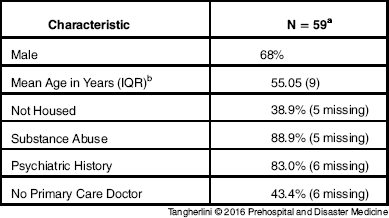
The basic demographic characteristics of the study participants are outlined in Table 1. Sixty-five participants were contacted during the study period. Six patients had missing information regarding their social characteristics, thus they were excluded from analysis. A total of 59 participants were included in the final analysis. The median age of the patient population was 55.05 years with an interquartile range of nine years. Thirty-eight percent of the patients were homeless, 43.4% had no primary care provider, 88.9% had a history of substance abuse, and 83.0% had a previously diagnosed psychiatric disorder.
Patient Demographic and Social Characteristics

a Patients with missing data were excluded.
b Age in 2004.
Main Findings
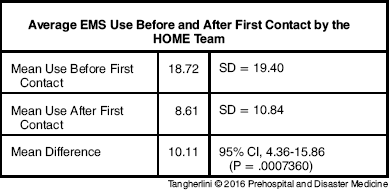
The HOME Team undertook 320 distinct contacts of 59 frequent users during the study period, with an average of 5.42 contacts per patient. The maximum number of contacts was 46. The average use of EMS services by the identified frequent users before first contact was 18.72 (SD=19.40). Average use after first contact was 8.61 (SD=10.84). The mean difference was 10.11; 95% CI, 4.36-15.86; P value <.001 (Table 2).
Primary Study Outcomes

Discussion
The SFFD HOME Team was well received by field providers. Furthermore, several cities have since developed similar programs based on the SFFD HOME Team model.Reference Dean, Sullivan and Soe 20
Previous to the HOME Team, some rural EMS systems have deployed an expanded scope of practice paramedics to perform various primary care functions, most notably the Red River, New Mexico (USA) Project.Reference Jamieson 21 However, to the knowledge of the authors, no EMS system had ever utilized paramedics to address the myriad needs of frequent system users.
The findings reported here suggest that frequent EMS users were male and overwhelmingly suffered from substance abuse disorders and mental illness. These findings were mirrored, albeit not to this degree, in other examinations of repeat users of both EMS and the ED.Reference Niska, Bhuiya and Xu 3 , Reference Shah, Glushak and Karrison 6 , Reference Martinez and Burt 10 , Reference Byrne, Murphy, Plunkett, McGee, Murphy and Bury 11 , Reference Pope, Fernandes, Bouthillette and Etherington 16 Rinke et al found that 70% of frequent EMS users in their study had either a mental health or substance abuse diagnosis.Reference Pope, Fernandes, Bouthillette and Etherington 16 The average patient age in the present study is also consistent with previous findings;Reference McCaig and Burt 2 , Reference Gilbert, Lowenstein, Kazial-McLain, Barta and Steiner 19 thus, the cohort addressed by the HOME Team is likely to exist in many EMS systems.
Tangherlini et al found homelessness to be the strongest predictor of frequent EMS use among an elderly cohort, but in that study, as in this one, the actual percentage of homeless patients was relatively low, 33.0% and 38.9%, respectively.Reference Niska, Bhuiya and Xu 3 Similarly, the HOME Team’s experience was mirrored closely by Mandelberg et al’s examination of frequent use in a large urban ED. 22
The results of the present study revealed the HOME Team interventions were highly associated with decreased EMS use among the target population with a mean reduction of 54% after first contact with the HOME Team. This showed a greater reduction in EMS use realized more quickly when compared to the program highlighted by Rinke et al that relied solely on intervention by a social worker.Reference Pope, Fernandes, Bouthillette and Etherington 16
Previous studies of case management interventions for frequent users of the ED were equivocal about effectiveness.Reference Larkin, Claasen, Pelletier and Camergo 13 - Reference Okin, Boccellari and Azocar 15 , Reference Mandelberg, Kuhn and Kohn 23 Similarly, studies that examined the ability of social workers to reduce frequent EMS use were split over effectiveness,Reference Pope, Fernandes, Bouthillette and Etherington 16 , Reference Spillane, Lumb, Cobaugh, Wilcox, Clark and Schneider 24 with at least one study concluding that ambulance use increased after intervention by social workers.Reference Jamieson 21 None of the programs studied involved EMS workers as part of the intervention, relying solely on social workers to locate, assess, and engage clients into services.
The HOME Team did not seek to replicate or replace the efforts of primary care providers, case managers, or public health nurses, but to make those services more effective and easily accessible to clients whose comorbidity impeded their ability to address their needs in a manner other than being overly reliant on emergency services. Being an integral part of San Francisco’s EMS system allowed the HOME Team to posit a message of change during a moment of crisis for clients and bridge the gap between the traditional modalities of treatment and transport engendered by field paramedic care and the types of ongoing care represented by the aforementioned providers.
These findings suggest that paramedics are uniquely positioned and qualified to engage frequent users into a variety of services. This seemingly new role for paramedics actually mirrors their role in acute care where the prehospital provider assesses a patient’s immediate needs and then determines the appropriate acute receiving facility. In fact, the National Highway Traffic Safety Administration (NHTSA; Washington, DC USA) envisioned this exact evolution for EMS in its 1996 Agenda for the Future.Reference Weiss, Ernst and Ong 25 Today, a number of communities are attempting efforts similar to the HOME Team under the auspices of community paramedicine. 26
Limitations
The greatest limitation to this study was the manner and scope of data collection. To the best knowledge of the authors, this project is the first effort to have an EMS-based response to frequent use of emergency services, thus the methodology of intervention and data collection were created in an ad-hoc manner as the effort developed. Additionally, the speed with which the HOME Team was created did not foster creation of more complete data collection tools and a prospective study was not undertaken.
The HOME Team was created by Mayoral decree for the specific purpose of reducing the amount of EMS responses to frequent users, thus there was no ability to create a control group who did not receive the intervention as policymakers viewed the success of the effort based on reduction in number and intensity of individuals on the monthly frequent EMS user list. Ideally, future efforts would have the resources and support necessary to carry out a prospective study of the effectiveness of EMS based outreach.
Conclusion
Frequent users of EMS suffer from comorbidities such as mental illness complicated by substance abuse and homelessness. These uniquely challenging patients respond positively to the intervention of a specially trained paramedic, as demonstrated by their dramatic reduction in EMS use over the study period.
The SFFD’s HOME Team was the United States’ first effort to utilize what has now come to be known as community paramedicine to proactively address the needs of high-risk and high-need populations and should be replicated in well-resourced pilot projects. Pilot projects should include prospective studies that examine the ability of specially trained paramedics to safely redirect high-need patients, particularly those that become over reliant on emergency services, into other systems of care.