When Thomas Robert Malthus first proposed his concept of the “preventive check” in 1798, he believed that it described a mechanism prevalent across the socioeconomic spectrum in England. The constraint on the birth rate, due to “a foresight of the difficulties of rearing of a family,” operated mainly through delayed marriage and increased rates of celibacy.Footnote 1 The outcome predicated by Malthus corresponded closely to the “European marriage pattern” proposed by John Hajnal, whereby in the early modern era Europeans west of an imaginary line linking Trieste and St. Petersburg married later and married less than people elsewhere.Footnote 2 Economic historians, in turn, have linked the Hajnal-Malthus pattern to the greater ability of the Europeans to accumulate capital and to their relatively high standard of living.Footnote 3
Two features of the Hajnal-Malthus pattern bear noting: first, it implies that the marriage rate was lower in Europe than elsewhere and, second, that marriages were responsive in the short term to changes in harvests or the wage rate. Since the early 1980s several statistical studies have addressed Malthus’ claim against historical evidence from England. All combine E. Anthony Wrigley and Roger Schofield's post-1540 demographic data with data on wheat prices or real wages.Footnote 4 Most find little if any impact of living standards on marriage rates.Footnote 5 But a lack of data has meant that the statistical search for a Malthusian pattern stopped in the sixteenth century. Does the apparent lack of a strong preventive check in the post-Reformation era rules out such a check in earlier centuries? This article addresses this issue by using new data on medieval marriages and disaggregated, parish-level data on early modern marriages. It finds, by contrast with the quantitative literature on the post-1540 period, that a strong preventive check operated both in the medieval and early modern eras.
To reconstruct medieval marriages, we look at the annual number of merchets—fines paid by an unfree peasant for the lord's permission for a daughter to marry—on the manors of the Bishops of Winchester from 1269 to the arrival of the Black Death in 1348. We find a strong connection between changes in wheat prices and subsequent changes in the number of merchets paid. For smaller merchets, corresponding to less wealthy tenants, the relationship is negative: higher wheat prices deter marriages; whereas for larger merchets the relationship is positive, suggesting that episodes of high food prices that forced indebted peasants to sell off their holdings created opportunities for children of wealthier families to acquire the land they needed in order to marry.
For both groups, in other words, there is a strong connection between economic conditions and nuptiality. For the period 1540 to 1800 we use Wrigley and Schofield's population data but, whereas all existing studies use their aggregate estimates, we look at total marriages and births in the 404 parishes on which they based their reconstitution. We find a strong impact of real wages on marriages by half-century up to 1800, whereas the impact of wages on birth rates rises in the early eighteenth century, but disappears in the late eighteenth century.
The outline of the article is as follows. Part 1 reviews the limitations of data on merchets as a proxy for marriages. Part 2 employs data on marriage fines in southern and eastern England and asks what they tell us about the preventive check. We find what we consider rather strong evidence of the preventive check for the relatively poor but not so for the better-off. Part 3 returns to the issue of the preventive check in England between the mid-sixteenth century and the end of the eighteenth century. Again, it finds strong evidence of a preventive check. Part 4 concludes.
Merchets and Marriages
The merchet was a fine or tax paid by a dependent peasant for the lord's permission to marry a daughter.Footnote 6 It was not a means of legitimizing marriage, since after the Fourth Lateran Council (1215) a valid marriage required just two consenting adults. Indeed, it is quite likely that the manor was uninterested in marriages between couples with little or no wealth because such marriages were unpromising sources of revenue. The merchet was more akin to a stamp duty, a means of controlling inheritance and taxing peasant wealth, so its size varied with the likely value of the dowry. In the manorial court rolls studied by Eleanor Searle, the value of merchets ranged between 5s and £4 when there was land involved, but usually between 6d to 2s in cases where land was not mentioned. Few cottagers appear in the records paying merchets.Footnote 7
Several authors have cautioned against inferring marriage rates from merchets. Larry Poos and Richard Smith cite the implausibly low marriage rate implied by the merchet data derived by Zvi Razi from the manorial records of Halesowen. The low rate is due the underrepresentation, if not the absence, of poor serfs in Razi's Halesowen data, presumably because the lord of the manor had little interest in taxing those who were unable to pay.Footnote 8
Others have linked the tendency for the number of merchets to decrease over time to the collapse of the feudal system. There was a big falling off in the number of merchets processed by Spalding Priory in Lincolnshire after the 1390s and a similar pattern is evident in Sutton-in-the-Isle in Cambridgeshire.Footnote 9 However, in Ramsey Abbey in the same county, the annual average number of merchets was higher in the first half of the fifteenth century than in the early fourteenth century.Footnote 10
For two main reasons, then—selection bias problems for class and for period—merchets are an imperfect indicator of the total number of marriages. However, our focus here is not on the trend in marriages or the marriage rate, but on short-term variations in their number. As long as the likelihood of being recorded did not change erratically over time, the year-to-year movement in marriage fines may offer a rough guide—and no more than that—to the variation in marriages. On this basis, we have constructed an annual series of merchets paid on the 65 manors located on the estates of the bishopric of Winchester in southern England.Footnote 11 We also analyze movements in marriage fines from two locations in eastern England.
Our main database, a series derived from the court rolls of the Winchester estate, refers to the pre-Black Death era (from the 1260s to the 1340s). The values of marriage fines by quartile are 12d, 24d, and 80d. At the bottom end, the relatively small number of very small fines—9 percent of the total are for 6d, and there are 30 fines of zero, 17 of 1d to 5d—is consistent with the tendency to exclude poorer cottagers from merchets. At the top end, the maximum fine was 400s, and there were 149 fines of 100s or more. The fact that fines varied with wealth allows us to see how the marriage patterns of different social groups responded to changing economic conditions by looking at changing numbers of large and small fines.
While data start in 1263, as in the case of inheritancesFootnote 12 the marriage fine data appear to suffer from considerable underreporting before 1269: large manors that always report some fines after this date often record zero before it. Our analysis therefore focuses on the period from 1269 to 1348. The five biggest Winchester manors (ranging from 432 to 589 marriage fines in total) account for 27 percent of observations; the biggest 11 (with a minimum of 281 fines each) for 50 percent; and the biggest 20 (with a minimum of 154 fines) for 71 percent. Twenty-five smaller manors recorded between one and fifty fines in total.
If couples married and entered landholdings at the point of marriage, the number of marriages should equal that of merchets recorded. If the death of a spouse resulted in the remarriage of the survivor then the number of merchets, if payable on the remarriage, would have exceeded that of land transfers. That there were only 0.8 merchets per inheritance means that not everyone entering a property through inheritance, if marrying subsequently, was required to pay merchet. This might suggest a tendency for those entering smaller properties to have been less likely to be charged merchet—a factor reflected in the tendency for fine levels to be positively correlated with landholding sizes.
MARRIAGE FINES AND LAND TRANSFERS, 1263–1348

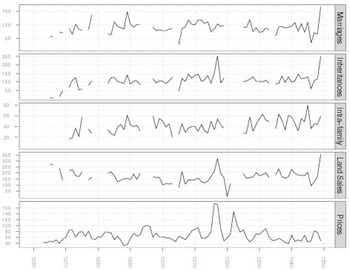
Figure 1 plots annual numbers of marriage fines, land transfers (inheritances, interfamilial transfers, and land sales between unrelated individuals) for the largest 20 manors from 1263 to 1348. An interesting feature of the data is the large number of interfamily land sales: about 200 annually versus 150 for inheritances, although inheritances involved larger plots: the median fine size is 80d for inheritances, compared with only 40d for intra-family transfers and 24d for interfamily transfers.
Thus the typical sale was of a small plot of land, consistent with these smallholders being forced to sell in hard times. It is notable how land sales follow wheat prices, a possible indication that high wheat prices put the poor under pressure, forcing them to sell their holdings to repay debts to wealthier tenants. In plotting deaths measured by entry fines, the figure for the first Black Death year of 1348 is truncated at 250 (the actual figure is 1306) in order to keep all the other inheritance data from crushing along the bottom.
The Preventive Check in the Middle Ages
Like Malthus, Hajnal equated marriage with a couple's economic independence. Since this involved the acquisition of both human and physical capital, marriage timing could be affected by economic shocks; marriage became “a movable feast.”Footnote 13 A series of poor harvests might delay a farmer's ability to pay a daughter's dowry or his son's ability to accumulate the savings necessary to set out on his own.
Exactly when England adopted Hajnal's marriage pattern is still unclear. Razi's pioneering study of the manor of Halesowen is sometimes interpreted as evidence against Hajnal's pattern. But Razi's finding that in a sample of 285 families living in Halesowen between 1280 and 1349 “at least 139 families (49 percent) had a son or a daughter… who probably married between the ages of 18 and 22” is hardly conclusive evidence in favor of early marriage.Footnote 14 On the other hand, Halesowen's poor, whose marriages were less likely to be recorded, probably married earlier than the better-off. Other studies argue for later marriages. For example, H. E. Hallam's analysis of data on the Lincolnshire Fenlands produced estimated mean ages at marriage (22.4 years for women and 25.9 years for men) that fitted the European marriage pattern. On the basis of a range of evidence drawn from poll taxes, marriage fines, and other sources, Richard Smith hypothesizes that the Hajnal regime emerged “as early as the 1260s” while Jeremy Goldberg suggests that it “may have developed most precociously in the towns and cities.” However the available data on marriage age are too patchy for definitive judgments.Footnote 15 Even less is known about mean marriage age in the fifteenth and sixteenth centuries, although some increase in marriage age in the wake of the big fall in real wages during the latter century is plausible. By the early seventeenth century mean ages at first marriage were over 27 years for men and 25 years for women.Footnote 16 By then, the Hajnal pattern was firmly established.
If marriages were postponed in bad years and moved forward in good years, this should be reflected in data linking marriages to economic conditions. What factors determined marriage rates? The first, naturally, is real wages or food prices: in times when real wages fell, it took longer for couples to accumulate the target wealth felt necessary to independent to establish an independent household, so marriage rates should have fallen. However, for wealthier families engaged in commercial agriculture, high food prices could be a boon, causing marriage to be accelerated. In addition, as high food prices caused indebted smallholders to sell their land, richer peasants would have had the opportunity to buy holdings to set their children up on.
The second factor is mortality: marriages rose as the widowed remarried, while the young inherited the property that would allow them to set up a household. For the manor of Halesowen, Razi found that in years where “mortality was high and many young villagers inherited land or husbands lost their wives, the number of marriages rose sharply.”Footnote 17 However, Razi notes that the Great Famine of 1316/17 was exceptional in that “although land was available and many husbands probably lost their wives, marriages had to be postponed.”Footnote 18 The same failure of marriages to rise in 1316/17 can be seen in our Winchester data in Figure 1.
In what follows, we assume the following simple log-linear Malthusian model

where M are annual marriages, N is population, w is the real wage, D are annual deaths, and X are other variables, such as technology, public charity, and urbanization. The right-hand side variables are vectors of current and lagged values. Taking first differences we have

For the marriage and death rate terms, we have the ratio of a fast-moving variable (marriages or deaths) to a slow-moving one: population. It follows that, apart from episodes of catastrophic mortality, the percentage change in marriage rates will approximately equal the percentage change in marriages: Δln(Mt/Nt) = Δln(Mt); and similarly for deaths: Δln(Dt/Nt) = Δln(Dt). Using Wrigley and Schofield's aggregate data for the period 1600–1800, the correlation between percentages changes in marriage rates and percentage changes in marriages exceeds 0.999, and similarly for births and deaths. For annual differences, we assume that the impact of changes of other factors X is negligible: it makes sense for the change in marriages from one year to the next to be affected by a change in real wages, but hardly by better technology or urbanization, although these variables can exert a strong influence over longer periods. We therefore estimate

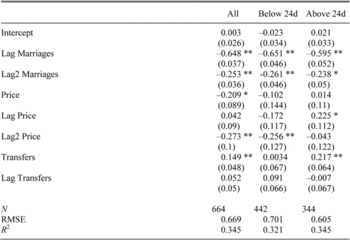
This approach has three advantages. Firstly, it removes the unknown variables N and X. Secondly, in a context where the accuracy of data on births, deaths, and marriages is in question, one can have more faith in data on their differences, as long as the degree of inaccuracy is roughly constant form year to year. Thirdly, for the same reason, we can place more faith in wage differences than in wage levels. Table 1 reports the results of regressing marriage fines on wheat pricesFootnote 19 and property transfers (the sum of inheritance taxes, sales, and intra-family transfers) for the 20 largest manors from 1269, when records become reliable, to 1347, the year before the Black Death. All variables are differences of logs, so the coefficients are elasticities. The first column refers to all marriages, the second to those involving fines of 24d or less, and the third to fines of over 24d.Footnote 20
It can be seen that a high number of marriages in one year results in lower marriages in the next two years. The overall effect of the price of wheat on marriages is negative. Note, however, that for larger fines the impact of lagged fines is marginally positive. The contemporaneous elasticity was −0.1 for small fines and 0.01 for fines over 24d. The cumulative responses after a year were −0.21 and +0.23, respectively; after two years, they were −0.54 for small fines and +0.40 for larger fines.Footnote 21 The cumulative estimate of −0.54 for poorer couples is strikingly high compared to those by David Weir and others reported earlier for later periods. Table 1 also indicates that land transfers had no impact for smaller fines, but they had a large impact for larger fines.Footnote 22
REGRESSIONS OF ANNUAL MARRIAGES BY MANOR ON WHEAT PRICES AND LAND TRANSFERS, 1269–1347

** denotes a coefficient significant at 1 percent.
Notes:
Regressions of annual marriage fines by manor on lagged fines, wheat prices, and number of land transfers. All variables are differences of logs. The second column uses fines of 24d or less, the third uses fines over 24d. Standard errors are in parentheses.
The negative impact of wheat price on marriages for smaller fines supports the standard preventive check story outlined above: as real income fell it took longer to save to reach target wealth for marriage, and so marriage was postponed. The evidence on wealthier peasants is more consistent with the finding by Razi that, in the wake of years of high wheat prices (which drove up the price of other grains also), laborers with plots too small to support themselves were plunged into debt, forcing them to sell their holdings to the rich.Footnote 23 This gave some more prosperous landholders an opportunity to marry off their daughters. We measure deaths in the regression by inheritance fines. However, as Figure 1 shows, inheritances are strongly correlated with other property transfers and by using total transfers (the sum of inheritances, intra-family transfers, and sales), the fit is slightly improved. We therefore report results for total transfers here.
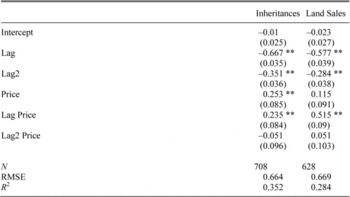
REGRESSIONS OF ANNUAL INHERITANCES AND LAND SALES ON WHEAT PRICES, 1269–1347

** denotes a coefficient significant at 1 percent.
Notes:
Regressions of annual inheritances and interfamily land transfers on wheat prices and lagged value of each dependent variable. All variables are differences of logs.
Although this is not the focus of this study, our data also highlight the link between economic conditions and mortality. Table 2 reports regressions of inheritances and land sales on wheat prices, all variables again differences of logs. It can be seen that rises in wheat prices have a strong impact on mortality in the current and following year, with an elasticity in each case of around 0.25. For sales of land between families, high wheat prices one year increase sales next year with an elasticity of 0.5. These results echo those already reported in a related studyFootnote 24 and also the link between economic conditions and heriots posited in a classic study by Michael M. Postan and Jan Z. Titow.Footnote 25 Taken together, they point to the presence of a strong positive check in medieval England, even among the landholding classes.
Halesowen and Ramsey Abbey
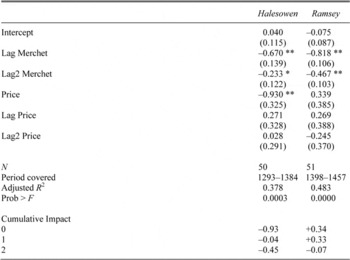
Razi presents data on marriage fines in Halesowen for 1293–1400, but with data missing for 1296, 1303, 1360, 1365, 1366, and only one observation after 1385.Footnote 26 He claimed that in Halesowen peasants married “only when they had land,” which meant that for the rich the wait might not be as long as for the poor.Footnote 27Table 3 reports the results of regressing marriage fines on wheat prices in Halesowen for 1293–1384. The more robust wheat price regression finds that high wheat prices had a strong negative impact on fines.Footnote 28 In other words, this is evidence of the Malthusian preventive check at work in Halesowen.
Judith Bennett's merchet data from Ramsey Abbey in the Cambridgeshire Fenlands cover a later period (1398–1457, but with data missing for 1401–1403).Footnote 29 The annual number of marriage fines in Ramsey rose with wheat prices, as was the case with larger fines on the Winchester estate. The positive (albeit very weakly determined) coefficients on current and lagged wheat price in Table 3 are consistent with only well-off villains paying marriage fines, since such individuals were likely to have been net producers of grain and beneficiaries of forced land sales by the poor. Thus high prices could have enhanced the marriage opportunities of those who with purchasing power to spare. The relatively small number of fines registered in Ramsey Abbey's Liber Gersumarum is interesting in this respect, given that the source relates to the entire Ramsey Abbey estate: this may reflect a wealth bias among those paying marriage fines in later medieval conditions.Footnote 30
Medieval demographic history is still at a stage where “a line of evidence is worth a page of hypothesis.”Footnote 31 While the results of our analysis of the preventive check in medieval England seem plausible to us, their reliance on three “lines of evidence” in the south (the Winchester estates), in the west Midlands (Halesowen), and in the fenlands of East Anglia (Ramsey Abbey) hardly needs laboring.
REGRESSIONS OF MERCHETS ON WHEAT PRICES IN HALESOWEN AND RAMSEY ABBEY

* denotes a coefficient significant at 5 percent.
** denotes a coefficient significant at 1 percent.
Notes:
Regressions of manorial fines on wheat prices and lagged values of both variables. All variables are differences of logs. Robust se's.
Post-1541: Marriages
As noted in the introduction, several previous studies have addressed the link between marriages, births, and living standards in early modern England. Those studies rely exclusively on the aggregate demographic data published in Wrigley and Schofield. One of the earliest and best known, that by Weir, estimated the cumulative responses of marriages to wheat price at +0.099 in 1640–1739 and −0.113 in 1740–1749; the cumulative responses of fertility were −0.050 and −0.164, respectively.Footnote 32 Roy Bailey and Marcus J. Chambers, using the real wage series constructed by Henry Phelps Brown and Sheila Hopkins rather than wheat prices, reported elasticities of births to real wages at between 0.2 to 0.3 and elasticities of the marriage rate at roughly half that for subperiods between 1542 and 1800.Footnote 33 Esteban Nicolini, employing VAR analysis as a means of accounting for possible variable endogeneity, finds that the preventive check “disappeared” in England “before 1740,” but his focus in on births rather than marriages.Footnote 34 Nicholas Crafts and Terence Mills, using Clark's real wage data and state space techniques, could find no evidence for the preventive check after the mid-seventeenth century.Footnote 35 All told, these estimates imply a rather weak preventive check; indeed, Weir was struck by how “at no time between 1670 and 1830 were marriages less responsive to economic shocks in France than in England.”Footnote 36
Our approach to this question differs from those just described in that it applies multilevel regression analysis to the 404 individual parishes constituting the Cambridge Group database for five subperiods from 1539–1600 to 1751–1800, as in an earlier study of the impact of living standards on deaths.Footnote 37 Besides increasing the number of observations, and reducing the standard errors of our estimated coefficients significantly compared with aggregate data,Footnote 38 this allows us to consider whether and how marriage patterns varied across parishes from the sixteenth century on. Coverage improves over time, as the proportion of parishes with the relevant records intact rises. In the absence of long-run data on regional wages, living standards are proxied by the national real wage series for agricultural laborers provided by Gregory Clark.Footnote 39 As above, variables are in differences of logs so that the estimated coefficients may be interpreted as elasticities.
Because we have data for individual parishes, we can estimate a multilevel regression, allowing the impact of wages and past marriages to vary across parishes

where the vector of random effects across parishes, βj, equals βj = (β′1j, β′2j)′ ˜ N(0, Σβj).Footnote 40
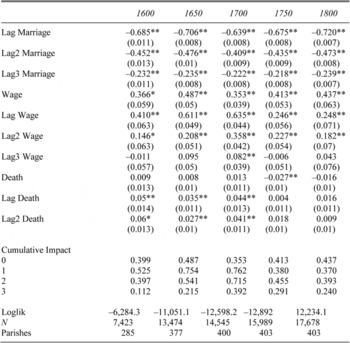
REGRESSIONS OF ANNUAL MARRIAGES BY PARISH ON REAL WAGES AND MORTALITY, 1539–1800

** denotes a coefficient significant at 1 percent.
Notes:
Multilevel regression of annual marriages on real wages and mortality. Each column is for the period ending on the date listed. All variables are differences of logs. Standard errors are in parentheses.
The outcome in Table 4 shows that current wages and wages lagged one and two years had a very strong impact on marriages throughout. The cumulative responses of marriages up to three lags are also reported in Table 4. Before 1700 the cumulative impact peaked one year later; thereafter the peak occurred two years later. Overall, the short-term response was strongest in 1650–1699, but the high cumulative impact in 1700–1749 corroborates our earlier finding that this was a challenging half-century in demographic terms. Deaths, by contrast to the medieval data, had virtually no impact on marriages. This may reflect greater economic opportunities, or simply the fact the medieval data are restricted to moderately prosperous farming households whereas the later data include all marriages. An added consideration may be that this period also saw a shift away from a predominantly peasant economy, and therefore from one where inheritance considerations and remarriages played a more central role.Footnote 41 Overall, we find that the preventive check was a good deal stronger than that found in earlier studies based on national totals.
Post-1541: Births
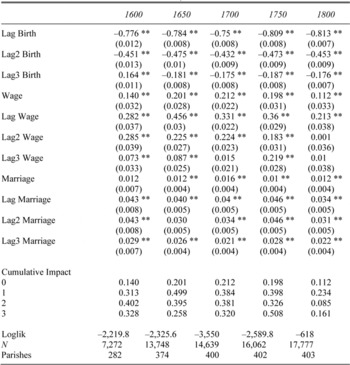
The outcome for births, described in Table 5, resembles that for marriages. The impact of variations in real wages on births before 1750 was quite powerful. The cumulative impact, also described in Table 5, increased during the first half of the eighteenth century, as with deaths;Footnote 42 indeed it was strongest in that half-century. The strong preventive check recorded in 1700–1749 probably reflects the impact of significant subsistence crises in 1728–1730 and 1740–1742.Footnote 43 Again, the estimated cumulative responses reported here are much stronger than those estimated by Weir or by Ronald Lee and Michael Anderson.Footnote 44
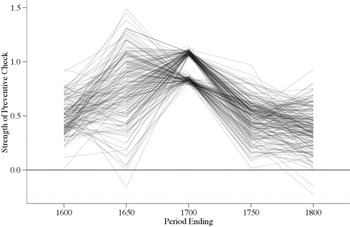
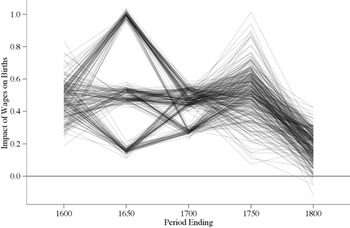
Figures 2A and 2B describe the cumulative effect after three years of wage changes on marriages and births by parish in each half-century from 1600–1650 to 1800–1850. A notable feature in both cases is how much the strength of the preventive check in individual parishes varied through time before the mid-eighteenth century: individual lines representing parishes frequently cross, so that many parishes with a strong (weak) check in one period have a weak (strong) check in the next. The variation across parishes in both responses diminished in the eighteenth century. We can only speculate that the fall in variation might have reflected greater integration in national markets, leading to a more homogeneous society. The patterns are geographically random through time, however. We discovered no correlation between the strengths of the positive and preventive checks across parishes.Footnote 45 This must be due in part at least to measurement error since although the model allows for regional variations in the response to any given shock, it cannot accommodate regional variations in harvest shocks.
REGRESSIONS OF ANNUAL BIRTHS BY PARISH ON REAL WAGES AND MARRIAGES, 1539–1800

** denotes a coefficient significant at 1 percent.
Notes:
Multilevel regression of annual births on real wages and mortality. Each column is for the period ending on the date listed. All variables are differences of logs. Standard errors are in parentheses.
MARRIAGES: WAGE COEFFICIENTS BY PARISH

BIRTHS: WAGE COEFFICIENTS BY PARISH

CONCLUSION
Wrigley and Schofield's path-breaking research on English population history emphasized the “low-pressure” character of the demographic regime. It built on and confirmed the presence of Hajnal's European marriage pattern and Malthus's preventive check. It is ironic, then, that econometric studies employing Wrigley and Schofield's annual data series have lent weak support to the presence of a preventive check, when defined as the short-run response of marriage and births to variations in proxies for the standard of living.
The new evidence produced in this article advances our understanding of English demographic history in two ways. It strengthens the case for the preventive check in both medieval and early modern England. Our reliance on merchets as a proxy for tracking short-run fluctuations in marriages in the medieval era is open to criticism, but the outcome can be defended as coherent. Its implication of the presence of a preventive check on marriages for poorer tenants is plausible, and its tentative finding that better-off tenants may have benefited from poor harvests interesting. Our analysis of the post-1540 period is based on the same data as previous analyses, but our study differs in that employs that data at parish level rather than in aggregate. The outcome offers rather clear-cut evidence of a stronger preventive check on marriages and births in early modern England than found in those studies using aggregate data. Our study thus points to the need for further analysis of the variation in both the preventive and positive checks at local and even household level.