Pete Maravich, Hank Gathers, Reggie Lewis, Alexei Cherepanov – these were all well-known professional athletes who suffered sudden cardiac death during competition. When these events occur, whether to professional athletes or to youth athletes, the headlines grab national attention, and there is an immediate call for more to be done to prevent future tragedies. Most experts agree that this is a public health concern; however, there is still no consensus on the most effective way to prevent these occurrences.
Most studies have determined the rate of sudden cardiac arrest and sudden cardiac death to be between 0.5 and 2.5/100,000 athlete-years.Reference Harmon, Asif, Klossner and Drezner 1 – Reference Toresdahl, Rao, Harmon and Drezner 5 These numbers likely underestimate the true incidence, because most reports consider only sudden cardiac death events that occurred during sanctioned games and practices, not those that occurred while training on one’s own or participating on club teams. The prevalence of unrecognised heart conditions that place athletes at risk is difficult to ascertain but have been estimated to be as high as 1 in 170.Reference Baggish, Hutter and Wang 6 The other factor that has drawn attention to this topic is that the rates of sudden cardiac arrest and sudden cardiac death appear to be higher in athletes compared with their age-matched peers; this suggests that exercise increases the risk for sudden cardiac arrest.Reference Corrado, Basso, Pavei, Michieli, Schiavon and Thiene 3 In fact, among National Collegiate Athletic Association (NCAA) athletes, the sudden cardiac death rate was reported to be 1:43,770 athletes per year,Reference Harmon, Asif, Klossner and Drezner 1 representing the single greatest cause of medical death in this population. Subgroup analysis showed this rate among male, African-American, Division 1 basketball players to be over 1:3000.Reference Harmon, Asif, Klossner and Drezner 1
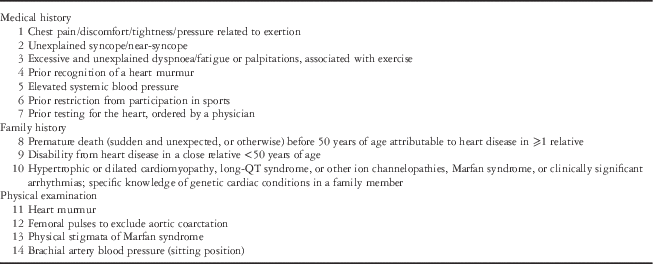
Currently in the United States of America the recommendations for athletic pre-participation screening, as endorsed by the American Heart Association and American Medical Association, are for an in-depth, 14-point history and physical exam before being cleared for participation in competitive sports. This includes a personal history of symptoms associated with prior exercise, family history of unexplained sudden death, and a cardiac examination (Table 1).Reference Maron, Thompson and Ackerman 7 , Reference Maron, Friedman and Kligfield 8 Mass screening that includes an electrocardiogram is specifically not recommended.Reference Maron, Friedman and Kligfield 8 However, in many parts of Europe and Asia, the mandated pre-participation screening includes a medical history, physical examination, and an electrocardiogram.Reference Corrado, Pelliccia and Bjornstad 9 The electrocardiogram screening requirement has also been adopted by the International Olympic Committee.Reference Bille, Schamasch and Kappenberger 10 Data suggest that over two-thirds of the common causes of sudden cardiac arrest would be detected by a 12-lead electrocardiogram. Many such affected athletes are asymptomatic before an arrest episode.Reference Corrado, Basso, Pavei, Michieli, Schiavon and Thiene 3
The 14-element American Heart Association recommendations for pre-participation cardiovascular screening of competitive athletes.

The purpose of this article is to discuss the evidence against and for the use of advanced testing – especially the electrocardiogram – as part of the pre-participation evaluation in the apparently healthy athlete. This will be followed by a discussion of the changing trends in evaluating these patients and where future research may be directed.
Data not supporting advanced testing
Experts agree that pre-participation screening of youth athletes before starting activity is necessary, but controversy arises in how this is best accomplished. In the United States of America, the most controversial aspect of screening is whether or not to include the electrocardiogram as a required element. Multiple studies have looked into the benefits of electrocardiogram screening with differing results.
In 1997 Israel legally mandated a screening programme for all national-sanctioned athletes that included a history, physical examination, electrocardiogram, and an exercise tolerance test that was performed by a specialised, accredited physician. Twelve years after implementation, Steinvil et alReference Steinvil, Chundadze and Zeltser 2 compared sudden cardiac death rates with those from the 12 years before the initiation of this programme. They found the overall risk for sudden cardiac death in athletes to be 2.6/100,000 person-years over the 24-year period of the study. The sudden cardiac death rate was 2.54/100,000 person-years before and 2.66/100,000 person-years after the electrocardiogram programme had begun. Hence, there was no decrease in sudden cardiac death after electrocardiogram implementation. The study did not disclose how many athletes were excluded from participation because of an abnormal electrocardiogram. It was also notable that during the 2 years before the implementation of the screening programme, the rate of sudden cardiac death was anomalously high, 8.4/100,000 person-years. This spike in sudden cardiac death may have been the impetus for starting more advanced screening. It is also important to note that this study examined all athletes who participated in any sanctioned event in Israel, from youth to older athletes, though the exact age range was not provided; the age range of sudden cardiac death cases was 12–44 years.
Roberts et alReference Roberts and Stovitz 11 reported on athletes aged 12–19 years who participated in school-sanctioned sports in the state of Minnesota. They found a sudden cardiac death rate of only 0.24/100,000 athlete-years. Athletes were screened with history and physical examinations every 3 years in accordance with current guidelines in Minnesota. This report did not include sudden cardiac death that occurred during club sports or during sanctioned competitons that were not part of the state school system. Because of this low sudden cardiac death incidence, the authors concluded that screening high-school athletes with electrocardiogram was unnecessary, because a test with such low yield would be inefficient.
Some experts have argued that advanced screening may create deleterious emotional and social effects among athletes having false-positive screens or those found to have minor cardiac defects. This may result in unnecessary restriction from sports participation. This can cause high levels of anxiety in both athletes and family members and can have social consequences as well. In many cases, socialistion and self-esteem is intertwined with being an athlete. Such unnecessary restriction may prevent the child from receiving the many short- and long-term benefits of exercise. Despite this concern, a study conducted to examine anxiety in athletes undergoing screening found that 75% of athletes wanted to know whether they had a previously unknown heart condition. Anxiety levels did not rise among those athletes who screened positive and had to undergo further testing.Reference Asif, Johnson and Schmieg 12
Lastly, some experts feel that electrocardiogram screening does not meet the requirements for a strong screening test. A screening test should have the following characteristics: (a) have high sensitivity; (b) be cost-effective; (c) identify condition(s) that have significant morbidity and mortality; (d) result in treatment that changes the outcome; and (e) identify high prevalence condition(s). It can be argued that electrocardiogram screening for sudden cardiac arrest does not meet at least some of these criteria. These experts support more research, education, and funding for secondary prevention strategies, such as ambulatory external defibrillators being readily available at all sporting events and mandatory cardiopulmonary resuscitation training for athletes, coaches, and athletic trainers.
Data supporting advanced testing inclusion in pre-participation screening
In 2006, Corrado et alReference Corrado, Basso, Pavei, Michieli, Schiavon and Thiene 3 reported a nearly 90% reduction in sudden cardiac death after introduction of electrocardiogram screening in a large Italian population. This study examined competitive athletes, who they defined as participating in organised sports requiring regular training and competition and who were between the ages of 12 and 35 years. The authors did note that this was a homogeneous mostly Caucasian population. The rate of sudden cardiac death was 4.19/100,000 athlete-years before institution of this pre-participation screening strategy. The authors broke down the study into smaller time frames and showed incremental decreases in sudden cardiac death throughout the study from the “early screening” period to the “late screening” period. The sudden cardiac death risk reached its nadir of 0.43/100,000 athlete-years in the final years of the study period. This resulted in an relative risk of 0.21 for sudden cardiac death during the late screening period when compared with pre-screening. The authors concluded that the dramatic decrease in sudden cardiac death during this time frame was due to identification of athletes having cardiomyopathy. Throughout the study period the rate of athletes excluded because of hypertrophic cardiomyopathy and arrhythmogenic right ventricular cardiomyopathy increased, and during follow-up none of these excluded athletes died. This suggested that exclusion from sports may be protective for patients with cardiomyopathy. Indeed, the sudden cardiac death rate among age-matched, non-athlete controls in the same geographic region was stable over the same study period at about 0.79/100,000 – similar to the “late screening” period risk of sudden cardiac death in athletes and higher than the final years of the study. Of the screened athletes, only 9% were referred for further testing because of a positive screen, with 2% ultimately being excluded from competitive sports. This final false-positive rate of 7%, the authors argued, would be fiscally acceptable.Reference Corrado, Basso, Pavei, Michieli, Schiavon and Thiene 3 The electrocardiogram has been the most studied advanced test because of its ease of use and portability, but other advanced screening methods have also been analysed. A study from the Children’s Hospital of Philadelphia determined the sensitivity and specificity of pre-participation screening by comparing history and physical examination alone with inclusion of electrocardiogram and with inclusion of echocardiogram.Reference Vetter, Dugan and Guo 13 The study end-point was detection of cardiac abnormalities that may put athletes at risk for sudden cardiac death. This study found that electrocardiogram screening was three times more likely to detect an abnormality than history and physical examination alone, that it was the most sensitive test, and that it had good specificity (93%). The false-positive rate was 7.8%. Echocardiography was the most specific modality (100%), but with greater costs and lower sensitivity. In particular, youngsters having primary electrical disease as their only abnormality would not have been identified by echocardiography. Although the majority of pathology cases series of young patients having sudden cardiac death identified a morphologic abnormality, every series has had a sizeable minority whose final diagnosis is “unknown”; a proportion of those likely had a primary electrical condition.Reference Drezner, Ackerman and Cannon 14 Electrocardiography was felt to be the most effective advanced screening modality.
Future research and direction
The information reviewed in this report is from observational studies, most of which were retrospective.Reference Harmon, Asif, Klossner and Drezner 1 – Reference Toresdahl, Rao, Harmon and Drezner 5 Large, randomised, controlled trials are needed to determine whether the rate of sudden cardiac arrest/sudden cardiac death can be reduced by advanced testing. Previous studies have presumed that the reduction in sudden cardiac death rates was from implementation of a new screening programme. The Israeli study, in particular, shows how this conclusion can be flawed.Reference Steinvil, Chundadze and Zeltser 2 The rate of sudden cardiac death during the 2 years before electrocardiogram implementation was exceptionally high, meaning that the reduced rate after the screening programme could have truly been from screening or simply due to regression to the mean of clinical events.
Some experts advocate for targeted screening. This would entail only screening athletes at the greatest risk for sudden cardiac death. For example, in the United States of America, this might be limited to males, African-Americans, and basketball players.Reference Harmon, Asif, Klossner and Drezner 1 Male athletes have been found to be at a five to six times greater risk for sudden cardiac death than female athletes.Reference Toresdahl, Rao, Harmon and Drezner 5 In a nationwide study of high-school athletes, female athletes were actually found to be at no greater risk than non-athlete peers.Reference Toresdahl, Rao, Harmon and Drezner 5 Black athletes had a higher rate of sudden cardiac death when comparing both males and females. The rate among black athletes was three to five times higher overall when compared with other racial groups.Reference Harmon, Asif, Klossner and Drezner 1 , Reference Asif, Johnson and Schmieg 12
Paramount to any screening test is the establishment of the normal values for that test. This is particularly problematic for electrocardiogram interpretation. Normative data have been taken from a mostly white, homogeneous, non-competitive population. High false-positive rates have historically been the Achilles heel of electrocardiogram screening. The European Society of Cardiology Criteria (2010 version)Reference Corrado, Pellicia and Heidbuchel 15 and the Seattle CriteriaReference Drezner, Ackerman and Anderson 16 were developed to address this concern . However, even these efforts do not adequately consider all potentially important features such as age, gender, and ethnicity. For example, the rate of hypertrophic cardiomyopathy in African-Americans is greater than that in other ethnic groups, but the healthy black population, on average, has greater left-sided forces.Reference Sharma, Merghani and Gati 17 Education of screening professionals has proven to be important. Providers properly trained in reading paediatric electrocardiograms should be able to provide reasonably low false-positive rates, in the range of 8%. These values from untrained electrocardiogram readers are at least twice that.Reference Maron, Friedman and Kligfield 8 With the establishment of more appropriate normal values and physicians who are aware of them, false-positive rates can be decreased even more. This rate should be within the range of other well-accepted screening tests.
Parallel to advanced screening are efforts to improve secondary prevention. Most states have recognised this and are legislating – although usually unfunded – that ambulatory external defibrillators be present at all sporting venues. In addition, teams and schools are becoming more aware of this concern and are promoting cardiopulmonary resuscitation training for coaches, athletic trainers, and even high-school students. Most reports of pre-participation screening consider rates of sudden cardiac death as opposed to sudden cardiac arrest. The studies that have evaluated sudden cardiac arrest have found higher incidences compared with sudden cardiac deaths.Reference Toresdahl, Rao, Harmon and Drezner 5 This suggests that on-site resuscitation has been successful in some instances. The study in high-school athletes by Toresadahl et alReference Toresdahl, Rao, Harmon and Drezner 5 examined rates of sudden cardiac arrest and sudden cardiac death. The rate of sudden cardiac death was much lower than that of sudden cardiac arrest, and in fact there were only two deaths despite 18 episodes of sudden cardiac arrest. The authors believed that the mortality rate among cases of sudden cardiac arrest was low (11%) because of selection bias. In total, 87% of the participating schools had an ambulatory external defibrillator programme, and in all but one case of sudden cardiac arrest an ambulatory external defibrillator was present. The high rate of resuscitation in this study may not reflect the general population but shows how important it is to have the proper equipment in place. Most of the data on ambulatory external defibrillators and out-of-hospital resuscitation have been from the general adult population, and the results are encouraging. When the push for lay person training began, only about 13% of out-of-hospital cardiac arrests survived, but more recent studies show 40% survival rates.Reference Shephard 18 Finally, prevention of sudden death in the presumed healthy athlete also has to take into account other common causes of death. Maron’sReference Maron, Murphy, Haas, Ahluwalia and Garberich 19 study found that the rate of sudden death in the NCAA from suicide and illicit drug use was similar to the rate from traditional cardiac causes of sudden cardiac death Pimary prevention of these other common causes of death in teens and young adults still needs to be stressed.
Conclusion
It has largely been accepted that pre-participation screening for student athletes is necessary, but there is still no consensus on the most effective and efficient ways to accomplish this. Prospective, randomised trials may help determine the most effective primary prevention. Normative data for age, gender, and ethnicity for screening tools need to be formulated to further reduce false-positive results. Targeted advanced screening aimed at the highest risk groups may be the most beneficial and cost-effective application of primary prevention. Lastly, systematic development of programmes to educate players, students, officials, and coaches on cardiopulmonary resuscitation and the use of ambulatory external defibrillators is needed to improve the rate of successful resuscitation.
Acknowledgements
None.
Financial Support
This research or review received no specific grant from any funding agency or from commercial or not-for-profit sectors.
Conflicts of Interest
None.
Ethical Standards
The authors assert that all referenced work contributing to this review complies with the ethical standards of biomedical or medicolegal investigation.