INTRODUCTION
The fan mussel Pinna nobilis Linnaeus, 1758 is endemic to the Mediterranean Sea and is considered the largest bivalve mollusc of this area (García-March et al., Reference García-March, García-Carrascosa, Cantero and Wang2007a), attaining a shell size up to 120 cm (Zavodnik et al., Reference Zavodnik, Hrs-Brenko, Legac and Boudouresque1991). The species is long lived, achieving up to 20 years of age according to previous studies (Butler et al., Reference Butler, Vicente and De Gaulejac1993), although 27 year-old individuals have been reported (Galinou-Mitsoudi et al., Reference Galinou-Mitsoudi, Vlahavas and Papoutsi2006). Recruitment of P. nobilis is patchy (Butler et al., Reference Butler, Vicente and De Gaulejac1993) and mostly occurs in soft-bottom areas overgrown by seagrass meadows at depths ranging from 0.5 to 60 m (Zavodnik et al., Reference Zavodnik, Hrs-Brenko, Legac and Boudouresque1991) and on bare sand bottoms (Zavodnik et al., Reference Zavodnik, Hrs-Brenko, Legac and Boudouresque1991; Katsanevakis, Reference Katsanevakis2007). This bivalve lives partially buried by the anterior part of the shell (Zavodnik et al., Reference Zavodnik, Hrs-Brenko, Legac and Boudouresque1991; Richardson et al., Reference Richardson, Kennedy, Duarte, Kennedy and Proud1999; Rabaoui et al., Reference Rabaoui, Tlig-Zouari and Ben Hassine2008) anchored with its developed byssus filaments (García-March, Reference García-March2005) within seagrass meadows such as Cymodocea nodosa (Ucria) Ascherson, Zostera marina Linnaeus, 1753 or Zostera noltii Hornemann (Zavodnik, Reference Zavodnik1967; Zavodnik et al., Reference Zavodnik, Hrs-Brenko, Legac and Boudouresque1991; Rabaoui et al., Reference Rabaoui, Tlig-Zouari and Ben Hassine2008), although Posidonia oceanica (L.) Delile meadow is the most common biotope where Pinna nobilis is found (García-March, Reference García-March2003; García-March et al., Reference García-March, García-Carrascosa, Cantero and Wang2007a, Reference García-March, Perez-Rojas and García-Carrascosab) where it is usually hidden by the leaves of the canopy (García-March et al., Reference García-March, García-Carrascosa and Pena2002).
The populations of Pinna nobilis have been greatly reduced during the past few decades as a result of recreational and commercial fishing, their use for decorative purposes, incidental mortality by trawling and anchoring (Richardson et al., Reference Richardson, Kennedy, Duarte, Kennedy and Proud1999; Katsanevakis, Reference Katsanevakis2007; Rabaoui et al., Reference Rabaoui, Tlig-Zouari, Katsanevakis and Ben Hassine2007) and, indirectly, through the regression of Posidonia oceanica meadows (Marba et al., Reference Marba, Duarte, Cebrian, Gallegos, Olesen and SandJensen1996). Additionally, the reduced energy investment in reproduction of the adults (Butler et al., Reference Butler, Vicente and De Gaulejac1993; Vicente, Reference Vicente2003), associated with a strategy of long adult life, and the short period of larval planktonic life, between five and ten days (De Gaulejac & Vicente, Reference De Gaulejac and Vicente1990), suggest that the potential of larval dispersion is reduced (Butler et al., Reference Butler, Vicente and De Gaulejac1993). This capacity would be further reduced in the Mediterranean where currents that transport the larvae are limited and since fertilization is external, in reduced populations fertilization success would be hampered (Levitan, Reference Levitan and McEdward1995), which subsequently interferes with the recovery of vulnerable populations (Butler et al., Reference Butler, Vicente and De Gaulejac1993). Consequently, the fan mussel has been listed as an endangered species. According to the European Council Directive 92/43/EEC on the conservation of natural habitats and wild fauna and flora, P. nobilis is under strict protection (Annex IV) and all forms of deliberate capture or killing of this bivalve are prohibited (Centoducati et al., Reference Centoducati, Tarsitano, Bottalico, Marvulli, Lai and Crescenzo2007). However, this bivalve still suffers from illegal fishing (Katsanevakis, Reference Katsanevakis2007; Rabaoui et al., Reference Rabaoui, Tlig-Zouari, Katsanevakis and Ben Hassine2007).
Knowledge about the biology and ecology of Pinna nobilis is fragmentary and needs further investigation (Butler et al., Reference Butler, Vicente and De Gaulejac1993; García-March et al., Reference García-March, García-Carrascosa, Cantero and Wang2007a). Recent investigation by Cabanellas-Reboredo (Reference Cabanellas-Reboredo, Blanco, Deudero and Tejada2009a, Reference Cabanellas-Reboredo, Blanco and Deuderob) provides useful information about the ecology and trophism of P. nobilis for the conservation of the species. Nevertheless available information about recruitment using spat collectors (Narvaez et al., Reference Narvaez, Lodeiros, Freites, Nunez, Pico and Prieto2000; Beer & Southgate, Reference Beer and Southgate2006) and transplant experiments (Wu & Shin, Reference Wu and Shin1998) of species within the Pinnidae family is scarce. There is only one study where the recruitment effect of the P. nobilis in a small marine protected area was modelled (Peharda & Vilibic, Reference Peharda and Vilibic2008). However, knowledge of the reproductive cycle of P. nobilis is necessary to study the dynamics of current populations, which in turn, helps in proposing effective measures for the protection of the species (Katsanevakis, Reference Katsanevakis2007). Accordingly, the aim of the present study was to increase the knowledge of the recruitment period of P. nobilis and to assess the number of recruits and their size-range through settlement at artificial recruitment devices as a tool for management and conservation of this species. Two types of collectors were tested in order to determine the efficiency in attracting P. nobilis juveniles.
MATERIALS AND METHODS
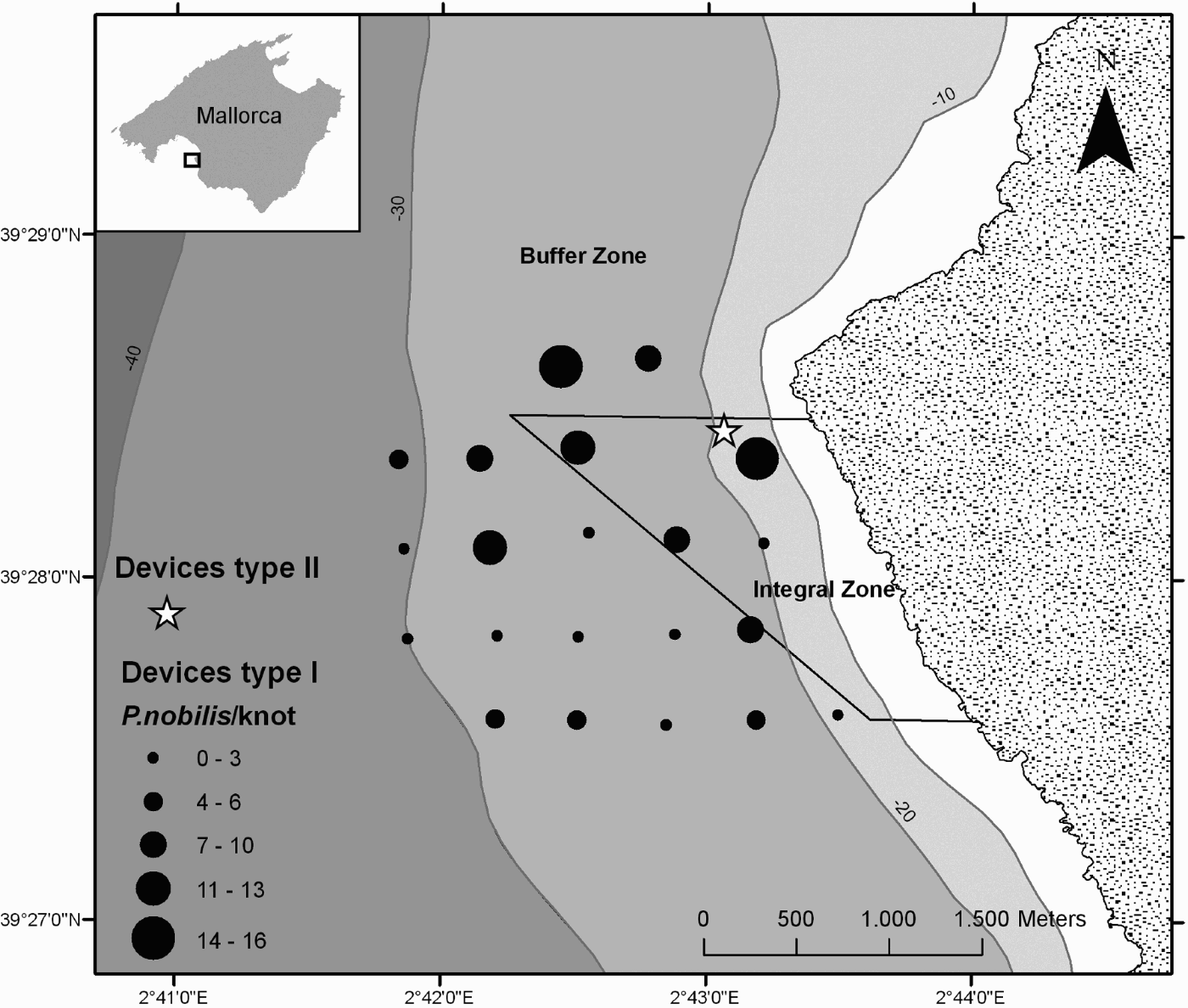
Two types of recruitment devices (I and II) were deployed between 2 and 6 July 2007 in the Marine Protected Area (MPA) of Palma Bay, Mallorca (western Mediterranean; Figure 1). The study area is included within a zone of integral protection, where extractive activities and boat anchorage are not allowed.
Map showing the distribution of the recruitment devices Type I (•) and Type II (*) in the Marine Protected Area of Palma Bay. The number of Pinna nobilis recruits was normalized by knot for all recruitment devices (Type I).

Twenty-one recruitment devices Type I were distributed across the 4 km2 of the MPA. Each device consisted of one rope hanging from a sub-surface buoy, anchored to the sea-floor with a mooring (Figure 2A). The settlement substrate consisted of an entangled rope of a differing number of knots at a constant depth of 5 m from the surface. This type of device remained immersed from July 2007 until February 2008 when it was recovered and re-submerged on the same sampling date.
Design and structure of the two types of recruitment devices. (A) Recruitment device Type I, the image shows two individuals of Pinna nobilis recruited inside the structural configuration generated by knots; (B) recruitment device Type II, the image shows several individuals of P. nobilis collected with this device.

The second group of structures, 15 recruitment devices Type II, were deployed in a zone with an average depth of 22 m. Recruitment devices Type II comprised black bags of knitted polyethylene mesh netting, with dimensions of 0.70 × 0.40 m and 0.009 m of mesh diameter (spat collection bags). In the interior of these bags another net with 0.005 m mesh size was placed in order to increase the surface available for recruitment. Over the full length of the rope, ten spat collection bags were located 1.5 m apart (Figure 2B).
In addition, sampling surveys outside the ‘supposed’ recruitment season were carried out to ascertain that no settlement took place. These surveys were conducted with a combination of both recruitment devices (Types I and II); before the recruitment period with devices Type II submerged for periods of some months (from 19 December 2006 to 23 February 2007; from 26 February to 25 April 2007; from 28 April to 1–6 August 2007) and after the recruitment period with devices Type I in full-time immersion and recovered on sampling days—6 August, 4 October, 20–22 November of 2007 and 20–21 February 2008. During those periods no recruits of P. nobilis were observed.
All presented results are expressed as mean±SE.
RESULTS AND DISCUSSION
The dominant substrate of the study area was Posidonia oceanica meadows, with mean of 759.60±15.14 shoots/m2, 13.47±0.84 apexes/m2 and mean area coverage of 79.78%±0.03. According to the concentration of shoots/m2 the meadow was classified as a very dense bed in an optimal conservation condition (Giraud, Reference Giraud1977).
Between 7 and 11 September 2007, i.e. 68 days after immersion (from July to September), the Type 1 recruitment devices were harvested. A total of 614 juveniles of Pinna nobilis were collected inside the artificial microhabitat generated by the knots of the devices (Figures 1 & 2A). These juveniles presented a mean length and width of 2.76±0.04 and 1.10±0.01 cm respectively. The rapid growth of the early stages of P. nobilis (García-March et al., Reference García-March, García-Carrascosa, Cantero and Wang2007a), and the small average size of the recruited individuals indicated collected P. nobilis juveniles just recently settled. Some bivalve species belonging to the genera Chlamys sp. (Röding, 1798) were also recruited in the Type I device. Moreover, the recruitment variability of the P. nobilis juveniles (individuals per knot; Figure 1) could be related to several parameters. In this sense, the settlement and recruitment of benthic marine invertebrates are complex processes determined by the interaction of biotic and abiotic factors that operate at different temporal and spatial scales (Rodriguez et al., Reference Rodriguez, Ojeda and Inestrosa1993). The dispersion of the larvae can be strongly affected by changes in environmental conditions (Davis, Reference Davis2001; Luppi et al., Reference Luppi, Spivak and Bas2003; Vikebo et al., Reference Vikebo, Sundby, Adlandsvik and Fiksen2005) and the real success of the colonization of these organisms depends on local circumstances such as site-specific hydrodynamics (Eckman & Duggins, Reference Eckman and Duggins1998; Granhag et al., Reference Granhag, Larsson and Jonsson2007). Moreover, anthropogenic factors such as pollution also affect larval establishment (Cebrian & Uriz, Reference Cebrian and Uriz2007).
The Type II recruitment devices were collected between 1 and 19 December after being immersed for six months (i.e. from July to December). Several recruits on these collectors, such as Chlamys varia (Linnaeus, 1758), C. pesfelis (Linnaeus, 1758), C. glabra (Linnaeus, 1758), C. flexuosa (Poli, 1795), Lima hians (Gmelin, 1791), Lima inflata (d'Orbigny, 1836), Ostrea edulis (Linnaeus, 1758), Irus irus (Linnaeus, 1758), Anomia ephippium (Linnaeus, 1758), Spondylus gaederopus (Linnaeus, 1758), Mytilus galloprovincialis (Lamarck, 1819) and Pecten jacobeus (Linnaeus, 1758) were found. From this Type II device, 691 Pinna nobilis were recruited with an average length of 5.38±0.08 cm and a width of 2.10±0.04 cm. The longer immersion period caused larger shell sizes than individuals of P. nobilis recruited on Type I devices. In fact, Pinnids such as P. nobilis and Pinna bicolor (Gmelin, 1791) have been described to present the fastest shell growth rates reported for any bivalve (Richardson et al., Reference Richardson, Peharda, Kennedy, Kennedy and Onofri2004). A growth study with tagged individuals of P. nobilis over ten years reported fast shell growth over the first 2 to 3 years, and much slower growth thereafter (Richardson et al., Reference Richardson, Peharda, Kennedy, Kennedy and Onofri2004), being able to reach a length of 20 cm in two years (Moreteau & Vicente, Reference Moreteau and Vicente1982). In the same way, P. bicolor has an estimated growth around 20 cm in one year (Butler & Brewster, Reference Butler and Brewster1979).
In the present work, both recruitment devices (Types I and II) presented a large efficiency in attracting P. nobilis juveniles, nonetheless the Type II recruitment device presented a large settlement surface allowing a major biodiversity of recruited bivalves. Likewise, the Type II recruitment device is more easily replicable than the Type I recruitment device.
The reproduction of this endemic bivalve is concentrated between the months of March and September (Vicente, Reference Vicente2003). Once the spawning occurs, gametes are fertilized externally, larvae develop from the embryos and after a period of 5 to 10 days, the fully developed larvae settle (De Gaulejac & Vicente, Reference De Gaulejac and Vicente1990) mainly during late summer and autumn (Richardson et al., Reference Richardson, Kennedy, Duarte, Kennedy and Proud1999, Reference Richardson, Peharda, Kennedy, Kennedy and Onofri2004). In accordance with previous studies and in the view of the present results, we hypothesize that recruitment of P. nobilis takes place between the last week of August and the first week of September. Nevertheless, recruitment in bivalves tends to be highly variable between years (Philippart et al., Reference Philippart, van Aken, Beukema, Bos, Cadee and Dekker2003). This recruitment is influenced by the pre-spawning condition of the adults (Beukema et al., Reference Beukema, Drent and Honkoop2001) and the presence of recruits' predators (Strasser & Gunther, Reference Strasser and Gunther2001) as well as by factors synchronizing spawning (Morgan, Reference Morgan and McEdward1995). Moreover, rising seawater temperatures could affect recruitment by a decrease in reproductive output and by spring advancement of bivalve spawning (Philippart et al., Reference Philippart, van Aken, Beukema, Bos, Cadee and Dekker2003). Therefore it would be interesting to observe if there is a relationship between water temperature in spring (the period in which the gonads ripen) and cohort size of juveniles in the autumn. A previous study (Ceballos-Vazquez et al., Reference Ceballos-Vazquez, Arellano-Martinez, García-Dominguez and Villalejo-Fuerte2000) reported that the bivalve Pinna rugosa Sowerby, 1835 had a seasonal gametogenetic cycle directly related to water temperature and photoperiod.
Future climatic changes will probably affect the recruitment of the fan mussel Pinna nobilis, due to the rise in sea level and temperature or other changes which may influence its reproduction phase and larvae transport (Peharda & Vilibic, Reference Peharda and Vilibic2008), presenting a challenge to the already vulnerable populations of the fan mussel (García-March et al., Reference García-March, García-Carrascosa, Cantero and Wang2007a). By focusing on the period of interest for P. nobilis settlement, the present work adds crucial information to effectively protect and further study this species, since artificial recruitment of this species with seed collectors would permit alternative tools for field studies without compromising the vulnerable populations of P. nobilis and their conservation.
ACKNOWLEDGEMENTS
The authors thank the Conselleria d'Agricultura i Pesca (Govern Balear) for the logistics, especially the guards of Palma Bay Marine Reserve, I. Maggiulli and P. Quesada. This study has been financed by the Acció Especial ‘Desarrollo de técnicas para evaluar juveniles del bivalvo endémico Pinna nobilis mediante dispositivos de asentamiento’ of the Direcció General de Recerca, Desenvolupament Tecnològic i Innovación and was integrated in the research projects ROQUER (CTM2005-00283) and JACUMAR. We would like to thank biologists M. Cerdà, S. Sardu and T. Frau for collaboration in field sampling and to N. Marbà for her suggestions and comments, which helped to improve the quality of the manuscript.