
Introduction
The King's Mirror (Konungsskuggsjá), a Norwegian courtier's manual from the thirteenth century AD, states that in Greenland “everything that is needed to improve the land must be purchased abroad, both iron and all the timber used in building houses” (Larson Reference Larson1917: 142).
This statement, as well as other medieval texts such as Eiríks saga rauða, Grænlendinga saga and Grænlendingaþáttur (Halldórsson Reference Halldórsson1978), have influenced the widespread view that the importation of timber was vital for sustaining the settlements in Greenland, and that a scarcity of this resource could have had severe consequences for Norse Greenlandic society (Gad Reference Gad1970; Krogh Reference Krogh1982; Seaver Reference Seaver1996; Diamond Reference Diamond2005; Ljungqvist Reference Ljungqvist2005; Wallace Reference Wallace2009; Haine Reference Haine and Hudson2011). Other scholars, however, argue that the need for, and scale of, wood imports should not be overemphasised (e.g. Bishop et al. Reference Bishop, Church, Dugmore and Møller2013; Pinta Reference Pinta2018; Guðmundsdóttir Reference Guðmundsdóttir2021).
According to medieval sources, timber was imported from Norway and regions on the north-east coast of North America (Halldórsson Reference Halldórsson1978; Seaver Reference Seaver1996; Wallace Reference Wallace2003), and excavations of Norse Greenlandic sites have generated large quantities of wood artefacts and debris. In this article, wood taxa analysis, a method that has been used successfully in the study of a number of North Atlantic and Arctic archaeological contexts, is used to distinguish between imported, drift and native wood (e.g. Malmros Reference Malmros1994; Alix Reference Alix, Maschner and McGhee2009b; Mooney Reference Mooney2016; Pinta Reference Pinta2018; Guðmundsdóttir Reference Guðmundsdóttir2021, Reference Guðmundsdóttir2022a). The Greenland wood assemblages examined here originate from five Norse farmsteads: one in Vestribyggð (Western settlement) and four in Eystribyggð (Eastern settlement). The aim is to assess the proportion of timber imported to Norse Greenland, and to determine from where the timber originated and how it was distributed and used on different types of sites. In doing so, the article also addresses the exploration of, and resource procurement on, the east coast of North America during the period of Norse settlement in Greenland.
Historical context
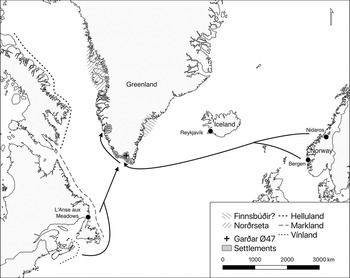
Greenland was colonised from Iceland by Norse settlers c. AD 985. The colonists established two settlements: Eystribyggð in south-west Greenland and, approximately 500km to the north, Vestribyggð in west Greenland. Both settlements were eventually abandoned, Vestribyggð c. AD 1350 and Eystribyggð approximately 100 years later (Sveinsson & Þórðarson Reference Sveinsson and Þórðarson1935; Arneborg Reference Arneborg, Kristiansen, Roesdahl and Graham-Campbell2015). The Norse Greenlanders initially relied on animal husbandry, but over time, hunting, especially of seals, became a more important component of their subsistence strategy (Arneborg et al. Reference Arneborg, Lynnerup and Heinemeier2012). The colonists’ main exports were exotic goods, such as ivory, walrus skin ropes, live polar bears and narwhal tusks (Roesdahl Reference Roesdahl1995; Keller Reference Keller2010; Frei et al. Reference Frei2015). These resources were found in the northern hunting grounds, Norðurseta, in the area today known as Disko Bay, and the eastern hunting grounds, Finnsbúðir, on Greenland's east coast (Halldórsson Reference Halldórsson1978). Scholars have long considered that the export of these goods was an essential means by which the Norse Greenlanders could acquire necessities, such as wood and iron, from Northern Europe (e.g. Nørlund Reference Nørlund1929; Roesdahl Reference Roesdahl1995; Seaver Reference Seaver1996). Timber could also potentially have been acquired from North America. Both the Grænlendinga saga and Eiríks saga rauða, for example, describe journeys from Greenland to the North American east coast. Three regions are mentioned: Helluland (lit. ‘slab land’), Markland (lit. ‘forest land’) and Vínland (lit. ‘wine land’) (Sveinsson & Þórðarson Reference Sveinsson and Þórðarson1935). Helluland is thought to have been located in the Baffin Bay area; Markland is associated with present-day Labrador, south of Hamilton Inlet; and Vínland is thought to have been in or close to the Gulf of St Lawrence (Wallace Reference Wallace2003). Only one Norse site, however, has been discovered on the North American east coast: the eleventh century site of L'Anse aux Meadows, in Newfoundland (Ingstad Reference Ingstad1985; Kuitems et al. Reference Kuitems2022). It has been proposed that L'Anse aux Meadows was a staging post for expeditions from Norse Greenland to acquire natural resources, such as timber (Figure 1) (Ljungqvist Reference Ljungqvist2005; Wallace Reference Wallace2009).
Locations of the main resource areas and possible import routes to Norse Greenland (figure by L. Guðmundsdóttir).

Wood resources in Norse Greenland
The wood resources available to the Greenlandic Norse can be classified as derived from native woodland, driftwood and importation. Due to the geographical position and isolation of Greenland, the tree flora comprises only a small number of different species, most of which are low-growing and crooked or twisted, such as downy birch (Betula pubescens), Greenland mountain ash (Sorbus groenlandica), grey willow (Salix glauca), green alder (Alnus viridis ssp. Crispa) and juniper (Juniperus communis). These taxa form open woodlands or are found in isolated patches (Böcher et al. Reference Böcher, Holmen and Jakobsen1968; Fredskild Reference Fredskild1973; Ledger et al. Reference Ledger, Edwards and Schofield2014, Reference Ledger, Edwards and Schofield2016).
The main driftwood taxa found in Norse Greenland are larch (Larix sp.), spruce (Picea sp.), and to a lesser extent Scots pine (Pinus sylvestris L.), white pine (Pinus sect. strobus) and fir (Abies sp.) (Hellmann et al. Reference Hellmann2013). Other tree taxa found in Norse Greenlandic contexts can be classified as imported. Oak (Quercus sp.) and beech (Fagus sp.) are most likely a Northern European import but could also potentially have originated from North America.
There is an overlap between some of the drift taxa, due to their wide distribution, and potential imported taxa. Scots pine and spruce could be either driftwood or imported from Northern Europe, while larch, spruce, and fir could also have been imported from North America (Brouillet et al. Reference Brouillet2010; Mooney et al. Reference Mooney, Pinta and Guðmundsdóttir2022).
Material and methods
Sites
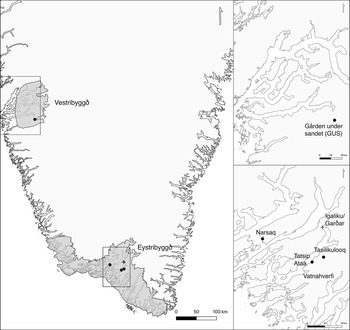
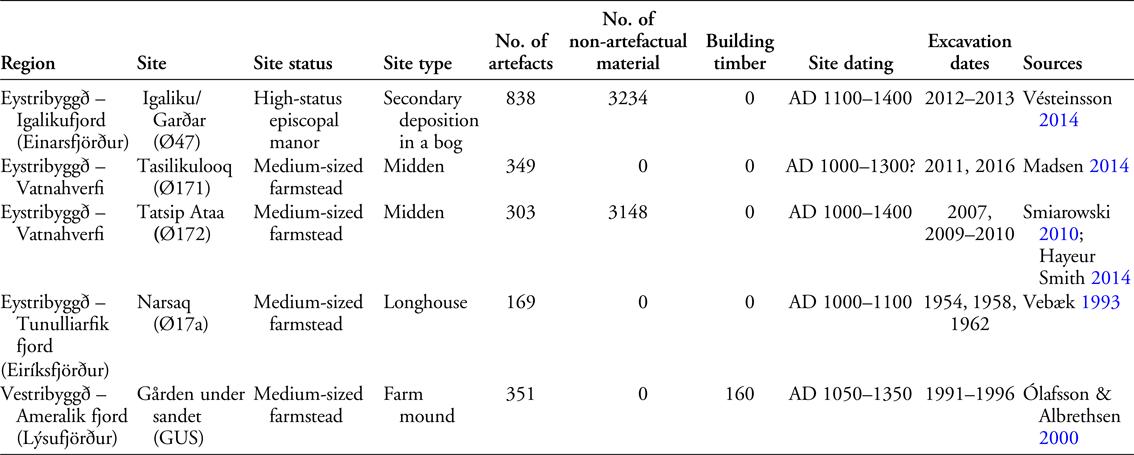
The wood assemblages investigated here come from five Norse sites in western Greenland (Table 1). One—the medium-sized farm site at Gården under sandet (GUS)—was located in Vestribyggð; the other four were located in Eystribyggð. Among the latter, Igaliku is a high-status site, which has been identified as the episcopal manor Garðar, while Narsaq, Tatsip Ataa and Tasilikulooq are all medium-sized farms (Figure 2). All five sites were in use between AD 1000 and 1400 (Table 1); although not all were continuously occupied throughout the entire period, they all overlap chronologically. The excavations at Igaliku, Tasilikulooq and Tatsip Ataa examined refuse deposits. The excavators used single-context recording, with all excavated cultural layers being sieved, retrieving both artefacts and large quantities of worked and unworked wood remains (Smiarowski Reference Smiarowski2010; Vésteinsson Reference Vésteinsson2014).
Location of the sites used in this study. The settlements are shaded. The insets are marked on the left map as black squares (figure by L. Guðmundsdóttir).

Details of the sites and assemblages used in this study.

The assemblages from Igaliku and Tatsip Ataa are divided into two phases: phase I represents AD 1000–1300 and phase II covers AD 1300–1400. The phasing of the assemblage from Igaliku is based on 14 radiocarbon dates. Although the material from this site comes from a secondary deposition, the deposits were in the correct chronological order (for a detailed discussion of the chronology, see Vésteinsson Reference Vésteinsson2014: 99–102). The assemblage from Tatsip Ataa is dated by 12 radiocarbon dates and is also a secondary deposition, although unlike at Igaliku that material is mixed (Smiarowski Reference Smiarowski2010). In addition, the phasing of this site has been re-evaluated through the inclusion of two subsequent radiocarbon dates on textiles, as well as artefact typology, which extends the use of the site through to the mid fourteenth century AD (Hayeur-Smith Reference Hayeur-Smith2014). The excavations at GUS and Narsaq focused on structures. The assemblages consist of artefacts and, to some extent, building timber. The dating of both sites is based on radiocarbon dates and artefact typologies (Vebæk Reference Vebæk1993; Ólafsson & Albrethsen Reference Ólafsson and Albrethsen2000, Reference Ólafsson, Albrethsen, Turner, Owen and Waugh2016).
Wood anatomical analyses
The anatomical features of trees vary between taxa. This variability can be used to determine the taxa present in archaeological wood assemblages. For the current study, thin sections were taken according to standardised procedures (Hather Reference Hather2000) and examined under both stereo and light microscopes, with magnification up to 600×. Wood remains were sectioned along three planes. First, the cross section was examined to determine whether the wood was deciduous or coniferous. Second, the radial section of each sample and, when necessary, the transverse section, was examined in order to determine genus or species. The identifications were made by comparing anatomical characteristics of the wood sample to comparative reference collections at the Institute of Archaeology, Iceland, and published sources (e.g. Schweingruber Reference Schweingruber1990; Hather Reference Hather2000; Schoch et al. Reference Schoch, Heller, Schweingruber and Kienast2004).
Results
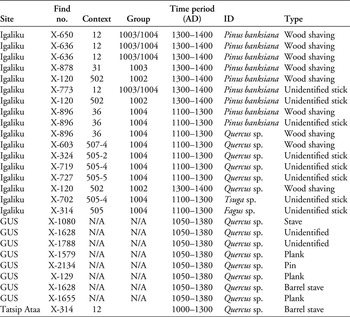
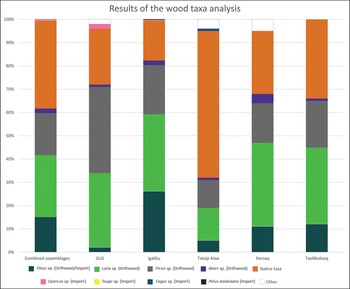
The results of the wood taxa analysis show that, of 8552 pieces identified to taxa, 26 pieces are of taxa that represent unambiguous imports (Table 2). These 26 pieces are of oak, beech, hemlock (Tsuga sp.) and Jack pine (Pinus banksiana), representing just 0.27 per cent of the combined wood assemblage from the five sites used in this study. Taxa identified in the combined assemblage that can be classified as either imported or driftwood are: larch, which represents 25 per cent of the total, spruce at 19 per cent, Scots pine at 13 per cent and fir at 2 per cent.
Unambiguous imported taxa identified in this study

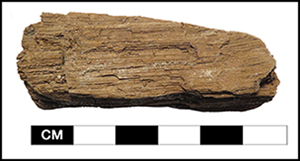
Looking at the individual site assemblages, the proportion of Scots pine ranges between 1 and 29 per cent, with the highest proportion at Igaliku, while the proportions of larch, spruce and fir are similar at all sites, except that the proportion of spruce is higher in GUS than at the other sites. Oak represents only 0.17 per cent of the total assemblage. Eight oak pieces were identified at GUS, six at Igaliku, and one at Tatsip Ataa. All the pieces of oak from Igaliku bar one come from the earlier phase. A single piece of beech, from Igaliku, was identified in the combined assemblage (Figure 3).
Results of the wood taxa analysis. The graph shows combined results from all sites, as well as each individual site (figure by L. Guðmundsdóttir).

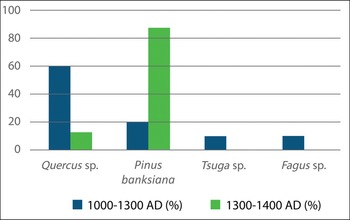
Hemlock and Jack pine were not present in Northern Europe during the early second millennium AD and the pieces identified here—all from Igaliku, with three from the earlier phase and seven from the later (Figure 4)—must therefore have originated in North America (Schweingruber Reference Schweingruber1990; Brouillet et al. Reference Brouillet2010). The documentation of their presence in Greenland confirms that the Norse acquired wood from the east coast of North America.
The proportions of unambiguous imported taxa identified at Igaliku and Tatsip Ataa, as well as change through time (figure by L. Guðmundsdóttir).

Discussion
Norse Greenlanders acquired wood from native woodlands, driftwood and importation. Native woodland taxa make up approximately 36 per cent of the combined assemblage but are represented primarily—and disproportionately—by unworked twigs and branches. Even though the native woodland species can be utilised for various wood-working purposes, driftwood or imported timber was necessary for large-scale projects, such as house construction and boat and ship building (Guðmundsdóttir Reference Guðmundsdóttir2021, Reference Guðmundsdóttir2022a). Driftwood was one of the most important raw materials in Norse Greenland, making up almost 50 per cent of the combined assemblage, while imports comprise approximately 13 per cent. The imported taxa are from Northern Europe and from across the Davis Strait in North America.
European imports
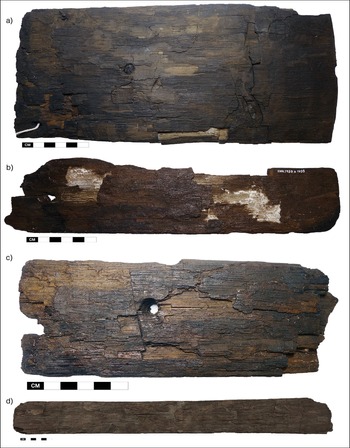
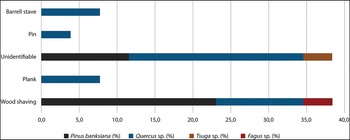
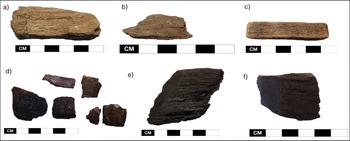
Three taxa which are most likely of European origin are oak, beech and Scots pine. Pieces of these taxa may have been imported as ready-made artefacts, especially the barrel staves, or as building timber that could either represent reused ship timbers or specially imported construction materials (Figure 5). The oak assemblage from Igaliku comprises entirely of wood debris, suggesting that oak was being worked on site, although it is unknown whether this debris reflects oak that was specially imported for construction or debris from the reuse of old timbers. The presence of a barrel stave at Tatsip Ataa indicates a Northern European import, most likely of barrels as containers for goods (Figures 4 & 6). Such curved, coopered vessels were not produced in Iceland until at least the seventeenth century (by Basque whalers) (Edvardsson & Rafnsson Reference Edvardsson and Rafnsson2006) and by Icelanders as late as the eighteenth century (Mehler & Eggertsson Reference Mehler and Eggertsson2006). It is therefore unlikely that these vessels were being made in Greenland during the Norse period. Furthermore, Pinta (Reference Pinta2018) identified four oak pieces at Qorlortup Itinnera—two staves and two lids/bases—arguing that they originated from Northern Europe. The highest number of oak artefacts in the combined assemblage comes from GUS: two reworked barrel staves, again indicating the importation of barrels from Europe; three pieces of building timber; one pin; and two unidentified artefacts (Figure 6).
Imported objects identified in this study: a–c) oak planks and a barrel stave from GUS; d) oak barrel stave from Tatsip Ataa (photographs by L. Guðmundsdóttir).

Proportion of artefact types identified within the material from Igaliku, Tatsip Ataa and GUS (figure by L. Guðmundsdóttir).

These eight oak artefacts from GUS are potentially distributed over a 300-year period. Furthermore, the finds context is different to that at Igaliku, Tatsip Ataa and Tasilikulooq. The excavation at GUS was focused on buildings, while the assemblages from the other sites, except Narsaq, were from secondary depositional contexts. Another factor that might explain why oak is more common at GUS is the extremely good organic preservation due to permafrost (Figure 7).
Wood-working debris and other unidentified objects: a–c) oak fragments from Igaliku; d) oak fragments from GUS; e) oak shaving from Igaliku; f) beech shaving from Igaliku (photographs by L. Guðmundsdóttir).

North American oak and European oak cannot be distinguished anatomically (Hather Reference Hather2000), and since the Norse acquired resources in North America, the oak could potentially be an import from that region. The northernmost limit of oak in North America is at 50° north. The Norse, however, travelled further south, based on the presence at L'Anse aux Meadows of butternut or white walnut (Juglans cinerea), which is only found south of 47° (Wallace Reference Wallace2003). None of the oak artefacts identified here was suitable for provenancing through dendrochronology. If the oak arrived in Greenland as ready-made artefacts, the origin is more likely European; however, the importation of oak timber from North America cannot be excluded.
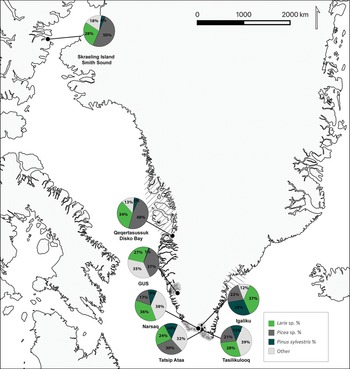
Scots pine does not grow in North America (Schweingruber Reference Schweingruber1990), so it was most likely imported from Northern Europe. Today, this species has a wide distribution in Europe, occupying a range from Spain (37°N) to northern Scandinavia (70°N) (Caudullo et al. Reference Caudullo, Welk and Miguel-Ayanz2017). Imported Scots pine could have originated from either the Baltic or Scandinavia (Norway/Sweden); however, given the close economic and political relationship with Norway at the time, it is more likely that the wood was imported from there (Magerøy Reference Magerøy1993; Nedkvitne Reference Nedkvitne2019). To assess the proportion of Scots pine that was imported versus acquired as driftwood, the results were compared with an Inuit site on Skraeling Island and a pre-Inuit site in Qeqertasussuk. As pre-Inuit and Inuit groups had negligible or no contact with Europeans, the pine from these sites almost certainly represents wood that drifted to Greenland. The proportion of Scots pine at these sites is 4–5 per cent (Grønnow Reference Grønnow and Jacobsen1996; Alix Reference Alix and Grønnow2009a, Reference Alix, Maschner and McGhee2009b). With reference to these proportions, it can be deduced that up to half of the Scots pine assemblage at Igaliku represents imported timber from Northern Europe, or about 5.3 per cent of the combined assemblage (Figure 8). Some of the Scots pine from Tatsip Ataa and Tasilikulooq might also represent imports. The other possibility is that the inhabitants of Eystribyggð had access to a different mix of driftwood taxa, since there is far less Scots pine and a higher proportion of spruce (Guðmundsdóttir Reference Guðmundsdóttir2021) at the Western settlement sites.
Proportions of Scots pine, larch, pine and other taxa in this study. The non-artefactual material identified from Igaliku and Tatsip Ataa is not included in the pie graphs (figure by L. Guðmundsdóttir).

American imports: Vínland the good (Vínland hið góða)
The sagas indicate that Norse expeditions to North America were partly resource-orientated, and that wood was one of the goods brought back to Greenland. The explorers Leifur heppni, Þorleifur karlsefni and Freydís are all said to have brought back timber from Vínland to Greenland (Halldórsson Reference Halldórsson1978: 86–87, 94 & 97). Markland, to the north of Vínland, however, refers to the forests that the explorers encountered. Wallace (Reference Wallace2003) argues that because wood was readily available in Markland, which is much closer to Greenland than Vínland, expeditions further south solely in search of timber were unnecessary. Furthermore, an Icelandic annal records that in 1347, a Greenlandic ship called Marklandsfar drifted off course and landed in west Iceland. Described as smaller than the ships that sailed from Norway to Iceland, this ship had been on route to Markland, presumably to obtain wood (Storm Reference Storm1888). This indicates that journeys were being made from Greenland up until the fourteenth century. It has been argued that timber from North America was a necessary part of Norse Greenlandic wood procurement strategies, especially for boat building (Seaver Reference Seaver1996; Diamond Reference Diamond2005; Ljungqvist Reference Ljungqvist2005). Furthermore, Wallace (Reference Wallace2003) argues that wood-working debris and iron nails in one of the structures at L'Anse aux Meadows indicate that boats were being repaired and possibly built there. The boat timbers that have been identified from Norse Greenland, however, are all most likely made from driftwood. Given the limited number of samples (n = 15) (Andersen & Malmros Reference Andersen, Malmros and Clausen1993; Guðmundsdóttir Reference Guðmundsdóttir2022b), however, this does not disprove that boats were being built from North American timber, only that there is currently no firm archaeological evidence to support this possibility.
In total, eight pieces of wood, mostly shavings, from the combined assemblage can be identified as originating from North America. Seven are Jack pine, which can be distinguished from Scots pine by the ray tracheids (Hather Reference Hather2000; Robichaud et al. Reference Robichaud, Ehrman, Mood and Laroque2012), and one is hemlock. Jack pine has a small native population in south-western Labrador but grows naturally from the Mackenzie River, east to Nova Scotia, and south to New England (Meades & Meades Reference Meades and Meades2019). Hemlock is present in the Quebec region, New Brunswick, Prince Edward Island, Ontario and Nova Scotia (Brouillet et al. Reference Brouillet2010). Therefore, these taxa could have been acquired in coastal areas along the Gulf of St Lawrence, which has been identified as a likely location of Vínland (Wallace Reference Wallace2003). The wood taxa identified in this study show, without doubt, that the Norse harvested timber resources in North America. These North American taxa are only found at Igaliku, where the episcopal seat was established in AD 1124 (Magnusen & Rafn Reference Magnusen and Rafn1838). This suggests that high-status farms such as Garðar were probably the only settlements that had both the need and the means to acquire North American timber.
The assemblage from Igaliku belongs to two phases: phase I (AD 1100–1300) and phase II (AD 1300–1400). The majority of the North American taxa relate to the latter phase, suggesting that these expeditions were predominantly undertaken in the later phase of the Norse period in Greenland. The sample size is small, however, and the written sources clearly indicate that these expeditions were being made throughout the period of the Norse settlement. The small proportions of North American wood taxa suggest, nonetheless, that such imports did not form an important element of Norse Greenlandic wood procurement strategies as a whole, although they were highly significant in relation to the ability of these settlers to sail, navigate and utilise remote resource areas throughout the period of Norse settlement. Even though L'Anse aux Meadows was primarily used in the eleventh century (Kuitems et al. Reference Kuitems2022), the current study suggests that journeys were being made until at least the fourteenth century.
Iceland and Greenland: a comparison
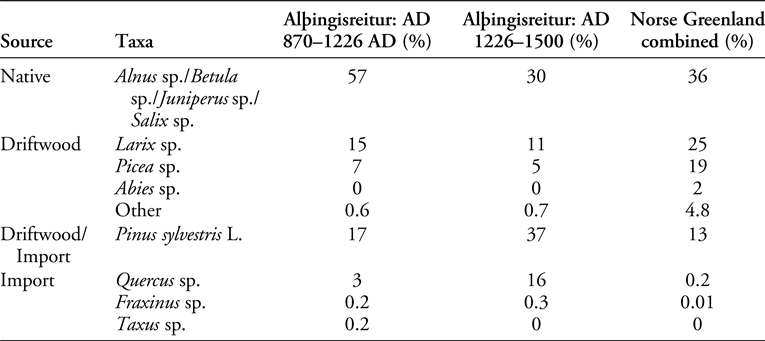
In both Iceland and Greenland, driftwood was the main source of wood (Guðmundsdóttir Reference Guðmundsdóttir2013, Reference Guðmundsdóttir2021; Mooney Reference Mooney2014, Reference Mooney2016). When the Greenlandic assemblages are compared with a contemporaneous assemblage from Alþingisreiturinn in central Reykjavík (phase IV: AD 870–1226 AD; and phase III: AD 1226–1500), differences are apparent (Table 3). The earlier phase at Reykjavík is comparable to the Norse Greenlandic assemblage. Unambiguous wood imports comprise approximately 3 per cent of the assemblage—slightly higher than in Greenland. Scots pine represents 17 per cent of the Reykjavík assemblage, while the rest is either driftwood or native wood.
Proportions of wood taxa analyses from Reykjavík, Iceland and Norse Greenland.

At Reykjavík, from AD 1226–1500, the proportion of Scots pine increases to 37 per cent, and oak from 3 to 16 per cent. A comparable change is not reflected in the Greenlandic assemblages, however. This is evident in the assemblage from Igaliku, in which there is very little change in wood taxa composition between phases: the proportion of Scots pine is the same in both periods, oak is only found in the earlier period, and Jack pine only in the later period. At Tatsip Ataa, there is little evidence for the importation of wood, and the farm relied predominantly on resources available in Greenland during both time periods. These differences seem to suggest that while both Iceland and Greenland had sufficient wood resources available locally, Iceland came within the orbit of growing international trade networks, which brought new timber supplies, while Greenland did not (Dugmore et al. Reference Dugmore2012).
Conclusion
Wood was a vital resource for the Norse Greenlanders. While the local woodland taxa could provide wood for fuel, the production of artefacts and for small-scale construction, larger building projects and shipbuilding required alternative sources: driftwood or specially imported timber. Driftwood was widely used in Norse Greenland and medium-sized sites sustained the majority, if not all, of their needs with either driftwood or from local woodlands. In contrast, most of the small amounts of imported timber identified in this study (Scots pine, oak, beech, Jack pine and hemlock) come from the site of Igaliku. The use of imported wood therefore appears to have been limited to higher-status sites. Nonetheless, while the high-status farm in Igaliku had access to imported timber, there is no indication that it was a necessity, and that its needs could not have been met through the use of driftwood; rather, the use of imported wood was a luxury. Even so, comparison with a contemporaneous wood assemblage from Iceland indicates increased wood imports to Iceland during the thirteenth and fourteenth centuries, while the wood assemblages in Greenland reflect no comparable change. Most of the wood specially imported to Greenland originated from Northern Europe, most likely Norway, while there is evidence of sporadic imports from North America. These findings highlight the fact that Norse Greenlanders had the means, knowledge and appropriate vessels to cross the Davis Strait to the east coast of North America at least up until the fourteenth century. As such, journeys were being made from Greenland to North America throughout the entirety of the period of Norse settlement in Greenland, and resources were being acquired by the Norse from North America for far longer than previously thought.
Acknowledgements
This research forms part of the Sticks and Stones: Raw Material Use in Norse Greenland project. The study of the wood comprised the author's PhD project, conducted at the University of Iceland and supervised by Orri Vésteinsson. The study of the wood assemblages is divided into three parts—utilisation of native woodland, driftwood and imports—each published as separate articles. The analyses of the wood assemblages took place at the Institute of Archaeology, Iceland, the National Museum of Greenland and the National Museum of Denmark. I would like to thank Orri Vésteinsson, Jette Arneborg and Ólafur Eggertsson for guidance and helpful comments, as well as the two reviewers who helped improve this manuscript.
Funding statement
This work was supported by the Icelandic Research fund (RANNÍS) under grant no. 185055-053.