1. Introduction
Stem cells are widely discussed yet poorly understood. These controversial biological entities have been the subject of political wrangling, clinical speculation, and a 2012 Nobel Prize. Yet, outside bioethics, stem cells have received very little philosophical attention. This essay is part of a project aiming to fill this gap, examining stem cell biology from a philosophy of science perspective. Here I focus on a deep evidential challenge for the field: the stem cell uncertainty principle. I show that this principle resolves into several distinct evidential problems, which follow from features of the stem cell concept and experiments that connect that concept to the biological world. The article is organized as follows. This section provides background and introduces basic assumptions. Section 2 explicates the basic stem cell concept, the shared core of working definitions offered by scientists. Section 3 presents the general design of experiments that aim to isolate and characterize biological entities conforming to this concept. This sets the stage for “the stem cell uncertainty principle,” introduced in section 4. Section 5 discusses possible responses to this evidential challenge, including one that predominates today. I conclude by discussing some implications of this result.
A striking feature of stem cell biology is the sheer variety of stem cells: adult, embryonic, pluripotent, induced, neural, muscle, skin, blood, and so forth (table 1). This diversity is exploited in political debates over stem cell funding and complicates public discussion of stem cells’ therapeutic promise.Footnote 1 To distinguish reasonable hopes from misleading hype, it is necessary to clarify the stem cell concept. The following tenets of cell theory are assumed: (i) Every organism begins as a single cell that, in multicellular organisms, gives rise to all the body’s cells. (ii) Cells reproduce by binary division.Footnote 2 (iii) The life of a cell begins with a division event and ends with either a second division event yielding two offspring, or cell death (and no offspring). (iv) Generations of cells linked by reproductive division form a lineage. A cell lineage, therefore, is a biological entity composed of successive cell generations, organized by reproductive relations.

| Stem Cell | Characters | Time Interval/Duration | Potency | Source |
|---|---|---|---|---|
| ESC | Shape, size, cell surface markers, gene expression | Indefinite (>50 cycles) | Pluripotent | Early embryo inner cell mass |
| HSC | Various | Various (weeks–decades) | Multipotent | Bone marrow, cord blood, peripheral blood |
| NSC | Morphology, cell surface markers, nerve function | Months–years | Oligopotent | Brain (adult and embryonic) |
| iPSC | Shape, size, cell surface markers, gene expression | Months–years | Pluripotent | Differentiated cells (various tissues) |
| epiSC | Shape, size, cell surface markers, gene expression | Months–years | Pluripotent | Early embryo inner cell mass |
| GSC | Shape, size, cell surface markers, gene expression | Months–years | Pluripotent | Genital ridge (embryo) |
| CSC | Various | ? | ? | Cancer (leukemia) |
| EC | Shape, size, cell surface markers, gene expression | Months–years | Pluripotent | Cancer(teratocarcinoma) |
| Epiderm | Morphology, cell surface markers | Months–years | Unipotent | Skin |
| Hair | Morphology, cell surface markers | Months–years | Unipotent | Follicle |
2. Stem Cell Concept
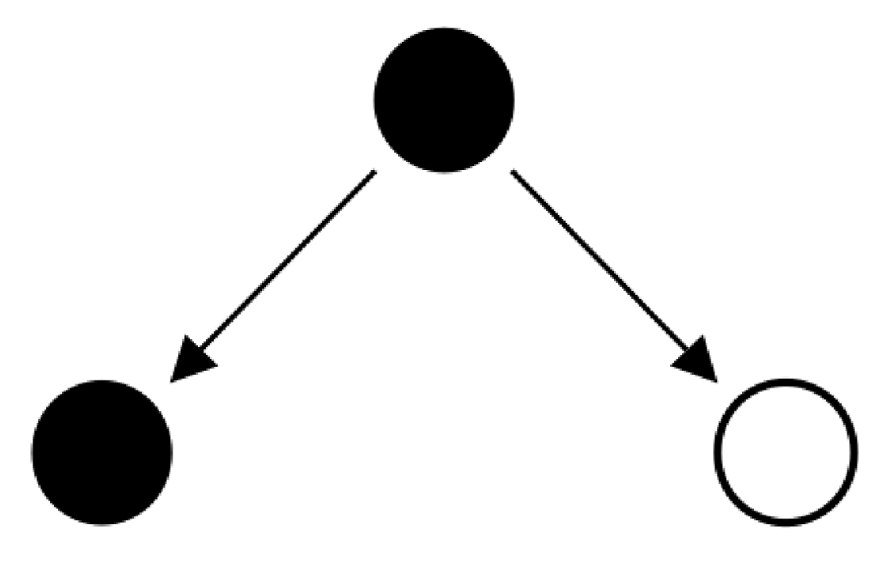
Stem cells are defined as cells that can give rise to more cells like themselves, as well as more specialized, or differentiated, cells.Footnote 3 These two cellular processes are termed, respectively, self-renewal and differentiation. Self-renewal is cell reproduction in which parent and offspring resemble one another. Differentiation is the process by which parts of a developing organism acquire diverse, specialized traits over time. The simplest way to conceptualize a stem cell, then, is in terms of a division event that includes both reproductive processes: one cell like the parent, the other more specialized (fig. 1).
Simple stem cell model.

However, to capture the general stem cell concept, additional parameters are needed. No two cells are the same or different in every respect. Minimally, cells involved in a division event differ in position and intercellular relations and share some material parts such as DNA sequences. Comparisons of cells are perforce relative to some set of characters (e.g., size, shape, concentration of a particular molecule). Furthermore, stem cell capacities are not restricted to a single division event. Self-renewal and differentiation are dynamic processes, with a temporal as well as comparative aspect. The temporal aspect of self-renewal is conceived as a number of cell divisions, while that of differentiation is a time interval over which cell character values within a lineage are compared.Footnote 4 These variables suffice to define self-renewal:
Self-renewal occurs in cell lineage L, relative to a set of characters C and number of cell cycles n, if and only if n + 1 generations of parent and offspring cells have the same values for C.
The concept of differentiation is more complex. Not every change in cell character, within or across generations, counts as differentiation, but only those ‘directed’ in a certain way. From a comparative standpoint, there are two distinct concepts of differentiation. One involves comparison between cells of a developing lineage. Cells differentiate in this sense just in case they become more heterogeneous over time, differentiating from one another.Footnote 5 In stem cell biology, however, the more significant comparison is between mature cells that have completed development and those that have not. Cells that compose the body of a fully developed organism are classified by morphological, functional, and molecular characters into many specialized cell types. Each of the latter is defined by a set of character values M i. In cell development, however, there is usually not one cell fate to consider, but a whole array, each with a characteristic complex of traits (M 1, M 2 … M n). Cell lineages vary both in number of ‘developmental stages’ (generations) distinguished and in number of developmental termini (mature cell types). So differentiation, in the sense at issue, can be defined as follows:
Cells in lineage L differentiate over time interval t 1 − t 2 if and only if M-values in L are more similar to those of some M i at t 2 than t 1.
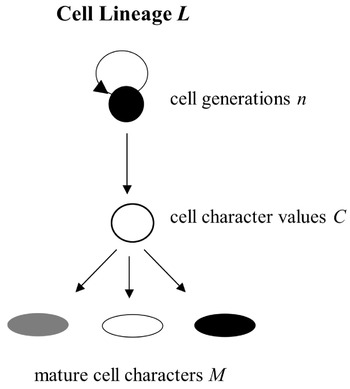
Putting the two definitions together yields a general definition of ‘stem cell’: the origin of lineage L defined by time interval n, characters C, and mature cell characters M. This abstract model structurally defines a stem cell by position in a cell lineage organized by two reproductive relations.Footnote 6 Within a lineage L, a stem cell has maximal self-renewal and differentiation potential (fig. 2). To apply to biological phenomena, the key parameters must be specified: lineage L, cell divisions n and/or time interval t 1 − t 2, character sets C and M. Different values of these variables correspond to different varieties of stem cell (table 1). Additional diversity results from different representational assumptions that connect the abstract model to biological objects. In stem cell biology today, objects in the model may represent (i) single cells, (ii) cell populations with statistical properties, or (iii) cell types individuated by a shared set of character values. I return to this point in section 4.
Stem cell concept: abstract model.

For now, the key result is that the general concept of a stem cell is relational, in that it presupposes comparative reproductive relations among cells, and relative to a lineage, sets of characters, and a time interval of interest. In order for this concept to map onto biological reality, these parameters need to be specified. Stem cell experiments provide these specifications. Therefore, any substantive stem cell concept is local, tied to an experimental context. I next examine these contexts more closely.
3. Methods
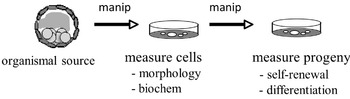
Experimental methods for identifying stem cells share a basic structure of three stages (fig. 3). The starting point is a multicellular organism, the source of cells. From this source, cells are extracted and placed in a new environment, where values of some of their characters are measured. These cells are then moved to another environment, in which capacities for differentiation and/or self-renewal can be realized. Finally, the amount of self-renewal and differentiation is measured. Stem cell experiments thus consist of two manipulations, each followed by measurement, of cells from an organismal source.Footnote 7
Basic design of stem cell experiments.

The results of such an experiment map character values of an organismal source onto those of cells in the first and second environments yielding, respectively, a ‘stem cell signature’ and a profile of ‘descendants’. Character sets for organismal sources and mature descendants are standardized and robust across a wide range of experiments. Characters for an organismal source are species, developmental stage, and location from which cells are extracted. For potential descendants, characters are those of mature cell types: morphology, expression of specific genes and proteins, and function within an organism. Exactly which characters compose the set depends on the mature cell type(s) of interest. For blood cells, the relevant characters are associated with immune function; for neurons, electrochemical function; for germ cells, morphological and genetic traits of gametes, and so on. Although character sets vary across experiments, for any particular experiment the characters of interest are specified by the standard set of morphological, biochemical, and functional traits used to classify cells in multicellular organisms.
In contrast, there are no preestablished criteria for inclusion in the set of characters of extracted cells—that is, presumptive stem cells. Cells characterized in the first set of measurements may vary with respect to physical, molecular, or morphological traits: size, shape, cell surface molecules, expression of particular genes or proteins, and so on. And similarly for cells characterized in the second set of measurements. But the characters measured are not the same. The first set of measurements targets undifferentiated, self-renewing stem cells (character set C), while the second targets mature differentiated cells (character set M). While M is well established for most cell types of interest, there is no such guidance for C.
Ideally, stem cell experiments would correlate character values of an organismal source, of self-renewing stem cells extracted from that source, and of their differentiated descendants, thereby identifying a ‘stem cell signature’. Such a signature would be a set of character values of all and only the stem cells from a given organismal source, which form a lineage terminating in one or more differentiated descendants. However, efforts to obtain such a stem cell signature face a serious evidential problem: ‘the stem cell uncertainty principle’.
4. Uncertainty
Several stem cell researchers have described this problem using an analogy with Heisenberg’s uncertainty principle in quantum physics. A common formulation of the latter states that a particle’s position and momentum cannot be simultaneously measured, because the procedure used to determine the value of one alters the value of the other. Analogously, it is claimed, “we cannot determine both the function of a cell and its functional potential … [because] our determination of a cell’s function at a given point in time interferes with an accurate determination of its developmental potential” (Askenasy Reference Askenasy2006, 489). Furthermore, we cannot rule out the possibility that “the investigator might be forcing the stem-cell phenotype on the population being studied” (Zipori Reference Zipori2004, 876). Potten and Loeffler (Reference Potten and Loeffler1990) state the problem without the physics analogy:
The main attributes of stem cells relate to their potential in the future. These can only effectively be studied by placing the cell, or cells, in a situation where they have the opportunity to express their potential. Here we find ourselves in a circular situation; in order to answer the question whether a cell is a stem cell we have to alter its circumstances and in so doing inevitably lose the original cell and in addition we may see only a limited spectrum of responses. … Therefore it might be an impossible task to determine the status of a single stem cell without changing it. (1009)
All these statements of the ‘uncertainty principle’ identify measurement of a cell’s differentiation potential as the key problem. Noting the impossibility of at once measuring a cell’s current characters and future potential, these stem cell researchers emphasize the distorting influence of the experimenter on the latter. The above sections set the stage for further clarification of the problem. Recall that stem cell experiments involve two manipulations, each followed by a measurement (fig. 3). The main concern is not that the first measurement might bias later ones but, rather, that (i) a stem cell experiment involves measuring cells in two different environments and (ii) no single cell persists through both sets of measurements. Because cells reproduce by division, parents and offspring cannot coexist. The second measurements are of cells descended from those measured in the first. This situation creates at least three distinct evidential problems.
First, self-renewal and differentiation potential cannot both be measured for a single cell. To determine a cell’s differentiation potential, that cell is placed in an environment conducive to differentiation, and its descendants measured. To determine a cell’s self-renewal ability, the cell is placed in an environment that blocks differentiation and its descendants measured. It is not possible to perform both experiments on a single cell. So both stem cell capacities cannot be measured for a single cell. Because stem cells are defined as having both capacities, it follows that stem cells cannot be identified at the single-cell level.
Nor does it help to treat the two defining capacities separately. A second problem is that the capacity of any single stem cell to self-renew cannot be decisively established. Self-renewal occurs just in case parent and offspring cells are the same with respect to some characters of interest, for some time interval of interest. A self-renewing stem cell divides to produce one or two offspring that are also stem cells: meaning that they have the same ability to self-renew as the parent (and the same differentiation potential). But the offspring stem cell’s ability to self-renew is revealed, in turn, by its offspring having the same capacities—and so on. The data needed to show that a stem cell has self-renewed are always one generation in the future. Experimental proof of self-renewal at the single-cell level is infinitely deferred.
Third, a single cell’s differentiation potential cannot be decisively established. A cell’s differentiation potential is revealed by placing that cell in an environment conducive to differentiation and then measuring its descendants to see if they exhibit specialized features of mature cells. The problem is that there is no generic ‘differentiation’ environment; instead, different kinds of specialized cell are elicited by different environments. A single cell can be placed in at most one such environment. So the full range of differentiation potential cannot be experimentally elicited from a single stem cell, if that range exceeds one mature cell type (as is usually the case). Experiments cannot tell us what a cell’s descendants would be like in a different range of environments.
For all three reasons, claims that any single cell is a stem cell are inevitably uncertain. This uncertainty is the root of perennial debates about differentiation potential, particularly for stem cells extracted from adult organisms. The uncertainty arises neither from the details of particular experiments nor limitations of measurement, but from the general stem cell concept. A stem cell is the ‘point of origin’ of a cell lineage that exhibits self-renewal and differentiation. Self-renewal and differentiation potential are measured after realization of these capacities in (different) environments. It follows that a single stem cell can be identified only retrospectively. At the single-cell level, stem cell researchers literally don’t know what they’ve got ’til it’s gone.
An obvious response is to shift focus to cell populations or types, using representational assumptions ii or iii to model stem cells identified by experiments (see sec. 2). But this will not do, because experimental support for models using these assumptions also rests on hypotheses about single stem cells. For brevity, I discuss only stem cell population models here; similar points hold for cell type (“compartment”) models.Footnote 8 Any population of cells undergoes some number n divisions over time interval τ, such that the population grows, diminishes, or remains constant in size. Any dividing cell in the population has a certain probability of undergoing each of three kinds of division: both offspring like the parent (p), one offspring like the parent (r), or no offspring like the parent (q), where p + r + q = 1. Relations among p, r, and q values entail general predictions about cell population size (growth, decrease, or “steady state”), such that equations predicting mean and standard deviation of population size, probability of stem cell extinction, and features of steady-state populations can be derived (see Vogel, Niewisch, and Matioli Reference Vogel, Niewisch and Matioli1969). In these equations, p is the fundamental parameter. Testable predictions require that the value of p be estimated. This is done by estimating the coefficient of variation for stem cell number in cell populations of the same age produced by division from a single founding stem cell. The data required for such an estimate are numbers of stem cells in replicate colonies, each originating from a single stem cell.
Given such an estimate, a stem cell population model predicts features of cell population kinetics, which can then be compared with experimental data. But the hypothesis thereby supported is not that “founder” cells are stem cells. Rather, it is that stem cell population size is regulated so as to yield predictable population-level results from randomly distributed single-cell capacities. Testing this hypothesis requires identifying stem cell populations. Stem cell population models make predictions given the assumption that “founding elements” are stem cells. All these predictions hinge on estimation of the fundamental parameter p, the probability that a stem cell undergoes self-renewal. This parameter is estimated from the pattern of variation in a set of replicate colonies, initiated by a single “stem element.” But in order for experiments to be replicates, all the stem elements for the set of colonies must be assigned the same probability values for p and (1 − p) − ω, that is, the same capacities for self-renewal and differentiation. Experimental test of a stem cell population model depends on the assumption that the cell population measured is homogeneous with respect to these characters. This is exactly the evidence that the stem cell uncertainty principle ensures we cannot get. So population-level stem cell models do not avoid the evidential problem.
To sum up: stem cell experiments cannot resolve stem cell capacities at the single-cell level, because we cannot directly measure a single cell’s capacity for self-renewal or differentiation, separately or together. To measure both self-renewal and differentiation potential for a single cell and to elicit the full range of a cell’s potential, multiple ‘copies’ of that cell are needed—a homogeneous cell population of candidate stem cells. Experimental evidence for population-level or cell-type models of stem cells depends on the same homogeneity assumption. So changing representational assumptions cannot resolve the difficulty. The stem cell uncertainty principle is an unavoidable evidential constraint for stem cell experiments.
5. Progress
How can stem cell biologists respond? One option is to replace the stem cell concept with a more experimentally tractable notion, such as ‘stemness’ (see Fagan Reference Fagan2013). Although some systems biologists advocate this option, it is unpopular among stem cell biologists, who are reluctant to give up on “the traditional notion of stem cells as a clearly defined class of intrinsically stable biological objects that can be isolated and purified” (cf. Brown, Kraft, and Martin Reference Brown, Kraft and Martin2006, 339). This is not mere stubbornness. Most clinical aspirations of stem cell research presuppose that we can isolate and purify stem cells for medical use. Giving up this aim when research is still at an early stage would be drastic and rash.
Accordingly, the prevailing response in stem cell biology today is not conceptual change but adoption of what I term the ‘single-cell standard’ for stem cell experiments. An experiment that meets this standard begins with a single cell in a controlled environment, with all relevant ‘cell signals’ taken into account, such that results reflect all and only the reproductive output of that single starting cell. Measured stem cell capacities can then be unambiguously attributed to that cell in that environment. Technologies that track a single cell’s reproductive output over time, combined with techniques that measure character values of single cells, can yield data of this sort.
The single-cell standard is not new but dates back to experiments in the 1950s and 1960s on cultured cells and transplantable tumors in inbred mice. The first method for measuring stem cells was announced as “a direct method of assay for [mouse bone marrow] cells with a single-cell technique” (Till and McCulloch Reference Till and McCulloch1961, 213). Current “gold standards” for stem cell experiments similarly emphasize the importance of isolating and measuring single cells. For stem cells from adult source organisms, the gold standard is a single-cell transplant leading to long-term reconstitution of a tissue or organ (Melton and Cowan Reference Melton, Cowan and Lanza2009). For stem cell lines derived from embryos, the ideal is for the line to behave as a single cell, exhibiting the same traits in the same culture environment so self-renewal or differentiation capacities can be realized on demand according to researchers’ specifications (Adewumi et al. Reference Adewumi2007). More recently, postgenomic and imaging technologies that enhance our ability to isolate or track single cells have been quickly adopted by stem cell biologists and reported as advances in the field.Footnote 9 Overall, for more than 50 years, stem cell biologists have looked to experimental techniques to manage uncertainties that follow from the stem cell concept. Progress in the field takes the form of ever-more-detailed measurements of single cells and their descendants.
In this way, technical innovations guided by the single-cell standard can support claims about stem cell capacities—but only relative to the environment in which those capacities are realized. More general results are obtained from replicate clonal experiments using a range of environments. If replicates behave consistently, then the same environment tends to elicit self-renewal of the same duration and/or differentiation into the same cell types, while different environments reliably yield different results. Such robust experimental results indicate that the cell population from which replicates are drawn is homogeneous with respect to stem cell capacities. Of course, populations homogeneous with respect to one set of cell traits need not be homogeneous with respect to all. But sorting cells into populations homogeneous for many measurable traits is the best way to proceed, given that we cannot identify stem cells in advance.
So the stem cell uncertainty principle does not undercut all support for hypotheses about stem cell capacities. But experimental support for these hypotheses depends on the assumption that the starting population is homogeneous. Because the possibility of heterogeneity in stem cell capacities cannot be absolutely ruled out, stem cell hypotheses are never fully and decisively established. For some characters (often those included in the first set of measurements) homogeneity is imposed during the experiment. Stem cell experiments can therefore provide good evidence for stem cell hypotheses at the single-cell level, but only relative to the set of characters used to specify a homogeneous subpopulation in the first set of measurements. As new cell traits are discovered and made accessible to measurement, the assumption of homogeneity must be continually reassessed and revised. Moreover, experimental results only indicate stem cell capacities relative to the set of environments used in the second set of measurements. All hypotheses about single stem cells are therefore doubly relative: to the set of characters and environments used in the experiment. Such hypotheses are necessarily provisional and become obsolete when new characters and environments are introduced.
6. Conclusion
The general stem cell concept is relational and relative. Stem cells are defined not absolutely but relative to a cell lineage, temporal duration, and sets of characters of interest. Experiments specify values for these variables. Hypotheses about stem cells must therefore be understood in terms of experimental methods used to identify them. These methods are subject to evidential constraints, summarized as the ‘stem cell uncertainty principle’, which entails that hypotheses about stem cell capacities (self-renewal and differentiation potential) can never be fully and decisively established by experiments. Methods that satisfy the ‘single-cell standard’, however, do provide good evidence about these capacities—but only relative to the set of characters and environments. Generalizations beyond these experimental situations are necessarily speculative.
Several consequences follow. First, the uncertainty principle accounts for long-running debates over developmental potential of stem cells from different sources. It also explains the rapid turnover in stem cell hypotheses and terminology: all substantive models of stem cells are provisional and rapidly become obsolete. Second, these results show that stem cell pluralism is not a symptom of incomplete understanding but follows from the general stem cell concept. Claims about stem cells based on different specifications of the abstract model do not conflict. The diversity of stem cells should not be a source of contention but a positive resource for inquiry. Finally, stem cell biology challenges traditional dichotomies of modeling and experiment, science and technology. Technical innovations that increase experimenters’ ability to measure and track single cells can bring about a situation in which experiments can provide strong evidence for hypotheses about stem cells. ‘Single-cell’ technologies are thus an important form of progress in stem cell biology, with evidential significance. Instead of refining theories and models, the field progresses through technical innovations, which improve our access to developmental activities of single cells.