Introduction
Knowledge acquired through multi-dimensional analysis of archaeological records opens possibilities of ever-new implementation, with the aim of gaining more detailed information about the lives of prehistoric populations. A long-term focal point of interest of the professional community undoubtedly is the problem of social reconstruction. However, a distinct limitation of knowledge is caused by the character of archaeological records themselves, which testify to certain social parameters only indirectly and fragmentarily, if at all (Hodder Reference Hodder1982, 207–211; Reference Hodder, Denzin and Lincoln1994; Shanks & Tilley Reference Shanks and Tilley1988, 29–60). This is why the formulation of hypotheses and answering questions concerning the size, internal organization or mutual interactions of individual communities (and not limited to the Bronze Age in east-central Europe) remains very topical in the current state of research (e.g. Earle & Kristiansen Reference Earle and Kristiansen2010a; Hansen & Müller Reference Hansen and Müller2017; Kienlin & Zimmermann Reference Kienlin and Zimmermann2012; Meller et al. Reference Meller, Hahn, Jung and Risch2016; Risch et al. Reference Risch, Meller, Gronenborn, Meller, Gronenborn and Risch2018).
Before accessing the case study, it is crucial to outline the issue, to what extent does the settlement give a perspective of social hierarchy reconstruction. The main theoretical and application directions prefer the extraction of more contoured intra-site social information, primarily the burials, while they are perceived as ‘closed deposits’ (Tainter Reference Tainter1978). Conversely, during their active lifetime the settlements represented dynamic organisms, where much larger transformational degradation of archaeological sources—spatial, temporal, qualitative, and quantitative—could be expected. Nevertheless, it is true that both types of source bases are useful in the modelling of past societies after certain prerequisites are met (e.g. well-preserved movable and immovable objects, favourable post-depositional and abandonment processes and extent and method of field excavation).
In this case, the settlement context reciprocally complements the missing interpretive potential of the cemetery, as it permits examination of collectivism at the expense of individualism. Despite the fact that evaluation of burial traits could better trace the biography of a person's identity, any hypothesis about their relations to the parent social units is usually limited. Also, inequalities/homogeneities can be better recognized in cemeteries, but without applying a complex bioarchaeological approach it is hard to explain them in relation to households, families, or past community systems (Mittnik et al. Reference Mittnik, Massy and Knipper2019). Similarly, wide-ranging methodological approaches (technology, macro- and micro-analysis of use-wear traces, taphonomy, statistical assessment, spatial analysis, etc.) help us to propose a suitable package to bridge the research gap in the field of intra-settlement analysis. Even if such methods are routinely used in order to examine certain specific social phenomena (e.g. Blankholm Reference Blankholm1991; Risch Reference Risch, Longo and Skakun2008; Schiffer Reference Schiffer1987; Vitezović Reference Vitezović2013), better results in exploring within-site variability can be achieved by combining them. Their selection and application are independent of the spatial or chronological aspect of the settlements and depend purely on the nature of the particular material spectrum.
If our arguments are to contribute in the future towards the reconstruction of social aspects in wider vertical and horizontal contexts, we must primarily pay attention to the smallest known discrete units—individual communities. Mutual comparison and synthesis of the knowledge acquired from several components have the potential to recognize and subsequently define the degree of complexity and centralization of socio-economic systems. The aim of the study lies in an attempt partially to fulfil the above-mentioned steps. The analysis of material culture of the fortified settlement in Spišský Štvrtok, inhabited during the turn of the Early and Middle Bronze Age, enables setting up a hypothetical model of the extent and form of differentiation and stratification of the local community. If we supplement the picture with comparable information bases from other settlement communities and burial grounds in the Carpathian region, then the validity of the presented model may also be verified in a wider culture-chronological context.
The current state of research on social organization at the end of the Early Bronze Age in east-central Europe
In the Carpathian region at the turn of the Early and Middle Bronze Age, generally we suppose the existence of a society that might have been hierarchized and organized in a particular way (Brück & Fontijn Reference Brück, Fontijn, Fokkens and Harding2013; Earle & Kristiansen Reference Earle, Kristiansen, Earle and Kristiansen2010b; Gilman Reference Gilman1981; Harding Reference Harding2000; Reference Harding2015). More detailed answers to questions concerning social hierarchization are mostly derived from the context of cemeteries or evident differences in the construction of burial pits, grave goods and sex and age of the buried individuals (Bátora Reference Bátora1982; Reference Bátora1991; Reference Bátora1999; Reference Bátora2018, 255–64; Dani et al. Reference Dani, Fischl, Kulcsár, Szeverényi and Kiss2016; David-Elbiali Reference David-Elbiali, Hansen and Müller2017; Kraus Reference Kraus2006; Laabs Reference Laabs2014; O'Shea Reference O‘Shea1996; Shennan Reference Shennan1975; Sosna Reference Sosna2009; etc.). In the past two decades, research on the degree of social complexity has considered settlements as a complement to cemeteries. However, syntheses are almost exclusively based on spatial analyses of settlement components or their urbanistic conceptions (e.g. Bátora Reference Bátora2018, 264–5; Bátora & Vladár Reference Bátora, Vladár, Furmánek, Bátora, Ožďáni, Mitáš, Kujovský and Vladár2015, 111–17; Brück & Fokkens Reference Brück, Fokkens, Fokkens and Harding2013, 93–5; Dani et al. Reference Dani, Fischl, Kulcsár, Szeverényi and Kiss2016; Duffy Reference Duffy2014; Reference Duffy2015; Duffy et al. Reference Duffy, Parkinson, Gyucha, Yerkes and Birch2013; Earle & Kolb Reference Earle, Kolb, Earle and Kristiansen2010; Gogâltan Reference Gogâltan, Horejs and Kienlin2010; Kienlin Reference Kienlin, Kienlin, Fischl and Pusztai2018; Molnár & Nagy Reference Molnár and Nagy2013; Quinn & Ciugudean Reference Quinn and Ciugudean2018; Szeverényi & Kulcsár Reference Szeverényi, Kulcsár, Jaeger, Czebreszuk and Fischl2012). In these syntheses, the attempts to detect internal structures in particular settlement areas are still only sporadic for the want of analysis and evaluation of larger assemblages of settlement finds (Earle & Kristiansen Reference Earle and Kristiansen2010a; Falkenstein et al. Reference Falkenstein, Hänsel, Medović, Kroll and Reed2016; Sørensen & Vicze Reference Sørensen, Vicze, Madella, Kovács, Kulcsarne-Berzsenyi and Briz i Godino2013; Vicze Reference Vicze, Anders and Kulcsár2013).
The variability of material culture and a wider geographic scope are reflected in the multiplicity of opinions. We could identify various interpretational tendencies in the published studies in literature, which explain the organization model of Bronze Age society in the Carpathian basin in different ways (for further details, see Harding Reference Harding2018). The discussions mainly diverge when determining the degree of social complexity and centralization of economic systems. Although they differ from one another in terms of their definitions, there is a consensus that the territory in question experienced social inequality at the end of the Early Bronze Age. Moreover, this inequality has been well documented in archaeological records, and above all by funerary finds (Bátora Reference Bátora1982, 290–301; Dani et al. Reference Dani, Fischl, Kulcsár, Szeverényi and Kiss2016; O'Shea Reference O‘Shea1996; Shennan Reference Shennan1975).
Some researchers advise greater care in drawing conclusions; they emphasize the risk of overestimating the interpretation of social inequality, as it does not always necessarily indicate more complex organization of a society. The emergence of tell settlements and fortified central settlements is ascribed to stabilized cultural traditions, economic benefits or adaptation to various environmental conditions rather than to higher political and economic centralization of regions or ‘cultural’ units (Dani Reference Dani, Jaeger, Czebreszuk and Fischl2012, 29; Duffy Reference Duffy2015, 96; Duffy et al. Reference Duffy, Parkinson, Gyucha, Yerkes and Birch2013, 56–8; Fischl Reference Fischl, Jaeger, Czebreszuk and Fischl2012; Kienlin Reference Kienlin2015, 66; Reference Kienlin, Kienlin, Fischl and Pusztai2018, 83). Individual settlement components as well as identified households or house inventories exhibit signs of autonomy. Conclusive evidence of their differentiation, hierarchization and mutual dependence is missing. Therefore, the arguments for a super-tribal or a more complex form of social organization seem to be insufficient (Dani et al. Reference Dani, Fischl, Kulcsár, Szeverényi and Kiss2016; Duffy Reference Duffy2014; Kienlin Reference Kienlin2015, 61; Kienlin et al. Reference Kienlin, Fischl and Marta2017).
Another part of the opinion spectrum is represented by experts who suppose that social organization in the Carpathian region during the Early and Middle Bronze Age can be characterized by hierarchized segmental communities. Based on the results of analysis of the settlement components, which probably have different primary functions, and their spatial relations, they theorize about the crystallization of centralized or decentralized stratified social structures. Consequently, they assume the possibility of the existence of a society with a higher form of economic and political organization in the region of the Benta Valley and northwestern Romania (Earle & Kristiansen Reference Earle and Kristiansen2010a; Gogâltan Reference Gogâltan, Horejs and Kienlin2010; Molnár & Nagy Reference Molnár and Nagy2013).
The latter interpretational tendencies are also indirectly preferred in Slovak archaeological literature. In the context of settlement archaeology, fortified settlements are traditionally regarded as centres of production, distribution and exchange of goods, cult and social elites (Bátora & Vladár Reference Bátora, Vladár, Furmánek, Bátora, Ožďáni, Mitáš, Kujovský and Vladár2015, 102; Furmánek et al. Reference Furmánek, Veliačik and Vladár1991, 273–80; Točík Reference Točík, Chropovský and Herrmann1982; Vladár Reference Vladár, Chropovský and Herrmann1982). Moreover, according to Slovak researcher A. Točík (Reference Točík, Chropovský and Herrmann1982), fortified settlements are divided based on their primary function into agrarian centres, centres of craft production, strategic hillfort locations controlling trade and exchange and tribal centres. Despite a stable and generation-old tradition of research on fortified settlements in Slovakia, we experienced a lack of published materials from excavated sites, which would have attested to the existence of mutual hierarchization and typological classification.
Site introduction
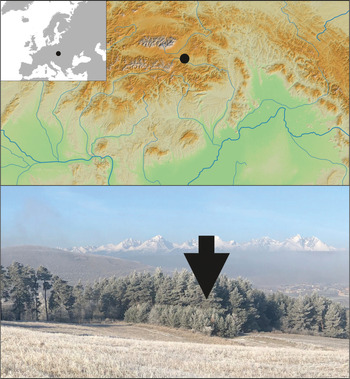
The fortified hillfort settlement from the turn of the Early and Middle Bronze Age in Spišský Štvrtok (Fig. 1), which belongs to the Otomani-Füzesabony Cultural Complex, has for a long time provoked the interest of the professional community in Slovakia and abroad, as evidenced by the many archaeological prospecting and excavation activities carried out in the area of the settlement and its close neighbourhood. The results, especially those of the systematic excavation directed by Jozef Vladár (Reference Vladár1975), classified the site as an important source of knowledge of Bronze Age society and the phenomenon of fortified settlements in east-central Europe (e.g. Furmánek et al. Reference Furmánek, Veliačik and Vladár1991, 81–2; Harding Reference Harding2000, 294; Jaeger Reference Jaeger2016, 101–38; Kienlin Reference Kienlin2015, 38; Marková & Ilon Reference Marková, Ilon, Fokkens and Harding2013, 824–5).
Geographical location of the fortified settlement in Spišský Štvrtok at Myšia hôrka (Slovakia, Levoča district).

The large-scale systematic excavation from 1968 to 1975, directed by Vladár under the auspices of the Institute of Archaeology of the Slovak Academy of Sciences, documented 46 settlement features within an area of 0.66 ha. These features were mostly interpreted as house relics. The area also encompassed a complex fortification system, which enclosed the western, northern and southern parts of the site. It featured a forward ditch and a rampart whose construction was supplemented with a system of defensive dry-stone walls built with vertically fitted stone blocks. The inner area of the settlement comprised buildings of varied construction, which were placed radially to the fortification line or in two parallel rows (Vladár Reference Vladár1975). Recently, the chronological classification of the stone fortification components to the Early Bronze Age has been questioned (Jaeger Reference Jaeger2014; Reference Jaeger, Hansen and Müller2017) and thus is subject to ongoing research. Therefore, it was not utilized in the argument, unlike the other phenomena persuasively dated to the Otomani-Füzesabony Cultural Complex, upon which there are remarks on the degree of communal social organization. Another kind of excavated feature was represented by a sacrificial–cultic pit, which contained, among other anomalous finds, partial skeletons of nine humans (Jakab Reference Jakab1978).
Besides the already mentioned architectonic characteristics, the abundant and variegated material evidence is also worth attention. There is an interesting collection of metal finds, which class Spišský Štvrtok as one of the settlement sites with an over-standard spectrum of bronze and gold artefacts. Such objects were found in the context of variably deposited hoards discovered in destruction layers and under house floors, or as solitary finds (Oravkinová & Vladár Reference Oravkinová, Vladár, Fischl and Kienlin2019). The collection of pottery, lithic industry and products made from bone and antler, evidently of local origin, can be considered as representative (Oravkinová Reference Oravkinová2018; Oravkinová et al. Reference Oravkinová, Hromadová and Vlačiky2017).
The chronological perspective presumes short-term site occupancy during the period 1600–1450 bc, which in the macro-regional relative chronological schemes represents the end of the Early Bronze Age and the beginning of the Middle Bronze Age. The timespan is supported by the uniform decoration and morphological pottery style of the post-classic stage with the rare occurrence of elements from a latter classic stage and terminal stage of the internal Otomani-Füzesabony Cultural Complex chronological development (Br A–Br B1/Br B2 after Reinecke: Oravkinová & Vladár Reference Oravkinová and Vladár2019b).
Following the topic of social complexity, marked differences in house inventories and variably concentrated activity areas in the Spišský Štvrtok settlement were indicated in several comprehensive studies published soon after the end of the excavation. On preliminary evaluation of the results, the inner ward of the settlement enclosed by fortification was divided into a so-called acropolisFootnote 1 and a craft district. This argument was primarily buttressed by the organized urbanistic concept of the settlement, the presence/absence of hoards, and differences in their compositions (Oravkinová & Vladár Reference Oravkinová, Vladár, Fischl and Kienlin2019; Vladár Reference Vladár1973, 291–3; Reference Vladár1975, 6–10). However, the preliminary conclusions lacked any further detailed evaluation of multiple associations, which might be a valuable contribution to the ongoing discussion focused on the social aspects of prehistoric society in the Carpathian area (Fischl et al. Reference Fischl, Kiss, Kulcsár, Rezi, Németh and Berecki2013a, 15–16; Jaeger Reference Jaeger2016, 19–23; Reference Jaeger, Hansen and Müller2017; Jockenhövel Reference Jockenhövel and Schauer1990, 213).
Source base: potential and critique
In the geographical and chronological context of the settlement in Spišský Štvrtok, we can address the problem of social complexity in more detail due to the unique combination of the finding circumstances. From the spatial perspective, the settlement was an area enclosed by fortification, which contained various production activities as well as the everyday lives of the people. The aspect of temporary occupation of a greenfield development site is important: this was almost fully excavated (Vladár Reference Vladár1975).
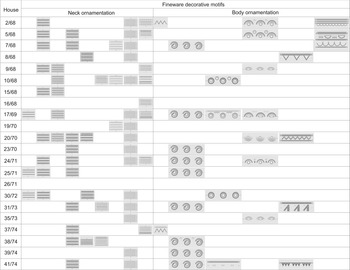
What is more, the settlement was abandoned rapidly and most artefacts were left on the site as de facto refuse. The causes of the favourable in situ preservation of households have not yet been sufficiently clarified. Their contemporaneity premise derives from the pottery similarities, as any stylistic heterogeneity of the material culture could not be observed even through feature fillings comparison (Fig. 2). The temporary character of the settlement was evidenced by almost absent superpositions of settlement features, or the absence of a composite–multilayered vertical stratigraphy. Multivariate statistical analysis of their depositionally sensitive indicators (e.g. pottery fragmentation and completeness indices, degree of taphonomic alteration of the surface and breaking edge abrasion) showed independent and reasonable clustering, along with the houses containing hoards, which were provably abandoned within short similar timespans (Oravkinová Reference Oravkinová2018, 238–46; ***Oravkinová & Vladár Reference Oravkinová, Vladár, Fischl and Kienlin2019a,Reference Oravkinová and Vladárb).
Overview of fineware decorative motifs from housing features, which were included in social indices calculation.

Earlier interpretation of massive fire damage of the inner built-up area (Vladár Reference Vladár1975, 14), which initiated the sudden abandon may be doubted, due to poor evidence. With only a few exceptions, no significant daub layers, compact ashy and burnt wooden constructions, or secondary burnt artefacts were documented in the related stratigraphical context. Moreover, any signs of violent episodes that might have forced residents to leave the site were absent (Oravkinová Reference Oravkinová2018, 246). In the context of further socio-economic development in the northeastern Carpathians at the beginning of the Middle Bronze Age, where settlement regression and attenuation were recorded, we can rather associate abandonment with the collapse of previously effective trading networks (Fischl et al. Reference Fischl, Kiss, Kulcsár and Szeverényi2013b). The causes and consequences of this disruption might have had a serious impact on the economic sustainability of the settlement, which notably profited from active participation in the exchange.
No dumping grounds were found in the settlement area; artefacts in the form of functional and production wastes were discarded and deposited in the immediate neighbourhood of the houses or the activity areas. Regarding the selected macro-level, the extent of n-transformations (movement by rain and water, animal interference, and soil erosion) was not sufficient to cause a more significant distortion of the results of spatial analysis. Moreover, the structures with representative inventory were not significantly disturbed by later occupation (Vladár Reference Vladár1975; Oravkinová Reference Oravkinová2018, 229, 237–8).
On the other hand, evaluation is limited due to several factors. The limitations mainly lie in the use of already outdated fieldwork methods and incomplete excavation documentation. Partial reduction of the information potential of archaeological sources was caused by the period in which the field research was conducted. Unfortunately, the find context does not guarantee or enable proper definition of the degree of entirety in the house inventories. However, the results could be influenced by intra- and inter-site reclamation processes at the time when the settlement was abandoned. The interventions and potential scavenging, collecting and pot-hunting in later periods after the decline of active occupation of the site can be evidenced by sporadic intrusion of finds belonging to the Púchov Culture, but mainly to medieval and modern times (Oravkinová Reference Oravkinová2018, fig. 43). The cemetery related to the settlement site has not been found yet. The analysis and evaluation of finds from this cemetery would undoubtedly contribute to the independent verification of conclusions.
Methodology
The hypothetical model of social organization in the Spišský Štvrtok settlement is derived from the analysis of social differentiation and stratification on the basis of contextual analyses of available material culture. From the perspective of the social sciences, we can define the differentiation as a horizontal structure of a particular social unit, which is reflected in different working activities. Besides other variables, these activities are often determined by sex and age, or by specific qualities of individuals (Durkheim [Reference Durkheim1933] Reference Durkheim1960; Juteau Reference Juteau and Juteau2003; Kerbo Reference Kerbo2003). Crystallization of horizontal structures subsequently also determines vertical social ranking and thereby stratifies society. Among the main determinants of social stratification, we can class the inhomogeneity springing from various status- and economy-based privileges, which can often be reflected through the medium of proprietary inequality (Davis & Moore Reference Davis and Moore1945; Kerbo Reference Kerbo, Bryant and Peck2006; Lenski Reference Lenski1966).
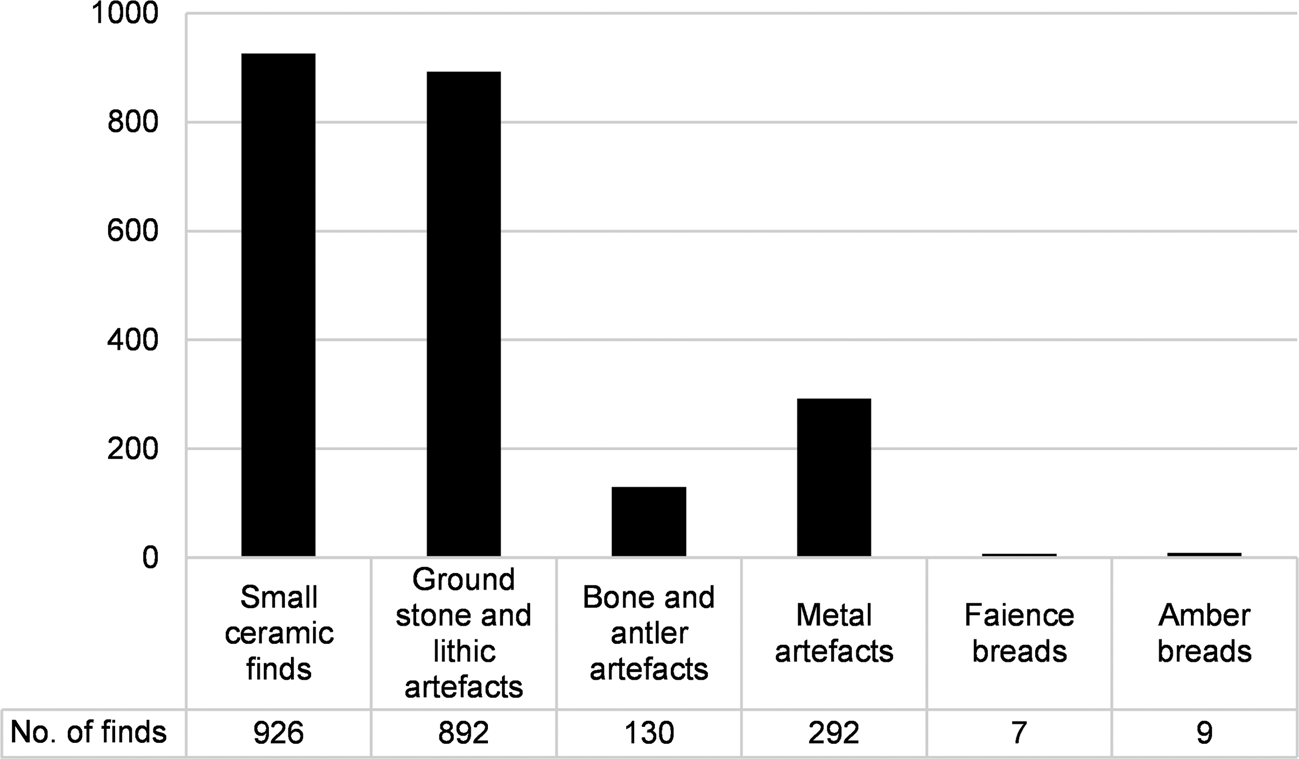
The differentiation is assessed on the basis of technological and morpho-typological analysis of selected groups of artefacts, which enables estimation of the form, relative intensity and extent of individual activities (Costin Reference Costin and Schiffer1991; Reference Costin, Maschner and Chippindale2005). Out of the 2256 artefacts from the settlement, we assessed the technologically and functionally classifiable assemblages (Fig. 3). The selection was conditioned by the known localization of the finds within the overall horizontal planography of the settlement, which can be well defined by the excavation grid of quadrants of 3×5 m. In addition to this, no other selection criterion was implemented into the evaluation (e.g. specific structure, feature or stratigraphic unit affiliation). Using this methodology, we were able to outline activities related to food production and consumption and suggest the potential craft mode of productions in the settlement as a whole. These indicators were quantified and overviewed in the spatial distribution maps of selected categories of artefacts. They would comprehensively illustrate the intra-settlement activity areas at a semi-micro level and their mutual relations within the residential zones, complementary to recognized features—houses. This might be more profitable than considering individual household inventories, as it was obvious that production activities or their remains were not strictly indoor-related, but also outdoor-related. The arrangement of the studied phenomena further defines the settlement context, indicating the degree of spatial organization of the settlement structure (e.g. Binford Reference Binford1983, 144–9; Blankholm Reference Blankholm1991; Jongsma & Greenfield Reference Jongsma, Greenfield and Nikolova2002; Schiffer Reference Schiffer1975).
Frequency of the main categories of artefacts in the Spišský Štvrtok settlement.

In the attempted reconstruction of vertical social structure, which might have been reflected in differences within material culture, we encounter difficulties when we tried to assess the studied elements objectively. One of the possible ways of analysing stratification is therefore the application of quantitative approaches based on calculation of social indices for individual assemblages of finds. The social index method has been successfully implemented in present-day professional literature, above all in contextual analysis of cemeteries (e.g. Laabs Reference Laabs2014; Rebay-Salisbury et al. Reference Rebay-Salisbury, Pany-Kucera, Spannagl-Steiner, Kanz, Galeta, Teschler-Nicola and Salisbury2018). We assumed that a combination of multiple characteristics (temporary settlement, extent of cultural and natural transformations, but mainly the model of rapid site abandonment) might enable addressing the problem of social structuring with the help of a modified calculation method of social indices in the sample of artefacts from the settlement in Spišský Štvrtok as well.
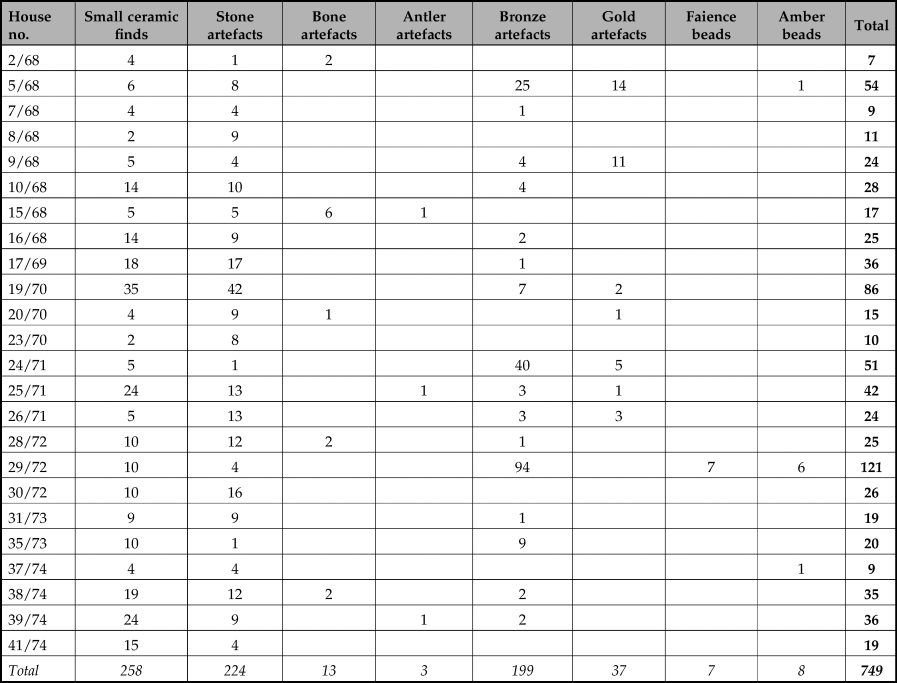
To conduct a stratification analysis, we filtered 749 morpho-typologically determinable artefacts that were found in the fill layers of 24 settlement features with assumed residential function (Table 1). Unlike in the case of differentiation where the artefacts from the regular cultural layers were included, this section was solely restricted to positive affiliation with the supposed household inventories. The households were observed in the field as structures of regular square layout sized 4.7–5.4×4.1–5.3 m, or rectangular layout sized 4–8×2.6–4.8 m with traces of variable construction modifications (underfloor levelling layer, floor, stone substructure, post-holes, fireplace, daub fragments), whose fill contained fragments of ceramic vessels with use-wear marks and artefacts of daily use. Due to the spit excavation technique based on standardized depths, the finds could not be associated with any internal feature stratigraphies, as they were only generally classified to the destruction layer. Therefore, the volume of the fill also could not be taken into consideration for analysis. To avoid bias, the features with documented secondary intrusions, incompletely preserved featuresFootnote 2 and features with assumed atypical function were excluded. We applied calculations of multiple partial indices (frequency, diversity, rarity, number of bronze artefacts and number of gold artefacts) to the extracted data. After the calculation, all partial indices were expressed as a value within the interval of 0–100. The advantage of calculation lies in the possibility of relative comparison of all resultant values, not just those in the context of individual indexes. Their sum represents the complete index, which was calculated using the same key. With regard to the questions of interest, data interpretation mainly focused on the spatial distribution of individual values within the settlement area, as was done in the case of differentiation assessment.
The main categories of artefacts from household inventories in the Spišský Štvrtok settlement according to frequency.

The resulting organization model is postulated on the basis of assessment of mutually independent qualities and quantities of artefacts and ecofacts from the settlement area. The identified correlations, which can be interpreted as differences in horizontal and vertical ranking of a social unit, are verified with the help of other additional factors. Special attention is paid to differences in house architecture, occurrence of hoards or the typological spectrum of contained artefacts, and the presence of ritual activities. Since the settlement does not have any related cemetery, parallels to the model must be sought in the contexts of other burial grounds within the Otomani-Füzesabony Cultural Complex as well as in the existing theoretical literature focused on topics of social complexity in the Carpathian basin during the Bronze Age.
Social differentiation
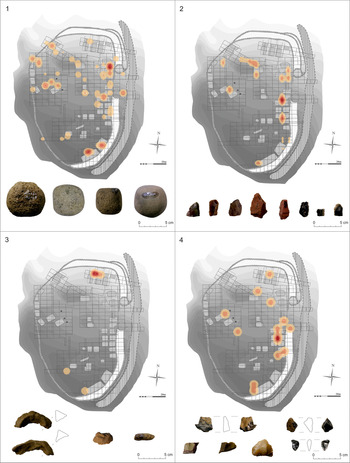
The extent of differentiation, which determines the level of social complexity, can be inferred from the local craft production as well as from the manner of food production and consumption (Gumerman Reference Gumerman1997; Renfrew & Bahn Reference Renfrew and Bahn1991, 233–70; Taylor et al. Reference Taylor, Kneisel, Dal Corso, Kirleis, Scholz, Tiedtke, Kneisel, Dal Corso, Kirleis, Scholz, Taylor and Tiedtke2015). In the case of the settlement in Spišský Štvrtok, we are working with only fragmentary sources, so that the study of subsistence strategies is limited in detail. The fact that food production played an important role in social activities taking place in the settlement is evidenced by numerous alterations in the form of sooting and carbonization marks, abrasions and use wear, which have been documented on ceramic fragments (Oravkinová Reference Oravkinová2018, figs 15–17). More information can be derived from the spatial distribution of finds which are traditionally associated with food production, namely macrolithic grinding and pulverizing tools (Fig. 4:1). Similar activities can be also associated with retouched microlithic tools intended for cutting, e.g. knives, saws and sickles (Fig. 4:2). Although neither of the above two artefactual groups show any distinct disproportion with regard to spatial distribution, we can observe evident clusters which fully correlate with structures in which the residential function is assumed. Even though we do not know any details concerning the differences in alimentation or food production at the level of presumed households, it follows from the analysis of results that food production was carried out separately in each house. Moreover, this also attests to the legitimacy of singling out the contexts with assumed residential function, whose inventory is assessed in the next step in order to clarify the vertical structure.
Spatial distribution of selected artefact groups on general plan of the Spišský Štvrtok settlement: (1) ground stone artefacts, active grinding and pulverizing tools (n = 112); (2) chipped stone industry, retouched tools intended for cutting (n = 47); (3) pottery, fired clay with traces of intentional modification and unfinished products (n = 5); (4) chipped stone industry, raw material cores (n = 14).

The assumption of local pottery production is based on a sparse collection of fired clay substance residues and unfinished products, which from the viewpoint of quantitative and spatial evaluation are concentrated in the southeastern and northeastern peripheral parts of the settlement (Fig. 4:3). The analysis of final products indicates the existence of stabilized technological procedures, which were mainly used for production of jugs, pots and storage jars. The technology of production of the other morphological groups, namely tableware and coarseware, is very variable, which is also reflected in their lower quality and standardized production (Oravkinová Reference Oravkinová2018, tables 1–6). Since the aspect of well-established and often technologically demanding schemes of recipes represents one of the arguments for a sophisticated system of organization of ceramic production (Rice Reference Rice1987, 180–91; Santacreu Reference Santacreu2014, 258–61), we suppose that one part of the production output may be associated with occasional household production for personal use. At the same time, we cannot rule out the existence of specialized household production, which might have had a wider distribution range. The assumptions regarding the existence of variously organized production within settlement areas are also supported by the results of analyses of other Early Bronze Age collections (e.g. Budden Reference Budden and Berg2008; Earle et al. Reference Earle, Kreiter, Klehm, Ferguson and Vicze2011; Michelaki Reference Michelaki2008; Petřík et al. Reference Petřík, Prokeš, Všianský, Salaš and Nikolajev2016; Sofaer & Budden Reference Sofaer, Budden, Sørensen and Rebay-Salisbury2012).
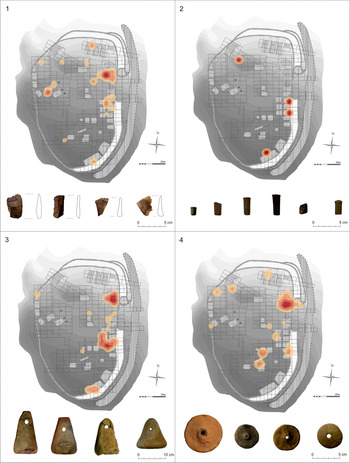
An important role in the local technical system of society was played by the production of microlithic and macrolithic artefacts. Analysis of the collection of chipped stone industry makes us take into consideration diverse and intensive local production of tools from distributed cores or from raw material prepared in other ways. A small part of the artefacts may also have reached the settlement in the form of prepared supports or finished tools. The production mode as such is indicated by the balanced representation of retouched tools (33.3 per cent) and worn debitage with or without local retouch (29.5 per cent in total). From the context of other assemblages of chipped stone industry dated to the end of the Early Bronze Age, where the proportional dominance is rather the opposite (Kaňáková Reference Kaňáková2014, 15; Kaňáková Hladíková Reference Kaňáková Hladíková2013, 249), we infer that the collection from Spišský Štvrtok can exhibit anomalies indicating a gradual replacement of chipped stone industry by other materials, which is reflected in the overall quality of lithic artefacts (Hladíková Reference Hladíková2003–2004, 82; Oravkinová et al. Reference Oravkinová, Hromadová and Vlačiky2017, 59). The character of the assemblage thus indicates variously organized production at household level. The distribution model reveals the existence of several districts in the eastern, southeastern and northeastern parts of the settlement area where the occurrence of cores overlaps with concentrations of unworn and unretouched debitage. Quite atypical is the presence of activities related to production of chipped stone industry in the western part of the settlement, within a wider range of the presumed acropolis (Figs 4:4 and 5:1). The overall picture is completed by the evaluation of a small collection of waste from production of stone hammer-axes—drilling cores, which are concentrated in the eastern and southeastern parts of the settlement, partly in the same locations as the accumulations of artefactual evidence of flintknapping (Fig. 5:2).
Spatial distribution of selected artefact groups on general plan of the Spišský Štvrtok settlement: (1) chipped stone industry, debitage with no use-wear or retouch marks (n = 56); (2) ground stone artefacts, production waste related to hammer-axes (n = 5); (3) artefacts associated with textile production, clay loom weights (n = 98); (4) artefacts associated with textile production, clay spindle whorls and discs with central hole (n = 69).

Local textile production, which included weaving and spinning, is represented by a relatively large collection of clay loom weights and spindle whorls, or discs with central hole. They are mainly concentrated in the southeastern, northeastern and eastern parts of the settlement (Fig. 5:3, 5:4). Interesting is a distinct accumulation of clay loom weights and spindle whorls in the eastern part, north of the entrance to the settlement area, where specialized or more intensive household production might have been performed. In the other locations of occurrence, we are inclined to assume individual forms of production for personal use or for the needs of the local community. Similar variants of organization are also considered in the context of other Bronze Age settlements (Belanová Štolcová & Grömer Reference Belanová Štolcová, Grömer, Andersson Strand, Gleba, Mannering, Munkholt and Ringgard2010, 17–18; Sofaer et al. Reference Sofaer, Jørgensen, Choyke, Fokkens and Harding2013, 481; Šteiner Reference Šteiner, Bátora and Tóth2015).
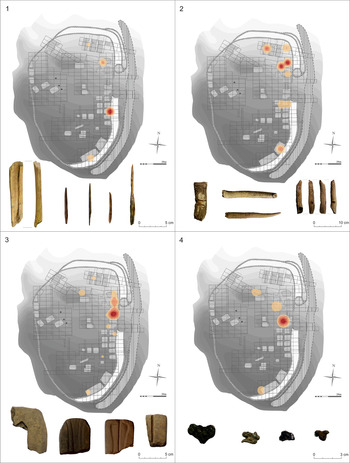
A wider spectrum of information about the production of tools from hard organic materials can be derived from the results of techno-morphological analysis (Oravkinová et al. Reference Oravkinová, Hromadová and Vlačiky2017). It refers to unspecialized craft production, which falls within occasional household production for personal use or for the needs of the local community. We can rather take into consideration individual production of objects of simple forms, which often take advantage of the natural morphology of raw material. As far as the spatial context is concerned, evidence of production in the southeastern, northeastern and eastern parts of the settlement is also accompanied by accumulations of finished artefacts and worn-out scrapped pieces (Fig. 6:1, 6:2). We can say that the artefacts were manufactured, actively used and depleted in the same areas, and there is no evidence of overproduction. Household production is indicated by the strategies of raw material selection, which utilized the best accessible ‘residual material’ discarded from the cooking process. A similar trend is also observed in other Early Bronze Age settlements (Choyke & Bartosiewicz Reference Choyke and Bartosiewicz2009, 359; Choyke et al. Reference Choyke, Vretemark, Sten, O'Day, Van Neer and Ervynck2004, 184–5; Nicodemus & Lemke Reference Nicodemus and Lemke2016, 117; Sofaer Reference Sofaer, Earle and Kristiansen2010, 211–12; Sofaer et al. Reference Sofaer, Jørgensen, Choyke, Fokkens and Harding2013, 486–7).
Spatial distribution of selected artefact groups on general plan of the Spišský Štvrtok settlement: (1) bone industry, objects referring to local production (n = 16); (2) antler industry, objects referring to local production (n = 15); (3) technical ceramics and ground stone artefacts, casting moulds (n = 13); (4) metal artefacts, tears and drops (n = 5).

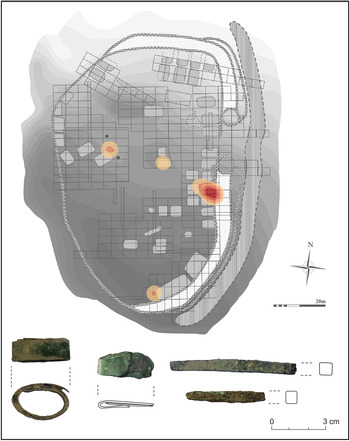
As regards the production activities, researchers pay a great deal of attention to the relationship between metallurgical production and fortified settlements (e.g. Bátora Reference Bátora2009; Jaeger Reference Jaeger2016; Kienlin & Stöllner Reference Kienlin, Stöllner, Kienlin and Roberts2009; Novotná Reference Novotná1983). Recognition of the extent of production and the origin of metallic artefacts in the Spišský Štvrtok settlement is limited, due to absence of metallographic analysis which identifies the raw material sources. The on-site metallurgical treatment of imported ore is indicated by a malachite ore dump, which was detected in the southeastern part of the settlement, as well as by sporadic slag finds (Oravkinová Reference Oravkinová2018, photos 74, 75, fig. 36). Metal founding and smithing activities are evidenced by ingots and semi-finished bronze and gold artefacts. The forms of clay and stone casting moulds, which directly correspond to finished artefacts in the spectrum of finds from the settlement, refer to possible local casting of awls, knives, axes, daggers, pins and bar-shaped blanks. In the spatial distribution of the evidence of metal founding we can see a distinct accumulation near the entrance to the area in the eastern part of the settlement (Fig. 6:3). Therefore, we must take into consideration a specialized production facility in this area. The existence of a production zone is also indicated by the total absence of other than metallurgical activities in this area. The workshop's location unfortunately cannot be associated with a particular archaeological context, because the entrance to the settlement was affected by recent exploitation. In the remaining area in the eastern, southeastern and northeastern parts of the settlement we can find clay casting moulds together with other evidence of metallurgical production—slag, ingots, semi-finished products (Figs. 6:3 & 6:4 and 7). For this reason, we must interpret metallurgical production in Spišský Štvrtok not only as a specialized workshop procedure, but also as an activity which may have had a significant position in household production (Horváth Reference Horváth, Jaeger, Czebreszuk and Fischl2012, 58; Kuijpers Reference Kuijpers2008, 108–9; Rowlands Reference Rowlands1971). The same model is also assumed with the culturally and chronologically parallel settlement in Nižná Myšľa, where metallurgical evidence is concentrated not only in a specialized workshop area (Szabová Reference Szabová2018), but also in the context of other houses in the craft production district within the settlement (Olexa Reference Olexa2003, 59).
Spatial distribution of blanks for metallic artefacts on general plan of the Spišský Štvrtok settlement (n = 8).

Social stratification
The presence of various activity areas in the settlement encouraged us to assess the degree of stratification, which could be expressed with the help of the calculation of selected social indices. The aim of the analysis is to relativize the past presumed values of artefacts and their assemblages that come from features with assumed residential function. The uneven distribution of wealth in the society at Spišský Štvrtok can be adequately reflected in the multiple calculations used for evaluating the differences among individual household inventories.Footnote 3 If proprietary inequality had existed, the collections of valuables would have probably been concentrated in only a few households. On the other hand, the more easily accessible and less valuable artefacts were probably concentrated in a larger number and wider spectrum of households (the pyramidal structure). The economic benefits might also reflect the status or the power position of presumed social units in the context of the settlement.
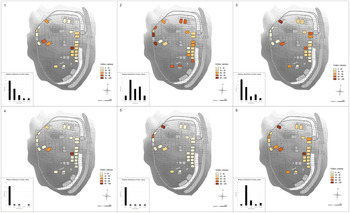
The frequency index of artefacts involves the total number of artefacts found in the fill of individual features. When the values were converted for spatial representation, it turned out that structures with large inventory were mainly accumulated in the northwestern and eastern parts of the settlement. In the other locations, we could find features with distinctly fewer artefacts. The graphic representation of cumulated intervals shows a downward slope, with a decreasing tendency in the number of features with higher values (Fig. 8:1).
Spatial distribution of values of calculated indices in the context of selected housing features on general plan of the Spišský Štvrtok settlement with a graphic representation of cumulated values: (1) relative frequency of objects; (2) relative diversity of objects; (3) relative rarity of objects; (4) relative number of bronze objects; (5) relative number of gold objects; (6) values of the resultant social index.

Diversity can be expressed by the number of artefact types divided by the total number of artefacts from a particular context. From a spatial perspective, households with a variegated spectrum of finds were concentrated only in the northwestern part of the settlement, at the location of the presumed acropolis. Higher values are present in the northeastern and southern peripheral zones as well. As with the frequency index, the resultant histogram showed a unimodal distribution with an evident decrease in the number of houses with higher intervals of values (Fig. 8:2).
Calculation of the rarity index for the occurrence of individual types was more complicated. First, we quantified the value for each type separately. This value corresponds to the total number of artefacts in the extracted collection divided by the total number of artefacts of the given type. The resultant value of the index for a particular feature is the sum of the rarity values of all artefact types within the inventory. The generated results showed that the least frequent types were found in household inventories in the area of the acropolis and the eastern zone of the craft production district of the settlement. The graphic representation of relative distribution of values in relation to the total number of features slants distinctly downward, with higher interval values (Fig. 8:3).
Since it is traditionally supposed that the valuable commodities in the Early Bronze Age were made from bronze and gold, and these articles are quite frequently found in Spišský Štvrtok, we expressed their frequency rate in houses with the help of two partial indices. The index of the number of bronze artefacts revealed exceptional contexts in the northwestern and eastern parts of the settlement area. Unlike the bronze artefacts, gold articles are concentrated almost exclusively in the acropolis of the settlement. The graphic representation of the frequency of occurrence of features in cumulated intervals slants downwards for both indices, where the contexts with higher index values are in the minority (Figs 8:4, 8:5).
The last calculated complete social index was derived from the values of the partial indices. Thus, each of the studied features acquired a numerically expressible value of the complete index, which corresponds to the sum of scores achieved in the previous calculations. We could observe evident concentrations of features with characteristic inventory in the craft district and the acropolis, which were already clearly visible after a brief evaluation of the partial indices. Unlike these clusters, the structures situated in peripheral southeastern and northeastern zones did not exhibit any exceptional spectrum of finds. The resultant distribution of relative wealth of the households is unimodal, with a decreasing number of houses whose inventory contains precious goods (Fig. 8:6). This finding proves the tested hypothesis of a pyramidal structure, in which the rich contexts are present in a distinctly lower proportion, compared to households with conventional or more modest inventory.
Model of social organization in the fortified settlement in Spišský Štvrtok
The reconstruction of social organization in the Spišský Štvrtok settlement is based on the assumption that the status and wealth of inhabitants may have been partly reflected in the archaeologically documented household inventories and in the intensity and form of the production activities. We found important correlations in the comparison of the model of spatial distribution of craft activity areas (Figs 4–7) and the model derived from the resultant social index (Fig. 8:6).
From the viewpoint of differentiation, the high degree of accumulation of various crafts might be an indicator of lower intensity or seasonality of these activities. Clustering indicates cross-craft interaction, that is, an organization model in which crafts were mutually dependent and tightly interconnected; consequently, the different production schemes might have influenced one another (e.g. Rebay-Salisbury et al. Reference Rebay-Salisbury, Brysbaert, Foxhall, Rebay-Salisbury, Brysbaert and Foxhall2014; Sofaer Reference Sofaer2006; Reference Sofaer, Earle and Kristiansen2010, 213; Sofaer et al. Reference Sofaer, Jørgensen, Choyke, Fokkens and Harding2013). The activity areas are not gender-specific; on the contrary, in the whole studied space we could observe a parallel occurrence of activities traditionally ascribed to men (metallurgy, production of lithic, bone and antler industry) and those ascribed to women (textile production and pottery making: Costin Reference Costin and Wright1996). Therefore, we regard the settlement in Spišský Štvrtok as a community space where specialized craft production and other activities takes place (Costin Reference Costin and Schiffer1991, 8; Stark Reference Stark1991, 72). The surplus, mainly that in the metallurgical sphere, generated by good access to raw material deposits, might have been utilized in internal or external trade and exchange.Footnote 4 The form and spatial distributions of activities reflect the need of society to distinguish the production district of the settlement with various and intensive craft activities from the residential zone with no production. Thus they indicate a certain systematic organization of activities that represents a precondition promoting the emergence of social hierarchy (Costin Reference Costin and Schiffer1991, 12; Reference Costin, Maschner and Chippindale2005, 1060; Risch Reference Risch, Longo and Skakun2008).
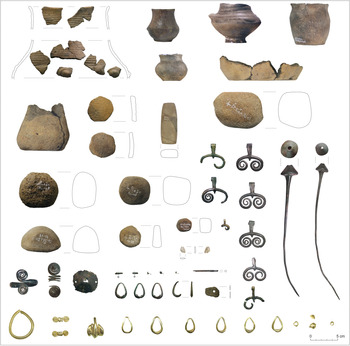
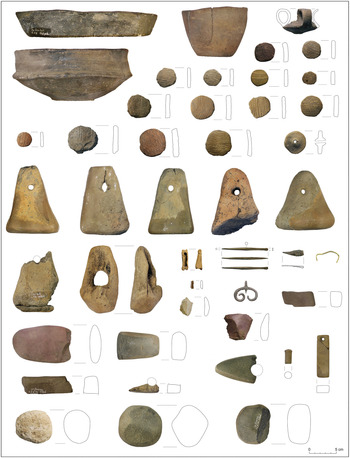
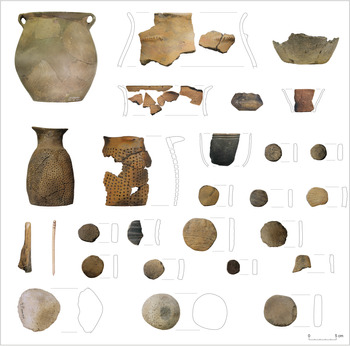
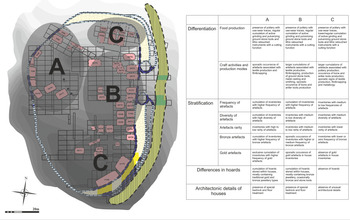
In the acropolis, in which there is sporadic evidence of production (textile production, chipped stone industry) we found a concentration of structures containing numerous articles of uncommon and varied types. Products made of gold are found almost exclusively in this area, moreover, there is also a distinct concentration of bronze artefacts (Fig. 9). The craft district, where the evidence of production is concentrated to a significant extent, could be divided into two sub-zones according to presumed intensity and specialization. The first is the zone in the eastern part of the settlement, with predominance of specialized forms of household production—textile production, metal casting and smithing, production of chipped stone industry and stone hammer-axes. Some of the features suggest the presence of houses with exceptional inventories, whose wealth is comparable with that in the acropolis. They contain large collections of artefacts having higher degrees of rarity and diversity, and despite the absence of gold articles, they include significant accumulations of bronze objects (Fig. 10). The second type is represented by the built-up areas in peripheral northeastern and southeastern parts of the settlement, where specialized household production, as far as the intensity of activities is concerned, is in a minority vis-à-vis individual unspecialized production—such as pottery making, production of bone and antler artefacts, textile production, sporadic evidence of metallurgy, production of axe-hammers and chipped stone industry. Their inventory is poor with regard to the complete social index. The documented spectrum of the artefacts is mostly not large; it is relatively variegated, but lacks rarity. The inventories also contained only a few bronze or gold artefacts (Fig. 11). Therefore, we can confidently suppose that the local elites were concentrated in the northwestern part of the settlement, i.e. in the acropolis. Wealthy craftspeople lived in the eastern part and the common inhabitants in the remaining peripheral parts of the settlement (Fig. 12).
Selection of finds from house 5/68, situated in the area of the acropolis.

Selection of finds from house 25/71, situated in the ‘wealthier’ craft district within the settlement.

Selection of finds from house 1/68, situated in the ‘poorer’ craft zones on the periphery of the settlement.

Spatial model of social organization of the Spišský Štvrtok settlement with a table of attributes describing the observed tendencies in differentiation, stratification, architectonic details, and composition of hoards.

The presumption of social hierarchization is also supported by the architectonic details of individual housing features. In particular, the places where the bedrock was modified and ‘carved out’ for building construction are remarkable. Such examples were documented with houses in the acropolis and with one feature in the wealthy craft district. Other specifics related to both these zones are the floors covered with layers of small stones and the occurrence of hoards, which are completely absent in the ‘poorer’ peripheral parts of the settlement.
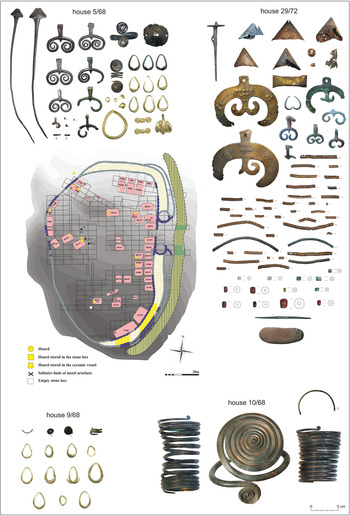
The composition of hoards, which might be interpreted as the property of multiple families or households in the settlement, represents another factor that distinguishes the acropolis from the wealthy craft zone. The hoards in the northwestern part contained solely bronze and gold jewellery, whereas the hoards in the eastern part of the settlement included only bronze ornaments, but in association with metallic and ground stone tools. In the acropolis, we could find traditional morphological types, which in the northeastern Carpathian basin had already occurred at the beginning of the Early Bronze Age, for example lock-rings and wire ornaments. On the other hand, the hoards from the craft districts of the settlement exhibit certain typological inventiveness. They evidently accumulated artefacts which were probably in use at the time when the settlement declined, such as tutuli pendants, a sheet metal belt with rolled-up ends, arm spirals and a Salgótarján arm-ring. Notably, the hoards from the acropolis have almost exclusively accumulated prestigious golden and bronze jewellery, which were a part of head decoration. Therefore, it cannot be ruled out that the presumed communal social groups might be differentiated from one another via the parts of their costume (Fig. 13: Oravkinová & Vladár Reference Oravkinová, Vladár, Fischl and Kienlin2019).
Location of hoards and solitary metal finds on the general plan of the settlement in Spišský Štvrtok, showing composition of the hoards from houses 5/68 and 9/68, situated in the acropolis, and from houses 10/68 and 29/72, situated in the ‘wealthier’ craft district in the settlement.

The level of social organization is also indicated by the spatially delimited public cult area situated in the eastern part of the settlement. The partial skeletons of nine humans were found at the bottom of a settlement pit. The skulls and post-cranial skeletons of almost all these individuals had evidence of perimortem trauma (Jakab Reference Jakab1978). The subsequent stratigraphic layering in the feature correlates with the accumulation of artefacts and pottery fragments, thus indicating the presence of structured deposits (Oravkinová Reference Oravkinová2018, 257–61). Regardless of the social or religious motivation of such actions, human sacrifice with subsequent repeated structured deposition attests to the evident organization and hierarchization of social structures in the settlement (Watts et al. Reference Watts, Sheehan, Atkinson, Bulbulia and Gray2016; Whitehouse Reference Whitehouse2002).
The denomination of this of organisation is problematic due to discrepancies in the discussions focused on the generally applicable terminological typology of organization schemes of particular social units (e.g. Duffy Reference Duffy2014; Harding Reference Harding2000, 386–93; Kienlin Reference Kienlin, Kienlin and Zimmermann2012; Parkinson Reference Parkinson and Parkinson2002; Risch et al. Reference Risch, Meller, Gronenborn, Meller, Gronenborn and Risch2018; Wason Reference Wason1994). Research results indicate the possible existence of various statuses and a well-established system of social organization in the settlement. Therefore, in the intra-site context, we can suppose internal hierarchization and inequality as well as complexity and probably also a certain degree of centralization of the community. However, the absence of in-depth knowledge of the contemporaneous settlements’ characteristics in the studied micro-region hindered drawing any conclusions regarding the overlap of the model at the inter-site level. The assumption of a certain degree of centralization is also supported by the detected territorial exclusivity of fortified settlement sites of the Otomani-Füzesabony Cultural Complex in advantageous strategic locations in East Slovakia. This exclusivity might have been strengthened by the natural geomorphological relief of the landscape and the diversity of environmental parameters in the northeastern Carpathian region (Tóth et al. Reference Tóth, Oravkinová, Pokutta, Fischl and Kienlin2019). Similar social organization can also be considered in the case of a central settlement site in another region, namely the agglomeration of several settlements and a cemetery in Nižná Myšľa. Differences in household inventories, similar to those in Spišský Štvrtok (Figs 8–10), can also be detected in the funerary equipment of people who were buried in the related cemetery. We could find here graves with ordinary equipment, modestly and richly furnished graves of craftspersons, as well as the graves of individuals with exclusive grave goods, but no evidence of craft production (Olexa Reference Olexa1987; Olexa & Nováček Reference Olexa and Nováček2013; Reference Olexa and Nováček2015; Reference Olexa and Nováček2017).
Regarding the characteristic attributes of tribalism or chiefdom (Harding Reference Harding2000, 388–93; Kienlin Reference Kienlin, Kienlin and Zimmermann2012; Renfrew & Bahn Reference Renfrew and Bahn1991; Service Reference Service1962), the source materials from Spišský Štvrtok meet the criteria of a tribal organization or segmental society. Moreover, they also partially reflect the criteria of a chiefdom, for example, the existence of social hierarchy, separate craft production zones and a sacred precinct. Considering the partial overlap of criteria for the both of these traditionally applied categories, the community from Spišský Štvrtok can be classified as a middle-range society (according to Duffy Reference Duffy2014 with cited literature). Thus, we prefer the conclusion of an organization which corresponds to the alternatives of intra-site organized segmental communities, as in the extent of present-day research, we see no possibility of proving any more complex power-political organization.
Conclusion
The definition of social structure (not only in prehistoric east-central Europe) might seem problematic and ambiguous for many reasons. Nevertheless, it is clear that the selected settlement collections for contextual assessment at least partly enable outlining the basic parameters of intra-site complexity as well as the organizational models of particular societies. This approach could be applicable to regions and periods where burial grounds were not so favourably preserved in comparison to settlements, or were not known or excavated at all. It helps to overcome scepticism regarding archaeological records of settlements, which, although fragmentary and limited, keep in their materiality the imprint of past humankind. Additionally, it might be useful in comparative evaluation of robust find inventories excavated through modern, as well as outdated field techniques of the last century. However, we should note that each relict of social unit, either settlement or burial ground, must first be assessed individually, as they evidently experienced dynamic changes with both time and space (e.g. Dani et al. Reference Dani, Fischl, Kulcsár, Szeverényi and Kiss2016; Harding Reference Harding2018; Kienlin Reference Kienlin2015; Kristiansen Reference Kristiansen, Kristiansen and Rowlands1998; Müller Reference Müller, Suchowska-Ducke, Reiter and Vankilde2015; Müller & Diachenko Reference Müller and Diachenko2019; Shennan Reference Shennan1993).
Passing from the general to the specific, the settlement in Spišský Štvrtok, inhabited at the end of the Early Bronze Age, was introduced as one of the sources with unique potential for solution of social questions. The extent of material culture in combination with specific find context allowed for assessment of intensity or the form of horizontal and vertical ranking of the society on the basis of a wider spectrum of indications. The urbanistic concept and the form of production and ritual activities in themselves are conclusive. This assumption could also be independently proved by the results of material culture analysis. Although the spatial distribution of the activities related to food production indicated the autonomy of presumed households, the house inventories and the areas of production activities reflect mutual inequality and possible hierarchization. Even though the identities of inhabitants who occupied a fortified location, which was probably regarded as some sort of social privilege, might have been equal, the community per se exhibits the attributes of strict social organization. The heterogeneity of intra-settlement residential layout crystallized when we overlaid the model involving the presence, intensity and modes of particular craft productions with another model derived from the analysis of inventories of the individual households.
The distributions of production activities and prestige goods were variably gathered in three areas, which have been interpreted as zones inhabited by different social groups within the local community. We might identify two sub-zones in the peripheral parts of the settlement, where the evidence of individual household productions is predominant and the presence of valuable goods is absent. In these sub-zones, we can probably assume the concentration of poorer ordinary people who contributed to economic prosperity of the settlement through the medium of unspecialized production and apparently also agrarian activities. The immediate neighbourhood of the entrance to the settlement was reserved for the households that carried out craft production activities with a higher level of specialization and therefore accumulated a richer inventory. We identified them with groups of craftspeople who might have participated actively in trade and exchange with the surround through the medium of surplus due to over-production. This is also reflected by the occurrence of valuable commodities in household inventories. Manufacturing activities, except the presumed metallurgical zone, did not reach beyond the scope of household productions. It is evident that the craftspeople themselves probably represented the wealthy and socially recognized community members. Eventually, in the most exposed and best protected part of the settlement we could observe a concentration of houses and areas without any, or with extremely sporadic, evidence of craft activities. On the other hand, these structures could be characterized by voluminous collections of bronze and gold jewellery or other valuables. Importantly, the collections of prestige artefacts could be associated with particular houses, that is, with private contexts. Thus they suggested possible concentration of wealth and power in the hands of some individuals, families or elite groups in the settlement. Regarding these characteristic attributes, the settlement meets the criteria of tribal organization. Moreover, some attributes—for example, the presence of social hierarchy, separated craft production zones and a sacred precinct—indicate the possible existence of a chiefdom organization.
The question regarding the general conclusiveness of the discussed model remains open for future research. Currently, this model cannot be independently validated, as we lack information from the evaluation of any chronologically and geographically comparable assemblages of finds. It is also true that the outlined organization model of the community in Spišský Štvrtok cannot give any satisfactory answer to the question regarding the degree of complexity or segmentation of the settlement components in the northeastern Carpathian region. The presence of strict internal hierarchy and clustering of settlements does not completely disregard the existence of certain forms of economic and political organizations of several settlement agglomerations or micro-regions. Although the present state of research intuitively takes into consideration the power-economical centralization of fortified settlements and the agrarian function of open unfortified settlements, argumentation based on any exact comparison is still missing.
Acknowledgements
The publication was supported by the Early Career Grant ‘Exploring Bronze Age Society: The rise and fall of fortified settlement in Spišský Štvrtok (Slovakia)’ (project No. EC-62092R-19) of the National Geographic Society and the Scientific Grant Agency VEGA ‘Economy and society in the Bronze Age in the area of middle Danube according to archaeological and environmental data’ (project No. 1/0100/19) of the Ministry of Education, Science, Research and Sport of the Slovak Republic and the Slovak Academy of Sciences. The paper represents a written version of the original presentation ‘All humans are equal, but some are more equal than others: towards intrasettlement social organisation in Spišský Štvrtok’, given at the conference ‘Settlement layouts, system and structure of the Otomani-Füzesabony Cultural Complex’ organized by K.P. Fischl in Miskolc (Hungary) in 2018.
We wish to express our gratitude to Anthony Harding for making general manuscript corrections, Ludmila Kaňáková Hladíková for consultation regarding the lithic industry assemblage and Anita Kozubová for discussing various topics within the scope of social archaeology, especially the index calculations. Moreover, we are also grateful to Martin Bača and Bibiana Hromadová for their beneficial comments and profound advice. Finally, we would like to extend our gratitude towards John Robb, the journal editor, and two anonymous reviewers who provided us with valuable suggestions and comments.
Supplementary material
The supplementary material to this article is available online at https://doi.org/10.1017/S0959774320000311